Toa Payoh Sports Centre’s 50-year-old legacy has come to an end as the complex will be making way for the new Toa Payoh Integrated Development expected to be ready by 2030.
Located along Toa Payoh Lorong 6, the sports centre, made up of a swimming complex, stadium and a sports hall, was built in 1973 in time for the Southeast Asian Peninsular (SEAP) Games, which was Singapore’s first hosted international sports event after independence.
SEAP Games Village
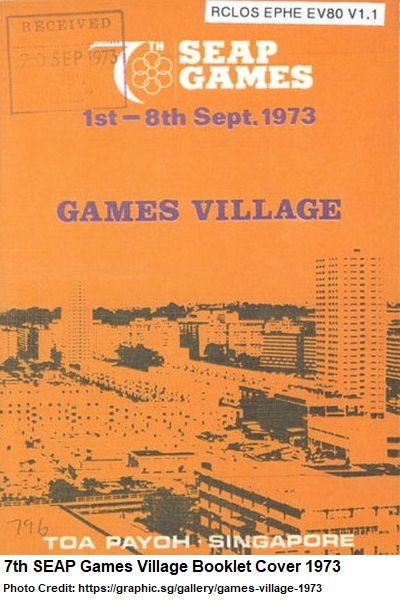
The SEAP Games was held between 1 and 8 September 1973. Seven Southeast Asian nations (Singapore, Malaysia, Thailand, Khmer Republic (former Cambodian state), South Vietnam, Burma (present-day Myanmar) and Laos) participated and as many as 1,623 athletes were involved in the 16 competitions of football, badminton, swimming, basketball and other sports.
A year before the event, the Singapore government announced that Toa Payoh would be the venue of the SEAP Games Village. The Housing and Development Board (HDB) new town, completed in 1968, was an ideal centralised location as the athletes could train at the new Toa Payoh Sports Centre and had their daily necessities and entertainment supported by the shops and amenities at the town centre. Four new HDB point blocks (Block 175, 179, 191 and 193), made up of 384 four-room flats, were specially designated as the accommodation for the athletes.
The SEAP Games Village was officially opened by Goh Keng Swee (1918-2010), then-Deputy Prime Minister and Defence Minister, on 30 August 1973. The SEAP Games was a success for Singapore, both in the hosting and competitions. It came in second in the medal table after Thailand, with 45 golds, 50 silvers and 45 bronzes.
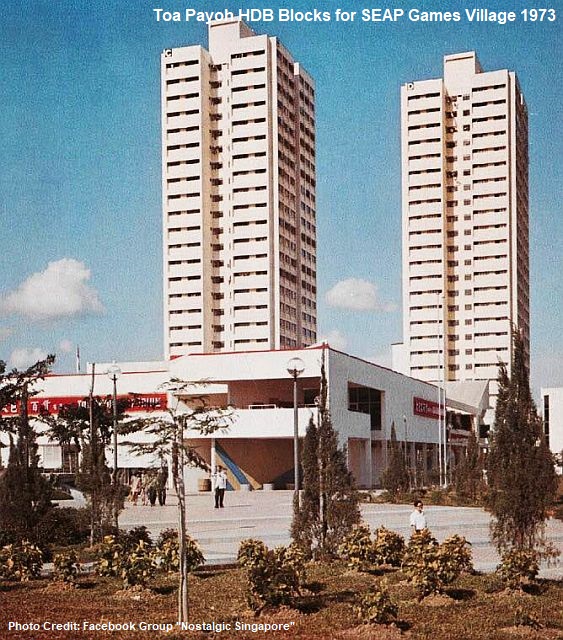
The SEAP Village received rave reviews from the athletes. After the games, the flats of the four blocks were sold to the public through a balloting exercise at a price of $19,000 per unit, with an additional $1,700 for furnishings. The three-storey building that served as the residential and office building for the SEAP Games Secretariat was converted into Toa Payoh Library in 1974.
Toa Payoh Swimming Complex
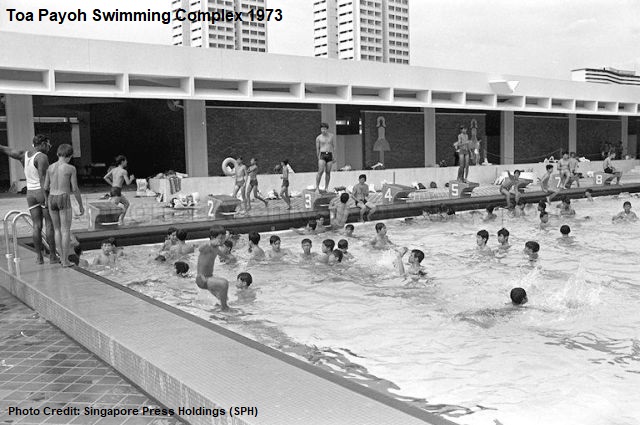
Toa Payoh Swimming Complex had five pools, including two Olympic-sized ones which were used by the SEAP Games’ elite athletes for trainings and competitions. Its other pools remained opened to the public. The entry price was 40c for adult swimmers, whereas children under 18 years old was charged 20c each.
Wednesdays and Thursdays were restricted to male and female swimmers respectively, while mixed swimming were allowed for other days. The popular swimming complex often saw long queues at its entrance in the seventies.

The swimming complex was installed with a $77,000 magnetic-numeric scoreboard for the 1973 SEAP Games. It could immediately display the results of the swimmers the moment they hit the finishing pads of the swimming pool. It was the first time such precise device was used in Singapore.
In the following decades, Toa Payoh Swimming Complex continued to be an important venue for regional and international swimming, diving and water polo competitions, such as the 1983 SEA Games, 1993 SEA Games, 2006 Asian Swimming Championships, 2009 Asian Youth Games and 2010 Youth Olympic Games.

As part of the preparations for the 1983 SEA Games (28 May to 6 June 1983), Toa Payoh Swimming Complex was upgraded at a cost of $45,000, including the replacement of diving boards and repairs and renovations of its Olympic-sized pools.
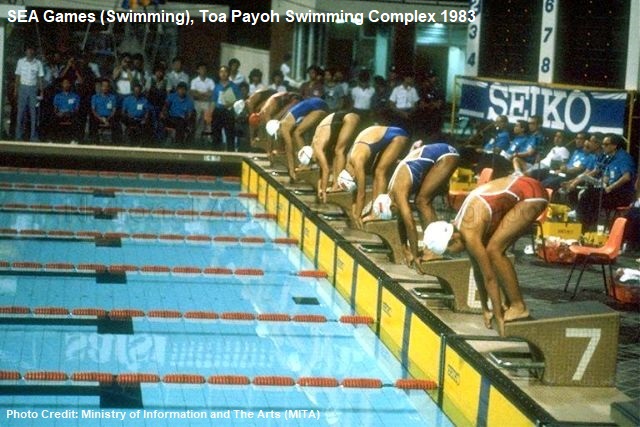
During the games, tickets were snapped up by the fans as they lined up to enter the swimming complex to witness the performances of Singapore’s “Golden Twins” Junie Sng and Ang Peng Siong. It was the first time the Singapore Broadcasting Corporation (SBC) telecast the SEA Games, including the swimming competitions at Toa Payoh Swimming Complex, live on TV. Many Singaporeans were able to watch Junie Sng and Ang Peng Siong dominating their categories with ten and five golds respectively.
Singapore would host the SEA Games again in 1993, with Joscelin Yeo the new golden girl making waves at the swimming competitions at Toa Payoh Swimming Complex. She swept a total of nine goal medals in the games.
Entering the millennium, the Singapore Swimming Association (SSA) established a new Centre of Excellence (COE) based at Toa Payoh Swimming Complex, in order to produce a large pool of young swimmers capable of competing at least at SEA Games level. The aims were to help Singapore top the swimming in SEA Games and achieve at least sixth in Asian Games.
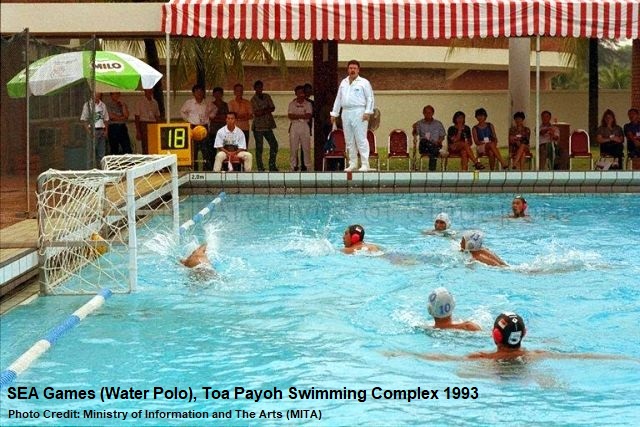
Other than a venue for swimming competitions, lessons and carnivals, Toa Payoh Swimming Complex also hosted the national water polo championships.
During the non-competition days, the pools were used by other organisations such as Singapore Amateur Swimming Association (SASA), Young Men’s Christian Association (YMCA) Singapore, Singapore Armed Forces Reservists’ Association (SAFRA), People’s Association (PA) Youth Swimming Club, Residents’ Committees (RC) and the various schools for their annual swimming meets.


Toa Payoh Swimming Complex was closed in 1979 for several months to defect rectifications in its foundation. It was closed again, for a year, in 1986 for repairs and retiling works. Some of its floor and pool tiles had cracked and this had caused injuries to the swimmers.
In 1996, it was closed for a long period of two years and eight months for the overhaul of its water filtration system and upgrade of wading pool. A 2000-seat gallery and lounge were also added.
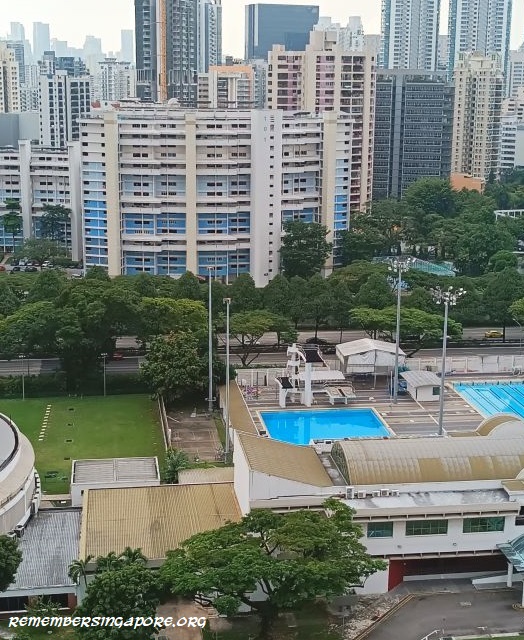
In October 2000, Singapore’s public pools, including Toa Payoh Swimming Complex, were shut down for a month to break the chain of transmission of the infectious hand, foot and mouth disease that caused the death of four children.
Toa Payoh Stadium
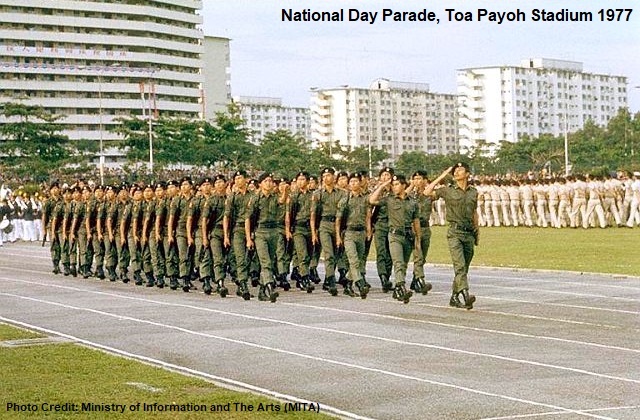
On the other hand, Toa Payoh Stadium’s early days were largely used for amateur and semi-professional football matches and other non-sporting events such as National Day’s parades (decentralised), political rallies and religious masses.
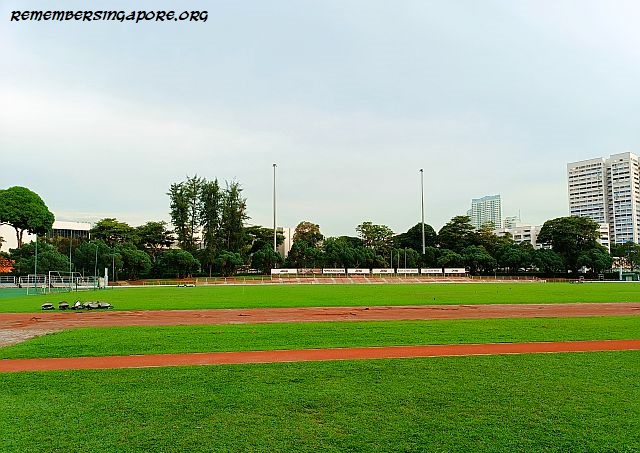
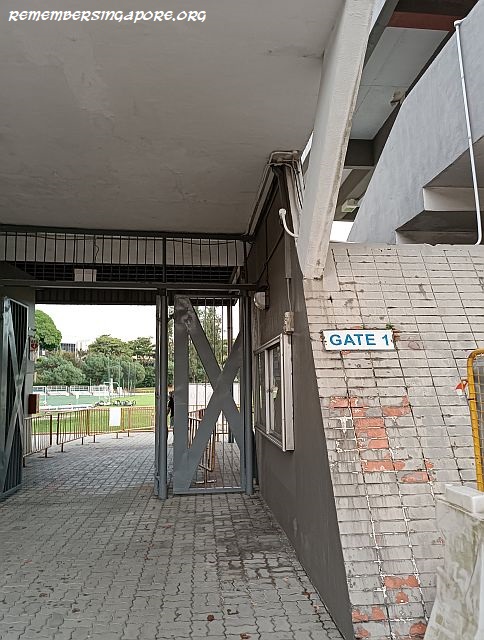
In 1989, Toa Payoh Stadium became the third stadium, after Farrer Park and Queenstown Stadium, to go “automatic” when it was installed with automatic gates configured to open at 5am daily. This allowed the early joggers to make use of the stadium’s running tracks and facilities. Before this implementation, the stadium gates were opened at 7am by the watchmen hired by the Singapore Sports Council (SSC).
Since 1996, Toa Payoh Stadium became the home ground for Balestier Central Football Club (merged with Clementi Khalsa in 2002 to become Balestier Khalsa). It was this year when the Singapore Football Association (FAS) launched the Singapore Professional Football League (S-League), following Singapore’s exit from the Malaysia Cup.
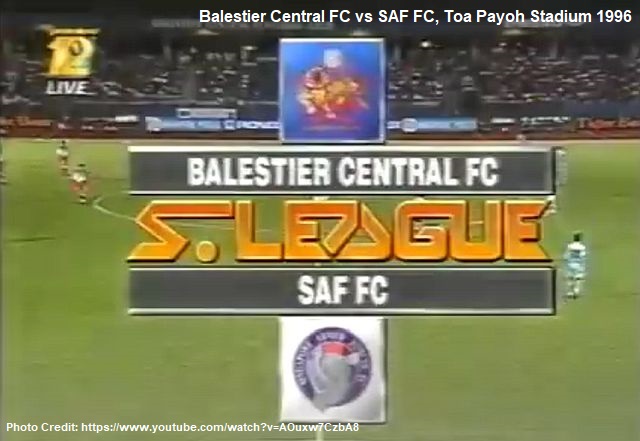
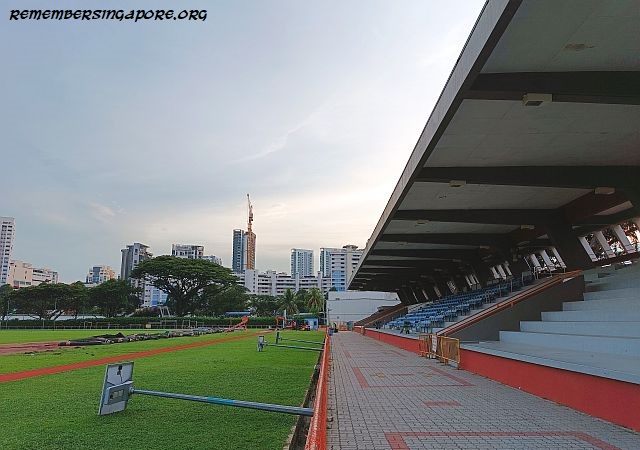
Toa Payoh Stadium, along with Yishun, Jurong, Bedok, Queenstown, Tampines, Jalan Besar and Woodlands Stadiums, were chosen as the key grounds for the eight S-League’s football clubs. The stadiums were renovated and upgraded as part of the preparations for the new league. Toa Payoh Stadium was closed for eight months as its pitch was overhauled and seating capacity increased from 2,000 to 3,500.
Below is the list of non-sporting events at Toa Payoh Stadium from 1973 to 1996 before it was allocated to Balestier Central Football Club for training and S-League matches:
|
Year |
Event |
|
1974 |
Brazilian superstar Pele visited Singapore for a three-day football clinic, as part of a world tour to impart football knowledge to developing countries. At Toa Payoh Stadium, he coached a squad of 90 players from six National Trades Union Congress (NTUC)-affiliated unions. |
|
1974 |
1st National Cadet Corps (NCC) Day parade was held at Toa Payoh Stadium. |
|
1976 |
The Singapore Armed Forces Training Institute (SAFTI) and six combat units were presented with the State Colours for the first time in 1976, with the ceremony and parade held at Toa Payoh Stadium. |
|
1977 |
The Singapore Red Cross Society organised a 1,600-member World Red Cross Day parade at Toa Payoh Stadium. |
|
1977 |
Toa Payoh Stadium was selected as one of the decentralised venues for National Day Parade. |
|
1979 |
Toa Payoh Stadium was selected as one of the decentralised venues for National Day Parade. |
|
1979 |
Telefun ’79 competition organised by the Radio and Television Singapore (RTS) and People’s Association (PA), attracting a 4,000 crowd at the Toa Payoh Stadium. |
|
1981 |
Toa Payoh Stadium was selected as one of the decentralised venues for National Day Parade. |
|
1981 |
The Catholic Archbishop of Singapore Monisgnor Gregory Yong held a mass at Toa Payoh Stadium with a capacity crowd from Singapore’s 28 Catholic churches. |
|
1982 |
1st Battalion of Royal New Zealand Infantry Regiment held an alliance parade at Toa Payoh Stadium to strengthen the ties between Singapore and New Zealand since 1974. |
|
1982 |
American singer Dan Peek held a concert at Toa Payoh Stadium. |
|
1983 |
Toa Payoh Stadium was selected as one of the decentralised venues for National Day Parade. |
|
1984 |
World Red Cross Day parade held at Toa Payoh Stadium. |

|
1985 |
J.B. Jeyaretnam and Worker’s Party held a rally “Our Kind of Society” at Toa Payoh Stadium. |
|
1985 |
6,000 people turned up at the Catholic Youth Rally exhibition organised by the Catholic youth organisations at Toa Payoh Stadium. |
|
1985 |
10,000 Thai workers gathered at Toa Payoh Stadium to see the address by Princess Maha Chakri Sirindhorn of Thailand, who was in Singapore on a six-day official visit. |
|
1985 |
12th National Cadet Corps (NCC) Day parade was held at Toa Payoh Stadium. |
|
1986 |
5,000 Filipinos attended a mass at Toa Payoh Stadium conducted by Cardinal Jaime Sin, Roman Catholic Archbishop of Manila. |
|
1987 |
Singaporeans packed into Toa Payoh Stadium to listen to Mother Teresa, 1979 Nobel Peace Prize winner and popularly known as the Living Saint of Calcutta, spoke about abortion, love, peace and the need to care for the poor and unwanted. |
|
1987 |
The Singapore Tourist Promotion Board (STPB) organised a “Musical Chair 6000” at Toa Payoh Stadium in an attempt to break the Guinness World of Records. It failed as 2,000 participants failed to turn up. |
|
1988 |
National Martial Arts and Qigong Solidarity Mass Demonstration is held at Toa Payoh Stadium. |
|
1988 |
Chiam See Tong and Singapore Democratic Party held a May Day rally at Toa Payoh Stadium. |
|
1989 |
8,000 school girls from 11 convent schools gathered at Toa Payoh Stadium to celebrate National Day and 135th anniversary of the Convent of the Holy Infant Jesus (CHIJ). |
|
1989 |
More than 300 civil defence personnel participated in the National Civil Defence Telematch finals at Toa Payoh Stadium. |
|
1991 |
Toa Payoh Town Council and Residents’ Day was launched at Toa Payoh Stadium. |
|
1991 |
Worker’s Party held a May Day rally “What After Lee” at Toa Payoh Stadium. |
|
1992 |
Worker’s Party held a May Day rally “A Wooing We’ll go” at Toa Payoh Stadium. |
|
1992 |
Mr Singapore contest was held at Toa Payoh Stadium. |
|
1993 |
Thousands of pre-enlistees took their fitness tests at Toa Payoh Stadium. The tests determined whether they were required to undergo two additional months of physical training before their Basic Military Training (BMT). |
|
1994 |
Worker’s Party held a May Day rally at Toa Payoh Stadium. |
|
1994 |
SAF Music and Drama Company (MDC) commemorated the 25th years of Operationally-Ready National Service with “A Night of Celebrations” performances at Bedok, Choa Chu Kang and Toa Payoh Stadiums. |
With the closure of Toa Payoh Stadium on 31 October 2023, Balestier Khalsa will share the Bishan Stadium with Lion City Sailors.
Toa Payoh Sport Centre
Other than the swimming complex and stadium, Toa Payoh Sports Centre also consisted of the Singapore Table Tennis Association (STTA) Training Hall. It was built in 1984 at a cost of $800,000. The two-storey building, serving as STTA’s headquarters, had offices, conference rooms and a training hall that could accommodate nine table tennis tables. The conference rooms would be converted into dormitories for the players during the tournaments.
In 2014, under the government’s vision of Live Better Through Sports, a national movement called ActiveSG was launched to encourage Singaporeans of all ages to keep fit and healthy and participate in sports and games. An ActiveSG gym was subsequently set up at Toa Payoh Sports Centre.
Published: 19 November 2023
Discover more from Remember Singapore
Subscribe to get the latest posts sent to your email.





 Remember Singapore
10,000-seater stadium, indoor pools and sheltered courts among new sports facilities in Toa Payoh
6 January 2025
The Straits Times
In a major rejuvenation of Toa Payoh town, residents will get to enjoy a slew of indoor and sheltered sports facilities – alongside a 10,000-seater stadium and community amenities – when the Toa Payoh Integrated Development (TPID) is completed by 2030.
The development, which is located between Lorong 6 and the PIE, will be the focal point of Toa Payoh, said Minister for Culture, Community and Youth Edwin Tong at a ground-breaking ceremony on Jan 5.
To be built on the site of the former Toa Payoh Sport Centre, which closed on Oct 31, 2023, after 50 years, the TPID will also feature a 2,000-seater aquatic centre with four indoor swimming pools, along with three outdoor leisure pools.
There will also be a 5,000-seater indoor hall with 22 badminton courts, another indoor hall for team sports, a gym and sheltered futsal, tennis and netball courts.
The 12ha development will also house the new Toa Payoh Polyclinic, a bigger library than the current one in Toa Payoh Central and an upgraded town park. The iconic lookout tower will be retained at the town park, and other planned amenities include a dog run and an allotment garden where residents can grow their own greens.
https://www.straitstimes.com/singapore/10000-seater-stadium-indoor-pools-and-sheltered-courts-among-new-sports-facilities-at-toa-payoh