As we bid farewell to longtime retail giant Robinsons, let us do a recap of those once-familiar Japanese, French, Hong Kong as well as local department stores that became defunct in Singapore (We will save the former supermarkets/hypermarkets for another day).
1. Robinsons (1858-2020)

Being in the business for a long 162 years, Robinsons began as a small shop at Raffles Place (formerly Commercial Square), named Spicier and Robinson. Its founders James Gaborian Spicer and Philip Robinson sold everything from European groceries, spices to women’s apparel.

In 1859, the business was renamed Robinsons and Company after James Spicer left the partnership. By the early 20th century, Robinsons had become the leading department store in Singapore, positioning itself as the upmarket store catering specially for the European expatriates.
In its history, Robinsons and its iconic department store at Raffles Place survived the Great Depression (it posted its first ever losses of about $233,000 in 1932), Second World War bombings, Japanese Occupation (it was closed between 1942 and 1945) and a disastrous fire in 1972 that killed nine people and destroyed million dollars’ worth of goods.
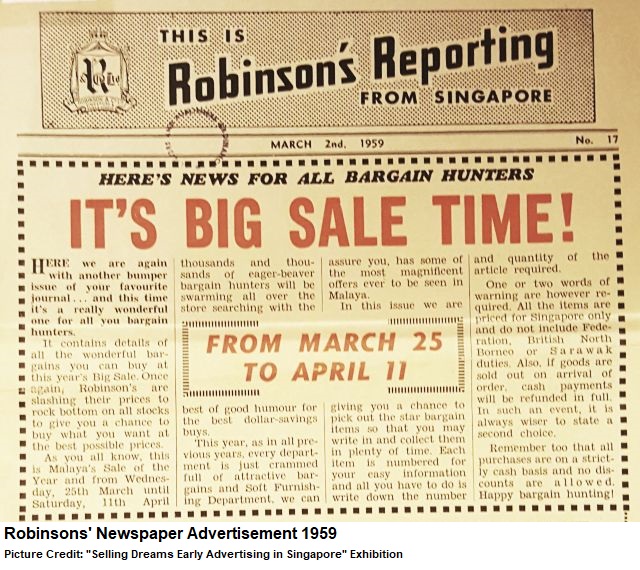
Robinsons picked itself up after the disaster, expanding to other parts of Singapore. It subsequently opened stores at the Specialist’s Shopping Centre (1972), Clifford Centre (1977-1983) and The Centrepoint (1983-2014). After the company was sold to the Al Futtaim Group, another three stores were opened – Raffles City (2001-2020), JEM (2013-2020) and The Heeren (2013-2020). But they were eventually closed in 2020 due to dwindling business, challenges from the eCommerce and the impact by the Covid-19 pandemic.
Memorable Slogan: “Robinsons Sale – The sale worth waiting for“
2. John Little (1842-2016)

Before Robinsons, John Little was Singapore’s oldest department store. It was started in 1842 when John Martin Little opened his shop at Raffles Place (formerly Commercial Square), selling wine, textile, furniture, stationery and clocks. In 1955, John Little was acquired by Robinsons.
John Little left his iconic Raffles Place store in the sixties, and over the years, went on to open stores at the downtown area, such as Plaza Singapura and Specialist’s Shopping Centre. It was revamped with a new logo “JL” in the late eighties in order to woo the younger crowds.
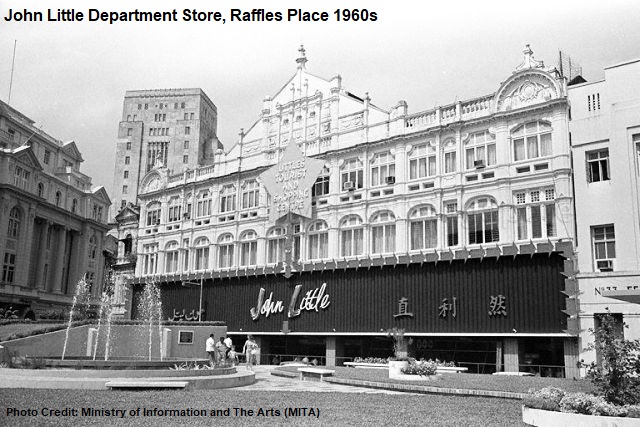
John Little reached out into the new towns and suburban area in the early 2000s, by opening outlets at Parkway Parade, Jurong Point, Northpoint and Compass Point. But by 2015, Robinsons’ new owner Al Futtaim Group decided to close all the John Little department stores in Singapore, with the last one at Plaza Singapura shuttered in November 2016.
3. Yaohan (1974-1997)

Japanese department store Yaohan entered the Singapore market in 1974 with its first branch at Plaza Singapura. Offering a wide range of merchandise, Yaohan also boasted a supermarket, bakery and even a child play centre, a fresh concept that attracted many shoppers in the seventies and eighties. Before Yaohan, Singaporeans had not have the chance to experience shopping, supermarket and takeaway snacks under one roof.
At its peak, Yaohan had stores at Katong (1977-1983), Thomson Plaza (1979-1998), Bukit Timah (1981-1996), Jurong (1983-1997) and Parkway Parade (1983-1997). But by the late eighties, it faced challenges from other Japanese department stores such as Daimaru. The new mega player Takashimaya, opened at Ngee Ann City in 1993, also influenced changes in the consumers’ shopping habits.


Yaohan opened its last store at Marina Square in 1996 in a bid to catch up with its rivals, yet a year later, its mother company in Japan was declared insolvent due to mounting losses. In Singapore, its flagship store at Plaza Singapura was closed in 1997. Thomson Yaohan, the last one standing, eventually shut down in 1998.
Memorable slogan: “For one-stop family shopping“
4. Daimaru (1983-2003)

Daimaru was another Japanese department chain that had been eyeing the Singapore market for a long time. It was during the Second World War when Daimaru set up its first department store in Malaya – opened in Penang in 1942. It had a brief presence in Singapore, replacing the ousted John Little at Raffles Place. During the sixties and seventies, Daimaru carried out market researches and surveys to establish a branch in Singapore.

Finally, in November 1983, Daimaru’s flagship store at Liang Court was opened. It enjoyed the best days throughout the eighties, warding off challenges from other large retailers such as Isetan, Metro, Robinsons and Tangs. But entering the late nineties, Damairu was suffering from consecutive years of losses.
Despite the tough times, Daimaru seemingly won the battle when they took over the space left behind by Yaohan at Plaza Singapura, as the latter had shut down in 1997 due to bankruptcy. However, Plaza Singapura’s Daimaru did not last for too long. It was opened for six years before its operations were ceased due to its Japanese headquarters’ decision to scale down on their overseas venture and concentrate in their main business back at home.
5. Sogo (1986-2000)

Sogo was another Japanese retail giant that had established a number of department stores in Singapore in the nineties. Back in Japan, it had a long history, starting off as a kimono shop in 1830. In the eighties and nineties, Sogo expanded to other Asian regions, such as Hong Kong, Taiwan, Malaysia, Indonesia and Singapore.
Sogo opened its flagship store at Raffles City in 1986, with Singapore’s Minister for Foreign Affairs Suppiah Dhanabalan (born 1937) invited as the guest of honour to officiate the opening. The company subsequently opened two more new stores at Paragon and Tampines’ DBS Building.

But in 2000, Sogo ran into real estate investment issues and landed itself in a mountain of debts. Several overseas stores had to be closed, including the ones at Singapore. The 14-year-old Sogo flagship store at Raffles City was replaced by Robinsons, whereas Metro took over Sogo’s former premises at Paragon.
6. Tokyu (1987-1998)

Tokyu joined other Japanese department chains in Singapore by opening its first store at Marina Square in October 1987, where former Finance Minister Dr Richard Hu (born 1926) officiated the opening.
Tokyu Department Store was designed to provide shoppers a “complete Japanese experience with the ingenuity of traditional Japanese-style customer services”. Tokyu positioned itself as a brand offering moderately-priced merchandise from Japan, Hong Kong and other sources. By the late eighties, besides the Singapore store, Tokyu had expanded to Hawaii, Bangkok and Hong Kong.
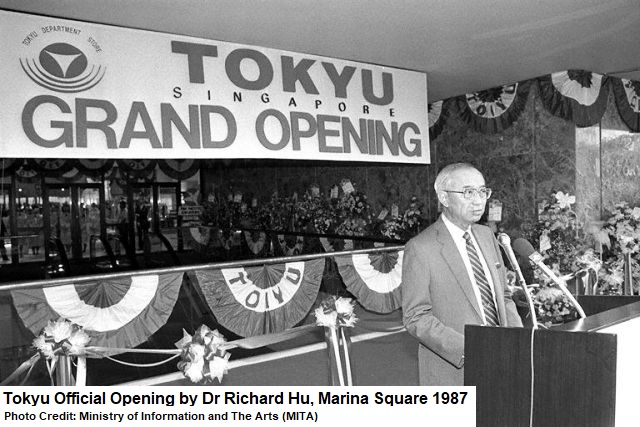

In 1993, Tokyu closed its Marina Square branch (1987-1993) and moved to Tampines (1993-1998). But by 1998, Tokyu had exited the local market as the group looked to restructure and liquidate their overseas assets due to hefty losses incurred during the 1997/98 recession. In 2014, Tokyu Hands, a sister store of the former Tokyu Department Store came to Singapore with a new lifestyle store opened at Westgate.
7. Seiyu (1998-2008)

Another Japanese brand was Seiyu, which was established in 1946. In Singapore, Seiyu appeared in 1994 as Seiyu Wing On Department Store, a joint venture with Hong Kong company Wing On. Seiyu then took over and became the main department stores at Bugis Junction, Junction 8 (Bishan) and Lot 1 (Choa Chu Kang) in 1998.

Singapore’s Seiyu stores were bought over by Beijing Hualian Group in 2005 for $4 million, and their stores renamed BHG. By 2016, BHG has owned seven department stores in Singapore, at locations such as Seletar Mall, Century Square Shopping Centre and Jurong Point. Meanwhile, the Seiyu Group back in Japan was fully acquired by Walmart in 2008.
8. Galeries Lafayette (1982-1996)

Upmarket French department store chain Galeries Lafayette has been finding successes in its business since it opened in 1912. However, that success was not replicated in Singapore. It had an official opening at Goldhill Plaza on 7 December 1982, occupying three storeys and offering many exquisite yet affordable items of Galeries Lafayette’s own brands.
However, the department store lasted only four years at Goldhill Plaza, before it had to shut down in 1986 after posting a total of $15 million’s worth of losses. Poor store location, image problems and merchandising difficulties were cited as the reasons behind its closure.

But Galeries Lafayette was determined to make a comeback in Singapore. On 28 March 1987, it reopened its store at Liat Towers, aiming to claim a stake in the fast growing Orchard Road shopping belt. It took over the space previously occupied by Isetan, which had moved to Wisma Atria.
But once again, stiff competition and leasing issues eventually saw Galeries Lafayette bowed out of the Singapore market again, this time in early 1996.

9. Printemps (1983-1989)

Galeries Lafayette was not the only French department store trying to penetrate the Singapore market. Printemps, a French department store that dealt with lifestyle, fashion and accessories, had a brief presence at Singapore’s Orchard Road in the eighties. The retail giant was founded in 1865, and went global in the eighties and nineties by opening stores in Japan, Korea, Malaysia, Taiwan as well as Singapore.
10. Lane Crawford (1994-1996)

Established Hong Kong retailer Lane Crawford has a significant history, dating back to 1850. It later expanded to China and Japan but was devastated by the Second World War. Lane Crawford quickly picked itself up after the war, becoming an upmarket department store that offered jewellery, fashion, furniture and watches.
In June 1994, Lane Crawford arrived at Singapore, with its store opened at Lane Crawford Place at Orchard Road. Former Minister for Information and The Arts George Yeo was the guest of honour for its official opening.
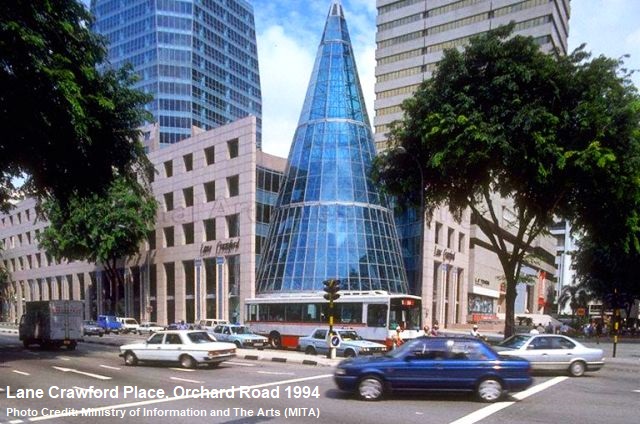
Singapore, however, was undergoing a retail slump in the mid-nineties. Lane Crawford itself was also bothered by internal issues, which saw some of its top management resigned in quick succession. In 1995, Lane Crawford slashed its store size from five floors to two.
Just slightly more than two years after its opening, Lane Crawford was closed in October 1996, incurring a loss of $7 million including a compensation to landlord Marco Polo Development for the early releasing of its four-year lease. Lane Crawford exited the Singapore market and Lane Crawford Place was subsequently renamed Wheelock Place.
11. Singapore Shui Hing (1980-1983)

Before Lane Crawford, Shui Hing had already attempted to break into the Singapore market. But it also suffered the same fate of having a short-lived presence here, lasting only three years. Shui Hing was started in Hong Kong in 1964, and had been successful, opening as many as 17 outlets in the former British colony by the end of the seventies.
 In Singapore, Shui Hing opened the first store at Orchard Road in August 1980, selling mainly American and European merchandise. It was designed in American style, in order to provide customers a feel of “shopping in New York”. The store consisted of four storeys, made up of sections selling fashion, kitchenware and household products. It also had a gourmet shop serving food and beverages.
However, a year later, Shui Hing attempted to shed its pricey New York image. By mid-1983, the department store and its building were put up for sale at a price of $32 million. OG bought the building for $25 million, and Singapore Shui Hong officially walked into history in July 1983.
Memorable slogan: “It’s like shopping in New York”
12. Kmart Metro (1994-1996)
In 1994, Kmart collaborated with Metro to open three stores in Singapore, including the ones at Marina Square and Century Square (at Tampines). Positioning itself as a store offering great values, Kmart aimed to bring a whole new meaning to “discount shopping”.
But again, Singapore’s retail slump in the nineties put massive pressure on its three stores, which suffered a total loss of $12.6 million in 1995. A year later, Kmart’s main office in the United States decided to close more than 200 stores globally, including the Singapore outlets, to concentrate in its North and South American markets.
13. Cortina (1973-late 1980s)
Cortina Department Store was a prominent shopping venue housed at Colombo Court, North Bridge Road. Covering six floors, the department store sold everything from fashion, shoes, bags and perfumes to toys, wine and kitchenware. But the fortune of Cortina went into a decline in the early eighties. It was downsized in 1984 and moved to Funan Centre a year later.

Other local department stores of the past also included the Aurora Department Store (1938-1960s), located at the junction of North Bridge Road and High Street, and Vashi’s Department Store (1960s-1973), a department store at Raffles Place’s D’Almeida Street during the sixties. It was closed in September 1973.
Both were upmarket department stores catering to the masses living and working at the city area.

14. Emporium (1961-1987)
Emporium was a name once familiar to many Singaporeans. It was Singapore’s largest department chain in the early eighties before it was hit by the 1985 recession.

At its peak, the Emporium Holdings Group, established by Lim Tow Yong and his brother back in 1961, opened more than 50 department stores in Singapore, Malaysia and Hong Kong. Its iconic Emporium department stores could be found in almost all major new towns in Singapore in the early eighties.
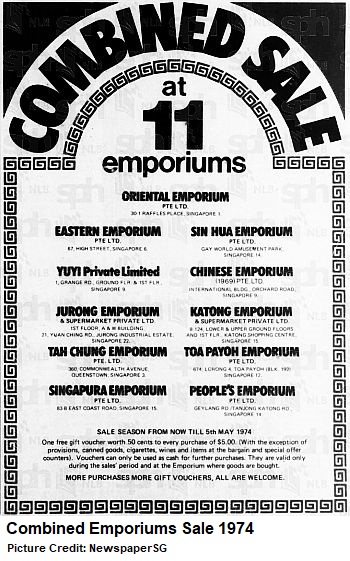
Besides Emporium, the group also owned Oriental, Chinese, Eastern, Sin Hua and Yuyi, which specialised in a wide range of Chinese products in garments, textiles and food stuff. In 1978, Emporium Holdings Group opened its 12th retail outlet – Klasse Department Store – at Lucky Plaza.
Debt-laden in the mid-eighties due to the unexpected recession and the group’s overly aggressive expansion, Emporium eventually fell into bankruptcy and faded away among the larger department store chains in Singapore.
Memorable Slogan: “There’s an Emporium around every corner to serve you!“
15. Tah Chung Emporium (1967-1990s)

Located between Commonwealth Avenue and Margaret Drive, Tah Chung Emporium was opened in 1967, and had been Queenstown’s iconic landmark for more than two decades. It was housed in a three-storey building, with the first and third floor occupied by hawkers and a Chinese dim sum restaurant. The emporium had the entire second level to itself, selling household goods, kitchenware, apparel and electrical appliances.
In the seventies, Tah Chung Emporium also collaborated with the Emporium Holdings Group, Singapura Emporium (East Coast Road) and People’s Emporium (Tanjong Katong Road) to dish out a “combined emporiums sale”, offering discount vouchers, free gifts and other attractive sale gimmicks.

As Queenstown aged, Tah Chung Emporium went into a decline and was eventually closed in the late nineties, with its building torn down in 1999.
Other Emporiums
The name emporium was widely used between the sixties and eighties. Besides the larger department stores under Emporium Holdings Group and Tah Chung Emporium, there were many others such as Tashing Emporium (at People’s Park Complex), Overseas Emporium (People’s Park Complex), Great Wall Emporium (Maxwell Road), Shankar’s Emporium (High Street) and Neo Soon Whatt Emporium (Serangoon Gardens).
Tashing Co (Pte) Ltd started as a heavy machinery supplier in 1969. They also established Tashing Emporium, which offered products imported from Taiwan. Their emporium business went into decline and was shut down in 2002, but Tashing Co (Pte) Ltd has since switched to wholesale distribution in food products and is among the top 1,000 food distributing SMEs (small and medium enterprises) in Singapore today.
Overseas Emporium was established in 1970 at the People’s Park Complex. At that time, it was the largest Chinese emporium in Singapore, and its signature paper bags carrying its Chinese name (中桥) were commonly seen throughout the seventies. Operating under the OEGroup, the department store is still a popular destination among the locals today.
Shankar’s Emporium was founded in the fifties, and has been in business for more than 65 years. Its headquarters is based in Singapore and has business operations in the Middle East.
Meanwhile, Neo Soon Whatt Emporium was a small former department store at Serangoon Gardens in the late sixties, selling China and locally manufactured products.
Current Department Stores
Today, the major department stores in Singapore are Takashimaya, Isetan, OG, BHG, Tangs, Marks & Spencer (formerly St Michael, renamed in 1994) as well as Metro.
Published: 7 November 2020
Discover more from Remember Singapore
Subscribe to get the latest posts sent to your email.






How about Carrefour, Yokuso at Tanjong Katong which bought along Four Leaves Bakery?
Wow i forgot Yokuso! issit the 1st 24hrs supermarket in Singapore?
Hi,
Can we get permission to republish this article on our blog at http://www.prolificskins.com/blog? A link will be added back to your site, indicating it first appeared here. Thanks for your kind attention.
Ok sure..
Thank you! 🙂
Mark & Spencer’s 34-year-old outlet at Raffles City Shopping Centre will close on the last day of 2021, but the retailer will continue operating in Singapore with its 10 other outlets.
https://www.straitstimes.com/singapore/marks-spencer-to-shut-raffles-city-outlet-but-its-10-other-stores-will-stay-open
You forget local department store Robina at the Robina House at Shenton Way??
There is a popular kimisawa supermarket at the former Hougang Center and also at Wisma Astoria. From all these demises, we can conclude that our economy is not improving but shrinking. We owe a debt to tell this present generation of how glorious and glamorous our shopping scenes during the 1980s
There was also Tay Ban Guan Emporium at Katong 😁
Do you know NTUC also tried to run an emporium before?
The NTUC Emporium was opened at Peace Centre in 1975, selling toys, children’s wear, watches, household items and electrical appliances.
However, due to poor public response, the emporium was closed just nine months later in September 1975.
https://eresources.nlb.gov.sg/newspapers/digitised/article/newnation19750924-1.2.8.17
Chinatown’s Overseas Emporium Shuts Down After More Than 50 Years
20 November 2024
TNP
In 1971, Overseas Emporium opened at People Park Complex, offering more than 20,000 sq ft of shopping space.
On Nov 17, it put up the shutters, marking the end of an era for what used to be one of the biggest Chinese emporiums in Singapore.
From winter clothing to bird’s nest, Overseas Emporium was a one-stop shopping destination.
Mr Guo, a regular customer who is in his 70s, told Shin Min Daily News he bought a pair of shoes and pieces of jade on the last day.
“Overseas Emporium has a very long history and I have been coming here to shop for many years,” he said.
“I feel sad that it is closing.”
Mr Chai, who is in his 60s, had been patronising the emporium since the 1970s.
“I remember it used to be a two-storey store. I come here for Chinese goods.”
Another regular customer said she was sad to see the emporium go.
“It’s a pity there will be one fewer good place to shop at,” she lamented.
“Many things here are sold cheaply. I come here to find what I need.”
On Nov 18, the area was quiet and the Overseas Emporium shutters remained down.
A worker told the Chinese daily that a travel agency was going to take over the shop space.
https://tnp.straitstimes.com/news/singapore/chinatowns-overseas-emporium-shuts-down-after-more-50-years
Metro Singapore’s history: From Hollywood-inspired name to Orchard Road heyday and final closures
21 July 2026
CNA
After nearly 70 years in Singapore, Metro is set to embark on a new chapter.
The department store giant will shutter its last two remaining department stores in Paragon and Causeway Point malls in a bid to move away from traditional large-format stores.
CNA traces Metro’s history from a small textile shop to becoming a household name.
The early years
Before it started operating in Singapore, Metro already had a store in Surabaya, Indonesia in 1953. A second store in 1955 was later dissolved when growing anti-Chinese sentiments in Indonesia were thought to affect business.
Its founder, the late Indonesian entrepreneur Ong Tjoe Kim, then decided to restart the business in Singapore, he said in an oral history interview with the National Archives of Singapore.
In 1957, he opened the first store here at 72 High Street (between Hill Street and North Bridge Road), which was a two-storey shophouse measuring merely 250 sq m.
He chose the location because he thought it was more upmarket than Chinatown.
A movie buff, Ong named the store after the Hollywood production house Metro-Goldwyn-Mayer (MGM), shortening it to Metro to make it easy to remember.
This was because “people loved the movies, and they were familiar with MGM, which made good movies”, he said in a past interview with The Straits Times.
He even invited a movie star, Hong Kong actress Li Mei, to snip the symbolic ribbon on the store’s opening day – becoming the first retailer in Singapore to do so.
Metro started as a textile shop selling a wide range of fabrics used for making traditional clothing such as the sarong kebaya and cheongsam worn by the ethnic communities here.
It was a hub for imported fashion and fabrics throughout the 1960s, selling lace from France, embroidery from Switzerland and linen from America.
While department stores Robinsons and Tangs catered to expatriates and Singapore residents respectively, Metro targeted wealthy housewives from Singapore and Indonesia.
Many of its early customers were Mr Ong’s Indonesian friends who shopped in bulk at his store.
In 1965, Metro expanded and opened a department store in Liat Towers along Orchard Road named Metrotex.
It was later renamed Metro Orchard when it moved to the Holiday Inn Shopping Complex on Scotts Road in 1973.
Metro Supreme in Supreme House, located on Penang Road in the Orchard Road shopping belt, was officially opened in 1971.
Again, a Hong Kong actress, Nora Miao – who starred opposite martial arts legend Bruce Lee in several movies – was invited to the opening.
Since the 1970s, it had established itself as a leading distributor and agent of several foreign brands, bringing in European luxury brands such as Cartier, Givenchy, Yves Saint Laurent and Monet, as well as other foreign brands such as Toys “R” Us, Tag-Heuer, Esprit and Burberry.
SGX listing, the boom years
Metro Holdings Limited was formed in 1973 to take over the three existing Metro department stores at the time.
The company was incorporated and listed on the main board of the Singapore Stock Exchange later that year.
In 1979, it also entered the market for fine watches through the establishment of The Hour Glass – which it later divested.
At its peak in the 1970s, Metro had five department stores housed in various shopping centres along Orchard Road, including Far East Plaza.
It opened Singapore’s first “high-end” department store, Metro Grand Store, in Lucky Plaza in 1978.
The group later entered the suburban areas in the 1970s with branches in Bukit Timah Plaza and Marine Parade – but these were closed in the late 1980s.
During the 1980s and 1990s, Metro served as a springboard for domestic and regional designers, and launched the Marissa clothing label.
It re-entered the suburban areas in the 1990s and 2000s with stores in various malls, namely Century Square in Tampines, Causeway Point in Woodlands, Compass Point in Sengkang and City Square Mall near Little India.
Venture into property development, stake in Ngee Ann City
Metro ventured into property development by searching for a prime location along Orchard Road for a Metro department store.
In 1976, it acquired Orchard Square Development Corporation, which owned a prime leased site with frontage along Orchard Road.
Work on what was to become Ngee Ann City later began in 1989, with Metro having a 27 per cent stake in the retail and office complex, which was completed in 1993. It leased space on the premises to Japanese retailer Takashimaya Department Store.
In 2003, Metro Group sold its investment in Ngee Ann City for a profit.
Outside of Singapore, its subsidiary Metrobilt entered into a joint venture in 1987 to develop office property in Guangzhou, China.
More joint ventures followed in later years as the group developed properties in Penang, Malaysia.
Besides property development, Metro further diversified into the construction, leisure, marketing and distribution sectors.
In construction, Metrobilt joined other contractors in a joint venture to complete the second phase of the Central Expressway in Singapore in 1991.
In the leisure business, Metro launched Sun Cruises and opened The Oasis Resort in Cairns, Australia. It eventually exited the cruise business in 2000.
Store closures
Across the 2000s and 2010s, Metro slowly closed a string of department stores across Singapore.
By 2015, it had just three outlets left across the island.
It later established its online store in 2017 in response to changing trends.
In 2019, Metro closed its six-storey flagship store at The Centrepoint after five years there, leaving just its Paragon and Causeway Point stores.
The Metro Group now operates two core business segments: retail and property investment and development, with a focus on five key markets that are Australia, China, Indonesia, Singapore and the United Kingdom.
https://www.channelnewsasia.com/singapore/metro-department-store-close-history-paragon-causeway-point-6267161