Dental education and oral hygiene for the young in Singapore have come a long way. In 1969, the Ministry of Health (MOH) launched dental education for all the primary schools in Singapore, with the aim to raise dental health standard and instil good oral hygiene practises among the students.
Many Singaporeans would fondly remember their school days during the seventies and eighties where they did their compulsory toothbrushing along the school drains during the recesses.
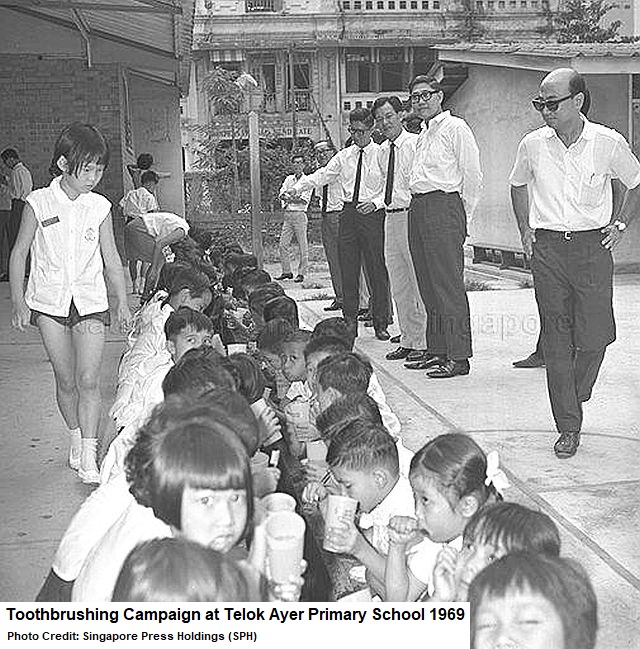
“Good sound teeth are essential to good health” was a slogan by then-Health Minister Chan Sian Chin (1933-2014) for his ministry’s push for the nationwide campaign. This was after the government released a dental health report that showed one out of two Singaporeans did not brush his teeth regularly, and about half of the student population had no toothbrushes, and even if they had, they either did not brush their teeth, or did it wrongly. The report was supported by the evidence from the poor state of the teeth of National Servicemen examined during their enlistment in service.
The dental health campaign began on 4 February 1969 when the largest primary school – Telok Ayer Primary School – had its students from 12 classes lined up along the school drains and squatted side by side with each other. For a subsidised 25 cents per set, the students had their toothbrushes and plastic water mugs ready, inscribed with “use me after food” and “clean teeth never decay” respectively, before being taught how to properly brush their teeth.

In addition, MOH also expanded the schools’ dental service. By 1971, there were 64 school dental clinics and two dental centres that provided half of the 350,000-strong primary school population with full dental treatment and regular attention. The rest of the primary school students, and 150,000 secondary school students, were provided with dental treatment only on demand.
Besides the campaign, it was also found that the fluoridation of Singapore’s water supply, since 1958, had helped reduce the incidence of tooth decay in children of age between seven to nine by 40% over a ten-year period. However, the fluoridation was never a fully effective solution against tooth decay.
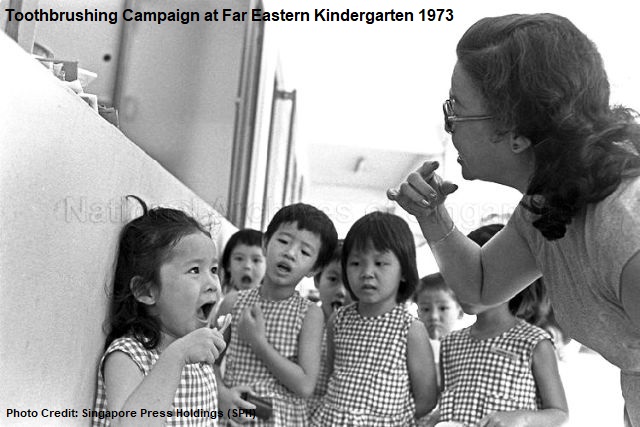
By 1973, the toothbrushing campaign was extended to the kindergartens, where their teachers were trained in the proper techniques of toothbrushing and basic dental hygiene at the Dental Health Education Unit.
There were some difficulties though, as the MOH found that some principals and teachers lacked the enthusiasm to foster dental health education to their students. Hence, the Dental Health Education Unit staff were tasked to pay regular visits to the schools to help and supervise the teachers.
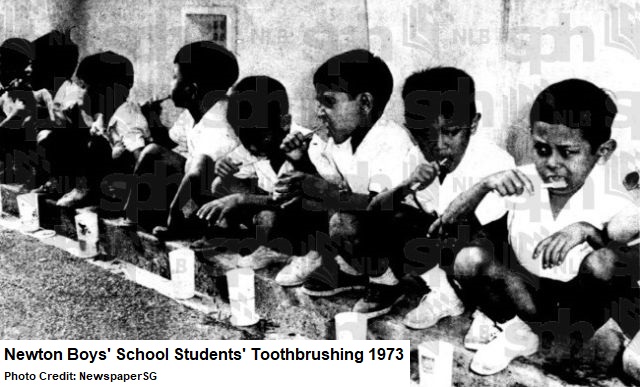
Additional lessons, competitions, exhibitions and other activities were also introduced to improve dental health awareness among the teachers and students. The annual Dental Health Week was launched by the Dental Health Education Unit in May 1970, where they distributed free dental health kits to all the primary school students. Each kit comprised a small toothbrush, a tube of toothpaste and a “Your Aid to Clean Teeth” pamphlet.
By the mid-seventies, the MOH were looking to increase the number of school dental clinics to 150. The ministry also instructed the primary schools to issue to their students free dental kits made up of four toothbrushes and a mug per set.

Today, free basic dental care is provided via the Health Promotion Board’s (HPB) Student Dental Centre to all students in Singapore aged seven to 18 at school-based clinics.
Published: 31 August 2025
Discover more from Remember Singapore
Subscribe to get the latest posts sent to your email.






 Remember Singapore