Although Singapore does not have an official national fruit, durian is arguably the favourite fruit among Singaporeans. Durian as a national fruit occasionally becomes a hot topic of debate between Singapore and Malaysia, or between Malaysia and Indonesia.
There was an old saying that durians have “the flavour of heaven, and the smell of hell”. According to Hikayat Abdullah, Sir Stamford Raffles (1781-1826) was not a fan of the fruit. It was said that a man came to Raffles’ office and wanted to sell six durians to him. But as soon as he caught the smell of the durians, Raffles held his nose and ran upstairs. He later complained that that the durian smell made him nauseous and gave him a headache.
But another Englishman Alfred Russel Wallace (1823-1913), who had Wallace Way (off Lornie Road) named after him, absolutely loved durians. A naturalist and biologist, he described the flavour of durians as indescribable, with “rich, butter-like custard and glutinous smoothness to the pulp”.
The scientific name of durian is durio zibethinus, where durio refers to thorns (derived from Malay word duri) and zibethinus refers to its strong pungent smell (derived from Italian word zibetto or civet cat. Civet cats produce a strong urinous, musky odour). Singapore has its own wild species of durian named durio singaporensis (Singapore Durian) that are found only in the forested areas at Nee Soon, MacRitchie and Upper Seletar.
Cultivated durian plantations and estates, on the other hand, were once abundant in Singapore, where tens of thousands of privately-owned durian trees were grown and harvested at the Mandai, Bukit Timah, Upper Serangoon areas as well as Pulau Tekong and Pulau Ubin.
Lorong Lew Lian (originally a dirt track called Kampong Lew Lian and renamed in 1957; lew lian means “durian” in Hokkien) and Jalan Durian (at Pulau Ubin) are some of the roads in Singapore named after the thorny fruit. Lew Lian Vale is a short minor road off Lorong Lew Lian.
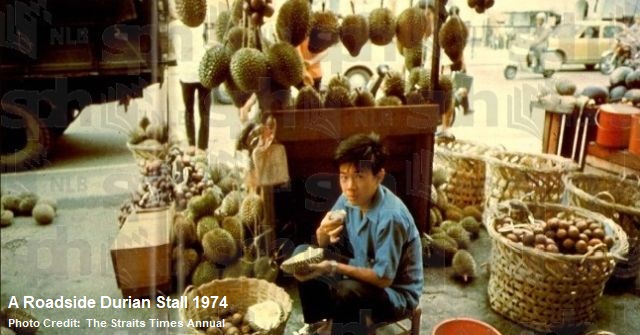
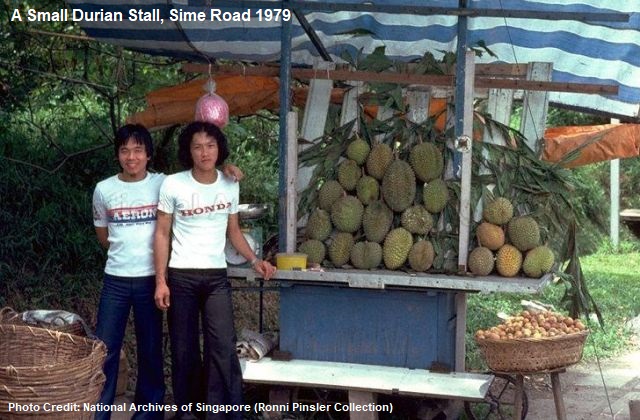
Durians were extremely popular that in the sixties and seventies, roadside durian stalls and their customers often clogged up the streets and obstructed the traffic. Another issue was the huge amount of durian shells disposed. The refuse disposal problem worsened especially during the durian seasons of June/July and November/December.

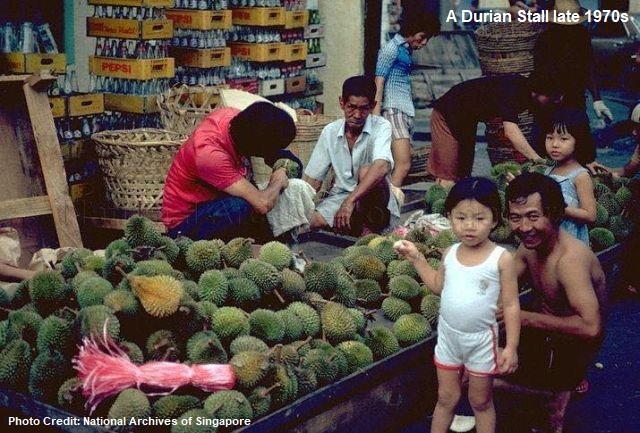
In the early seventies, the average refuse in Singapore was between 1,300 and 1,400 tons a day. During the durian seasons, the figures shot up by another 200 tons. To tackle the issue, Lim Kim San (1916-2006), then-Minister for the Environment, proposed a $1 tax levy for every durian imported into Singapore. Much to the relief of the local durian lovers, the proposal did not materialise.
In the seventies, the best places in Singapore to get the durian fix were Geylang, Rochor and Chinatown. While most durian hawkers were fair in doing their businesses, there were some black sheep that spoiled the reputation of the durian trade.
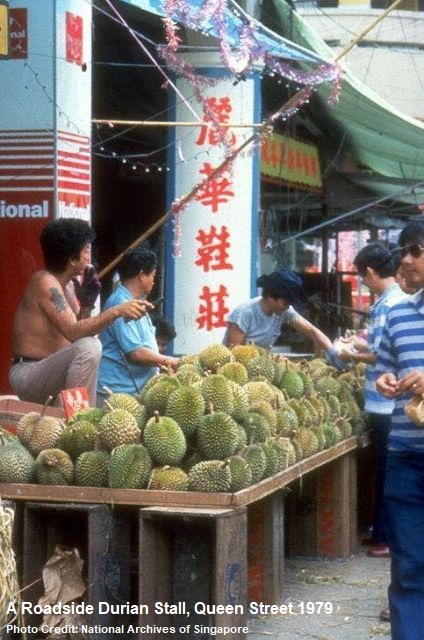
In 1975, the Weights and Measures Unit of the Trade Department cracked down on 25 durian hawkers for using rigged weighing instruments to cheat customers. These hawkers made an additional 40 to 50% earnings from every basket of durians sold, where they weighed using the Chinese measurement unit of kati (about 600 grams).
Under the law, any person who is found using unjust weighing machines is liable, on conviction, to a fine of $500 on first offence, or $1,000 for subsequent offence. Besides the dishonest hawkers, there were also many reports and complaints of thuggish durian hawkers and their aggressive hard selling tactics or even threats to customers.
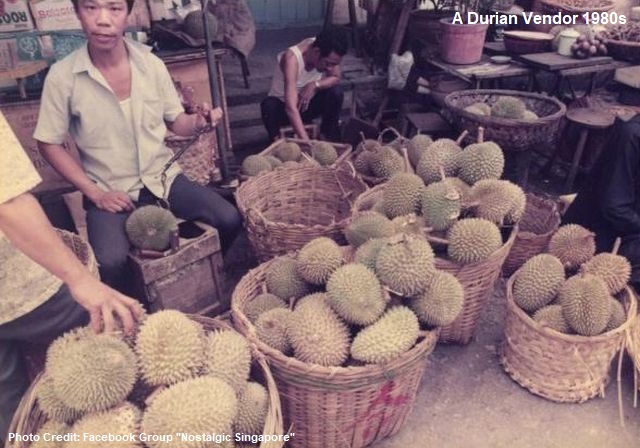
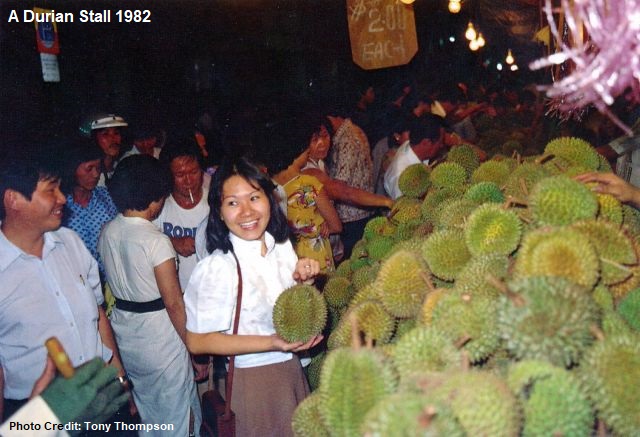
Singapore’s imports of durians reached $10 million in 1983, with as much as 13,400 tons of durians shipped into Singapore. In the mid-eighties, good quality durians from Malaysia weighing between 2kg and 3kg were sold at $6 to $8 per kg.
In 1990, a premium type of durians from Malaysia was marketed as XO or Tiger Hill, costing $8 per kg (an average size durian weighs between 1.5 and 2kg). A king XO durian could even fetch $25 per kg.

Since then, over the years, different durian varieties such as D10, D24, Musang King, Red Prawn, Golden Phoenix, Black Thorns and Old Tree have made their way into the Singapore market, commanding different qualities and prices to the local durian lovers.
Gourmet King, Singapore’s first durian restaurant, was opened in 1983. Located at Hougang Street 21, the air-conditioned restaurant offered various types of durians for the customers to taste.
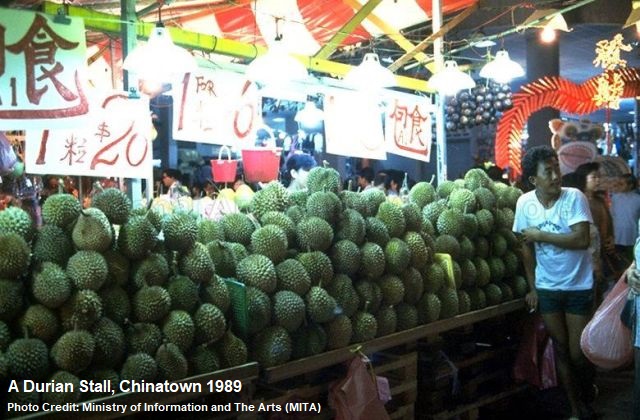
The nineties also saw the rise of many durian-themed dessert and pastry shops, whose innovations included durian cakes, ice kacangs, tarts, puffs, cream rolls and other desserts. There was even a durian cafe, Singapore’s first, set up at China Square Food Centre in 1999.
Even though it’s Singapore’s favourite fruit, durians, due to their strong lingering smell, are banned by the Singapore Mass Rapid Transit (SMRT). In May 1988, the MRT Corporation outlawed the fruit from its trains; passengers are only allowed to bring durians into the trains if they are properly vacuum sealed. Under MRT Regulation No 7, offenders would be fined $500.
Published: 10 December 2025
Discover more from Remember Singapore
Subscribe to get the latest posts sent to your email.






 Remember Singapore