Searching for the Remnants of Ama Keng

Mention Lim Chu Kang, and the first impressions that come to our mind are probably ulu (secluded), countryside or cemetery. The name Ama Keng may be even more unfamiliar to many Singaporeans, who are unaware of the former existence of this famous and bustling village.

Lim Chu Kang Road and the Villages

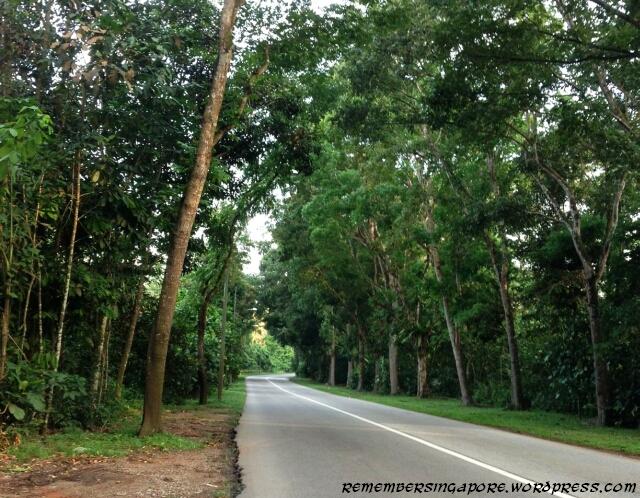
Lim Chu Kang Road has a long history. It was built in the 19th century as an ease of accessibility to the pepper and gambier, and later rubber, plantations that once flourished in this vicinity. The road soon became the main link between the rural villages that scattered around Lim Chu Kang and the city-bound roads of Choa Chu Kang and Bukit Timah.

Three large Chinese kampong once flourished at Lim Chu Kang. They were the Ama Keng Village (亚妈宫村), Thong Hoe Village (通和村) and Nan Hoe Village (南和村). Located between the 17.5 milestone of Lim Chu Kang Road, Ama Keng Village was filled with attap and zinc-roofed houses and single-storey shophouses that provided the basic needs for a self-sufficient rural community. Thong Hoe Village was situated a short distance away at the 18.5 milestone of Lim Chu Kang Road, while Nan Hoe Village stood along Neo Tiew Road.

lim chu kang road2

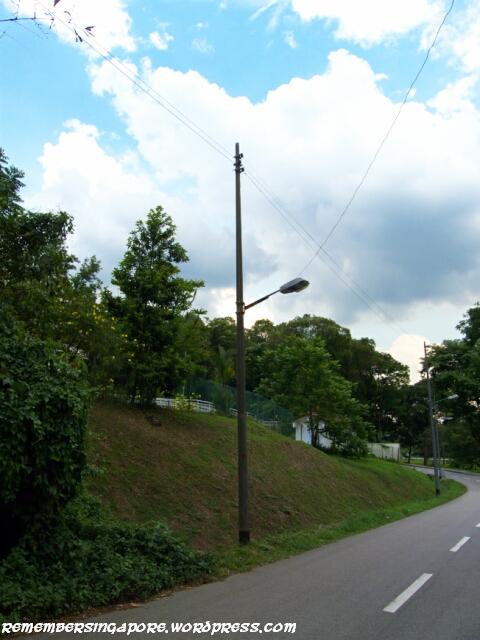
Flanked by thick canopies of Angsana and Mahogany trees, the rustic Lim Chu Kang Road was gazetted as a Heritage Road by the National Parks Board in 2001. Four other Heritage Roads elsewhere in Singapore are Arcadia, Mandai, Mount Pleasant and South Buona Vista Roads.

 Early History of Ama Keng

The name Ama Keng originated from a popular Chinese temple built in 1900 (see Ama Keng Temple below) that worshipped the deity of Ma Zhu, the Chinese goddess of the sea. The words “Ama” and “Keng” means grandmother and temple (or palace) respectively in Hokkien and Teochew. By the 1930s, there was a sizable population living around the temple, and the growing kampong came to be known as Ama Keng Village.

The rubber industry at Lim Chu Kang took a big hit when the prices of rubber crashed in the early 1930s. Abandoned plantations soon became wastelands. In 1933, the British’s Department of Agriculture tried to experiment with pineapple cultivation at the old rubber estates near Ama Keng in an attempt to tap into the growing pineapple business in Malaya.

In 1935, a tiger was spotted within the Lim Chu Kang vicinity, creating panic among the villagers. The Sultan of Johor had banned the shooting of tigers in his state for several years, resulting in its abundance. It was believed that a few swam across the Straits of Johor and roamed around Bukit Timah and Lim Chu Kang, where there were more than 10,000 acres of jungle.

japanese invasion of lim chu kang 1942

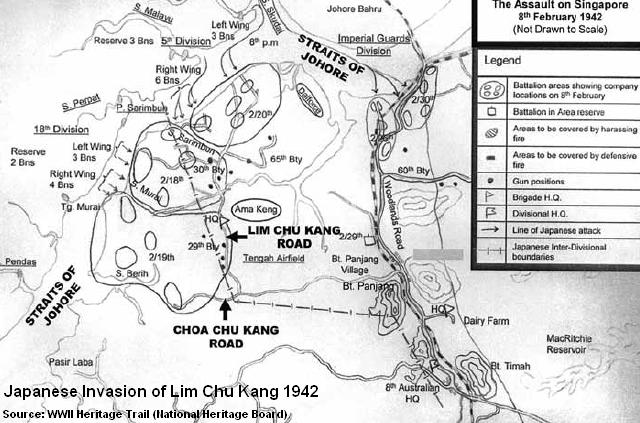
In the early 1940s, the Lim Chu Kang vicinity fell into total darkness at night when the British Royal Air Force (RAF) ordered the total prohibition of lights in order to prevent air surveillance by the enemies. This, however, did not deter the Japanese invaders from pinpointing Ama Keng Village as one of their first targets. On 8th February 1942, the Japanese crossed the Johor Straits and attacked from the northwestern side of Singapore, swiftly occupying Ama Keng. Tengah Airfield fell into the enemies’ hand within a day. The planned Ama Keng-Sungei Berih line, defended by the Australian brigade, rapidly fell apart.

Ama Keng after the War

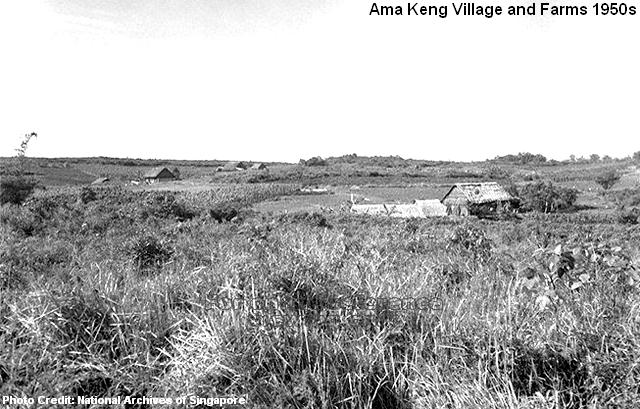
It was a chaotic period after the war. Food was scarce and jobs were limited. In 1953, the British government decided to speed up Singapore’s food production with a multi-million food production centre at Ama Keng.

ama keng village 1950s

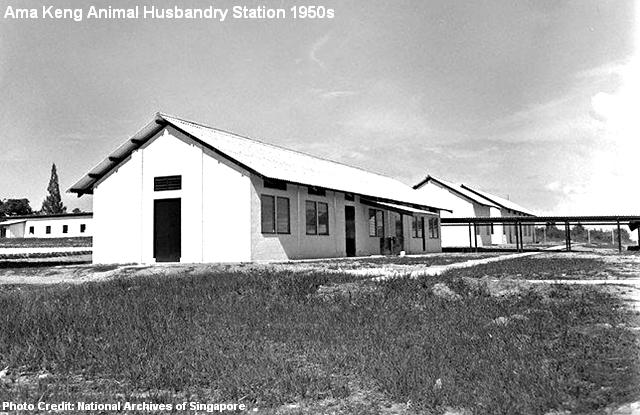
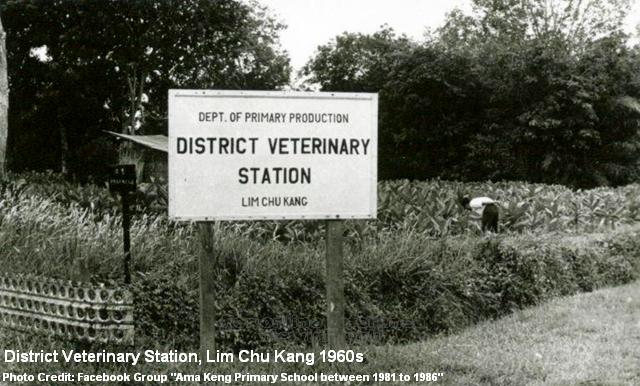
Over 300 squatter farmers, more than half of them living at Ama Keng Village, were given lands for vegetable cultivation in a 750-acre site along Lim Chu Kang Road. The remaining farmers were from other parts of Singapore whose farms were affected by other development plans. The British also set up Animal Husbandry Station and Veterinary Station along the 17th milestone of Lim Chu Kang Road (present-day Old Lim Chu Kang Road) to encourage organised rearing of poultry and other farming livestock to meet the growing domestic demand.

ama keng animal husbandry station 1950s

district veterinary station at lim chu kang 1960s

Things gradually improved, but life was still tough for the residents at Ama Keng Village. Water cut-offs were frequent in the Lim Chu Kang vicinity. The Konfrontasi period made it worse, as the relatively peaceful Ama Keng Village was one of the sites where the Indonesian saboteurs hid their guns, hand grenades and TNT explosives. Fortunately raids and arrests were carried out successfully by the Special Branch after tip-offs.

Construction of Public Amenities

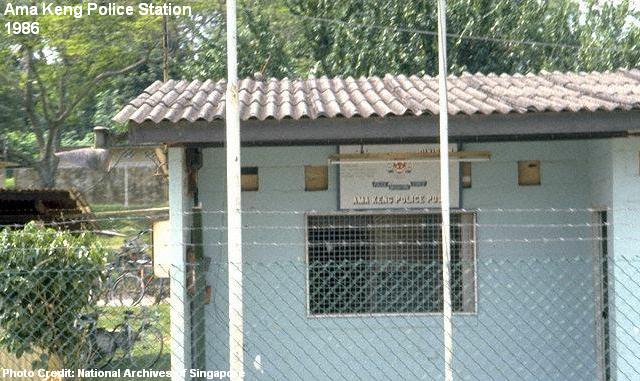
As the population size grew, more public amenities were needed. One of the facilities built in the vicinity was the Ama Keng Police Station, constructed in the fifties to provide assistance and security to the residents. Located a short distance from the junction of Lim Chu Kang and Ama Keng Roads, the police station was housed in a single-storey concrete building with a signboard that states “Balai Polis Ama Keng” in Malay.

ama keng police station 1986

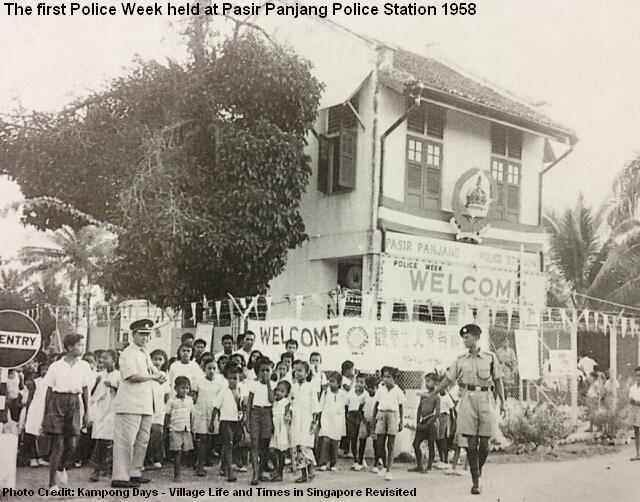
In September 1958, the rural police station was one of the chosen sites to be involved in the first Police week organised by the Singapore Police Force to improve the public-police relationship and cooperation. The police premises was opened for three evenings for the villagers to visit and understand its operation, facilities and equipment.

Ama Keng Police Station was eventually closed in July 1989 due to the impending resettlement which led to the decline in the number of residents seeking police assistance. With its closure, the remaining residents were advised to visit the Jurong or Choa Chu Kang Neighbourhood Police Posts (NPP) for urgent matters.

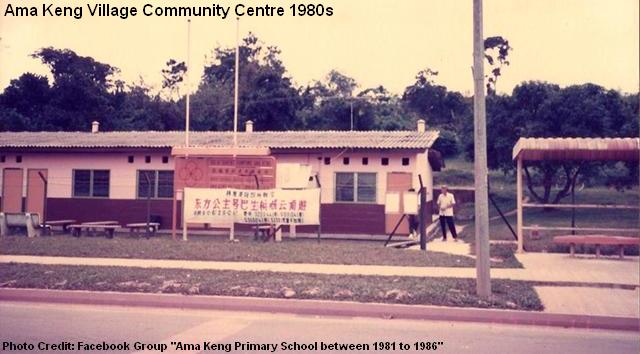
ama keng village community centre 1980s

Located beside the police station was the Ama Keng Village Community Centre. It was opened in 1959 after three years of construction that cost $12,000, and proved to be popular among the villagers as a central meeting place for interactions, newspapers-reading and sports and games. Other amenities included the Maternity and Child Welfare Centre, opened in 1956, to provide dental services to the residents in the rural areas. It was later renamed as the Maternal and Child Health Centre before its operation was ceased in 1981.

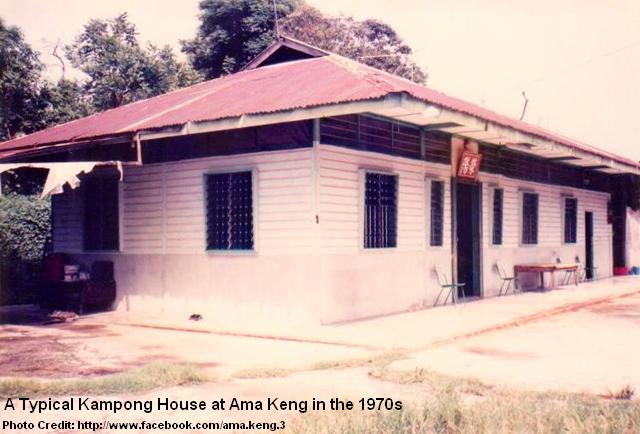
kampong house at ama keng village 1970s

In 1978, the Telephone Exchange fitted Ama Keng with 2,000 new lines for the telephone subscribers in the village. For the first time ever, the residents could dial to both local and international numbers. By the end of the seventies, Ama Keng had become a bustling neighbourhood with shophouses, kopitiam, provision stores and motor repair shops. Life was simple yet happy for the residents who lived in their kampong houses and farms that stretched more than a milestone along the present-day Old Lim Chu Kang Road.

New Ama Keng Road

It was a joyous time for the Ama Keng villagers in late 1969. Electricity supplies were provided to the kampong for the first time. A new tarmac road was also constructed for the convenience of the residents, who had to bear with the muddy tracks that were prone to floods during stormy weathers. To celebrate the achievement, dinners, dragon dances and variety shows were held at the community centre.

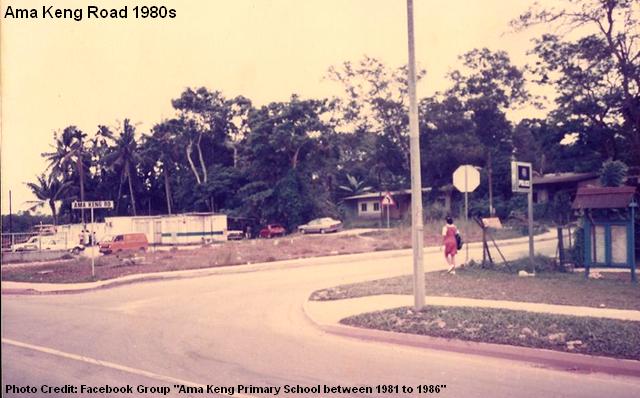
ama keng road 1980s

The newly paved Ama Keng Road used to link up Lim Chu Kang Road and Choa Chu Kang Road (present-day Old Choa Chu Kang Road) via a long and winding path known as Jalan Piring.

ama keng5

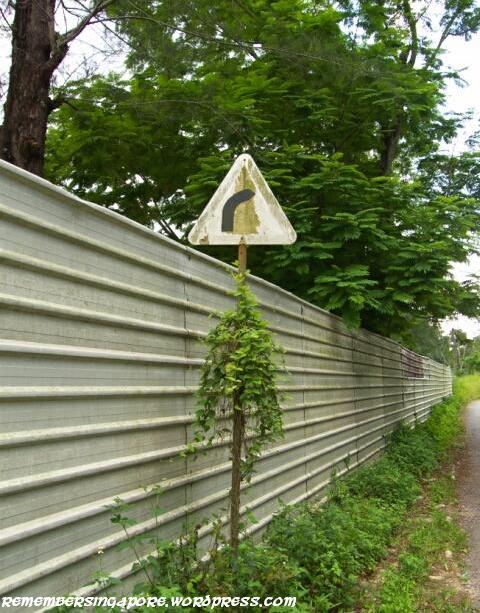
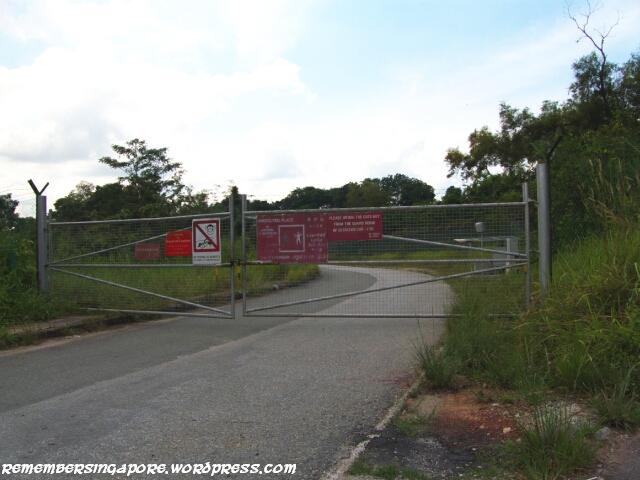
Today, the majority of Jalan Piring had been absorbed by Tengah Air Base and Lim Chu Kang Camp. A small part of it still exists off Old Choa Chu Kang Road today, although it is now restricted to public access.

In the early eighties, there was a lot of safety concerns because many drivers would use Ama Keng Road as a shortcut to Choa Chu Kang Road and Woodlands Road (via Jalan Pisang and Neo Tiew Road respectively). Lorries tend to speed above limits due to the absence of traffic police in the rural areas, posing a threat to the students and residents in the areas.

Before the expansion of Tengah Air Base, a network of tracks existed in Ama Keng. They were, interestingly, given names in ayam (chicken in Malay), possibly due to the abundance of chicken farms in the vicinity. Some of the small roads such as Lorong Ayam Hutan and Lorong Ayam Katek still exist today, but the access is now cordoned off by a military gate.

ama keng

Others like Lorong Ayam Belaga, Lorong Ayam Beroga, Lorong Ayam Bogel, Lorong Ayam Borek, Lorong Ayam Dara, Lorong Ayam Denak, Lorong Ayam Jalak, Lorong Ayam Jantan and Lorong Ayam Selaseh had all vanished in history.

A Lorong Ayam Betina also once existed nearby. It was paved in 1980 by 800 volunteers made up of national servicemen, students and citizens’ committee members, using tools and machinery provided by the Public Works Department. Upon its completion, the metalled road was able to serve 200 residents living in the area. Such gotong royong (mutual aid) projects were common in Singapore during the seventies and eighties.

Live Firing Area Dangers

Due to Ama Keng’s location near the designated live firing area, there had been a couple of accidents occurring in the seventies and eighties. Some of the villagers earned a side income by picking up the shells and sell them to the rag and bone dealers for their copper value. One Ama Keng Village resident was killed in 1980 when an anti-tank shell exploded in his house after he collected a basket full of spent and unspent cartridges. The fatal accident prompted the Ministry of Defence (Mindef) to step up their security in preventing villagers from entering the live firing area to collect the shells.

Earlier in 1971, a 10-year-old boy was shot dead near the village. The boy, along with other children, had apparently followed the army troops in an obstacle training exercise. One of the soldiers lost his grip and fell. His rifle, loaded with blanks, went off and hit the boy in close range. It was a sad moment, as the mother was only 30 yards away selling soft drinks when her son was killed.

Ama Keng Chinese Temple

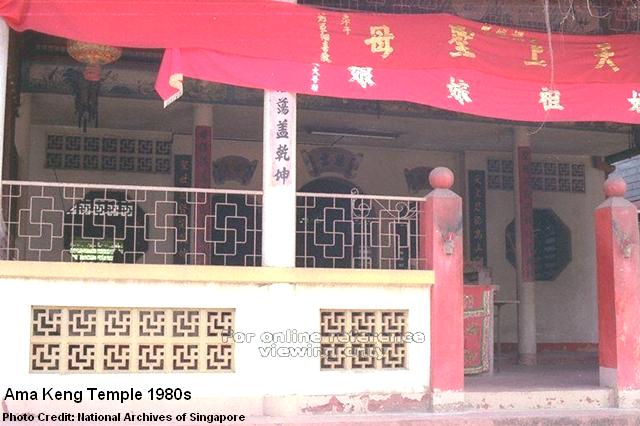
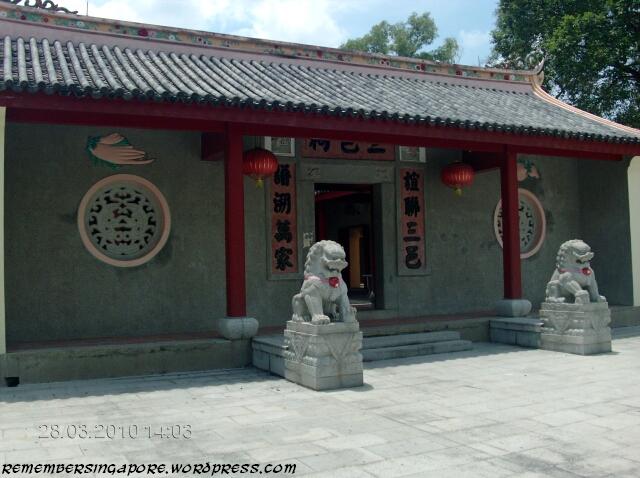
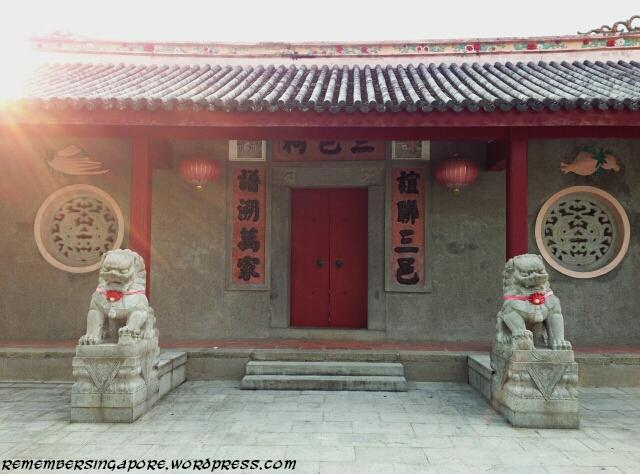
The historic Ama Keng Chinese Temple was one of the earliest landmarks at Ama Keng. It was first built in the form of a simple wooden structure in 1900 by Lim Yek Soon* (林玉顺), Lim Chee Meng* (林子明) and Eng Seet Chuan* (翁翼泉), and had its deity statue of Ma Zhu extravagantly “invited” from Yuen Hai Ching Temple (粤海清庙), the oldest Taoist temple in Singapore located at Phillip Street. The kampong temple was destroyed when the Japanese invaders landed in Singapore in early 1942. Surprisingly, the Japanese were respectful of the deity and later ordered the temple to be rebuilt in 1943.

ama keng temple 1980s

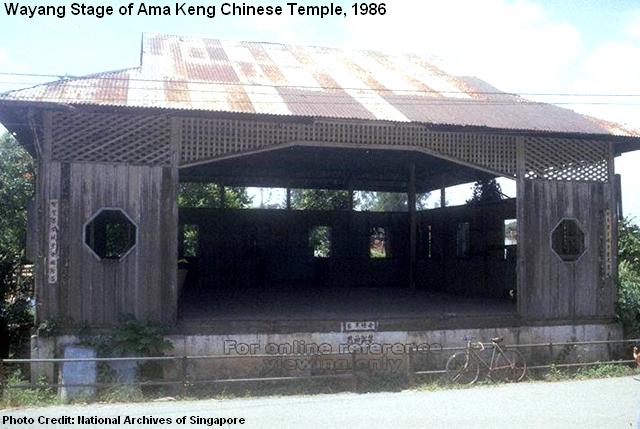
With increasing number of devotees visiting the temple, the temple committee decided to expand its premises in 1965. When Jurong and Tuas underwent industrial development in the late sixties, population in the western part of Singapore surged and more people visited and prayed at the temple. The following decade was arguably the golden period in the history of Ama Keng Temple. At the peak of its popularity, the temple organised grand religious ceremonies, filled with wayang performances and extravagant dinners, several times each year.

ama keng temple wayang 1986

The better days of Ama Keng Temple ultimately came to an end by the late eighties, when the government decided to acquire the lands for military purposes. The temple committee, residents and devotees tried to petition the acquisition without success, and its building was subsequently demolished.

(* the names were loosely translated into dialects due to lack of records)

Ama Keng Clinic

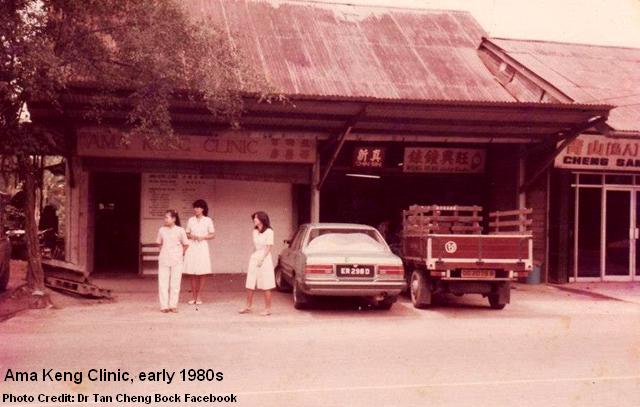
Operated in a small rundown shophouse, the Ama Keng Clinic had been an indispensable healthcare provider for the villagers for almost twenty years. It was opened in 1971 by Dr Tan Cheng Bock who decided to become a doctor at the countryside after his graduation, a noble move that surprised many.

ama keng clinic early 1980s

Many poor villagers could not afford their medical fees, let alone travelled to the nearest hospital which was at least 28km away from Ama Keng Village. Dr Tan Cheng Bock generously accepted their eggs, vegetable and chickens in exchange for the consultation and medicine. He also waived the fees for those who could not pay. Over time, a special bonding between Dr Tan Cheng Bock and the villagers was developed. Even till today, the highly respected doctor still keeps in contact with his former patients from Ama Keng.

Like others, Ama Keng Clinic was affected by the resettlement plans of Ama Keng in the late eighties. Dr Tan Cheng Bock shifted his medical practice, which had retained the name “Ama Keng Clinic”, three times before settled down at Jurong West. It was eventually closed in late 2012, after a long significant 41-years of history.

Ama Keng School

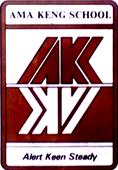
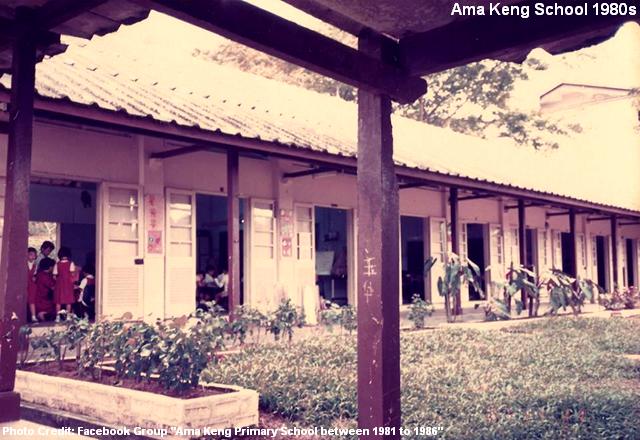
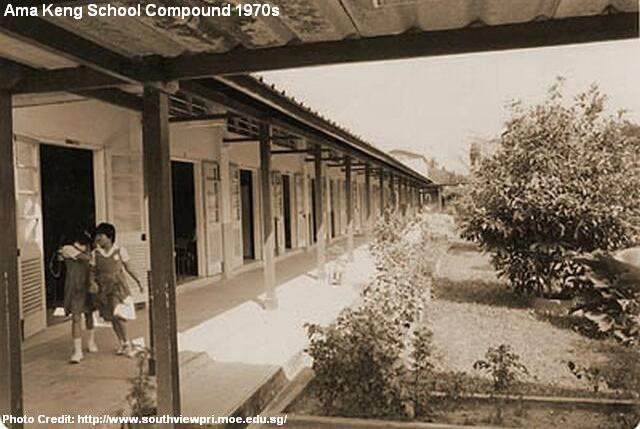
ama keng school crestFounded in 1951 as part of the colonial government’s Ten Year Plan, Ama Keng School 亚妈宫学校 first started with only 53 students having their classes in three simple single-storey buildings of 14 classrooms. There was also a double-storey block that served as the teachers’ quarters.

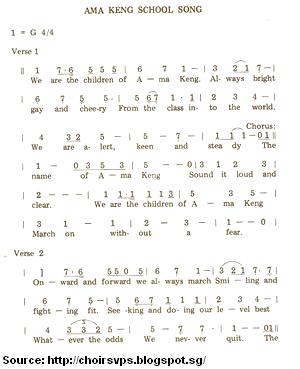
ama keng school songIn 1959, the Ministry of Education approved the construction of tuck shops at several rural schools for the benefits of the students. Ama Keng School, along with other schools at Jurong, Clementi, Boon Lay and Teluk Jaku, was given the priority.

Over the years, the enrolment at the school increased rapidly. By the late sixties, the school premises was unable to cope with the student size ballooned to almost a thousand. As a result, an extension wing was built. The four-storey building, completed at a cost of $300,000, was officially opened in 1971, followed by an addition of a hall-cum-canteen two years later. The enrolment of students for Ama Keng School peaked in 1982; the number reached 1,512 that year.

ama keng school 1980s

ama keng school 1970s

The school introduced Chinese-medium classes in the seventies but they did not last. By 1987, the Chinese-medium classes were phased out by the government’s decision to make English as the compulsory first language for all schools in Singapore. Under the new system, the mother tongue would be taught as the second language. Likewise for other races, the Tamil-medium schools in Singapore were phased out in 1982, and the Malay-medium ones saw their end by 1986.

Ama Keng School was closed with the resettlement of the Lim Chu Kang residents in the late eighties. In March 1990, it was merged with the former Nam San School 南山学校 to become the new South View Primary School located at Choa Chu Kang.

ama keng2

ama keng3

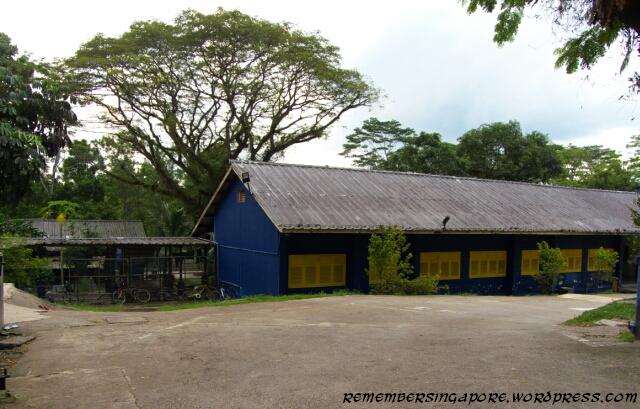
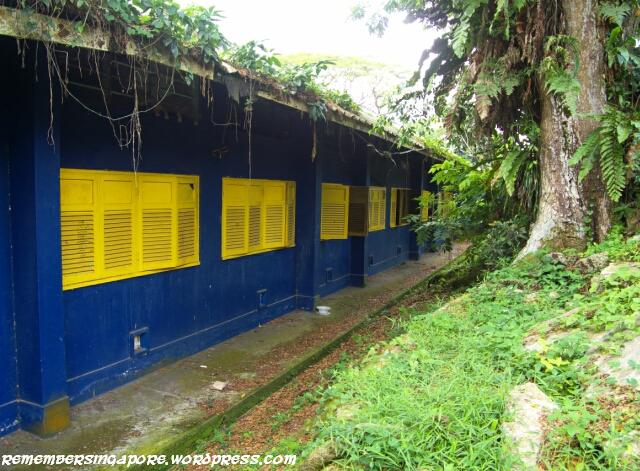
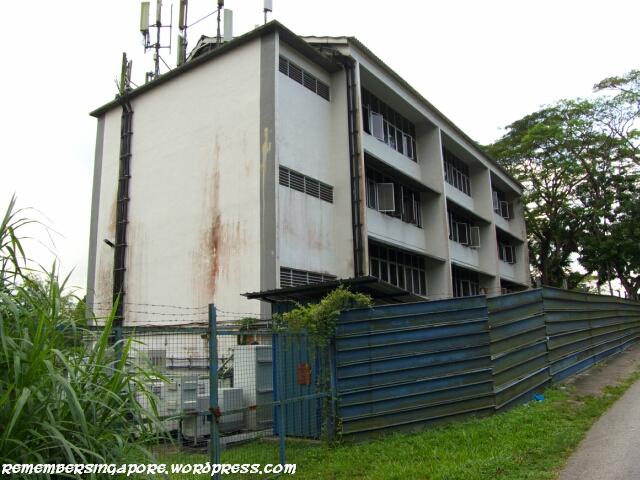
Today, the old school compound of Ama Keng School still stands unnoticed and undisturbed along Ama Keng Road, retaining its original sloping zinc roof and wooden windows. The premises has been utilised as a foreign worker dormitories since the early 2000s; its four-storey extension building was converted into a nursing home for several years but is now left vacated.

ama keng4

Decline and Demise of Ama Keng

Two factors had led to the decline and demise of Ama Keng and other villages at Lim Chu Kang. First, the planned expansion of Tengah Air Base and land acquisition was announced as early as 1983. The government followed up by also introducing agrotechnology program to Lim Chu Kang in 1986. It was a scheme to maximise output in limited space, but it also meant hundreds of small traditional farmlands would have to be sacrificed as they were converted into modern agrotechnological parks.

In the resettlement plans, the existing farmers were given options to relocate their operations to Mandai, while other residents were encouraged to move into the new HDB flats.

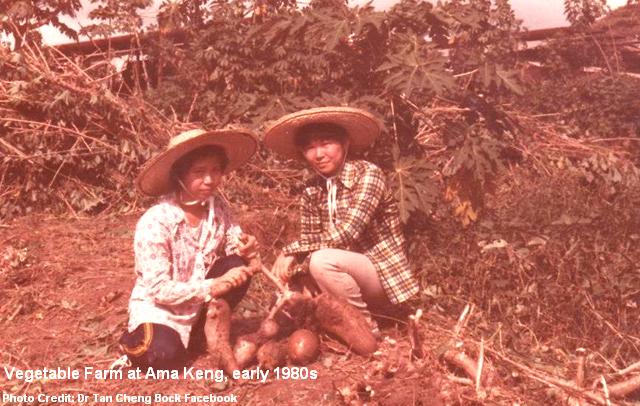
vegetable farm at ama keng early 1980s

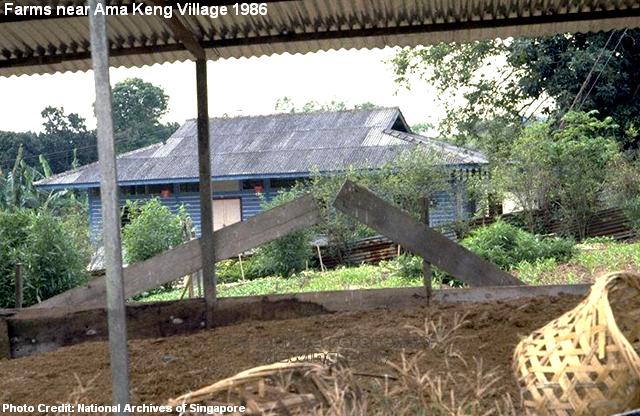
farms at ama keng village 1986

There were still close to 660 small parcels of vegetable farms at Ama Keng and Lim Chu Kang by the late eighties, providing as much as 17,000 tonnes of lettuce, Chinese cabbage and chye-sim (Chinese spinach) to Singaporeans. Some of the farms had already been around for sixty years. The pig farms, on the other hand, were already phased out.

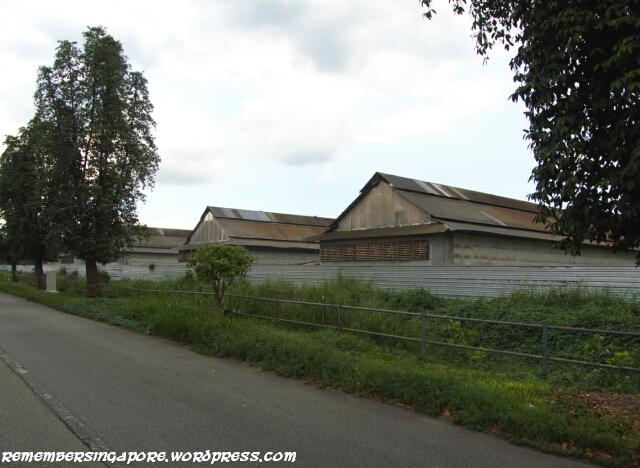
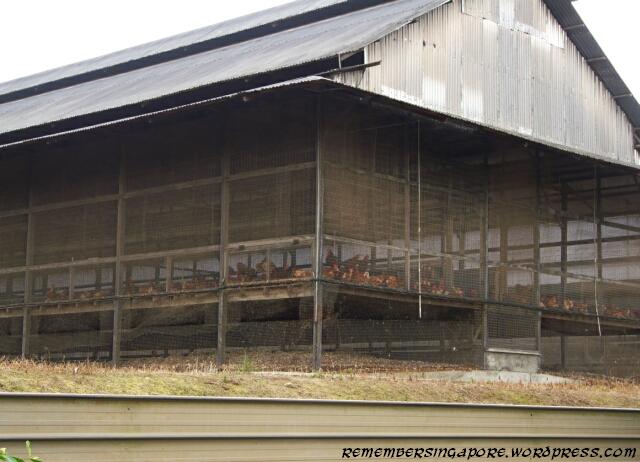
In 1988, approximately 550 chicken farms at Ama Keng were still in operation, producing almost three million eggs everyday to be sold to both local and Malaysian markets. The number would dwindle rapidly in the next couple of years. Today, there are only four chicken farms in Singapore, all of which are located within the Lim Chu Kang vicinity. The Chew’s Agriculture of Murai Farmway, first started as a breeder farm in 1975, is one of the more prominent ones that stands along Lim Chu Kang Road.

murai farmway

murai farmway2

By the early nineties, most amenities at Ama Keng were gone. The temple was demolished, and the police station had shut down. The Ama Keng Market, a simple zinc-roofed single-storey building, was left empty after the stallholders had shifted. There were, however, some 4,500 residents still persisted in staying at Lim Chu Kang, but by the the turn of the millennium, the last family finally moved out. Most former residents by then had already resettled at the new towns of Jurong East, Jurong West, Choa Chu Kang and Bukit Panjang.

ama keng6

Today, what is remaining of Ama Keng is a quiet and forgotten road. Many who drive past may not even notice its existence. Nothing much is left to remind us of the bustling village that once stood here. But to many former residents, this was once a familiar place made up of closely-knitted homes, childhood playmates and simple, peaceful and happy days. Hopefully the memories can be passed on to their next generations.

Published: 22 August 2013

Updated: 17 July 2016

Posted in Nostalgic | Tagged , , , , , , , , , , , , , , , , , , , , , , , , , , , , , , | 49 Comments

Mata.Mata: History of The Singapore Police

The much-advertised English drama Mata.Mata has finally made its debut on Channel 5 last night.

Mata refers to eye in Malay, but mata-mata generally means policeman (or watchman), where a patrolling policeman of the olden days was the “one on all eyes”. The local Chinese “borrowed” the word and instead used the shortened version to refer to police. “mata chu“, for example, refers to the police station. Like the word “kopitiam“, it is a unique mixture of Chinese dialects and Malay that is not found anywhere else except Singapore and Malaysia.

The Early Police Force (1819-1826)

When Sir Stamford Raffles founded Singapore as a trading post, he assigned Singapore’s first Resident William Farquhar to be in-charge of the new colony’s law and order. In 1820, Singapore’s first true police force was established under the command of Police Chief Francis James Bernard, William Farquhar’s son-in-law. At the start, he had 11 staff – a sergeant, eight constables, a jail warden and a Malay administrator – and a monthly operating budget of 300 Indian rupees.

The First Police Station

The first police station, however, only came into existence three years later. Francis James Bernard built his residence at the southern bank of the Singapore River in 1823, which double functioned as the Police Office with a basement room for prisoners. In the same year, anti-arms laws were passed to forbid all residents on the island to carry weapons, with the exception of the Johor Sultan’s guards.

Straits Settlements Police (1826-1946)

When the British merged Singapore with Penang and Malacca to form the Straits Settlements in 1826, the police force in Singapore became part of the Straits Settlements Police Force until its disbandment in 1946.

Different Police Departments

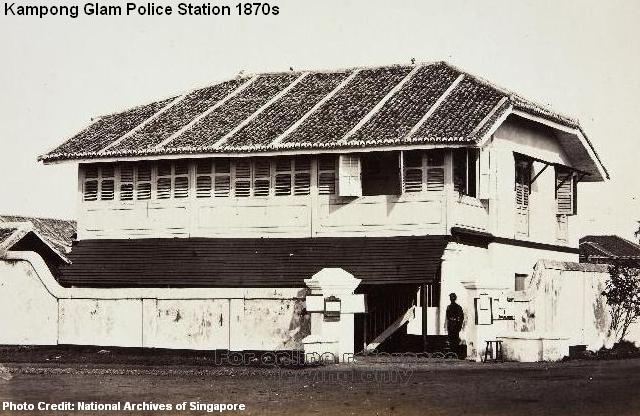
As the settlement progressed and population grew, more police departments had to be established for different specialised roles. The Marine Police was one of the earliest to be formed. With two sampans, a 15-men force (a sub-Inspector, two corporals and 12 constables) and headquarters at the Cavanagh Bridge Police Station, it was set up in 1824 to combat against piracy near the Singapore harbour.

kampong glam police station 1870s

The increasing number of secret societies also prompted the police to establish the Detective Branch in 1886, which was later renamed as the Criminal Investigation Department (CID) in 1903. The Police Coast Guards was formed in 1916, followed by the Traffic Police two years later to control and regulate the traffic.

In dealing with seditious activities, the police set up the Criminal Intelligence Department in 1925. The same year also saw the formation of the first Police Force Band. By 1925, the construction of a Police Training School was completed at Thomson Road. The Communications Branch was set up in 1936, while the first batch of Auxiliary Police was recruited in 1939.

Singapore’s Early Riots

One of Singapore’s earliest riots occurred in 1854 when two leading Chinese secret societies clashed. Started from a quarrel over a bag of rice, it quickly escalated into widespread riots between the Hokkien-dominated Ghee Hock against Ghee Hin, backed by the Teochews. As many as 5,000 men fought on the streets for eight days, resulting in the death of 400 Chinese, dozens of shops looted and some small villages destroyed.

Without proper trainings, the small police force were inefficient and incapable of dealing with the unexpected conflicts. Many local residents had to be recruited as special constables to work with the military troops, who were brought in from the British navy ships for the peace-keeping.

Rise of Colonial Police Stations

The late 1920s and early 1930s were important periods in the history of the local police force. The British colonial government decided to invest huge amount of money in the construction of police stations and training barracks in many parts of Singapore in a battle against the Chinese secret societies and triads.

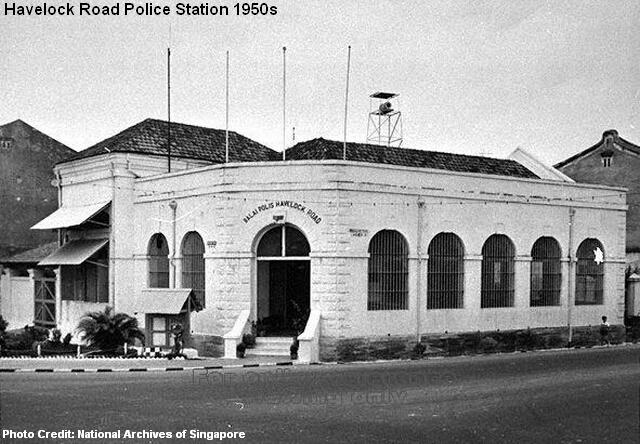
New stations, depots and staff quarters were erected at Thomson Road, Maxwell Road, Beach Road, Havelock Road, Tanjong Pagar, Bukit Panjang, Sepoy Lines, Kandang Kerbau, Joo Chiat and Woodlands. Two of the most prominent projects belonged to the new Hill Street Police Station and the extension of the Central Police Station.

Central Police Station, South Bridge Road

central police station at south bridge road 1870s

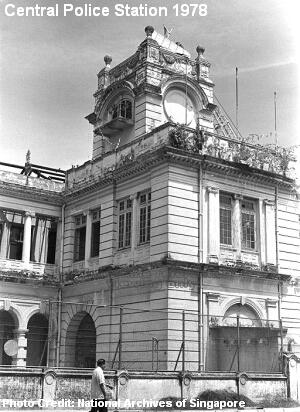
The history of the Central Police Station dated back to 1867, the same year Singapore was established as a British crown colony. It was strategically located at South Bridge Road to function as a police base against the secret societies that had plagued Chinatown for decades. central police station 1978By the late 1920s, the British government decided to splash $144,000 on a new Central Police Station.

The main administrative office of the original police station was retained; new three-storey blocks, made of reinforced concrete and equipped with armoury, detention cells and recreational rooms, were constructed. The architectural design of the new buildings was similar to the Central Police Station in Hong Kong.

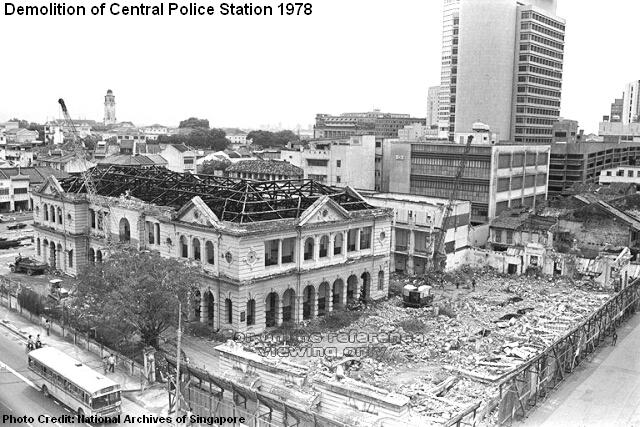
The Central Police Station was occupied by the Japaneses military during the Second World War, with several of its detention cells used as torture chambers. By the late seventies, it was decided that the aging building had to be torn down to make way for the widening of Upper Pickering Street. Upon its demolition in 1978, its police staff were relocated to the former CID Headquarters at Eu Tong Sen Street.

Hill Street Police Station

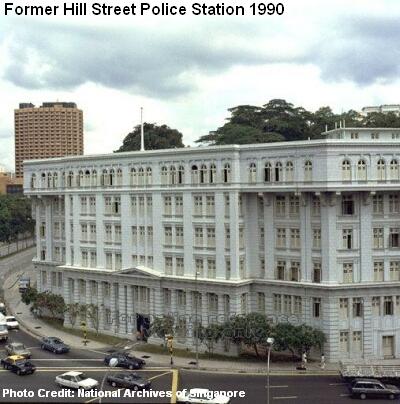
former hill street police station 1990A massive $494,000 was pumped into the construction of Hill Street Police Station at the junction of Hill Street and River Valley Road. When it was completed in 1934, the six-storey Neo-Classical building was the largest police barracks in British Malaya.

Designed by J.F. MacNair and mostly made of reinforced concrete, the large building consisted of a police station, staff quarters, parade ground and even playgrounds for the children of the European police officers.

Like the Central Police Station, the Hill Street Police Station was taken by the Japanese during the Second World War. It was rumoured that the Kempeitai used the offices as interrogation and torture rooms for the anti-Japanese personnel.

former hill street police station

The former Hill Street Police Station was gazetted as a national monument in 1998, and became an iconic landmark with its new colourful appearance. Today, the premises are used as the headquarters of several government ministries and bodies such as the Ministry of Communications and Information (MCI) and Ministry of Culture, Community and Youth (MCCY).

Lower and Upper Barracks, Pearl’s Hill

Completed in 1934, the Lower and Upper Barracks at Pearl’s Hill were first used to house the Sikh Sepoys, one of the Straits Settlements Police’s early contingents. The married Sepoys were accommodated at the Upper Barracks, while the unmarried ones stayed at the Lower Barracks along Eu Tong Sen Street.

lower barracks at pearl's hill

The first Sepoys were among the first Indians to arrive at Singapore with Sir Stamford Raffles in 1819, and were mainly stationed as infantry troops at Tanglin, Fort Canning and Pulau Brani. Known for their bravery, they were later recruited by the police. Many later settled down to form the Sikh community in Singapore today.

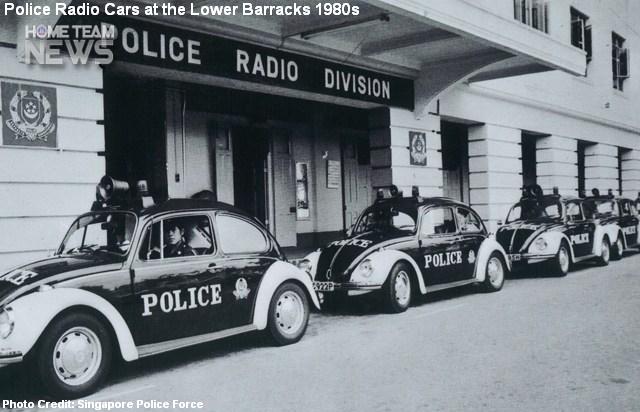
The Police Radio Division, with its emergency hotline ‘999’, was established at the Lower Barracks in 1948. The top floor of the building was converted in a 24-hour radio-linked operation room to attend to any emergencies. By the mid-1950s, the division was able to operate with 13 radio networks and a fleet of 60 patrol cars. Due to its strategic location at Eu Tong Sen Street, the police could easily dispatch their radio cars to islandwide operations. One tragic event that shocked the Police Radio Division was the collapse of Hotel New World in 1986, when hundreds of panic calls swarmed the communication centre that particular morning.

pearl's hill police radio division 1980s

After Singapore’s independence in 1965, the Ministry of Interior and Defence (the predecessor of the Ministry of Defence and Ministry of Home Affairs) moved into the Lower Barracks, sharing the buildings with the Police Radio Division. In the seventies and eighties, several police departments such as the Criminal Investigation Department (CID), Police Licensing Division, Anti-Vice Unit and the Central Narcotics Bureau (CNB) were also relocated at the Lower Barracks. The premises were eventually left vacant after 1996.

pearls-hill-police-operational-headquarters

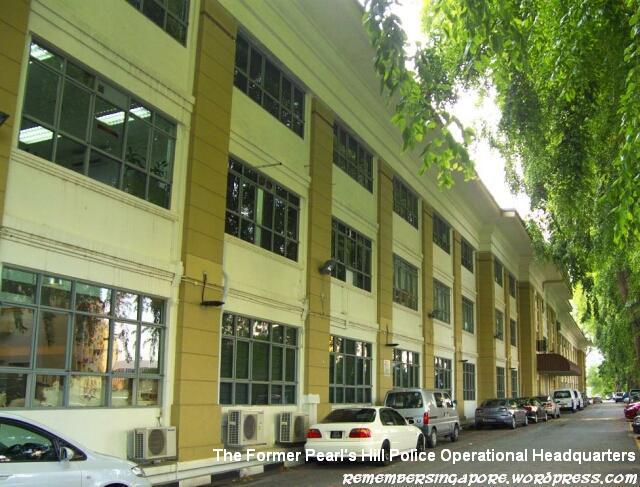
The Upper Barracks, on the other hand, was a grand three-storey Neo-Classical building that stands on the slopes of Pearl’s Hill and watches over Chinatown. It was also occupied by the Ministry of Interior and Defence in 1965 before being converted into the Police Operational Headquarters. By 2001, all the police divisions from the Lower and Upper Barracks were relocated to the new Police Cantonment Complex.

The wall of its entrance still bears the crest of the Straits Settlements Police. Both the Lower and Upper Barracks were gazetted for conservation in 2008.

straits settlements police crest

Beach Road Police Station

The former Beach Road Police Station was another police station built in the early 1930s to closely monitor the crimes in the city. It stood on reclaimed lands near the famous Alhambra and Marlborough Cinemas, where the seaside was just a few steps away behind the station. During the Japanese Occupation, the building was used as a holding area of the local Chinese, Indians and Jews before they were sent to Changi Prison by the Japanese.

Since the early seventies, the Beach Road Police Station was occupied by the Geylang Police Division and, later, the Central Police Divisional HQ. By the late eighties, it was apparent that its location was not suitable to look after the needs of the new and upcoming housing estates. The police station was eventually decommissioned in 2001, and given the status of a historic site two years later. Today, its premises serve as the campus of Raffles Design Institute.

traffic police station at maxwell road 1974

Traffic Police Station, Maxwell Road

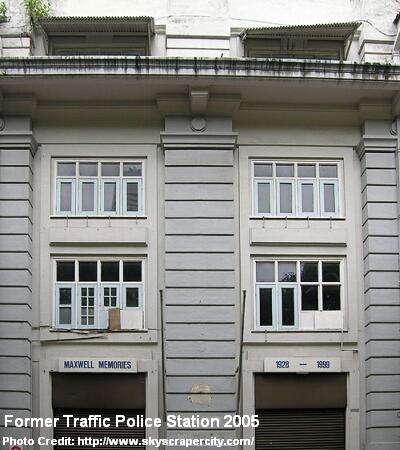
former traffic police station building 2005Constructed by the British in 1928, the grand building at Maxwell Road served as the headquarters of the Traffic Police Branch for nearly 70 years. The police station also functioned as a venue for the driving tests in the early days. In 1999, the Traffic Police Department moved to its new office at Kampong Ubi, and the building was left vacated.

It was not until 2005 before the 100,000 square feet site was converted into a Red Dot Traffic design centre and museum. Given a fresh coat of red paint, the easily recognisable landmark of Maxwell Road was presented with the conservation status by the URA in 2007.

Detective Headquarters, Robinson Road

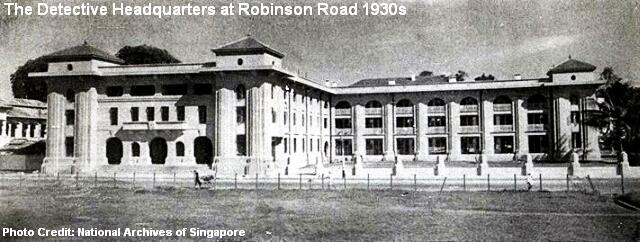
Perhaps the most interesting police station built in the 1930s was the Detective Headquarters at Robinson Road. Nicknamed the “hush hush” house, the three-storey building was specially designed in such a way that any preparations or consultations of police operations would be invisible to prying eyes. Hidden behind bricked walls, inspectors on missions could rapidly leave the station undetected. This helped to halt the collaboration and leakage of confidential information by the corrupted policemen.

detective headquarters 1930s

Dubbed as Singapore’s “Scotland Yard”, the Detective Headquarters set up different departments to study criminal statistics, photography, fingerprints and analysis of bullets and cartridges. Officers specialised in different Chinese dialects were recruited to combat crimes committed by the Chinese secret societies. The information collected were used to monitor illegal activities such as commercial crimes, prostitution and gambling.

Prominent Figures

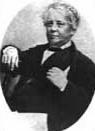
thomas-dunmanRegarded as the father of the police force in Singapore, Thomas Dunman (1814-1887) was the first Commissioner of Police between 1856 and 1871. The riots in 1854 came as one of the early tests for Dunman, who was then a Superintendent. The small police force could not cope with the widespread clashes, and military troops had to be called in. To avoid repeating the same mistake, Dunman carried out training of his police force, improving its efficiency and discipline. By also maintaining good relationships with various communities, Dunman was able to gain first-hand information of the incidents in the city. Under his leadership, there was soon a significant decline in the crime rate. To honour his contributions, Dunman Road was named after him.

Famous for his campaigns against gambling and communism, René Henry de Solminihac Onraet (1887-1952) was the Inspector-General of the Straits Settlement Police between 1935 and 1939. Proficient in Hokkien and Malay, Onraet worked as an undercover in Chinatown and successfully busted the operations of many gambling dens. In 1922, after his promotion to superintendent, Onraet was tasked to monitor political threats, especially those coming from the communist organisations. He retired in 1946 and returned to Hampshire, where he died six years later at an age of 67. Onraet Road was named as a tribute to him.

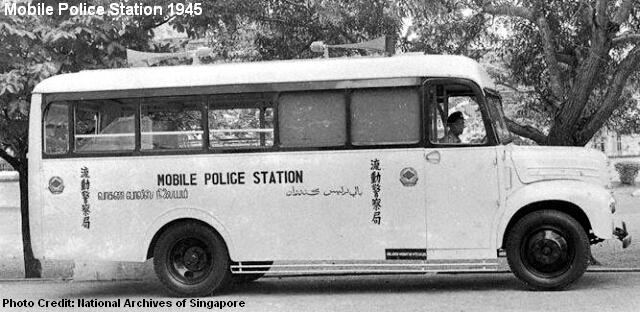
mobile police station 1945

Disbandment

With the Special Branch and Detective Branch well-established, the Crown Colony, by the late 1930s, boasted having one of the best police forces in the British Empire. However, all these were undone when the Japanese forces invaded and captured Singapore in February 1942. The Straits Settlements Police Force came under the control of the Japanese and all vessels owned by the Marine Police were confiscated.

After returning to the Malay peninsula at the end of the Second World War, the British decided to form a Malayan Union under a unifying administration. This led to the Straits Settlements being dissolved in April 1946. Penang and Malacca joined the Malay states to form the Malayan Union, while Singapore remained as a separate Crown Colony of the British. With the Straits Settlements no longer in existence, the Straits Settlement Police Force was disbanded.

kampong bahru police station 1954

Singapore Police Force (1946-1959)

The chaotic Singapore society was in urgent need to be stabilised after the Japanese Occupation. The Volunteer Special Constabulary (VSC) was established in October 1945 to help the police enforced law and order in the streets that were seeing the return of gangsterism and secret societies. To make things worse, Singapore was facing the infiltration of communist elements and rising racial tensions.

The strength of the local police force was dealt with a blow after its Sikh contingent was decimated in the Second World War. To make up for the losses, the Singapore police founded the first batch of Gurkha contingent in April 1949. It proved to be a crucial move as the disciplined and loyal Gurkhas maintained their neutral stand during the racial riots.

The First Policewomen

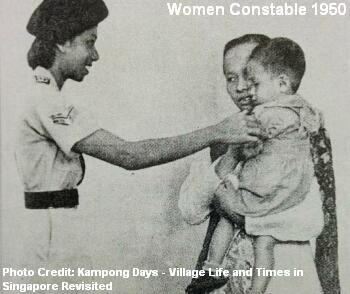
women constable 1950In 1937, Shanghai deployed its first ever batch of 33 Chinese policewomen to fight crime and perversion. The surprising news had many wondered when would Singapore have its first women police. When interviewed, the Singapore Police clarified that there were no plans of recruiting women, claiming that they were not required in the country.

This discrimination lasted until March 1949, when women were allowed for enrolment for the first time. After months of training, 10 female trainees were selected and became Singapore’s first policewomen when they signed on in January 1950. One of the trainees, Mary Quintal, went on to become the first female Assistant Superintendent of Police in 1961.

havelock road police station 1950s

New Threats to Society

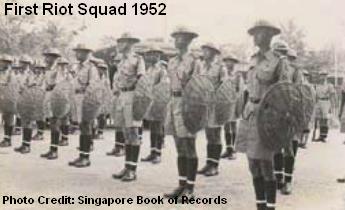
first riot squad 1952

The 1950s was arguably the toughest period faced by the police force, as they had to deal with a series of social unrest in the Maria Hertogh Riots (1950), the Hock Lee Bus Riots (1955) and the Chinese Middle School Riots (1956). After the Maria Hertogh Riots, the first Riot Squad was formed in 1952. It would later become the Police Task Force well known for their distinctive ang chia (red riot control vehicles).

The basic police force in the early fifties was made up of only 3,000 constables and detectives, 2,700 of them Malay and 300 Chinese. To increase its efficiency, the police force went through a thorough restructuring in 1952. The strength of its Gurkha contingent was also doubled to deal with the increasing number of riots. At the end of the 1950s, the police force had strengthened to 4,000. More than half were Malays, with the remaining made up of Chinese, Indians, Pakistanis, Gurkhas, Ceylonese, Eurasians and Europeans.

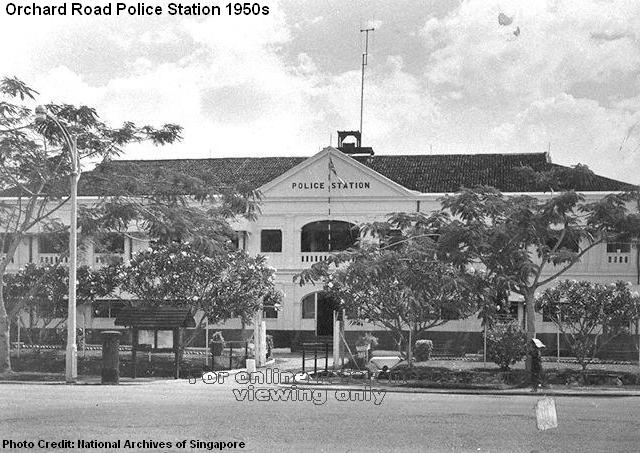
orchard road police station 1950s

First Police Week

The first Police Week was organised in 1958 to foster good public-police relationship. The public could visit the 12 police stations every evenings during the one-week event. More than 370,000 men, women and children, about one quarter of Singapore’s population, turned up to read the posters, listen to talks and visit the detention cells, guided by the officers and constables themselves.

singapore first police week 1958

The second Police Week, however, was held 13 years later in 1971.

Polis Negara Singapura (1959-1965)

Joining the Federation

As Singapore marched towards its self-governance, the police force also received a new name. The Singapore Police was renamed as Polis Negara Singapura in December 1959, represented by a new coat-of-arms with a crescent moon and five stars.

In 1961, a Police Force Amendment Bill was debated and passed in the Legislative Assembly, unifying all police units to be placed under the command of the Commissioner of Police. The Bill also approved the replacement of small individual police forces, stationed at strategic locations such as the airport, Singapore Harbour Board and the Shell Company, by the auxiliary police.

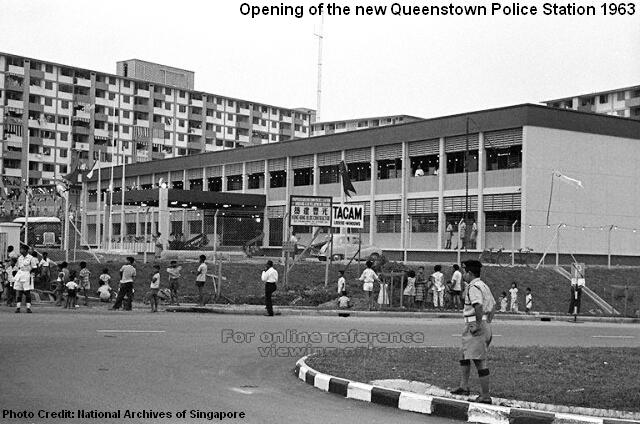
queenstown police station 1963

The Polis Negara Singapura was officially integrated into the Royal Malaysian Police Force in September 1963, after Singapore’s decision to merge with the newly-established Federation of Malaysia. At the ceremony held at the Pearl’s Hill headquarters, its dark blue flag was lowered, replaced by the Royal Malaysian Police Force’s navy blue flag.

Prominent Figures

song kok hoo acting police commissioner 1959Song Kok Hoo (1906-undetermined) was the first Chinese to act as the Commissioner of Police, taking charge of the police force temporarily for two months in 1959. His appointment was taken into consideration to prepare Malayans for the top police posts after the eventual departures of the senior British officers. A 20-year-old Song Kok Hoo first joined as a probationary police officer in 1926, before rising to be the most senior Asian police officer in the force by the late fifties.

john le cain police commissioner 1963-1967In 1963, John Le Cain (1912-1993) became the first Asian to be appointed as the Commissioner of Police. Born in Thailand, Le Cain arrived at Singapore at age 2, and joined the Straits Settlement Police Force in 1939. A well-known Eurasian, Le Cain faced many major social issues during his tenure, such as the Indonesian Konfrontasi, racial riots and Singapore’s independence. He retired in 1967 after an illustrious 29-year career with the police force.

20 years serving in the police force and rising to the rank of assistant superintendent, Wilfred Skinner (1936-2003) was perhaps better remembered for his sporting talents as a double international for Singapore. One of the best goalkeepers produced by Singapore in the fifties and sixties, he made his debut at age 18 and dominated the posts for the national football team for as long as 15 years. In addition, Skinner was also the half-back and captain of the hockey national team in the early sixties.

kandang kerbau police station2 1960s

Kampong Spirit

In the fifties and sixties, the police force was mainly concentrated at the city and downtown areas. Hence, police assistance was limited in the rural regions.

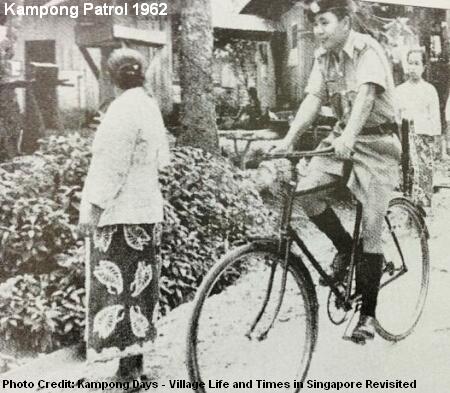
kampong patrol 1962A constable was usually assigned to look after several kampong, and it would be a familiar sight to see him patrolling around on his bicycle. Most villagers would welcome the constable as he offered advice and helped to settle minor disputes.

As population grew and kampong flourished, several police posts were erected at convenient locations in the suburban areas, such as Ama Keng, Bedok, Kampong Bahru and Kandang Kerbau. Some of the former police stations had unique names that are seldom heard today. The Wayang Satu Police Station was located at the junction of Bukit Timah Road and Stevens Road, whereas the Rumah Miskin Police Station, standing along Serangoon Road, was later converted into a halfway (rehabilitation and counseling) house for former drug addicts.

Singapore Police Force (1965-Present)

From Khaki to Blue

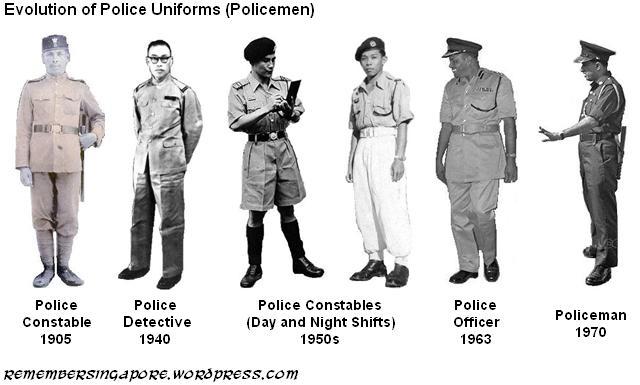
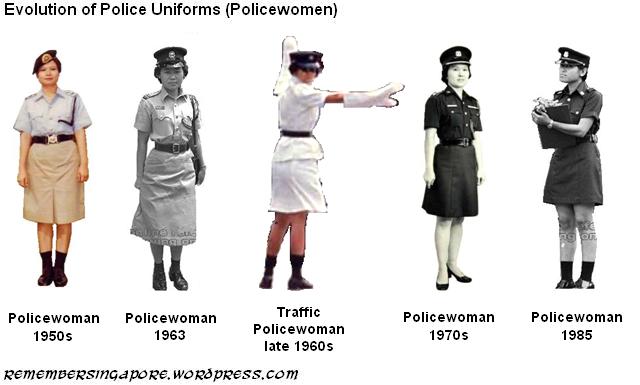
The local policemen first donned regular uniforms in 1856. Although the designs had gone through several changes, the colour and material used largely remained the same. By 1959, there were proposals to overhaul the design of the police uniforms to present the image of a new self-government of Singapore. The grey flannel shirt, khaki shorts and black beret were viewed as colonial products left behind by the British, and had be changed immediately. The songkok was suggested to replace the beret.

However, the makeover plan did not materialise and it would take almost another decade before the policemen were able to don their new uniforms.

evolution of police uniforms

evolution of police uniforms2

The year 1969 was a significant year for Singapore and its police force. It was the 150th anniversary of the founding of modern Singapore. The Singapore Police Force, already 6000-strong by then, received a brand new design in their uniforms. A stark contrast as compared to the former colonial ones, the new dacron blue uniforms, completed with long-sleeved shirts, trousers and peak caps, would play an important role in helping the policemen maintain a professional look. The material used for the new uniforms was also well suited in a tropical climate.

The Singapore Police Force also revolutionised the ranking system. In 1972, the ranks of Lance Corporal, Corporal and Staff Sergeant were abolished. However, the move led to a lack of morale and motivation among the junior police officers. After much considerations, the ranks were reinstated four years later (but the rank of Lance Corporal, however, was again removed in 2002).

Demolition of Old Police Stations

After Singapore’s independence, the country was facing several issues such as overcrowding in the city and poor living conditions of the people. There was also a severe lack of infrastructure. In 1967, the Urban Renewal Department (URD) was set up to redevelop the central part of Singapore, and it was obvious that many of the former aging colonial police stations had to go.

The Orchard Road Police Station, standing at the busy junction of Orchard Road and Patterson Road, was high up on the demolition list. Constructed before the 1880s, it was one of the oldest buildings in the Orchard vicinity. The police station and its staff quarters, built in 1922, were eventually torn down in 1967.

demolition of central police station 1978

In the next decade, several other colonial police stations also faced the same fate. The Havelock Road Police Station was demolished in 1969, followed by the Tanjong Pagar Police Station in 1972. The Central Police Station, one of the biggest police stations built during the British era, was also torn down in 1978 due to the widening of Upper Pickering Street.

The Hill Street Police Station, Beach Road Police Station and Pearl’s Hill’s Lower and Upper Barracks were the only colonial police stations located in the city area that had escaped the fate of demolition.

paya lebar police station 1982

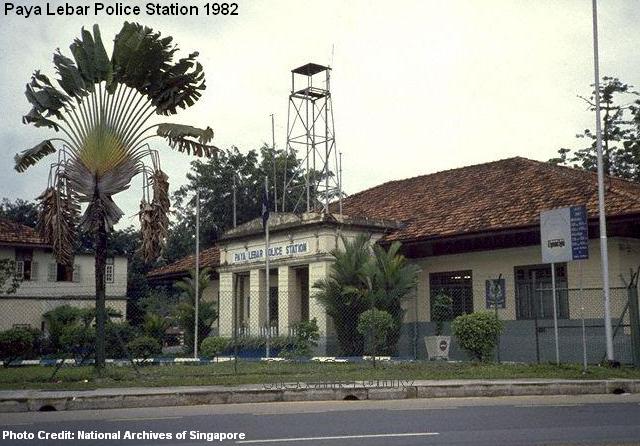
Some of those police stations located in suburban areas were also fortunate to stay on. After its closure, the premises of the former Paya Lebar Police Station were used as the headquarters of the Singapore Civil Defence Force (SCDF) and, later, the school campus of several foreign educational institutions. The former Joo Chiat Police Station, built in 1928, has been converted into a hotel and restaurant, and will likely be conserved in the coming years.

former joo chiat police station

The Neighbourhood Police Posts

As new housing estates were developed in the seventies, new police stations were built within the residential areas to bring the Singapore Police Force closer to the community.

In 1983, the Neighbourhood Police Post (NPP) system was implemented in many new towns. Modeled after the Kōban system in Japan, the objective of NPP was to promote community policing. Each small police post was set up to look after its designated neighbourhood, provide assistance and interact with the residents on a regular basis. The NPP system proved to be a success, as it helped to bring down the crime rate and was well-received by the public.

policemen 1980s

Khe bung npp at boon keng road 1983

However, the NPP system put a strain on the police force’s limited resources and manpower. After a review in 1997, the Singapore Police Force decided to pool the resources together to form the Neighbourhood Police Centre (NPC) to cover the eastern, western, north-eastern and central regions of Singapore. The Queenstown Neighbourhood Police Centre became the first NPC to be established. Today, there is a total of 35 NPCs in Singapore.

Published: 10 August 2013

Updated: 14 January 2018

Posted in Historic | Tagged , , , , , , , , , , , , , , , , , , , , , , , , , , | 43 Comments

A Forgotten Past – ‘Prison on Fire’ at Pulau Senang

Many movie fans are familiar with Chow Yun-Fat’s blockbuster “Prison on Fire”, a 1987 Hong Kong classic that featured inmates rioting against the prison authorities. Few, however, are aware that a similar incident had happened in Singapore in the early sixties.

A Turbulent Period

It was 1963, a year of turbulence and instability in Singapore. In January that year, Indonesia President Sukarno had declared Konfrontasi against the new Federation of Malaysia, in which the Malaya Peninsula was joined by Sabah, Sarawak and Singapore. Domestically, some 100 demonstrators marched their way to City Hall in April to protest against the arrests of left-wing activists and trade unionists. In August, a 100,000-strong “blood debt” mass rally took place at the Padang, demanding Japan to pay a $50-million compensation for their war atrocities in Singapore.

The violent Pulau Senang riot on 12th of July added further shocks to an already unstable Singapore society.

map of pulau senang

Gangsterism and the Isle of Ease

The People’s Action Party (PAP), Singapore’s new self-government in 1959, was determined to eradicate gangsterism and secret societies. It was estimated that there were as many as 120 gangs, such as the Ang Hor Tiap, Sio Koon TongTiong Neng Tok, Sri Tong and Loh Kuan, and more than 10,000 active secret society members in Singapore. Rival clashes occurred almost every week, resulting in dozens of deaths. A thousand gangsters were arrested each year.

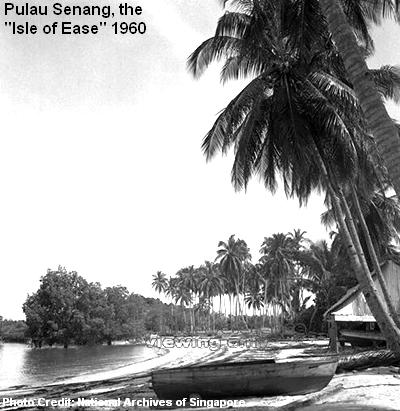
pulau senang the isle of ease 1960-2The outdated prison system soon could not cope with the continuous arrests. Its overcrowding and hygienic issues forced the authority to explore new ideas and solutions. By early 1960, a Pulau Senang Settlement proposal was drawn; its objective was to solve the existing issues and also to help the gangsters work their way back to the society through hardship and sweat.

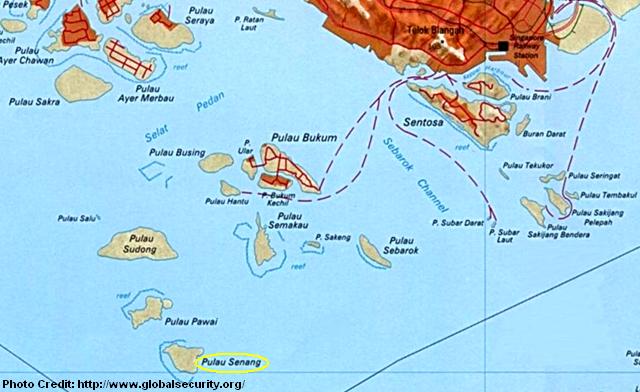
Pulau Senang, or “Isle of Ease” in Malay, was then an uninhabited coral island that laid 13km away from the mainland of Singapore.

The Island Experiment

It was believed that the hardcore criminals and violent gangsters, with no regards for laws and orders, were forced into the tough circumstances due to lack of jobs and security. Through disciplined means, they could be reformed and would, one day, be accepted into the society again.

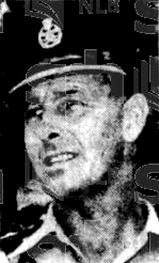
superintendent of pulau senang daniel stanley duttonAt least one person, Irishman Daniel Stanley Dutton, held this belief. A born leader and the superintendent of the Prison Department, Dutton strongly believed that no man was born evil, and a second chance should be given to those who were willingly to change for the better. It was a noble aspiration, but Dutton’s iron-fist rule also meant that his prisoners were subjected to his harsh disciplinary methods, one of the reasons that might have incited the riot.

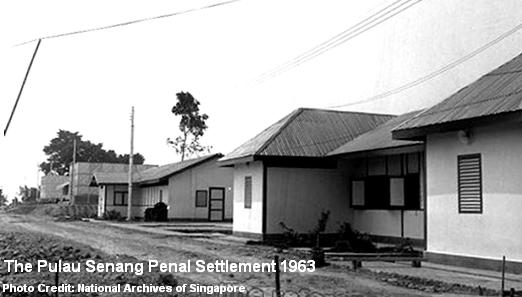
In May 1960, the penal reform experiment officially started. Dutton and his 50 prisoners landed on Pulau Senang, and began developing the bare island immediately. Other detainees subsequently arrived in batches of 30. Within a short period, the island, no larger than 227-acres big, was turned into a self-sufficient rehabilitation centre with roads, reservoirs, workshops, farms and even a sports ground.

An Initial Success

The Pulau Senang experience was a success at the beginning. In just two years, over 250 prisoners, most of them Chinese secret society members, went through the reform system. After spending a year in Changi prison, the prisoners had the option to redeem themselves at Pulau Senang. They were given various manual tasks upon their arrivals, and each of them was accessed by Dutton himself every month. If the prisoners’ performances were satisfactory after six months or so, they would be released back to the mainland. A government department would help them settle down and find suitable jobs. Dutton, however, would not hesitate to send any rebellious or resentful individual back to jail.

pulau senang penal settlement 1963

The 40-plus years old Daniel Dutton was a confident man. Nicknamed “The Laughing Tiger”, he was the sole European on the island, and had only three assistants, two Chinese and one Ceylonese, to help him. There were no firearms in the settlement. Dutton even allowed minimum supervision of his prisoners, believing that they would not escape. He also laughed it off when his informers told him that the hardcore gangsters were plotting to kill him.

The Violent Riot

By 1963, the number of detainees on Pulau Senang had ballooned to over 300. The island security, headed by Dutton, was less than fifty. The riot on the fateful day of 12th July was believed to be sparked off by the deportation of 13 detainees who had been working on the construction of a jetty. There was already a growing resentment when the 13 men were ordered to work only during the low tides, regardless of day or night. Their fatigue turned into anger after Dutton demanded nothing but hard work and results.

When the crowds became rowdy in the morning, Dutton refused to call for reinforcement from the mainland police or the coastal guards. He was confident that the majority of the detainees would stand by him against the “few” rebellious ones. By the time Dutton realised he could not control the hostile situation, it was all too late.

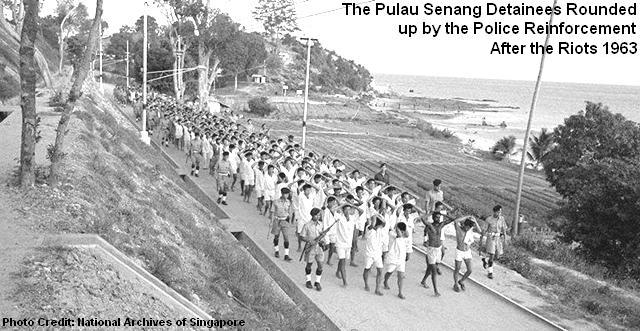
The island, which the detainees took three years to build and develop, was practically destroyed in just 40 minutes. Buildings were burnt to the ground. Dutton and three of his assistants were brutally chopped to death by the rioters using axes and changkuls. Most of the rebels made no attempts to escape from the island. After the horrifying murders, they cheered and celebrated as though they were the new conquerors of Pulau Senang.

pulau senang detainees rounded up after riots 1963

The Verdict

It was the first time in the legal history of Singapore that so many men were charged and convicted at the same time for capital offence. The case dragged on for two years. In June 1965, the appeal against their death sentences was rejected by the Privy Council. Out of the 58 detainees involved in the rioting, 11 were acquitted and 29 were jailed two to three years. The remaining 18, including the notorious Tan Kheng Ann, nicknamed “Robert Black”, and “Botak” Chia Yeo Fatt, were hanged in October 1965.

criminal district court 1963

Pulau Senang’s penal reform experiment was eventually deemed as a failure. Investigations and studies were carried out to find out the reasons but the real motive of the riot remained inconclusive. After the incident, Pulau Senang was declared out of bounds. It would take many years before the island was converted into a Singapore Armed Forces (SAF) live-firing training ground along with Pulau Pawai and Pulau Sudong.

Published: 27 July 2013

Posted in Historic | Tagged , , , , | 25 Comments

A Journey into Singapore MRT’s Past

It seems like it was only yesterday when the grand opening ceremony of the North-South Line was held at the Toa Payoh station. A total of 26 years has since passed, as the MRT (Mass Rapid Transit) system becomes an integral part of our daily life. Today, we put aside all the recent troubles of overcrowding, breakdowns and line disruptions, and take a little ride into the MRT’s past.

The Early Debates

The conceptualised idea of a rail system was proposed as early as 1967, two years after Singapore attained its independence. Studies and reviews were carried out, but more than a decade later, the public transport plan remained inconclusive. By the early eighties, intense debates regarding the proposed building of MRT erupted in the parliament.

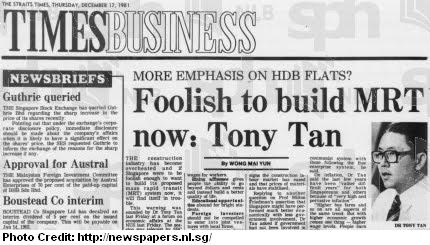
business times mrt article 1981Then-Trade and Industry Minister Dr Tony Tan suggested more emphasis to be placed on the construction of public housing instead of a mass rapid transit system, as Singapore was facing a labour shortage and rising building costs. The building of Changi Airport also took a toil on the construction resources in the previous five years between the late seventies and early eighties.

Dr Goh Keng Swee, then-Finance Minister, also objected to the rail system. He was concerned that the huge cost, estimated to be $5 billion, could drag down the country’s economy. Believing in an all-bus system instead, Dr Goh Keng Swee even invited two Harvard professors to come out with a report to support his case.

The pro-MRT camp was represented by Ong Teng Cheong, the former Minister for Communications and Labour. He argued that the MRT system would have a tremendous influence in shaping the economic growth and development of Singapore. Comparing with other cities such as Toronto, Montreal, Chicago and Marseille, Ong Teng Cheong pointed out that an efficient MRT system could also help in enhancing the image of Singapore, and increased the overall standard of living of the people.

The Final Decision

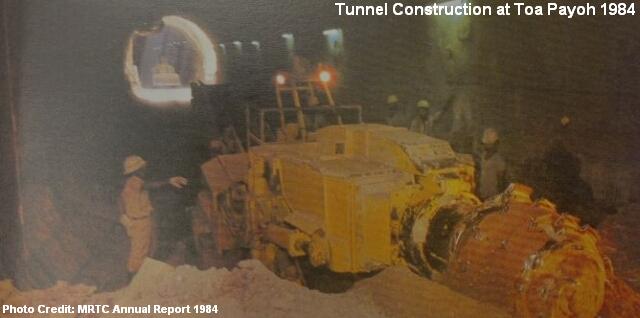
The Comprehensive Traffic Study in 1981 showed that an all-bus system in Singapore was not practical and efficient. A mass transit rail system was recommended instead. Thus, after more than 10 years of feasibility studies, the decision to build a rail-based MRT system was finally made in May 1982. Construction started shortly at Toa Payoh and Novena after a ground-breaking ceremony held at Shan Road on 22th October 1983.

tunnel construction at toa payoh 1984

A formal organisation named the Mass Rapid Transit Corporation (MRTC) was set up on 14th October 1983 to oversee all roles and responsibilities of the train network. It would later be combined with the Registry of Vehicles and Roads & Transportation Division to form the new Land Transport Authority (LTA) in 1995.

The First Lines & Stations

1. North-South (NS) Line

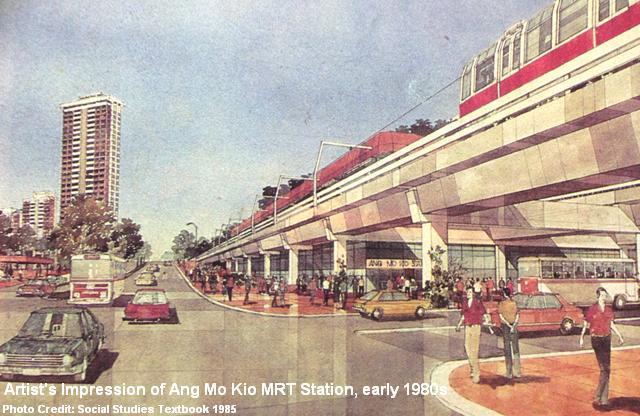
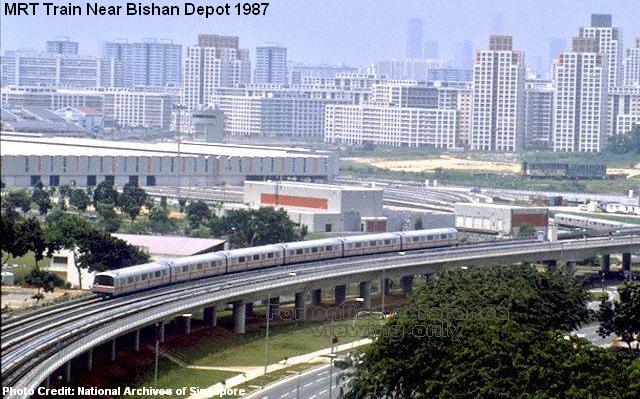
The first MRT line in operation, the NS Line was intended to link the city to the upcoming new residential towns of Yishun, Ang Mo Kio and Bishan. The 5-station section between Yio Chu Kang and Toa Payoh was officially opened on 7th November 1987, before extended to Raffles Place a month later. The Yishun and Marina Bay stations were added by the end of 1990. The second phase of the NS Line development was completed in February 1996, linking Yishun to Choa Chu Kang, and established a continuous loop to the branch line of the East-West (EW) Line.

artist's impression of ang mo kio mrt station early 1980s

As the NS Line was the first train line to be built in Singapore, it faced many technical and social problems. Many old buildings had to make way, businesses were affected and traffic congestion surged due to the construction works on the ground level. Beside tight schedules and constant track alignments, there were also major challenges in the building of the tunnel below the Singapore River. Due to technical issues, the location of the Newton MRT Station had to be shifted to Scotts Road, a distance away from its original plan at the Newton Circus.

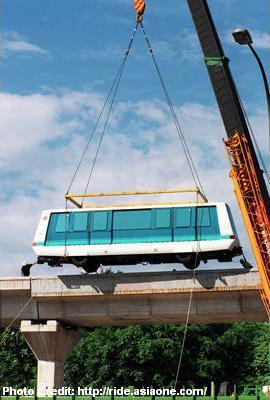
mrt train near bishan depot 1987

Double functioning as air-raid shelters, the six MRT stations in Braddell, Newton, Somerset, Raffles Place, City Hall and Marina Bay are equipped with thick, anti-blast steel doors. Overall, the NS Line has a 44km-long track, 25 stations and seven interchanges that are also linked to the new North-East (NE) Line and Circle (CC) Line

2. East-West (EW) Line

The first section of the EW Line, consisting of two interchanges (City Hall, Raffles Place) and two stations (Tanjong Pagar, Outram Park), was officially opened on the 12th December 1987, about a month after the opening of the NS Line. Its development extended rapidly to Lakeside in the following year. By early 1990, the eastern section was also completed, linking City Hall to Tanah Merah.

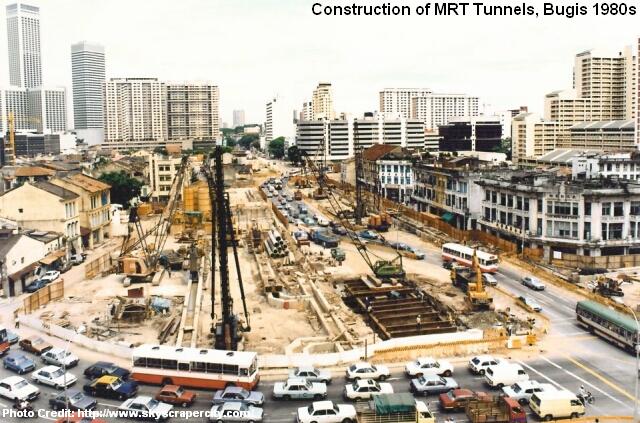
construction of mrt tunnels at bugis 1980s

The construction of the Boon Lay station, the westernmost station on the early MRT map, was nearly shelved in 1987. However, with HDB’s decision of building 25,000 new flats in the vicinity, the station was eventually opened in July 1990 to cater for the needs of the new residents as well as the workers from the industrial estates at Jurong and Tuas.

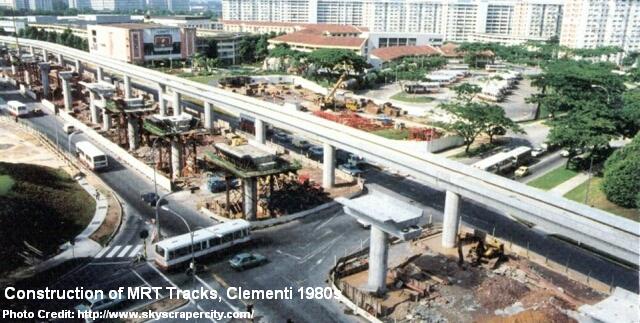
construction of mrt tracks at clementi 1980s

Like some of the stations at the NS Line, there are three MRT stations (Bugis, Tiong Bahru and Lavender) at the EW Line that double as Civil Defence stations. As of 2013, the EW Line remains the longest train line in Singapore, spanning almost 53km and 31 stations from Paris Ris and Changi Airport to Joo Koon.

The development of MRT, upon the completion of its initial stage in the late eighties, was then the largest public project in Singapore, costing a total of $5 billion in construction.

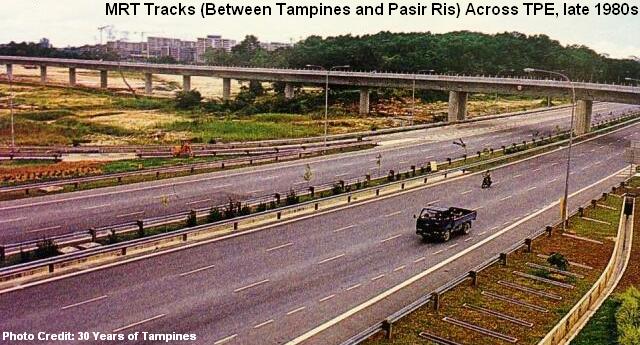
mrt tracks between tampines pasir ris late 1980s

The Evolution of the MRT Map

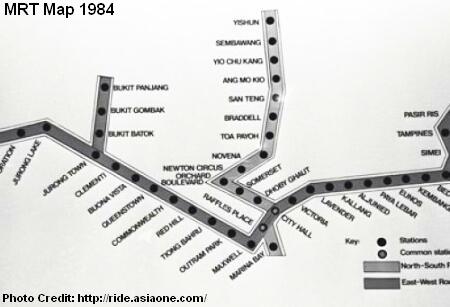
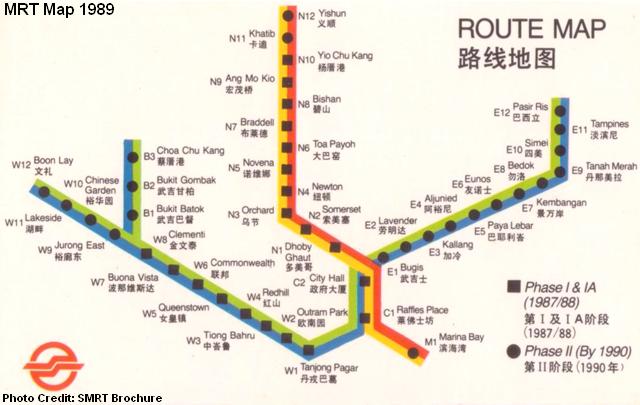
The early MRT map of NS Line and EW Line consisted of 42 stations, 15 of which were underground. The three depots were based at Bishan, Ulu Pandan and Changi. The conceptualisation was introduced in late 1984, before the first finalised MRT map was released to the public three years later.

early mrt map 1984There were glaring differences in the early maps. The station codes were absent, and there was no Khatib station. Instead, a Sembawang station stood between Yishun and Yio Chu Kang. The stations of Bishan, Newton and Orchard were also listed as San Teng, Newton Circus and Orchard Boulevard respectively.

The second phase of development of NS Line initially did not include Sembawang and Kranji stations. They were later added, while Sungei Kadut was omitted instead. There is a likely possibility of the development of a new town at Sungei Kadut in the future, hence a station code (NS6) is reserved between Yew Tew (NS5) and Kranji (NS7). Likewise, the missing station code of NS12 is a likely reservation for a new housing estate named Simpang built between Sembawang (NS11) and Yishun (NS13).

mrt map 1989

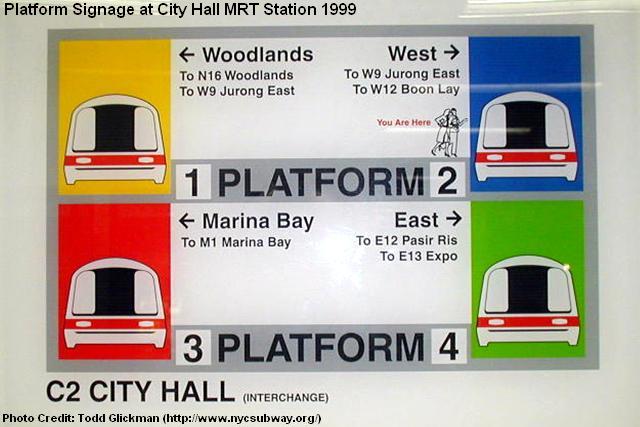
There were even more changes in the EW Line. A series of MRT stations were renamed, such as Lakeside, Chinese Garden, Tanjong Pagar, Bugis and Choa Chu Kang (originally known as Corporation, Jurong Lake, Maxwell, Victoria and Bukit Panjang respectively). Queenstown station switched places with Commonwealth, whereas Dover station was unavailable at the start of the planning; it was only added in 2001. The trio of Bukit Batok, Bukit Gombak and Choa Chu Kang, initially categorised under the branch line of EW Line, became an integrated part of NS Line when the loop was completed in 1996.

platform signage at city hall mrt station 1999

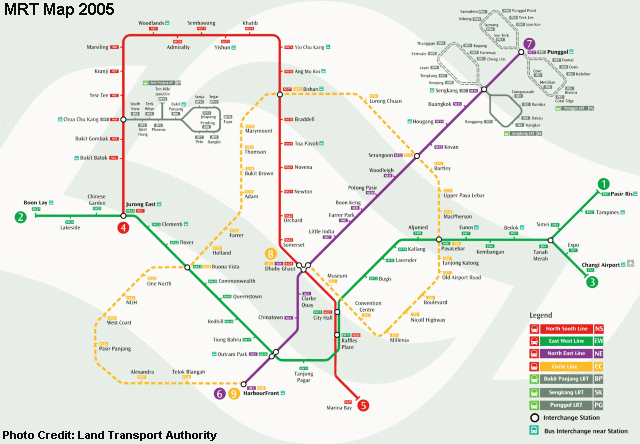
In 2009, the Boon Lay Extension was completed with two additional stations (Pioneer, Joo Koon) added. A further four stations (Tuas, Tuas Crescent, Tuas West, Tuas Link), known as the Tuas West Extension, is expected to be up and running by 2016. At the eastern side of Singapore, the Changi Airport Extension was opened by 2002. Branching off at the Tanah Merah station, it consists of two new stations named Expo and Changi Airport.

mrt map 2005

The colour codes of the MRT Lines have evolved from NS Line’s red-yellow band and EW Line’s blue-green to red (NS Line), green (EW Line), purple (NE Line), orange (CC Line) and blue (DT Line). The colour grey is used to represent all the LRTs.

The Grand Opening Day

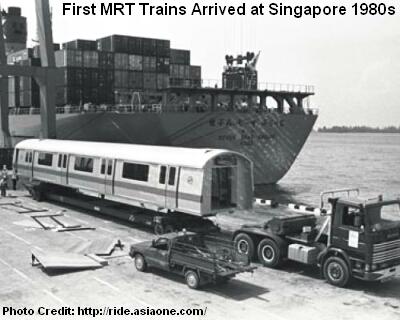
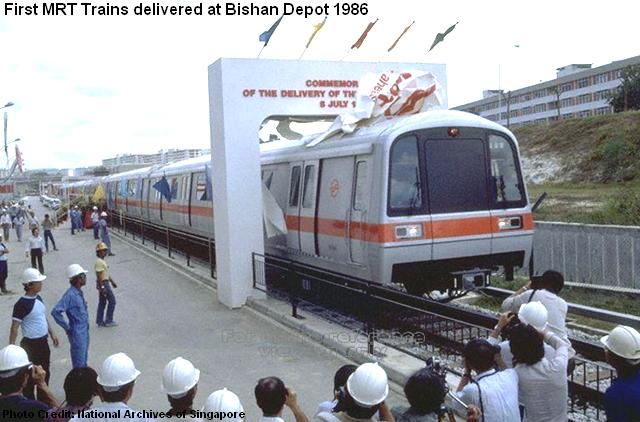
first mrt trains arrived at singapore 1980sOne of the first MRT trains arrived at the Bishan Depot in July 1986. A commemoration ceremony was held to mark the significant event, and was officiated by Dr Yeo Ning Hong, then-Minister for Communications and Information.

Singapore Mass Rapid Transit Limted (SMRT), the private operator of the new rail system, was established on 6th August 1987 to take over the roles and responsibilities previously held by the MRTC. As the opening date approached, hundreds of trial runs were conducted between August and October of 1987 to ensure the smooth and faultless operation.

first mrt train delivered at bishan depot 1986

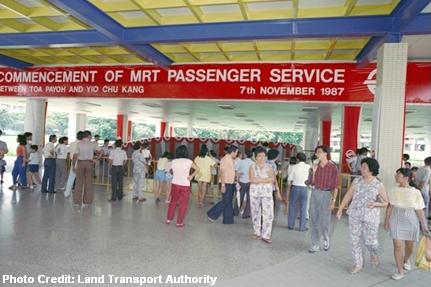
The biggest moment finally arrived on the 7th of November 1987 when the first section of NS Line was opened at the Toa Payoh MRT Station. Likened the historical event to a new-born baby, Second Deputy Prime Minister Ong Teng Cheong described it as an incredible achievement after a long and difficult 20 years.

commencement of mrt service 1987

The public response was overwhelming. Massive crowds turned up to witness the opening. Hundreds queued to experience the new ride.

The first train, carrying some 400 VIPs and guests, left Toa Payoh and reached Yio Chu Kang in a 15-minute journey. Just three weeks after the opening of the NS Line, the MRT recorded its first millionth ridership.

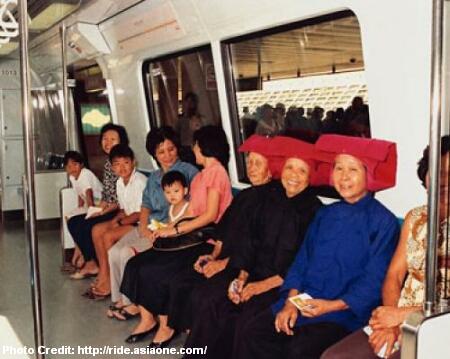
samsui women in mrt train on opening day 1987

There was a touching moment observed on the opening day of the MRT when the boss of a construction company gave his workers, three of them Samsui women, a well-deserved day off to enjoy a ride on the new train. The Samsui women had been working painstakingly at the construction site of the Bishan station for four years.

A month later, there were more celebrations as the second section of the NS Line was successfully opened by then-Deputy Prime Minister Goh Chok Tong. The trains made their debuts from Toa Payoh, passing by City Hall and Raffles Place, before stopping at the EW Line’s Outram Park station. By early 1988, the MRT system was deemed a success in meeting the expectations of the public. Its official opening was held by former Prime Minister Lee Kuan Yew at Raffles City on 12th March 1988.

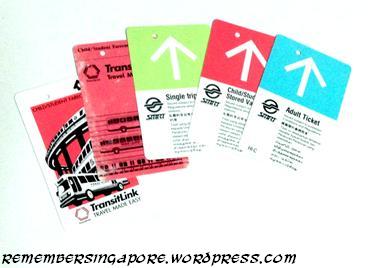
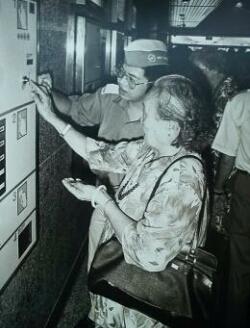
transitlink mrt tickets  introuction to mrt farecard machine 1989

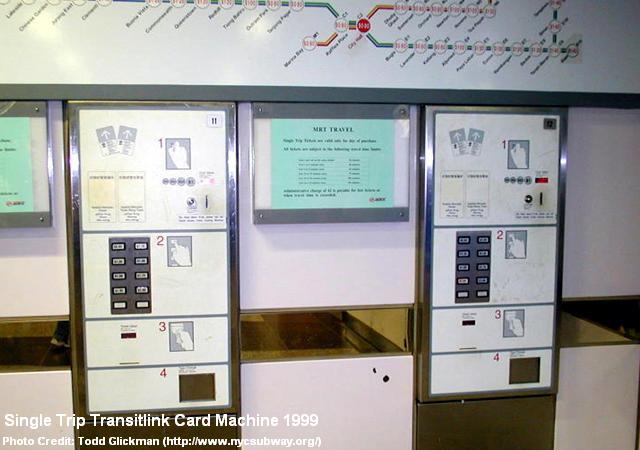
The TransitLink was established at the start of 1989 by SMRT, SBS (Singapore Bus Service) and TIBS (Trans-Island Bus Services) in an effort to develop an integrated bus-rail public transport system. Commuters could enjoy the convenience of the same ticketing system for both buses and MRT by November 1990. TransitLink would last for 12 years before it got replaced by the contactless Ez-link card system in April 2002.

single trip transitlink card machine 1999

The Current & Future Lines

3. North-East (NE) Line

Spanning 20km and comprising 16 stations, the $5-billion NE Line is Singapore’s third mass rapid transit line. The idea of an additional NE Line was mooted in the mid-nineties, when the Woodlands Extension was being added to the NS Line. The construction, however, only began in 1997 due to the immaturity of the northeastern new towns of Sengkang and Punggol.

Fully underground, automated and driverless, the NE Line was opened in June 2003, with the exception of Buangkok (opened in 2006) and Woodleigh (2011)  stations.

4. Circle (CC) Line

When it was completed in 2011, the CC Line was Singapore’s longest underground automated MRT system. Stretching nearly 36km in length and consisting of 31 stations (except Bukit Brown), it costs an initial estimation of $6.7 billion in construction. Till date, it has seven interchanges at Harbourfront, Buona Vista, Bishan, Paya Lebar, Serangoon, Dhoby Ghaut and Marina Bay.

Like the NE Line, the CC Line was first proposed in the nineties, and was originally named as Marina Line. Its stations, under the Art Program, are given different designs to bring out the unique identities and historical backgrounds of the vicinities where the stations are located. One of its stations, the Bras Basah MRT Station, is the deepest station in Singapore, built at a depth of 35m below ground level.

When the Farrer Road MRT Station was opened in October 2011, there was confusion over the similarity in its name with NE Line’s Farrer Park MRT Station, despite both stations being 5km apart.

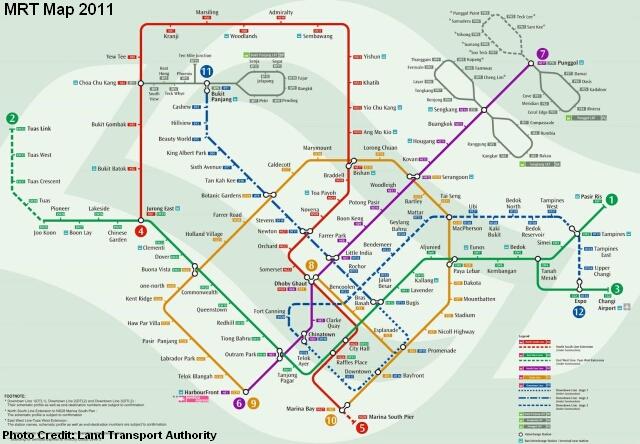
mrt lrt map 2011

5. Downtown (DT) Line

Upon its completion in 2017, the 42km-long DT Line will overtake the CC Line as the longest underground and automated train line. There are three stages of DT Line scheduled, comprising of a total of 34 stations between Expo and Bukit Panjang, passing through new stations such as Tampines West, Kaki Bukit, Ubi, Bendemeer, Fort Canning, Sixth Avenue and Beauty World.

The project of DT Line was first announced in mid-2005, with an estimated cost of $18 billion. One of its functions is to take over some of the traffic loads at the Dhoby Ghaut and Raffles Place interchanges. The second stage of the DT Line, also known as the Bukit Timah Line, aims to provide convenience to the commuters travelling between the northwestern residential estates and the city areas.

One of DT Line’s stations, the Tan Kah Kee MRT Station, struck up a controversy in 2008. Originally planned to be named Duchess MRT Station, LTA later suggested its renaming to Watten or Kah Kee after the students from the nearby Hwa Chong Institution petitioned the station to be named Hwa Chong. In the end, the name Tan Kah Kee was chosen as a tribute to the founder of the institution. It was the first time in Singapore MRT’s history that the full name of a person was used for the name of a station.

6. Thomson (TS) Line

First announced in early 2008, a 30km underground system called the Thomson Line will be built and completed by 2019. Projected to cost $18 billion, the line will cut through the central part of Singapore, connecting to residential areas at Springleaf, Upper Thomson, Mayflower, Sin Ming and Kim Seng.

The TS Line is also expected to be integrated with the Rapid Transit System (RTS), a link between Singapore and Johor Bahru.

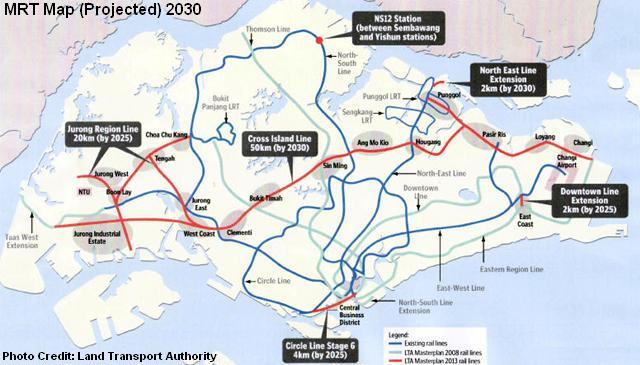
mrt-map-future-2030

7. Eastern Region (ER) Line

The ER Line is intended for the residents living in the southeastern part of Singapore. Scheduled to be completed by 2020, it will be 21km long, have 12 stations and run through the likes of Changi, Upper East Coast, Bedok South, Siglap, Marine Parade and Tanjong Rhu.

8. Jurong Region (JR) Line

The JR Line will extend into the heart of the western side of Singapore, connecting Tengah, Jurong West, Jurong East, Choa Chu Kang and West Coast together. It will be in operation by 2025.

9. Cross-Island (CR) Line

The CR Line will provide an alternative route for the commuters of EW Line, and is not expected to be ready before 2030.

Today, the current rail system covers a total of 178km. LTA targets to increase the distance to 360km by 2030. By then, the MRT network will be expected to serve at least double of the 2-million daily ridership today.

first lrt train at bukit panjang track

The Light Rapid Transit (LRT)

Developed to ease the traffic conditions within a new town, the LRT system aims to replace the feeder bus services. The project, however, did not produce stellar results as compared to the MRT system. Restricted to only Bukit Panjang, Sengkang and Punggol today, there is little indication that more LRT systems will be built in the future.

The first LRT network was launched at Bukit Panjang in November 1999, after a three-year construction and a cost of $285 million, whereas Sengkang and Punggol LRT were opened in stages between 2003 and 2007. The total length of the tracks is approximately 29km.

The Incidents Over the Years

1980s

In November 1989, the MRTC announced that the consumption of chewing gums was prohibited in MRT trains and stations. The ban was implemented after several littering and vandalising of MRT doors and seats. In some worse cases, train services were disrupted by spent gums. The ban of chewing gum was extended to nationwide by early 1992. On the other hand, food and drinks had been prohibited in MRT premises since 1987.

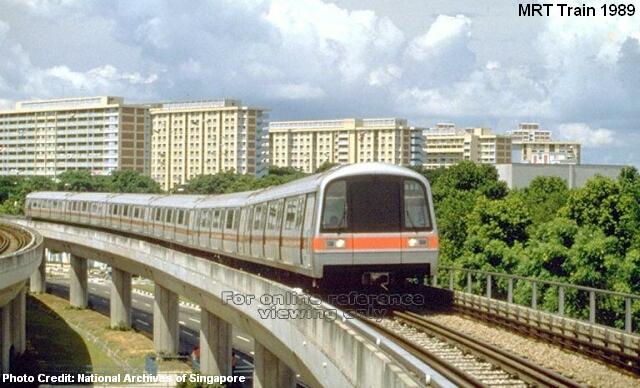
mrt train 1989

1990s

In the early morning of 5th August 1993, an east-bound train carrying a full load of 1,800 commuters failed to stop in time, resulting in a collision with a stationary train at Clementi MRT Station. There were as many as 156 injuries reported in this first ever accident in the history of MRT. Investigations were immediately carried out and oil spill was found to be the main cause of the unfortunate accident.

2000s

A plot to bomb Yishun MRT Station in December 2001 was foiled when several  suspects belong to terrorist group Jemaah Islamiyah (JI) were caught planning an attack on the embassies in Singapore.

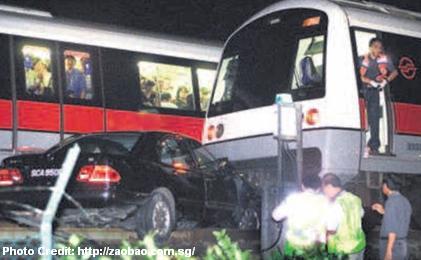
mrt car accident at lentor ave 2003On 3rd March 2003, a 23-year-old driver lost control of his Mercedes Benz along Lentor Avenue, crashing through the fence and landing onto the tracks. A northbound train could not stop in time, but slowed down sufficiently to avoid a major collision. There were some injuries reported and a three-hour disruption in service.

A tragedy occurred at Nicoll Highway in the afternoon of 20th April 2004. A retaining wall gave way, resulting in the collapse of a section of the road. Several natural gas pipes were ruptured, causing explosions and fire. Four men working at the site died, with a further three injured. The construction of the CC Line was halted for a year due to the investigations.

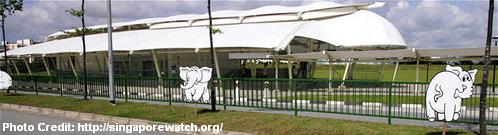
Several dissatisfied residents at Buangkok captured the attention of public and media after displaying eight paper-cut elephants figures outside Buangkok MRT Station on 27th August 2005, signifying the unused station as a white elephant. They were given stern warnings by the police after investigations, and the Buangkok station was later opened in January 2006.

white elephants at buangkok 2005

A commuter named Tan Jee Suan, 46, committed suicide at the Chinese Garden MRT Station in the evening of 18th October 2006. Apparently depressed over financial problems, he jumped onto the tracks and was instantly killed by the approaching train. Sympathetic towards the plight of his family, the public donated more than $500,000 to Tan Jee Suan’s widow and two teenage sons.

A maintenance works train broke down on the morning of 21st January 2008, causing a seven-hour disruption in the services between Pasir Ris and Tanah Merah. More than 57,000 commuters were affected. SMRT was subsequently fined $387,176 by LTA.

2010s

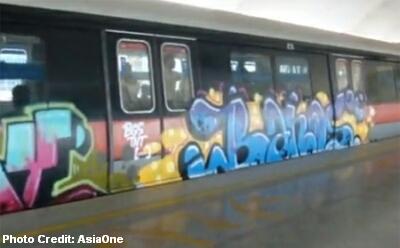
mrt vandalism 2010The security of the SMRT depots at Changi and Bishan was twice breached in May 2010 and October 2011, resulting in trains being vandalised with graffiti. The first vandalism was committed by a Swiss expatriate Oliver Fricker, 32, and his British accomplice, Dane Alexander Lloyd. After the repeated incident of vandalism, SMRT was fined a maximum of $50,000 by LTA.

The MRT network suffered its worst ever breakdowns on the 15th and 17th of December 2011. Over 200,000 commuters were affected by the disruption in the NS Line that totaled more than 12 hours. Nearly 1,000 passengers were stranded in the tunnels between City Hall and Dhoby Ghaut. SMRT was fined a record $2 million by LTA.

Two workers died and eight more injured on 18th July 2012 when a 4m-tall scaffolding gave way at the constructions site of the DT Line’s Bugis Station.

Others

Over the years, there were also many cases of suicides and accidents at several MRT stations where the victims were killed or seriously injured by the approaching trains.

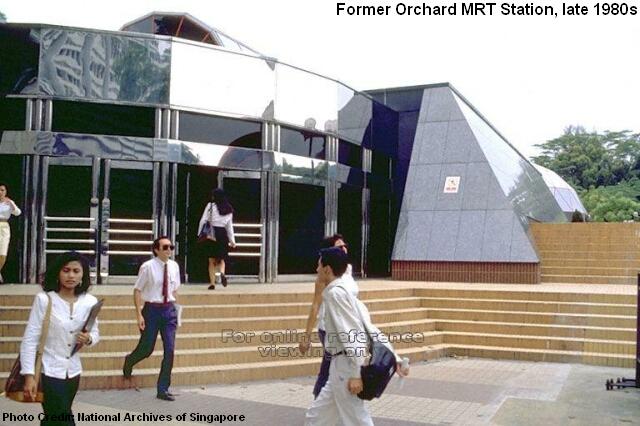
former orchard mrt station late 1980s

The MRT Trivia: Captain SMRT

Do you know that SMRT has a mascot of its own?

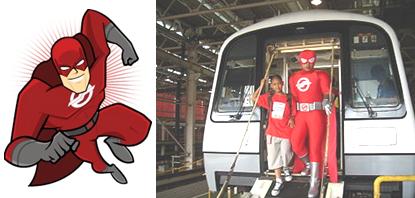
captain smrtIt is simply known as Captain SMRT. The superhero, donned in red and possibly the only second superhero in Singapore after VR Man (created by the Television Corporation of Singapore (TCS) in 1998), was created to promote the safe behaviour of commuters and the train system’s safety measures, such as the emergency exits.

The MRT Trivia: Urban Legends

Many members of the public were skeptical when the MRT was first built. There was disbelief that long underground tunnels could be constructed in a small island like Singapore. Coupled with superstitions, urban legends of the MRT began to spread among Singaporeans. Fortunately, the rumours subsided when people started to realise the benefits and convenience provided by the new transport network.

Bad Fengshui

Strong rumours surfaced in the eighties that then-Prime Minister Lee Kuan Yew consulted Venerable Hong Chuan regarding the construction of the MRT system in Singapore. The highly respected monk warned that the tunnels would destroy the country’s good fengshui. To rectify the problem, every citizen had to carry a bagua (octagon diagram) with them. Hence, the new $1 coin with a octagon shape was born. It was “coincidentally” launched in September 1987, two months before the NS Line’s grand opening at Toa Payoh.

Ghosts in the Tunnels

When the NS Line was first built, there were persistent rumours of supernatural sightings inside the new tunnels at Bishan and Novena, both of which were former cemetery sites. Stories of maintenance personnel encountering ghostly coffin bearers while doing their checks spread like wild fires. Another popular tale was the haunting of the last train at Bishan, where a lone passenger was terrified by a ghastly spirit of a girl who, after boarding the train, removed her head and calmly placed it on the empty seat.

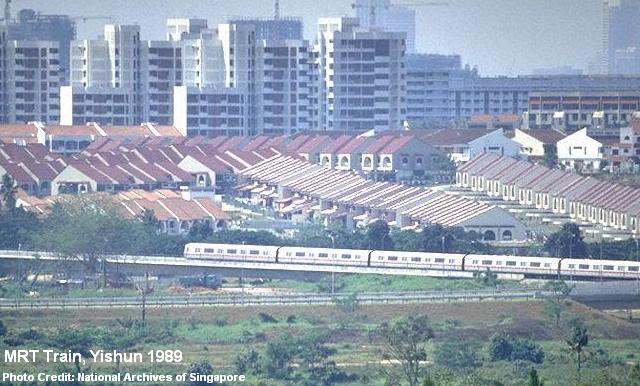
mrt train at yishun 1989

A Disneyland at Lentor

The section between the stations of Yio Chu Kang and Khatib has the longest tracks among all train lines in Singapore. This led to speculations in the late nineties and early 2000s that a MRT station, possibly named Lentor, might be reserved for the construction of a Disneyland along Lentor Avenue, where there was a large piece of undeveloped forested land. The plan, however, did not materialise. Disney opened their theme park in Hong Kong (in 2005) instead.

Published: 23 July 2013

Updated: 24 September 2013

Posted in Historic | Tagged , , , , , , , , , , | 67 Comments

Last Breakfast at Tong Ah Kopitiam

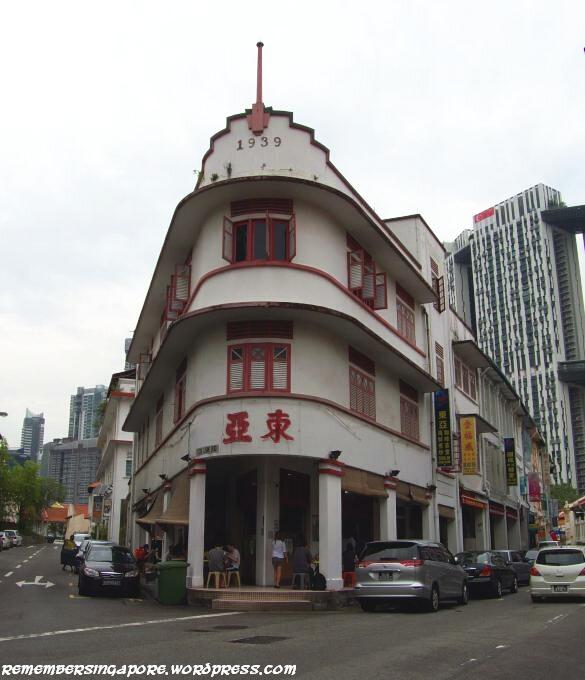
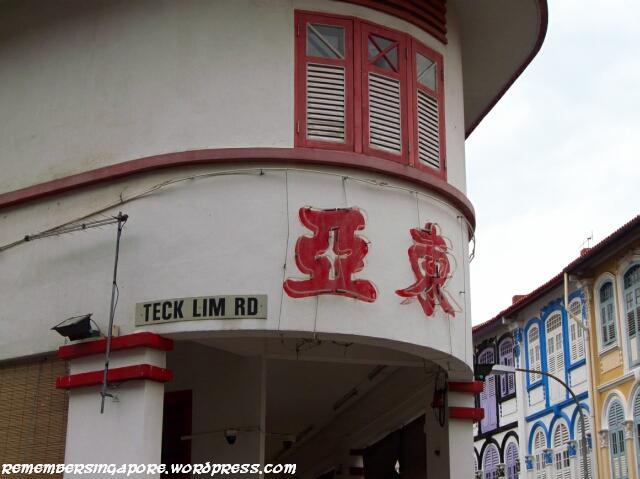
It was a cooling Sunday morning, but I decided to wake up a little earlier to make a trip down to Tong Ah Eating House. It was the last day of operation for the 74-year-old iconic kopitiam located at the junction of Keong Saik Road and Teck Lim Road.

tong ah kopitiam

There was already a long queue of customers at the kopitiam, many of them regulars who wanted to salvage a last piece of memory of their favourite breakfast joint. Others probably wished to capture another glimpse of the place, which could be turned into a boutique hotel soon. The eye-catching triangular shaped building was apparently bought by a foreign investor in hotels for $8 million.

The Tanjong Pagar area has been a hot spot for private investors in recent years. Traditional shopowners are being squeezed out of business by the surging rental fees and property prices. Tong Ah Eating House, for example, has to pay a reported $8,000 per month for its rental.

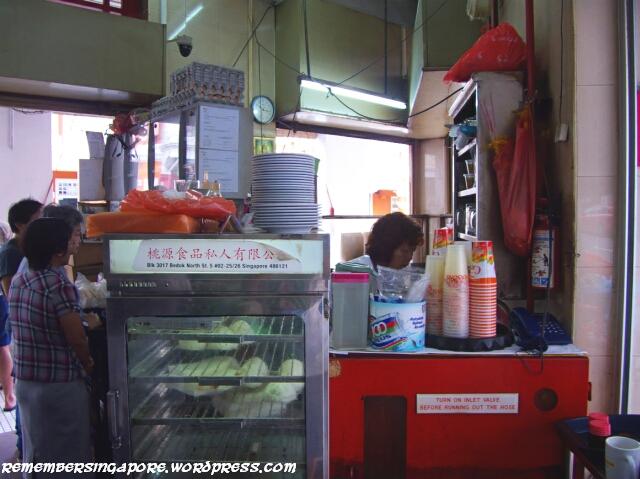
tong ah kopitiam2

tong ah kopitiam3

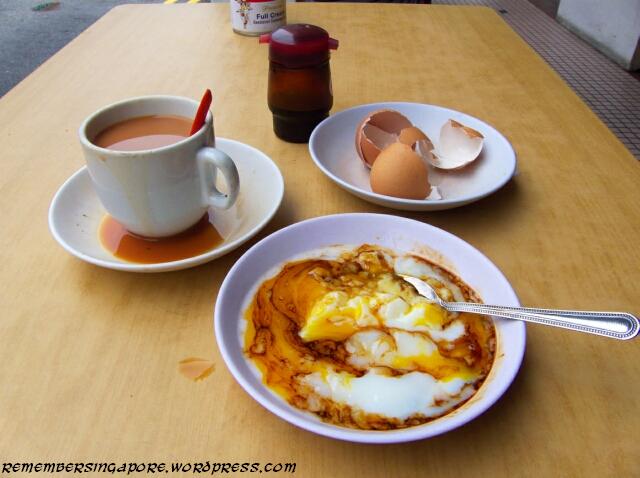
The number 1939 listed at the top of the facade of the building stated the year of its construction. It was also the same year Tong Ah Eating House was established by the great-grandfather of Tang Chew Fue, who took over from his father in 1999. Now, after four generations of family business, the 50-year-old owner had no choice but to bid farewell to a place filled with memories. The faithful customers could no longer enjoy a laid-back meal, or simply a cup of kopi, at the familiar five foot way.

tong ah kopitiam4

For seven decades, the kopitiam had survived the Second World War and endured the triad-infested streets and red-light district of the sixties. But even so, it could not defeat the rising rental cost and flexing financial muscle of the big players. Other traditional kopitiams are facing the same challenges too, such as the 70-year-old Hua Bee coffee shop at Tiong Bahru and North Bridge Road’s Heap Seng Leong.

The only positive thing is that Tong Ah Eating House will be shifted to a nearby location at a refurbished shophouse along Keong Saik Road, but that old charming feel of the kopitiam will probably never be the same again.

tong ah kopitiam5

Published: 14 July 2013

Posted in Nostalgic | Tagged , , , , | 10 Comments

Haze – A Burning Issue For Four Decades

singapore haze 2013-4

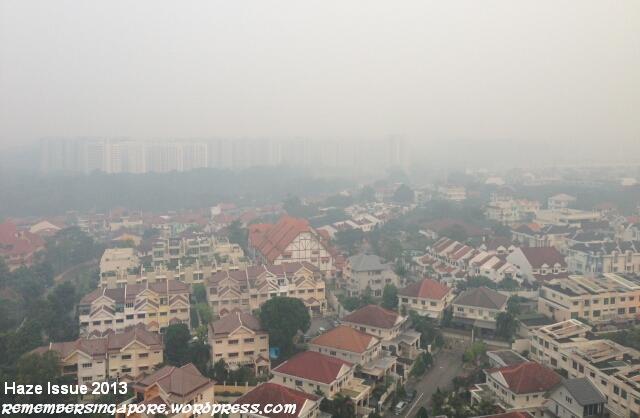
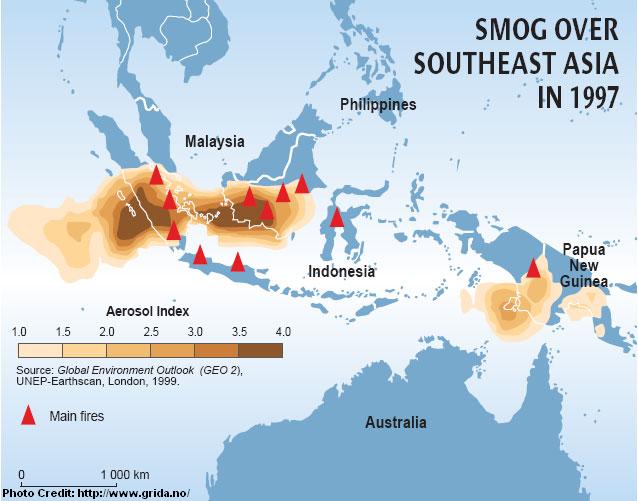
Singapore is fortunate to be freed of most natural disasters, but we are not spared of occasional floods and haze. The records at the National Archives and Newspaper Archives of Singapore show that the haze issue has been affecting Singapore and Malaysia for the past four decades. Most were due to the massive burning of forests at Kalimantan and Sumatra.

Here are some of the reports:

1972

In October 1972, Singapore and West Malaysia were covered by thick haze after days of burning of extensive forests and grass lands around Palembang, Indonesia. The worst day happened on the 14th October, when practically every part of Singapore was fog-bound. Motorists had to switch on their full headlights at Orchard Road and Nicoll Highway.

1975

A reddish haze hanged over the eastern and southern parts of Singapore due to the jungle clearing works at Johor Bahru and Kota Tinggi.

singapore haze 1977

1977

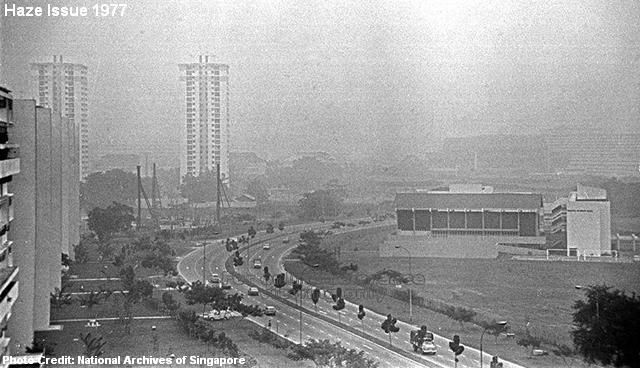
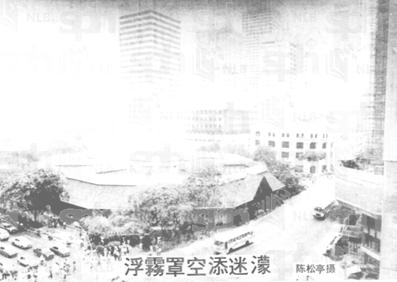
By October 1977, the smokes from the raging forest fires at Sumatra had covered much of Singapore and the western and southern parts of Peninsula Malaysia. Reported to be 366m high, the thick haze caused visibility to be so low that towering skyscrapers could hardly be seen from short distances.

1979

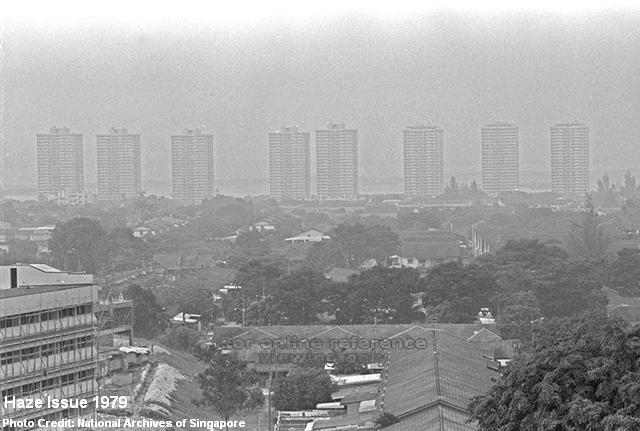
In May 1979, a combination of mist and haze covered almost three-quarter of Singapore, reducing the visibility to less than 2km. In Bedok, neighbouring blocks of HDB flats 400m away were barely visible. The source of the haze was undetermined.

singapore haze 1979

1982

Many complained eye irritation after the Anti-Pollution Unit of the Prime Minister’s Office detected 300 micrograms of fine suspended particles in the atmosphere, the highest level since there were records. The haze was reported to be originated from forest fires.

singapore haze 19831983

Thousands of hectares of forests at East Kalimantan were burned since March 1983, causing a blanket of smoke over Singapore, Malaysia and Sarawak. Visibility was down to 1km. Fortunately, an occurrence of widespread rain helped to lighten the hazy condition.

1987

Days of smoky haze bothered Singaporeans in September 1987 as a result of dry weather and forest fires at Indonesia. Visibility rapidly dropped from 10-20km to 2-3km.

1991

The 73-storey Westin Stamford, the world’s tallest hotel then, and other buildings at Raffles City were barely visible from the Fort Road flyover of the East Coast Parkway in October 1991, covered by the haze caused by the raging fires in Indonesia.

1994

The thick smoke from the fires, engulfing forests and plantation areas at Jambi and South Sumatra, were blown by strong winds to Singapore in September 1994. The runway lights at the Changi airport had to be switched on during the day to help pilots land safely.

1995

ASEAN ministers (of environment) gathered at Kuala Lumpur to discuss the management of haze and other forms of transboundary pollution.

southeast asia haze 1997

1997

The worst haze issue hit Singapore and Malaysia in September 1997, with the local 3-hour PSI (Pollutant Standards Index) level recorded at the peak of 226 (on 18th September). Known as the 1997 Southeast Asian Haze, it was caused by massive forest fires at Kalimantan and Sumatra. Singapore suffered USD300 million in losses, due to health cost, slowdown in tourism and numerous flight disruptions. Malaysia declared a state of emergency in Sarawak after their pollutant level exceeded the 500-mark. Total regional loss amounted to a hefty USD9 billion.

1998

ASEAN officials met at Manila, seeking ways to deal with future forest fires and the haze that enveloped large parts of the region in the previous year.

1999

Singapore provided more than $600,000 worth of forest-fire and haze-monitoring equipment to Indonesia. The Indonesian enforcement authorities were also alerted of hot spots detected by the satellite. Indonesia also passed a law to ban open burnings. The haze condition in 1999 was lightened by the rainy season.

singapore haze 2005

2000-2005

The strong winds sent the smoke of the burnings at Borneo and Sumatra to Singapore, Peninsula Malaysia and southern Thailand. In October 2002, the PSI recorded 79. The economic losses for Singapore was estimated to be USD50 million. By January 2003, all member nations of ASEAN, except Indonesia, had agreed to sign the environmental treaty in a bid to control the recurring haze issue.

Singapore experienced a PSI of 95 in March 2005, but was spared when a worse haze situation hit Peninsula Malaysia later that year. With the pollutant index shot up to 424, Port Klang was declared an emergency state. Selangor followed suit soon after that. Hundreds of flights were suspended, and schools were shut down.

2006-2013

The region practically experienced haze problem every year after the millennium. Singapore experienced its worst ever haze crisis in June 2013, when the PSI level rose to an unprecedented 321 on the 19th June, before hitting an all-time high of 401 two days later.

Previously, the highest record in the new millennium was 150 in 2006 (on 7th October). In that year alone, the regional losses in economic, social and environmental aspects amounted to be approximately USD50 million.

singapore haze 2013

singapore haze 2013-3

Published: 19 June 2013

Updated: 08 July 2013

Posted in General | Tagged , , | 15 Comments

10 Common Misconceptions of the Names of Places in Singapore

Is Ang Mo Kio “ang mo kio” (tomato)? Or is Holland Village named after the Dutch community in Singapore? Are there any links between the new Chong Pang estate and the old Chong Pang Village? Let’s find out more…

1. Ang Mo Kio

Tomatoes are called “ang mo kio” (Caucasian’s brinjal) in Hokkien, which probably led to the misconception that the name of Ang Mo Kio New Town was named after the fruit. However, no tomato farms were ever recorded growing in the old Ang Mo Kio vicinity.

tomato sculpture at ang mo kio

A more likely explanation of the name Ang Mo Kio was the bridge purportedly built by the British Government Surveyor John Turnbull Thomson (1821–1884), where the locals referred it as the “Caucasian’s bridge”. It was also said that there was not one but a total of nine bridges built along Thomson and Upper Thomson Roads, starting from the “red bridge” at Cavenagh Road  and ending at the junction of Upper Thomson Road and Ang Mo Kio Avenue 1.

But for the time being, the tomato sculptures near the Ang Mo Kio Town Centre shall stay on.

2. Holland Road & Holland Village

Holland Village has one of the most common misnomers in Singapore, mistakenly thought to be named after the Low Country of Europe. Started off as a humble plantation village located at the junction of Holland Road and Buona Vista Road, the name Holland Village was proposed by the Singapore Rural Board in 1929.

Holland Road, on the other hand, has been in existence since the late 19th century, and was reportedly named after Hugh Holland, an early resident, architect and amateur actor in Singapore in the early 1900s. There was, however, limited information of Hugh Holland.

Holland Village gradually became a vibrant private residential estate for the Europeans since the fifties, and remained so until the British military withdrew from Singapore in the early seventies. More arterial roads of Holland namesake (Holland Drive, Holland Avenue, Holland Close) were added in 1972, paving way for the construction of the first batch of public housing flats in the vicinity.

holland village

Another interesting trivia is that the local Chinese used to associate the name Holland with some of the day-to-day stuff, such as soft drinks (荷兰水, “hor lan zhui“, Holland water) and peas (荷兰豆, “hor lan dao“, Holland beans). This may be derived from the facts that they were imported from Holland (or by the Dutch East India Company in the past). There is also a crude Hokkien phrase “dua ker hor lan” (弹去荷兰), which literally means “being sprung to Holland” but it refers to sabotage instead. The origin of the phrase is unknown today, though there are some sayings that “hor lan” refers to the genitals of a tiger instead of Holland!

3. Tampines

The pronunciation of the name Tampines may sound embarrassing to some, but it has really nothing to do with the male reproductive organ.

Tampines was originally named after a highly-valued timber tree tempinis, or “strebulus elongata“, once abundant in this area. In the early days, however, there were several variations of the name appearing in maps and newspapers, such as Tampinis, Tempines, Tampenis and Tampenes. The name tampenis, in particular, was commonly used in Kedah as a reference to the tree.

In 1939, after consulting the Malay Union in an effort to standardize the spelling, the Singapore Rural Board began erecting new street signs bearing the name Tampines. Tampenis Road, the oldest road in the vicinity built in 1864, therefore became officially known as Tampines Road. There were concerns, though, that the new name might be confusing to the newly arrived Europeans, who might pronounce the name as “tam-pynes” and mistakenly linked the history of the vicinity to pine trees instead of tempinis tree.

tampines 1980s

Although the spelling had changed, the pronunciation of the name remained the same. Tampenis was also casually used in books and newspapers until the early eighties, when the construction of Tampines New Town started. Perhaps by then people realised the old name was not very appropriate for the new upcoming housing estate.

Interesting Trivia: Due to the non-standardisation of street names in the 19th century, it was not uncommon to have two different streets bearing the same name. There was, in fact, another Tampenis Road located between present-day Robertson Quay and River Valley Road. In 1907, local rubber tycoon Tan Chay Yan (1871-1916) made a request to the Municipal Commissioners to rename the street as Teck Guan Street, in honour of his father Tan Teck Guan who once owned the land in the area. Teck Guan Street later became home of the Singapore Cold Storage complex before it was expunged in the late nineties.

4. Hong Kah

The residential district of Hong Kah used to cover the region between part of Bukit Batok and Jurong West. Today, the name refers to a small housing estate after its vicinity was splitted up and renamed respectively as Jurong Green, Nanyang and Gek Poh Ville.

The Chinese name of Hong Kah has been interpreted as 丰加 (or 丰嘉). It literally means “abundance and bountiful (or praises)”, an auspicious description of the new town established in the eighties. However, the actual origin of the name Hong Kah was derived from 奉教 (“to serve the religion”), the Teochew term for Christianity.

Established in 1876, the St. John Church at Jurong Road had been preaching to the Chinese farmers in the vicinity for decades. Most of the families were Teochews and Hokkiens, with a minority being Hakkas and Cantonese. By the late forties, the kampongs became collectively known as “Hong Kah Choon” (“Christian Village” in Teochew).

old jurong road and hong kah village 1986

A series of minor roads existed between the sixties and eighties bore the name Hong Kah. Mostly muddy trails without street lamps, Hong Kah Road, Hong Kah Drive, Hong Kah Lane and Hong Kah Circus were located off the main Jurong Road, which was the first road in Jurong built as early as the mid-1800s.

Due to the development of Jurong New Town in the early eighties, Hong Kah Village was later demolished, with many of its former residents resettled at the new flats at Jurong West. The name Hong Kah was retained but its Chinese characters were modified, probably in a bid to remove the religious context.

5. Lavender Street

As mentioned in the previous article, the Lavender Street has a misnomer name as it was not a place of pleasant smell in the old days. It was, in fact, filled with foul smells of night soil, urine and fertilizers used for the plantations in the vicinity. To make things worse, the pungent odour of gases produced by the nearby Kallang Gasworks could also be detected.

lavender street old building

Another misconception of Lavender Street was its colloquial name “mang kah kar“. Similar in its Hokkien pronunciation, it could mean “foot of the jackfruit [tree]” or “mosquitoes bite leg”. Although mosquitoes were abundant in the plantations, it was widely accepted that “mang kah kar” actually referred Lavender Street as a road located at “the end of the jackfruit plantations”.

6. Jalan Kayu

We often hear screams of “referee kayu!” during local football matches, whenever the referee puts in a poor performance, commits perceived errors or makes some decisions that are unflavourable to the fans’ team.

The word kayu refers to wood in Malay, thus the popular football phrase can be interpreted as “referee you blockhead!”. Some, though, argue that kayu was derived from the Chinese word “jiayou” (加油), which means “buck up!” or “put in more efforts!”. That can be considered an encouragement offered to the poor verbally-abused man in black.

jalan kayu

Jalan Kayu, on the other hand, has no links to petrol or referees. It was built in the 1930s by the Royal Air Force (RAF) as a link to the newly completed Seletar Airbase. When the airbase’s chief designer and engineer C.E.O. Wood returned to London with glory in 1937, RAF made a proposal to the Singapore Rural Board for the road to be named after him.

7. ABC Market

Built in 1974, the popular ABC Market (its full name is ABC Brickworks Market and Food Centre) along Jalan Bukit Merah was not randomly named, nor was it named after some nursery rhymes. It has also nothing to do with the now-defunct Alexandra Brickworks Company.

The market was actually named after Archipelago Brewery Company, the first commercial brewery in Singapore, established by a group of German investors in 1931. The factory was located at where Anchorpoint is standing right now, at the junction of Jalan Bukit Merah and Queensway. During its peak between 1930s and 1960s, its star product Anchor Beer was one of the favourite alcoholic drinks in Singapore.

archipelago brewer company 1960s

Archipelago Brewery Company was seized by the British government in 1941, at the onset of the Second World War, with its assets taken over by Fraser and Neave (F&N). The German brewery, however, was soon captured by the Japanese Army during the occupation for their own production of Japanese beer.

8. Chong Pang

Although Chong Pang Garden, a residential district within Yishun New Town, shares the same name with the vanished Chong Pang Village, both have little in common in their histories.

In recognition to his contributions in the public service, the former Chong Pang Village was named after Lim Chong Pang (1904-1956), the second son of prominent Teochew rubber magnate and “pineapple king” Lim Nee Soon (1879-1936). In the 1930s, Lim Chong Pang, as a member of the Singapore Rural Board (1929-1938), built a village at a rubber estate near the 12th milestone of Sembawang Road. Originally known as Westhill Estate, it was then renamed as Chong Pang Village in 1956 upon his death. There was also a Chong Pang Road (originally Westhill Road), branching off Sembawang Road and linking to Sultan Theatre, one of the many cinemas in Singapore set up by Lim Chong Pang.

chong pang village 1980s

chong pang road 1980s

The bustling Chong Pang Village was demolished in March 1989, becoming part of Sembawang New Town, although its exact location is still an undeveloped piece of forested land today. Chong Pang Garden, on the other hand, was built in 1981 between Sembawang Road and Yishun Avenue 2, approximately 1.2km away from the village.

Chong Pang Road was expunged when Chong Pang Village was torn down. Ironically, Chong Kuo Road, located some 5km away, managed to survive till this day. The road was named after Lim Nee Soon’s eldest son Lim Chong Kuo (1902-1938) in 1955.

9. Newton Road & Newton Circus

For every action there is always an equal and opposite reaction

The famous Newton’s third law of motion has been taught in Singapore’s secondary school science classes for decades. The name Issac Newton (1642-1727) is so well-known in Singapore that people tends to associate the English physicist and mathematician with Newton Circus, Newton Road and the Newton vicinity located in the central part of the country.

newton circus 1977

Newton Circus and Newton Road, however, were named after Howard Newton (1852-1897), a capable British engineer who arrived at Singapore in his early twenties. Howard Newton spent twenty years as the Deputy Executive Engineer in the Water Department of the Singapore Municipality, working hand in hand with James MacRitchie (1848-1895) to improve the waterworks of Singapore.

When MacRitchie (the MacRitchie Reservoir was named after him in 1922) passed away in 1895, Newton was expected to take over his position as the chief Municipal Engineer. The Municipal Commissioners unexpectedly appointed S. Tomlinson from Bombay of British India instead, while the vacated post of the Executive Engineer of Waterworks of Bombay Municipality was given to Newton.

It turned out to be a misfortune for Howard Newton, as he died of cholera shortly after taking up his new position in India. In 1914, Syed Ali Road was renamed as Newton Road as a tribute to him.

10. Orchard Road

Orchard Road, the bustling famous shopping belt of Singapore, underwent many major transformation since it started as a simple lane in the early 19th century. Nutmeg plantations first flourished at the hillocks by the road, before pepper farms and fruit tree orchards took over. It was not until the collapse of nutmeg prices in the mid-19th century before private residences and bungalows appeared around Orchard, Scotts and Tanglin Roads. A portion of the lands near Orchard Road was also acquired by Ngee Ann Kongsi as their Teochew private cemetery.

Shophouses began to dot along Orchard Road during the 1890s. The popular Orchard Road Market and Singapore Cold Storage, opened in 1891 and 1905 respectively, brought crowds to the vicinity. The definition of Orchard Road as a shopping haven was finally established in the late 1950s when C.K. Tang opened their flagship departmental store.

It has been widely accepted that Orchard Road was named after the fruit orchards in the 19th century. However, the prominent existence of nutmeg, gambier and pepper plantations led to suggestions that the road was actually named after a certain Mr Orchard, who supposedly owned some of the plantations in the vicinity. It might be a similar case to the streets near Orchard Road, where Scotts Road, Cuppage Road and Koek Road were named after major plantation owners William G. Scotts (1786-1861), William Cuppage (1807-1872) and Edwin Koek (unknown-1891) respectively.

However, little is known of the plantation owner. Even his existence is debatable. That will be left to the historians to verify.

Published: 16 June 2013

Updated: 09 July 2018

Posted in Cultural | Tagged , , , , , , , , , , | 20 Comments

Compassvale Ancilla and Mang Kah Kar

Recently, there was a rather amusing news regarding the chim (profound) names of the new housing estates at Sengkang and Punggol.

Some joke that the job of a taxi driver will get tougher next time with the latest Build-To-Order (BTO) flats given fanciful names like Matilda Portico(柱廊), Ancilla(女随从), Nautilus(鹦鹉螺), Periwinkle(长春花), Edgedale Green, Waterway Sunbeam, Spectra(光谱) and The Coris (红喉盔鱼).

Most public housing estates in Singapore are easily recognisable by their block numbers or street names, such as Ang Mo Kio Street 43 or Bedok South Avenue 3, but the “branding” of HDB housing estates is not something new. Kim Keat Court was the first such “branding” in 1995, although its name may sound ordinary by today’s standard.

The Colloquial Names

Beside the official names, there used to have an alternate type of naming of streets, places or landmarks that proved to be popular among locals. Call them variant, common or colloquial names, these vividly descriptive names were simple, easy to remember and largely reflect the history of certain places. Ask any older generation of Singaporeans, and they are likely to be able to pinpoint you the exact locations of “mang kah kar“, “orh kio tau” or “pek sua pu“.

The early Chinese immigrants, mostly from South China, could not really comprehend the English names of the streets named by the British, such as Phillip Street and Waterloo Street, so they took matters into their own hands and named the roads in their familiar Hokkien, Teochew and Cantonese dialects. Many were named after the notable landmarks in the vicinities where the streets ran through, such as temples, markets, trading houses or even a rich or famous man’s residence.

Others were named after bridges, cemeteries, hills or just simply numbers. Today, many locals still fondly call the seven parallel roads near City Hall “first (main) road” to “seventh road”.  Waterloo Street, known as “si beh lor” (四马路, fourth road) is arguably the most famous of all, due to the popularity of the Kwan Im Thong Hood Cho Temple.

City Hall vicinity

The vicinity around present-day City Hall, bounded by Crawford Street, Jalan Besar, Fort Canning and the Singapore River, was generally known as “sio po” (小坡, little downtown) in the past, where a large number of its streets had colourful colloquial names.

common names city hall-1 v5

In the sixties, the Ellenborough Market (1845-1968) and Clyde Terrace Market (1872-1983) were the two largest public markets in Singapore, situated at opposite sides of the Singapore River. Standing at the junction of Beach Road and Rochor Road, the Clyde Terrace Market was nicknamed “ti ba sat” (铁巴刹, iron market) due to its iron framework. Rochor Road, therefore, became better known as “market lane” in Hokkien, even after the market was demolished in the eighties.

dok lee kio” (独立桥, independence bridge) actually refers to the Merdeka Bridge, opened in 1956 together with Nicoll Highway, linking the city to Kallang, Geylang and Mountbatten over the Kallang Basin. Over the years, the variant name became the reference for Nicoll Highway instead.

merdeka bridge

The vicinity around Istana Kampong Glam was a historic district once belonged to the Malay royalty of Singapore. Sultan Gate, the road leading the former palace, was well-known for its iron-smiths; some of them still plying their trades today. Hence, Sultan Gate was given a range of variant names such as “pah ti koi” (打铁街, iron-smith street), “ong hoo kau” (王府口, mouth [front] of palace) and “tua che kar” (大井脚, foot of big well), referring to an old well at the middle of the road.

rochor canal and new singapore ice works ltd 1970s

Famous for its flea market and charcoal-cooked laksa, Sungei Road is better known as “gek sng kio” (结霜桥, frosted bridge). The name was derived from the establishment of the Singapore Ice Works, the major ice supplier in Singapore, at the junction of Sungei Road and Pitt Street in the 1930s. The factory, however, was shut down in the early eighties with its site taken over by HDB.

common names city hall-2 v4In the 19th century, Tan Seng Poh 陈成保 (1830-1879), a wealthy Teochew opium farm owner as well as a municipal commissioner and Justice of Peace, built a large mansion at Loke Yew Street near Fort Canning. The house was so prominent that the local Chinese named the adjacent Armenian Street as “seng poh sin chu au” (成保新厝后, at the back of Seng Poh’s new house).

Trading houses and godowns (warehouses at the dockside) used to line up on both sides of the busy Singapore River filled with many old traditional wooden boats called sampans (舢板), tongkangs (舯舡) and twakows (大[舟古]). These provided inspirations to the variant names of the roads beside the waterway. High Street was known as “tua kow koi” (大[舟古]街, twakow street) while Clarke Quay and Boat Quay are called “cha zhun tau” (柴船头, front of wooden boat) and “zhap buay keng” (十八间, eighteen [trading] houses) respectively.

Raffles Place vicinity

The streets in the modern Central Business District (CBD), filled with skyscrapers, office towers and banks, are a far cry from their appearances in the old days. During the 19th and early 20th century, the southern part of the Singapore River, known as “tua po” (大坡, large downtown) was a place mixed with legitimate businesses and illegal activities. Old dingy shophouses lined up along the cramped streets, housing the street hawkers, coolies, Samsui women, secret society members and prostitutes.

common names raffles place v5

One notoriously famous road within the vicinity was China Street. Better known as “giao keng kau” (赌间口, mouth [front] of gambling den), it was then filled with gambling dens and secret societies. One particular Hokkien secret society Ghee Hin Gongsi (义兴公司) was so powerful and influential that the local Chinese also called China Street “ghee hin koi” (义兴街, Ghee Hin street).

Other colloquial names that were named after secret societies were the Upper Nankin Street, Upper Cross Street and Carpenter Street. The former two were coined “seong pek koi” (松柏街, Seong Pek street) and “hoi san koi” (海山街, Hoi San street), named after Siong Pek Kwan (松柏馆), or Siong Pek Gongsi, and Hoi San (海山), two large Hakka secret societies that functioned as the oversea branches of Tiandihui (Heaven and Earth Society) in Qing China. Carpenter Street was known as “ghee hock hang” (义福巷, Ghee Hock lane), where Hokkien triad Ghee Hock Gongsi (义福公司) ruled their territories.

The gambling and unlawful activities were eventually eliminated in the late 1930s by the British government.

china street and ocbc centre 1982

tau hu koi” (豆腐街, tofu street), made famous by the local Chinese drama of the same namesake in 1996, was the colloquial name for Chin Chew and Upper Chin Chew Streets, where there were many beancurd makers and sellers in the late 19th century. The beancurd trade, however, disappeared by the early 20th century. The streets then became known as “orh sa koi” (黑衣街, black shirt street), referring to the red headgear and dark shirts donned by the Samsui women who led a tough life living in the tiny cramped cubicles of the old shophouses.

Affected by the constructi0n of Hong Lim Complex, Upper Chin Chew Street was expunged in the late seventies.

lau pa sat telok ayer market

Telok Ayer Market, the trademark orthogonal-shaped market at the junction of Raffles Quay and Cross Street, had a long significant history dating back to 1822. Despite its conservation as a national monument in 1973, it had to be dismantled in the mid-eighties due to the construction of the Mass Rapid Transit (MRT) tunnels at Raffles Place. In 1989, the market’s signature iron-frames were reassembled in a $6.8 million renovation, and was renamed as “Lau Pa Sat” (老巴刹, old market), a name that had been used by the locals for decades.

collyer quay 1968

In the 1860s, land reclamation and the construction of a seawall were carried out at the mouth of the Singapore River. A road named Collyer Quay was completed in 1864, and offices, godowns and trading houses started to emerge at the new street. At Johnston’s Pier, red beacon lights were installed, which later led to the local Chinese’s naming of Collyer Quay as “ang teng beh tau” (红灯码头, red light pier). The famous Change Alley and Arcade also became known as “tor kho hang” (土库巷, godown lane).

Some streets at “tua po” were derived from the Chinese temples situated. One of them is Magazine Road’s Tan Si Chong Su Temple (陈氏宗祠), built in 1876 as an ancestral hall for the Tan clan in Singapore and a temple for Chen Yuan Guang (陈元光), a famous Tang Dynasty general worshipped at Taiwan and Southeast Asia. Over time, the deity’s honorary title “tan seng wang” (陈圣王) became the colloquial name for Magazine Road.

Another example is Phillip Street, commonly known as “lao ya keng” (老爷宫, deity palace). It refers to Yueh Hai Ching Temple (粤海清庙), Singapore’s oldest Taoist temple built in 1826.

Chinatown/Tanjong Pagar vicinity

gu chia zhui” (牛车水, buffalo cart water) is possibly Singapore’s most well-known colloquial name, so famous that the Chinese name of Singapore’s Chinatown had taken reference to it instead of the usual “Tang Street” (唐人街).

The colloquial name, however, refers to the bullock carts that delivered the fresh water between Ann Siang Hill and Telok Ayer Bay for consumption and cleaning of the streets. “gu chia zhui” is not limited to Kreta Ayer Road only; it refers to the vicinity that generally covers between Mosque Street and Neil Road.

common names chinatown v4

Eu Tong Sen Street, the main road to Chinatown, was nicknamed “nam tin cheng” (南天前, front of Southern Sky), referring to the Great Southern Hotel that once stood at the junction of Eu Tong Sen and Upper Cross Streets. Completed in 1936, it was the tallest skyscraper in Chinatown and was the first Chinese hotel to have a lift. Today, the hotel no longer existed; its conserved building has been converted into a departmental store called Yue Hwa.

great southern hotel 1980s

Lai Chun Yuen Theatre (1887-1942) was a famous Cantonese opera theatre located at Smith Street before the Second World War. It was so popular that the locals named Smith street as “hee hng koi” (戏院街, theatre street). Its widespread fame also ensured the theatre was taken as the main reference for the nearby Temple Street and Trengganu Street, which were simply called “hee hng au” (戏院后, back of theatre) and “hee hng hang koi” (戏院横街, street adjacent to theatre) respectively.

sago lane late 1970s

It once housed many sago flour factories and, later, brothels before the early 20th century, but Sago Lane was more famous for its death houses that lined up the street until their ban in 1961. Its variant name “sei yang koi” (死人巷, lane of the death) vividly described the dreadful scene back then, where many old and sick folks were left to live out the remaining of their days.

By the mid-seventies, part of Sago Lane was expunged for the construction of the Kreta Ayer Complex and HDB flats. Some of the former funeral paraphernalia shops at Sago Lane were moved to the adjacent Banda Street.

tanjong pagar plaza late 1970s

Cheng Cheok Street, also known as “gu kar wan” (牛角湾, bull horn bay), was formerly an important crossroad at Tangjong Pagar. Its colloquial name referred to the goods-carrying bullock carts that plied their routes between the Singapore River and the wharves. The road was later expunged in an urban redevelopment project, replaced by Tanjong Pagar Plaza and its flats in the mid-seventies.

Tiong Bahru vicinity

There were many familiar colloquial names around the old estates between Bukit Merah and Tiong Bahru. The terms “ho zhui sua“, “orh kio tau“and “si bai po” easily ring a bell with many Singaporeans.

common names tiong bahru redhill alexandra v2

One of the first Indians to arrive at Singapore in the early 19th century, the sepoys, hired by the British East India Company, were initially accommodated in the barracks near Outram Road. The military site later became known as “si bai po” (四排坡, sepoy plain), a phonetic interpretation of the name Sepoy Lines. After the Singapore General Hospital (SGH) was established at Sepoy Lines in 1882, it became associated with the colloquial name instead.

Some elderly Singaporean Chinese today still harbour subconscious fear of “si bai po“, due to the word “si” which also means dead in the Hokkien and Teochew dialects, even though the colloquial name has nothing to do with death.

singapore general hospital 1985

One end of Havelock Road, near Beo Crescent, used to be known as “orh kio tau” (乌桥头, head [start] of black bridge). It belonged to one group of past colloquial names that referenced after bridges. Other than Havelock and Sungei Roads, there were “orh kio” (乌桥, black bridge), “pek kio” (白桥, white bridge) and “gao tiao kio” (九条桥, nine bridges), referring to Balestier, Moulmein and Upper Thomson Roads respectively.

Queenstown vicinity

When HDB high-rise flats were built at the early housing districts such as Queenstown, Tanglin Halt, Strathmore, Dawson and Commonwealth, many were confused by their official English names. An easy way to remember the different locations was to nickname the estates according to the height of their flats.

tanglin halt zhap lau

Hence, Tanglin Halt was coined “zhap lau” (十楼, ten storeys). The former iconic Forfar House at Strathmore Avenue was popularly known as “zhap si lau” (十四楼, fourteen storeys), while “zhap lark lau” (十六楼, sixteen storeys) generally referred to the area around Commonwealth Close, Commonwealth Lane and Commonwealth Crescent.

common names queenstown v2

Other “shorter” versions included “gor lau” (五楼, five storeys), “qek lau” (七楼, seven storeys) and “gao lau” (九楼, nine storeys), referring to the SIT (Singapore Improvement Trust) flats at Tiong Bahru, Redhill Close and St Michael’s respectively.

As more HDB flats were built in other parts of Singapore, the conventional naming became impracticable, and probably discontinued due to confusion.

Kallang/Serangoon vicinity

For many years, the iconic blue cylindrical tower and its incinerator chimneys at Kallang was well-known as “huey sia” (火城, fire city), a colloquial name derived from the nearby residents’ phobia that the facilities would explode. Fortunately, the fear of a fire disaster was never realised, as Kallang Gasworks produced an amazing 137 years of continuous supply of gas until its closure in 1998.

kallang gasworks 1990s

mang kah kar“, the colloquial name of Lavender Street, has been the subject of debate for years. Was it the Hokkien translation of 芒胶脚 (foot [end] of jackfruit) or 蚊咬脚 (mosquitoes bite leg)?

Apparently, there were many jackfruit plantations near the junction of Lavender Street and Serangoon Road in the old days. Jackfruit was called nangka in Malay, but the local Chinese somehow mistranslated it into mangka. Hence, the street was coined “mang kah kar“, meaning the end of a jackfruit plantation. It had nothing to do with mosquitoes although the pesky insects were abundant in the plantations. An interesting trivia of Lavender Street was that its official name “lavender” was originally, and ironically, referring to the foul smells of night soil and fertilisers used for the plantations.

kim jio kar” (金蕉脚, foot end] of banana) was another colourful colloquial name in the vicinity, but it was unknown whether there were large banana plantations at Petain Road in the past. It is, however, more famous as a red-light district today.

common names serangoon kallang v2

Largely known as “Little India” today, the Serangoon Road had a rather romantic name: “nam seng heu hng pi” (南生花园边, side of Nam Seng garden), which referred to the Whampoa’s Gardens, a Chinese garden beside the grand mansion built by Hoo Ah Kay (1816–1880), one of the wealthiest men in Singapore during his time.

Jalan Besar, on the other hand, was known as “kam gong ka por tai ter long” (甘榜加卜宰猪厂, Kampong Kapor pig slaughterhouse), due to the numerous pig abattoirs, situated between Desker and Rowell Roads, in the old days.

Upper Serangoon vicinity

When the colonial-flavoured estate of Serangoon Gardens was built in the fifties, the eye-catching red roofs of the early batches of houses led to its colloquial naming of “ang sar lee” (红砂厘, red zinc). The name is still commonly mentioned by the older residents today, outlasting its lesser known cousins of “zhap ji cheng” (十二千, twelve thousands) and “zhap si cheng” (十四千, fourteen thousands), both referring to the prices of the houses in the vicinity during the sixties and seventies.

common names upper serangoon v1

Another local way of naming the places was using the milestone method, in which one milestone was approximately equivalent to 550m. The origin or “point zero” started from the Fullerton Building (previously General Post Office), and the milestones were measured with reference to “point zero” on the old long roads that extended to the rest of Singapore, such as Bukit Timah Road, Jurong Road, Punggol Road and Changi Road.

An example was the Upper Serangoon Road, where there were [ow gang] “si kok jio” ([后港]四條石, Hougang 4th milestone – near the junction of Upper Serangoon Road and Upper Aljunied Road), “gor kok jio” ([后港]五條石, Hougang 5th milestone – Lim Tua Tow Road) and “lark kok jio” ([后港]六條石, Hougang 6th milestone – Simon Road).

Other examples were:

Beauty World – Bukit Timah (Upper Bukit Timah Road) 7th milestone
Bukit Panjang – Bukit Timah (Upper Bukit Timah Road) 10th milestone
Cheng Hwa Village – Bukit Timah (Upper Bukit Timah Road) 11th milestone
Chong Pang (Old) Village – Sembawang (Road) 13½th milestone
Hun Yeang Village – Tampines (Road) 9th milestone
Jalan Ulu Sembawang Village – Sembawang (Road) 2nd milestone
Jurong Village – Jurong (Upper Jurong Road) 7th milestone

somapah changi village 1980s

Kampong Sungei Tengah – Choa Chu Kang (Road) 13th milestone
Kampong Teban – Tampines (Road) 7th milestone
Princess Elizabeth Estate – Bukit Timah (Upper Bukit Timah Road) 9th milestone
Sixth Avenue – Bukit Timah (Road) 6th milestone
Somapah VillageChangi (Upper Changi Road) 10th milestone
Teck Hock Village – Tampines (Road) 7½th milestone
Thong Hoe Village – Lim Chu Kang (Road) 13th milestone
Tua Pek Kong Kau – Yio Chu Kang (Road) 11th milestone
Tuas Village – Jurong (Upper Jurong Road) 18th milestone

Many of these names were associated with villages, and when these villages were demolished, the names also ceased to exist.

Elsewhere in Singapore

The colloquial names of places elsewhere in Singapore:

Arumugam Road (“gu cai ba“, 韭菜芭, farm of chives)
Bukit Brown (“kopi swa“, 咖啡山, coffee hill)
Chai Chee (“chai chee“, 菜市, vegetable market) – referring to the small markets selling fresh produce from the nearby farmlands.
Changi Village (“changi buay“, 樟宜尾, end of Changi)
Coleman Bridge (“tiao kio tau“, 吊桥头, head [start] of suspension bridge)
Dhoby Ghaut (“kok tai“, 国泰, Cathay) – referring to Cathay Cinema at Handy Road
Elgin Bridge (“ti tiao kio“, 铁条桥, iron bridge)
Java Street (“pah jio koi“, 打石街, mason street)
Kampong Silat (“gu kia swa“, 龟仔山, little tortoise hill)
Kandang Kerbau (KK) Hospital (“tek ka“, 竹脚, foot of bamboo)
Lorong Tai Seng (“dai seng hang“, 大成巷, Tai Seng lane)
Old Holland Road (“kek nang ba“, 客人芭, Hakka farm) – referring to the Hakka villages in the vicinity during the sixties and seventies
Ord Bridge (“tse kio“, 青桥, green bridge)
Rangoon Road (“gia dau hang“, 拿豆巷, aloe lane) – referring to the plantations of aloe in the vicinity in the old days
Seletar (“goon kang“, 军港, military port) – referring to the British Royal Air Force base and Seletar Airport
South Buona Vista Road (“gao zhap gao wan“, 九十九弯, 99 bends) – referring to the numerous bends of the road
Springleaf (“nee soon kang kar“, 义顺港脚, foot of Nee Soon port or “chia zhui kang” 淡水港, fresh water port) – referring to the flavourable deep waterways at Sungei Seletar
Telok Blangah Way (“sit lat mun“, 石叻门, Silat door)
Thomson Garden (“gor ba keng“, 五百间, five hundred houses), referring to the terrace houses in the vicinity

ow gang lark kok jio hokkien mee

By the eighties, new colloquial naming of places and landmarks almost came to a stop, probably due to the government’s efforts in discouraging dialects and promoting the usage of Mandarin and English.

Some of old names can still be found today though, particularly at the hawker centres or kopitiams where they are used by the food stalls as their signature branding. A few that come to mind are the “giao keng kau you zar kueh” (赌间口油条) at Maxwell Market, “ow gang lark kok jio hokkien mee” (后港六條石福建面) at Simon Road and “mang kah kar char kuay teow” (芒胶脚炒馃条) at Ang Mo Kio Avenue 10.

All maps credited to Google Maps

Published: 28 May 2013

Updated: 06 November 2016

Posted in General | Tagged , , , , , , , , , | 49 Comments

Once in Our Life, Two Years of Our Time

“Training to be soldiers
To fight for our land
Once in our life
Two years of our time

Have you ever wondered
Why must we serve?
Coz we love our land
And we want it to be free, to be free

Looking all around us
People everywhere
While they’re having fun
We are holding guns

Have you ever wondered
Why must we serve?
Coz we love our land
And we want it to be free, to be free

Stand up!
And be on your guard
Come on every soldier
Do your part
Do it for our nation
Do it for our Singapore”

After almost 18 years of active National Service (two-and-a-half years of full-time NS plus ten cycles of In-Camp Trainings), I finally received my precious MR (Mindef Reserve) certificate. Looking back, the unforgettable experiences were both fun and siong (tough). There were good and bad memories, as well as absolute nightmares in the confinements, devilish trainings and tekan by sadistic instructors. Memories of NS may be nostalgic to some, but most, if not all, will not want to go through it again.

NS life is a favourite chit chatting topic among male Singaporeans. Many like to reminisce their NS days, and compare whose units were the most siong. There are always countless tales to tell; from outfields and trainings to supernatural stuff.

Pre-Independence Period

The British colonial government first mooted the idea of national service in 1952. The bill, named the National Service Ordnance, was passed by the Legislative Council and was supposed to come into effect in 1954. The new law required the local men of ages between 18 and 20 to be called up for trainings at the Singapore Military Force (SMF) or the Civil Defence Corps (CDC). Those who failed to register would be fined or jailed.

However, most locals rejected the new law. Thousands of local Indians left Singapore, while the Chinese middle school students organised aggressive protests. In May 1954, the National Service Riots broke out. As many as 2,500 students locked themselves at Chung Cheng High School. Police marched in to quash the riots, but the colonial government eventually backed down and “postponed” the bill.
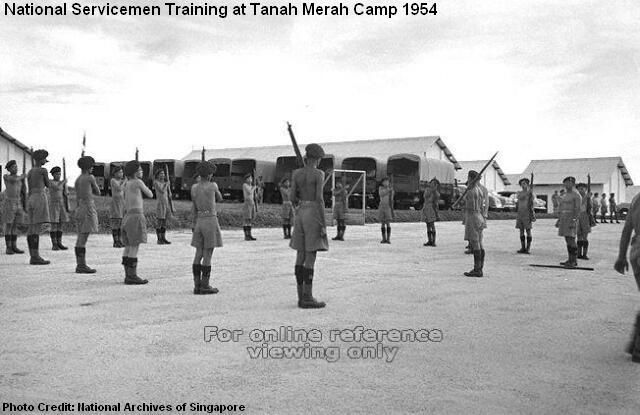
national servicemen training at tanah merah camp 1954

Even though the students successfully forced the authority to reverse their decision, dozens of them were injured and arrested in the riots. The Chinese middle schools, in the later years, even became a breeding ground for pro-communist elements.

Singapore’s First Battalion
1sir pioneers 1960sThe history of local military regulars has gone a long way back. In April 1955, Singapore was given its first Legislative Assembly Election, with David Marshall (1908-1995) served as the First Chief Minister of Singapore. When Lim Yew Hock took over the partial self-government a year later, his hardline approach against the communists persuaded the British to grant Singapore more autonomy.

As the complete self-rule of the country became imminent, there was a need for Singapore to have its own military defence. On 12 March 1957, a total of 237 men born in Singapore was selected from an application pool of 1,420 to form the First Singapore Infantry Regiment (1SIR). Trainings of the new recruits were first carried out at Nee Soon Camp, which was still under the ownership of the British Army and was used to train their own forces.
1sir battalion badges 1957-presentThe officers and men were later based at Ulu Pandan Camp, but it took six years before 1SIR reached its full battalion strength of over 800 men. The early roles of 1SIR was mainly to engage internal security and maintain civil order with the police.

During the merging with Malaysia and the Konfrontasi period against Indonesia (1963-1965), 1SIR was posted to Perak, Sabah and Johor for jungle trainings and defensive missions. The experienced battalion later produced many commanders to train the new enlistees when NS started in 1967.

Compulsory National Service

When Singapore attained independence in 1965, there was an urgency for the newly born nation to have its own defence force. Its two existing battalions of regulars were clearly insufficient, but any expansion of the army would cost a lot of money and put a strain on the economy.

Finance Minister Dr Goh Keng Swee (1918-2010) was appointed as the first Minister for Defence to work on the proposal in building up a sizable voluntary force to back up the regulars. However, when the British indicated their intention to reduce their forces in Malaysia and Singapore in 1966, the need for compulsory national conscription with reservist became the long term plan.
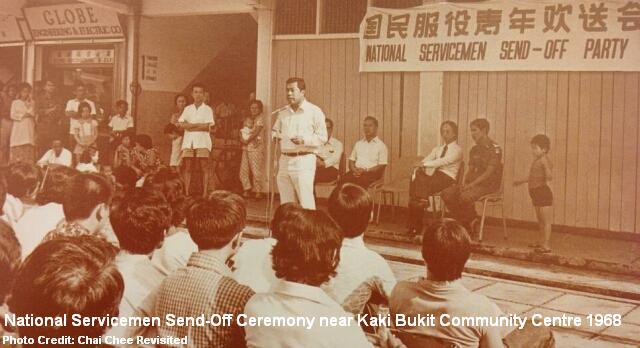
national servicemen send-off party near kaki bukit community centre 1968

At the beginning, Singapore’s military development and directions were not determined. Several international case studies were conducted, and Switzerland was one of the considerations, based on the success of its economy and citizen army. In the end, Israel was deemed as a more suitable model. A secret pact with Israel was reached, with Israeli advisors flew in to train the first batch of graduates from the Singapore Armed Forces Training Institute in June 1967.

In the early days of Singapore’s independence, the military cooperation with Israel was never formally acknowledged, due to the sensitivity of a predominately Muslim region. The Israeli advisors, when arrived at Singapore, even had to take up the identities of “Mexicans” or “Indians”.

first commissioned officers passing out parade 1968

By January 1967, all new civil servants were required to undertake military training. A month later, the NS (Amendment) Act was passed in the parliament. On 28 March 1967, registration was first opened for all 18-year-old male Singaporeans. Only one tenth of the 9,000 applicants was selected for full-time NS due to the limited training facilities. The remaining was posted to part-time national service at the People’s Defence Force (PDF), the Special Constabulary and the Vigilante Corps.

The 900 selected personnel were officially enlisted on 17 July 1967, added to the newly-formed infantry battalions of 3SIR and 4SIR after weeks of basic military training (BMT). Subsequent batches of fresh enlistees soon followed, reporting at the community centres or the Central Manpower Base.
national servicemen send-off ceremony 1970s

In the late sixties and early seventies, send-off dinners and ceremonies were regularly organised at the community centres to boost the morale and the commitment of the new national servicemen, whose loved ones would line up along the roads to witness their departures on the three-tonner trucks.

saf recruitment posters 1978-1980With the successful establishment of the additional infantry battalions and the new SAF Training Institute, other facilities such as the School of Artillery and School of Signals soon followed. In the late sixties, SAF also introduced its first scholarship program to attract the brightest talents to join the military as their careers. The university study fees and living expenses were offered in exchange for an eight-year bond with the armed forces.

Singapore celebrated its first ever National Day on 9 August 1966. Six contingents, including the Singapore Infantry Regiment and the People’s Defence Force, marched past the building of City Hall, saluting then-President Yusof bin Ishak. Crowds of thousands cheered loudly as the troops continued their march to Chinatown and Tanjong Pagar. On 1st July 1969, Singapore also celebrated its first Armed Forces Day (SAF Day) to mark the armed forces’ loyalty and dedication to the nation. A 1,500-strong contingent of national servicemen and servicewomen was involved in the special day filled with parades and open houses.
national day parade 1966

amx-13 tanks at national day parade 1969

The national servicemen of the sixties and seventies, beside trainings, took part in many gotong royong (helping out in the communities) such as tree planting, rivers’ clean-up, debris removal in flood-affected areas and road repairs at kampongs. Many were also activated for major rescue operations, notably the Laju Crisis in 1974, the Spyros Disaster in 1978, the Sentosa Cable Car Accident in 1983 and collapse of Hotel New World in 1986.

national servicemen kampong clearance 1971

MINDEF and CMPB

Before its split into Ministry of Defence (MINDEF) and Ministry of Home Affairs in 1970, it was the Ministry of Interior and Defence (MID) which took charge of SAF. The ministry was established in 1965 with only a small office at Empress Place as its headquarters. It was then shifted to Pearl’s Hill Barracks in early 1966, sharing the premises with the Central Manpower Base (CMPB) and the Police Headquarters.
reciting the pledge at kallang central manpower base 1967

A year later, CMPB was moved to Kallang Camp. It was reunited with MINDEF at the Tanglin Barracks in 1972, after its buildings were left vacant by the departed British forces. This lasted 17 years until 1989, when MINDEF moved to its new headquarters at Bukit Gombak, while CMPB was relocated to Depot Road.

Training to be Soldiers

Before the official inauguration of the centralised Basic Military Training Centre (BMTC) in 1996, the recruits were trained in two major camps at Nee Soon and Pulau Tekong. A small number of other enlistees was recruited directly in units through the mono-intake system introduced since 1980.

To many, the Physical Training Instructor (PTI) was a terror figure during BMT. Daily routine of morning exercises included jumping jack, burpees, star jumps, pushups, situps, half squats and others. Waking up at 5.30am, the recruits gathered at the parade square to do 5BX (5 Basic Exercises) in the darkness, followed by a short run before they could have their breakfasts.
physcial training 1970s

5bx star jump

To do more than 200 pushups in a morning session of physical training was a norm in the nineties. After the tekan, the body would ache so much that many could not lift their arms while changing shirts. Threading water for several minutes in the swimming pool was another gruelling exercise. Nevertheless, the tough physical trainings ensured the national serviceman was kept at his best fighting-fit condition.
log pt

Today, the likes of log PT and medicine ball are banned. Even the role of PTI is being outsourced to commercial fitness outfits.
standard obstacle course 1990s

The Standard Obstacle Course, or SOC, was a nightmare for many.

Dressed in combat attire with SBO, helmet and rifle, this was one of the basic courses in BMT that a recruit must complete within 9 minutes.

A short 50m run was followed by a 1.83m low wall. Other obstacles were the monkey bars, stepping board, 3.5m rope, swinging bridge, balancing log, Jacob’s Ladder and a low ramp with concertina wires.

After clearing all the obstacles in this “military playground”, the recruit had to run another 600m before finishing the physically-demanding course.

The Battle Inoculation Course (BIC) was an interesting course a recruit had to go through in his BMT. It was a simulation of a battlefield environment during wartime, and the trainees had to get past barbed wires by doing leopard crawling and back crawling with live rounds flying above them. After an exhausting 90m of crawling and wiggling in the mud, the recruits would have to gather all their might to make a final charge at their “enemies”.

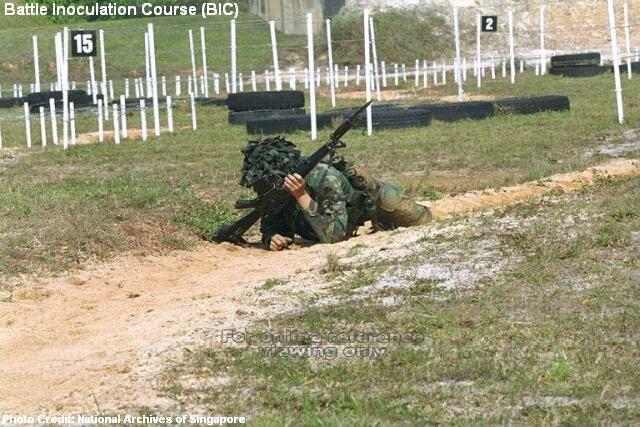
battle inoculation course

battle inoculation course2

Many older Singaporeans would be familiar with the hand grenade training in BMT, influenced by the classic SBC drama The Army Series (新兵小传) in 1983, in which veteran actor Huang Wenyong played an acting role as a lieutenant who lost his life while saving a recruit during a hand grenade training.

In reality, the course was not as dangerous as it seemed. Trainees had to be familiarised through repeated throwing practices with a dummy grenade before they could actually try the real thing. Standing behind a concrete barrier, the recruit had to release the safety pin before throwing the live grenade and witnessing its explosion six seconds later.
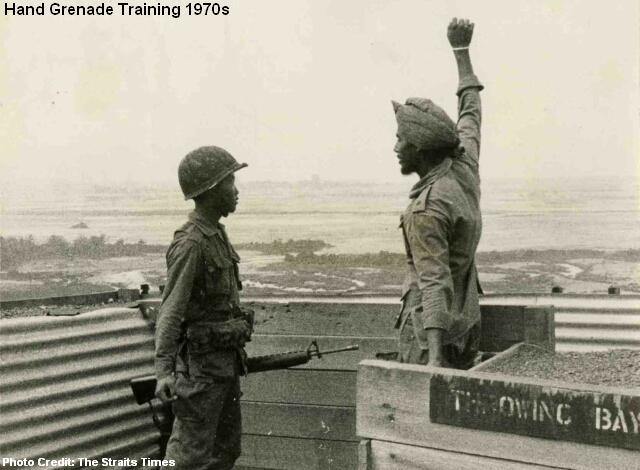
hand grenade training 1970s

The instructor must keep his calm at all time, but even the most experienced ones would be unnerved by three types of recruits, namely the blur sotongs, the gan cheong spiders and those with sweaty palms!

Chemical Agent Training used to be one of the courses in BMT. Trainees donned in masks and full body suits had to go through a tear gas-filled chamber. The worst experience was not the eye-burning sensation caused by the tear gas but the sight and smell of those stains of tears, saliva and mucus on the used mask!
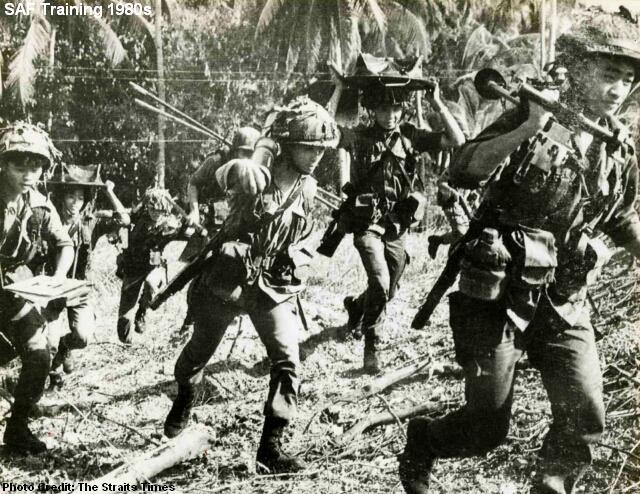
saf training 1980s

The eight-week BMT was rounded off with a six-day field camp and a 24km route march in FBO (Full Battle Order). But it was not over yet! In fact, it was just the beginning of a two-year (two-and-a-half year previously) National Service. Different batches of national servicemen, depending on their vocations, went to experience different types of training courses.
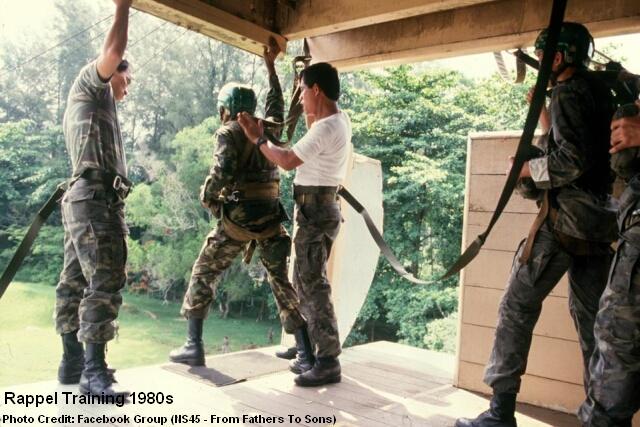
rappel training 1980s

Cheong sua, literally “means charging (up) the hill” in Hokkien, is a phrase used to describe basic infantry training. The tactical movement was by no means an easy feat. Many national servicemen could recall their exhausted days at the notorious Peng Kang Hill and Elephant Hill (at Pasir Laba) and Botak Hill (at Pulau Tekong).

In the 1970s, there were many small knolls at the training area between Woodlands and Mandai, such as Hill 180 and Hill 255, which were named according to their heights (in feet). The most famous was perhaps Hill 265 with its steep barren slopes covered with orange mud. Part of it was flattened in the nineties due to the construction of the Seletar Expressway (SLE).
exercise platypus at australia 1981

Not all national servicemen had the chance to experience it, but for those who did, the oversea exercises at Brunei were unforgettable experiences, or nightmares. Its thick and dense jungles made Singapore’s Mandai or Sungei Gedong look like playgrounds.

Wearing sweat-drenched No. 4 and carrying heavy weapons, the soldiers had to trek long distances over hilly areas filled with commando-trained mosquitoes, sand flies, armies of giant ants and, occasionally, some mean-looking centipedes. As if the physical toil was not enough, there were also rumours that the jungles contained many restless souls of previous National Servicemen who got lost in the thick vegetation and never made it back home.

Life in the Army Camps

Beside combat trainings and physical exercises, national servicemen had to learn to adapt to routine life in the army camps, sharing bunks with each other and working hand in hand to ensure the required disciplinary standards were met.
typical modern bunk in army campUnlike today, the past national servicemen had to do all the area cleanings themselves, taking turns to wash the toilets, empty the drains and clear the dry leaves on the carparks. Beds had to be made each morning with wrinkle-free bedsheets. The boots must be polished gilat gilat, and displayed neatly along with the shoes and slippers by the beds. The items in the cupboards should be placed in their orders, with the shelves kept dust-free.

The two-week confinement period during BMT was perhaps the most restricted period for the national servicemen. In those days without internet or handphones, the connection with the outside world was basically cut off. At nights, the recruits queued up in long lines at the coin phones, while others tried to find pleasure listening to their walkman. Leisure time was short anyway, as the lights had to be off by 10pm.

Despite the authority’s denial, the existence of “white horse” was never in doubt. Those who had the “luck” to be part of a BMT platoon or company with a “white horse” would enjoy more canteen breaks and less punishments!

Life in the units was generally better, but new birds were likely to be tekan with constant stand-by-bed, turn-outs (in the middle of the night) and change parades in their first few weeks. The worst of all was the falling-in of beds’ and cupboards’ at the parade square. Imagine carrying those heavy and bulky cupboards up and down three or four levels. Luckily for the new national servicemen, this sadistic practice is banned today.

Rifles as Wives

On the first day when M16 (or SAF21 today or AR15 before the 1980s) was handed to a recruit, he was taught that he must treat the 3.3kg weapon like his wife.

saf rifle range targetIt was a grave mistake to lose one’s rifle. Without his weapon, a soldier was like a vulnerable sheep during the war. During an outfield exercise, the weapon must be slung by the side at all times, even during sleeping. The sergeants would not hesitate to “steal” the rifle from any careless soldier, and a “lost” weapon would mean extra confinement and burnt weekends.

There were many M16-related trainings. For the fitness part, a M16 (or the heavier dummy weapon) was often used to train the endurance and the strength of the arms. In close combat trainings, a recruit also learned, in times of ammunition shortage, how to pierce the target with the bayonet fixed at the end of his M16, or hit the target with the rifle butt. In reality, it seems a better idea to lie low or retreat when your rounds are exhausted.

To many, shooting range was one of the most enjoyable activities in NS. But the excitement of firing live rounds and hitting the targets was often offset by the fear of punishment due to misfiring or other silly mistakes in the range. And not forgetting the exhausting moment during that 300m run down. A shooting range exercise usually took a day to complete. The difference between marksmen and bobo shooters became more obvious during the night shoot.
ar-15 firing range 1970s

The arrival of the ninja van, with its fried bee hoon, nasi lemak and soft drinks, was perhaps the best consolation in an otherwise boring range where sections of trainees sat on long wooden benches waiting for their turns. The nickname of ninja van probably derived from its ability to find the starving troops in ulu camps and training grounds.

There were much to do after a shooting range exercise. Empty cartridges had to be picked up; rifles had to be cleared, cleaned, oiled and checked before returning to the armskote. By then, the soldiers were already shack out.

The Military Identity

The SAF 11B is a military identification card all active national servicemen must possess. The predecessor of 11B was 11A, which was phased out two years after the introduction of 11B in 1981.
my ns booklet

The little green NS Booklet was replaced by the convenience of the online NS Portal in the early 2000s. National servicemen no longer need to refer to their booklets on their total number of high-key and low-key ICTs.

The Defence Industry

The first Minister for Defence Dr Goh Keng Swee was also the chief architect in the development of local defence-related companies to support SAF. One of its first in the industries, Chartered Industries of Singapore (CIS) was established in 1967 to supply 5.56mm ammunition rounds for the M16 rifles.
v200 armoured fighting vehicle 1970s

In 1969, Singapore bought 72 French-made AMX-13 tanks and 170 V200 armoured vehicles. The purchase was significant, as it kicked off a program of continuous upgradings in the history of SAF.

The late sixties and early seventies also saw the formation of Singapore Shipbuilding & Engineering (SSE), Singapore Electronic & Engineering Limited (SEEL), Singapore Automotive Engineering (SAE), Singapore Food Industries (SFI) and SAF Enterprises (SAFE).
sm1 tank 1980s

These supporting companies provided SAF with maintenance services in communication and electronic equipment, military vehicle servicing, engineering and design, and even daily food supply to the SAF soldiers.

Evolution of SAF Cookhouses

The sight of military chefs, metal trays and green plastic mugs represented the days before the commercialisation of SAF cookhouses in 1997.

Hungry soldiers risked facing the wrath of cooks who were frustrated by long hours of work and oily environment, whose sweat would sometimes trickle down into the large pot while they were stirring the rice. A request for more vegetable? The emotionless cook would just dump a big load onto your tray, spilling over onto your fingers.
saf cookhouse 1970s

Daily meals of just rice, meat and vegetable were a norm. On occasional days, there would be fish ball noodles, but the noodles tasted more like rubber bands than anything else. During BMT, recruits had to take turns to wash the cookhouses and clear the garbage too. Canteen breaks became a valuable treat, as the national servicemen looked to avoid cookhouses at all cost.
saf cookhouse 1980s

The plan of outsourcing to civilian caterers was proposed as early as 1984, due to the declining number of young male Singaporeans entering the national service. However, the commercialisation of SAF cookhouses was not finalised until 1997.
saf cookhouse 1990sTwo catering companies Singapore Food Industries Manufacturing (SFIM) and Foodfare Catering (FFC) were contracted to manage 60 SAF cookhouses and provide a wide range of food to the National Servicemen, who were treated with safer food preparation and healthier choice of food.

The environment-friendly packaging and higher quality and lighter combat rations also made it convenient for the soldiers during their outfield exercises. The cans of baked beans, hard tack biscuits and melting chocolates were replaced by commercial off-the-shelf snacks and beverages that could be found in the supermarkets.

Today, the national servicemen enjoy different daily menus such as chicken rice, nasi bryani, pasta and even fish and chips.

Temasek Green, Camouflaged and Pixelised

Temasek Green, the first generation of SAF combat uniform debuted in 1967, replacing the old military clothing formerly used by the British. The uniform, which was made of thick cotton and had two pockets for the shirt and three for the pants, was modified in 1977 with a darker green tone, baggier in size and an addition of two extra shirt pockets.

different generations of saf headwear

In 1983, the old Temasek Green uniform was replaced by the camouflaged type. Its colour fastness, however, was poor and the camouflage patterns faded easily after repeated washings. A new version made by a different material was introduced in 1985. Lighter in weight and had better air permeability, the second generation of SAF uniform lasted 25 years before being replaced by the latest 3G uniform with pixelised patterns.

With the introduction of the No.3 uniform in 1982, the parade days of the starch-stiff Temasek Green were all but memories. New monotone PT kits also made their way into SAF in 1995, replacing the old camouflaged ones.

Army Ghost Stories

Ghost stories always ranked high in the list of common topics among national servicemen during chit chatting sessions, especially if they were stationed in an old ulu camp.

The most famous of all was the legendary three-door bunk of Charlie Company at Pulau Tekong. The story managed to find its way between batches and generations even though the unfortunate incident happened more than 30 years ago and the creepy bunk no longer exists today.
jacobs ladder

Prowling around the old Tekong camp at night was never fun, especially when there were rife rumours of a weeping female ghost in white dress sitting on the Jacob’s Ladder. Another popular ghost story in NS was the spirit of an old man walking around at night with his granddaughter. Their footsteps could be heard from afar, but the next moment you could sense them standing beside your bed.

“This one not asleep yet!” the granddaughter mocked, pointing to those who closed their eyes tightly pretending to sleep.

What about the famous haunted White House at Nee Soon Camp? Sounds were always heard at night, yet the building was empty when the prowlers checked it out. Or that poor soul of a soldier who had to return to the same level of the building every night to repeat his suicide. And when a pack of dogs gathered and howled at the chin up bar, there were whispers that it was due to the spirit of a national serviceman who hanged himself at the bar many years ago.

Colourful NS Lingo

Singapore is a place full of acronyms and abbreviations, such as PIE (Pan-Island Expressway), ERP (Electronic Road Pricing) and MOE (Ministry of Education). Likewise, SAF itself has many abbreviations. With the addition of our unique Singlish, a list of colourful NS lingo is born.

my grandmother can run faster than youHokkien used to be a common language used during SAF trainings. It was, however, banned in October 1978. Only English, Malay and Mandarin were allowed. But as the old army saying goes: “Do whatever you want, just don’t get caught“, the widespread usage of Hokkien, especially the vulgarities, has continued to this day.

Some common phrases seemed to be frequently used by most instructors. Eg, during a run, the instructors like to say sarcastically: “Walk some more! Never mind, take your time” or “My grandmother can run faster than you“.

During a tekan session: “Whole lot knock it down!“, “I can’t hear you!“, “Shack right? Cannot think properly isn’t!?“. Other favourite phrases include “You think I thought who confirms?“.

common ns lingo1 v4

eye power

common ns lingo2 v4

ROD (Run Out Date), arguably the most significant acronym to any national serviceman, was changed to ORD (Operational Ready Date) in July 1994.

NS Sing-a-Long

“Any Sweat? No Sweat! Chicken feed, ha ha all the way!”

Little was known of how the NS songs came about. Some were perhaps passed down by the British during the colonial era, while others might be created by some talented local national servicemen in the seventies and eighties. Nevertheless, the songs aimed to boost the morale of the soldiers during a run or a route march. Who forget the 24km BMT graduation route march, where everyone sang in high spirits (at the start) and encouraged each other to complete the feat?

“C130 rolling down the street
Airborne rangers take a little trip
Stand up hook up shuffle to the door
Jump right down by the count of 4

If this chute doesn’t open wide
I have another one by my side
If this one doesn’t open too
Then you all can see me die

If I die in a Russian front
Bury me with a Russian gun
If i die in a Vietnam war
Send me back to Singapore

Tell my major I’ve done my best
Silver wings upon my chest
Tell my mama I’ve done my best
Now its time to take a rest”
saf national servicemen 1980s

“Purple light, in the army
That is where, I wanna be
Infantry, best companion
With my rifle and my buddy and me

SOC, sibei jialat
Log PT, lagi worse
Everyday, doing PT
With my rifle and my buddy and me

Booking out, saw my girlfriend
Holding hands, with another man
Broken heart, back to army
With my rifle and my buddy and me

ORD, back to studies
Get degree, so happy
Can’t forget, still remember
With my rifle and my buddy and me

Purple light, in the war front
There is where, my body dies
If I die, would you bury
With my rifle and my buddy and me”
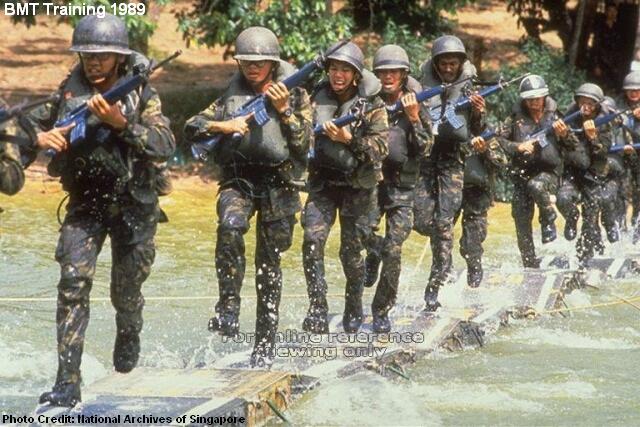
bmt training 1989

“Far far away in the South China Sea
I left a girl, with tear in her eyes,
I must go where the great men fights ya
A soldier has to fight the front because he love his land ya
A soldier has to fight even his has to die!
Coz we are the one who fight the front
And we are the one who holds the gun,
We are mighty warriors from this land ya
Alpha warriors marching in hoorah hoorah
Coz we are the one who fight the front
And we are the one who holds the gun,
We are mighty warriors from this land ya”

“Everywhere we go-o
People want to know-o
Who we are
Where we come from
So we tell them
We are from (name of platoon/company/battalion)
Mighty, mighty (name of platoon/company/battalion)
And if they can’t hear us
We sing a little louder”

Army Camps in Singapore
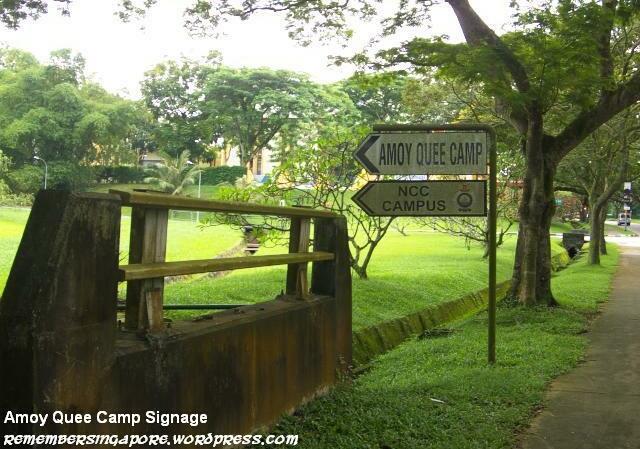
amoy quee camp sign

There are over 100 army camps and military bases in Singapore. Many were built by the British during the colonial era, while the rest were formed by the Singapore Armed Forces after independence. Below are brief descriptions of some of the old and former camps in Singapore.

Ayer Rajah Camp (1940s-2010)

Located at Portsdown Road, the Ayer Rajah Camp was well known as a servicing and vehicle maintenance camp. It was formerly part of the British’s Pasir Panjang Complex that also included the Gillman Barracks and Alexandra Camp. The camp was first home to the British Royal Electrical and Mechanical Engineers, which provided maintenance services to the British military vehicles before the Second World War.

former ayer rajah camp

After the war, the camp was taken back from the Japanese forces and placed under British control for another 27 years before they departed in 1971. It was then handed over to SAF’s Ordnance Maintenance Base (OMB). In the eighties, the Headquarters (HQ) Maintenance and Ordnance Engineering Training Institute (OETI) moved in to share the premises with OMB, which was reorganised as General Support Maintenance Base (GSMB).
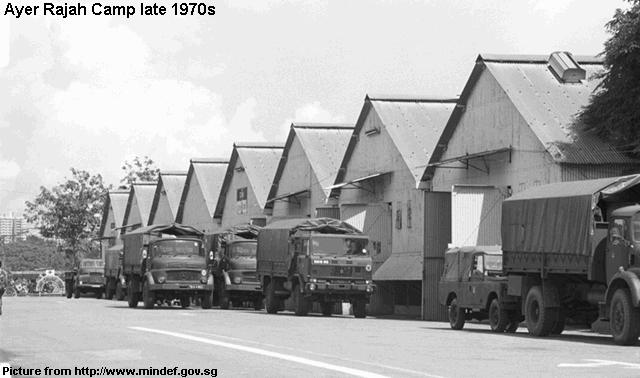
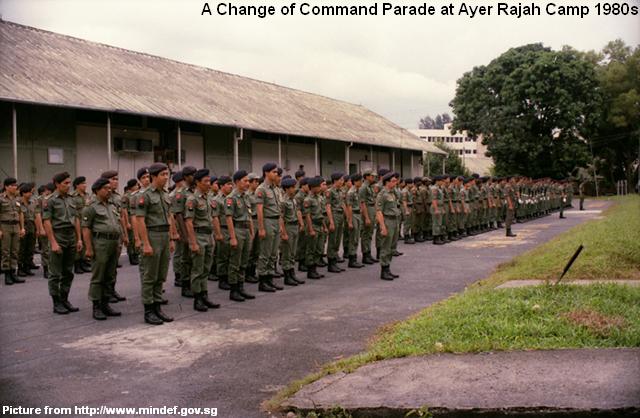
ayer rajah camp late 1970s

change of command parade at ayer rajah camp 1980s

In 2010, the camp was closed and its site was returned to the State. Its premises will be leased to MediaCorp in 2014.

Beach Road Camp (1930s-2000)

One of the few former military camps situated in the City, the Beach Road Camp was built on reclaimed lands and originally standing just beside the coastline. Its Art Deco-styled buildings were functioning as the headquarters for the Singapore Volunteer Corps (SVC), which was formerly located at Fort Fullerton.
passing out parade at beach road camp 1989

Beach Road Camp played a significant military role in the early days of Singapore’s independence. It served as the main registration centre for the early batches of NS enlistees, and was home to several SAF units such as the infantry regiment, signal unit and provost company. The People’s Defence Force (PDF), formerly SVC, retained the camp as its headquarters.
beach road camp early 2000s

By the mid-nineties, it became apparent that Beach Road Camp would be shifted due to its location in the prime land district. In 2000, the camp was officially shut down. Its three colonial buildings Block 1, 9 and 14 were given conservation status in 2002, while its plot of land, along with the former NCO club, was sold to private developers of hotels, offices and residences.

Blakang Mati Artillery Barracks (1910-1972)

Built in 1910, the Blakang Mati Artillery Barracks on present-day Sentosa was part of the British’s defensive facilities for the southern coastline of Singapore. The island and the barracks, however, fell to the Japanese forces during the Second World War, and were used as a prisoners-of-war camp.
blakang mati artillery barrack

Singapore’s first artillery division First Singapore Regiment Royal Artillery was established at Blakang Mati Artillery Barracks in 1948. It also housed the Singapore Naval Volunteer Force, School of Maritime Training and Naval Medical School after Singapore’s independence. But SAF’s control of the barracks lasted only until 1972, when the government decided to develop the island for leisure and tourism.

The barracks were abandoned for many years until recently, when the site was put up for sale for a hotel development project.

Changi Command Barracks (1935-1990s)

Standing proudly on Fairy Point Hill, the former Changi Commando Barracks was once an integrated part of the British’s naval and air defence strategy against any potential invasions at the eastern part of Singapore. Constructed in 1935, it was originally a command building for the British Royal Engineers.

In 1971, the vicinity became part of the Commando Unit’s premises when the SAF elite troops were relocated from Pasir Laba Camp to Changi Camp. Two years later, the unit was strengthened with its first NS battalion, supported by a new school and headquarters. The iconic colonial building on Fairy Point Hill was used as the HQ office for the Commandos.

changi commando barracks

When Hendon Camp was officially inaugurated in 1993 as the new home for the Commandos, Changi Commando Barracks was abandoned for many years. In 2002, it was given the conservation status, and the premises are now part of a new hotel development project.

Guillemard Camp (1969-2003)

The former Guillemard Camp was home to 1SIR, Singapore’s first military unit. It was established at the start of 1969 for the relocation of 1SIR from Taman Jurong Camp. Generations of recruits had gone through intensive infantry training at the small Guillemard Camp for past 30-plus years.
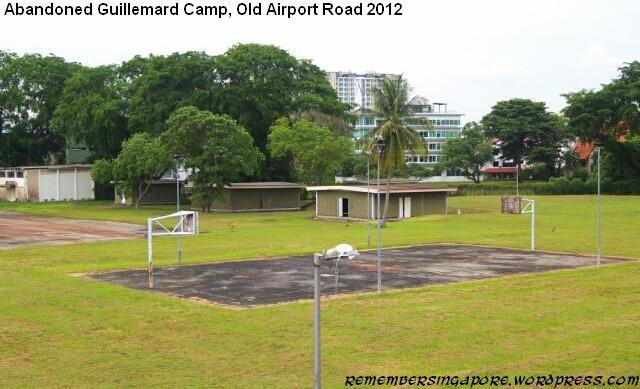
guillemard camp

guillemard camp2

The camp stayed relatively the same despite the changes in its surroundings, where blocks of residential flats popped up along Old Airport Road and Dakota Crescent. Due to the limitation in space and aging training facilities, its operations were finally ceased in in 2003, with 1SIR shifted to Mandai Hill Camp. The plot of land has since been reserved for future housing development.
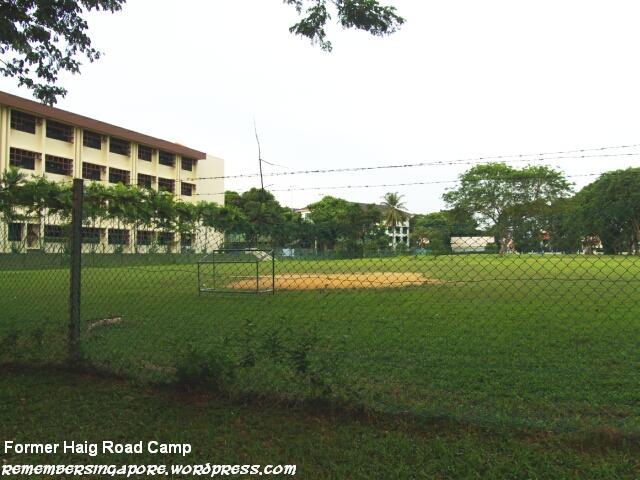
former haig road camp

As the population increases, the growing need for more residential development means those old redundant camps have to make way. In recent years, the likes of Haig Road Camp, (Old) Keat Hong Camp and Simon Road Camp were demolished for the construction of public flats and condominiums. As the old barracks were being torn down, they vanished together with the memories of many generations of national servicemen once stationed at those camps.
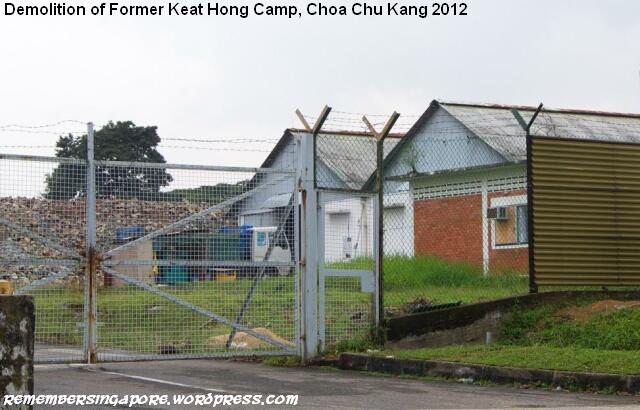
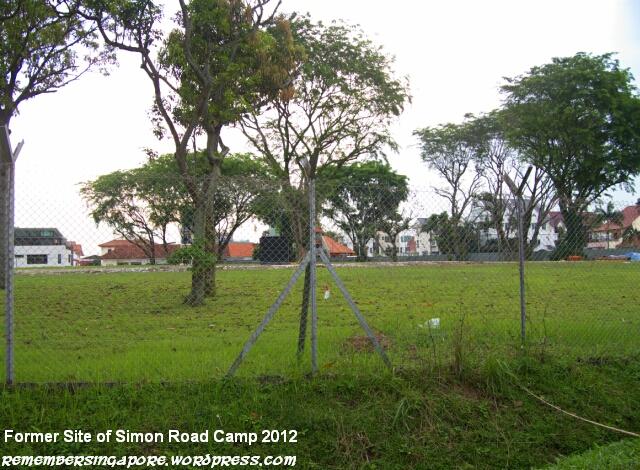
old keat hong camp under demolition 2012

former site of simon road camp

Mowbray Camp (Old) (1937-2002)

The old Mowbray Camp at the junction of Ulu Pandan Road and Clementi Road was a former British camp that used to house its guard contingent. It was, however, more well-known for being the home of the SAF Provost Unit between 1971 and 2002. SAF Provost Unit was first established in 1966 at Beach Road Camp, before moving to Hill Street Camp and finally settled at Mowbray Camp for 31 years.

The mentions of MP (Military Police) and DB (Detention Barracks) had struck fear into the hearts of many generations of national servicemen. SAF’s first military detention cells were set up at Beach Road Camp together with the SAF Provost Unit in 1966. By the eighties, there was a total of four major detention barracks in Singapore (Kranji, Nee Soon, Changi and Tanglin). In 1987, the SAF Detention Barracks was officially opened as a centralised military prison, replacing the other old detention barracks.
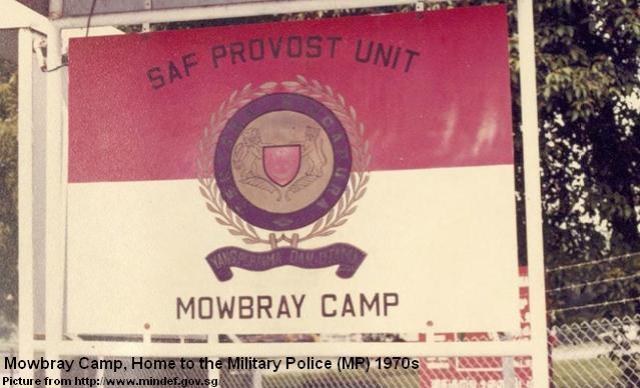
mowbray camp home to military police 1970s

Mowbray Camp was also home to Home Team’s canine unit. The Police Dog Unit was stationed here as early as the 1950s, before being linked up with the Customs & Excise Department’s canine unit (in 1987), the Prisons Department’s canine unit (1995) and the Singapore Civil Defence Force’s Rescue Dog Section (1997).

In 2002, the SAF Provost Unit moved to the new Mowbray Camp at Choa Chu Kang Way.

Nee Soon Camp (1934-Present)

Located opposite Kangkar in the olden days, Nee Soon Camp was first set up by the British in 1934 as one of the military bases in the northern part of Singapore. The recruits of first Singapore Infantry Battalion were trained at Nee Soon Camp when Singapore established its own military forces in 1957.

The establishment of Nee Soon Camp brought prosperity to its surroundings, increasing the population and commercial activities. In 1930, prominent Chinese businessman Lee Kong Chian (1893-1967) saw the opportunities and bought the row of 24 shophouses opposite Nee Soon Camp, renting them out as provision shops, bakeries, barber salons, tailor shops and others.
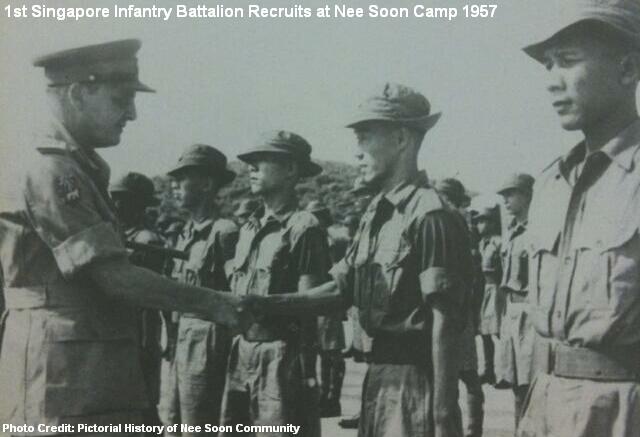
singapore infantry battalion recruits at nee soon camp 1957

Nee Soon Camp functioned as a school of BMT until the late 1990s. It received major revamp in the 2000s, with many of its old colonial buildings demolished. Today, there is even a condominium standing near the entrance of Nee Soon Camp, beside the row of shophouses that are famous for their military apparel and paraphernalia.

Selarang Camp (1938-Present)

The British built Selarang Camp at Loyang, in the eastern part of Singapore, in 1938. It was used by the Scottish Battalion but was occupied by the Japanese during the Second World War. During the Japanese Occupation, as many as 15,000 Australian Prisoners-of-War (POWs) were imprisoned at Selerang Camp. In 1942, the Japanese forced the POWs onto the parade square for five days without water and sanitation, in a bid to force the prisoners to agree not to escape. This was later known as the “Changi Incident”.
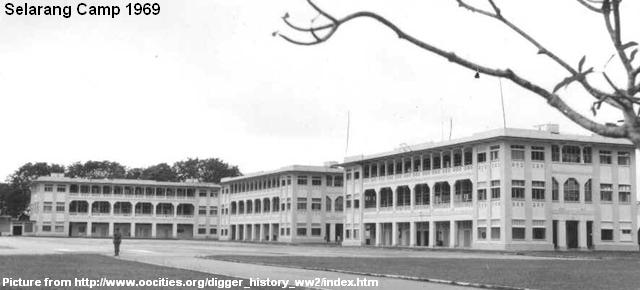
selarang camp 1969

After the Second World War, Selarang Camp was used as a base by the Australian Army units from the ANZUK, which was made up of troops from Australia, New Zealand and the United Kingdom. In 1971, the camp was officially handed over to SAF, and had housed the 9 Division of the Armed Forces since 1984. Its premises were given an extensive upgrading at a cost of $50 million in 1991. Many of its old colonial buildings were demolished to be replaced by new modern complexes.

Seletar Camp (1920s-Present)

Seletar Camp and its airbase were largely constructed in the 1920s as British military facilities for air travel and air defence. The premises were officially owned by the Royal Air Force in 1930 but fell to the hands of the Japanese forces during the Second World War. The Japanese navy captured Seletar Airbase in 1942 and renamed it as Seretar Hikojo.

seletar camp

After the war, the British repossessed Seletar Camp but the airbase no longer boasted the largest in Singapore, being replaced by the new airfield at Changi. SAF took over Seletar Camp in 1971, and maintained restricted public access to its eastern part of the camp. The western part was open to public and commercial aircraft.
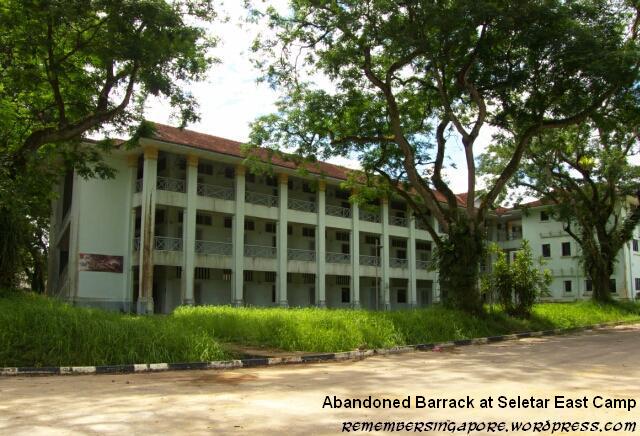
abandoned seletar barracks

Due to the Seletar Aerospace Park project since the late 2000s, the quiet rustic Seletar Camp had gone through tremendous changes, with many of its old colonial buildings demolished.

Tanglin Barracks (1861-1989)

Tanglin Barracks were one of the oldest camps in Singapore. Built in 1861, it was situated in a former nutmeg plantation, functioning as a base for the British garrison infantry battalion. After SAF took over it in 1971, the camp was designated as the headquarters for the Ministry of Defence and the Central Manpower Base. Since the early 2000s, the premises around the vacated Tanglin Barracks had seen significant development as a hub for lifestyle, fine dining and cultural arts.
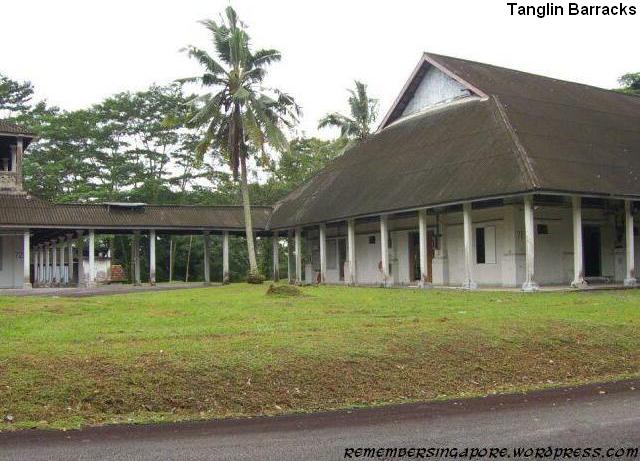
tanglin barracks

The list consists of other camps not mentioned above:

list of army camps singapore v3

Saluting all former and current NS personnel!

Published: 01 May 2013

Updated: 19 October 2014

Posted in Cultural, Historic | Tagged , , , , , , , , , , , , , , , , , , , , , , , , , , , , , , , , | 103 Comments

Old Holland Road and The Hakka Clan

It is Qing Ming Festival (Tomb Sweeping Day) again. I make my annual trip to pay respects at Fung Yun Thai Association Columbarium near Old Holland Road, where my grandparents’ funeral urns are stored. Also commonly known as Hakka Clan (客人邑), this is where the early Chinese Hakka immigrants had settled and lived for generations.

Old Holland Road

There are many “old” roads in Singapore, such as Old Yio Chu Kang Road, Old Upper Thomson Road and Old Tampines Road. In most cases, these roads were renamed after their roles and importance diminished over time and were replaced by the newer arterial roads of the same names.

In the sixties, a long stretch of the original Holland Road wound its way through a massive Chinese Hakka graveyard called Fung Yun Thai Cemetery (丰永大坟山), serving as a link between 6½ Milestone Bukit Timah Road and its main arterial portion at the junction with Ulu Pandan Road.

old holland road

When the cemetery was exhumed in the early eighties, part of Holland Road (see map below) was also demolished. A new road by the name of Holland Road North was constructed in the late nineties as an accessible route to planned private condominiums in the vicinity. It was supposed to be linked up with Holland Road South and Holland Road West, but the constructions were never completed.

Holland Road North was later renamed as Old Holland Road, as a continuation of the road that started off Bukit Timah Road. The incomplete Holland Road South and West, on the other hand, became rocky paths, and are out of bounds to motor vehicles today.

map of old holland road

The newer Holland Plain and Holland Link, as their names suggest, refer to the grass plain that has formerly the exhumed cemetery, and the link that joins Old Holland Road to the original Holland Road. The rocky paths are now a favourite route for joggers and dog owners, while many enthusiasts can be seen flying their kite and remote-controlled aircraft at the vast grass plain.

junction of holland plain and holland link

Shocking Crime

Durian plantations were once abundant off Old Holland Road; there were several cases of thefts of durians reported on the newspapers in the eighties. A horrific crime, however, shocked Singapore on 22 May 1985 when 18-year-old Catholic Junior College student Winnifred Teo Suan Lie (张碹丽) went missing while jogging near the exhumed cemetery. Her body was discovered naked and lying in the bushes along Old Holland Road the next morning, with six fatal slashes on her neck. The murderer was never caught.

fung yun thai association columbarium

Changing Landscape

The Hakka columbarium, completed in 1991 and tucked at the corner of Holland Plain and Holland Link, off Old Holland Road, has enjoyed undisturbed peace and serenity for the past two decades. In the last three years, however, the columbarium started to experience changes in its surroundings. Like other parts of Singapore affected by the construction frenzy, private development are now slowly engulfing the former graveyard that has been vacated and forgotten over time.

fung yun thai association columbarium 2010-1

Almost a forgotten place in Singapore, the Fung Yung Thai Association Columbarium receive few visitors in any days other than Qing Ming or other special occasions. Before 2011, its main ancestral hall was accompanied by a large garden, with a main tomb that probably buried a significant or wealthy Hakka figure of the past. Few would have expected these to vanish within two years.

fung yun thai association columbarium 2010-3

fung yun thai association columbarium 2010-4

fung yun thai association columbarium 2010-2

By April 2013, the latest private property project in the highly sought-after District 10 is almost ready. Named Eleven @Holland, the brand new strata-titled semi-detached houses are located such a short distance away that a tall circling wall has to be built around the columbarium, probably to prevent the new residents from facing its ghastly neighbours. The vanished garden and main tomb of the columbarium had become part of the premises of the new housing project.

fung yun thai association columbarium3

fung yun thai association columbarium 2010-6

An Old Hakka Association

The history of Fung Yun Thai Association (丰永大公会) dated back to the 19th century, when the early Hakka immigrants from the three counties of China (Fung Shoon 丰顺, Yun Teng 永定 and Tai Po 大埔), arrived at Singapore.

By the late 19th century, there were about 6,000 Hakkas settled at the areas around present-day Commonwealth and Buona Vista, a relatively small number compared to the three major Chinese dialect groups in Singapore. According to a population census conducted by the Straits Settlements government in 1881, the strength of the Hokkien, Teochew and Cantonese groups ranged between 15,000 and 25,000 each.

yu shan teng cemetery temple 1980s

In 1888, for the price of 300 silver dollars plus an annual tax of 50 cents, the Hakkas purchased parcels of land off Holland Road from the Straits Settlements government for their ancestral temple (Sanyi Ci 三邑祠) and cemetery (Fung Yun Thai Cemetery 丰永大坟山, also known as Yu Shan Teng 毓山亭), with Fun Yun Thai Kongsi (丰永大公司) established to manage the properties.

The kongsi was re-registered as an association in 1906 in order to run the temple, cemetery and small surrounding clusters of Hakka villages effectively. In the fifties, the ancestral temple also functioned as Nam Tong School (南同小学) to provide elementary education for the Hakka children who lost their opportunities to study during the Japanese Occupation.

fung yun thai association columbarium 2010-5

fung yun thai association columbarium2

Acquisition of Cemetery

This lasted until 1977, when the entire cemetery hill was acquired by the Singapore government. Nam Tong School was discontinued, while the Hakka villagers were resettled elsewhere. A compensation of $1 million and a small 6.38 hectares of land, including the site of the temple, was reserved for Fung Yun Thai Association. Exhumation was then carried out four years later. In 1991, a columbarium was constructed within the designated area to house the exhumed ashes.

Together with another Hakka cemetery Ying Fo Fui Kuan, Fung Yun Thai Cemetery was one of two earliest burial grounds in Singapore to be acquired by the government for redevelopment purposes. It was rumoured that Lee Bok Boon, the great-grandfather of former Prime Minister Lee Kuan Yew, was previously buried here, and the move was to demonstrate to other Chinese dialect clans that, should their cemetery hills be also acquired for redevelopment, they would have no reasons to object.

canal near old holland road

A large canal called Bukit Timah Diversion Canal, constructed in the early seventies, makes its way behind the columbarium. Half a century ago, this was a long stream, with farms and fish-rearing ponds on its either sides. Today, the long canal runs through the vicinity between the Bukit Timah Road Canal and Sungei Ulu Pandan, serving as a reminder of the olden days.

After being left vacated for more than three decades, the grass plain and greenery of Old Holland Road may soon be giving way for more private residential development.

Published: 09 April 2013

Updated: 13 April 2013

Posted in Exotic, Religious | Tagged , , , , | 42 Comments