Singapore’s Vanished Markets and Hawker Centres

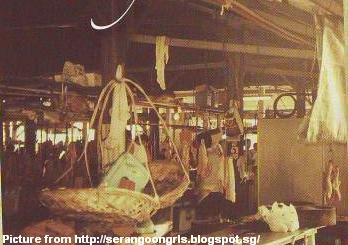
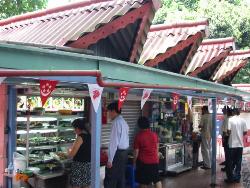
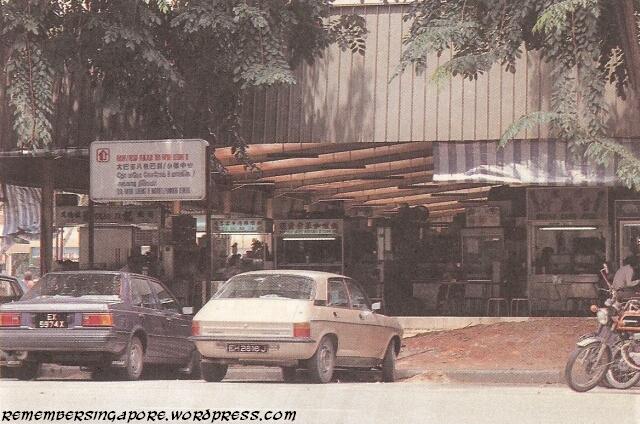
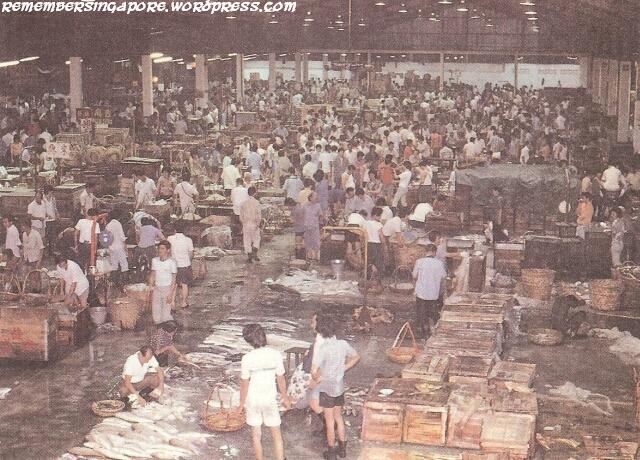
In October 2011, the government announced plans to build ten more hawker centres over the next decade. Since the early seventies, hawker centres had become part of Singapore’s unique culture. The mid-eighties saw some 140 markets and hawker centres located all over the island, although the number now stands at around 100.

Wet markets, on the other hand, are the main sources of fresh produce such as meat, fish, vegetables and fruits. However, they are gradually losing their clientele due to the competitiveness, convenience and cleanliness of supermarkets. Today, the large wet markets that are still going strong include Chinatown Complex Market, Empress Market (or Farrer Market), Holland Village Market, Tiong Bahru Market, Tekka Centre, Toa Payoh Central Market, Ghim Moh Market and Geylang Serai Market.

From Street Hawkers to Hawker Centres

Hawker centres were first built in 1971 as part of the government’s street hawkers resettlement program. Before hawker centres, street hawkers had to constantly face the wrath of di gu (National Environment Agency inspectors), and customers were exposed to hygienic issues. After several food poisoning and epidemic cases, the Environment Ministry decided to clean up the streets.

Yung Sheng Food Centre at Jurong was the first hawker centre to operate in Singapore. It proved to be a success, clearing the doubts of the street hawkers and prompting others to follow suit. The hawker centre was later merged with Corporation Drive Food Centre and Corporation Drive Market to become Taman Jurong Market & Food Centre.

In 1985, Jurong West Street 52 Block 505 Market & Food Centre was the last hawker centre to be built, and a year later, the last street hawker was successfully resettled.

Between the late seventies and early nineties, many hawker centres were renamed as (cooked) food centres, but many still preferred to call them by their old names.

The former Telok Ayer Market, Singapore’s first ever market, had its history dated all the way back to 1825. It began as a simple wooden structure standing next to the sea, so as to allow goods to be loaded and unloaded directly to the boats. Due to the land reclamation of Telok Ayer Basin, the market was demolished in 1879, but was rebuilt five years later by James MacRitchie (1848-1895), the Municipal Engineer, who retained its iconic octagonal shape but changed its building materials to cast-iron.

Despite being conserved in 1973, the market had to be dismantled in 1984 due to the nearby tunneling of the MRT system. It took more than five years before the market was reassembled and reconstructed, sticking to James MacRitchie’s original design. It finally reopened in 1991 as Lau Pa Sat (“old market”).

Other prominent hawker centres in Singapore are Maxwell Road Food Centre (originally Maxwell Market since 1935), Tiong Bahru Market (since 1955), Newton Circus Food Centre (since 1971), Chomp Chomp Food Centre (since 1972), East Coast Lagoon Food Village (previously East Coast Hawker Centre, since 1978) and Pasir Panjang Food Centre (since 1978).

In the eighties, the Chinatown Complex Food Centre was the largest hawker centre in Singapore with an astonishing 803 stalls.

Currently, the markets and hawker centres in Singapore are largely managed by three entities; Ministry of the Environment and Water Resources (MEWR), Housing Development Board (HDB) and Jurong Town Corporation (JTC).

Below are some of Singapore’s vanished markets and hawker centres (not in alphabetical or chronological order) in the past decades.

Orchard Road Market (1891-1982)

The almost century-old Orchard Road Market was a firm notable landmark located at the junction of Orchard Road and Koek Road, where Orchard Point is standing now.

The land where Orchard Road Market once stood on belonged to early nutmeg plantation owner William Cuppage in the 19th century, whose estate was later inherited by his son-in-law Edwin Koek. Both Cuppage Road and Koek Road were named after them.

In 1890, the Municipal Authorities bought the land and built a new cast-iron market which had extensions and wings added over the years. Its iconic six metre tall fountain, made in Scotland, was brought over from Telok Ayer Market in 1902. The fountain accompanied Orchard Road Market for some eighty years before it was shifted again to Raffles Hotel.

Orchard Road Market was an extremely popular place for fresh produce in the sixties. In 1982, it was demolished by the Urban Redevelopment Authority (URA) in a bid to transform Orchard Road into a prime shopping district.

Orchard Road Carpark Hawker Centre (1966-1978)

Located at open-air carpark next to the Specialists’ Shopping Centre, the Orchard Road Carpark Hawker Centre, also known as Glutton’s Square, was one of the most popular makan places in Singapore.

The street hawkers pushed their wooden carts, generators, cooking utensils and pails of water and set them up in rows in the carpark after it was closed at 5pm everyday. The feasting usually lasted from dinnertime to suppertime in the early morning, sometimes till 5am.

By the early seventies, the place had reached its peak of popularity, especially among young couples, families and tourists. In its later years, Glutton’s Square, however, gained an unwanted reputation of being a “carrothead chopping” place for foreigners.

As many as 80 stalls were selling delicious local delights at cheap affordable prices, such as Hokkien mee, char kway teow, bak chor mee, satay, bak kut teh and orh luak.

Despite being popular with the customers, Glutton’s Square was constantly bothered by overcrowding and hygienic issues. In 1978, the government decided to close it, and relocate the hawkers to the Newton Circus and Cuppage hawker centres. The Singapore Tourism Board (STB) tried to revive the nostalgic charm of Glutton’s Square during the Singapore Food Festival 2004. Lasted until early 2005, the event was met with overwhelming responses, although the prices of the food had risen dramatically as compared to the older days.

Boat Quay Food Centre and Empress Place Food Centre (1973-1993)

Boat Quay Food Centre was built in 1973 with a splendid (some said smelly) waterfront view of the Singapore River filled with tongkangs and twakows. Tongkang and twakow are Malay and Hokkien/Teochew words for bumboat.

The purpose of the hawker centre was to accommodate the street hawkers plying their trades at Hallpike Street near the original Parliament House. Now defunct, Hallpike Street was named after Stephen Hallpike, an English blacksmith who arrived here in 1826 and founded the first shipyard (or boatyard) in Singapore.

Enjoyed by the working class in the city, the hawker centre offered many delicious and affordable food, and it was particularly famous for a stall selling beef kway teow.

In 1983, due to the construction of MRT work, some ninety hawkers from Boat Quay Food Centre and Empress Place Food Centre were shifted to a temporary site named Empress Place Transit Food Centre off North Boat Quay. Boat Quay Food Centre itself was demolished by the mid-nineties due to the redevelopment plans to turn the place into a trendy spot for wine and dine.

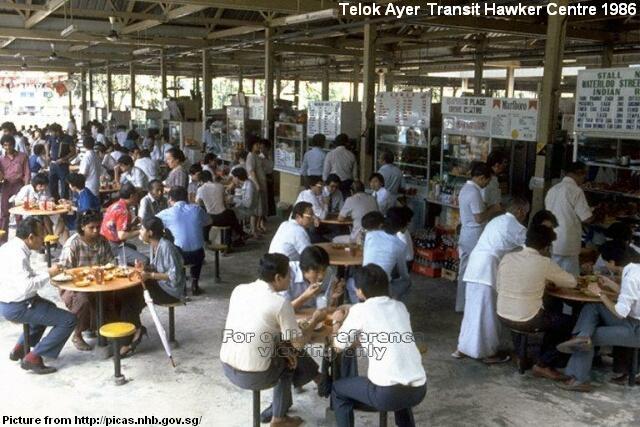
Telok Ayer Transit Food Centre (early 1980s-1997)

Like Boat Quay Hawker Centre, Telok Ayer Transit Hawker Centre was also a convenient lunch venue for many working class at Shenton Way.

When the Telok Ayer Market (later Lau Pa Sat) was dismantled between 1984 and 1991 due to the construction works of the MRT, many stallholders were relocated to Telok Ayer Transit Hawker Centre. One of them was the now-famous Ya-Kun coffee-stall.

Originally meant to be the temporary site for Lau Pa Sat stalls (hence the name “transit”), the hawker centre, however, stayed on for a couple of years after the new market was reopened. It was eventually shut down at the end of 1997.

Simon Road Market (1948-1999)

The popular Simon Road Market was built in August 1948, initially at the nearby Lim Ah Pin Road before moving to Simon Road, or fondly known as “ow gang lark kok jio” (Hougang sixth milestone).

Simon Road was named after prominent Eurasian of Portuguese descent Simon Aroozoo (1850-1931) (who also had the nearby Aroozoo Avenue named after him), a close friend of Gan Eng Seng.

When Simon Road Market was first set up, it was met with poor response by the public. A series of publicity campaigns was carried before things improved. From then on, vegetable farmers from Potong Pasir and fishermen from Kangkar and Serangoon River would bring their products to Simon Road Market every morning for sale.

The market would later become a makan haven, serving delicious Hokkien mee, muah chee, pork congee, wanton mee and mee rebus. However, it was demolished in 1999, with some of the stall holders moved to the markets in Hougang to continue their businesses.

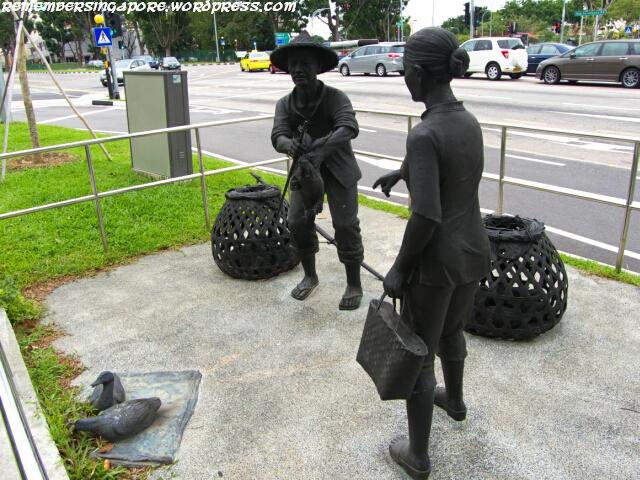
Today, the once-bustling market was no more, only to be replaced by posh condominiums. The only landmark still remaining is the newly-renovated Nam Heng kopitiam standing at the junction of Simon Road and Upper Serangoon Road, and a pair of bronze statues that served as the memories of the vanished Simon Road Market.

Commonwealth Avenue Food Centre (1969-2011)

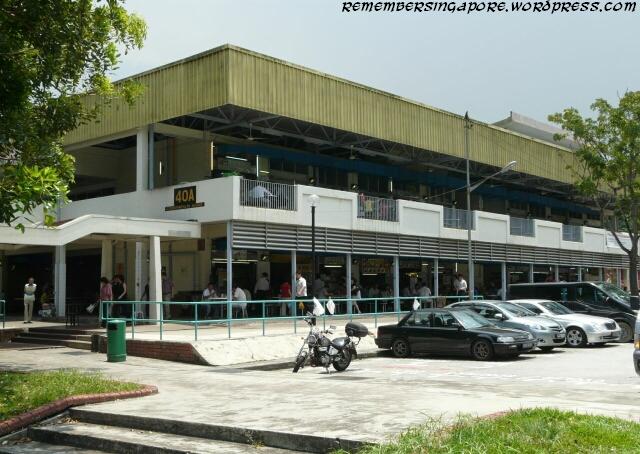
The double-storey Commonwealth Avenue Food Centre used to stand at the sleepy Margaret Drive of Queenstown. It was the favourite makan place of many residents and working people especially during lunchtime, where it served popular Teochew fishball noodle, chicken rice, popiahs and char kway teow.

In early 2011, after more than three decades of operation, the popular hawker centre was officially closed. Like its surrounding blocks of flats, it was demolished as new plans of redevelopment were laid out for the large plots of land opposite Queenstown MRT Station.

Seletar Hills Market & Food Centre (1974-2005)

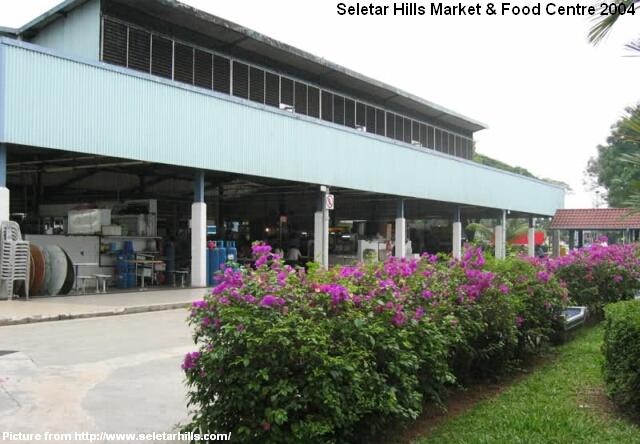
The old wet market by HDB (Housing Development Board) proved to be a popular grocery and makan place during its heydays, enjoyed by the flat-dwellers as well as the residents living at the nearby private estate. Flanked by four block of low-rise flats, there was also a basketball court beside the large open-air carpark, where the players would enjoy a cold drink or dessert at the hawker centre after their games.

In 2000, Seletar Hills Market was partially damaged in a fire, costing $700,000 to refurbish it. However, two years later, the blocks of flats at Seletar Road was torn down under the Selective En bloc Redevelopment Scheme (SERS), causing the market to lose a critical mass of customers. Thus, in 2005, Seletar Hills Market & Food Centre also met its demise. After being left vacated for almost four years, its site is now occupied by the residential-cum-shopping mall Greenwich.

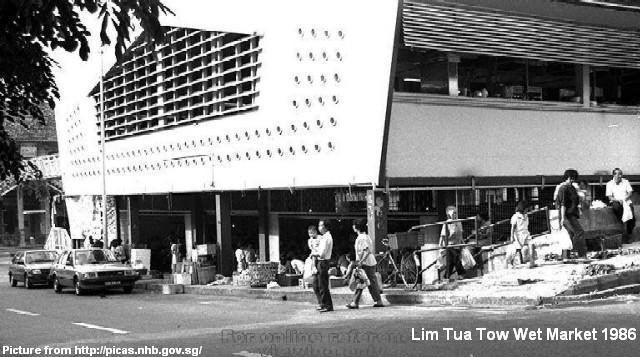
Lim Tua Tow Market (early 1960s-early 1990s)

Lim Tua Tow Road, commonly known as ow gang gor kok jio (Hougang fifth milestone), was named after Chinese pioneer and Teochew merchant Lim Tua Tow (Tua Tow means “big head” in Teochew). Naturally, the wet market that once stood here was called Lim Tua Tow Market.

Well-known for its Hokkien mee and chai tow kuay, Lim Tua Tow Market served the community living at Upper Serangoon well. It also was the main grocery place for the residents living at Chia Keng Village, a teochew kampong that existed until 1984.

Lim Tua Tow Market and Simon Road Market were the two prominent wet markets along Upper Serangoon Road between the sixties and nineties.

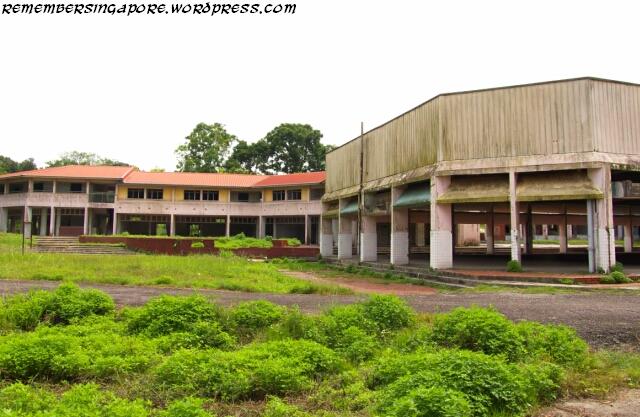
Neo Tiew Market & Food Centre (1979-2002)

Like Neo Tiew Estate itself, the market and hawker centre are now in dilapidated states, having left abandoned for a decade. It was named after Chinese pioneer Neo Tiew (1883-1975), who contributed much to the development of old Lim Chu Kang.

When it was first set up, the market served mainly the little Neo Tiew Estate as well as the residents living at Lim Chu Kang, Ama Keng and other villages. It would later become a resting point and makan place for the army personnel from Sungei Gedong Camp during their booking-out.

Serving great char kway teow, carrot cake and wanton mee, the hawker centre remained a favourite but distant memory for many. The flats at Neo Tiew Estate were en-bloc and vacated in 2002. The empty premises is now being used as a training ground by the Singapore Armed Forces.

The little Dover estate with its market and hawker centre experienced the same fate as Neo Tiew, having shut down in 2011 due to the en-bloc program.

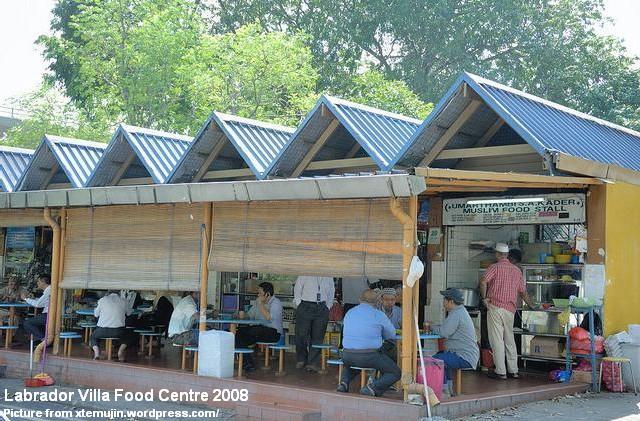
Labrador Villa Food Centre (1972-2008)

It was tiny, run-down and isolated, but Labrador Villa Food Centre was nothing but a gem for many who yearned old-time ambience with cheap authentic food.

Located at the junction of Alexandra Road and Pasir Panjang Road, the hawker centre with only 10 stalls, most of them selling Muslim cuisine, was popular among patrons working at the nearby factories and offices, hunting for their favourite mee goreng, nasi lemak or simply having an afternoon break with a glass of teh tarik.

Many expressed regret that the little hawker centre had to be demolished in 2008 to make way for the Labrador Park MRT Station and the development of Labrador Park into a seafood village.

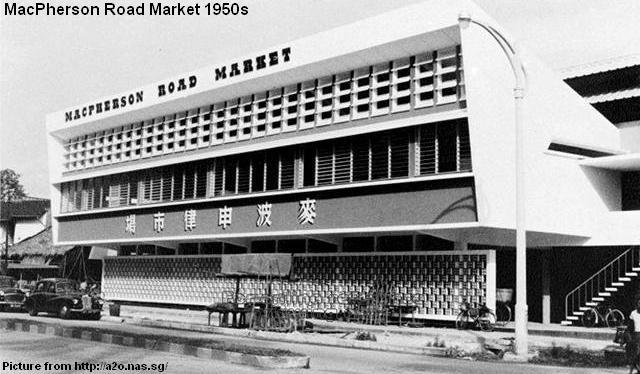
MacPherson Road Market (1955-1990)

The MacPherson Road Market was completed in 1955 at the junction of Upper Serangoon Road and MacPherson Road to serve the 22,000 residents living at Sennett Estate and other nearby districts.

macpherson road market 1950s

The market, with 200 stalls in its double-storey building, cost about $250,000. It was built by a local construction firm owned by Lim Kah Ngam, who was famous for his Federal House project at Kuala Lumpur.

In 1989, the land where the market was standing on was acquired by Lim Kah Ngam’s company for $2.1 million. The site was initially intended to be redeveloped for commercial and residential purposes. The first level of the market, however, was converted into a giant 24-hour kopitiam two years later, and the building renamed as Jackson Centre.

Lakeview Market & Food Centre (late 1970s-2000)

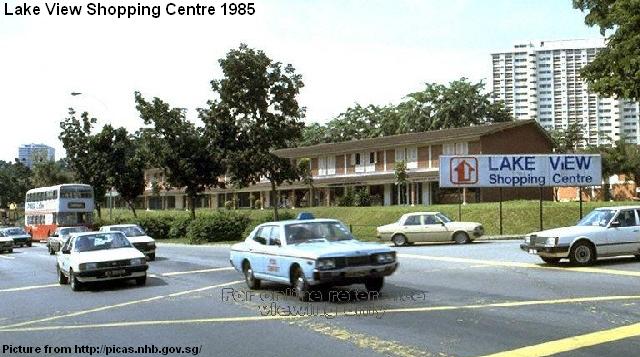
For almost 20 years, Lakeview Market & Food Centre remained a popular makan place for the residents living at Upper Thomson. The name Lakeview probably arose from the waterfront view of the nearby Macritchie Reservoir. At the same neighbourhood in the eighties also existed a row of HDB low-rise shops collectively known as Lake View Shopping Centre.

In 2000, the 168 stallholders had to shift when the hawker centre was demolished. After more than a decade of demolition, many loyal patrons are still missing and searching for the relocated stalls from Lakeview Food Centre that specialised in bak kut teh, duck rice, Hokkien mee, curry fish head, carrot cake, you zhar kway and other good food.

Today, only the old HUDC flats of Lakeview Estate and a few shops still carry the name Lakeview. As for the site of the former Lakeview Market & Food Centre, it remains an empty plot of land till this day.

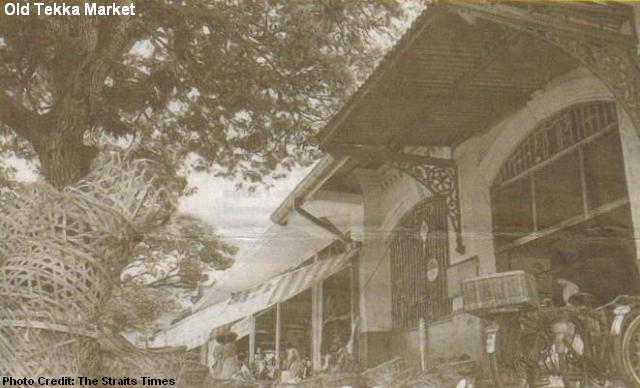
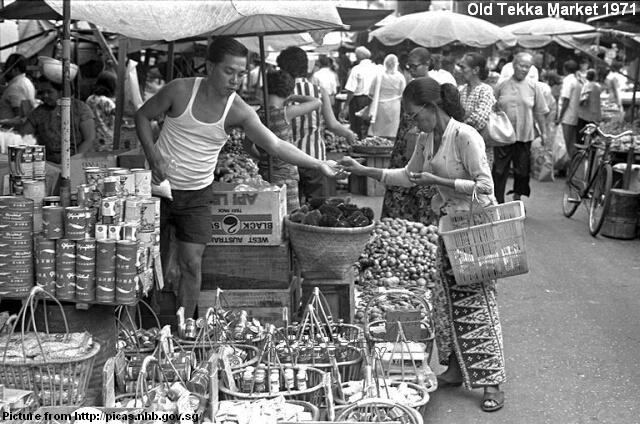
Old Tekka Market (1915-1982)

After it was completed in 1915, the Old Tekka Market became a notable landmark at Little India. Originally called Kandang Kerbau (KK), the name means “buffalo pens” in Malay, and it actually referred to the cattle slaughtering houses at Serangoon in the early 20th century.

Its name was later changed to Tekka Pasar, a unique combination in a name that made up of Chinese dialect and Malay, similar to that of “kopitiam“. Tekka means “the foot of the bamboo” in Hokkien while Pasar is “market” in Malay.

In the seventies, there were many makeshift stalls lined up along Serangoon Road outside Tekka Market. The bustling place, selling almost all sort of basic necessities, was extremely popular among the housewives, and attracted a large mixture of Chinese, Malay and Indian customers.

In 1982, Old Tekka Market was torn down to make way for the construction and widening of the nearby roads. All the stallholders were relocated to the new double-storey Tekka Market, also known as Buffalo Road Market, situated opposite the former old market. The new building, which houses a wet market, a hawker centre and rows of retailer shops, continues to demonstrate the multicultural cohesiveness and harmonious relationship between the local races of Chinese, Malay and Indian.

An interesting trivia about Tekka happened in the eighties, when the authority decided to change its name to Zhujiao, the hanyu pinyin version of the name, in a bid to suit the Speak Mandarin Campaign. The change did not go well with the locals, especially the non-Chinese. It was later officially reverted back to Tekka in 2000. The same thing happened elsewhere in Singapore, where the names of Bukit Panjang, Nee Soon and Hock Lam were changed to Zhenghua, Yishun and Funan respectively.

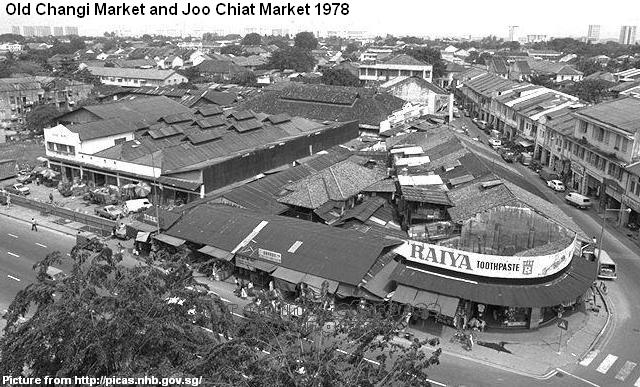
Changi Market and Joo Chiat Market (1930s-1979)

The Changi Market and Joo Chiat Market co-existed side by side for several decades, including the harsh Japanese Occupation, before their demolition in 1979. Changi Market, built in the late 1930s, was facing the main Changi Road, while Joo Chiat Market, completed in the early 1930s, faced the inner Joo Chiat Road.

In 1964, Geylang Serai Market was officially opened just opposite the main road, forming a unique and huge concentration of stalls and shops at the busy junction of Changi Road, Geylang Road and Joo Chiat Road. It became the main source of fresh produce, groceries and provision for the local Malays and Chinese. During its heydays, rows of trishaw riders lined up along the roads to fetch the housewives with heavy purchases home to the kampong nearby.

In the sixties and seventies, Changi Market was plagued by several fire hazards. A fire in 1971 destroyed 30 shophouses beside the white office building of Changi Market, resulting in a loss of almost $600,000. Six years later, a large fire raged through another block of shophouses. Finally in 1979, the two markets were torn down with plans of residential development. By 1984, the $37-million Joo Chiat Complex and its three blocks of flats had occupied the former site of the two old markets.

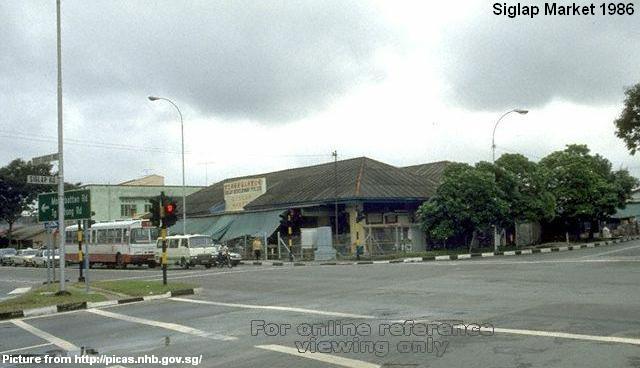
Siglap Market (1945-1989)

Beside being a wet market selling poultry, fish and other fresh produce, Siglap Market, located at the junction of Siglap Road and East Coast Road, also had many hawker stalls that were once famous for their traditional Teochew mee pok and kway teow, carrot cake and nasi lemak.

During the Chinese New Year in 1962, a large fire occurred near Siglap Market. Caused by firecrackers, the fire quickly spread and destroyed 50 attap houses in the nearby kampong.

When Siglap Market was planned for closure in 1982, more than 200 vendors and hawkers rejected the compensation and held on to their stalls as a protest. The private market’s owner, Siglap Development Private Limited, could not reach a compromise with the stallholders, causing the case to drag on for years. It was not until late 1988 when the agreement between the company and the stallholders was reached, and Siglap Market finally closed for good on the first day of 1989.

The site of Siglap Market is now occupied by Siglap Centre.

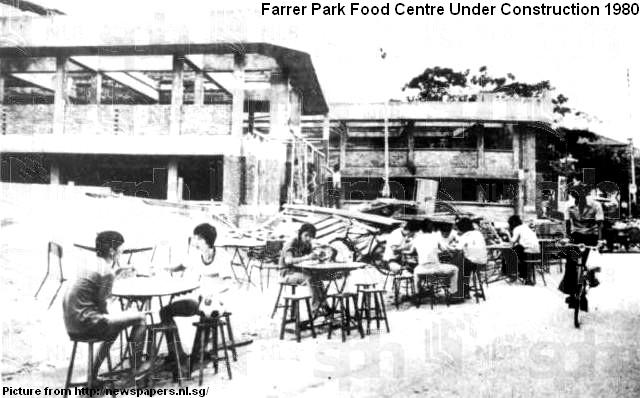
Farrer Park Food Centre (1980-late 1990s)

Before the double-storey Farrer Park Food Centre was constructed in 1980, Northumberland Road was lined up with 20 food stalls with hundreds of customers slurping their food at the tables by the roadside. This scenario lasted for decades, enjoyed by football fans who could catch their teams playing at the Farrer Park Field while having delicious local delights.

A combination of factors such as hygiene, traffic congestion and open-air stalls, which were vulnerable to rains, prompted the authority to plan a hawker centre at Farrer Park. While the $1.6-million project was welcomed by many, others preferred the old way because the football fans could no longer able to watch their games and eat at the same time.

Farrer Park Food Centre was affected by the construction of the North-East MRT Line and had to make way in the late nineties. With its large selection of good food, it was missed by many. Beside wanton mee, rojak, chilli crab, fried carrot cake and other good food, there was a particularly famous stall that sold prawn noodles in pre-war Hokkien-style.

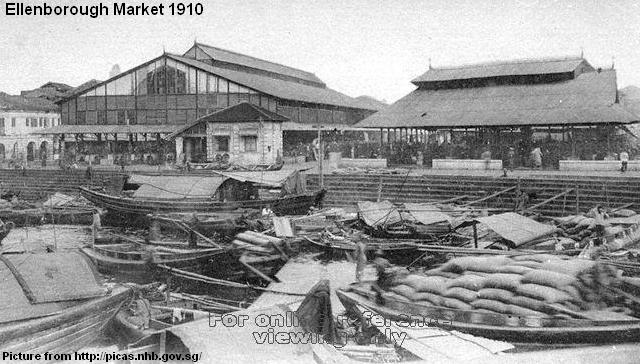
Ellenborough Market (1845-1968)

Named after Lord Ellenborough, Edward Law, also 1st Earl of Ellenborough and Governor-General of India (1841-1844), the market was built in 1845 near New Bridge Road by the Singapore River, serving as both a market and a trading post. The street it was situated on was also named as Ellenborough Street.

After a new cast-iron market was built in the late 1890s on the site of the original market, Ellenborough Market became known as the “New Market”, or “Pasar Bahru“, to the local Malays. Many Teochews moved in as hawkers to sell their food, and the market soon became well-known as the “Teochew Market”.

In early 1968, the market was destroyed in a large fire. More than a thousand hawkers lost their stalls. Ellenborough Market was never rebuilt or restored after that. It was left abandoned for a few years before being demolished in the early seventies. Meanwhile, Ellenborough Street survived till the nineties when it became defunct in the development of the Boat Quay area.

Clyde Terrace Market (1872-1983)

Built on reclaimed lands near the junction of Rochore Road and Beach Road, the Clyde Terrace Market, like Ellenborough Market, had been in existence for more than a hundred years.

Otherwise also known as Beach Road Market, the stalls at Clyde Terrace Market engaged in a wide variety of goods and fresh produce such as fish, chicken, fruits, vegetable and dried food. Its fish section was closed in the early seventies, replaced by the new Jurong Fishing Port and Central Fish Market. Other sections endured until June 1983, when the stallholders eventually moved to market at Pasir Panjang.

The Gateway, a 37-storey commercial building, now stands at the former site of Clyde Terrace Market.

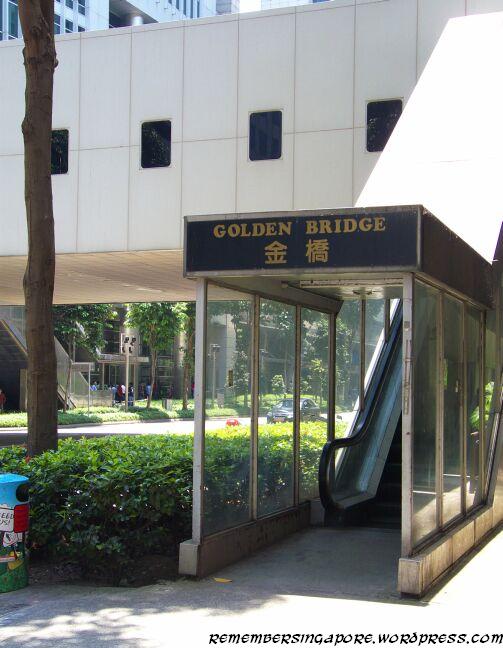
Golden Bridge Food Centre (1973-2011)

It looks like one bulky overhead bridge on the outside, but internally, it once housed dozens of hawker stalls which enjoyed brisk business at Shenton Way on busy weekday afternoons.

When its 30-year lease expired in 2003, the Singapore Land Authority (SLA) wanted to demolish the bridge and redevelop the area around MaCallum Street, but the plan was shelved for another couple of years. In early April 2011, the shops and hawker centre at Golden Bridge finally ended their businesses. Many stallholders, some of them had operated at Golden Bridge for some 30 years, had to look for other alternatives.

In late 2011, however, the Golden Bridge was reopened for food and beverage and retail businesses again, this time on a short-term three-year lease, with the monthly rental fees risen to more than $9,000. The plan to demolish the bridge was shelved once again, causing displeasure to many former tenants who felt that they should not be forced to move out in the first place.

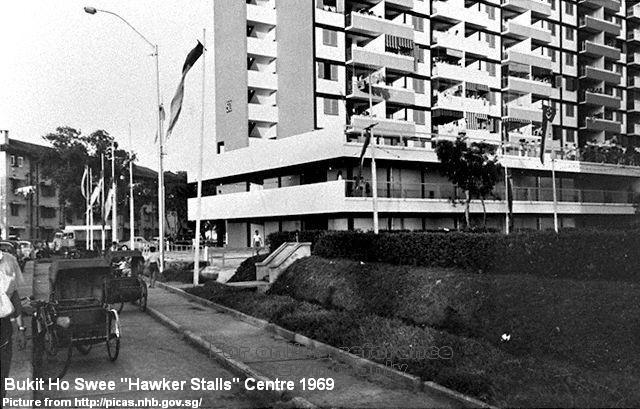
Bukit Ho Swee Markets & Hawker Centre (1966-1980s)

After the squatter settlements at Bukit Ho Swee were destroyed by two fires in 1961 and 1968, the government embarked on a housing project to resettle the homeless residents.

A new Hawker Code was implemented in 1966 to control and license the street hawkers. Since the implementation, many street hawkers were relocated to markets and shophouses where water supply, electricity and refuse bins were provided.

During its rebuilding, Bukit Ho Swee was also involved in the relocating of street hawkers. Balloting of the stalls began as early as 1966, while the “hawker stalls’ centre” was officially opened three years later. The venue would become the predecessor of the Bukit Ho Swee Hawker Centre.

Beside having the venue for the hawkers to ply their trades, two wet markets were also established at Bukit Ho Swee. In 1979, one of the markets was renamed as Membina Barat Market. The market, together with the road Jalan Membina Barat where it was located, was later replaced by new HDB housing estates.

Some hawker centres do make a comeback.

Taman Serasi Hawker Centre, located at Cluny Road and reputed to serve the best Roti John in Singapore, returned in 2006, although it is now known as Taman Serasi Food Garden. It was demolished in 2004 as part of the redevelopment plans of Botanic Gardens.

Let’s hope in the future, the hawker centres can continue to provide us with our favourite delicious Singaporean food at affordable prices.

Anyone feeling hungry already?

Published: 27 August 2012

Updated: 16 May 2013

Posted in Historic | Tagged , , , , , , , , , , , , , , | 108 Comments

Sipping Teh at a Kampong Kopitiam

I was reading about the kampong kopitiam” on the Chinese newspaper, and decided to pay a visit one morning.

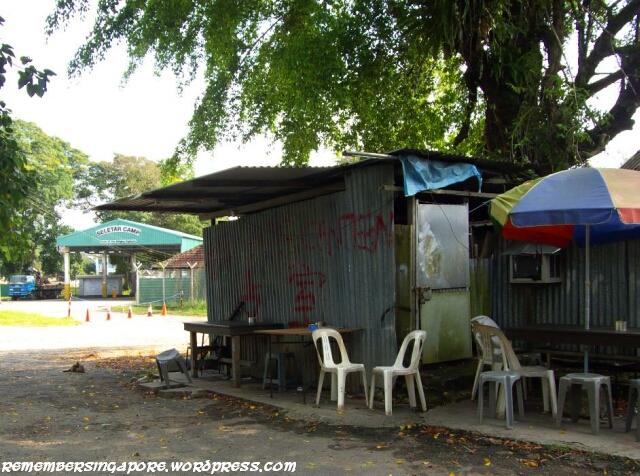
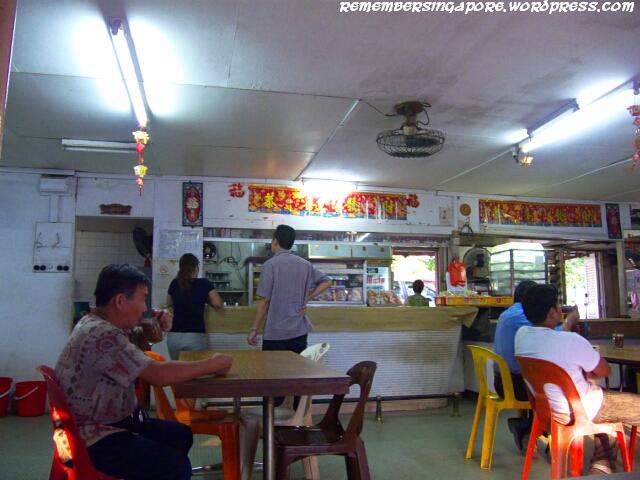
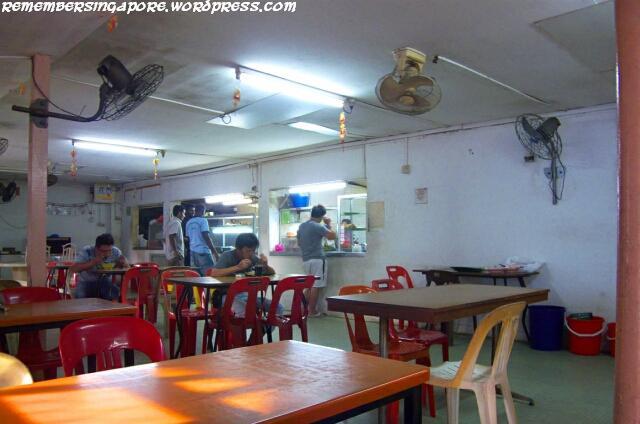
Looking nothing like a typical coffeeshop found elsewhere in Singapore, it actually resembles more of an old school tuckshop. Housed in a single-storey colonial-styled building and named 398 Canteen, the kopitiam sits quietly at a corner along Piccadilly Road just a few steps outside the Seletar Camp.

Established in 1969, the canteen now serves mainly the NS personnel from the Seletar Camp, construction workers and some of the residents living nearby. In its early days, it enjoyed brisk business from the British military stationed at Seletar.

Sipping my teh quietly, I was enchanted by the nostalgic charm of the kopitiam which reminded me of the old army canteens I once frequently patronised during my NS days. It was a nice retreat away from the city life, as my morning seemed to be passing by slowly.

Inflation, too, seems unaffected here. According to the boss of the kopitiam, Mr Toh Ee Cheng, 62, the prices of the kopi and teh remain at 70/80c while a simple plate of nasi lemak is $1.

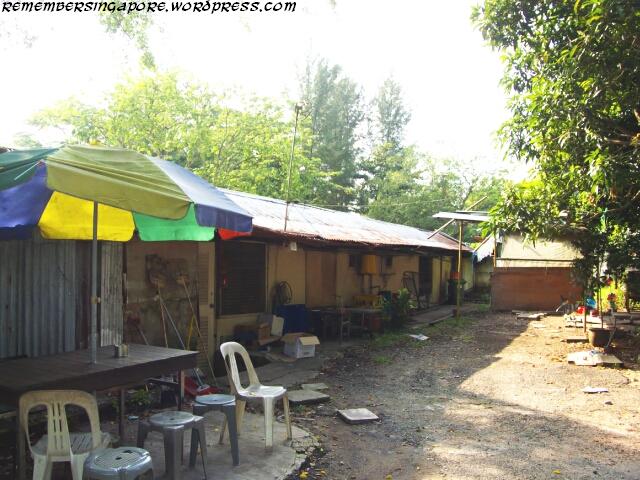
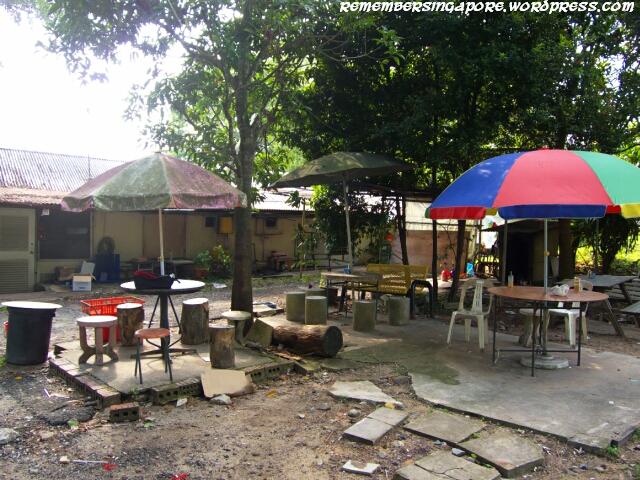
The customers can also choose to sit outside, under the trees and surrounded by sounds of cicadas. Little has been changed in the appearance of this forgotten place for the past decades.

However, Seletar itself has seen tremendous changes in recent years, due to the development of the new Aerospace Hub. Many old black and white colonial houses within the compound had already been vacated and demolished. Come December 2012, the 43-year-old kampong kopitiam will cease operation due to the expiring of its lease. Like many others, it will then formally walk into the history and disappear in the face of a modern Singapore.

Published: 24 August 2012

Posted in Nostalgic | Tagged , , , | 27 Comments

Singapore’s Most Enduring Ghost Stories

The smoke from the burning of incense, the noise of the busy getai and wayang, and the offerings by the roadsides tell us that the annual Hungry Ghost Festival is here. According to the Chinese beliefs, the first day of the seventh Lunar month signals the opening of the “Gates of Hell”. The festival, practised by many local Chinese, has been a traditional custom in Singapore and Malaysia for decades.

In addition to The Top 10 Haunted Places in Singapore, RemSG sorts out Singapore’s 11 Most Enduring Local Ghost Stories, or at least in the past 30-odd years, where these hugely popular stories were passed down word-by-word and generation-by-generation. While some of the stories may have become over-exaggerated, others are favourite topics in chit-chat sessions or chalets. But one thing for sure, these favourite ghost stories will not go away easily in the next decade or so.

1. Tekong’s Three-Door Bunk

This might be Singapore’s most popular army ghost story ever, spread by batches after batches of national servicemen since the eighties. The story had several variations, but the most popular version goes like this:

The recruits from Charlie Company were having a tiring route march on Pulau Tekong. One of the recruits was feeling sick but he pushed himself to continue. The night was falling and it began to drizzle. Finally the recruit could not catch up with the rest and fell out from the company. At about the same time, another recruit who had reported sick earlier joined the route march. The sergeant did not suspect anything after a headcount check.

Concerned that the sick recruit did not catch up after some distance, his buddies decided to inform the sergeant. The route march was quickly called off and two search parties were dispatched to find the lost boy. But the search proved to be unsuccessful. It was not until the next morning when the recruit’s cold body was found sitting by a tree near the track, with his fullpack, helmet and rifle lying nearby neatly.

After the incident, other recruits from the Charlie Company started to experience sightings of the dead recruit in the bunk. A medium was consulted after several complaints to the officers. The medium proposed the opening of a third door in the bunk to allow the trapped spirit to escape.

The old bunks, including the “special” three-door bunk, had since been replaced by newer facilities in the early 2000s.

2. Hell Money for Taxi

While the Filipinos has their fair share of ghost stories of the notorious Balete Drive, where a female ghost in white scared the hell of taxi drivers, we have our own supernatural stories whispered by our local taxi uncles too.

For years, the story was almost certain to be one of the talking points during a kopi session. It usually took place after midnight at an ulu place such as Old Tampines Road, Punggol Road, Mount Pleasant Road, Old Upper Thomson Road or Lim Chu Kang Road, where a lady in white or red flagged down a taxi.

Her destination was always the cemetery, which made the innocent taxi driver wondering why on earth would someone visit the cemetery at such an ungodly hour. The journey was eerily silent even though the taxi uncle tried to strike a conversation.

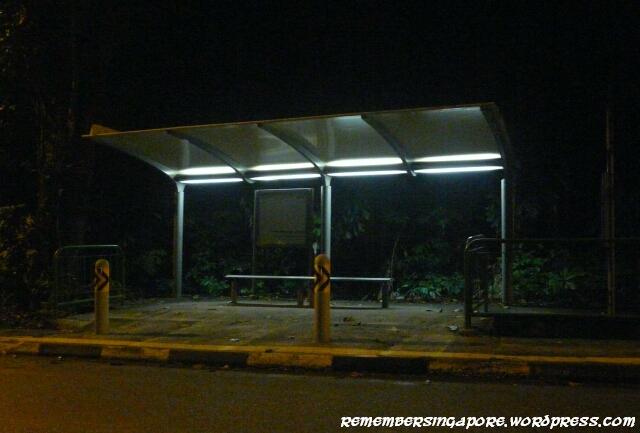
punggol road bus stop

Upon reaching, it seemed nothing was wrong when the lady paid her fare, but after the taxi driver finished his night shift, he received a big scare when hell notes were found among his daily income.

3. Oily Ghost

Not to be confused with the delicious and crispy you zha kueh (油炸鬼), the story of the oily ghost or orang minyak (known as 油鬼仔 in Chinese) was rife in the old kampong days in the sixties. Said to be a ghost, covered in thick black oil, who went around violating unmarried women sleeping alone. His power would increase if “it” succeeded in raping 40 virgins in a week. The method to counter orang minyak was to bite its left thumb and cover it with batik.

However, the more rational theory is that orang minyak was actually a human rapist who soaked himself in oil so that others could not catch hold of him. The legend of orang minyak has slowly faded away in Singapore of modern era, but it is widely believed that the oily ghost still occasionally disturbs the villages in Malaysia.

4. Selling Salt in Cemetery

Only a brave or a desperate man would do this. It was rumoured that selling salt in a cemetery was one of the easiest ways to earn money. Ghosts need salt, lots of salt, to preserve their decomposing states.

The courageous one first had to pack the salt in many packets for his business, so that his supply would not run out. Before dusk, he would make his way to a suitable spot in the cemetery. There he sat down comfortably with his head bowed, and waited patiently for his “customers”. There were two important rules for this business; he must never look up at all times, and he must never fall asleep or leave his spot before the dawn. Any violations would endanger his life greatly.

The brave man had to resist any urge to peep at his “customers”, who would place the money on his hands after taking the salt. When the first light arrived, the man must quickly pack up and leave with his stack of cash, which would not turn into hell notes, unlike the poor taxi driver.

5. Black Magic (Gong Tau)

Black magic, or gong tau (降头), was a popular topic for discussion especially in the Southeast Asia. Scorpions, centipedes, snakes, spiders, corpse oil, strands of hairs or bits of fingernails were often the items associated in making powerful charms for revenge, love enhancement or simply a change of luck.

Likely to be originated from Yunnan of China; some said it was the work of Maoshan Taoist priests, black magic flourished in Southeast Asian countries such as Thailand and Indonesia. Many locals in Singapore also believed in black magic, especially when things in life went wrong. It was said to be extremely difficult to heal a person suffered under a strong curse, and the one who placed the curse usually had to pay a high price in the end.

Interest in black magic reached its peak in Singapore in the seventies, thanks to the influence of many scary gong tau movies made popular during that era.

6. Toyol (Gui Kia)

Toyol, on the other hand, was a child spirit used to create mischief or steal money from others. It was also known as qi gui kia (养小鬼) in Hokkien. In the early days, there were consistent rumours that the hardcore gamblers would keep toyols to help them win money in chap ji kee.

The way of creating a toyol was gruesome. The bomoh would get his human foetus, usually just died from abortion or miscarriage, from the cemetery and placed it in a jar. After the some rituals, the spirit of the fetus was revived, and it was sold to anyone who wanted to keep it for his own personal gains. He would then need to feed it everyday, sometimes with his own blood.

It was not uncommon to hear stories that the toyol would later become too rebellious and uncontrollable. Or it simply went berserk after the owner forgot to feed it regularly. In the end, he was killed by his “money-making tool”.

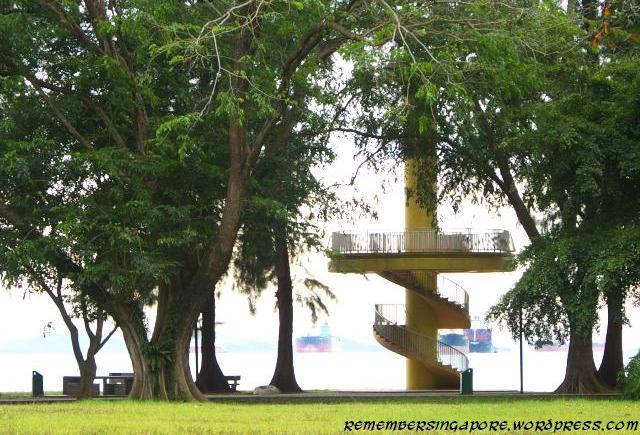
7. The Haunted East Coast Yellow Tower

Many years ago, a loving couple was taking a stroll at East Coast Park at night. They arrived at the quiet and isolated Amber Beacon Tower near Carpark C. Suddenly a group of thugs appeared and knocked the guy unconscious. They brutally gang-raped the poor girl, and proceeded to stab her to death after that.

Ever since then, passers-by claimed to see sightings of a female apparition near the yellow tower. Others heard screams of help, but found nothing when they searched the tower. It was said that the criminals were never caught and the spirit of the girl was weeping about her ill-fated life every night.

8. The Banana Spirit

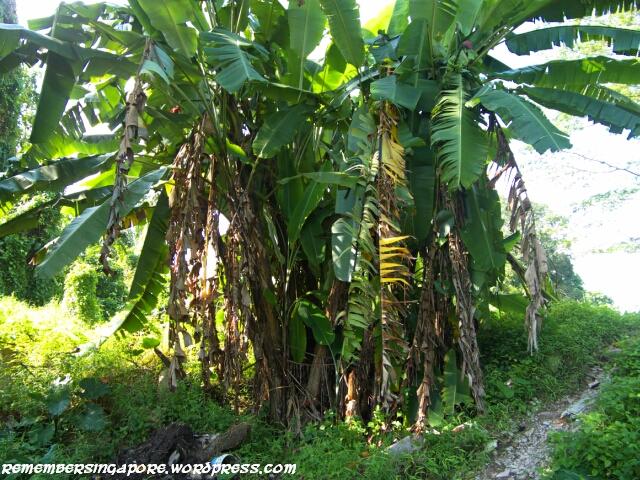
The desperate man heard a story on how to control the banana spirit to help him strike 4D, so he went and struck a needle into the trunk of a banana tree, tying a long red thread between the needle and himself. The man then waited patiently until the night fell. Soon he heard a wailing sound. It was the banana spirit pleading him to remove the needle as it hurt her terribly. Having the bargaining chips, the man asked for the winning 4D numbers in exchange for her freedom.

banana trees at lorong terigu

Weeks after weeks, the man’s greed grew and he kept asking for more winning numbers, failing to keep his promise to release her. Soon, he became a rich towkay. Arrogant and unscrupulous, the man soon offended many people. One of them found out the source of his wealth and subsequently removed the needle from the banana tree.

The next day, the man was found dead, in a horrible manner. The banana spirit finally had her revenge.

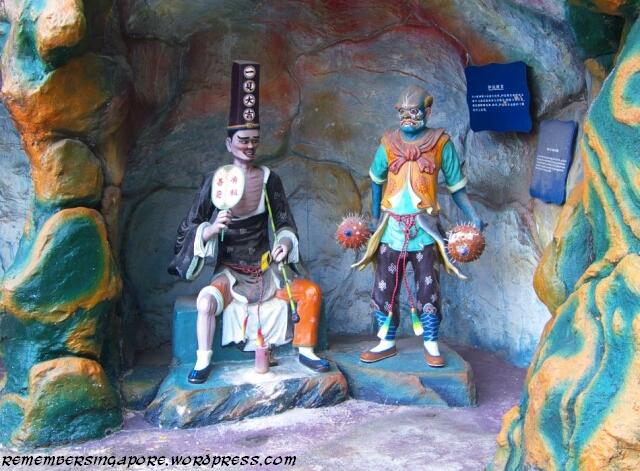
9. Haw Par Villa Statues

Today, it is a sad plight to a former popular place of interest and tourist attraction, but Haw Par Villa is more than a place that showcases Chinese mythology. Its lively statues, and the famous Ten Courts of Hell, are the source of nightmares to the young kids who used to come here for school excursions during the eighties and nineties.

haw par villa statues

It was once rumoured that Haw Par Villa was the location of the gates to Hell. Security guards would tell their stories that how the place became alive when nights fell. Others had heard painful screams from the statues depicting gruesome punishments in the Ten Courts of Hell.

Ghost stories had plagued Haw Par Villa for decades. There were whispers that some of the statues were actually dead humans covered with wax. And on a small deserted hill within the theme park existed a dumping site where several unused statues were abandoned for many years. Old staff claimed that these unwanted statues were possessed by wandering spirits.

Real or just urban legends? Only the brave will attempt to find out.

10. Pontianaks

The pontianak was perhaps the most famous supernatural being in Singapore and Malaysia. In Malay folklore, it was the vengeful spirit of a woman who died tragically during childbirth (or pregnancy). Long haired and dressed in white, the pontianak flew around between trees, sometimes taking forms of birds, looking for pregnant women to kill for their foetus.

In the early kampong days, young pregnant women were particularly concerned about the legends of pontianaks. Unusual wails or sounds of scratching at nights were signs that a pontianak was nearby, ready to prey on its next victim. Long nails were kept within the house as pontianaks were afraid of sharp objects.

There was a well-known story about pontianak in Malaysia, in which a couple travelled on the North-South Highway (NSHW) at night. Halfway through their journey, their car broke down, beside some ulu plantations. The husband decided to find help elsewhere, while his wife locked herself in the car. After a while, a police patrol car passed by and stopped some distance away. The policemen rushed out of the car and screamed to the woman, urging her to get out. The wife obliged and ran towards the police car. When she eventually turned back to take a look, she saw a pontianak eating the flesh of her dead husband on top of her car.

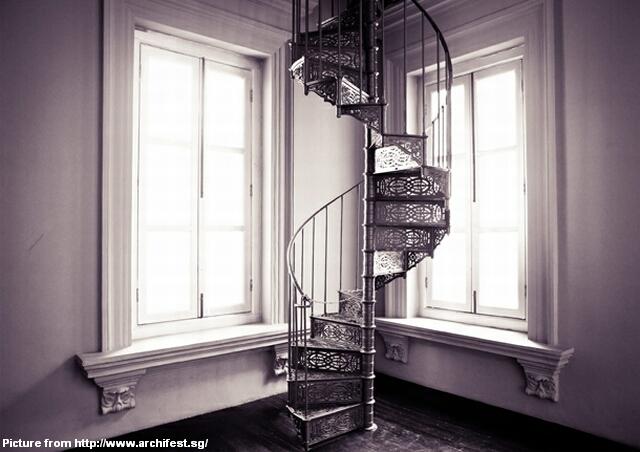
11. Spiral Staircase at the National Museum of Singapore

The Victorian-styled spiral staircase is reputedly the most haunted part of the century-old museum, first built in 1882. Sightings of the spirit of the former museum director, British doctor and zoologist Carl Alexander Gibson-Hill (1911-1963), were repeatedly reported. A diabetic and heavy smoker, Gibson-Hill suffered poor health in his latter years and was rumoured to have committed suicide in 1963.

Standing at the corner of the room, flanked by two large windows, the staircase, leading to the rooftop, is now inaccessible to the public. However, witnesses claimed that in the past, any daring souls who attempted to climb it were said to be stopped by an invisible force.

Even after the restoration of the museum in 2003, the spiral staircase still gives visitors a chilling feeling, or is it due to the aircon?

Published: 17 August 2012

Updated: 23 April 2014

Posted in Paranormal | Tagged , , , , , , , , , , , | 47 Comments

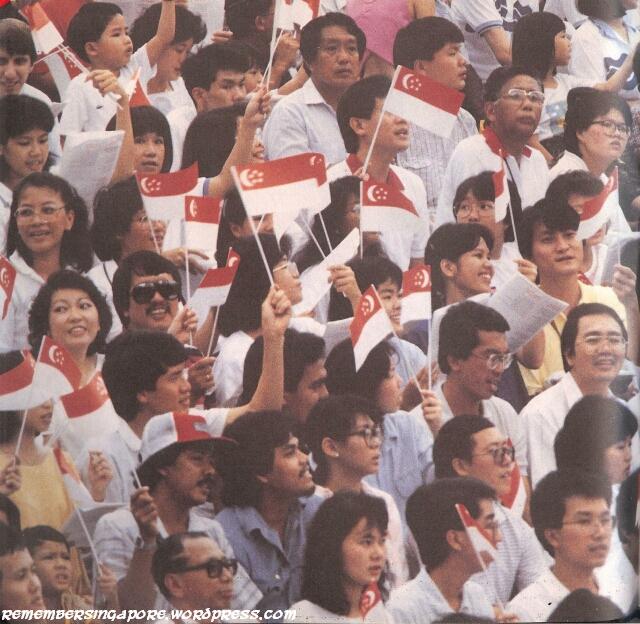
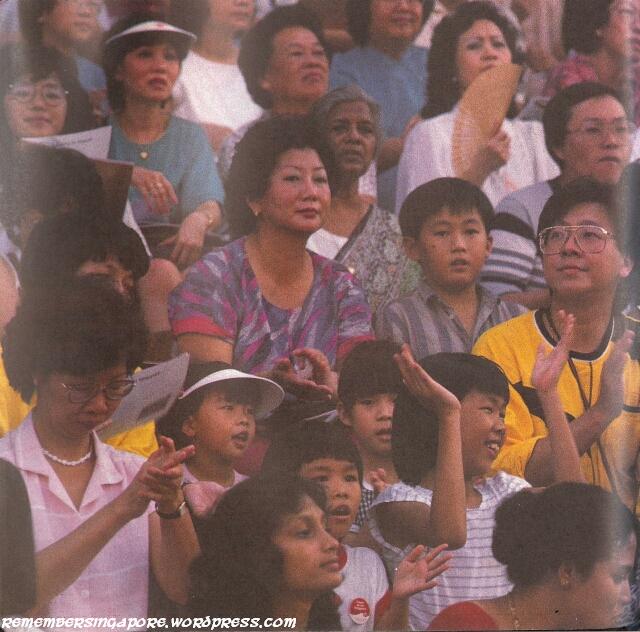
Those Favourite National Day Songs We Once Sang

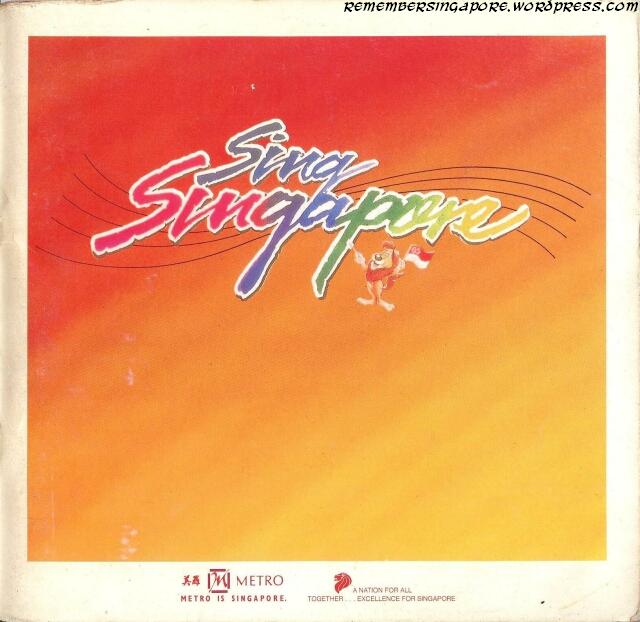
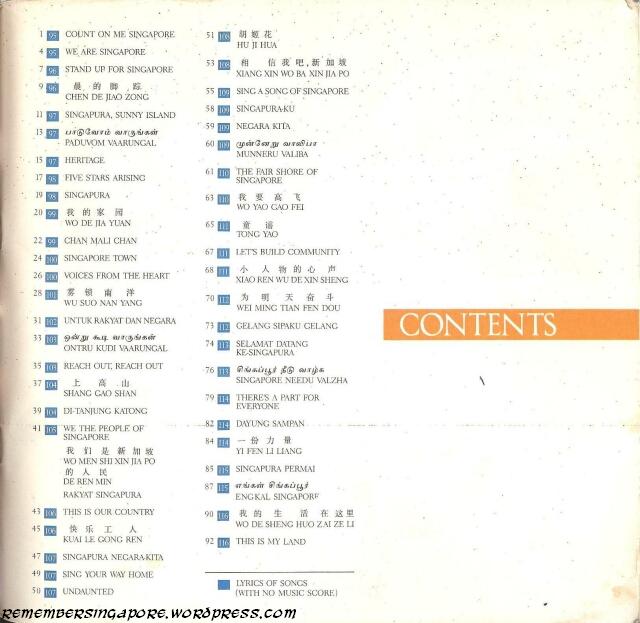
Sing Singapore was a song book published in 1988 by the Ministry of Communications & Information. If I remember correctly, every student that year received one copy.

As written in the message of the first page, this simple book of 47 patriotic and community songs of all four main languages reflects the diversity of our culture, the history of our people, and the evolution of our nation.

Stand Up For Singapore (1984)

Lyrics and Music by Hugh Harrison

We Are Singapore (1987)

Lyrics and Music by Hugh Harrison

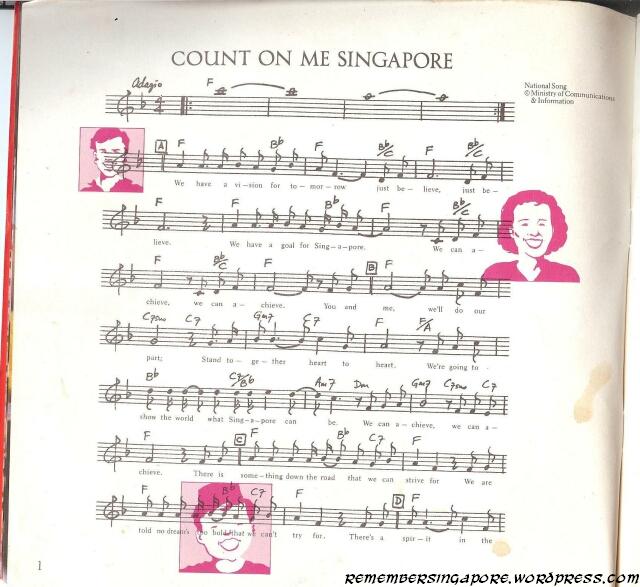
Count On Me Singapore (1986)

Lyrics and Music by Hugh Harrison

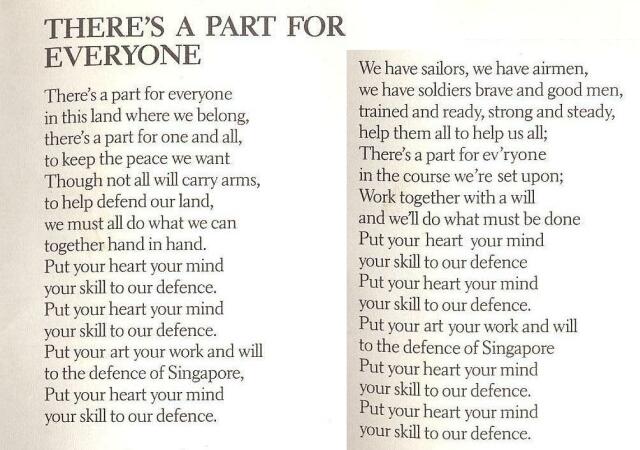
There’s A Part For Everyone (1984)

Lyrics and Music by Gerald Png


Five Stars Arising (1969)

Lyrics and Music by Lim Su Chong

This Is My Land (1980s)

Lyrics by Derrick De Alwis, Music by Goh Say Meng

Other than the well-known National Day songs above, the book also includes other popular ones such as Chan Mali Chan, Singapura Sunny Island, Sing A Song For Singapore雾锁南洋 and 我的生活在这里.

One, People, One Nation, One Singapore, though, was not recorded in the book because the song was composed in 1990.

One People, One Nation, One Singapore (1990)

Lyrics by Jim Aitchison, Music by Jeremy Monteiro

Happy 47th Birthday, Singapore!

Published: 08 August 2012

Updated: 08 August 2020

Posted in Cultural | Tagged , , , , , , , | 10 Comments

A Century of Cinemas, Movies and Blockbusters

Watching movies is one of Singaporeans’ favourite pastimes, along with dining and shopping. A nation of avid movie-goers, the locals have been going to cinemas for movies for more than a century! In 2009 alone, the cinema attendance was as high as 19 million.

One Century Ago

In 1902, the first public screening took place at a tent in an open space between River Valley Road and Hill Street. Two years later saw the opening of the first ever movie theatre in Singapore. It was the Paris Cinema at Victoria Street. Subsequently two other theatres also opened at North Bridge Road and Bidadari Road at about the same period.
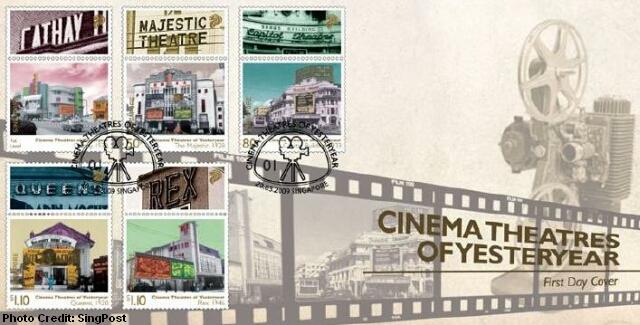
By 1906, Beach Road had a theatre named “La France”. The famous Alhambra Theatre was built at the junction of Beach Road and Middle Road a year later. The concentration of theatres at Beach Road in the next few decades prompted the area to be dubbed as “the place of cinemas”.

The 20s And 30s

Two prominent cinemas were built at New Bridge Road of Chinatown in the late 1920s, namely the Oriental Theatre and the Majestic Theatre. Majestic Theatre started off as a Cantonese opera theatre, before being converted into a cinema in 1938.

The first golden period of cinemas in Singapore occurred in the 1930s, when more than nine cinemas sprung up from Dhoby Ghaut to Katong, including Cathay, Capitol, Marlborough, Palacegay, Pavilion, Roxy, Surina, Tivoli and Wembly.

The Japanese Occupation

During the Japanese Occupation, western films were banned and many large cinemas, such as Capitol, Oriental and Majestic, were occupied by the invading forces. Renamed in Japanese names, they were then used to screen Japanese propaganda flicks in an attempt to justify their invasion of Asia.

After the War

The movie industry thrived after the war. Established giants such as Shaw Organisation and Cathay Organisation expanded their cinema empires aggressively. They would be later joined by another prominent player in Eng Wah.

The Cinema Kings

Lim Chong Pang (1904-1956), surprisingly, was a notable contributor in the local movie industry. As a member of the Singapore Rural Board, he was aware of the importance of entertainment needs for the residents. When his father Lim Nee Soon passed away in 1936, Lim Chong Pang took over and managed a number of cinemas in Singapore. By then, he became well-known as the “cinema king” of Sembawang. Two of the most prominent theatres under him were Sultan Theatre and Garrick Theatre (later known as Galaxy Cinema).

In the 1920s, two Shanghainese brothers Runme Shaw (1901-1985) and Run Run Shaw (1907-2014) arrived at Singapore to carve out a career, establishing the Shaw Organisation (邵氏院线) in 1924. With the success of their first cinema, the Empire Theatre at Tanjong Pagar, the Shaw Brothers began expanding aggressively into Malaya.
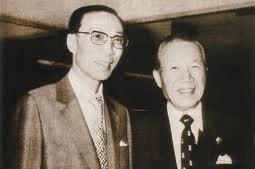
From silent movies to Chinese and Malay films, the Shaw Brothers owned more than 100 cinemas in much of Southeast Asia by the end of 1930s. The Second World War put a stop to their movie empire but the Shaws were able to make a stronger comeback after that.

By 1965, Shaw Organisation had the widest cinema network in Singapore, with 19 cinema halls and another 30 that were licensed to play their distributed movies. The twenty years between the sixties and eighties represented another golden period in Shaw Organisation’s famous Chinese kungfu movies.
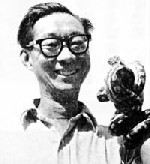
Loke Wan Tho (1915-1964) was the founder of Cathay Organisation (国泰院线). Born in Kuala Lumpur in 1915, Loke Wan Tho was the ninth son of Loke Yew, the richest man in Malaya during the early 1900s. Despite inheriting his father’s mines and plantations, Loke Wan Tho’s interest was in movies. In 1935, he established Associated Theatres Ltd, and started building cinemas in Kuala Lumpur and Singapore.

At his peak, Loke Wan Tho’s company produced hundreds of Malay and Chinese movies, and owned cinema chains in Hong Kong, Thailand, Malaysia and Singapore. Loke Tho Wan was also credited for creating the golden era of Hong Kong movies from the fifties to sixties. In 1953, Associated Theatres Ltd was renamed as Cathay Organisation. Loke Wan Tho, however, died in a plane crash at Taiwan in 1964. He was only 49.

The founder of Eng Wah Organisation (荣华院线) Goh Eng Wah was born in 1923 at Muar, Malaysia. During the Second World War, he fled to Singapore. In 1945, at an age of only 21, Goh Eng Wah started a cinema with a friend at the Happy World Amusement Park. Called Victory Theatre, it screened many Japanese propaganda films. The success of his first venture encouraged him to acquire another cinema Happy Theatre soon after the war came to an end.
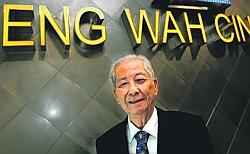
In 1968, Goh Eng Wah established Eng Wah Theatres Organisation Pte Ltd, bring countless Chinese movies from Hong Kong and Taiwan to the audience of Singapore. After the eighties, in an attempt to suit the taste of young Singaporeans, Eng Wah Organisation began to bring in films from Hollywood.

A much newer cinema operator compared to others, Golden Village (嘉华院线) came into prominence in May 1992 when they opened their first cinema Yishun 10, Asia’s first multiplex, at Northpoint Shopping Centre. Golden Village is a joint venture company between Australia’s Village Roadshow Limited and Hong Kong’s Orange Sky Golden Harvest, previously known as Golden Harvest. Golden Harvest, founded in 1970, was famous for its kungfu films starring Bruce Lee and Jackie Chan.

Then and Now
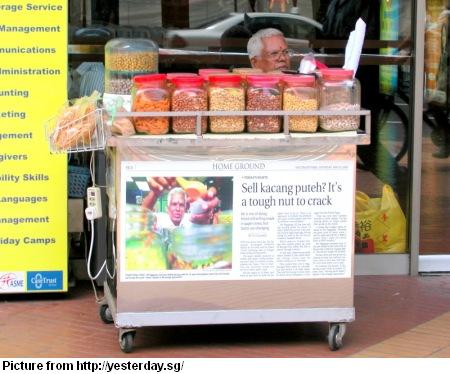
Over the years, the rising standards of movies also saw the increasing expectation of the cinemas by the movie-goers. The cinemas had gone from open air to air-conditioned; the films went from reels to digital to 3D. Even the habits of the movie-goers changed over time; they now prefer popcorn than kacang puteh.

Ushers would shone their torches onto the small paper tickets and directed the audience to their seats. Before the multiplex era, the screens were covered by curtains which would be then drawn partially during displays of advertisements and trailers. Only when the movies started would the curtains be drawn fully.

The local cinema industry had its golden era in the late seventies, but was hit by video piracy and recession in mid-eighties. The number slowly picked up again after the nineties, coincided with the comeback of Hong Kong films. Hollywood blockbusters, meanwhile, dominated the 2000s with their superior computer effects.

Vanished Cinemas and Theatres

The old cinemas each had their horrifying tales. Bug-infested seats, stained fabrics, dirty toilets or ghost stories were the common ones. But regardless of any era, the cinemas remained popular with the Singaporeans hungered for movie entertainment.

The list of Singapore’s old cinemas, most of them had already shut down, is arranged below in an alphabetical order. The newer cineplexes are not included.

Arcadia Cinema, East Coast Road (1920s)

Arcadia Cinema was one of the earliest cinemas in Singapore, opened by proprietor Wee Teow Beng. It was located at East Coast Road, showing English movies that were mainly catered to the upper class that lived around Tanjong Katong.

Alhambra Theatre, Beach Road (1907-1960s)

Opened in 1907 by motion picture industry pioneer Tan Cheng Kee at the junction of Beach Road and Middle Road, Alhambra Theatre (新娱乐戏院) was built near the sea, decades before the land reclamation that now stretches the coastline 500m away. The site was then known as hai kee or seaside, where one could hear the waves crashing against the walls of the cinema during high tides.
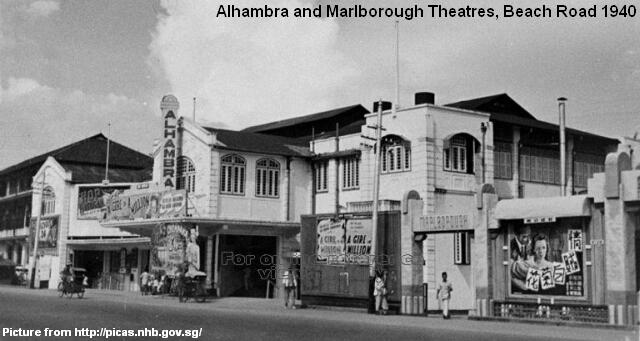
Alhambra Theatre was bought by the Shaw Brothers in the 1930s, and became Singapore’s first cinema that was fully air-conditioned. During the fifties, the cinema was renamed as New Alhambra. Its name was changed again to Gala Theatre after being taken over by Cathay Organisation which gave the building a series of renovations. Its previous glory was revived when the original Satay Club was set up near the building, attracting crowds from all parts of Singapore.

Alhambra and Marlborough Theatres would later be demolished and replaced by the Shaw Towers in 1970 (see Jade Theatre and Prince Theatre).

Ang Mo Kio Cinema, Ang Mo Kio Central (1980s)

Part of the group of four cinemas at Ang Mo Kio central, Ang Mo Kio Cinema (宏茂桥戏院) was the smallest of all as well as the earliest to cease its operation. After its closure in the mid-eighties, the building was converted in what is known as Big Mac Centre today.

Bedok Cinema, Bedok Town Centre (1980-2006)
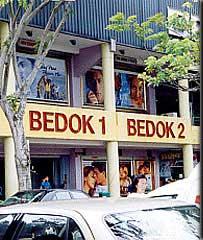
Cathay Organisation-owned Bedok Cinema (北斗戏院), standing next to Changi Theatre at Bedok Town Centre, used to screen Chinese and English films in the eighties and early nineties. It was opened in February 1080, screening Hong Kong actor Richard Ng’s Murder Most Foul on its debut day. The cinema was converted into Bedok 1 and Bedok 2 in 1990, after which it was leased to Golden Village temporarily.

An independent operator took over the cinema in 1996, specialising in Hindi and Tamil movies, until its closure a decade later. Together with Shaw Brothers’ Changi Theatre, it was then torn down and a brand new Bedok Point now stands in its place.

There were once four old cinemas at Bedok Town Centre, namely Bedok, Changi, Liwagu and Princess/Rajah. All four of them had ceased their operations by the end of 2000s.

Broadway Cinema, Ang Mo Kio Central (1980s-late 1990s)
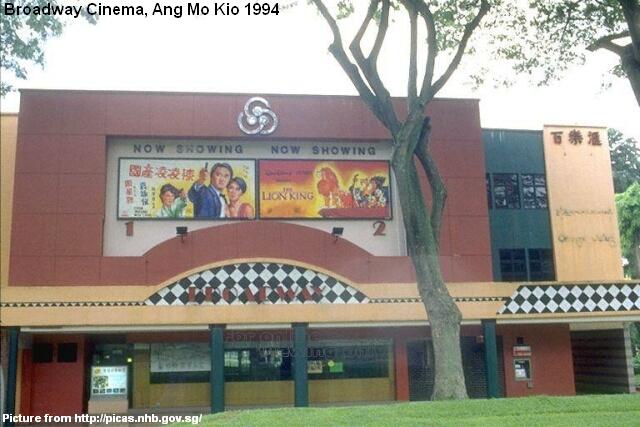
Broadway Cinema (百乐汇戏院) was strategically located beside the popular Ang Mo Kio Central hawker centre in the nineties. Equipped with two halls, it was operated by the Cathay Organisation, followed by a brief period by Golden Village.

The building was sold for $9 million in 2000, and is now called Broadway Plaza.

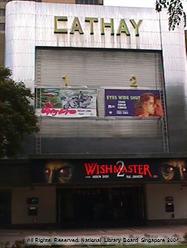
Cathay Cinema (Old), Handy Road (1936-2000)
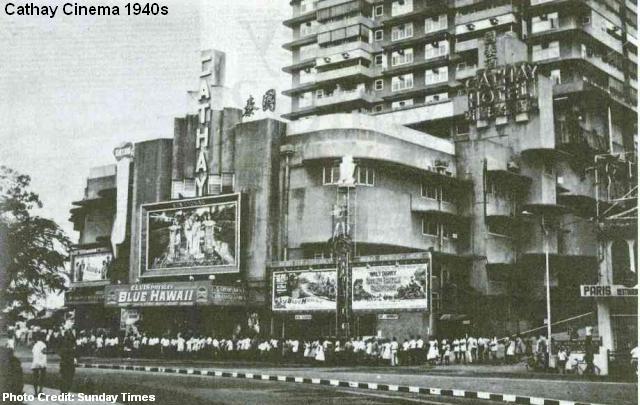
Cathay Cinema (国泰戏院), with its Cathay Hotel, was Singapore’s first skyscraper and the tallest building in Southeast Asia when it had its grand opening in 1936. More than one thousand fans packed into the cinema, Singapore’s first fully air-conditioned cinema, to catch the premier of “The Four Feathers”.

Due to the Second World War, Cathay Cinema was closed in 1942 to become a Red Cross station, in order to deal with the increasing number of injuries and casualties.

The Japanese occupied the building of Cathay Cinema during the war, controlling its broadcasting facilities. The notorious Japanese soldiers would display the heads of their victims outside the building, stuck on poles, in a bid to crush the fighting spirit of the locals.
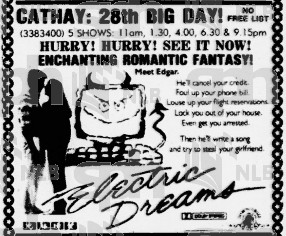
After the war, Cathay Cinema reopened with the first post-war movie “The Tunisian Victory”, but it was not until 1948 before the building was taken back by its rightful owner Cathay Organisation.

In the next few decades, Cathay Organisation expanded the building and added Cathay Restaurant, Cathay Hotel and Cathay Apartments. In 1990, Cathay opened Singapore’s first arthouse cinema, The Picturehouse, within its premises. The last curtains of Cathay Cinema fell in 2000 as the building was redeveloped into a three-cinema cineplex. It finally reopened in 2006 as The Cathay.

Capitol Theatre, Stamford Road (1929-1998)

The premier picture house in Singapore in the early days, the Neo-Classical styled Capitol Theatre (首都戏院) was built in 1929 and mainly catered for the English movie fans. The Japanese occupied the building during the Second World War, using it as a media for their propaganda. It was renamed as Kyo-Ei Gekijo as Japanese films were screened.
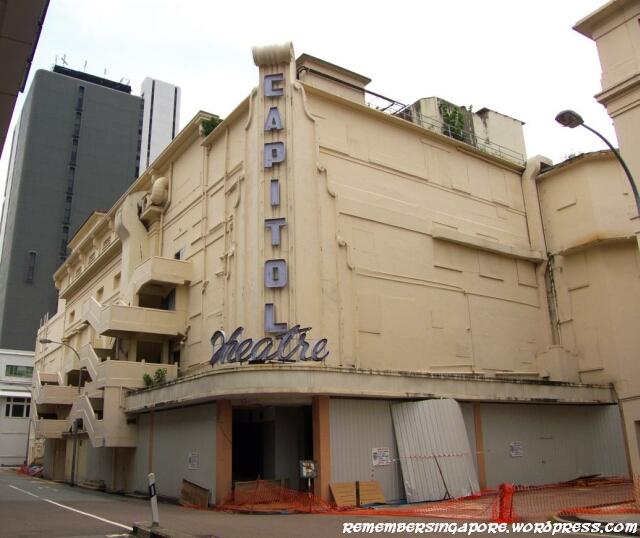
After the war, the Shaw Organisation bought the premises and it became known as the Shaw Building until 1989. The curtains to the almost 70 years of showbiz were finally brought down in 1998 when the last movie was screened at Capitol Theatre.

Both Capitol Theatre and Capitol Building were given conservation status in July 2007.

Central Cinema, Jalan Eunos (1950s-1970s)

A small cinema called Central Cinema once stood along Jalan Eunos between the fifties and seventies.

Changi Cinema, New Upper Changi Road (1940s-1970s)

Not to be confused with the Changi Theatre at Bedok in the eighties and nineties, the old Changi Cinema had a history that went back to the 1940s. Located at the 14-1/2 milestone of Changi Road, the ownership of the cinema changed hands several times.

Changi Theatre, Bedok Town Centre (early 1980s-2000)
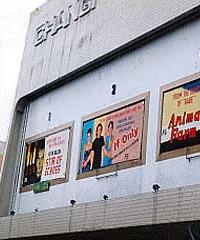
One of the four cinemas at Bedok central, the three-screen Changi Theatre (樟宜戏院) used to stand beside Bedok Cinema, facing New Upper Changi Road.

Owned by the Shaw Organisation, Changi Theatre started off as a single screen cinema, before being converted into three halls. It was Singapore’s first “triplex”, built at a cost of $2.5 million and equipped a total of 1150 seats.

However, due to the space constraints, the halls were small and cramped. Towards the late nineties, Changi Theatre struggled and eventually closed in 2000 due to poor attendance.

In late 2000s, together with Bedok Cinema, its building was demolished and replaced by Bedok Point Shopping Mall.

Chinatown Cinema, New Bridge Road (1990s)

In November 1990, the Shaw Organisation launched two cinema halls 1 and 2 (唐城戏院) at Chinatown Point, at a cost of $2 million.

Ciros Cinema, Telok Blangah Road (1970s-early 1980s)
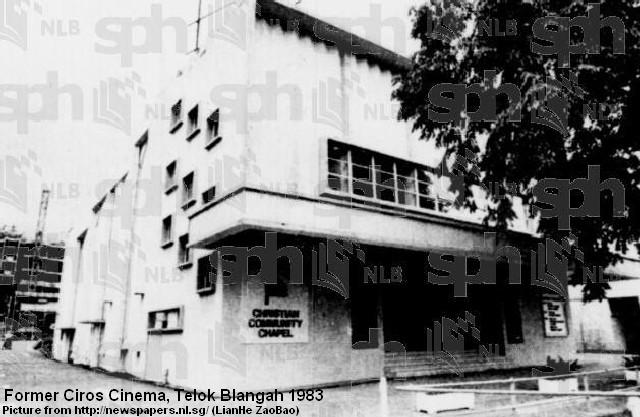
A small cinema along Telok Blangah Road that mainly showed Hindi movies, Shaw Organisation-owned Ciros Cinema (仙乐戏院) was leased to Christian Community Chapel in 1983. The building was later demolished and replaced by Grace Methodist Church since April 1998.

Clementi/Commonwealth Theatre, Clementi Town Centre (1980s)

Standing at an excellent location in front of Commonwealth Avenue West and Clementi MRT Station, Clementi/Commonwealth Theatre (金文泰/联邦戏院) had enjoyed good crowds during the eighties.

In the later part of the eighties, it faced competition from the nearby Eng Wah-owned Empress Cinema. After shutting down, the building became karaoke haven Party World, before converting again to a small shopping mall called CityVibe.

Dalit Theatre, Bukit Merah Town Centre (1981-late 1990s)

Dalit Theatre (达利戏院) and Regal Theatre were the only two cinemas at Bukit Merah central; both of them facing the busy Jalan Bukit Merah. While Regal Theatre screened mainly Chinese movies, Dalit specialised in Tamil films.

Dalit received its first Public Entertainment License in 1981. The building was revamped in 1998 to be used as a theatre for the non-profit charitable Christian organisation TOUCH Community Services.

Da Dong Ya Cinema, Upper Bukit Timah Road (1942-1946)

At the start of the Japanese Occupation (1942-1945), two Hokchia businessmen of surnames Yuan and Yan sought approval from the Japanese authorities to set up an amusement park at the seventh milestone of Upper Bukit Timah Road. The name chosen was, unfortunately, Da Dong Ya (大東亞) or Greater East Asia, after the Japanese’s propaganda claim of achieving a Greater East Asia Co-Prosperity Sphere (大東亞共栄圈).

The open air cinema at Da Dong Ya Amusement Park mainly screened Japanese propaganda flicks or old Chinese films. Locals living nearby and Japanese soldiers patronised the park with 20c banana currency as entry fees. After the war, the park’s popularity declined and was soon replaced by the construction of Beauty World Market in 1947.

Diamond Theatre, North Bridge Road (1947-1977)

Diamond Theatre was part of the five cinemas located at around North Bridge Road between the fifties and seventies; the other four being Royal, Capitol, Odeon and Jubilee.

Like Royal Theatre, Diamond Theatre specialised in Tamil Movies. It was a $250,000 joint venture between Indian jeweller Kassim Mohamed Oli Mohamed (died 1988) and Cathay Organisation’s founder Loke Wan Tho (1915-1964).

In the fifties, Diamond Theatre was plagued by fire hazards, which cost it hundreds of thousands in damages and restoration. Out-competed by other cinemas by the mid-seventies, Diamond Theatre finally ended its business in November 1977, after three decades. The land that it occupied was acquired by the government, and the building was demolished two years later for the building of Blanco Court Resettlement Centre.

East Shore Cinema, Stadium Walk (1990s)

Formerly known as Leisure-Drome (乐心宫戏院), East Shore Cinema (东滨戏院) was owned by Cathay Organisation in the nineties. After it upgraded to three halls (East Shore 1, 2 and 3), it received its first Public Entertainment License in 1994.

The premises is now known as Kallang Leisure Park.

Empire Theatre, Neil Road (1916-undetermined)

Opened in 1916 at the junction of Tanjong Pagar Road, South Bridge Road and Neil Road, the Empire Theatre was then a wooden cinema owned by proprietor T. S. Kung, who targeted the residents of Tanjong Pagar, Keppel Harbour and Pasir Panjang.

Able to accommodate 900 seated audience on wooden chair, the theatre mainly screened silent American films. On its opening night, T. S. Kung showed his generosity by donating the day income to British Red Cross Fund.

In 1926, the cinema was leased to the Shaw Brothers for a hefty $2,000 a month.

Empress Cinema, Clementi Town Centre (1980s-2010)

Owned by Eng Wah Organisation, Empress Cinema (华声戏院) had been a landmark at Clementi central for more than three decades. In 1993, the cinema was given a revamp, with the theatre being upgraded into three halls named Empress 1, 2 and 3.
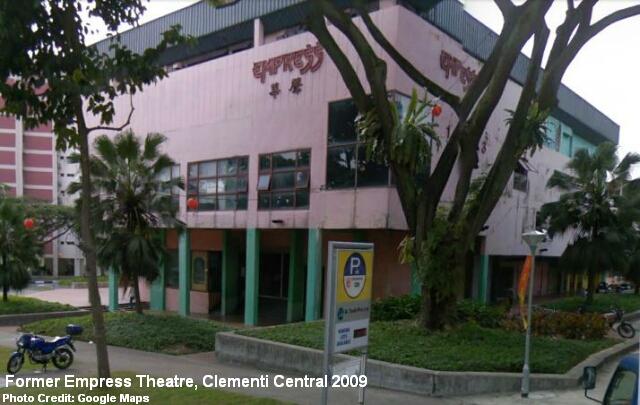
It ceased its operation in 2010, and the building was demolished by mid-2012. The site is expected to be reborn as a brand new cinema after the complete makeover of Clementi Town Centre, scheduled in 2013.

Eng Wah Cinemas, various locations (1980s-Present)

In the eighties, Eng Wah Organisation had an open air cinema at Holland Village.
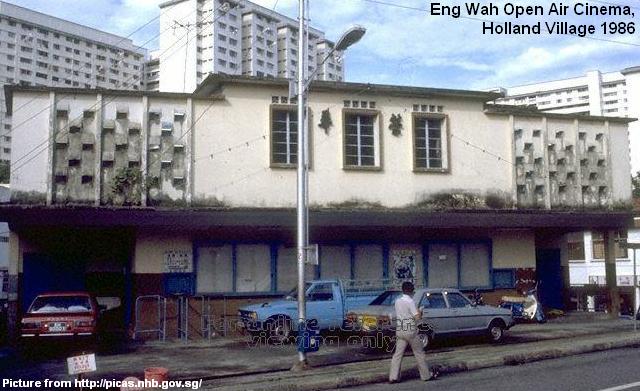
After the mid-nineties, Eng Wah Organisation started to venture aggressively into the new towns. It opened a branch of its cinemas at Paris Ris Central when White Sands Shopping Centre opened in 1996. However, due to the lack of human traffic at the relatively new town at the far eastern part of Singapore, the cinema was shut down at the end of the nineties.

The 1200-seat 6-screen Eng Wah cinema at Sun Plaza was the main source of entertainment for the residents of Sembawang when it was opened in 1998. It closed in 2009 after a decade of operation.

The Eng Wah cinemas at Suntec and West Mall (Bukit Batok), both opened in 1998, are still in operation.

Gala Cinema, Upper Bukit Timah Road (late 1970s-mid 1990s)

There was an old cinema called Gala Cinema (嘉宾戏院) at Bukit Timah Shopping Centre. Operated by Eng Wah Organisation, it screened a mixture of Tamil and Chinese movies, and was popular among the local residents and the Malaysian tourists during the eighties.

With the aging Bukit Timah Shopping Centre experiencing a significant drop in the human traffic, the cinema was forced to shut down in the mid-nineties.

Gala Theatre, Beach Road

See Alhambra Theatre.

Galaxy Cinema (formerly Apollo/Garrick Theatre), Onan Road (1930s-1980s)
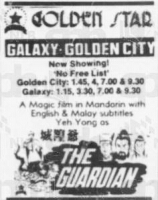
Located at the junction of Geylang Road and Onan Road, Galaxy Cinema was part of the The Galaxy, a movie-cum-shopping centre that largely served the Muslim community at Joo Chiat. Other than Malay films, it also screened Chinese movies with English and Malay subtitles added.

Galaxy Cinema was formerly known as Apollo Theatre in the 1930s. It was taken charge by Lim Chong Pang, son of Lim Nee Soon, who renamed it as Garrick Theatre. Before the Second World War, Garrick Theatre was one of the most prominent cinemas in Singapore.

It is now known as the Muslim Converts’ Association of Singapore.

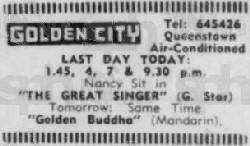
Golden City Theatre, Margaret Drive (1965-1984)

There were three cinemas at Margaret Drive of Queenstown in the eighties, namely Venus, Golden City and Queenstown/Queensway.
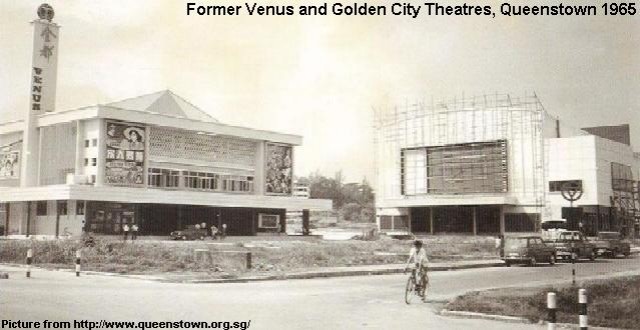
Both Venus Theatre (金都戏院) and Golden City Theatre (金城戏院) specialised in Taiwanese horror movies and gongfu flicks. The cinemas were proposed by the Singapore Improvement Trust (SIT) as early as 1958, but were originally planned to be built at Dundee Road.
After the Housing Development Board (HDB) took over from SIT, it built the twin cinemas at Margaret Drive to cater for the entertainment needs of the residents at Duchess Estate.

The locations of both cinemas are now occupied by the churches of The Fisherman of Christ Fellowship and Church of Our Saviour.

Golden Sultan Theatre, Jalan Sultan (1981-early 2000s)

Cathay Organisation’s Golden Sultan Theatre (金皇戏院) was formerly located along Jalan Sultan, off Beach Road. Its premises at Sultan Plaza is now occupied by a nightclub.

Golden Theatre, Golden Mile Tower (1970s-Present)

Situated in the Golden Mile Tower at Beach Road, Golden Theatre (黄金戏院) was opened in the early seventies, screening mainly Chinese movies until the nineties. Three halls, named Golden 1, Golden 2 and Golden Studio, were later added in a bid to restore the faltering business of the cinema.
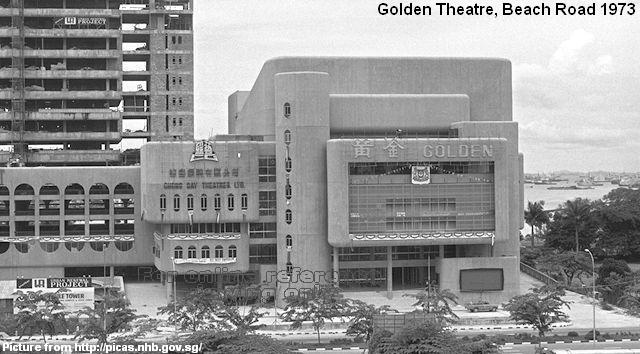
For a period of time, Golden Theatre showed erotic films but has now switched to Hindi and Tamil blockbusters from India’s Bollywood and Kollywood.

Great World Cinemas, Kim Seng Road (1958-1978)

Great World Amusement Park was developed in the 1930s by Lee Choon Yung on a site bounded by Kim Seng Road, River Valley Road and Zion Road. Just before the Second World War, he sold the land to the Shaw Brothers.
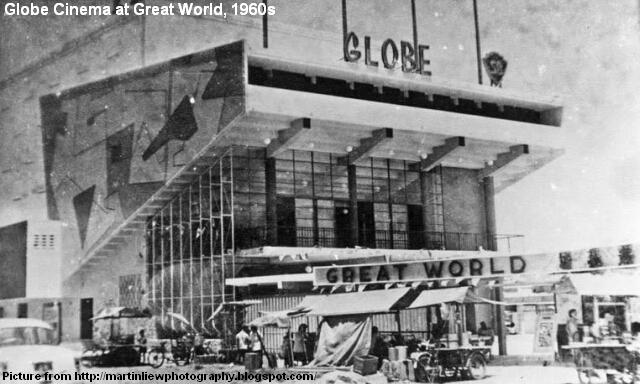
After the war, Shaw upgraded the park and had it reopened in 1958. Its popularity soared, with people flocked to the park for food, circus shows, carnival rides and cinemas. The four theatres at Great World were Canton (广东戏院), Atlantic (大西洋戏院), Sky (青天戏院) and Globe (环球戏院).

Screening a mixture of Chinese, Cantonese and Western films, the cinemas would outlast Great World even after it shut down in March 1964. They would survive together with the restaurants until 1978, when the Shaw Organisation sold the land to Malaysia’s Robert Kuok.

Movie-watching at Great World was a considerably luxurious pastime for many, where the price of movie tickets in the sixties was 50c. During the screening of Chinese blockbusters, long queues could stretch to as far as the Kim Seng Bridge. Fans would get up early at 5am to join in the queues.

Happy/Gay World Cinemas, Mountbatten Road (1945-2000)

When Happy World was set up between Geylang Road and Mountbatten Road in 1936, it was an amusement park filled with various entertainment such as boxing matches and film-screening, where Victory Theatre was its main cinema.

Victory Theatre was set up by Goh Eng Wah, the founder of Eng Wah Organisation, in 1945. It was highly popular even though it screened many Japanese propaganda films during the end of the Second World War.
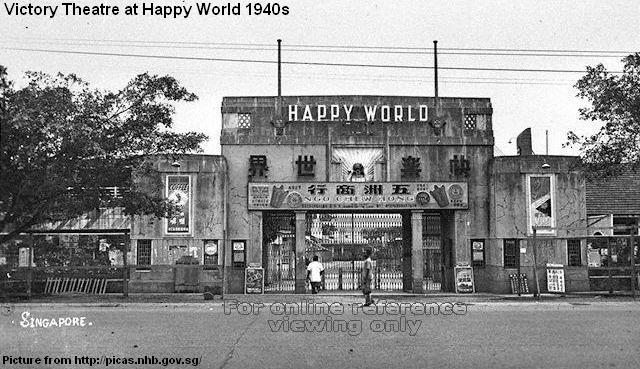
With the success of his initial investment of Victory Theatre (胜利戏院), Goh Eng Wah expanded his business and acquired the nearby Happy Theatre (快乐戏院) and Silver City Theatre (银国戏院) after the war. Eng Wah Organisation’s cinemas at Happy World specialised in Chinese movies during the fifties and sixties.
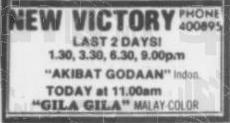
Another cinema at Happy World was New Victory Theatre (新胜利戏院), a small cinema that exhibited Malay and Indonesian films during the late seventies.

The fifth cinema at Happy World, also the smallest, was New Happy Cinema (新快乐戏院). It started to show Tamil films exclusively in 1982, and when all three Eng Wah cinemas closed down by 1987, New Happy Cinema continued to struggle until the late nineties.

Happy World was renamed as Gay World in 1966 and closed down in 2000 as the last of the three popular amusement parks, the other being New World and Great World. Together with Gay World Stadium (renamed as Geylang Indoor Stadium), it was demolished a year later.

Hollywood Theatre, Tanjong Katong Road (1959-1995)

Once famous for its screening of Chinese blockbuster flicks and the appearances of Hong Kong superstars Fung Bo Bo and Siao Fong Fong, Hollywood Theatre (好莱坞戏院) spanned for almost 40 years from the late fifties to mid-nineties.

After its closure in 1995, the building was leased to City Harvest Church for six years before the church moved to its permanent premises at Jurong West.

Hoover Theatre, Balestier Road (1960-1989, 1992-1996)

Hoover Theatre (豪华戏院) was an easy choice for fans of the Shaw Brothers’ gongfu films during the sixties and seventies. Opened in 1960, the 900-seat cinema mainly catered for the Chinese majority at Balestier, although it also screened English and Indian movies. The ticket prices ranged from $1 to $3.
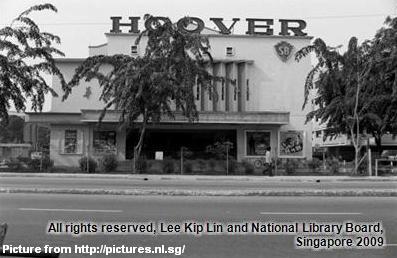
With the decline of kungfu films in the eighties, Hoover Theatre was closed in December 1982 due to poor business. It, however, relaunched as Hoover Live Theatre a year later, but was used to hold live variety shows instead. In 1989, the building was leased to an independent church called His Sanctuary Services.

Hoover as a cinema was reborn once again in 1992 when the church did not renew its lease. The building was reopened as New Hoover Cinema, the first cinema in Singapore to screen classic Tamil, Sinhalese, Malayalam and Hindi films regularly.

After the cinema played its last Indian movie in 1996, the building was closed and demolished, together with President Theatre, for the construction of the new Shaw Plaza-Twin Heights. Opened in 1999, Shaw Plaza now comprises a six-screen cinema fitted with the latest digital sound systems called Balestier Cineplex.

Imperial Theatre, Upper Thomson Road (1970-1985)
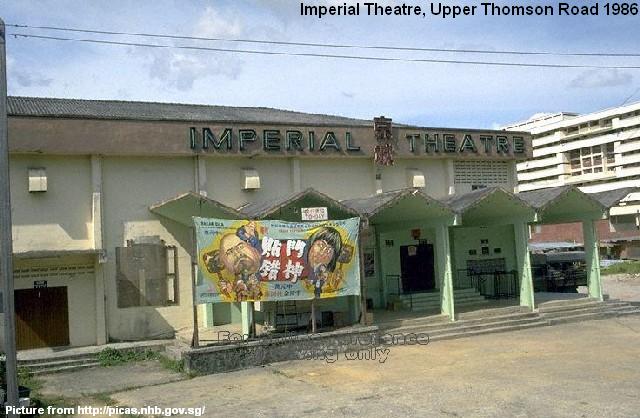
Imperial Theatre (京都戏院) started operating its movie business at Upper Thomson Road since 1970. It was located beside the present-day Thomson Community Centre.

In the seventies, rows of old shops with zinc roofs lined up beside the cinema, and there were many stalls selling candies and toys to the movie-goers. By the mid-eighties, the cinema suffered a steep decline in its business and was forced to shut down. The building was temporarily used for worship services of Glory Joy Christian Church.

Today, the cinema is no longer around, and in its place stands Thomson Imperial Court. The word “Imperial” in its name is the only remnant of the former popular cinema.

Jade Theatre, Beach Road (1977-2008)

Jade Theatre (翡翠戏院) and Prince Theatre (太子戏院) were officially opened in 1977 by the Shaw Organisation at Shaw Towers, which was built much earlier in 1970 on the former sites of Alhambra and Marlborough Theatres.

In 1988, both theatres were expanded to two halls each, known as Jade 1 and Jade 2, and Prince 1 and Prince 2 respectively, under the new concept of cineplexes. The first movie to be screened at Prince was Jackie Chan’s Dragons Forever. In 1991, Jade 2 was converted into Jade Classic (新艺戏院) to cater for the niche art house audience.

In 1996, the cinemas at Shaw Towers were sold to the United Artists, which renamed the four halls into Grand Prince, Alhambra, Royal Jade and Emerald. The cinemas were later bought back by Shaw in 2001 before their closure seven years later.

Jalan Kayu Cinemas, Jalan Kayu (1960s-1980s)

There were previously a couple of small cinemas at Jalan Kayu between the sixties and the eighties. Screening mainly Chinese kungfu movies, the cinemas (永华戏院, 国华戏院, 星光戏院) provided a source of entertainment for the residents who were mostly farmers living around present-day Sengkang.

Jubilee Cinema, Ang Mo Kio Central (1979-2010)

A neighbourhood cinema at Ang Mo Kio Central owned by Eng Wah Organisation, Jubilee Cinema (光华戏院) was perhaps the smallest compared to Broadway and New Crown/New Town during the nineties. The name Jubilee might be derived from the famous Jubilee Theatre at North Bridge Road, also owned by Eng Wah Organisation and closed in the mid eighties.
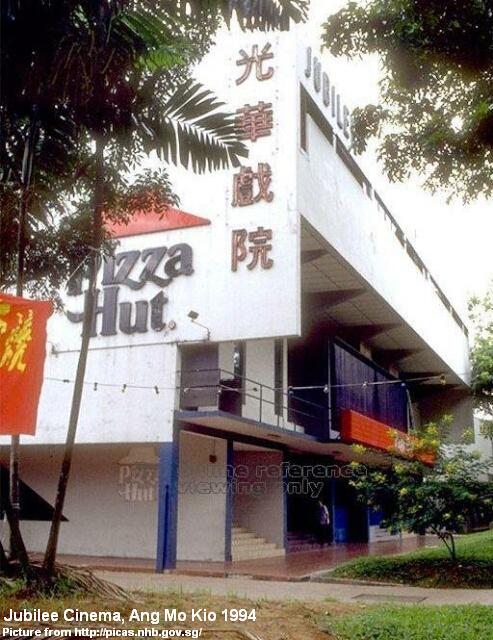
The Ang Mo Kio residents would remember the small white building with Pizza Hut operating at the ground floor and Jubilee at the second level. The cinema was closed in December 2010.

Jubilee Theatre, North Bridge Road (1930s-1970s)

Opened in the 1930s beside Raffles Hotel, Jubilee Theatre (光华大戏院) was hugely popular in its early days. It was bought by Goh Eng Wah in 1966, two years before he established Eng Wah Theatres Organisation Pte Ltd.

The theatre was later demolished to make way for the extension of Raffles Hotel.
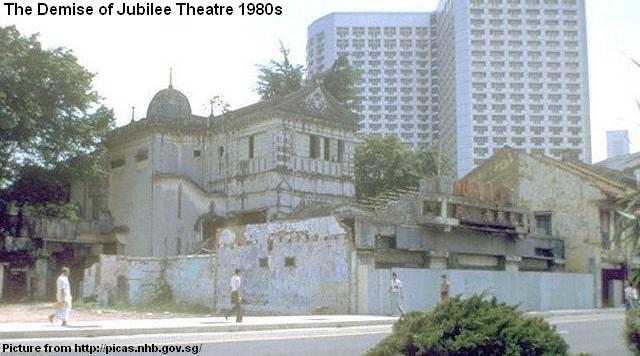
Raffles Hotel’s Victorian-styled theatre playhouse Jubilee Hall is named after this popular cinema of the early days.

Jurong Drive-In Cinema, Yuan Ching Road (1971-1985)
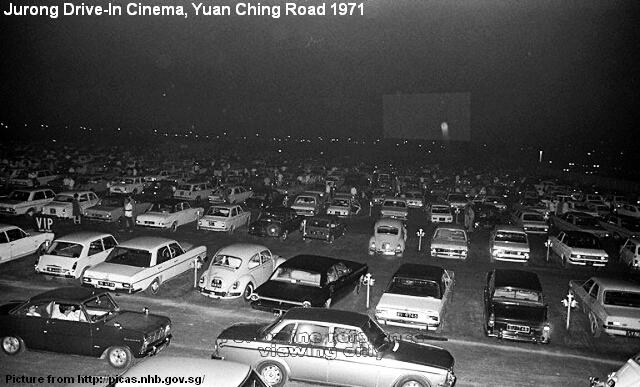
Opened by then Minister of Culture Jek Yeun Thong in July 1971 at Yuan Ching Road (near the Chinese and Japanese Garden), Jurong Drive-In Cinema (裕廊大影场) created a buzz among Singaporeans. It was a bold project by Cathay Organisation; the first of its kind in Singapore and Malaysia, and the largest in Asia.
When the nights fell, rows of cars were parked neatly, with their engines off, in front of a giant screen. There were poles with connecting speakers for the patrons sitting inside the cars. The experience was fresh to many, but the weather sometimes proved too much to bear, especially on humid nights or rainy days.

Nevertheless, the unique cinema was a success, which had raked in some S$12,000 in a single evening, its highest income in a day, during the screening of Bruce Lee’s Big Boss. Jurong Drive-In Cinema was closed in September 1985, and the space is now occupied by Palm Resort’s Fairway Club.

Kallang Theatre (Former), Stadium Walk (1970s-1986)

The largest commercial theatre in Southeast Asia in the seventies, Kallang Theatre (加冷戏院) was originally built as a cinema but was converted into a theatre for the arts in 1986 when the iconic National Theatre was demolished. Costing $15 million, Kallang Theatre was equipped with 100 speakers and 2400 seats segregated in four classes.
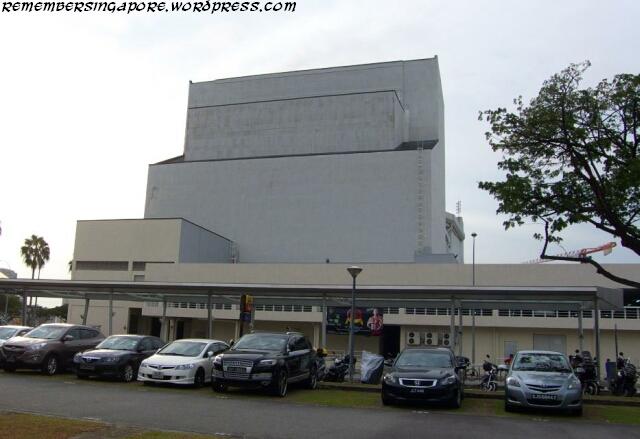
For two decades, it was used for international and local musicals and plays. The curtains came down on Kallang Theatre in 2007 when the performing arts venue was moved to Esplanade-Theatres on the Bay.

King’s Theatre, Kim Tian Road (1950s-early 1980s)

The King’s Theatre (璇宫戏院), a notable landmark at Kim Tian Road of Tiong Bahru during the sixties, mainly screened films in Amoy dialect (or Hokkien).
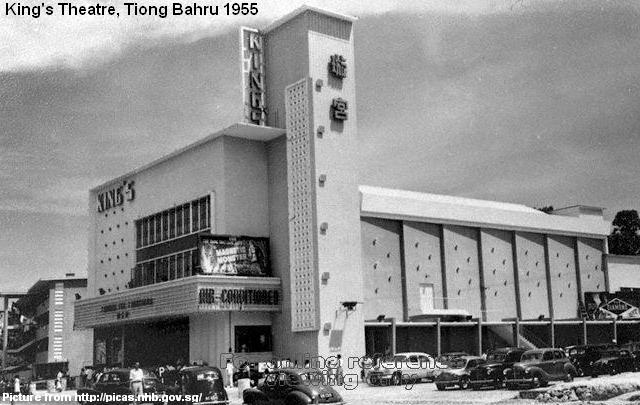
When the popularity of Amoy films declined in the late sixties, King’s Theatre was acquired by Goh Eng Wah in 1968 and managed to keep its business afloat by screening the upcoming Chinese films.

Kim Tian Road is now home to a housing estate.

Kok Wah Theatre, Yio Chu Kang Road (1960s-1980s)

There were once two small kampong cinemas at the junction of Upper Serangoon Road and Yio Chu Kang Road, fondly known as ow gang ngor kok jio, or Hougang five milestone. One of them was Kok Wah Theatre (国华戏院), which screened mainly Chinese, Cantonese and Teochew movies. The other was the English film-majority Mercury Theatre.

Between the sixties and eighties, the two cinemas were popular among the residents living at the nearby Chia Keng Village and Lim Tua Tow Road. After the cinemas were demolished, a building called Kovan Centre was built on their former sites. Kovan Centre itself was torn down in the late 2000s, and would be replaced by a new building called Space @Kovan, scheduled to be completed in 2016.

Kong Chian Cinema (also Central Cinema), Toa Payoh Central (1972-1987)
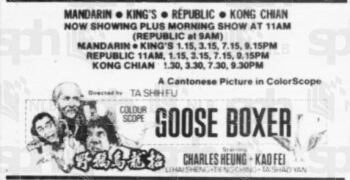
Kong Chian Cinema (光前戏院) was Toa Payoh’s first cinema, opened in 1972 by Cathay Organisation and located near the Toa Payoh library with its iconic fountains. During the eighties, it was one of the two cinemas at the new town of Toa Payoh, the other being Toa Payoh Cinema.

A typical small neighbourhood cinema which was later renovated and renamed as Central Cinema (中央戏院), Kong Chian Cinema screened mostly films from Hong Kong, China and even North Korea. After its closure in 1987, the building was sold to McDonald’s and is now called 600@Toa Payoh.

Kreta Ayer People’s Theatre, Chinatown (1970s-late 1990s)
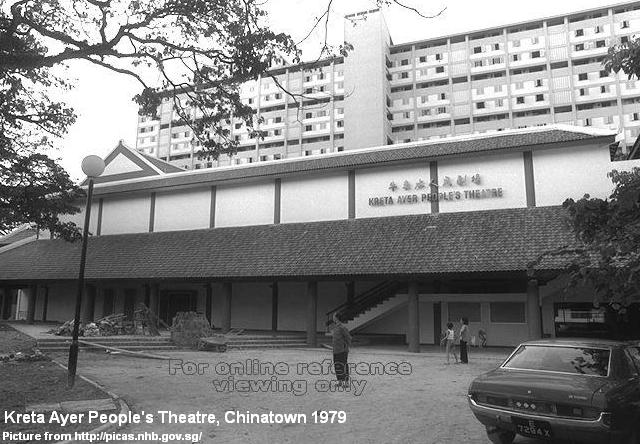
Built at a cost of $100,000, Kreta Ayer People’s Theatre (牛车水人民剧场) was officially opened in March 1969, as a venue for performances of Chinese operas and the promotion of arts.

In the seventies, Cathay Organisation struck a deal to screen Hong Kong Cantonese movies at Kreta Ayer People’s Theatre. This lasted till the mid-nineties when Golden Village took over for a short period.

Today, Kreta Ayer People’s Theatre no longer screens movies, but functions as a community arts centre.

Liberty Theatre, Marine Parade Central (early 1980s-late 1980s)
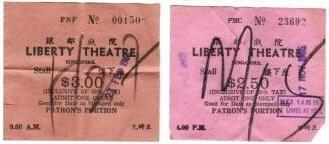
Liberty Theatre (银国戏院) was opened at Marine Parade central in the early 1980s by the Shaw Organisation. It shut down at the end of the eighties and, like Dalit at Bukit Merah, the building was taken over by Christian organisation TOUCH Community Services.

Lido Cinema, Scotts Road (1959-Present)

It was only a barren piece of land with a lone Esso petrol station at the junction of Scotts Road and Orchard Road when the Shaw Brothers acquired it in 1952.
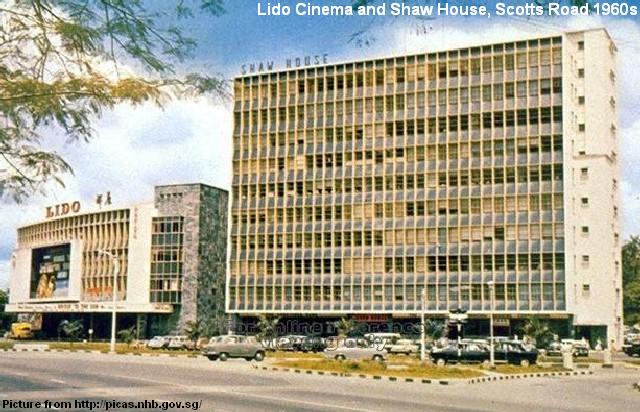
By 1958, the construction of Shaw House and the old Lido Cinema were completed, and were officially opened in November 1958 and February 1959 respectively. From the fifties to the eighties, the 1602-seat cinema remained one of the most popular cinemas in Singapore, and was one of the venues in town to hold charitable events.

The old Lido Cinema underwent a long revamp in 1996 to be converted into a eight-screen cineplex. In 2011, after another $20 million makeover, the new Lido Theatre was reopened to the delight of its fans.

Liwagu Cinema, Bedok Town Centre (1982-late 1990s)

One of the four cinemas at Bedok Town Centre in the eighties, the building of Liwagu Cinema (丽华宫戏院) was built in 1980. It started to operate its movie business in 1982 after receiving its Public Entertainment License.

After its closure, local S-league football club Geylang United moved in. In the early 2000s, the building, owned by Eagle Crest Plaza, was mortgaged to Taiwan’s First Commercial Bank, who then sought a $7.5 million sale of the building in 2003.

Majestic Theatre, Eu Tong Sen Street (1928-1998)

Built in 1928 by prominent Chinese merchant Eu Tong Sen (1877-1941) for his Cantonese opera-loving wife, the building was designed by then leading architectural firm Swan and Maclaren and was originally known as Tien Yien Moh Toi Theatre (天演舞台).
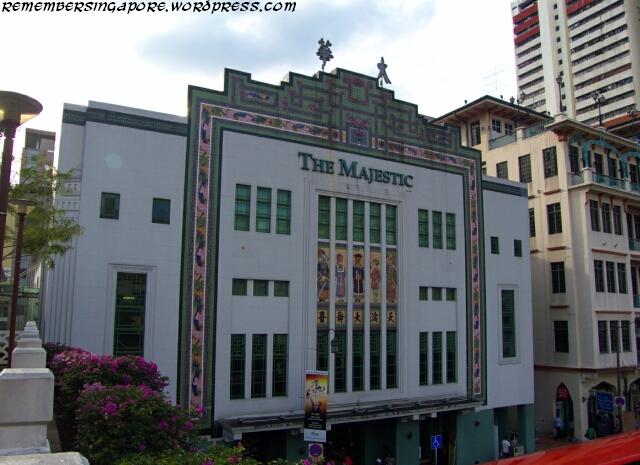
The Shaw Organisation bought it in 1938 to convert into a cinema, called Queen’s Theatre (皇后戏院), for screening of the Cantonese blockbusters. It also functioned as a venue for fund raising to aid China in the Sino Japanese War before the full-scale Second World War. During the Japanese Occupation, it was renamed as Ta He Ju Chang (大和剧场) to be used for spreading the propaganda of Japanese rule.

After the war, the Shaw Organisation leased the building again, and gave it a new name as Palace Talkies. The name Majestic Theatre (大华戏院) was used when the new tenant The Majestic Film Company moved in. The Eu family sold the building to Cathay Organisation for a hefty $1.1 million in 1956, and the cinema maintained its popularity throughout the years until its closure in 1998.

In 2003, the building was converted into a shopping mall known as The Majestic, but it could only last four years before it ceased its operation.

Mandarin Theatre, Kallang Bahru (1975-2000)

Mandarin Theatre (文华戏院) was one of Eng Wah Organisation’s ventures into the heartlands of Singapore, along with Ang Mo Kio and Toa Payoh, during the late seventies. It was situated at the junction of Kallang Bahru and Geylang Bahru.
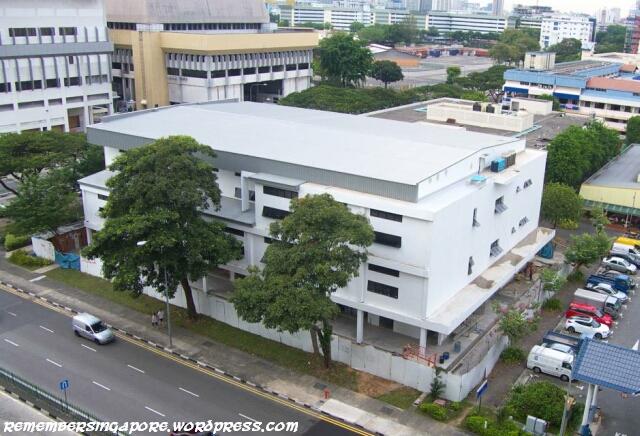
In 2011, local supermarket Sheng Siong intended to rent the premises but the application to covert the former theatre into a supermarket and food court was rejected by HDB.

Recently, the building of the former cinema was given a fresh coat of paint and is currently undergoing some renovation, suggesting that it may be reopened for other commercial purposes. The vacated building has been on sale since 2008.

Marlborough Theatre, Beach Road (1930s-1960s)

Opened in the 1930s by the Shaw Brothers, Marlborough Theatre (曼舞罗戏院) was situated beside Alhambra Theatre along Beach Road.
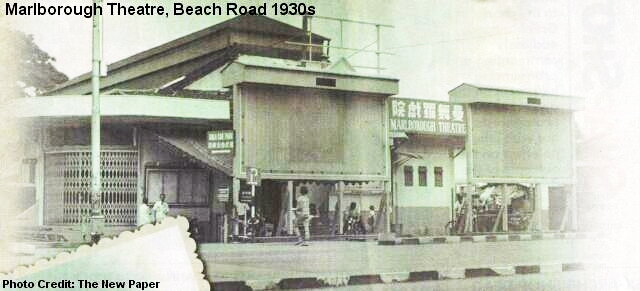
The fifties and sixties were perhaps the golden era for Marlborough Theatre, where the popularity of the area was helped by the strategic locations of the original Satay Club at nearby Hoi How Road (now defunct) and the bus depot of Tay Koh Yat (郑古悦 1880-1957) Bus Company.

Mercury Theatre, Yio Chu Kang Road (1960s-1980s)

Mercury Theatre coexisted with Kok Wah Theatre at the junction of Yio Chu Kang Road and Upper Serangoon Road from the sixties to the eighties. (See Kok Wah Theatre)

Metropole Theatre, Tanjong Pagar Road (1958-1986)

The former building of the famous Metropole Theatre (金华戏院) has been standing at the junction of Tanjong Pagar Road and Neil Road, just opposite the popular Maxwell Road Hawker Centre, for more than half a century.

Metropole Theatre had been a popular cinema for Chinese movie fans from the sixties to eighties. Well-known Hong Kong actress Nancy Sit Ka Yin (薛家燕) made guest appearances at Metropole in 1967 to promote her two latest films.

In 1986, the building’s new owner spent $2.75 million to convert the place of entertainment into a place of worship. It became known as the Fairfield Methodist Church.

New City Theatre, Aljunied Avenue 2 (early 1950s-1985)

New City Theatre (新城戏院) was situated within Geylang East Town Centre, catering for the residents living in the old neighbourhood of Aljunied. In its thirty years of existence, It had seen tremendous changes in its surroundings, as the Pan-Island Expressway (PIE) was built just behind its building in the late seventies.

New City Theatre was closed in mid-eighties, taken over by the church of Bethel Assembly of God. In 2010, the old building was demolished to make way for the new multi-functional building of the church.

New Crown/New Town Cinema, Ang Mo Kio Central (1990s)

The twin cinemas of New Crown/New Town (皇冠/皇城戏院) were one of the four main cinemas at Ang Mo Kio central, where its peak was during the nineties.
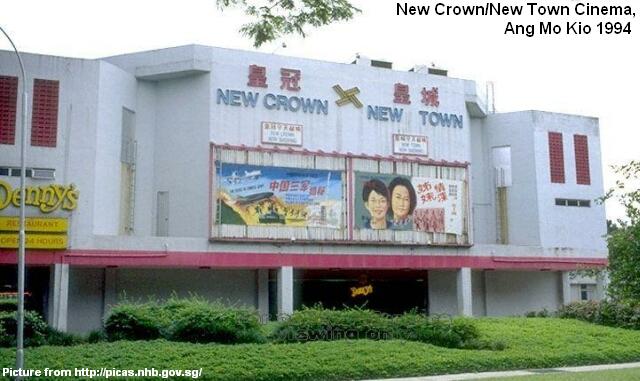
After the cinema ceased its operation, the space within the building was leased to restaurants and arcade game shops. It once housed the popular Korean-styled buffet restaurant Seoul Garden. The building became known as New Crown Building but was razed to the ground by mid-2012, where a new mall is expected to be completed in a year’s time.
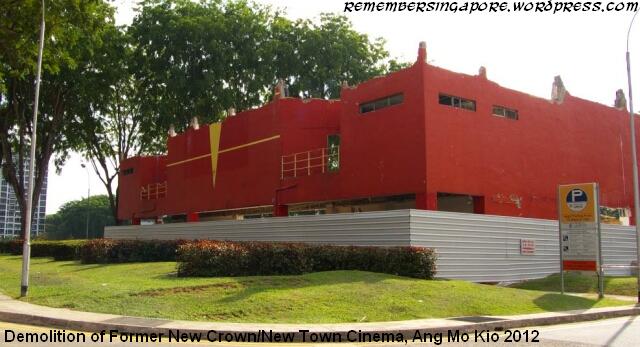
New World Cinemas, Jalan Besar (1960s-early 1980s)

Like Happy World and Great World, New World Park, the first of the three famous amusement parks in Singapore, also had a number of cinemas as one of its attractions to the crowds. The cinemas of Grand (大光戏院), Pacific (太平洋戏院) and State (新都戏院) were filled with people every weekend during its peak.
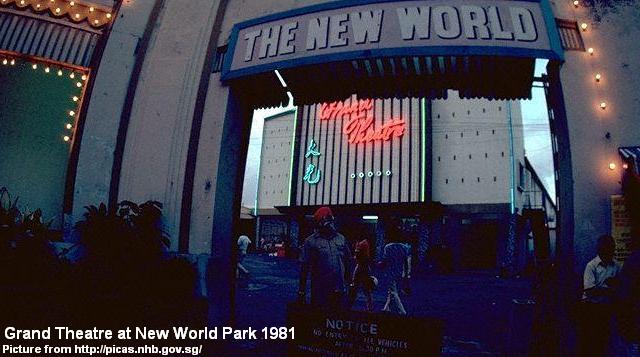
New World was set up by Ong Boon Tat and Ong Peng Hock in 1923, before being sold to the Shaw Brothers before the Second World War. The amusement park arguably had its golden period from the fifties to the seventies.

By early eighties, the park went into a rapid decline, not helped by the closure of Grand and Pacific Theatres, which were converted to churches temporarily. The Shaw Organisation eventually sold the land to City Development in 1987.

Ocean Theatre, Upper East Coast Road (early 1960s-1985)

When Ocean Theatre (海洋戏院) operated at Upper East Coast Road between the sixties and eighties, it showed a large variety of Malay, Tamil, English and Mandarin movies.

After its closure in 1986, the premises was converted into a 20-stall Ocean Food Centre, but its business lasted for only a couple of years.

Odeon Theatre, North Bridge Road (1953-1984)

The large 1,500-seat Odeon Theatre (奥迪安戏院), owned by Cathay Organisation, was situated opposite Raffles Hotel and Jubilee Theatre at North Bridge Road between the sixties and seventies.
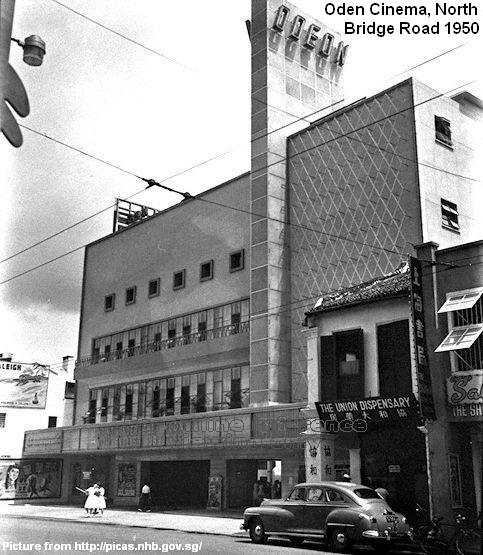
Opened in June 1953, Odeon was a modern theatre by the standards of that era. Its building was equipped with a basement carpark, a fully air-conditioned cinema and eight dressing rooms. It even had a room for parents to comfort their crying babies, so as not to disturb the audience during the screening of movies.

Odeon Theatre was closed in June 1984, after some thirty years of operation. Today, Odeon Towers stands in its site, with its name the only remnant left of this once glorious cinema.
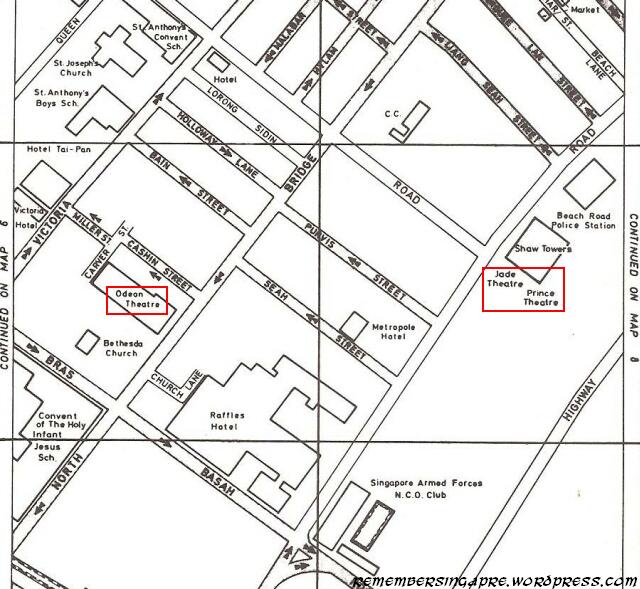
Above is the 1980 map of where Odeon Theatre was located. Jubilee Theatre at Raffles Hotel was not around anymore, while Jade and Prince Theatres at Shaw Towers had just made their debuts.

Odeon-Katong Theatre, East Coast Road (1960-1993)
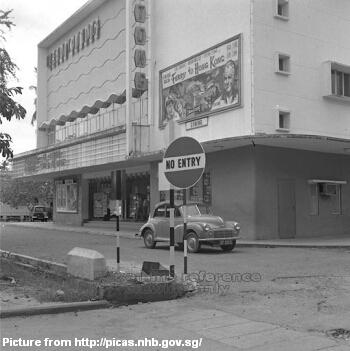
Odeon-Katong Theatre (加东-奥迪安戏院) was one of the cinemas in Singapore owned by Cathay Organisation, running both Chinese and English movies. Between the sixties and eighties, it was part of Katong’s famous three cinemas; the other two being Roxy and Paradise.
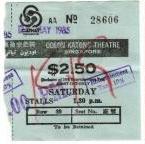
The building of Odeon-Katong Theatre was later used for worship services by Bethesda Cathedral and is now mainly occupied by Cornerstone Community Church.

Orchard Cinema, Grange Road (1965-1995)
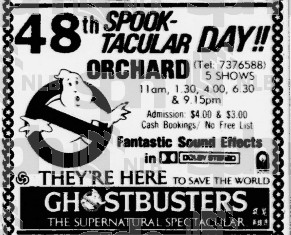
In the first year of Singapore’s independence, Cathay Organisation opened their second premier cinema after Cathay Cinema. It was the Orchard Cinema (国宾戏院) at Grange Road. The building also included a 24-lane Jackie’s Bowl (later renamed as Orchard Bowl).

Orchard Cinema was closed in 1995 for redevelopment. It took two years before Cathay Cineleisure Orchard was completed at the site of Orchard Cinema.

Oriental Theatre (Palacegay), New Bridge Road (1927-1960s)

Originally known as the Palacegay, Oriental Theatre (东方戏院) was the first cinema in Singapore to screen Chinese movies with sound when it was opened in 1927. Before Oriental Theatre, only silent films were shown.

Oriental Theatre was renamed as Toho Gekizyo during the Japanese Occupation. After the war, the Shaw Brothers bought it and name it as Oriental Theatre. The Oriental Plaza, owned by the Shaw Organisation, still bears the name of this once popular cinema at Chinatown.

Paradise Cinema (or Palace Theatre), East Coast Road (1965-1992)

Paradise Cinema (新海燕戏院), also named Palace Theatre (丽宫戏院) or Palace Centre, was located at the junction of East Coast Road and Brooke Road. From the sixties to the eighties, it was one of the three cinemas at Katong; Odeon-Katong and Roxy being the other two.
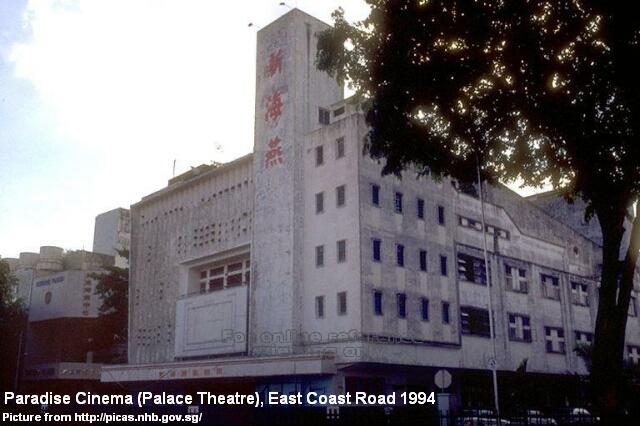
In the seventies, Paradise Cinema, owned by Cathay Organisation, was sold to Chong Gay Group. In 1989, the cinema was chosen to be one of the cinemas in Singapore to screen the best selling Taiwanese film, starring several Golden Horse Award winners, from the Taiwan Film Festival.

By the early nineties, the cinema ended its movie business and the premises was converted into a venue for live performances, named Sin Kim Kok Theatre. Today, the Eastgate Building stands in its former site.

Paramount Theatre, Portchester Avenue (1962-1983)

The Paramount Theatre (百乐门戏院) at Serangoon Gardens was more than a cinema during its heydays. It was also used as a venue for Christian prayer services and fund-raising.
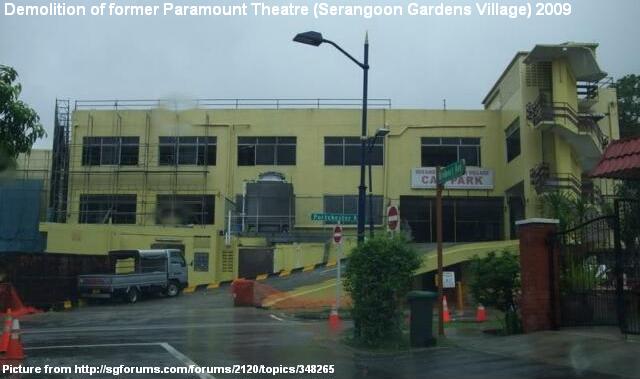
When the cinema shuttered in 1983, the Paramount building went through numerous transformations in a bid to catch up with the pace of development. It became the first cinema in Singapore to be converted into a supermarket when popular retailer Fitzpatrick’s spent $1.1 million to renovate the leased premises as its eighth branch.

After its demolition, its site was occupied by Serangoon Gardens Village for more than a decade. Today myVillage @Serangoon Garden takes its place.

Paris Cinema, Victoria Street (1904-undetermined)

Paris Cinema (巴黎戏院) was considered as Singapore’s first ever cinema, built in 1904 by an Indian jewellery company.

Pavilion Cinema, Tampines Central (1993-early 2000s)

Pavilion Cinema (东艺戏院) was the first cinema to be opened in the new town of Tampines. Owned by Cathay Organisation, it opened in 1993 and closed in early 2000s. Tampines 1 Shopping Mall now stands in its former site.

Pavilion Theatre, Orchard Road (1920s-1950s)

Opened in the 1920s, Pavilion Theatre was originally known as the Paladium Theatre. Its location at the old Orchard Road was where the Specialists’ Shopping Centre previously stood.

The cinema was part of successful local Jewish businessman Joseph Aaron Elias’ (1881-1949) business empire.
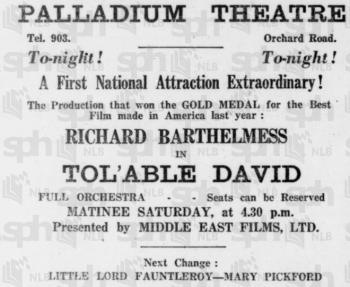
After the Second World War, Pavilion Theatre was bought by the Shaw Organisation, which experimented with the smoking ban, making the air-conditioned cinema one of the first in Singapore to impose such a rule.

In 1954, Pavilion Theatre went on the national news after its manager was prosecuted for pocketing the cinema’s daily income.

Peking Theatre, Pipit Road (1960s)

Peking Theatre was once an old small open-air cinema at MacPherson.

Picturehouse, Cathay Building (1990-2000)

A small extension was added to the Cathay building in 1990, housing a restaurant and a small cinema named Picturehouse. It was used to screen global art films initially, but it would go on to include Hollywood blockbusters in the later times. Picturehouse, together with the old Cathay building, was demolished after 2000 for redevelopment.

Plaza Theatre, Jalan Sultan (late 1970s-1995, 1999-2000s)

Eng Wah Organisation-owned Plaza Theatre (光辉戏院) was once located on the seventh floor of the Textile Centre beside Sultan Plaza. It used to screen English and Chinese movies.

After its closure, it was used briefly by a church as a venue for worship services. In 1999, the cinema made a comeback, switching its strength to Tamil and Hindi films.

Premier Theatre, Claymore Drive (late 1970s-early 1980s)
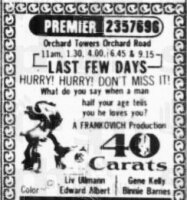
Premier Theatre (辉煌戏院) was the only cinema at Orchard Towers after the 18-storey retail-office building was completed in 1975.

The cinema was operating on the fourth level in the eighties.  After it was shut down, its large 16,000 square feet premises were taken over by a club called Top10. In 2006, Top10 was reopened as Top5.

President Theatre, Balestier Road (1973-1996)

Shaw Organisation-owned 1200-seating President Theatre (总统戏院) had a grand opening at the end of August 1973. It was part of Shaw’s multi-million project in the 8-storey Shaw Plaza which also consisted a restaurant, an emporium, apartments and a multi-storey carpark.
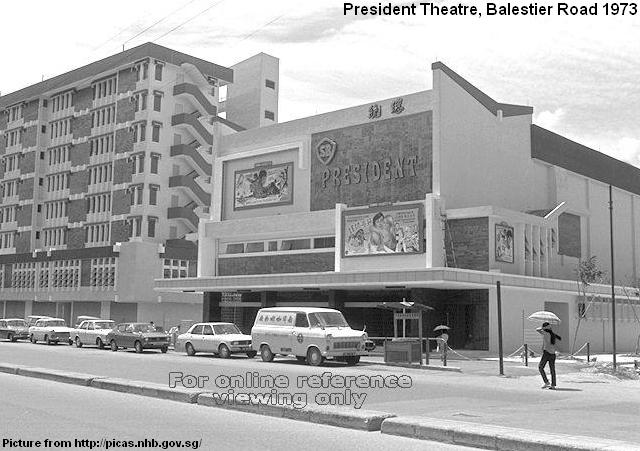
A popular venue of shopping and movies for the Singaporeans for more than twenty years, the building was eventually demolished in 1996 together with the Hoover Theatre to make way for the construction of the new Shaw Plaza-Twin Heights.

Prince Theatre, Beach Road (early 1970s-2008)

See Jade Theatre.

Princess/Rajah Cinema, Bedok Town Centre (1983-2008)

The last of the four cinema at Bedok central to shut down, Princess/Rajah Cinema (公主/王子戏院) was well known among the Bedok residents for the relatively cheaper prices of its tickets, as well as good quality of its seats and screens.
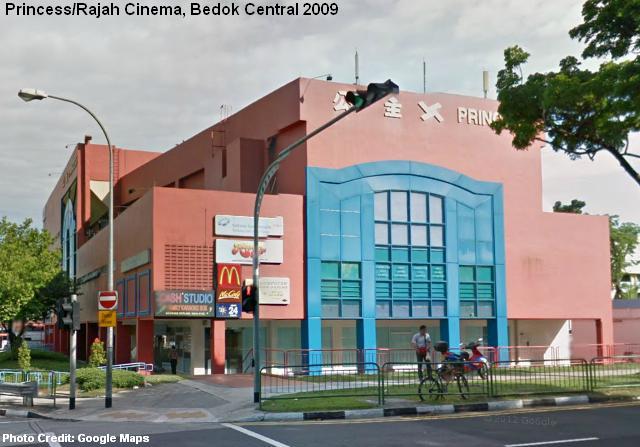
The lax rules of the neighbourhood cinema was also a plus point, as the audience had the freedom to bring all sorts of food into the cinema. But once in a while, there were complaints that someone was caught smoking in the cinema, or the operator switched off the aircon to save money when the audience was small.

The cinemas at Bedok central had seen booming business in the eighties and nineties. But by the end of 2000s, all four had to shut down due to dwindling attendance. Even cheap tickets could no longer lure the crowds. When Princess/Rajah closed in 2008, the prices of its tickets were still some 30% cheaper compared to the ones in town.

Queen’s Theatre, Geylang Road (early 1930s-1950s)

Opened in around 1932, Queen’s Theatre (乐宫/皇后戏院) was located at the junction of Geylang Road and Guillemard Road.

In 1952, Queen’s Theatre was on the headlines when a carpenter fell to his death while repairing the roof. It was the cinema’s second fatal accident in three years. Rumours started to spread that a spiteful ghost was haunting the ceiling of the cinema, so much so that no workmen wanted to take up the repair job. It did not help that Queen’s Theatre was built on the site of an old Malay cemetery.

Despite the rumours, crowds were still patronising Queen’s Theatre which showcased Malay, Indonesia and even Egyptian movies. It was so popular that the Shaw Organisation once expressed interest in acquiring the cinema.

Today, the site of the former cinema is occupied by Grandlink Square.

Queenstown/Queensway Cinema, Commonwealth Avenue (1977-1999)

Queenstown/Queensway Cinema (皇宫/女皇戏院) was part of the three cinemas at Duchess Estate of Queenstown, where they had their glories during the seventies and eighties.
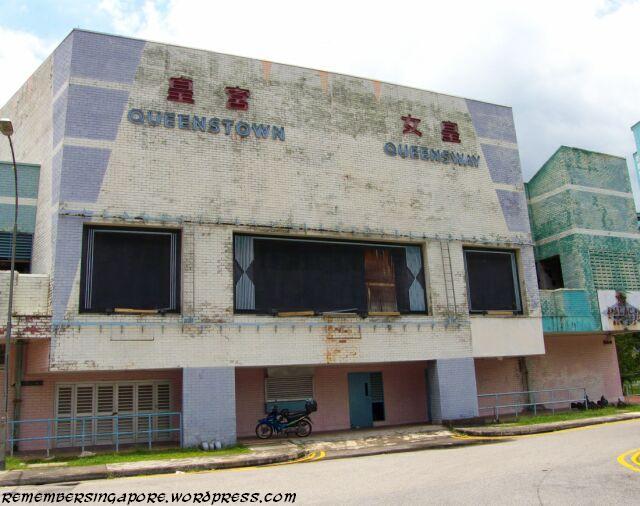
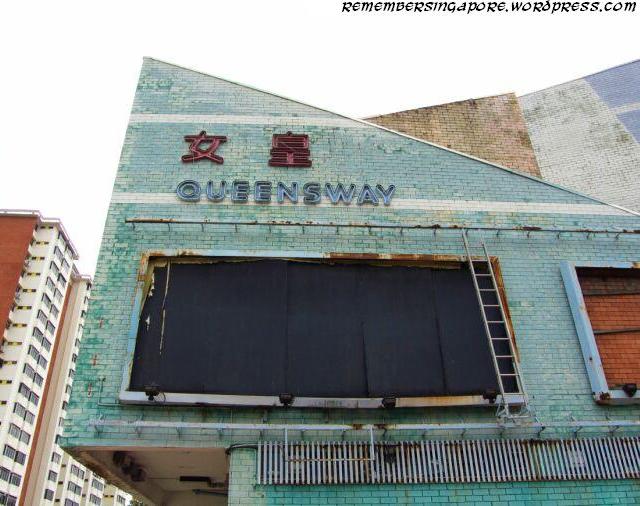
One of the earliest cinemas in Singapore, termed as multiplexes, to be fitted with modern facilities; a twin-hall cinema, a 18-lane bowling alley, karaoke lounges and fast food restaurants, Queenstown/Queensway Cinema was the favourite hangout for scores of students and residents living nearby. Accessibility was also made easier when the Queenstown MRT Station opened in 1988.

However, towards the end of the nineties, Queenstown/Queensway Cinema could not compete against the new multiplexes fitted with better picture quality and Dolby Surround sound effect, leading to its closure in 1999. With the crowds gone, the bowling alley also ceased its operation a year later, along with the fast food restaurant of Kentucky Fried Chicken (KFC).

The theatre was then leased to a billiard and gaming shop. They could not last long and the building was left vacated since then. It was sold for $10.2 million in October 2002.

Regal Theatre, Bukit Merah Town Centre (1979-late 1990s)

Owned by Cathay Organisation, Regal Theatre (皇都戏院) was one of the only two cinemas at Bukit Merah central; the other one being Dalit Theatre. As the first suburban cinema by Cathay, it was opened in 1979, catering to the residents of Bukit Merah, Redhill Close and Henderson.

bukit merah regal theatre 1990s

After it was shut down at the end of the nineties, the building continued to enjoy crowds due to the popular McDonald’s fast food restaurant at the ground level. The ownership of the building changed hands in 2000 for $12 million, but McDonald’s continue to lease the premises until late 2000s.

By mid-2012, the building was demolished, with the site likely to be replaced by a new educational and training center.
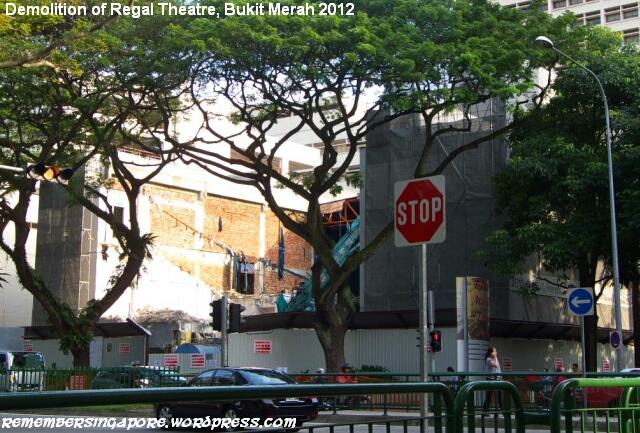
Republic Theatre, Marine Parade Central (early 1980s-early 1990s)

Republic Theatre (金国戏院) was one of the two cinemas, the other being Liberty Theatre, at Marine Parade central during the eighties. Its Chinese name means golden kingdom, while Liberty means silver kingdom.
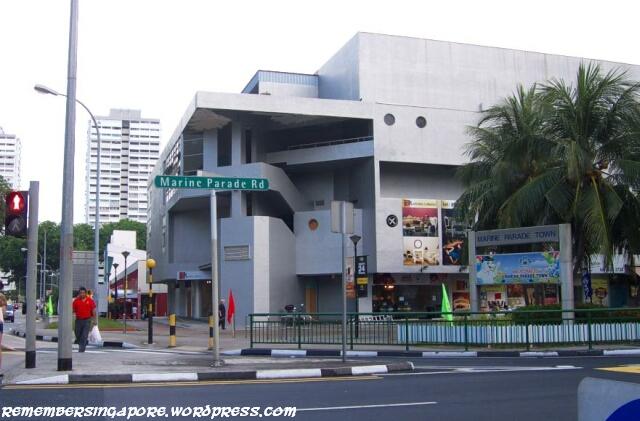
Both Republic and Liberty were owned by the Shaw Organisation. While Liberty Theatre exhibited mostly Chinese movies, Republic was the venue in Marine Parade for the fans of English films. Liberty could not survive after the mid-eighties, but Republic was given a chance when it was converted into a three-screen cinema in 1989. However this proved to be short lived as Republic Theatre was also closed a few years later.

In 1992, it was used briefly for worship services by Bethesda Charismatic Centre.

Rex Theatre, Mackenzie Road (1946-1983, 2009-Present)

Rex Theatre (丽士戏院) opened with a bang in 1946 by the Shaw Organisation, screening its first movie “The Jungle Book”. The cinema, located at Mackenzie Road near Little India, lasted some thirty-plus years before it ceased its operation after “Jaws” in 1983.
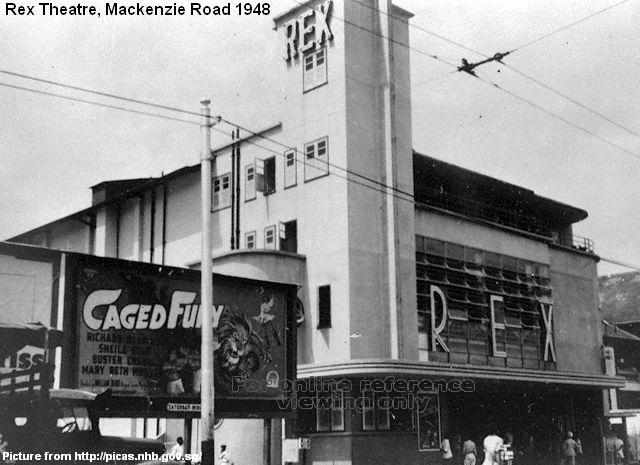
In 1976, Rex Theatre became a talking point as crowds were seen queuing for the screening of “Earthquake”, the first film in Singapore with the new “Sensurround” sound effects that could send vibrations through the cinema seats as the simulation of a real earthquake.
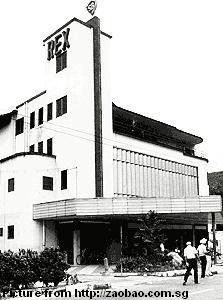
When Rex Theatre closed in 1983 due to struggling movie industry, it was converted into a performance house for two years. Several popular Taiwanese and Hong Kong singers such as Steven Liu (刘文正) and Roman Tam (罗文) had their concerts held there. In 1989, the cinema building was used as an ice-skating rink by Fuji and then leased to a church in the late nineties.

In 2001, the building of Rex Theatre was acquired by Ryan Wong, former national squash player and the elder brother of local artiste Wong Li-Lin. It was rebranded as TJ Live House, consisting of a disco, pub and a performing stage for live bands. Invested by two businessmen, Rex Theatre finally reopened as a cinema in 2009 for the screening of Indian films.

Roxy Cinema, East Coast Road (1930s-1978)

Roxy Cinema (乐斯戏院) was opened in the 1930s at East Coast Road, opposite the famous Red House Bakery. Being the first cinema in the eastern part of Singapore, it was a favourite haunt, especially among the Eurasian students of the nearby St Patrick’s School.
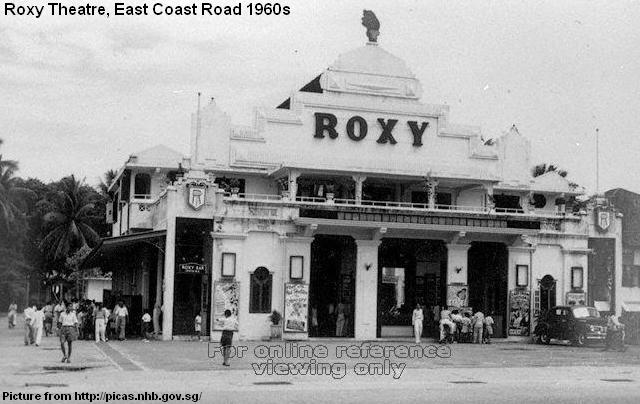
After the Second World War, the Shaw Brothers bought over the cinema. Its household name was retained while the cinema continued its screening of wide varieties of English, Chinese, Malay and Indian movies. It was not until 1978 when Roxy Cinema was sold by the Shaw Organisation.

During its heydays, the cinema was so popular in Katong that its premises were referred as “The Roxy Area”. After its demolition, a new building, named as Roxy Square, was built in 1984 near the location of the old theatre.

Royal Theatre, North Bridge Road (early 1900s-1977)

Like Diamond Theatre which was standing by its side at North Bridge Road, Royal Theatre mainly screened Tamil films, but it was opened almost half a century earlier than Diamond.
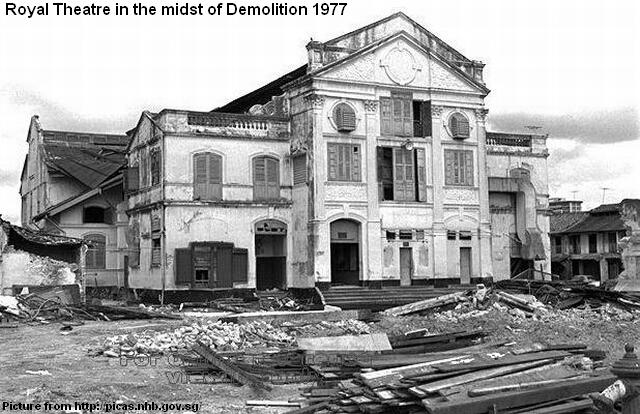
Royal Theatre first started as a Malay theatre before switching to Indian movies from the fifties to seventies, a golden period of its colourful history when it enjoyed brisk businesses. It, however, was also bothered by fires, black market tickets and gangsterism.

Ruby Theatre, Balestier Road (1958-1985)
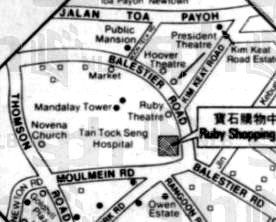
Ruby Theatre was opened by Cathay Organisation along Balestier Road in 1958.

In the seventies and eighties, the Balestier area had a reputation of being a mini entertainment hub, as three cinemas, the other two being President and Hoover, stood here. There was also the Shaw Studio at Jalan Ampas which specialised in Malay films for almost thirty years.

In 1986, the residential-cum-shopping mall Balestier Point was built replacing the demolished Ruby Theatre.

Savoy Cinema, Boon Lay Place (1980s-late 1990s)

Shaw Organisation stretched its movie empire to the far western part of Singapore when it opened a branch at Boon Lay Place in the eighties. It was called Savoy Cinema (四海戏院), or commonly known as Old Boon Lay Cinema.
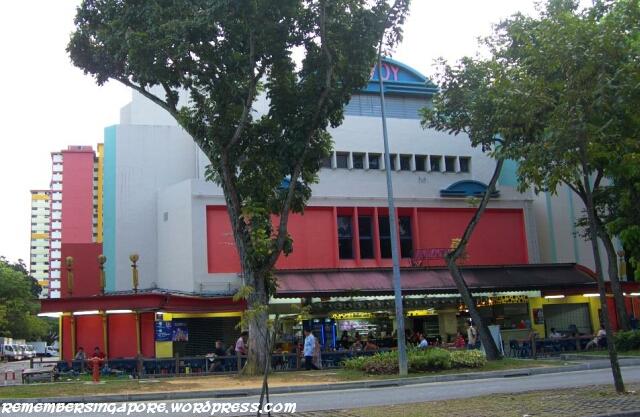
The cinema underwent a major renovation in 1988, after which it received its first Public Entertainment License for its two new cinema halls. But by the late nineties, its business declined due to the opening of the new Jurong Point Shopping Mall with its Golden Village Cinemas.

After its closure, the ground premises was occupied by McDonald’s for a period of time, before taken over by a kopitiam.

Seletar Cinema, Sembawang Road (1930s-1960s)

Seletar Cinema, previously called Pei Li Cinema, was opened in the 1930s at Bah Soon Pah area (between Sembawang Road and the current Yishun Avenue 6) for the benefits of the villagers. It was then purchased by Lim Chong Pang (1904-1956) at the end of 1930s and renamed as Seletar Cinema.
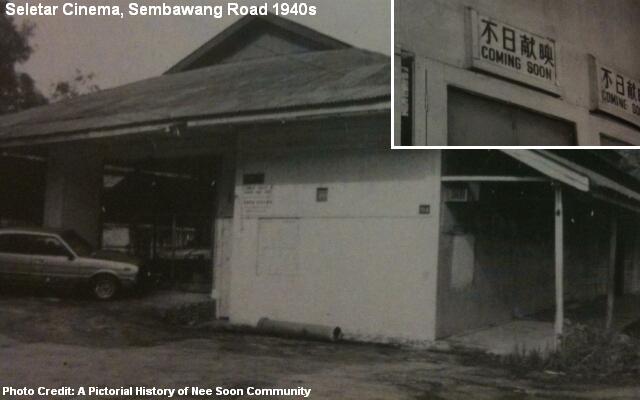
In 1947, the cinema was bought by Koh Chin Chong who called it Nee Soon Cinema. When the business of the cinema deteriorated, it was shut down and its building was converted into a motor-car showroom.

Singapura Cinema (formerly Taj Cinema), Changi Road (1960s-early 2000s)
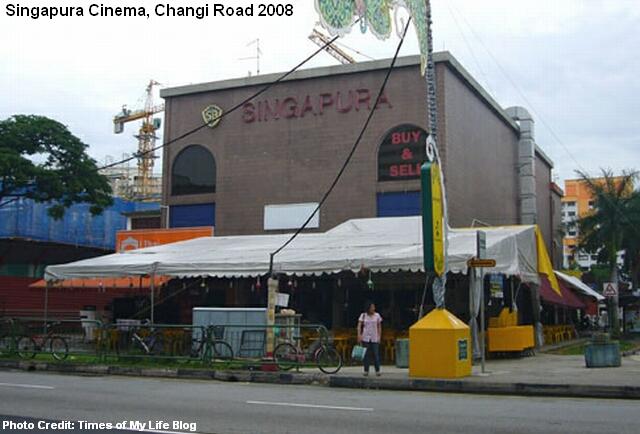
Singapura Cinema (新加坡戏院), formerly known as Tai Cinema, was an iconic landmark at Geylang Serai. Owned by the Shaw Organisation, it used to screen Malay movies. Standing beside Geylang Serai Market and Hawker Centre, the cinema was part of a development plan for the needs of the residents living at Geylang Serai.

The brown building is expected to be demolished soon for the construction of new condominium Millage @Changi.

Sin Wah Theatre, Lorong Ah Thia (1970s-late 1980s)
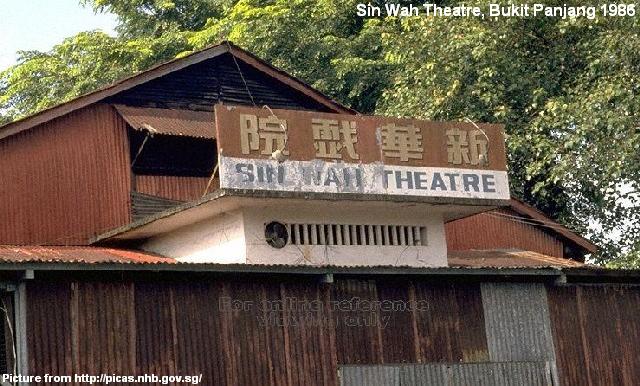
The air-conditioned Sin Wah Theatre (新华戏院) was once a popular landmark among the residents of the old Bukit Panjang. The humble cinema, standing next to a two-storey shophouse with kopitiam, provision shops, tailor shops and electronic shops, was often used as a venue for fund-raising events and children’s singing competitions.

Specialised in Chinese kungfu movies as well as the Western films, Sin Wah Theatre finally met its demise in the late eighties due to the rapid development of the new town of Bukit Panjang.

Straits Theatre, Old Woodlands Town Centre (1970s-1984)

The Straits Theatre (海峡戏院), located at the Old Woodlands Town Centre, specialised mainly Malay and Indonesian films. By 1984, it was shut down and its building was sold for other commercial use.

Sultan Theatre, Chong Pang Village (1930s-1980s)
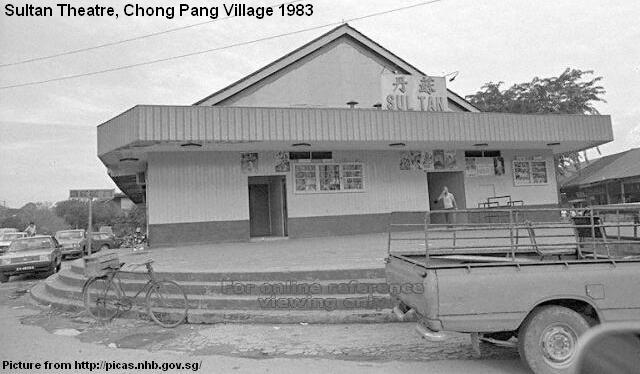
Sultan Theatre began as early as the 1930s. The project was initiated by Lim Chong Pang, who continued his father Lim Nee Soon’s involvement in the development and municipal works of the present-day Yishun and Sembawang areas.

Due to he increasing population in the villages scattered around Nee Soon, Lim Chong Pang felt that there was a need to construct an entertainment center for the residents. Sultan Theatre survived until the eighties, maintaining its high popularity with its imported Chinese movies.

Surina Theatre, North Bridge Road (1920s)
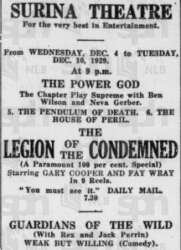
One of the early pre-war cinemas at North Bridge Road along with Tivoli and Jubilee, Surina Theatre was a high-end cinema patronised largely by the British.

It was opened in the early 1920s, importing British movies and charging $2.00 to $2.50 for its reserved seats, which was a hefty amount during that era.

Taman Jurong Cinema, Yung Sheng Road (early 1970s-mid 1990s)

The former Taman Jurong Cinema was located near the junction of Yung Sheng Road and Corporation Drive. Taman Jurong was the first housing estate, followed by Boon Lay Garden, Teban Garden and Pandan Garden, that was developed by the Jurong Town Corporation (JTC) in 1964. As the housing estate grew rapidly in the early seventies, a swimming complex, stadium, community centre and cinema were added.

Taman Jurong Cinema was not the earliest cinema in the western part of Singapore. After the Second World War, a Jewish businessman called Joe David set up an open-air cinema using the site of a former sawmill.

The former building of Taman Jurong Cinema is currently being leased to S-11 Eating House.

Tivoli Theatre, North Bridge Road (1910s-1930s)

The name Tivoli was taken from the old classic cinema Tivoli Theatre located at Scotland, also known as Her Majestic’s Theatre. Like Surina, it showcased British films and was popular among the Eurasians. Its golden period bettered Surina, lasting more than two decades before the Second World War.

Toa Payoh Cinema, Toa Payoh Central (1972-2010)

Toa Payoh Cinema (大巴窑戏院) was opened by Eng Wah Organisation in 1972, one of its bold moves in opening a cinema at the heartlands of Singapore. It was one of the two cinemas, the other being Kong Chian Cinema, at Toa Payoh Central.

It was upgraded to Toa Payoh Entertainment Centre but had ceased its operation by 2010. It was then sold to Hersing Pte Ltd for S$66 million a year later, and the building is now known as ERA Building.

Venus Theatre, Margaret Drive (1965-1984)

See Golden City Theatre.

White Sands Cinema, Paris Ris Central (1990s-early 2000s)

Eng Wah Organisation’s White Sands Theatre (白沙戏院), located at Pasir Ris’ White Sands Shopping Centre, closed in the early 2000s while the shopping mall itself changed ownership in 2007.

Its premises now houses the Pasir Ris Public Library.

Wembley Theatre, Geylang (1930-undetermined)

Wembley Theatre was one of Singapore’s earliest suburban cinemas when it was opened at Geylang in 1930.

Woodlands Theatre, Old Woodlands Town Centre (1980-early 2000s)

The residents of Woodlands were delighted when the Shaw Brothers opened the Woodlands Theatre (兀兰戏院) in February 1980. It was the first cinema at the Old Woodlands Town Centre, a transition point that was popular among Singaporean and Malaysian travellers between the two countries during the seventies to nineties.

During its premier, Woodlands Theatre screened a Chinese movie called Fists of the White Lotus, starring popular Hong Kong artistes Lo Lieh, Liu Chia Hui and Hui Ying Hung. The popular demand in the early eighties saw Woodlands Theatre put on five movies daily.

In 1989, Shaw Organisation converted Woodlands Theatre into a two-hall 600-seating multiplex (Woodlands 1 and 2). It was Shaw’s sixth cinema conversion after Prince, Jade, Savoy, Republic and Changi.
Like Old Woodlands Town Centre itself, Woodlands Theatre gradually lost its popularity by the late nineties. The opening of Causeway Point in 1998 helped determine its final days.

Yangtze Theatre, Eu Tong Sen Street (1977-2015)

Perhaps more famous for its screening of erotic films, Yangtze Theatre (长江戏院) actually came a long way. Started in 1977, it mainly showed Chinese kungfu movies, catering to the Chinese-dominated Chinatown and People’s Park.
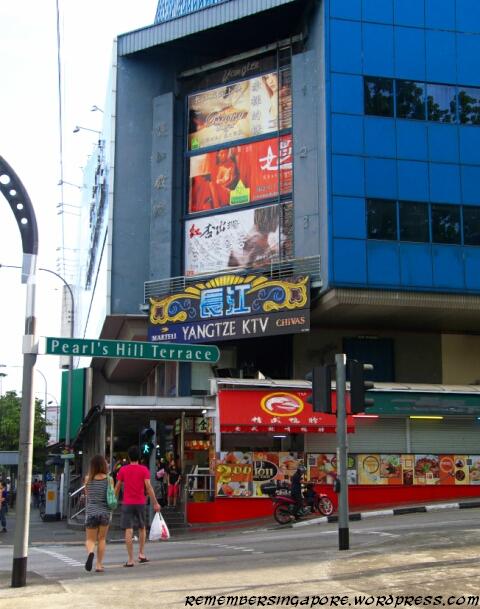
In 1988, its Malaysian owners Sun Chai Realty Pte Ltd tried to sell the building for $6 million without success.

In the late 2000s, the cinema tried to change its image by switching the majority of its screened films to mainstream blockbusters, but the move failed and the cinema faced financial difficulties. In 2011, a $350,000 renovation was given to the aging cinema, and crowds began to return for the erotic movies again. However, it could only last for another couple of years before its eventual closure in 2015.

Yi-Lung Cinema, Dover Road (1970s-1980s)

Yi-Lung Cinema was a small cinema that existed at the quiet neighbourhood of Dover between the late seventies and early eighties.

Zenith Theatre, Tampines Road (late 1960s-1984)

A cinema called Zenith Theatre (仙宫戏院) that mainly showcased Malay and English films once stood along Tampines Road.

It was took over by the church of Bethel Assembly of God in 1984, which then moved to New City Theatre a year later.

Today, Fortune Park Condominium stands at Zenith Theatre’s original site.

Others: Cinemas in British Military Camps (1950s-1970s)

British army and naval camps used to have small cinemas for the benefit of their crews.
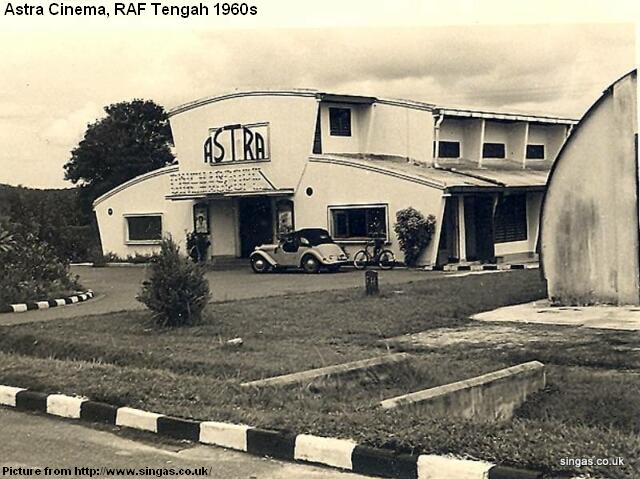
The Royal Air Force based at Tengah Air Base had an Astra Cinema, while there was a Kent Cinema, housed together with a bowling alley, at Dover Road possibly for the welfare of the British military stationed at the nearby Portsdown Camp. A cinema by the name of AKC Cinema also once existed at Gillman Camp. In the north, there was this Naval Base Cinema located at Sembawang Naval Base (1938-1968).

Screening mostly British films, the cinemas were opened to the public as well.

Others: Film Studios (1937-1973)

Two film studios that deserved a place in the history of Singapore-produced movies were the Shaw’s Malay Film Studio (1937-1942, 1947-1967) at Jalan Ampas and Cathay-Keris Studio (1953-1973) at East Coast Road.
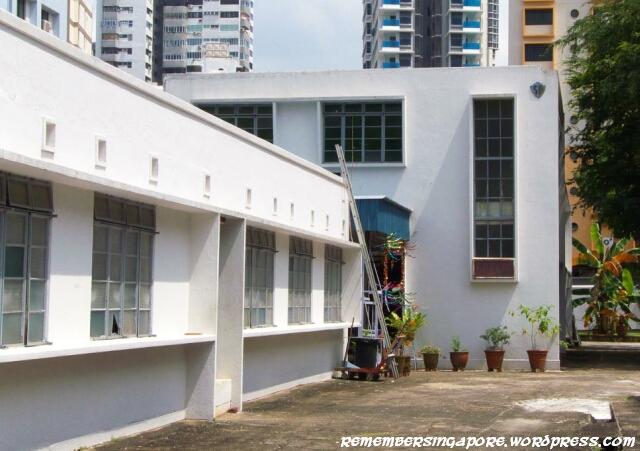
Set up by the Shaw Brothers in 1937 to produce Malay movies for the local clientele, the Malay Film Studio launched more than 160 films in more than two decades, in what was known as the “Golden Age of Malay Cinema”. The legendary actor, singer and director Tan Sri P. Ramlee (1929-1973) was the most famous name to emerge from the studio, winning numerous awards and honours from his 70 films and 200 songs.

After its abandonment for several decades, the premises of the Malay Film Studio was given a fresh makeover in early 2012, ending speculation that the land it is sitting on might be used for private residential purposes.

Cathay joined in the black and white Malay movie industry with its Cathay-Keris Studio established in 1953. Encouraged by the success of its 1957 Malay blockbuster, Pontinanak, Cathay produced a series of movie sequels and other Malay supernatural films. The Lion City in 1960 was Singapore’s first locally produced Chinese-language movie.

How many of these old cinemas do you remember? 😉

Published: 02 August 2012

Updated: 28 June 2021

Posted in Historic | 147 Comments

The Story of a Crocodile Farm at Upper Serangoon Road

Tan Moh Hong Reptile Skin and Crocodile Farm (陈茂丰皮业鳄鱼饲养场, officially known as Singapore Crocodile Farm) was located along Upper Serangoon Road.

Operated for more than 67 years, it was formerly the oldest crocodile farm in Singapore before its closure in mid-2012. Its premises, occupying more than an acre of land, is likely to be sold to a private residential developer in the near future.

In 1945, shortly after the end of the Second World War, an entrepreneur named Tan Gna Chua (陈岳泉) decided to go into trading business of crocodile skins.

He turned his residential home at Upper Serangoon Road into a reptile farm, which was the first of its kind in Singapore. Due to the unstable political conditions and a lack of restrictions in the country during that era, it was not uncommon that an exotic farm could be established in Singapore.

At the start, around 10 crocodiles were breed in the pits with high bricked walls. As his business grew, Tan Gna Chua set up a skin-processing factory within the premises. The number of crocodiles increased rapidly, and Tan Gna Chua’s business was soon able to attract a large clientele. Its various reptile skin products, such as wallets and handbags, and crocodile meat were also exported to overseas.

Tan Moh Hong Reptile Skin and Crocodile Farm was later opened for free admission to the public, a policy that remained till the day of its closure.

Despite operating for decades, many locals were not aware that there was a crocodile farm at Upper Serangoon Road. Even some of the residents living nearby did not realise the existence of this unique place.

In 1972, Tan Moh Hong Reptile Skin and Crocodile Farm received much publicity in the media when Louis Mountbatten (1900-1979), the Earl Mountbatten of Burma, paid a private visit to the farm with his family.

By the mid-2000s, Tan Moh Hong Reptile Skin and Crocodile Farm possessed more than 100 crocodiles of three to four different species. The interior of the farm largely remained the same for more than half a century, despite the rapid changes in its surrounding environment. It old signboard at the entrance, written in three languages of English, Chinese and Japanese, showed signs of aging with its fading colours and peeling paint.

Tan Gna Chua passed away in 2000 at an age of 85, leaving behind an estimated $30 million worth of assets. The Tan family was later involved in a legal dispute between the children of Tan Gna Chua’s two wives.

With the closure of Tan Moh Hong Reptile Skin and Crocodile Farm, there is only one such farm left in Singapore. It is the 40-plus-year-old Long Kuan Hung Crocodile Farm (农光行鳄鱼场) located at Neo Tiew Crescent. Occupying a large compound equivalent to 12 football fields, the farm has currently more than 8,000 crocodiles and three major breeding ponds.

Formerly the largest regional crocodile farm was Jurong Reptile Park situated opposite Jurong Bird Park. It was, however, shut down in 2006 due to bankruptcy.

Published: 15 July 20112

Posted in Exotic | Tagged , , , , , | 27 Comments

You’ve Got Mail… Singapore’s Former/Old Post Offices

In mid-2012, an old forgotten colonial-styled house standing at the junction of Yio Chu Kang Road and Jalan Kayu was demolished due to the widening of Yio Chu Kang Road and the building of a new road that will link to the new Seletar Aerospace Hub.

Not many were aware that this was actually the former post office of Jalan Kayu. In the fifties, there was a need to build a post office to serve the increasing number of residents living at Jalan Kayu and Seletar Hills, as well as the British military personnel stationed at the nearby Seletar Airbase.

One of the best maintained and efficient post offices in Singapore, Jalan Kayu Post Office gained its prestige by winning its third straight title as the Singapore’s Best Kept Post Office in 1969. It continued to serve the community well in the seventies, when Seletar Hills began to be filled with low-rise flats, markets and rows of new private houses.

Jalan Kayu Post Office ceased its operation after the mid-eighties. The building was then served as Chatsworth Kindergarten for several years before taken over by The Hiding Place, a Christian organisation that was founded in 1978 to help inmates of drug rehabilitation centres.

In 2004, SingPost set up a branch at Jalan Kelulut, off Yio Chu Kang Road, to cater for the needs for postal services for the residents of Seletar Hills.

The Early Days

The postal service in Singapore started in the early 19th century, shortly after Sir Stamford Raffles founded Singapore. As the initial postal volume was small, only a small team was tasked to handle the postal service, sharing their office with the Marine Office and Import/Export department.

General Post Office

Due to the flourishing trades in the Straits Settlements by the mid-19th century, the postal service was separated from the Marine Office, becoming an independent entity to deal with the increasing mail traffic. The Post Office was later renamed as Singapore Post Office. In 1854, it had its own building, under the name of General Post Office (GPO in short), near the Town Hall along the Singapore River.

By the 1870s, the rapidly increasing mail volume prompted the General Post Office to employ a team of postmen for mail delivery. Postal boxes were also installed at different location to pick up mails by horse carriages.

The rising importance of General Post Office saw it shifted twice, in 1873 and 1885, to bigger buildings. In 1925, the buildings were demolished to make way for the construction of Fullerton Building, in which the postal service made it its permanent office.

The Chinese Sub-Post Office and the 1876 Riots

In 1876, the British colonial government decided to set up a Chinese Sub-Post Office in a bid to act as a forward agent for the China-bound letters and remittances sent by the Chinese working in Singapore. There were as many as 50,000 Chinese then, and the revenue gained from the service would be significant for the government.

However, the move by the British was opposed by the rich local towkays who had monopolised this service for years. They collaborated with the secret societies to incite protests at the sub-post office and police stations. Riots broke out when the police marched in, resulting in several casualties, but the violence was managed to be quelled within two days. Many rioters, as well as several Chinese towkays and secret society leaders, were imprisoned.

After some weeks, the Chinese community came to accept the existence of the new Sub-Post Office.

General Post Office (at Fullerton Building)

The General Post Office moved into the Fullerton Building in 1928, sharing the premises with Singapore Chamber of Commerce and several other government offices.

Nicknamed the “Grand Old Dame”, the new General Post Office at Fullerton Building was described as the most important post office in the East. It occupied two levels and equipped with a conveyor belt system to transfer the mails to the postal halls. All the mails were sent by ships during its early days.

At the end of 1971, General Post Office shifted its mail handling department to a warehouse at Port of Singapore Authority (PSA), before settling at Chai Chee Complex twelve years later. By 1998, all mail processing operations were done at the new Singapore Post Centre at Eunos Road.

The Fullerton Building was acquired by Sino Land, Far East Organisation’s sister company in Hong Kong, in 1997 and redeveloped into a prestigious hotel opened four years later.

Other Former/Old Neighbourhood Post Offices

Alexandra Post Office

Alexandra Post Office, also formerly known as Prince Philip Avenue Post Office, is housed in a low-rise block that stands between Alexandra Road and Prince Philip Avenue and has been functioning since the early sixties.

Today, Alexandra Post Office shares its premises with a pre-school.

Bukit Panjang Post Office

Located at the junction of Jalan Tech Whye and Choa Chu Kang Road, Bukit Panjang Post Office was officially opened in 1955 by then Minister of Communications and Works Francis Thomas.

The white two-storey building had since been demolished and replaced by one that houses SingPost’s ( (Singapore Post Limited) Bukit Panjang branch.

Joo Chiat Post Office

Joo Chiat Post Office was once located in a small two-storey building at the junction of Tembling Road and Joo Chiat Place, along the main road of Joo Chiat. The building used to be operated as an opium stall and a liquor shop before it was used as a post office.

The building was demolished in the seventies to replaced by a small artery road to an open-air carpark. After its demolition, the residents of Joo Chiat was served by Haig Road Post Office until 1986, when the new Joo Chiat Post Office re-opened at Joo Chiat Complex.

Katong Post Office

Katong Post Office was opened in around 1931, and largely maintained its same size of staff for more than twenty years. In the mid-fifties, the district of Tanjong Katong had seen the population grew rapidly, leading to some concerns from the public that the post office had difficulties in handling the increasing number of customers.

Standing at the junction of Tanjong Katong Road and Mountbatten Road, the two-storey colonial house of Katong Post Office (also known as Tanjong Katong Post Office) is currently the oldest neighbourhood post office in Singapore after Geylang Post Office.

After decades of operation, the post office was given a major renovation and an extension was added to the left side of the building. The building also became fully air-conditioned.

While Katong Post Office looks brand new now, its neighbouring house retained the same image for more than fifty years. It is currently being utilised as a guard house for the SingTel’s Tanjong Katong Telephone Exchange.

Like Alexandra Post Office, Katong Post Office also shares its premises with a pre-school nowadays.

Killiney Road Post Office

Killiney Road Post Office (KPO in short) is one of the few early colonial-styled post offices in Singapore that are given a new lease of life in recent years. Situated at the junction of Orchard Road and Killiney Road, it was opened in the early sixties to serve the community living at River Valley and Cairnhill.

In 2009, Killiney Road Post Office underwent a series of renovation works, with KPO Cafe Bar added to the post office. During its closure, the postal service continued in a temporary post office housed in a container.

Maxwell Road Post Office

Maxwell Road Post Office was a major tenant that occupied the ground floor of the former Custom House, located at the junction of Maxwell Road and Wallich Road.

After it was completed in 1932 at a cost of $313,000, the Custom House was used as the headquarters of the Singapore Customs. Like other buildings commissioned by the Public Works Department (PWD), it also housed several other administrative offices, in which the Film Censor’s Office was one of the tenants.

In 1989, Maxwell Road Post Office ceased its operation at the Custom House, which was re-designated for commercial use. It was renamed as the White House, and subsequently the Maxwell Chambers after its conservation in 2007.

Nee Soon Post Office

Probably the most iconic representative of colonial post offices in Singapore, Nee Soon Post Office has been standing at one end of Mandai Road for decades. In the past, Nee Soon Police Station and a small bus terminus used to exist beside the post office.

At its main door, it still possesses that distinctive orange-white posting box that bears the trademark of Telecommunication Authority of Singapore (TAS) and was used islandwide in the eighties.

Nee Soon Post Office was closed for six weeks in 1974 due to renovation. It ceased its operation in the nineties when the emergence of Yishun New Town gradually took over the administrative roles of Nee Soon and Sembawang area.

Over the years, the building was left vacant except for some storage purposes. In 2003, the Urban Redevelopment Authority (URA) planned to convert the building into a visitor centre but the move did not materialise. It was not until almost a decade later that the former Nee Soon Post Office is given a makeover to become a vet clinic.

Newton Post Office

The former building of Newton Post Office stood near Newton Circus at Kampong Java Road. The history of Newton Post Office went back all the way to the 1920s, spanning over half a century.

In 1974, Newton Post Office was closed for a month due to renovation. It, however, shut down for good a few years later, when the new Newton Post Office and its POSB branch opened at Winstedt Drive off Bukit Timah Road in 1980.

North Canal Road Post Office

Situated at the edge of Hong Lim Park, the name of North Canal Road Post Office was derived from the road it was facing. North Canal Road itself, together with the adjacent South Canal Road, was named after the Singapore Canal that used to link the areas around South Bridge Road to the nearby Singapore River.

In 1974, North Canal Road Post Office temporarily took over the role of postal service provider in the City area when Maxwell Road Post Office was closed for renovation.

In the seventies, the government launched an upgrading program at many aging post offices, such as Kampong Glam Post Office, Sepoy Lines Post Office and Alexandra Post Office, in a bid to improve postal facilities on the island. The renovation project would last more than nine years.

After its operation ceased, the former building of North Canal Road Post Office was refurbished into the present-day Kreta Ayer Neighbourhood Police Post.

Orchard Road Post Office

The post office at Orchard Road was mentioned in the early local newspapers dated in the 1910s, which means there was postal services provided at Orchard Road when it was still a land of plantations and cemeteries.

It might have moved to its stand-alone building in the fifties, besides the Singapore Society For The Prevention Of Cruelty To Animals which was set up at Orchard Road in 1954.

In 1984, the government acquired the lands around Orchard Road for development plans. Both Orchard Road Post Office and SPCA had to be relocated. SPCA was moved to Mount Vernon Road, while a new post office was set up at the former Tangs Superstore.

Paya Lebar Post Office

Located at the junction of Yio Chu Kang Road and Upper Serangoon Road, or fondly known as ow gang ngor kok jio (“Hougang Fifth Milestone” in Hokkien), the former Paya Lebar Post Office existed between the 1930s and the early nineties.

In 1959, Paya Lebar Post Office won the honour of being the best-maintained post office in Singapore. The second and third prized went to Jalan Kayu Post Office and Geylang Post Office respectively. The annual nationwide competition focused on the tidiness and efficiency of each post office.

Postal services gradually gained importance after the self-governance of Singapore in 1955. By 1960, there were as many as 32 post offices operating in different parts of the island.

In 1992, with the closure of its old building, Paya Lebar moved to a temporary office at Upper Serangoon Shopping Centre.

Sepoy Lines Post Office

The colonial-styled building of Sepoy Lines Post Office used to stand at the junction of Neil Road and New Bridge Road from the fifties to eighties, opposite of the Singapore General Hospital.

Nicknamed si bai po by the Hokkiens, it refers to the area around Cantonment Road which was previously known as Sepoy plain. Sepoy refers to the Indian soldiers employed by the European colonial powers from the 17th to early 20th century. They were one of the first Indians to arrive at Singapore, when one troop landed on the island in 1819 with Sir Stamford Raffles and William Farquhar.

In June 1970, Sepoy Lines Post Office was thrown into spotlight on the national news when a robber, armed with a revolver, attempted to rob the POSB (Post Office Savings Bank) branch inside the building. He got away with $1,732 successfully.

Today, only part of its boundary walls and a row of steps remain among patches of grass.

Serangoon Garden Post Office

Serangoon Garden Post Office is housed in a single-storey building beside the famous Chomp Chomp Hawker Centre. Almost as old as the estate itself, it was officially opened in May 1959 by M.P.D. Nair, then Minister of Communications and Works.

Taman Warna Post Office

The former post office of Taman Warna, which means Garden of Colour in Malay, was located at the junction of Holland Avenue and Taman Warna.

In 1977, Taman Warna Post Office was shut down to be replaced by the new Ghim Moh Estate Post Office about one kilometre away. A branch of Post Office Savings Bank was set up at the former site of Taman Warna Post Office.

Tanglin Post Office

Opened at the start of the 20th century, Tanglin Post Office was once one of the oldest post offices in Singapore. The two-storey colonial house, previously a landmark at the junction of Tanglin Road and Nassim Hill, was demolished in 2008. Between 1968 and 1974, the building also housed the Ministry of Science and Technology and the Social Council.

Today, a lifestyle concept store called Friven & Co. shares a new building in the original site of Tanglin Post Office with Singapore Post’s Tanglin branch.

Others

As the country progressed, many old post offices were torn down and replaced by new branches of SingPost.

The likes of old Bukit Timah Post Office (opened in 1953), Circuit Road Post Office (opened in 1972), Crawford Post Office (opened in the early seventies), Farrer Road Post Office (opened in 1963), Kallang Basin Post Office (opened in 1974), Kampong Glam Post Office (closed in 1981) and Owen Road Post Office (opened in late sixties) had all vanished in the history.

Post Office Saving Bank

The General Post Office first offered financial services to the public in January 1877, when Post Office Saving Bank (POSB) was set up.

Known as the People’s Bank, the relationship lasted for almost a century before POSB became a statutory board in 1975, under the charge of the Ministry of Finance. It was later acquired by the Development Bank of Singapore (DBS) in 1998.

The Postal Services Department itself became an autonomous entity after Singapore’s independence in 1965. It was merged with Telecoms (Telecommunication Authority of Singapore) in 1982, before becoming the current SingPost a decade later.

The Postmen

Often understaffed, the early post offices were handled by a postmaster, a clerk and several postmen. Mails were handled by hand before 1983, and postmen had to brave through mud tracks and dogs to reach those isolated kampong and other rural areas. The delivery of letters and parcels usually took days to reach their destinations.

Daily mail volumes have jumped from a few hundreds in the sixties to more than 2.7 million today.

Interesting Trivia

According to SingPost, the earliest local postmark was recorded in 1829, and the first mail steamer to arrive at Singapore was Lady Mary Wood in 1845, which did deliveries for China and the Straits Settlements. The paddle-wheel ship took a record of 41 days to arrive from London to Singapore. However, postage stamps were not used for mails until 1855.

The oldest post office still in operation today is Geylang Post Office, opened since 1930, while the most isolated posting box is located on Pulau Ubin. In the past, there were also postal branches at Pulau Bukom and Pulau Semakau.

Published: 10 July 2012

Posted in Historic | Tagged , , , , , , , , , , , , , , , , , | 45 Comments

10 Legends and Myths of Singapore

Even though we are a young nation, Singapore, like any other countries, has its fare share of legends and myths. Most Singaporeans are aware of the popular folktale of how the name Singapura came about, but what about the other lesser-known legends of Singapore, such as the Merlion, Redhill or Radin Mas?

Let’s find out more…

1. Singapura

Sang Nila Utama, or Sri Tri Buana, was once the ruler of the Srivijaya Empire at Sumatra. According to legends, he went on an expedition in the late 13th century, and discovered an island with white sandy shore. After learning that the place was called Temasik (Temasek), Sang Nila Utama decided to cross the waters to reach this newly discovered land.

However, a storm appeared out of nowhere and nearly capsized the boat. In a desperate attempt, Sang Nila Utama threw his crown into the turbulent waters. The weather and the sea immediately became calm, and the crew reached Teluk Belanga (present-day Telok Blangah) safely. As they landed, a strange beast was spotted from afar. Upon hearing that it was a lion, an auspicious symbol, Sang Nila Utama was overjoyed and decided to name the island Singapura, or Lion City.

The discovery was said to have happened in around AD1297, and Sang Nila Utama went on to rule Singapura for 48 years before his death. His palace and burial ground was located on top of Bukit Larangan, or Forbidden Hill (present-day Fort Canning Hill).

2. Pulau Ubin

How did the island of Pulau Ubin form in the first place?

A legendary tale explains that in the early days, an elephant, a pig and a frog challenged one another to reach the Johor shores from mainland Singapore. The stakes were high, as those who did not succeed would be turned into rock. The frog, being the first to try, failed to cross the straits and was turned into Pulau Sekudu. Pulau Sekudu literally means Frog Island in Malay.
The elephant and the pig were the next to attempt the feat. They did not make it too, thus both of them fused together to become the main island of Pulau Ubin.

3. Pulau Blakang Mati

The former name of Sentosa was Pulau Blakang Mati, where Blakang Mati means “behind the dead” in Malay.

No one knows exactly how the name of the island came about, but there were many legends about its origin. According to one version, the island was once a place of piracy and bloodshed in the past. The victims of the murders haunted the island so much that it was given this not-so-auspicious name. Another account was that the island was located “behind” Pulau Brani, which was the burial ground of many ancient Malay warriors.

Nevertheless, Pulau Blakang Mati was renamed as Sentosa (which means “isle of tranquility”) in 1972. With the island becoming a favourite beach resort among Singaporeans and the tourists, the unhappy legends were soon forgotten.

4. Kusu Island

It is said that in the early 19th century, two holy men went to Kusu Island on a pilgrimage trip. A bond of friendship was forged between the Arab Dato Syed Rahman and the Chinese Yam during their stay on the island. However, Yam became ill one day, and they were running out of their food supplies. Syed Rahman did not abandon his friend and instead stayed and prayed for his recovery.

Miraculously, a boat containing food and water appeared by the shore, and Yam recovered from his illness. The grateful pair returned to Kusu regularly as a gesture of gratitude.

Another version was that a giant tortoise miraculously appeared to save a group of Chinese and Malay fishermen, who were on the verge of drowning after their fishing boats sank in the stormy weather. The tortoise turned itself into an island so that the fishermen could climb ashore. In order to remember their gratitude to the holy tortoise, the fishermen built a Chinese temple and a Malay shrine on the island.

5. Sisters’ Islands

Lying south of Sentosa, Sisters’ Islands refer to Pulau Subar Darat and Pulau Subar Laut.

Many years ago, there was a pair of sisters Minah and Linah living by the southern coast of Singapore. Being very attached to each other, the sisters vowed to marry two brothers so that they could live together always. However, fate could be cruel sometimes, as one night Linah ran into a group of pirates by the sea.

Stunned by her beauty, the pirate chief was determined to marry Linah. When the dawn broke, the pirates came and abducted Linah to their ships. Weeping over the loss of her dear sister, Minah came swimming after the boats. The stormy waters were merciless, and she was drowned eventually. In a desperate attempt, Linah broke free and dived into the sea.

The next day, a pair of islands appeared at where the sisters had drowned. They were named Sisters’ Island by the villagers in memory of the two ill-fated girls.

6. Redhill and Tanjong Pagar

A long time ago, the southern coast of Singapore was infested by numerous fierce swordfish. The villagers and fishermen could not ply their trades at the sea, as they would be attacked by these fearsome creatures if they ever ventured near the waters. The people requested help from the Sultan, but even him and his royal army could not do anything about it.

redhill and swordfish

A little boy then proposed a solution to the Sultan. Build a row of barricade made of banana tree trunks along the affected coast, he said. When the swordfish tried to attack the villagers again, their pointed beaks would pierce through the barricade and would be trapped immediately.

The plan worked perfectly, and the smart boy became popular among the villagers as their saviour. This invited jealousy from the Sultan. Fearing his rule would be threatened in the future, he sent his soldiers to kill the boy who lived on top of a hill. As the poor boy died, his blood flew down the hill, soaking the whole hill red. This was how Redhill, or Bukit Merah (literally means hill red), got its name.

In turn, the place where the barricade of banana tree trunks were set up became known as Tanjong Pagar, or “cape of stakes”.

7. Radin Mas

Radin Mas is the name referred to the area lying between Telok Blangah, Bukit Purmei and Jalan Bukit Merah.

According to legend, the place was named after a Javanese princess called Radin Mas Ayu, which means a sweet golden princess. Her father was a warrior prince named Pangeran Adipati Agung, who married a commoner, her mother, despite objection from the Sultan. During an expedition by Pangeran, the Sultan sent his men to burn their house down, killing Radin Mas Ayu’s mother. Radin Mas Ayu was saved by a loyal servant.

Upon his return, Pangeran was devastated. He decided to flee the Javanese kingdom with his infant daughter Radin Mas Ayu, and managed to arrive at Telok Blangah of Temasek (Singapore). Delighted with his arrival, the Sultan of Temasek arranged the marriage of his daughter to Pangeran. However, Radin Mas Ayu was not well-liked by her new stepmother.

When she grew up, Radin Mas Ayu had a marriage proposal from her stepmother’s nephew Tun Bagus. She refused but Tun Bagus threatened to kill Pangeran. In an attempt to shield her father from the attack, Radin Mas Ayu was stabbed in the heart by Tun Bagus. She was said to be buried at the foot of Mount Faber, and a shrine was erected in respect of her filial piety.

The few landmarks that still bear the name are Radin Mas Flyover, Radin Mas Primary School and Radin Mas Community Centre. Kampong Radin Mas was demolished in the eighties and Masjid Radin Mas (Mosque) was torn down in 2001.

8. Selegie

The legend about Selegie Road is that it was the location of many great battles that took place in ancient Singapore. When Temasek fell in 1377, the last ruler of the kingdom was believed to have fled via this road, still a dirt track then, to Seletar. He escaped by the waters at the coast of Seletar and never managed to launch a comeback in a bid to reclaim his territories.

In the later years, a Bugis pirate tribe known as Orang Selegie was said to have occupy the area around Selegie, where they made Mount Sophia their home. The name Selegie may mean a Malay word that refers to a sharpened and hardened wooden spear.

9. Merlion

One night, the villagers living by the southern coast of Temasek were awakened by the howling winds and the crashing waves. The dark clouds blocked out the lights of the moon and the stars, turning the world in complete darkness. It was as though the island of Temasek would be engulfed by the raging sea. The terrified villagers sank on their knees in prayers.

During this moment, a bright light was observed emerging from the southern waters. A massive creature, half lion and half fish, roared in anger. The battle between the fierce mystical animal and nature was intense, as the sky was filled with flashing lightnings. The villagers had never witnessed such terrifying phenomenons before.

After some time, the winds began to die down, the waves subsided and the sky started to clear. The gigantic sea beast had won the battle against the nature. As it claimed its victory, it stood proudly on Mount Imbiah of Pulau Belakang Mati (Sentosa). By morning, the merlion had retreated into its waters, leaving behind a bright colourful trail.

10. Badang and the Singapore Stone

According to local Malay folklore, Badang began as a poor fisherman who plied his trade at mouth of the Singapore River. One day he caught a genie in his fishing net, and in return of his release, the genie granted Badang’s wish to be the strongest man alive.

Impressed with Badang’s enormous strength, the Rajah of Singapura appointed him as the imperial warrior. Soon, other kingdoms heard of Badang’s fame and sent their warriors to challenge him. The king of India, in particular, sent his kingdom’s strongest man Wadi Bijaya to Singapura for a duel. In the last contest, Badang beat Wadi Bijaya by lifting a huge rock and throwing it towards the Singapore River.

Ancient inscriptions were added to the rock, probably to commemorate Badang’s achievements but centuries later in 1843, the British colonial government blasted it to pieces. Known as the Singapore Stone, only a fragment remains, and is now kept in the Singapore History Museum.

Note: The legends and myths of Singapore are not to be mixed up with Top 10 Most Popular Singapore’s Urban Legends.

Published: 29 June 2012

Updated: 05 December 2012

Posted in Cultural, Paranormal | Tagged , , , , , , , , , , , , , | 44 Comments

A Pictorial Gallery of Singapore in 1980

Looking back at time, many say that the eighties was a golden era in Singapore.

It was a period of stable economic growth and peaceful society with racial and religious harmony. Inflation was low, as seen in the relatively cheap HDB flats, public transport or vehicle ownership. The manufacturing sector was on the rise, attracting foreign investment and providing plenty of job opportunities for the Singaporeans. With their incomes on a steady rise, the middle-class was contended in starting small families. Social tensions between locals and foreigners were almost unheard of.

Hidden in the corner of my storeroom for many years, my long lost primary school textbooks of Social Studies (1983-1988) finally came to light during one of my housekeeping efforts. Inside the six textbooks, there are many photos portraying the Singapore of the early eighties. Social Studies were excellent educational materials for primary school kids to understand more about our nation, history and society.

We can never go back to the eighties, but for the very least, we can reminisce the lifestyles back then. 🙂

The tallest building standing in the skyline of CBD (Central Business District) in 1980 was OCBC (Oversea-Chinese Bank Corporation Limited) Centre. Built in 1976 and towering at 198m high, it easily dwarfed other skyscrapers.

Its title as the tallest building at CBD, however, has since been taken over by One Raffles Place (completed in 1986; 280m tall), UOB (United Overseas Bank) Plaza One (completed in 1995; 280m tall), Republic Plaza (completed in 1995, 280m tall) and One Raffles Quay (completed in 2006, 245m tall).

In the early eighties, the Singapore River was filled with sampans, and rows of old shophouses lined up along its banks. It was an interesting mix between the old and the new downtown core.

More than two decades later, Boat Quay would become a popular dining place filled with pubs and seafood restaurants.

The white statue of Sir Stamford Raffles has witnessed tremendous changes in the development of the areas along the Singapore River.

It was a rather quiet day on the roads at CBD in 1980 as compared to today.

The street name signs were made up of black wordings in white backgrounds, and had four-digit post codes listed after the names.

Four-digit postal code began in Singapore in 1979 and lasted until 1995 when they were replaced by the six-digit system. Before 1979, Singapore had 28 postal districts, and each was represented by a single- or double-digit code.

As for the format of the street name signs, it was changed to green background with white letters in Rotis font in the early 2000s.

The construction of of luxury hotel Westin Stamford Singapore began in the early eighties. It would be completed by 1986, becoming the tallest hotel in Singapore at 226m tall. It was renamed as Swissôtel The Stamford in 2002.

This is a scene at the straight road of Shenton Way/Raffles Quay, where Hong Leong Finance Limited has now replaced the Japanese bank of The Mitsui Bank Limited seen in the background.

A traffic policewoman was helping the children to cross the road in front of Victoria Memorial Hall.

The picture here shows a now-defunct white-top blue cab and an old bus, numbered 173, that had been in service since the seventies.

This was the public bus running on Singapore roads in the early eighties. Non-aircon, bumpy and cramped but its fares were definitely much cheaper. The fare of a feeder bus would cost 15c in the eighties, while that of a normal service was anything around 50c.

The old shophouses in the city did not stay around for too long before they were demolished to make way for the development of the prime area.

Telok Ayer Market was the first market in Singapore to be located at the southern bank of the Singapore River. Its history went back all the way to the early nineteenth century, when it began in 1825 as a simple wooden building.

In 1973, Telok Ayer Market was converted into a hawker centre, but was shut down in 1986 due to the tunneling works of the new SMRT (Singapore Mass Rapid Transit) line. The market would be reopened in 1991 as Lau Pa Sat.

The Satay Club has been in existence at many locations but most Singaporeans would remember fondly the one at the Esplanade. It was 1970 when the Satay Club moved to the Esplanade from Beach Road, where it had stayed popular among Singaporeans for a full 25 years.

The Satay Club was demolished in 1995 to make way for the construction of Esplanade – Theatres on the Bay.

It was just another day at Beach Road in the year of 1980. The tall white building was Shaw Towers, built in 1970. The colonial building on the left side of Beach Road has become the refurbished Evershine & Century Complex.

Orchard Road in 1980 looked more like today’s Lavender Street.

Yellow-top black taxis were already plying their trades on the road. They would last more than 30 years till now. The tall white building in the background was the hotel of Meritus Mandarin Singapore (now Mandarin Orchard Singapore). Completed in the late sixties, it was the first hotel to be built at Orchard Road.

There was no SMRT in Singapore in 1980, not until seven years later. Commuters largely relied on public buses, taxis or personal transports. But there were no COE (Certificate of Entitlement, implemented since 1990) and ERP (Electronic Road Pricing, implemented since 1998) either.

This was the early appearance of the popular Ang Mo Kio Central, with its iconic fountain. Oriental Emporium had just opened its branch here in 1980. In the early eighties, a typical three-room flat in Ang Mo Kio cost about $10,000 to $13,000.

Children who grew up living at Ang Mo Kio might remember this little traffic garden at the the town centre. Designed with road signs, traffic lanes and zebra crossings, kids could drive small rented motorised cars or bicycles here, which was probably modeled after the Road Safety Park at East Coast.

This was Marine Parade at its infancy stage. The new town was built on the reclaimed lands in the southeastern part of Singapore. ECP (East Coast Parkway) was officially opened in 1981, after a decade of construction.

East Coast Lagoon became a popular venue for families’ picnics during the weekends.

Benjamin Sheares Bridge, the longest bridge in Singapore at 1.8km long, was completed in 1981. The total construction cost was $177 million.

This flat became a popular landmark at Hougang with its eye-catching rainbow painting. It is still standing proud at Hougang Avenue 7 today, but with a new gigantic rainbow painted.

New blocks of flats also sprung up at other parts of Hougang, decorated with different designs of facade paintings.

The residents living at Bedok, already a bustling new town in 1980, welcomed the new swimming complex.

Hawker centres were built in the residential neighbourhoods since the early seventies to provide affordable and hygienic food for the people. Ang Mo Kio is the new town with the most hawker centres, numbered at nine, while Toa Payoh comes in second at six.

This was a playground in Clementi town centre designed in the shape of a dove.

Many of these locally-flavoured designs, such as the dragon playgrounds and the pelican playgrounds, were the masterpieces of HDB’s in-house designer Khor Ean Ghee in the late seventies.

The areas around the Causeway (seen in the background) were aggressively developed into residential and industrial estates since the early eighties. It would become the present-day Woodlands new town, inclusive of Marsiling and Admiralty.

The other parts of Singapore, such as Punggol and Ulu Sembawang, were still… ulu. Kampong with many attap houses and large areas of farms had existed throughout the eighties.

This was the scene of the busy Central Fish Market at Jurong.

When Jurong Fishery Port and Central Fish Market became overcrowded in the mid-eighties, the government developed the Punggol Fishing Port and Fish Market Complex. Punggol Fishing Port itself was replaced by Senoko Fishing Port in 1997.

A kopitiam operated its business in an old shophouse. Still a common sight today, it has been one of Singaporeans’ favourite venues for meals.

Loud cheers could be heard at the National Stadium (1973-2010) at Kallang during one evening of 1980, when Singapore beat Selangor 2-1 to claim the Malaysia Cup. The winner was scored by a 18-year-old Fandi Ahmad.

Opened since 1973, the Singapore Zoological Gardens was already a well-known place of interest in 1980, attracting countless of tourists and locals. Animal shows and train rides around the zoo were the favourite activities for the children.

The Singapore Cable Car system between Sentosa and Mount Faber was opened in 1974, and was the first aerial system in the world to span a harbour.

In 1983, a Panamanian-registered oil rig hit the hanging cable, resulting in a disaster that claimed seven casualties when the two cable car cabins plunged into the sea from a height of 55m.

Kranji Way was built across the mouth of Sungei Kranji (with the smaller Sungei Peng Siang, Sungei Kangkar and Sungei Tengah) to turn the freshwater river into Kranji Reservoir. The barrage was built between the small island, which was developed into Kranji Reservoir Park in 1985, and the mainland of Singapore.

In 1980, the NS (National Service) personnel wore Temasek olive green uniforms and armed with AR-15 rifles for their trainings. The uniforms were changed to the camouflaged type in 1985.

The RSAF (Republic of Singapore Air Force) had been using the A-4 Skyhawks since 1973 as the main fighter-bomber role of the air force. The project was upgraded to A-4SU Super Skyhawks in the late eighties. The iconic aircraft was eventually retired in 2005.

Published: 26 June 2012

Updated: 05 November 2012

Posted in Nostalgic | Tagged , , , , , , , , , , , , , , , , , , , , , , , , , , , , , , , , , | 56 Comments

Time Stands Still at Singapore’s Veteran Shopping Malls

Compared to the brand new shopping centres, these veteran shopping malls look as though they are forgotten by time. While it is a norm for new shopping centres to have several fast food restaurants, food courts, fashion outlets or even cineplexes, the old shopping malls are instead dominated by foreign-maid agencies, travel agencies and renovation companies.

Not all aging malls are frozen in time. Those which are managed by sole owners can turn back the time through a series of renovations and makeovers. The strata-titled ones are in more tricky situations. They are usually co-owned by different groups of people, making them difficult to be bought over by private developers. The owners also have the freedom to lease their shops to any tenants who are lured by the relatively lower rents, which is why it is not unusual to find similar businesses in the same building.

While the likes of VivoCity, Nex or JCube attract huge crowds, many veteran malls look deserted even during the weekends.

When was the last time you have visited one of these old shopping malls?

The Veteran Heartlanders

Katong Shopping Centre, Mountbatten Road (since 1973)

Katong Shopping Centre was opened in 1973, much to the delight of the residents living in Katong and Marine Parade. The first air-conditioned shopping mall in Singapore, it was then well-known for a concentrated number of textile shops in its early days, as well as its anchor tenant the Oriental Emporium. The building, styled with the iconic holes-in-walls design, was filled with people every weekends.

As time passed, the domination of the textile businesses was gradually taken over by renovation companies, computer-software and gaming shops, employment agencies and other retail outlets. In 1997, Katong Shopping Centre was renovated with a new striking blue outlook. It is now mainly catered to the crowds from the nearby churches and hotels.
Since 2010, the strata-titled Katong Shopping Centre has been undergoing through en-bloc sales. It may be re-developed into a new commercial building if the en-bloc exercise is successful by the end of 2012.

The Oden Katong Shopping Complex beside Katong Shopping Centre was built in place of the old Oden Katong Theatre in the eighties.

Queensway Shopping Centre, Queensway (since 1976)

Completed in 1976, Queensway Shopping Centre is well-known for its large number of retail shops selling sneakers, tennis racquets, soccer boots and other sport apparels. Other retailers deal with fashion, photocopying and tailorship.

Standing at one corner of the busy cross junction between Alexandra Road and Jalan Bukit Merah, Queensway Shopping Centre has seen major changes in its neighbours in the last 35 years. Before 1990, the Archipelago Brewery Company, specialised in the popular Anchor Beer from the 1930s to 1960s, had its manufacturing plant, production line and warehouse at where Anchorpoint (hence its name) and Ikea are standing today. Bukit Merah SAFRA Club was opened in 1982, and was shut down in 2004 after 23 years of services. There are some redevelopment plans in building a hotel to replace it.

The busy cross junction used to be a round-about named Rumah Bomba Circus in the seventies. Malay street hawkers lined up outside Queensway Shopping Centre peddling delicious satay, otah otah and mee rebus, which were extremely popular with the patrons after their shopping sprees at the mall.

Upper Serangoon Shopping Centre, Upper Serangoon Road (since 1970s)

Located at the junction of Upper Serangoon Road and Upper Paya Lebar Road, Upper Serangoon Shopping Centre was completed in the seventies. The four-storey heartland mall used to be filled with activities in bookshops, tailor shops, hair salons and even a tattoo shop.

The most famous tenant is perhaps Ah Lim, a nickname fondly called by the shoppers, who is the owner of the evergreen computer shop which sells the latest PC games at lower rates compared to other places.

Upper Serangoon Shopping Centre has become a ghost town in the past decade, with more than 70% of of the shops vacated. In 2010, there were plans to sell the building to a private developer for a major revamp, but nothing came out of it. Its fortune was not helped by the opening of Nex, the largest suburban shopping mall in the northeastern Singapore, in 2011.

Bukit Timah Plaza, Jalan Anak Bukit (since 1978)

Deemed as a higher end shopping mall during its heydays, Bukit Timah Plaza used to have many shops specialised in computer hardware and software, household products and a large Yaohan store (see Thomson Plaza below).

The fortune of the plaza declined since the late nineties. With the rapid decrease in the crowds, shops found it difficult to continue their businesses. Rental fees dropped and small renovation contractors companies and maid agencies moved in to become the dominant batch of tenants. Meanwhile, the NTUC FairPrice supermarket replaced Yaohan as the anchor tenant of Bukit Timah Plaza.

Bukit Timah Shopping Centre, Upper Bukit Timah Road (since 1978)

Once popular among the Malaysian tourists for its retail shops selling a wide variety of affordable clothing, Bukit Timah Shopping Centre is now largely dominated by renovation contractor companies and maid agencies, just like the nearby Bukit Timah Plaza.

Even though Bukit Timah Shopping Centre stands opposite of a row of popular eating houses, a lack of human traffic today makes the aging mall pale when compared to its heydays during the eighties. Only a couple of computer gaming shops and billiard saloons are able to lure some youths to the shopping mall, while food-lovers are attracted by a reputed restaurant specialised in nonya cuisine. Otherwise, the building is like a forgotten place frozen in time.

The construction of the Beauty World MRT Station of the Downtown Line (scheduled to be ready in 2015) may bring the old shopping mall back to life, but for the time being, it is destined to retain its reputation as a ghost town.

Thomson Plaza, Upper Thomson Road (since 1979)

Owned by DBS (Development Bank of Singapore), the $30-million project along Upper Thomson Road was handled by Japanese construction company Ohbayashi-Gumi as early as 1977. The shopping complex was fully completed in 1981.

During the eighties and nineties, Thomson Plaza was perhaps more well-known as Thomson Yaohan, due to its anchor tenant Yaohan (1979-1997), a Japanese departmental giant which also had other branches at Plaza Singapura (1974-1997), Bukit Timah (1982-1997), Parkway Parade (1983-1997) and Taman Jurong (1983-1989). After the Asian currency crisis in 1997/98, a bankrupted Yaohan was forced to close most of its operations in Asia. Yaohan Best, Yaohao’s subsidiary which specialised in electronic products, was restructured and became Best Denki.

After the closure of Yaohan, Thomson Plaza went through a period of decline before being revived by a series of upgrading. Its other long-time tenants include KFC and Yahama Music.

City Plaza, Geylang Road (since 1981)

Opened since 1981, the yellow-orange shopping mall at Geylang Road began as a mall filled with shops selling cheap Hong Kong-made clothes and dresses. It also used to have coin-operated massage chairs on its ground floor for tired shoppers.
Today, the mall is a favourite for bargaining experts who like to search for their treasures at the wholesalers in ladies’ fashion. The Arnold’s Fried Chicken on the second level is one of the most popular eating outlets in the building.

Located close to Geylang, the shopping mall has gained a notorious reputation in which old lecherous men can sometimes be spotted lurking around. It has also become one of the gathering points for the Filipino maids in Singapore during weekends.

Beauty World Plaza, Upper Bukit Timah Road (since 1983)

Beauty World Plaza is one of the old shopping malls clustered at Upper Bukit Timah Road, along with Bukit Timah Shopping Centre, Beauty World Centre and Bukit Timah Plaza.

Its name was derived from the Beauty World, an amusement park that once existed at Upper Bukit Timah, and was as popular as Gay World, New World and Great World at Kim Seng. The amusement park was converted into a market place after the Second World War.

Before the construction of Beauty World Plaza, there were the Beauty World Park Market and Beauty World Town, where both of them were destroyed by fires in 1975 and 1984. Years later, some of the stallholders and shop-owners were relocated at Beauty World Plaza and Beauty World Centre to continue their businesses.

Tanjong Katong Complex, Geylang Road (since 1983)

The first fully air-conditioned shopping mall managed by the Housing Development Board (HDB), Tanjong Katong Complex once housed the popular Japanese supermarket and department store Yokoso. In the nineties, other retail shops such as 2nd Chance (First Lady), Toko Lisa and Smart supermarket moved in. The mall is also well-known for selling traditional clothing and textiles. Its current major tenant is Shop N Save.

The construction of Tanjong Katong Complex began as early as 1980, on the site of a former Malay settlement at Lorong Engku Aman. Together with the adjacent Geylang Serai Malay Village, it has maintained its popularity among the Malay community for many years. The Malay Village was demolished in 2011, while Tanjong Katong Complex is given a lease extension of another 10 years, so as to allow the Malay trades to remain in this culturally rich area.
Parkway Parade, Marine Parade Road (since 1984)

An unmistakable landmark of Marine Parade since 1984, Parkway Parade was developed by Parkway Properties. Extremely popular since its opening, it also housed many unforgettable fast food restaurants, such as Hardee’s and Chuck E Cheese, that had long ceased their operations in Singapore.
In 2000, Parkway Parade was sold to Asia Pacific Investment Company, and after a series of upgrades, anchor tenants such as Giant Hypermarket, Best Denki, Isetan, Marks & Spencer and Borders (2007-2012) moved in.

It now boasts eight levels (including basement) of food and beverages, fashion, medical services, beauty salons, family entertainment and a fitness centre.

Holland Road Shopping Centre, Holland Avenue (since mid-1980s)

During the fifties and sixties, Holland Village thrived due to the presence of the British military staying at the nearby Chip Bee Gardens. Holland Village was feared to become a ghost town when the British started their withdrawal from Singapore in 1971, but luckily for the “westernised” neighbourhood, it was able to attract a new group of clientele in the locals and the expatriates.

Holland Road Shopping Centre has three levels of shops selling everything from Asian crafts and jewellery to furniture and carpets. Its large variety in arts, antique and crafts make the mall popular among the expatriates. Lim’s Arts and Living, one of its biggest stores, sells exotic items such as shisha pipes, African statues and Moroccan dinnerware.

In recent years, however, soaring rental fees and the inconvenience due to the construction of the Holland Road MRT Station have affected many tenants. Mama Joe Magazine Corner, one of the iconic tenants of Holland Road Shopping Centre, closed down in 2007 due to bankruptcy.

Holland Road Shopping Centre was given a fresh paint of orange coat after 2009. Before that, it had a white and blue theme.

Other Veteran Malls in Singapore

Serangoon Plaza, formerly known as President Shopping Centre, mainly caters for the middle-class. President Shopping Centre operated from the mid-sixties to early eighties. Mustafa’s founder Mustaq Ahmad first rented a store at Serangoon Plaza in 1985, before acquiring the whole row of shophouses at the nearby Syed Alwi Road to set up Mustafa Centre.

Goldhill Shopping Centre, built in 1969 as a low-rise retail-office hub, was owned by Malaysian developer Goldhill Group. The building will be affected by the construction of the new North-South Expressway scheduled to start in 2013.

Owned and managed by HDB, Balestier Hill Shopping Centre (since mid-1970s) and Boon Lay Shopping Centre (since early 1980s) are more like typical neighbourhood hubs rather than what their names suggest. Another similar HDB neighbourhood shopping hub was the Lake View Shopping Centre along Upper Thomson Road. However, it was demolished in the late nineties.

United Square or formerly Goldhill Square at Novena has been around since 1982, standing beside the Goldhill Plaza and Goldhill Shopping Centre. After successfully reinvented itself as a kids’ learning hub, the mall becomes popular among young families.

A $77 million project, Roxy Square was completed in 1984 at Katong. It is standing on the former site of Roxy Theatre, owned by the legendary Shaw Brothers.

Sembawang Shopping Centre was previously famous for its anchor tenant Sembawang Music Store, which had since ceased its operation in 2009 due to bankruptcy. The mall was refurbished and given a new look in 2007. The popular Sembawang Satay Club used to operate beside the shopping mall before its revamp.

Veteran Shopping Malls at Orchard and City

C.K.Tang/Tang Plaza, Orchard Road (since 1958)

The famous Tangs departmental store was founded by legendary Singaporean entrepreneur Tan Choon Keng (1901-2000), or fondly known as C.K. Tang. Born to a Teochew Presbyterian pastor in Swatow of China, Tang Choon Keng arrived at Singapore at an age of 23.

Began as a humble salesman, Tang Choon Keng soon saved enough to open a small shop at River Valley Road. In 1958, much to the surprise of others, Tang Choon Keng bought a plot of land at the corner of Orchard Road and Scotts Road for S$10,000. Being a devoted Christian, Tang Choon Keng had no concerns that the new building he was going to build was facing Tai San Ting Cemetery.

C.K. Tang Departmental Store went on to become the landmark of early Orchard Road, and kicked off the development of Orchard Road as a prime shopping district of Singapore. Modeled after the Forbidden City of China, C.K. Tang was designed with green-tiled roofs that remains as its iconic feature today.

In 1982, the former building of C.K. Tang was demolished and replaced by a larger complex made up of Tang Plaza and Marriott Hotel (formerly called Dynasty Hotel). A new slogan called “All the best under one roof” was launched with great success. Due to Tang Choon Keng’s Christian beliefs, Tang Plaza remained the only departmental store in Orchard to close on Sundays until 1996.

Tanglin Shopping Centre, Tanglin Road (since 1971)

Located along the bustling Tanglin Road, Tanglin Shopping Centre was built in 1971 as a luxury mall. One of its famous tenants in the early seventies was Club 21, a humble men tailor-turned-into high-end boutique for ladies.

Today, it has gained a reputation of a heritage and culturally-rich shopping mall where one can find Oriental shops specialising from exotic artifacts and antiques such old Buddha heads and Tibetan prayerbeads, to Southeast Asian textiles and Japanese furniture. There is also an extensive collection of vintage items in old movies, music CDs and books for nostalgia lovers.

Peninsula Shopping Centre, Coleman Street (since 1971)

The site where Peninsula Shopping Centre (and Hotel) is standing today has a prestigious history, going back all the way to the early 19th century.

In 1829, Raffles’ adviser and Irish architect George Drumgoole Coleman (1795-1844) built his residence at 3 Coleman Street (which was named after him). When Coleman left Singapore in 1841 due to ill health, the building changed hands several times. By 1865, it was converted into a high-end hotel until the Second World War. Its deteriorated conditions after the war saw its demolition in 1965, and had Peninsula Hotel and Shopping Centre built in its place in 1971.

Golden Mile Complex, Beach Road (since 1972)

The Golden Mile Complex (formerly known as Who Hup Complex) at Beach Road was one of the first commercial-residential projects in Singapore to integrate shops, offices and residences into one single building. Completed in 1973 (its shopping mall was opened a year earlier), the iconic landmark by the Kallang Basin won several architectural awards in the seventies.

Its fortune, however, declined in the mid-nineties. The lack of maintenance, dirty toilets and poor security caused it to be termed from the pride of a “vertical city” to the humiliation of a “vertical slum”. Others called it an eyesore or a national disgrace, due to its prominence beside the busy Nicoll Highway.

Tour agencies and shops selling Thai goods and cuisines now dominate Golden Mile Complex. It is filled with Thai foreign workers during the weekends. There were plans by its owner to sell the building in recent years but the move did not materialise due to disagreements by its shop and residential owners.

People’s Park Complex, Eu Tong Sen Street (since 1973)

The biggest shopping complex in Singapore upon its completion in 1973, the People’s Park Complex is one of the most prominent landmarks at Chinatown, the 31-storey building consists of 6 levels of shops and offices and a residential block of 25 floors.

For decades, the People’s Park Complex has been popular with the wide diversity of its retail shops, ranging from money-changing services, electronic goods, jewellery to travel agencies. It remains as one of most popular hangouts for shoppers during the Chinese New Year festivals.

Its owner, People’s Park Development Pte Ltd, also owned Katong People’s Complex (Katong Mall) from 1984 to 2009. The mall is now revamped into 112 Katong.

Far East Shopping Centre, Orchard Road (since 1974)

Far East Shopping Centre was one of Far East Organisation’s (FEO) first projects in the retail markets. Built in 1974, the shopping centre was the first mall in Singapore to have an atrium and external escalators.

The success of Far East Shopping Centre prompted Ng Teng Fong (1928-2010), head of FEO and one of Singapore’s richest men, to continue his venture at Orchard Road. Subsequently, Lucky Plaza (1978), Orchard Plaza (1981), Far East Plaza (1983) and Claymore Plaza (1984) were built. Ng Teng Feng became well-known as the “King of Orchard”.

Far East Plaza, in particular, became popular among youngsters from the eighties to nineties with its large variety of trendy fashion shops. 77th Street was one of its most popular tenants, operating at the shopping centre from 1988 to 2012.

Plaza Singapura, Orchard Road (since 1974)

While Centrepoint attracted the likes of trendy youngsters, Plaza Singapura was more suitable for family outings in its early days. One of the largest malls in Singapore upon its completion, Plaza Singapura was managed by DBS Land, which was the predecessor of CapitaLand.

In 1974, Japanese departmental giant Yaohan opened its first store in Singapore at Plaza Singapura. Subsequently, other famous brands such as OG, Times Bookstore, Yamaha Music, McDonald’s, Ponderosa, Daimaru and Courts Superstore moved in.

After going through two major revamps in 1998 and 2003, and had its basement linked to the Dhoby Ghaut MRT Station, Plaza Singapura continues to enjoy high popularity till today.

Orchard Towers, Claymore Road (since 1975)

Completed in 1975, the building of Orchard Towers has five levels of retail shops with 13 floors of offices on top. Since the nineties, Orchard Towers became a household name in Singapore, for the wrong reasons.

There are a couple of electronic shops, massage parlours and internet cafes in the building, but when the nights fall, the dozen of bars, pubs and clubs on the first four levels take over. Prostitutes and transvestites roam around, giving the place a notorious nickname of “Four Floors of Whores”. Due to its sleazy nature, Orchard Towers is subjected to regular police raids.

Peninsula Plaza, Coleman Street (since 1981)

Like Peninsula Shopping Centre which is situated on the opposite of Coleman Street, the site of Peninsula Plaza has a long history.

It was once the site of the residence of wealthy Chinese businessman Tan Kim Cheng in the late 19th century. Property developer Manasseh Meyer bought the place and developed it into a five-storey residential apartments with offices and shops known as the Meyer Mansions. The apartments were torn down in 1970. It was not until more than a decade later before Peninsula Plaza occupied its current location.

Peninsula Plaza has largely retained its appearance for the past 20 odd years. Its shops are specialised in a wide range of merchandise, such as household items, fashion, imported snacks and cameras and its accessories. Some of the shops, however, have notorious reputations of high-pressure selling tactics which the shoppers need to be cautious of.

The Arcade, Collyer Quay (since 1981)

The Arcade at Raffles Place, built in 1981, may look out of place standing among the new skyscrapers, but it has a long history stretching back to the early 20th century. Its predecessor was the Alkaff Arcade owned by the Alkaffs, Singapore’s prominent wealthy Arab family.

Completed in 1909, the Moorish-styled Alkaff Arcade was Singapore’s first indoor shopping centre stretching from Collyer Quay to Raffles Place. At four-storey tall, it was also the highest building at the time of its completion.

The former Arcade was demolished in 1978 to make way for the new Arcade at a construction cost of $20 million. The shopping-cum-office building is now famous for the intense competition among its numerous money-changers.

Centrepoint, Orchard Road (since 1983)

Centrepoint was built in 1983, replacing the old Cold Storage building. Renowned British retailer Robinsons became its flagship since then, occupying five levels after its move from the opposite Specialist’s Shopping Centre.

In the mid-eighties, Centrepoint was considered a trendy shopping mall and a popular gathering point among the youngsters, which saw the rise of the infamous Centrepoint Kids. As many as 2,000 teenagers gathered here every weekends. Most of them, dressed in loud outfits and hairstyles, were just engaging in normal conversations among friends, but a few committed illegal activities such as shop-lifting and glue-sniffing. Some fights occurred due to staring incidents. This gave the groups of youngsters a bad reputation, and prompted the police to keep an eye on the premises outside Centrepoint.

In 2006, after a major revamp, Centrepoint Shopping Centre was renamed as The Centrepoint.

Liang Court, River Valley Road (since 1985)

Standing beside Clarke Quay, Liang Court aims to provide an “Asian Fusion by the River” shopping experience for its customers. The 5-levels-2-basements mall takes on a Japanese theme, having MEIDI-YA supermarket and Kinokuniya bookstore as its anchor tenants, as well as a number of Japanese restaurants. MEIDI-YA at Liang Court is the Japanese supermarket’s second overseas branch after its first store in Amsterdam of Holland.

The Singapore River clean-up project was kicked off in 1977, and lasted almost a decade to keep it pollution free. When Liang Court was opened in 1985, the Singapore River was a vibrant and clear waterway beside the brown buildings of Liang Court and Novotel Hotel.

Liang Court underwent a major $40 million revamp in 2008.

Sim Lim Square, Rochor Canal Road (since 1987)

Like Funan Centre (opened since 1985), Sim Lim Square, or popularly known as SLS, is famous for it large variety of computers, handphones, cameras and other electronic gadgets. While Funan Centre is considered more upmarket and expensive, Sim Lim Square caters more for the general masses. It has, however, an unwanted reputation of scams and high-pressured selling tactics.

Consisting of six levels and two basements of retail shops selling all sorts of electronic and computing devices, Sim Lim Square offers the customers many choices at negotiable prices and bargains. However, the well-known IT mall has been plagued by dishonest and unethical business practices of some shops in recent years. Along with Lucky Plaza at Orchard Road, Sim Lim Square has gained a notorious reputation of “carrot-chopping” (scamming) the tourists.

Rise and Fall of Other Shopping Centres

Tay Buan Guan Supermarket, East Coast Road (1950s-2001)

Comprising of a Chinese emporium, jewellery shop, pharmacy, confectionery, refrigeration facilities and even a beauty saloon, Tay Buan Guan Supermarket sold everything from groceries, books, flowers to electrical appliances and household items. Housed in a building made up of 13 two-storey shophouses, the supermarket was a landmark at Katong and frequently patronised by the Peranakans, Eurasians and the English-educated Chinese.

Tay Buan Guan Supermarket’s founder Tay Leck Teck started off as a hawker at Joo Chiat before he saved enough to open a shop, and later set up the shopping centre in the fifties. It enjoyed some forty plus years of popularity and prosperity, but was later outshone by Katong Shopping Centre and Parkway Parade. In 2001, the building was bought over by a condominium developer and subsequently demolished.

Specialists’ Shopping Centre, Orchard Road (early 1970s-2008)

One of the oldest shopping centres at Orchard Road, Specialists’ Shopping Centre was home to Hotel Phoenix Singapore and, more famously, the John Little departmental store. It was originally named Specialists due to the concentration of medical specialists in its early days, and it was built in the site of the Pavilion Theatre in the early seventies.

Owned by OCBC Bank, the 30-plus years old mall and hotel were finally demolished in 2008 to be replaced by Orchard Gateway, a new mall with restaurants, offices, hotel rooms and a library linked between two towers.

Scotts Shopping Centre, Scotts Road (1982-2007)

Scotts Shopping Centre, at Scotts Road, was a high-end boutique mall mainly catered for wealthy Indonesian or other overseas customers. Opened in 1982, it had five levels of retail shops with a 23-storey service apartment building on top. The mall even had Singapore’s first air-conditioned food court, Picnic Foot Court, opened in 1985.

In 2004, Scotts Shopping Centre and the Ascott Serviced Residences were bought over by Wheelock Properties for $345 million. The buildings were subsequently demolished three years later, and replaced by a luxury apartment-and-retail complex known as Scotts Square.

Promenade Shopping Centre, Orchard Road (late 1980s-2003)

Promenade Shopping Centre was built at the site of the former Fitzpatrick’s Supermarket in the late eighties. In 2003, it was demolished to make way for the extension of the luxury high-end mall Paragon.

Other than the defunct shopping malls, major departmental retailers in Singapore that have closed in recent decades were Oriental Emporium (1966-1987), Yaohan (1974-1997), Daimaru (1983-2003) and SOGO (1986-2000).

Published: 13 June 2012

Updated: 28 June 2021

Posted in Historic | Tagged , , , , , , , , , , , , , , , , , , , , , , , , , , , , , , , , , , , , , , , , | 130 Comments