Old Hill Street Police Station, the Iconic Colourful Landmark by the Singapore River

Originally called the Hill Street Police Station and Barracks, the majestic six-storey Neoclassical-style colonial building was Singapore’s largest government building when it was completed at a cost of about $634,000 in 1934. It was dubbed by the British as one of the finest police barracks in the world.

Former Landmarks

Old Hill Street Police Station is located at the junction of Hill Street and River Valley Road and at the foot of Fort Canning Hill. Singapore’s first prison and the Assembly Hall (also known as Assembly Rooms) formerly occupied this site in the 19th century.

The Assembly Hall started as an attap and wooden house, built for public functions as Singapore’s first town hall. In 1858, it held one of the colony’s most elaborate ceremonies, when the Knight Commander of the Bath (KCB) was bestowed on James Brooke, the “White Rajah of Sarawak”. A new Town Hall was later built in 1862 at Empress Place. The Victoria Memorial Hall was added to the Town Hall in 1905, and the building has become known as the Victoria Theatre and Concert Hall today.

Early Police Stations

The first police office was a wooden shack built by convicts in 1821 near the present-day Anderson Bridge. Other police stations before 1880s were mostly timber buildings with unstable foundations.

In the late 1920s, Harold Fairburn (1884-1973), the Inspector-General of the Straits Settlements Police Force from 1925 to 1935, pushed for the construction of modern police stations in Singapore. He studied police requirements, crafted proposals and sought funds and approval from the colonial government.

Due to Harold Fairburn’s efforts, new concrete police stations were erected by the Public Works Department (PWD) between 1931 and 1936, including the Central Police Station, Beach Road Police Station and Barracks, Traffic Police’s branch at Maxwell Road and Sikh Police Barracks at Pearl’s Hill.

But the largest would be the Hill Street Police Station and Barracks, completed and officially opened in 1934. It was designed by Frank Dorrington Ward (1885-1972), Singapore’s Government Architect from 1928 to 1939, whose impressive portfolio included the Volunteers Headquarters, Clifford Pier, former Supreme Court building (present-day National Gallery Singapore), former Custom House and the terminal building of the former Kallang Airport.

Largest Police Station

The huge Hill Street Police Station and Barracks, designed with offices, garages, two prison cells and three electric lifts, could house 1,000 working personnel. The building also had bunks, kitchens and even badminton courts to meet the accommodation and recreational needs of the hundreds of policemen and their families staying at the police station between the 1930s and 1950s.

There was also the Singapore Police Creche, a nursey located at the top floor of police station. It served as a temporary home for the children of the policemen when they were outstationed or away for duties. Necessary medical care was also provided for those with sick and undernourished kids.

The nursery, headed by the Lady Medical Officer of the Police Force, was said to be one of its only kind in the Far East. During the Second World War, however, the Singapore Police Creche’s medical equipment, cots, beds and toys were looted by the Japanese.

Warning Sirens

The late 1930s saw increased international tensions throughout Europe and Asia. In Singapore, the colonial government carried out civil defence exercises in March 1939, simulating air raids and naval attacks of the island. A total of eight air raid warning sirens were installed at Hill Street Police Station, Orchard Road Police Station, Kandang Kerbau Police Station, Kallang Airport, Geylang Fire Station, Keppel Harbour and a garrison school at Mount Faber.

After the war, in 1958, another new air raid warning siren was installed and tested at Hill Street Police Station.

Japanese Occupation

The Hill Street Police Station, like many other government buildings, was taken over by the Japanese during the occupation. The offices and prison cells were rumoured to be used by the Kempeitai (Imperial Japanese Army’s military police) for interrogation and torture of the anti-Japanese personnel.

In 1943, the Japanese painted the Hill Street Police Station in dark brown shades, in order to camouflage the building against the Allied Forces’ air raids. After war, in 1949, the British repainted the building with new pearly white coats of paint, to signify a new era after Singapore’s darkest period in history.

Post-War Period

The Arms and Explosive Branch moved to Hill Street Police Station in 1949. It was the department that issued licenses to the private gun owners between the fifties to seventies.

In the fifties and sixties, audacious cases of robberies and fights between secret society members just outside the Hill Street Police Station were not uncommon.

Hill Street Police Station underwent a $500,000 renovation project in 1971. More than just a functioning office for the police force, the building then also housed numerous police-affiliated organisations such as the Police Junior Officers’ Association, Junior Officers’ Mess, Junior Officers’ Non-Muslim Benevolent Society, Lembaga Khairat Muslim (Muslim Benevolent Society) and the Police Cooperative and Loan Society.

In the seventies, urban renewals were carried out at many parts of Singapore’s downtown and city areas. In 1977, the Whampoa Ice House, a 123-year-old godown opposite of Hill Street Police Station, was demolished to make way for the widening of River Valley Road. The ice house, built by Ho Ah Kay in 1854, had been a prominent landmark in the vicinity for more than a century.

Hill Street Police Station was also a demolition target in the late seventies. Fortunately, in 1983, it was included in the Preservation of Monuments Board’s list of buildings, bridges, statues and monuments that merit preservation.

The police force vacated Hill Street Police Station by the end of the seventies. As the building no longer functioned as a police station, Hill Street Police Station was renamed Hill Street Building in 1980.

In the following decade, various agencies from the civil and public services moved into the building, including Board of Film Censors, Public Trustee’s Office, Official Receiver, Official Assignee, Display and Distribution Unit, Prison Welfare Service, and the National Archives and Records Centre (became National Archives and Oral History Department in 1981 and National Archives of Singapore in 1993).

The National Archives of Singapore stayed at Hill Street Building until 1997 as its last tenant.

Hill Street Building was gazetted as a national monument on 18 December 1998. It was given a $82-million facelift to convert the building into an arts centre, as well as offices for the Ministry of Information and The Arts (MITA) and its related statutory boards such as National Arts Council, National Heritage Board, Singapore Broadcasting Authority and Singapore International Foundation.

The major facelift also gifted the building its iconic appearance today. In 1999, the former police station building’s dull and stern image was instantly transformed when its 927 windows were painted with a riot of bright yellow, tangerine, red, green, blue and purple. On 1 November 2000, the reburbished building was officially reopened as MITA Building.

The opening of MITA Building would place MITA strategically opposite of The Treasury at High Street, which housed the Ministry of Trade and Industry, Ministry of Law, Ministry of Finance and Ministry of Foreign Affairs.

MITA absorbed the information technology function from the Ministry of Communications and Information Technology in 2001 and became the Ministry of Information, Communications and the Arts (MICA). Three years later, in 2004, MITA Building was renamed MICA Building.

In 2012, MICA was restructured to become part of the Ministry of Communications and Information (MCI) and Ministry of Culture, Community and Youth (MCCY). As it might be too difficult to remember the building’s name carrying the acronyms of the two ministries, it was decided that MICA Building would be renamed Old Hill Street Police Station.

A summary of the changes in the building’s name throughout the decades:

Name

Years

Remarks

1

Hill Street Police Station and Barracks

1934-1960s

Officially opened in 1934.

2

Silver Jubilee Building

1935

Briefly renamed in 1935 as a commemoration for the 25th anniversary of King George V’s reign.

3

Hill Street Police Station

1960s-1980

Policemen housed in the building were gradually relocated to other accommodation in Singapore.

4

Hill Street Building

1980-2000

The police force moved out of the building in 1980.

5

MITA Building

2000-2004

Home to the Ministry of Information and The Arts (MITA).

6

MICA Building

2004-2012

MITA was renamed Ministry of Information, Communications, and the Arts (MICA).

7

Old Hill Street Police Station

2012-Present

Reverted to its original name after MICA was restructured to become part of Ministry of Communications and Information (MCI) and Ministry of Culture, Community and Youth (MCCY).

Published: 30 June 2024

Posted in General, Historic | Tagged , , , , , , , , , , , , , , , , , , | 3 Comments

End of the Road for Trishaws in Singapore

The First Trishaws

According to Singapore Infopedia, trishaws were first introduced in Singapore in 1914 as an improvised version to the two-wheel rickshaws. It had side chairs bolted to tricycle frames, and could be pedalled like bicycles. An American company apparently was keen to import 500 trishaws to Singapore but this request was rejected by the colonial government due to road safety issues.

However, in the local newspapers, “trishaw” was mentioned only in 1936 as a new type of vehicle that made its debut in Burma’s Rangoon. It was described as a further development of the rickshaw, fitted with a third wheel and propelled by pedals. It was able to cruise at 15 miles per hour (or 24km/h) speed on its three pneumatic tyres. Its inventor was said to be a Chinese resident in Burma, who had patented the new vehicle for use in British India and Burma.

Trishaws in Malaya

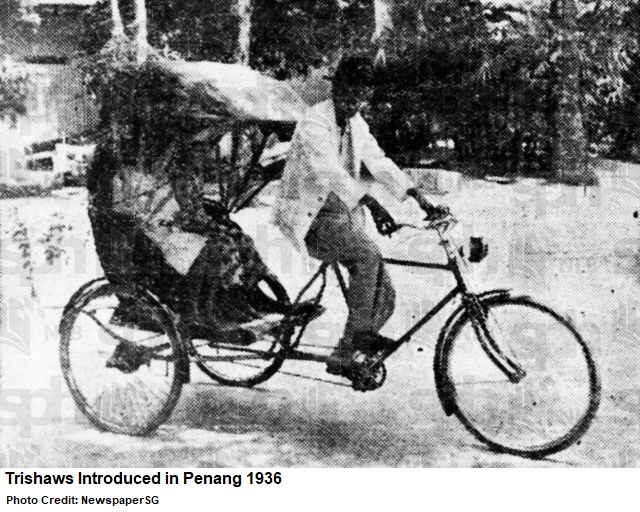
In British Malaya, 50 trishaws were introduced in Penang in 1936. Taiping had its first batch of 15 trishaws in 1941, whereas trishaws were brought into Singapore a year later, during the Japanese Occupation. The Syonan Times reported in 1942 that there were 48 trishaws plying the roads in Singapore.

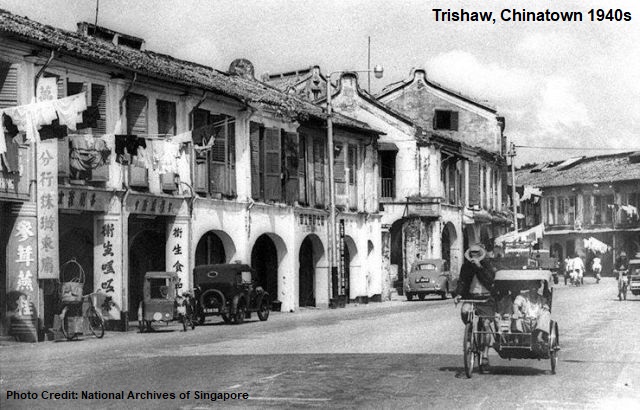
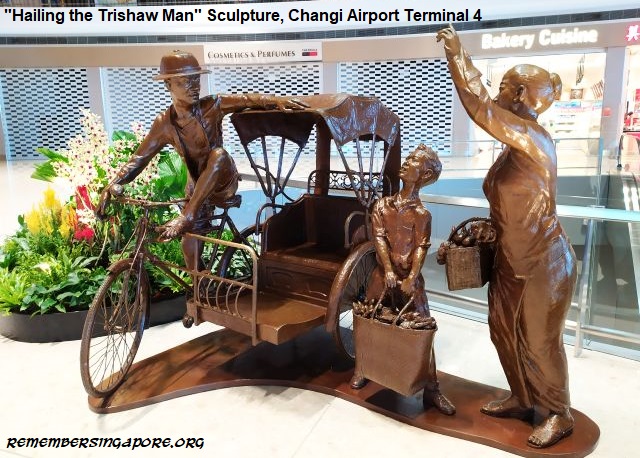
Trishaws gained popularity rapidly, eventually replacing the rickshaws after the war. Bicycles, on the other hand, were still the most common mode of transport; the registered bicycles numbered 42,000 in September 1942.

In 1946, the Singapore Municipal Commission regulated the fares of the rickshaws and trishaws, after many complaints that the rickshaw pullers and trishaw riders were frequently demanding exorbitant charges. This was especially so during chaotic periods when bus companies put up strikes and disrupted the public transport system.

The regulations stated that the distance-based rickshaws and trishaws could not charge more than 20c per half mile. For those hired by time, the charge would be $1.50 per hour, and an additional 40c every subsequent 15 minutes. A rickshaw or trishaw hired for an entire day, regardless of distance, would cost a maximum of $6. For reference, a trishaw cost between $280 and $300 in the late forties, and could be rented out for $1 to $1.50 per day.

Rules and Regulations

In July 1946, the Municipal Commission decided not to renew the licenses of the 3,500 rickshaws in Singapore, as it was considered inhumane to treat the pullers as “beasts of burden” in this “degrading trade”. Rickshaws, therefore, would be officially phased out on 1 May 1947. In other parts of Malaya, rickshaws were banned in Malacca on 1 January 1948, followed by the ban of rickshaws in Penang in the same year.

The total number of registered trishaws in 1946 was 4,000. Due to impending ban of rickshaws, many rickshaw owners and pullers rushed to apply licenses to switch their vehicles to trishaws. In just a year, in 1947, the number of trishaws in Singapore more than doubled to 10,000, with 20,000 registered riders.

The oldest rickshaw puller at that time was 72-year-old Goh Ah Leng, who came to Malaya when he was 54 years old. He had previously worked as a sedan chair carrier in China. The rickshaw ban prompted him to retire and go back to China.

Besides the regulated fares, the Municipal Commission also imposed a list of rules for the trishaws, including the installation of efficient brakes, bells, and front and rear lamps. Every rider must wear a numbered arm badge that was visible at all times. No licenses would be granted to riders under 16 years old.

Trishaw riders were also required to pass a traffic test that comprise control of the trishaw, road sense, how to read the hand and light signals and knowledge of the rates of hire. Unlicensed trishaw riders were not permitted to ride on the Singapore roads.

In May 1947, 5,000 trishaw riders protested the new trishaw registration law and the hefty $5 registration fee, but the Municipal Commission stood firm in its decision. The trishaw riders also refused to wear the arm badges as they felt it was “humiliating”.

In 1948, the Municipal Commission added more rules, including the definition of trishaws as passenger-carrying vehicles and must not be used to carry goods only. It also ruled that trishaw riders must wear blue clothes, as a form of identification, starting from 1949.

The Singapore Rickshaw Owner’s Association, Singapore Trishaw Labour Union, Singapore Rick and Trishaw Workers’ Union, and Singapore Trishaw Owner’s Association were the major associations that looked after the interests of the rickshaw pullers and trishaw riders. This included subsidising the funeral expenses of a deceased member, or providing loans to a sick member to cover his medical expenditures.

Other than the more stringent rules and regulations, trishaw riders faced numerous issues during the forties and fifties. More riders means stiffer competition for customers; the riders often resort to aggressive touting and fights occasionally broke out.

There were extortions from the secret society members and gangsters too; although many of the riders themselves were part of the gangs. The riders also frequently flouted traffic rules, causing accidents and congestions and affecting other road users.

In 1949, the Singapore Commission proposed a third party insurance scheme to be taken up by each trishaw riders, much to the displease of the riders and their associations and unions. The insurance would be additional burden to their financial difficulties. The proposal was eventually dropped.

Trial of Trixis

The Municipal Commission and Registry of Vehicles (ROV) did a trial run of motorised trishaws (nicknamed “trixis” or “trishaw-taxis”) in 1950. “Trixis” were commonly found elsewhere in Bangkok, Saigon, Hong Kong and Indonesia.

George Lee Motors brought a small number of motorised trishaws into Singapore, but the attempt to introduce this new vehicle on a massive scale was strongly protested by the traditional trishaw riders and taxi drivers. In 1951, the Municipal Commission decided to scrap the “trixis” proposal.

Tourist Attraction

In 1954, almost 7,000 trishaw riders generously donated their entire day’s earning, along with the likes of shopkeepers, street hawkers and taxi drivers, for the building of the new Nanyang University.

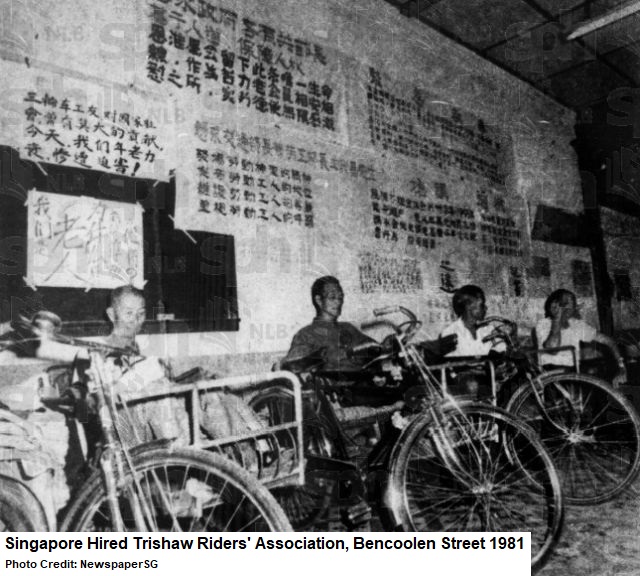
Buses and taxis had become more common in the sixties, offering passengers speedier rides with competitive fares as compared to the slow and outdated trishaws. This caused the trishaw population to decline to around 3,000. The number dropped further to less than 2,000 by the end of the seventies. Many trishaw riders were struggling and living hand-to-mouth in this declining trade.

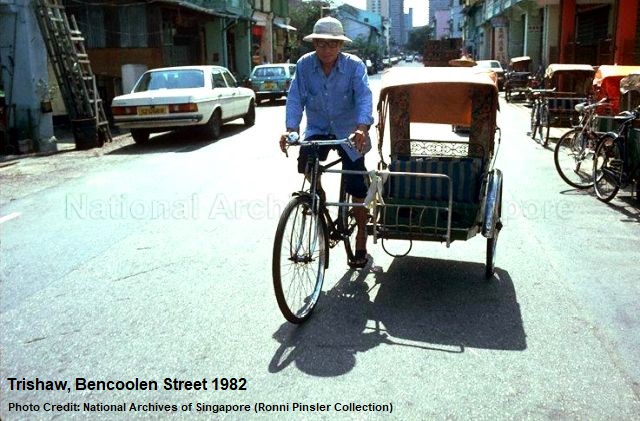
The trishaw business was given some revival hope in 1965, shortly after Singapore’s independence. The newly-set up Singapore Tourist Promotion Board (STPB) identified trishaws as “great tourist attractions”. At some of the leading hotels, designated trishaw stands were built for tourists to take the trishaws for some sightseeing tours of the Chinatown and city area.

Singapore also featured a trishaw as one of its attractions at the Expo ’70 held at Osaka, Japan. In 1973, Singapore presented a trishaw to a French museum during the Jaycees World Congress. Another trishaw was displayed by STPB at the Singapore Fair ’76 in Tokyo’s Toshima-en Amusement Park.

There was even a “cleanest trishaw” competition in 1968, organised by the ROV as part of “Keep Singapore Clean” campaign. 41-year-old trishaw rider Ong Ah Lock, with his gleaming blue trishaw, came in first and was awarded $60 in prize money.

In the seventies, the University of Singapore’s (NUS) Student Union organised the Trishaw Pageant as a means to foster the cultural and social aspects of the Singapore society. Held annually, it featured a convoy of trishaws that displayed different national themes of slogans and undergrads in their fancy dresses. The trishaw parade would travel from NUS’s Bukit Timah campus to Orchard Road, attracting huge crowds along the way.

In December 1974, the trishaws were banned from plying along the major and congested roads during peak hours. Some of the roads listed in the ban were Bra Basah Road, Victoria Street, New Bridge Road, Robinson Road and North and South Bridge Roads.

Another new rule under Road Traffic (Public Service Vehicles) (Vocational Licenses and Conduct of Drivers, Conductors and Passengers) (Amendment) Rules was implemented in 1977, setting an age limit for the licensing of public service vehicle drivers and trishaw riders. They could no longer drive these vehicles on the roads after the age of 70.

The seventies and eighties witnessed Singapore’s booming tourism industry but this also led to numerous complaints of taxi drivers and trishaw riders overcharging and extorting the tourists.

One 1981 case even involved the Interpol when a couple of Japanese tourists were forced to pay $310 each for trishaw rides from King’s Hotel to the Singapore Handicraft Centre at Tanglin Road. In 1982, an American university professor was demanded $128 for a two-hour trishaw ride in town. The increasing number of such cases damaged Singapore’s reputation as a tourist destination.

As a result, Operation Trishaw was carried out in 1982 by the ROV and Tanglin Police to round up the unlicensed trishaw riders and those who charged exorbitant fares from their passengers. 12 trishaw riders were caught in the operation.

In 1987, the ROV approved the displaying of advertisements on trishaws in Singapore. Japanese camera and film maker Konica was the first to advertise on trishaws. This brought an additional income of $50 per month for each of the selected 150 trishaw riders.

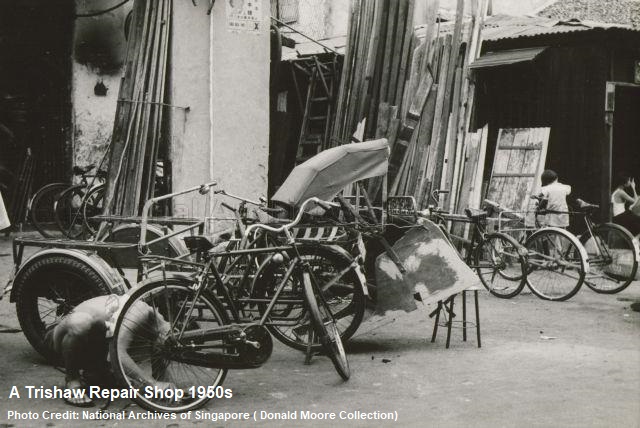
According to ROV’s 1988 Annual Report, there were only 533 licensed trishaw riders left in Singapore. Hock Sin Hin, located at Joo Chiat Road, was the last shop in Singapore to assemble, repair, rent and sell trishaws. Its business was started half a century ago in the 1930s.

In the nineties, STPB licensed three travel agents – Trishaw Tours Pte Ltd, Triwheel Tours Pte Ltd and Pedicab Tours Pte Ltd – to operate trishaw tours in Singapore.

Trishaw Uncle, the sister company of Singapore River Cruises Leisure, was established in 2010. With its fleet of 100 trishaws, the company hoped to revitalise the nostalgic scene of old Singapore with city tours for the tourists. The Singapore Tourism Board (formerly STPB and renamed STB in 1997) appointed it to manage the Albert Mall Trishaw Park at Queen Street.

However, in May 2023, Trishaw Uncle, by then the only licensed trishaw operator left in Singapore, had its license ended and not renewed. Its trishaw tours were halted, with most of its trishaws scrapped. Once a common mode of public transport in Singapore for many decades, trishaws would likely disappear from the roads forever.

Published: 11 May 2024

Posted in Nostalgic | Tagged , , , , , , , , , , , , | 10 Comments

Exploring the Marsiling Tunnels

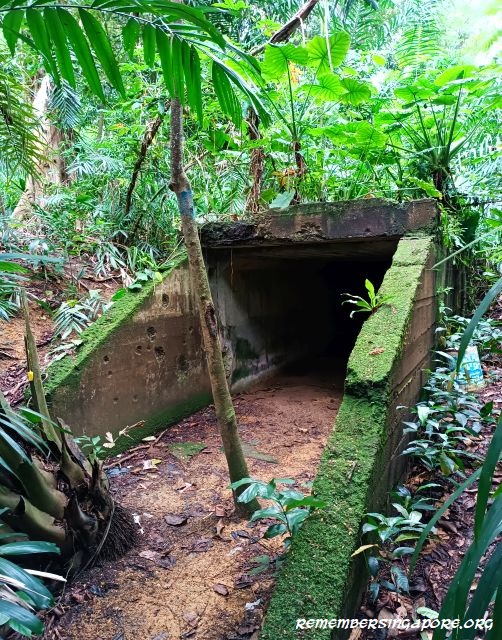
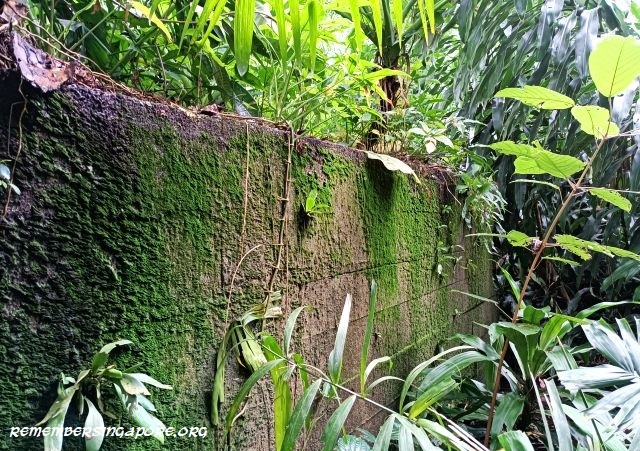
Hidden in a small forested hill at Marsiling, the Marsiling Tunnels refer to a mysterious underground bunker when they were rediscovered in the early 2000s. It turned out to be the Woodlands North Depot, an oil reserve station built by the British for their Royal Air Force (RAF) aircrafts. During the Second World War, the Japanese occupied and used the tunnels as their own fuel reserve depot.

It was initially thought that the tunnels might lead to a nearby British barracks at View Road, which was built in the early forties. The building was then used as a mental institution between 1975 and 2001, and as a foreign worker dormitory in the 2010s. Another speculation was that the Marsiling Tunnels’ link to Johor Bahru, but this turned out to be untrue.

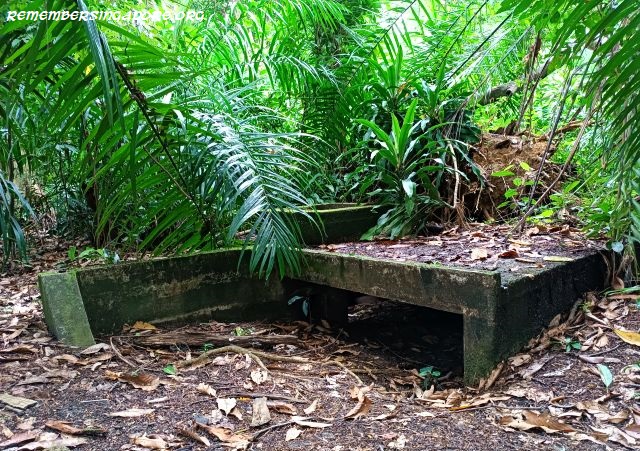
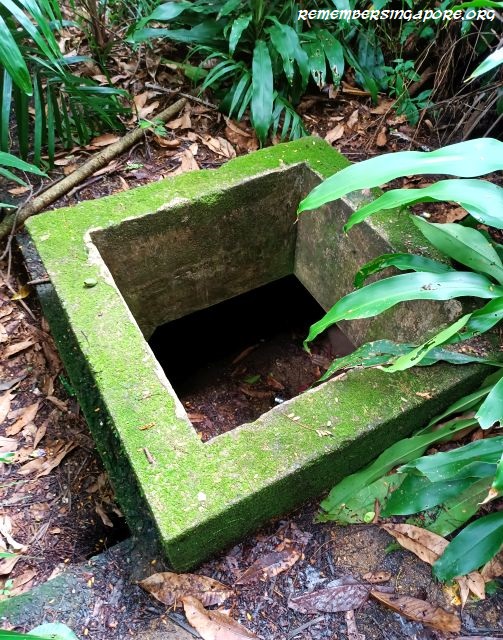
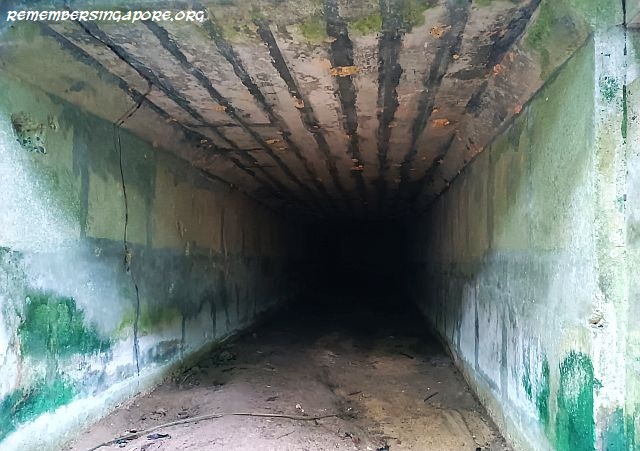
The Marsiling Tunnels reportedly descend two storeys deep, and have four entranceways but three have already been sealed for safety reasons. Deep inside the tunnels are large rusty pipes.

The Marsiling Tunnels are not the first tunnel to be discovered in the Kranji and Woodlands areas. There were reportedly several tunnels built by the British and Japanese to be used as stores or air raid shelters. Most were destroyed after the war, while a few were forgotten with their sites reclaimed by nature over the years.

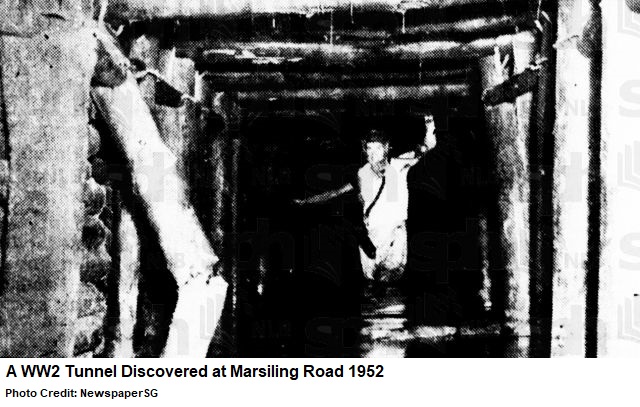
One such tunnel was discovered at Marsiling Road in 1952 by four youths searching for scrap metal. The discovery was then reported by the newspapers, prompting many to explore the tunnel for treasure. A Boyanese worker came forward to reveal the mystery – the tunnel was built by the Japanese during the occupation as an oil and arms dump, believed to be the largest in southern Malaya during the Second World War.

One Chinese contractor, in hope of finding some war treasure or oil reserve, spent $4,000 to excavate the tunnel, but found nothing but concrete walls and some remnants of railway lines and electrical cables.

A former prisoner-of-war (POW) shared that such tunnels were common, as the Japanese dug many tunnels after they invaded Singapore, possibly using them as refuge for their troops in case of bombardment attacks by the Allied forces. He and other POWs were forced during the Japanese Occupation to dig tunnels at Outram Road, Havelock Road and Tiong Bahru Road.

In 2014, the National Library Board (NLB) launched a Marsiling Tunnels heritage tour to commemorate the 72nd anniversary of the Battle of Singapore.

Published: 24 April 2024

Posted in Exotic, Historic | Tagged , , , , , , , , , | Leave a comment

Sago Lane’s Grim History of “Death Houses”

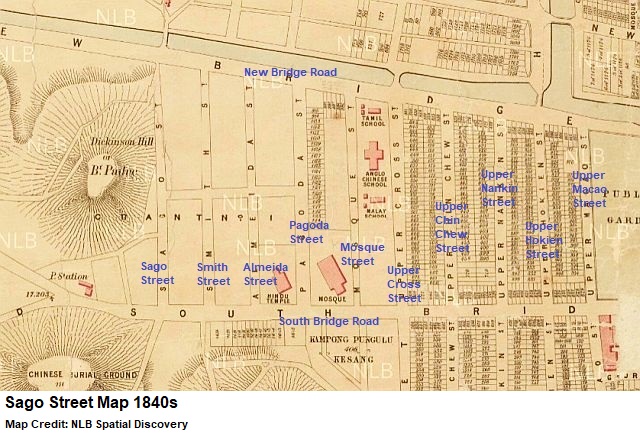
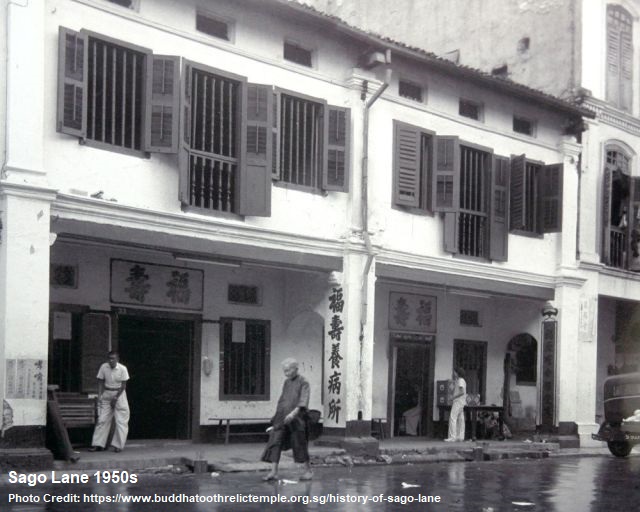
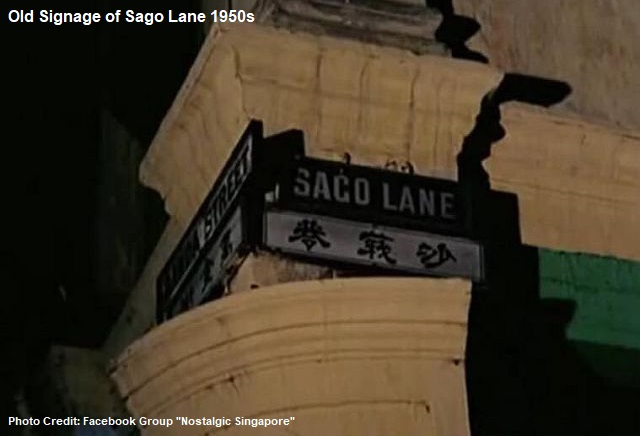
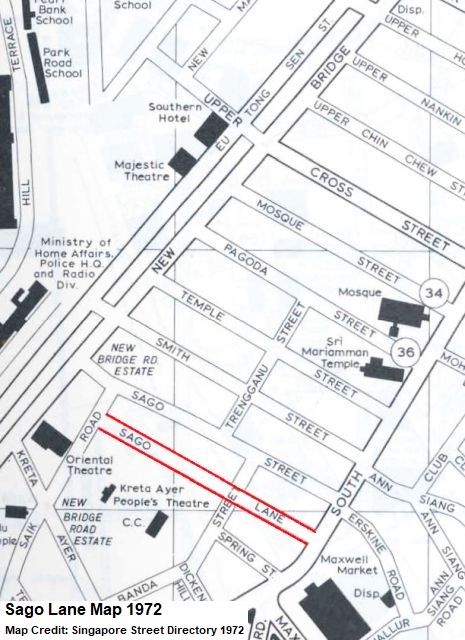
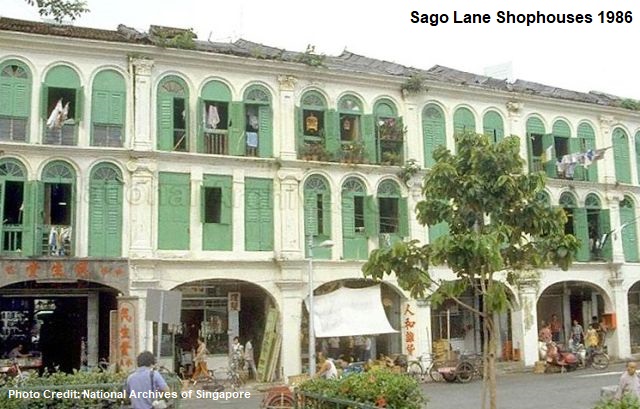
According to a 1840s map, Sago Street appeared earlier than Sago Lane. Sago Street was located at the westernmost boundary of the Chinatown area, a Chinese precinct created as part of the British’s town planning and ethnic segregation in the early 19th century.

A small hill named Dickinson Hill was situated where Kreta Ayer People’s Theatre is today. It was named after Reverend J.T. Dickenson who ran a missionary school at the nutmeg tree-filled hill. Also known as Bukit Padre, it was later renamed Bukit Pasoh.

In 1826, when the first landed property titles were issued, many leases for land around North and South Bridge Roads were won by the Chinese, who went on to build rows of shophouses along Sago Street, Smith Street, Almeida Street, Pagoda Street, Mosque Street, Upper Cross Street, Upper Chin Chew Street, Upper Nankin Street, Upper Hokien Street and Upper Macao Street.

Many of the shophouses at Sago Street were used as sago factories when they were built in the 1840s. There was a total of 17 sago factories – 15 Chinese sago factories and 2 owned by the Europeans. The abundance of the sago factories gave rise to the names of Sago Street and later Sago Lane.

Chinatown Streets

In 1927, the colonial government approved the Dickinson Hill development scheme, including the building of many tenement houses at the area to improve the housing issue. New roads – Keong Siak Road and Dickenson Hill Road – were built at the vicinity in 1931.

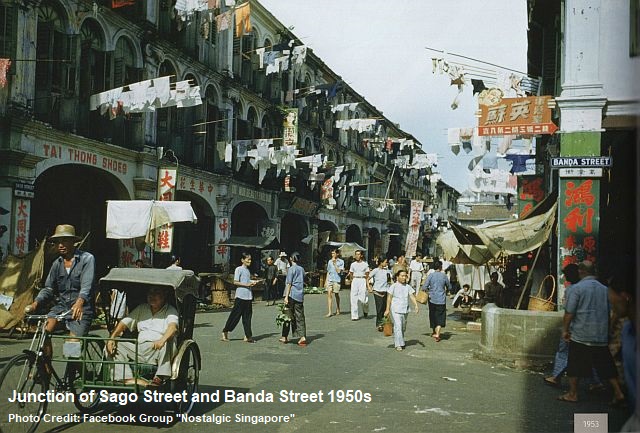
Pre-war Banda Street was notoriously known as Japanese Street due to many Japanese prostitutes soliciting in the area. After the war, it was occupied by the night street hawkers who enjoyed brisk businesses from the mourners and families visiting Sago Lane’s death houses and funeral parlours.

Almeida Street was renamed Temple Street in 1908 to avoid confusion with D’Almeida Street (at Raffles Place) and Almeida Road (Orchard).

Chin Chew Street, Nankin Street, Hokien Street and Macao Street were all named after places in China (Quanzhou, Nanjing, Fujian and Macau today). On 1 January 1925, the Municipal Commission renamed Macao Street (and Upper Macao Street) to Pickering Street (and Upper Pickering Street). Upper Chin Chew Street and Upper Nankin Street were expunged in the mid-seventies to make way for the development of Hong Lim Complex.

Social Issues

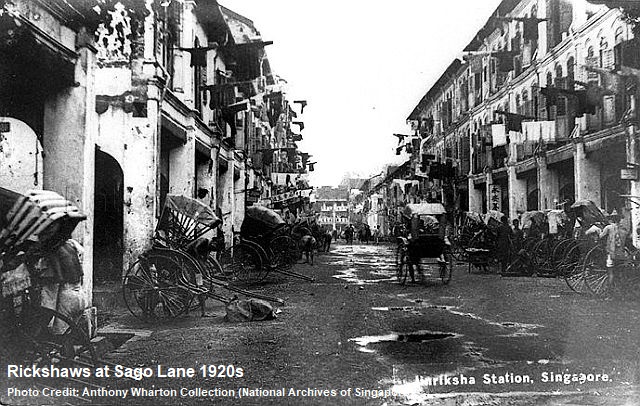
In 1849, there were about 28,000 Chinese in Singapore. The influx of Chinese immigrants in the late 19th century led to the dense population at Chinatown. The Chinese immigrants, many of them working as coolies and rickshaw pullers, were packed into the overcrowded shophouses.

Sago Street and Sago Lane were constantly plagued by the several secret societies that fought for territories. At Sago Lane, gang fights frequently broke out around a popular eating house called Wah Tian Lock. Extortions and robberies were rife, with many shophouses used as brothels, gambling houses, opium shops and gangster hideouts.

Infectious Diseases

In 1895, the Municipal Health Officer reported many deaths due to cholera, especially at the overcrowded places such as Sago Lane. Cases of infectious diseases such as beriberi, tuberculosis, dysentery, malaria and smallpox continued to plague Sago Lane and other parts of Chinatown throughout the early 20th century.

Installation of clean water pipes, levelling of drains and metalling of the road were carried out at Sago Lane in the 1910s. However, this did little to improve its sanitation and hygienic conditions.

Fire Disasters 

A large fire broke out in 1925 and destroyed two three-storied shophouses at the junction of Sago Lane and Banda Road. Another fire occurred in 1933, damaging six of South Bridge Road’s shophouses. The flames spread rapidly towards Sago Street and Sago Lane but fortunately the firemen were able to put out the fire in time.

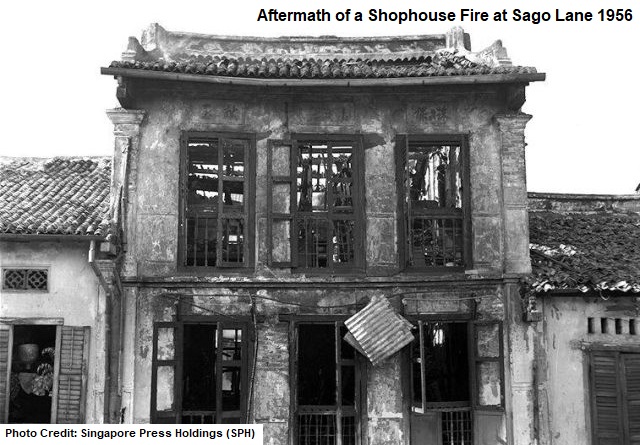
In 1956, a fire blazed through a four-storey building at Sago Lane. Six, including two kids, perished. 47 people were made homeless. Acting Chief Minister Chew Swee Kee (1918-1985) visited and consoled the families of the victims.

The disaster, Singapore’s worse since the war, raised concerns of the fire safety of Chinatown’s shophouses. The overcrowded living conditions, lack of fire escape exits in the buildings, widespread use of oil lamps, and the burning of joss sticks and paper effigies all posed a deadly fire risk to the residents.

Violent Riots

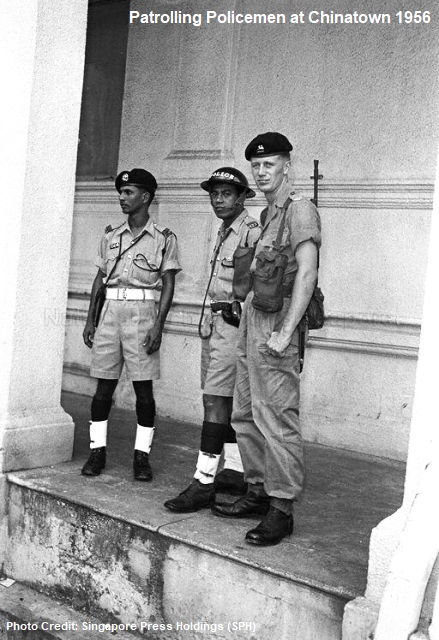
On 26 October 1956, many parts of Singapore were struck by riots and violence after the government shut down the Singapore Chinese Middle Schools Students’ Union (SCMSSU) and dismissed teachers and students involved in suspected communist-related activities.

Later known as the Chinese Middle School Student Riots, hundreds of hysterical mobs, made up of Chinese students and hooligans, attacked the Europeans and policemen, who fired back, resulting in the death of seven rioters. More than 70 rioters, civilians and policemen were injured.

A curfew was enforced in the afternoon but did little to tame the riots. 160 Federation policemen were activated from Johor as reinforcement to support Singapore’s police force. Some of the violence occurred at Paya Lebar Airport, Guillemard Road, Merdeka Bridge, Maxwell Road, Telok Ayer Road, South Bridge Road, Beauty World and Geylang. At Sago Lane, a crowd of 200 mobsters attacked a police radio car.

Sick Houses

A 1892 newspaper article of a Sago Lane shophouse might be one of the earliest mentions of a sick or death house that later became a common phenomenon at Sago Lane. In this shophouse were sick and dying women and their babies abandoned by the nearby brothels. Seven deaths took place in it in just 18 days, including five infants and two young women.

Sick houses were also known as sick receiving houses. But these hospices of the older days, in reality, were not for the sick to recuperate and recover. Those suffering from critical illness and injuries were instead left to die in them.

This was due to a common Chinese belief. If a person was allowed to die in a dwelling house, it would bring bad luck to the co-tenants living in the same house. This persistent superstition often forced the dying person to be removed and sent to the sick houses.

However, most of the sick houses were of poor conditions. Some sick houses were run by the undertakers, and they simply placed the sick or dying person on a bed beside coffins with corpses inside.

In 1928, out of a total 12,000 deaths in Singapore, almost 1,000 happened in the sick houses. The Municipal Commission therefore passed a law to license the sick houses so that the owners would properly maintain the facilities and conditions of their sick houses.

By 1939, there were four sick houses at Sago Lane and a dozen more in other parts of Chinatown. For $10, the sick person could be admitted to any of these sick houses and left alone to his or her fate. The sick houses would not provide any food; this had be provided by the sick person’s relatives or friends.

Death Houses

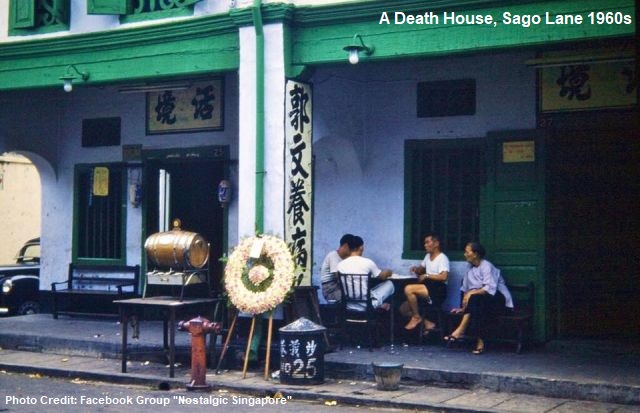
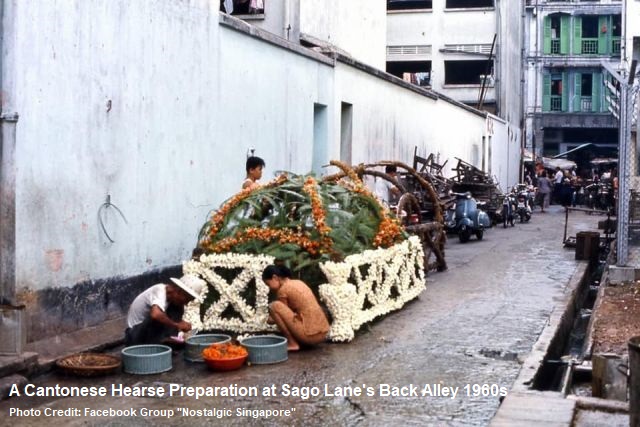
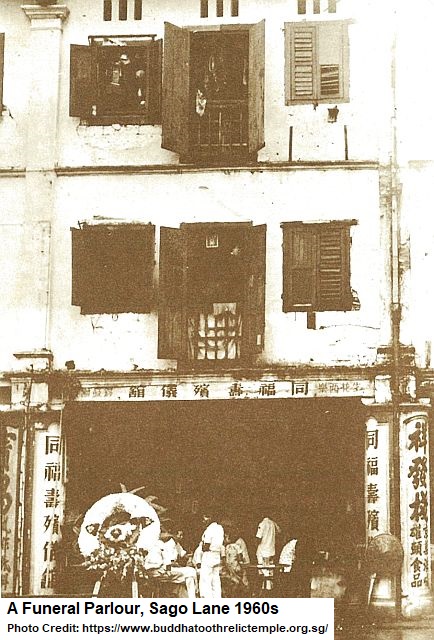
After the war, sick houses became better known as the death houses or dying houses, as Sago Lane evolved into the centre of the Chinese funeral industry in Singapore. The local Cantonese called it sei yan kai (“street of the dead in Cantonese) or mun chai kai (“undertaker street”).

By 1948, seven death houses were operating in Singapore; two were licensed as “sick receiving houses” and the other five unlicensed. One of the two licensed death houses was Kwok Mun, said to have established at Sago Lane 45 years ago in the early-1900s. It occupied two shophouses where one shophouse served as the admission office whereas the other was the mortuary. The top floors were separated into the male and female wards, each with wooden beds arranged in typical dormitory style.

An average of six deaths occurred daily at Sago Lane’s death houses. The street was constantly filled with frangipani smell due to the rows of wreaths. Death houses never closed their doors – they were manned by their staff day and night.

The Ban

In 1958, the Singapore City Council proposed that the death houses – two at Sago Lane and one at Balestier Road – to be shifted to the rural areas as they were increasingly considered a fire hazard. Those who opposed argued that death houses were a social necessity. The proposal eventually did not get approved.

In the late fifties, the British media screened a documentary film about Singapore’s death houses, leading to many curious tourists flocking to Sago Lane to see the mysterious houses and funeral trade.

Instead of showing fear, the tourists often checked out with great interest the Oriental-style casket shops, coffin makers and the workers that made paper houses, cars, horses, effigies and lanterns.

The Singapore government was disturbed by Sago Lane’s unwanted publicity that the death houses were officially banned in 1961. The owners could still continue their businesses if they converted their premises into funeral parlours, but they were not allowed to accept any living person other than the dead. Sick people had to be taken to the hospitals for treatments, and not to the death houses.

Urban Renewal

Even with the ban, death houses at Sago Lane persisted until the seventies. There was still a demand as many Chinese elderly remained reluctant to go to the hospitals when they were ill, instead preferring to check into a death house.

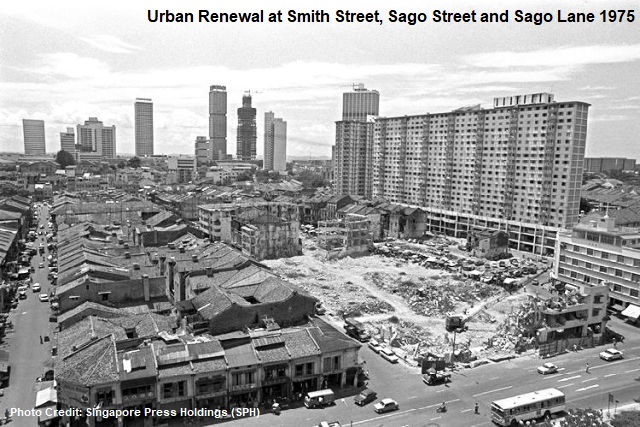
But the end of Sago Lane’s death houses, and its prosperous businesses of funeral parlours and coffin makers, eventually came to an end due to the government’s urban renewal programme. In the early seventies, a section of Sago Lane was expunged to accommodate the Housing and Development Board’s (HDB) construction of the $18-million Kreta Ayer Complex.

The existing L-shaped shophouses and tenement houses along Sago Lane were torn down in 1971, affecting thousands of residents who had lived there for generations. The street hawkers were also ordered to shift to other places.

12 funeral parlours were left at Sago Lane by 1972. Many were arranged to continue their businesses at Geylang Bahru Industrial Estate. The decades-old Kwok Mun registered its business as a funeral parlour in 1975 and was shifted from Sago Lane to Sin Ming in 1983. The company, however, folded in the 2000s.

At the site of the former shophouses and tenement houses were two new 21-storey HDB flats (Block 4 and 5) completed in 1973.

Next to be affected was Smith Street and its residents. Eventually almost 100,000 people living in Chinatown were impacted by the urban renewal programme and had to be rehoused in HDB estates after their pre-war shophouses were pulled down.

Kreta Ayer Complex, consists of two blocks at 21-storey and 25-storey respectively, was completed in 1981. Its wet market and hawker centre, opened in 1983, housed many of Chinatown’s former street hawkers. Kreta Ayer Complex was renamed Chinatown Complex in 1984.

The death houses and funeral industry of Sago Lane were gone after the mid-seventies; its grim yet legendary past gradually faded away and forgotten over time.

Prominent Landmarks

Several prominent landmarks had emerged near Sago Lane. Built in 1960, the Kreta Ayer Community Centre was originally known as Banda Street Community Centre. It underwent extensive renovations in 1979. In 1993, in another upgrading project, an old coffin containing a skeleton was uncovered underneath the community centre’s basketball court, indicating that the area was near a Chinese burial ground in the past.

The Kreta Ayer People’s Theatre was opened on 24 March 1969 as an open-air stage for traditional Chinese operas and wayangs. It underwent an overhaul in 1979, and became a 940-seat theatre for cultural performances.

The Kreta Ayer Education Centre at Sago Lane was opened by then-Deputy Prime Minister and Minister of Defence Dr Goh Keng Swee on 3 February 1976.

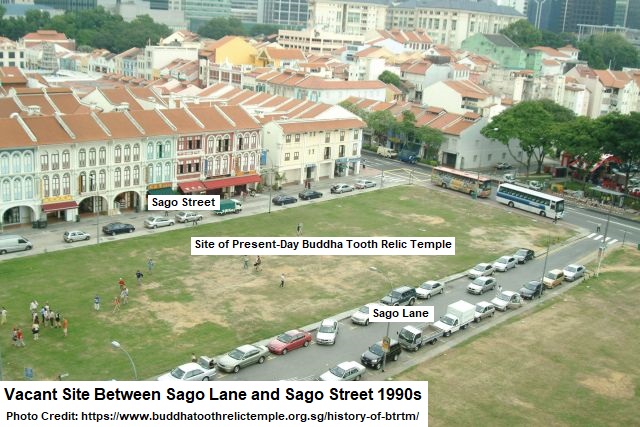
In the late nineties, the Singapore Tourism Board (STB) proposed that the vacant site between Sago Lane and Sago Street to be used for the construction of a traditional Buddhist temple, so as to blend into Chinatown landscape. This led to the construction and opening of the grand Buddha Tooth Relic Temple on 30 May 2007.

Published: 26 March 2024

Posted in Cultural, Historic | Tagged , , , , , , , , , , , , , , , , , , , , , , , , , , | 5 Comments

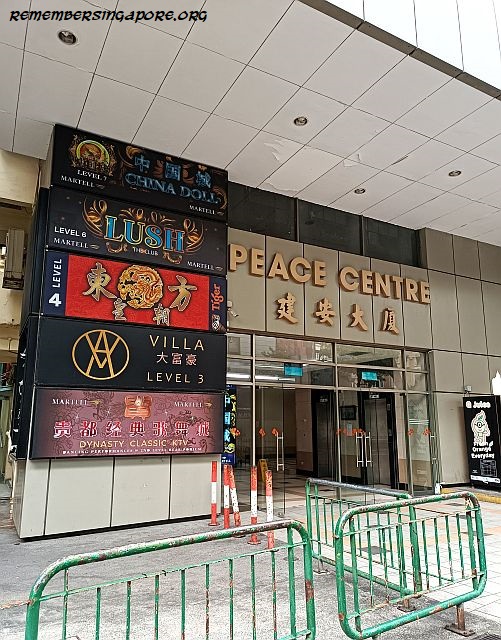
Doors Shuttered for Good for Peace Centre

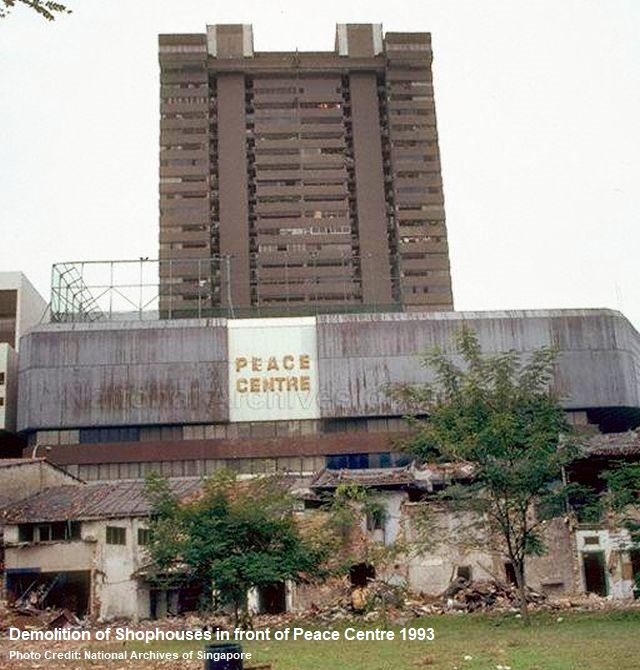
Peace Centre was born in the early seventies, a period where many skyscrapers popped up in the city and downtown areas of Singapore. Towering commercial complexes costing tens of millions of dollars were built at blistering pace; some examples were the 50-storey Development Bank of Singapore (DBS) building, United Industrial Corporation (UIC) building (40 storeys), Robina House (26 storeys), Shenton House (25 storeys), Hong Leong Building (45 storeys) and Straits Trading Building (28 storeys).

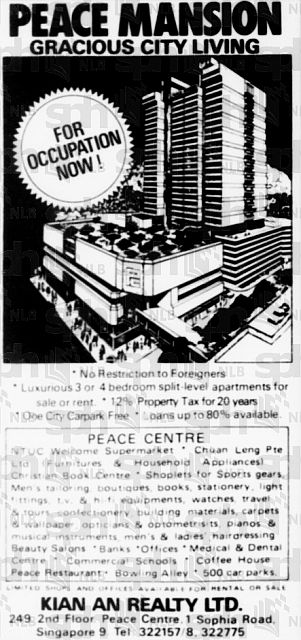
The site of Peace Centre at the junction of Sophia and Selegie Roads was acquired in 1970 with a 99-year tenure. Its concept, dubbed as a utilitarian concept in building construction and a multi-million dollar towering skyscraper, was released a year later. The $30-million project by Kian An Realty, jointly financed by Singapore and Hong Kong businessmen, would consist of two parts – Peace Centre and Peace Mansion.

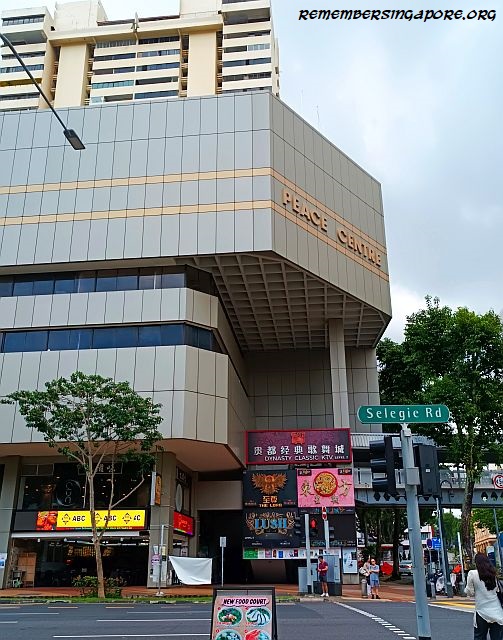
Peace Centre was designed to have a seven-storey front podium and a ten-storey rear podium with a multi-storey carpark, whereas Peace Mansion would be a 22-storey residential tower made up of 84 apartments and two penthouses. The project was built by local construction company Low Keng Huat Construction (LKHC), who was also the builder of the iconic People’s Park Complex, UOB Building, OCBC Centre, Mandarin Hotel and Plaza Singapura.

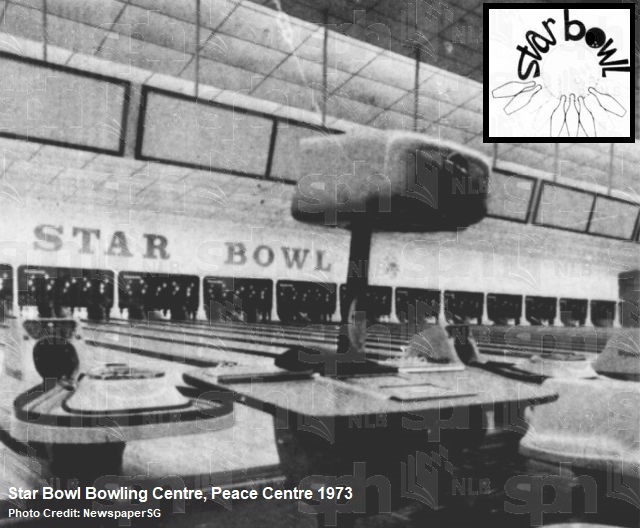
In 1973, Peace Centre’s front podium was completed. It had shops, supermarket, medical specialist centre, eateries, offices and even a 36-lane bowling centre called Star Bowl. Peace Mansion was completed in 1977.
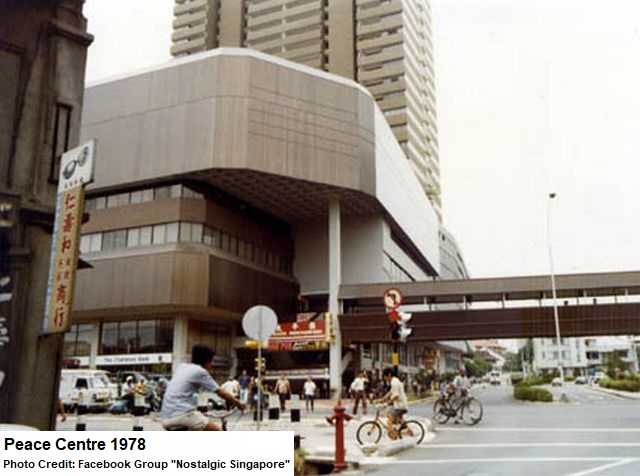
Shortly after its completion, Peace Centre’s new neighbour Parklane Shopping Mall, a 10-storey building catered for one-stop shopping, was also opened for business, adding vibrancy to this stretch of Selegie Road.

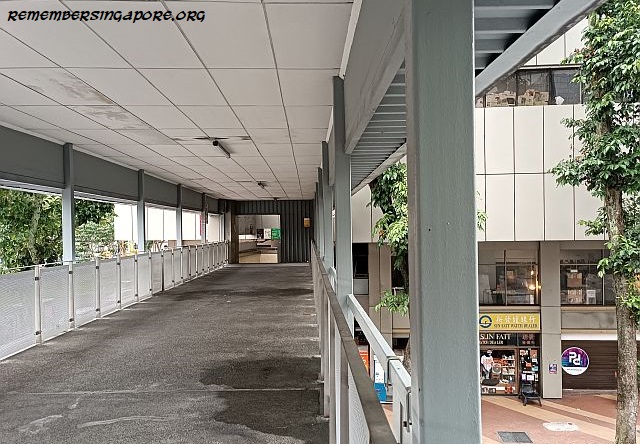
A sheltered pedestrian bridge, built by the Urban Renewal Authorities, was linked from Peace Centre to Selegie Complex (present-day Wilkie Edge Shopping Mall) on the other side of Sophia Road. Over the years, the bridge became a recognisable landmark for drivers entering Sophia Road.

The $5-million Star Bowl bowling centre at Peace Centre was the largest in Singapore when it was opened in September 1973. On its opening day, the management donated the entire earnings of $1,514 to the Singapore Anti-Narcotics Association and Spastics Children Association of Singapore.

In July 1974, Star Bowl hosted the 7th Cathay Pacific-Brunswick Far East bowling tournament involving top bowlers from Singapore, Thailand, The Philippines, Hong Kong, Japan, South Korea, Indonesia and Australia. The popular bowling centre, however, lasted only eight years. It shut down in February 1981, when the owners sold it to an office developer.

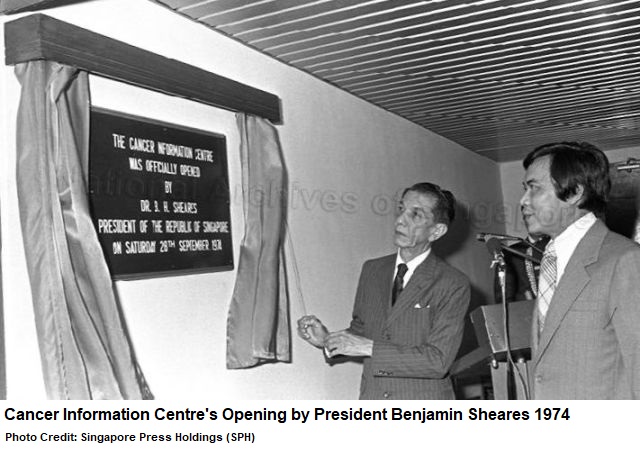
One of the early tenants at Peace Centre was the Singapore Cancer Society, which set up clinics and a Cancer Information Centre in the new building in 1974. Officially opened by then-Singapore President Benjamin Henry Sheares (1907-1981), the Cancer Information Centre consisted of a Books and Films Library that provided materials for the society’s campaigns to educate the public on the importance of early detection in cancer and the cures.

Singapore Cancer Society, in 1979, also set up a Smoking Cessation Clinic at Peace Centre to help smokers who wished to kick their habit.

Some of the other associations that were housed at Peace Centre were the Singapore Government Servants’ Co-operative Thrift and Loans Society, Singapore Association for Counselling, Singapore Optometric Association, Girls’ Brigade International and Youth Challenge.

The National Trades Union Congress (NTUC) had their Welcome supermarket opened at Peace Centre’s ground and first floors in 1974, taking up 1,200m2 of space. The seventies saw NTUC expanding their operations; the Peace Centre’s branch was NTUC’s fourth in Singapore, after Toa Payoh, Bukit Ho Swee and Serangoon Gardens.

A NTUC Travel Service was also established at Peace Centre, offering discounted travel package tours to workers under the union.

In January 1975, NTUC added its first ever emporium at Peace Centre’s first floor, selling a wide range of products from children’s wear and toys to watches and electrical appliances. It was a $50,000 pilot project to test the public response to NTUC’s selling of non-supermarket items. However, the emporium lasted only nine months. Poor revenue forced the management to shut it down in September 1975.

Peace Centre’s NTUC Welcome supermarket ceased in the early eighties after years of relatively poor sale turnover compared to other NTUC branches. It was then restructured into NTUC FairPrice supermarket, where it continued until 2002. Its retail space at Peace Centre was then outbid and took over by Cold Storage.

Peace Centre had a large variety of shops, ranging from bookstores, money changers and tuition centres to hair salons, pubs and coffee houses.

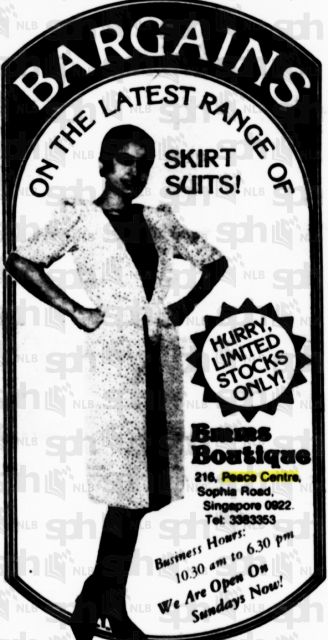
Regular patrons would remember the likes of City Music Company (music store in the eighties), Kam Kee Yong’s School of Music (music school), Intellect Education Centre (tuition centre, third floor), Waterford School (tuition centre), Systematic Business Training Centre (course provider), Iwa Oneprice Store (department store), Christian Book Centre (religious books), Prince Book Centre (secondhand books, ground floor), Emms Boutique (female apparel and office wear, second floor), Bigston Electronics (car stereo products), Ren Sports (sports equipment), Chong Seng Tailor (first floor), Supreme Chemist (pharmacy), Shafinah Video Vision (videotapes), Art Friends (art and craft materials) and Otrona, the first Singapore-owned company to make personal computers in the eighties.

For Peace Centre’s restaurants and eateries, the more well-known ones were the uniquely-named Sorry Snack House in late seventies, Paseo Cafe Bar (second floor, eighties), Don Sancho Members Club (nightclub beside Paseo), Coffehouse Restaurant (second floor) and Peace Restaurant, which was opened at the seventh floor of Peace Centre in 1977.

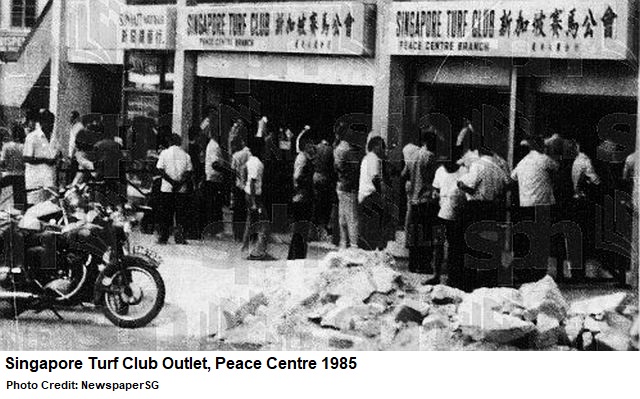
A Singapore Turf Club branch also operated at Peace Centre’s ground floor, a favourite lottery and horseracing betting outlet among the punters.

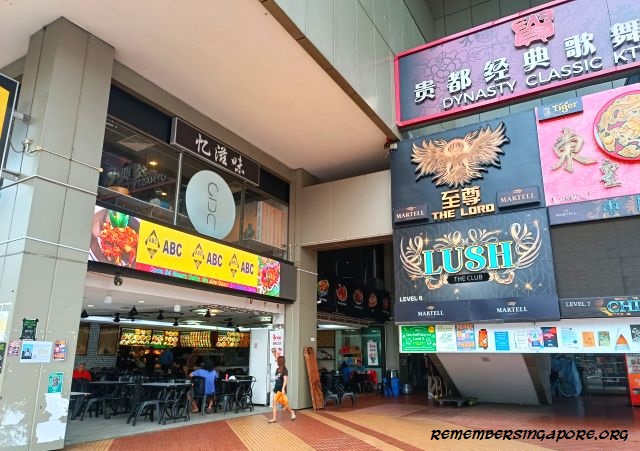
By the 2000s, the aging Peace Centre was gradually falling out of favour due to the emergence of many new shopping malls elsewhere in Singapore. The mall’s interior was outdated and there were frequent aircon breakdowns, and power and water supply disruptions. At Peace Mansion, it was getting a poor reputation with its all sleazy KTVs and nightclubs. It was not uncommon to see fights and brawls broke out outside Peace Centre and Peace Mansion.

In 2007, Peace Centre and Peace Mansion were put up for a collective sale of $470 million but without success. The properties were put up for sale again in 2011, this time for $700 million. A third attempt for $680 million was in 2014.

Peace Centre and Peace Mansion were eventually sold, on the fifth try, in 2021 for $650 million to property firms Chip Eng Seng and SingHaiyi.

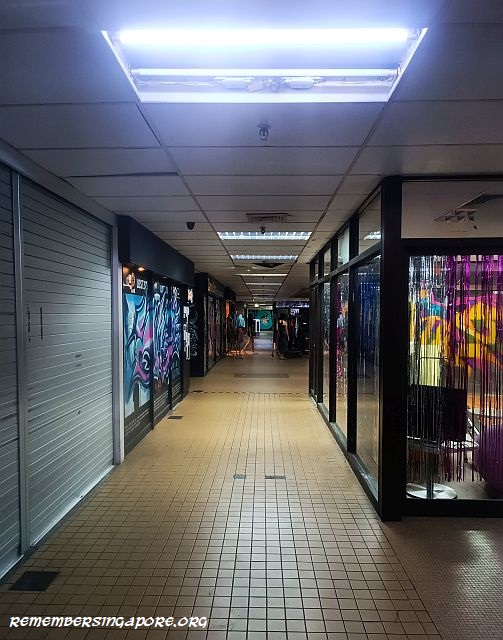
The demolition date for Peace Centre and Peace Mansion was scheduled to be in mid-2023, but the new owners agreed to extend it by another six months for the building to used by PlayPan and their social movement which included art jamming, painting of wall graffiti and murals, and other creative experimental projects. Some also set up small temporary thrift shops to try out their entrepreneurial aspirations.

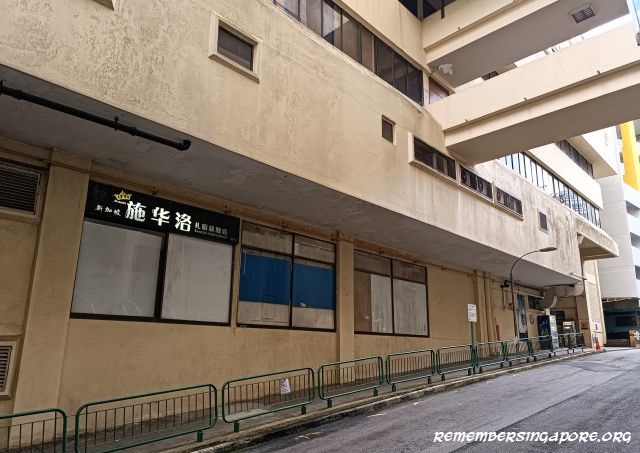
In the last weekend of January 2024, a PeaceOut festival was organised, where more than 1,500 partygoers attended. Peace Centre and Peace Mansion were officially closed after that.

Published: 27 February 2024

Posted in General | Tagged , , , , , , , , , , | Leave a comment

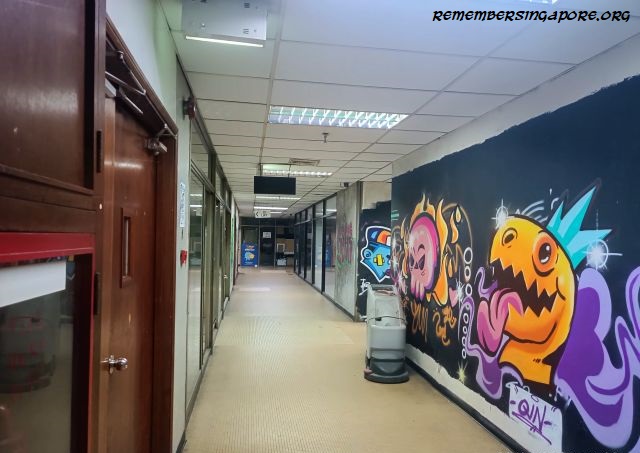
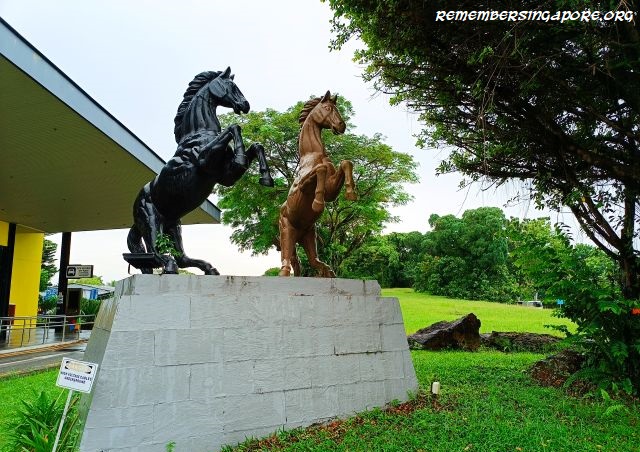
A Last Look at Turf City

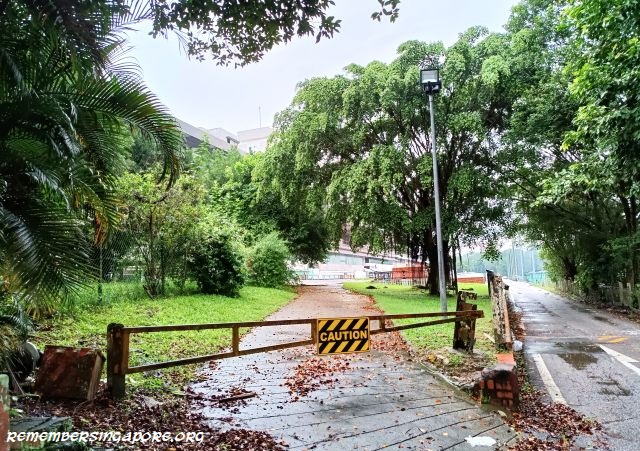
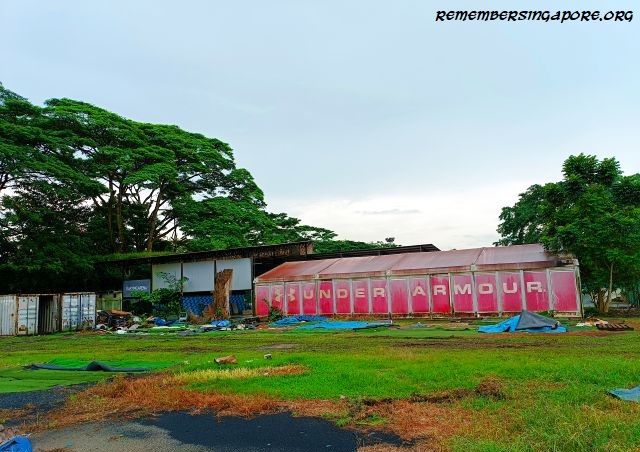
Turf City was officially closed on 31 December 2023, after a brief history that lasted slightly more than two decades. It had been existing on borrowed time, as the site was safeguarded for future residential use since the Master Plan 1998, according to Urban Redevelopment Authority (URA).

On 22 September 2022, the Land Transport Authority (LTA) announced that the new Cross Island Line’s (CRL) will have six stations, and one of them, Turf City Station, will be constructed under the former racetracks and fields. That began the countdown for the closure of Turf City.

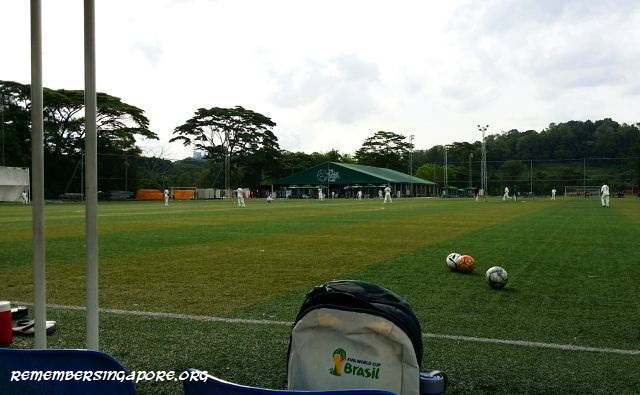
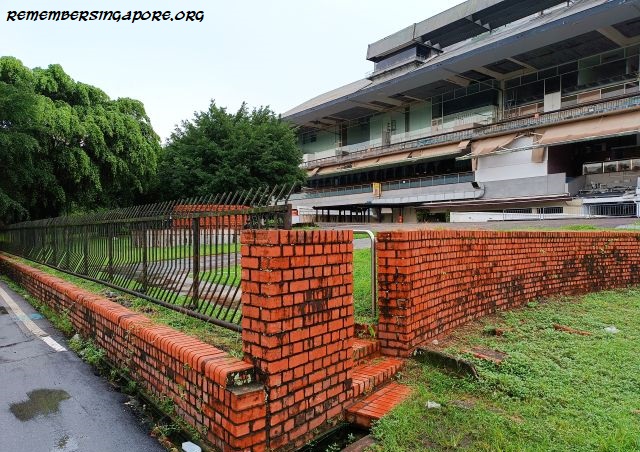
Turf City consisted of a large 150-hectare open space, about the size of 200 football fields, that was built at the former racecourse of the Bukit Timah Turf Club (1933-1999). When the Turf Club was relocated to Kranji in 1999, the site was handed over to the Singapore Land Authority (SLA), which went on to manage the premises for 24 years until its closure in end-2023.

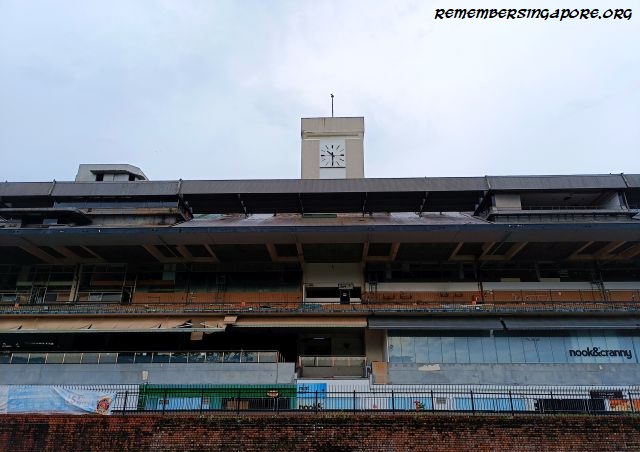
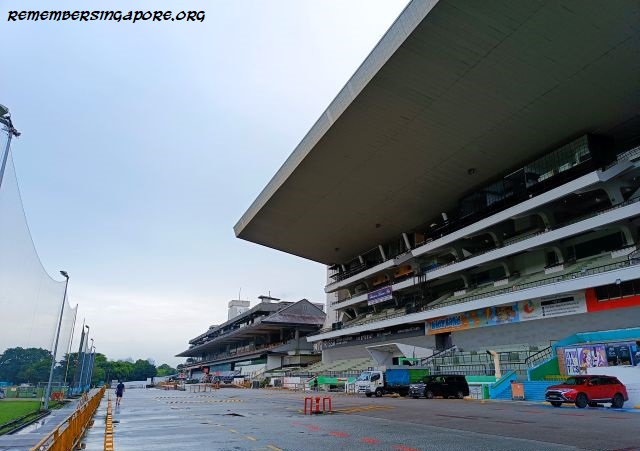
The old Turf Club grandstand was extensively renovated in 2001 with a $20-million budget, promising to become a megamall with anchor tenants and specialty shops. A massive used car dealing centre was also established to rival the motor hubs at Kampong Ubi and Leng Kee Road.

After the completion of its renovations, Turf City had a soft opening to the public as some of its larger tenants moved in. Giant Superstore extended its presence in Singapore with the opening of a second hypermarket at Turf City in December 2001. It had earlier successfully launched at IMM in 1999.

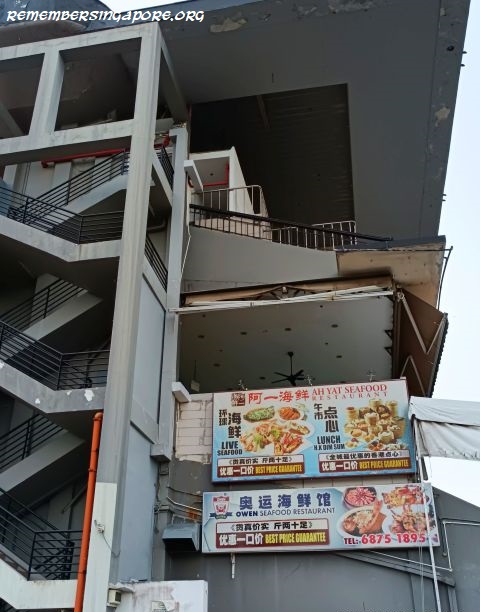
Courts opened at Turf City too, with its iQ concept tech store showcasing the latest gadgets and electronic consumer products. A large furniture store was also opened by the Singapore Furniture Association (SFA). Ah Yat Seafood Restaurant was one of the first eateries at Turf City when they opened in 2002.

Expecting to attract huge crowds to the megastores and restaurants, Turf City designated more than 2,000 parking lots to ensure ample parking space for the visiting customers.

But Turf City was not born in the best of times. The burst of the dotcom bubble and 911 incident in the United States clouded the global economic outlook in the early 2000s. Singapore was not spared, as it suffered from weakening consumer demand and a slowing retail property market. The rental rates of the new Turf City, about 80% the size of Suntec, were significantly lower in order to attract businesses and tenants. Nevertheless, Turf City was officially opened on 22 June 2002.

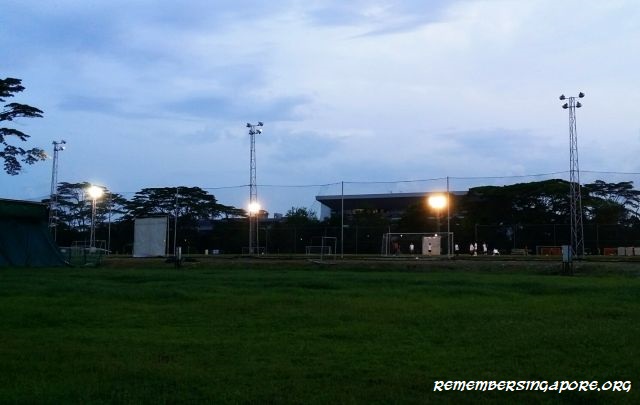
In 2003, the old racetrack was converted into numerous pitches and courts that catered to a wide variety of sports such as football, futsal, rugby, softball, netball, tennis and archery. Other than a lifestyle and automobile hub, Turf City was also establishing itself as a leisure sports hub. For the next two decades, Turf City became an all-in-one place for sports, seafood, second hand cars, groceries, childcare, antiques and other services. It even had an axe-throwing range.

Singapore’s horse-racing industry has been in steady decline in the recent years. The Bukit Timah Saddle Club, popular with its rustic environment and stables, was closed in February 2023. The Singapore Turf Club at Kranji, which took over from Bukit Timah Turf Club in 1999, is expected to cease operations in October 2024, bringing the 180-year-old local horse-racing history to an end.

For Turf City, a heritage assessment conducted by the National University of Singapore’s (NUS) Department of Architecture in 2022 recommended keeping some of the iconic structures of the former Turf Club, especially the huge grandstand building. But so far there is no confirmation from the URA yet.

Published: 14 January 2024

Posted in Exotic | Tagged , , , , , , , , , , , | 3 Comments

Rejuvenation of the Old Ang Mo Kio Swimming Complex

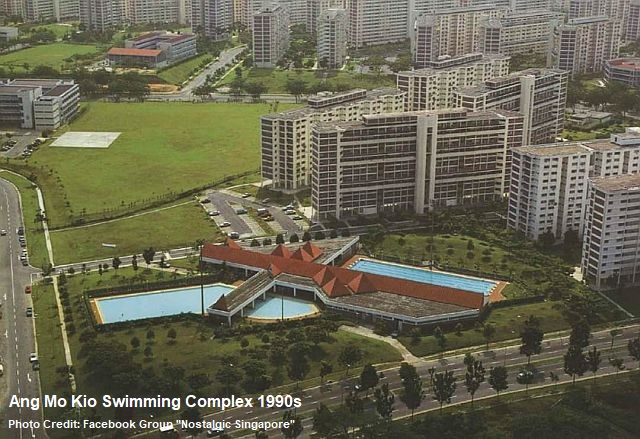
Right after the tearing down of the old Toa Payoh Swimming Complex, another old public swimming complex will also be walking into history. The old Ang Mo Kio Swimming Complex is currently undergoing demolition, as part of the rejuvenation plans for the aging Ang Mo Kio New Town. The site will be redeveloped into a new complex called Active SG @Ang Mo Kio, comprising swimming pool, gym and fitness studio.

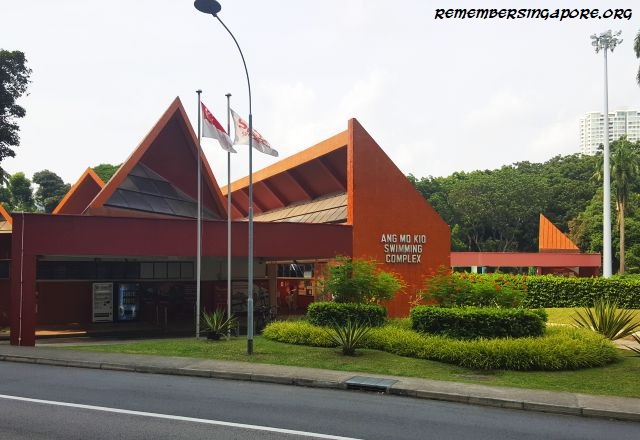
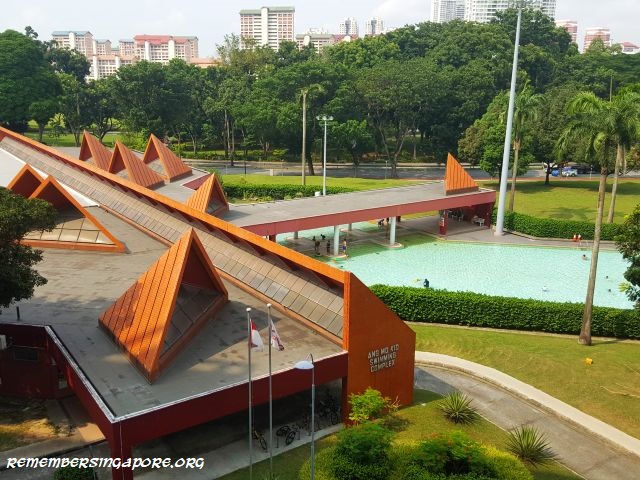
Opened in May 1982, the 41-year-old Ang Mo Kio Swimming Complex was perhaps best known for its iconic orange-bricked walls and tetrahedron-shaped roofs.

The unique design of the roofs was recognised and nominated by the Singapore Institute of Architects in 1986 for its Micro Architectural Design Awards, competing with other design nominees in the Housing and Development Board (HDB) category including the Woodlands Town Garden (roof), Bukit Batok Neighbourhood Centre (column) and Hougang Area Office (sunscreen).

Not all memories were good at the old Ang Mo Kio Swimming Complex. Two tragic drowning incidents occurred at its swimming pools in a span of two months between September and October 1986. A 11-year-old boy struggled and drowned after a daring challenge with his friend. A month later, a 24-year-old clerk suffered a heart failure and drowned in the pool.

In April 1989, the maximum temperatures in many parts of Singapore reached 34.5degC. Due to the scorching hot weather, Ang Mo Kio and Toa Payoh Swimming Complexes reported a rise in the number of swimmers by 20 to 30 percent.

Ang Mo Kio Swimming Complex underwent a major renovation in December 1993. It was closed for a long 20 months for a series of upgrading works and defect rectifications, and was eventually re-opened in August 1995.

Many nearby residents and long-time swimmers of the old Ang Mo Kio Swimming Complex will certainly miss the place that had accompanied them for more than four decades.

Published: 21 December 2023

Updated: 8 January 2023

Posted in Nostalgic | Tagged , , , , , , | 4 Comments

50 Years of Toa Payoh Swimming Complex and Stadium

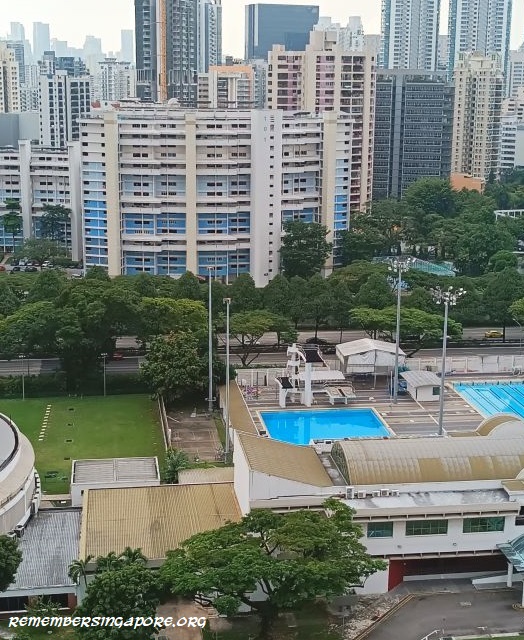
Toa Payoh Sports Centre’s 50-year-old legacy has come to an end as the complex will be making way for the new Toa Payoh Integrated Development expected to be ready by 2030.

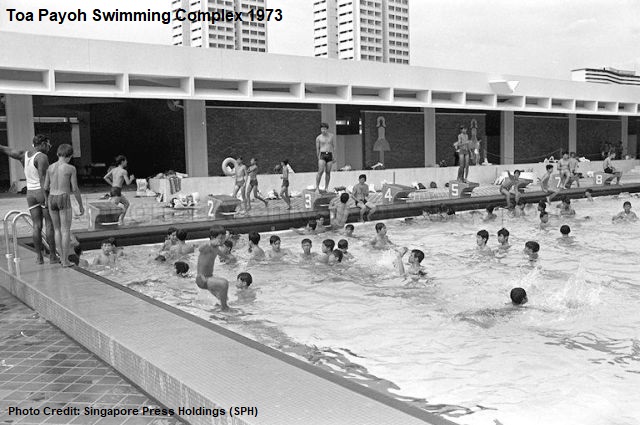
Located along Toa Payoh Lorong 6, the sports centre, made up of a swimming complex, stadium and a sports hall, was built in 1973 in time for the Southeast Asian Peninsular (SEAP) Games, which was Singapore’s first hosted international sports event after independence.

SEAP Games Village

The SEAP Games was held between 1 and 8 September 1973. Seven Southeast Asian nations (Singapore, Malaysia, Thailand, Khmer Republic (former Cambodian state), South Vietnam, Burma (present-day Myanmar) and Laos) participated and as many as 1,623 athletes were involved in the 16 competitions of football, badminton, swimming, basketball and other sports.

A year before the event, the Singapore government announced that Toa Payoh would be the venue of the SEAP Games Village. The Housing and Development Board (HDB) new town, completed in 1968, was an ideal centralised location as the athletes could train at the new Toa Payoh Sports Centre and had their daily necessities and entertainment supported by the shops and amenities at the town centre. Four new HDB point blocks (Block 175, 179, 191 and 193), made up of 384 four-room flats, were specially designated as the accommodation for the athletes.

The SEAP Games Village was officially opened by Goh Keng Swee (1918-2010), then-Deputy Prime Minister and Defence Minister, on 30 August 1973. The SEAP Games was a success for Singapore, both in the hosting and competitions. It came in second in the medal table after Thailand, with 45 golds, 50 silvers and 45 bronzes.

The SEAP Village received rave reviews from the athletes. After the games, the flats of the four blocks were sold to the public through a balloting exercise at a price of $19,000 per unit, with an additional $1,700 for furnishings. The three-storey building that served as the residential and office building for the SEAP Games Secretariat was converted into Toa Payoh Library in 1974.

Toa Payoh Swimming Complex

Toa Payoh Swimming Complex had five pools, including two Olympic-sized ones which were used by the SEAP Games’ elite athletes for trainings and competitions. Its other pools remained opened to the public. The entry price was 40c for adult swimmers, whereas children under 18 years old was charged 20c each.

Wednesdays and Thursdays were restricted to male and female swimmers respectively, while mixed swimming were allowed for other days. The popular swimming complex often saw long queues at its entrance in the seventies.

The swimming complex was installed with a $77,000 magnetic-numeric scoreboard for the 1973 SEAP Games. It could immediately display the results of the swimmers the moment they hit the finishing pads of the swimming pool. It was the first time such precise device was used in Singapore.

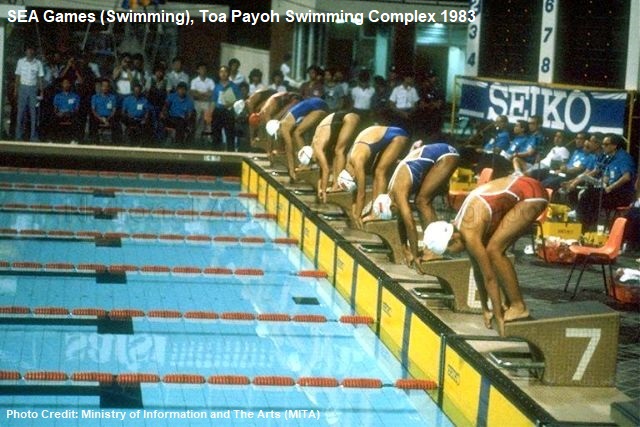
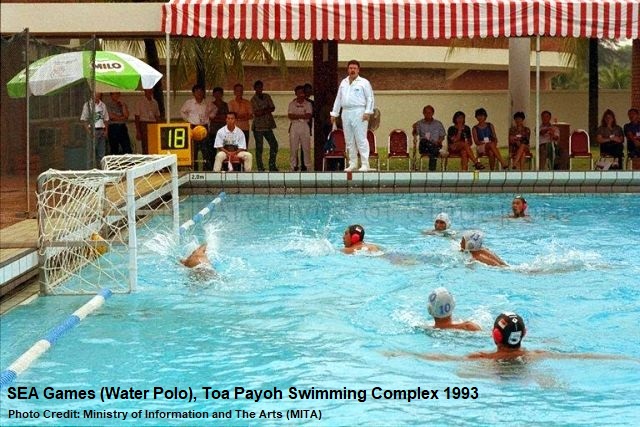
In the following decades, Toa Payoh Swimming Complex continued to be an important venue for regional and international swimming, diving and water polo competitions, such as the 1983 SEA Games, 1993 SEA Games, 2006 Asian Swimming Championships, 2009 Asian Youth Games and 2010 Youth Olympic Games.

As part of the preparations for the 1983 SEA Games (28 May to 6 June 1983), Toa Payoh Swimming Complex was upgraded at a cost of $45,000, including the replacement of diving boards and repairs and renovations of its Olympic-sized pools.

During the games, tickets were snapped up by the fans as they lined up to enter the swimming complex to witness the performances of Singapore’s “Golden Twins” Junie Sng and Ang Peng Siong. It was the first time the Singapore Broadcasting Corporation (SBC) telecast the SEA Games, including the swimming competitions at Toa Payoh Swimming Complex, live on TV. Many Singaporeans were able to watch Junie Sng and Ang Peng Siong dominating their categories with ten and five golds respectively.

Singapore would host the SEA Games again in 1993, with Joscelin Yeo the new golden girl making waves at the swimming competitions at Toa Payoh Swimming Complex. She swept a total of nine goal medals in the games.

Entering the millennium, the Singapore Swimming Association (SSA) established a new Centre of Excellence (COE) based at Toa Payoh Swimming Complex, in order to produce a large pool of young swimmers capable of competing at least at SEA Games level. The aims were to help Singapore top the swimming in SEA Games and achieve at least sixth in Asian Games.

Other than a venue for swimming competitions, lessons and carnivals, Toa Payoh Swimming Complex also hosted the national water polo championships.

During the non-competition days, the pools were used by other organisations such as Singapore Amateur Swimming Association (SASA), Young Men’s Christian Association (YMCA) Singapore, Singapore Armed Forces Reservists’ Association (SAFRA), People’s Association (PA) Youth Swimming Club, Residents’ Committees (RC) and the various schools for their annual swimming meets.

Toa Payoh Swimming Complex was closed in 1979 for several months to defect rectifications in its foundation. It was closed again, for a year, in 1986 for repairs and retiling works. Some of its floor and pool tiles had cracked and this had caused injuries to the swimmers.

In 1996, it was closed for a long period of two years and eight months for the overhaul of its water filtration system and upgrade of wading pool. A 2000-seat gallery and lounge were also added.

In October 2000, Singapore’s public pools, including Toa Payoh Swimming Complex, were shut down for a month to break the chain of transmission of the infectious hand, foot and mouth disease that caused the death of four children.

Toa Payoh Stadium

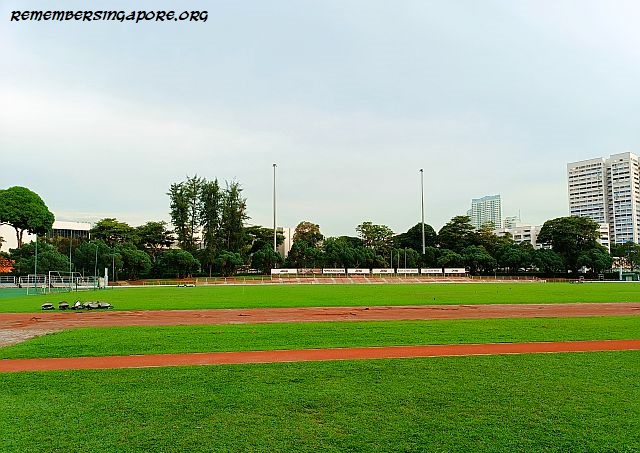
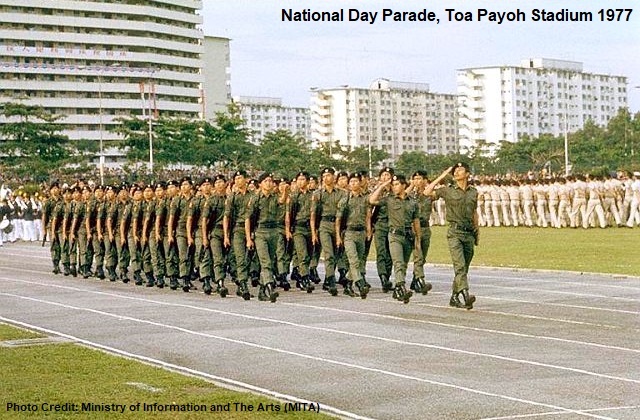
On the other hand, Toa Payoh Stadium’s early days were largely used for amateur and semi-professional football matches and other non-sporting events such as National Day’s parades (decentralised), political rallies and religious masses.

In 1989, Toa Payoh Stadium became the third stadium, after Farrer Park and Queenstown Stadium, to go “automatic” when it was installed with automatic gates configured to open at 5am daily. This allowed the early joggers to make use of the stadium’s running tracks and facilities. Before this implementation, the stadium gates were opened at 7am by the watchmen hired by the Singapore Sports Council (SSC).

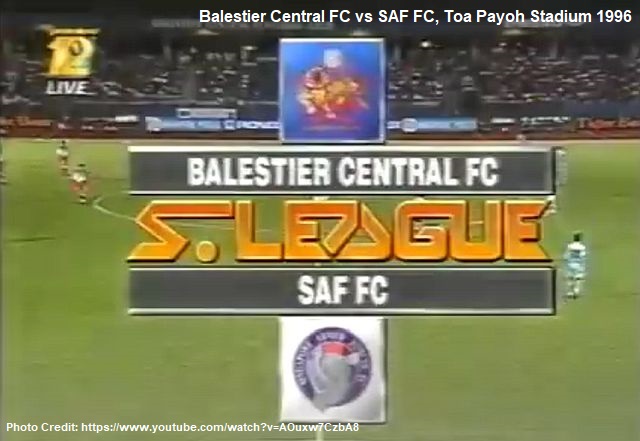
Since 1996, Toa Payoh Stadium became the home ground for Balestier Central Football Club (merged with Clementi Khalsa in 2002 to become Balestier Khalsa). It was this year when the Singapore Football Association (FAS) launched the Singapore Professional Football League (S-League), following Singapore’s exit from the Malaysia Cup.

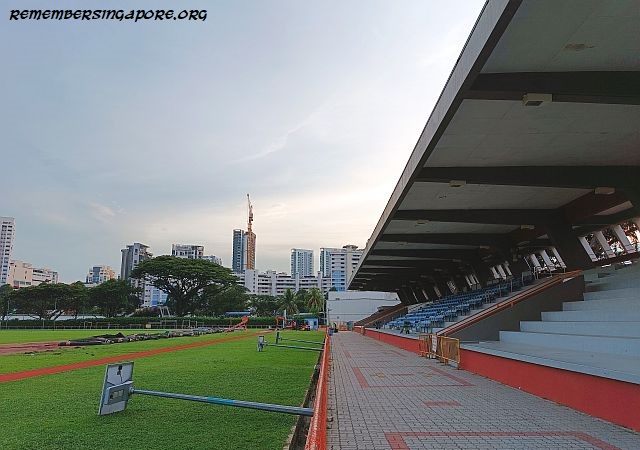
Toa Payoh Stadium, along with Yishun, Jurong, Bedok, Queenstown, Tampines, Jalan Besar and Woodlands Stadiums, were chosen as the key grounds for the eight S-League’s football clubs. The stadiums were renovated and upgraded as part of the preparations for the new league. Toa Payoh Stadium was closed for eight months as its pitch was overhauled and seating capacity increased from 2,000 to 3,500.

Below is the list of non-sporting events at Toa Payoh Stadium from 1973 to 1996 before it was allocated to Balestier Central Football Club for training and S-League matches:

Year

Event

1974

Brazilian superstar Pele visited Singapore for a three-day football clinic, as part of a world tour to impart football knowledge to developing countries. At Toa Payoh Stadium, he coached a squad of 90 players from six National Trades Union Congress (NTUC)-affiliated unions.

1974

1st National Cadet Corps (NCC) Day parade was held at Toa Payoh Stadium.

1976

The Singapore Armed Forces Training Institute (SAFTI) and six combat units were presented with the State Colours for the first time in 1976, with the ceremony and parade held at Toa Payoh Stadium.

1977

The Singapore Red Cross Society organised a 1,600-member World Red Cross Day parade at Toa Payoh Stadium.

1977

Toa Payoh Stadium was selected as one of the decentralised venues for National Day Parade.

1979

Toa Payoh Stadium was selected as one of the decentralised venues for National Day Parade.

1979

Telefun ’79 competition organised by the Radio and Television Singapore (RTS) and People’s Association (PA), attracting a 4,000 crowd at the Toa Payoh Stadium.

1981

Toa Payoh Stadium was selected as one of the decentralised venues for National Day Parade.

1981

The Catholic Archbishop of Singapore Monisgnor Gregory Yong held a mass at Toa Payoh Stadium with a capacity crowd from Singapore’s 28 Catholic churches.

1982

1st Battalion of Royal New Zealand Infantry Regiment held an alliance parade at Toa Payoh Stadium to strengthen the ties between Singapore and New Zealand since 1974.

1982

American singer Dan Peek held a concert at Toa Payoh Stadium.

1983

Toa Payoh Stadium was selected as one of the decentralised venues for National Day Parade.

1984

World Red Cross Day parade held at Toa Payoh Stadium.

1985

J.B. Jeyaretnam and Worker’s Party held a rally “Our Kind of Society” at Toa Payoh Stadium.

1985

6,000 people turned up at the Catholic Youth Rally exhibition organised by the Catholic youth organisations at Toa Payoh Stadium.

1985

10,000 Thai workers gathered at Toa Payoh Stadium to see the address by Princess Maha Chakri Sirindhorn of Thailand, who was in Singapore on a six-day official visit.

1985

12th National Cadet Corps (NCC) Day parade was held at Toa Payoh Stadium.

1986

5,000 Filipinos attended a mass at Toa Payoh Stadium conducted by Cardinal Jaime Sin, Roman Catholic Archbishop of Manila.

1987

Singaporeans packed into Toa Payoh Stadium to listen to Mother Teresa, 1979 Nobel Peace Prize winner and popularly known as the Living Saint of Calcutta, spoke about abortion, love, peace and the need to care for the poor and unwanted.

1987

The Singapore Tourist Promotion Board (STPB) organised a “Musical Chair 6000” at Toa Payoh Stadium in an attempt to break the Guinness World of Records. It failed as 2,000 participants failed to turn up.

1988

National Martial Arts and Qigong Solidarity Mass Demonstration is held at Toa Payoh Stadium.

1988

Chiam See Tong and Singapore Democratic Party held a May Day rally at Toa Payoh Stadium.

1989

8,000 school girls from 11 convent schools gathered at Toa Payoh Stadium to celebrate National Day and 135th anniversary of the Convent of the Holy Infant Jesus (CHIJ).

1989

More than 300 civil defence personnel participated in the National Civil Defence Telematch finals at Toa Payoh Stadium.

1991

Toa Payoh Town Council and Residents’ Day was launched at Toa Payoh Stadium.

1991

Worker’s Party held a May Day rally “What After Lee” at Toa Payoh Stadium.

1992

Worker’s Party held a May Day rally “A Wooing We’ll go” at Toa Payoh Stadium.

1992

Mr Singapore contest was held at Toa Payoh Stadium.

1993

Thousands of pre-enlistees took their fitness tests at Toa Payoh Stadium. The tests determined whether they were required to undergo two additional months of physical training before their Basic Military Training (BMT).

1994

Worker’s Party held a May Day rally at Toa Payoh Stadium.

1994

SAF Music and Drama Company (MDC) commemorated the 25th years of Operationally-Ready National Service with “A Night of Celebrations” performances at Bedok, Choa Chu Kang and Toa Payoh Stadiums.

With the closure of Toa Payoh Stadium on 31 October 2023, Balestier Khalsa will share the Bishan Stadium with Lion City Sailors.

Toa Payoh Sport Centre

Other than the swimming complex and stadium, Toa Payoh Sports Centre also consisted of the Singapore Table Tennis Association (STTA) Training Hall. It was built in 1984 at a cost of $800,000. The two-storey building, serving as STTA’s headquarters, had offices, conference rooms and a training hall that could accommodate nine table tennis tables. The conference rooms would be converted into dormitories for the players during the tournaments.

In 2014, under the government’s vision of Live Better Through Sports, a national movement called ActiveSG was launched to encourage Singaporeans of all ages to keep fit and healthy and participate in sports and games. An ActiveSG gym was subsequently set up at Toa Payoh Sports Centre.

Published: 19 November 2023

Posted in Historic, Nostalgic | Tagged , , , , , , , , , , , , , , , , , , , , , , , , , , | 1 Comment

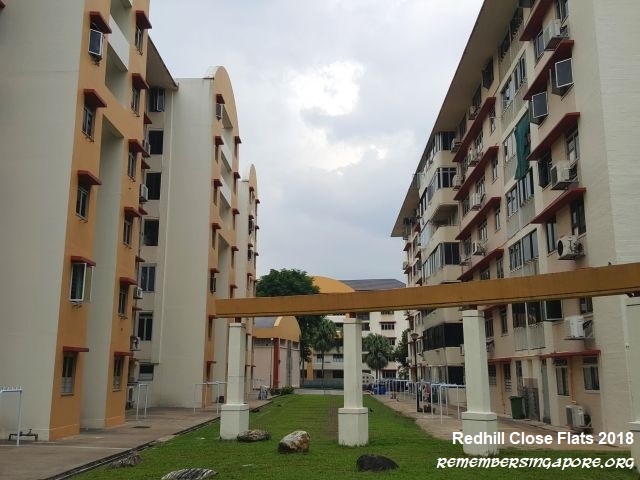
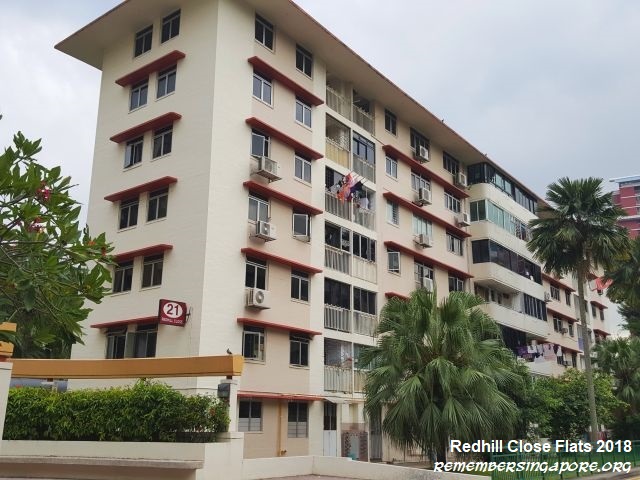
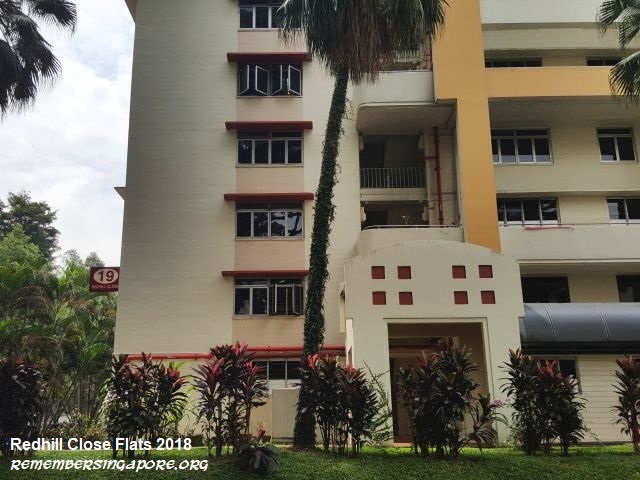
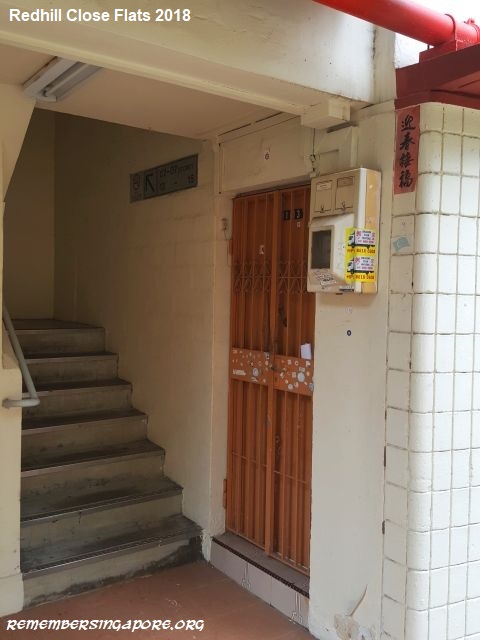
Redhill Close SIT Estate Walks Into History

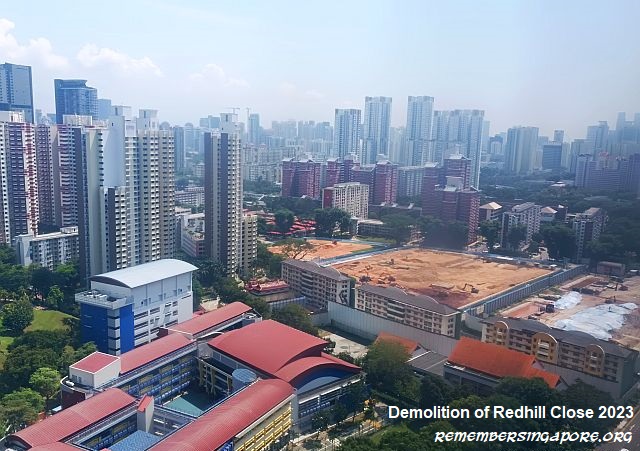
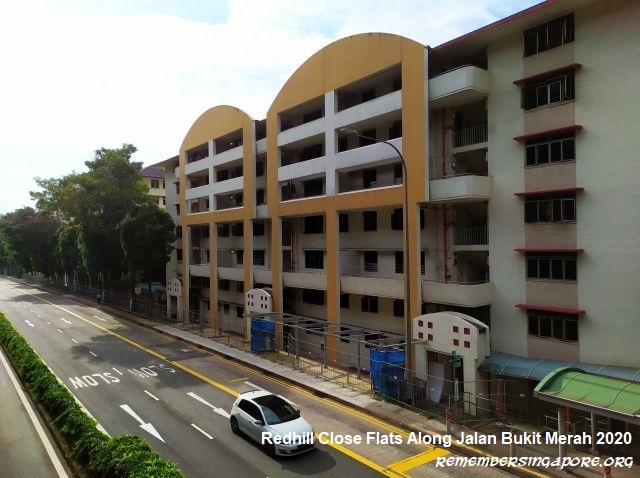
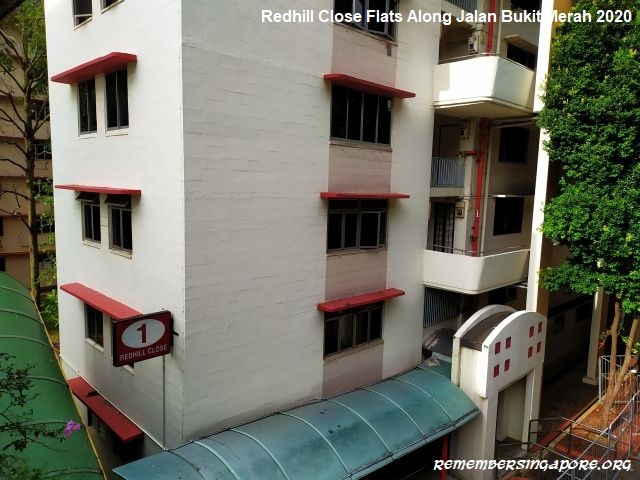
By October 2023, a large part of Redhill Close estate has been bulldozed, with only a couple of blocks left standing. Another old Singapore Improvement Trust (SIT) estate has silently walked into the history.

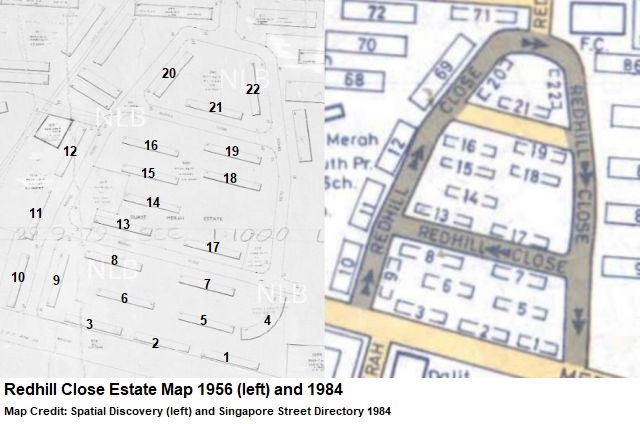
Redhill Close was declared for Selective En-bloc Redevelopment Scheme (SERS) back in 2011. The small SIT housing estate was built in 1955, almost seven decades ago. Sometimes known as Redhill Estate in its early days, it was originally made up of 22 blocks that simply numbered 1 to 22. The blocks, fondly known as chek lau chu (“seven storey house” in Hokkien) by the locals, were built within and along a closed loop (also named Redhill Close) accessible from the main Jalan Bukit Merah.

Then-Governor of Singapore Sir Robert Black (1906-1999) toured the newly-built Redhill Close in August 1955, shortly after he took office. He also visited other SIT estates at Queenstown, Tiong Bahru and Outram.

From the fifties to the seventies, Redhill Close estate that appeared peaceful during the day, however, was notoriously dangerous at night. Robbery and hooliganism were rife, and house break-ins and gang fights were common. Cases of thefts and stabbing at Redhill Close frequently appeared in the news. The situation was so bad that the residents of Redhill Close wanted to form their vigilante group to patrol the lanes at night and keep an eye on unescorted women and children.

One major secret society that operated at Redhill Close and caused troubles to the residents was sio ang koon of the 24 Group, who committed several high-profile extortion, robbery and rape cases in the seventies. In 1976, the police stormed a 11-storey unit at the nearby Block 88 of Redhill Close with tear gases. Hidden inside was a notorious gang leader, who was involved in a series of armed robberies throughout Singapore. He retaliated by shooting at the policemen, but was eventually shot dead in the head by a police sniper.

Hygiene and fire safety were major issue too, as squatters and some residents built illegal attap huts around Redhill Close to rear pigs, which were left roaming around the estate causing much annoyance to the ground-floor tenants. Some inconsiderate ones even threw the dead pigs into the drains, leading to choked waters and mosquito breeding. The huts were also prone to fires, putting the nearby residents at risk.

There were several public amenities built around Redhill Close, which included schools, market, community centre, temple and an old folk’s club.

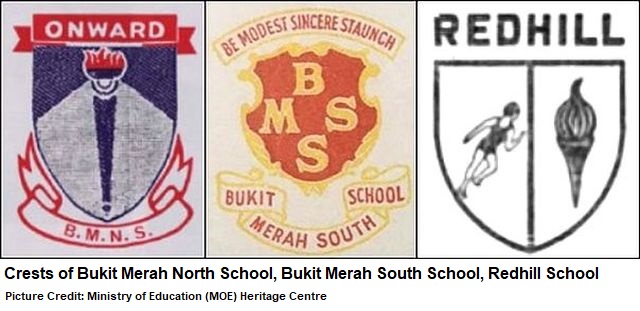
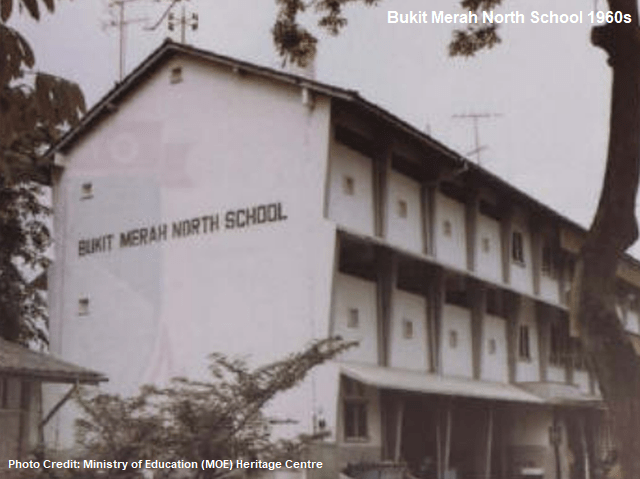
Three neighbourhood schools – Bukit Merah North School, Bukit Merah South School and Redhill School – were established in the fifties, around the same period as the development of the Redhill Close estate. Proving basic education for the students living in the area for three decades, the three schools were eventually merged in 1986 to become Bukit Merah Primary School.

In 1998, Bukit Merah Primary School merged with Alexandra Hill Primary School and shifted into the latter’s campus. Its own premises were occupied in the early 2000s by Gan Eng Seng Primary School and Bukit Merah Secondary School which lasted till today.

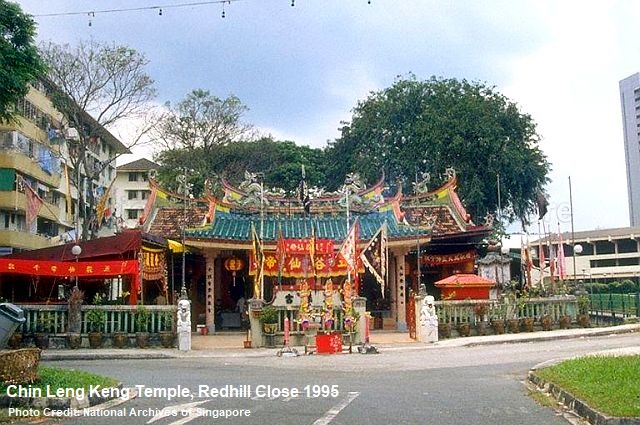
Chin Leng Keng, or Zhen Ren Gong Temple, was a Chinese joint temple established in 1978. Built at a cost of $300,000, the temple was a merger of four old temples – Kai Kok Tien, Chin Lin Keng, Ban Sian Beo and the 1oo-year-old Leng San Teng – that had to make way for redevelopment purposes. Chin Leng Keng temple stands beside the former Block 12 of Redhill Close.

The Bukit Merah Old Folk’s Club was set up at two adjoining flats at the first floor of Block 14 Redhill Close. Opened on 30 June 1979 by Lim Chee Onn, former Member of Parliament (MP) for Bukit Merah, the club regularly organised recreational activities for the elderly living in the area.

In the early eighties, one end of the closed Redhill Close loop was “opened up” to improve the traffic flow within the estate. It was extended and linked to Jalan Bukit Merah, converting Redhill Close into a one-way open loop with an entrance and exit via Jalan Bukit Merah. As a result, Block 4 was demolished to make way for the new junction, and Redhill Close estate was left with 21 blocks.

In 1983, under the national policy to encourage home ownership, the HDB offered the residents of Redhill Close estate to purchase their flats at $20,000 each. For a large part of its history, the Redhill Close flats, since 1955, had mostly been used as rental flats.

As an incentive for home ownership, Redhill Close was given a major upgrading project in 1984, where the residential units’ old windows and doors were replaced with new ones, and new mosaic tiles were laid for the bathrooms and toilets. New power cables were routed and laid at the grounds between the blocks. Repainting of the blocks were also carried out.

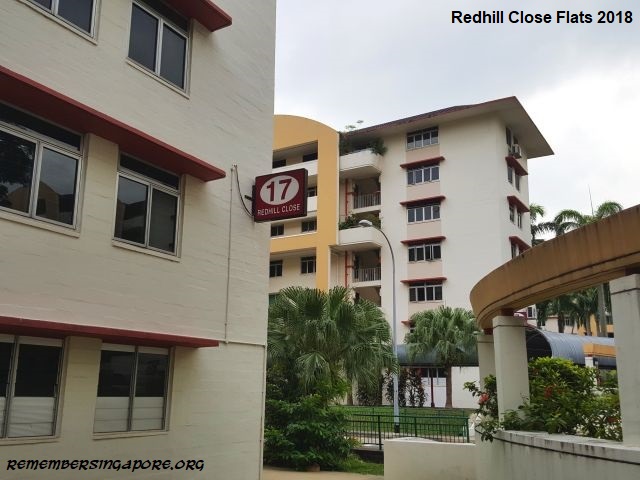
Redhill Close underwent another HDB’s upgrading program in the mid-nineties. 91.6% of the homeowners voted for the upgrading that came with refurbished toilets and additional utility rooms. Covered walkways, landscaped courtyards and new block facades were also added to the estate.

After the 2011 SERS announcement, HDB began building new replacement blocks at the nearby Henderson Road as a relocation option for the Redhill Close residents. By 2018 and 2019, most of the estate’s residents had vacated their homes.

In 2020, some of the vacant Redhill Close blocks were used as temporary accommodation to house the foreign workers, so that they could continue to provide the essential services and facility management during the Covid-19 pandemic period. The demolition works eventually commenced in 2023. The blocks were pulled down one by one, marking the end of this old SIT estate.

Published: 21 October 2023

Posted in General | Tagged , , , , , , , , , , , | 9 Comments

The End of Singapore’s First HDB Flats at Merpati Road

Block 45, 48 and 49 of Stirling Road have long been considered as Singapore’s first Housing and Development Board (HDB) flats when they were completed in October 1960, eight months after the statutory board was established.

First HDB Flats

But the three blocks, standing more than six decades near the junction of Queensway and Stirling Road, are in fact part of the Singapore Improvement Trust’s (SIT) Queenstown satellite town project that began in the fifties. HDB inherited the housing project and went on to finish the incomplete works left behind by SIT.

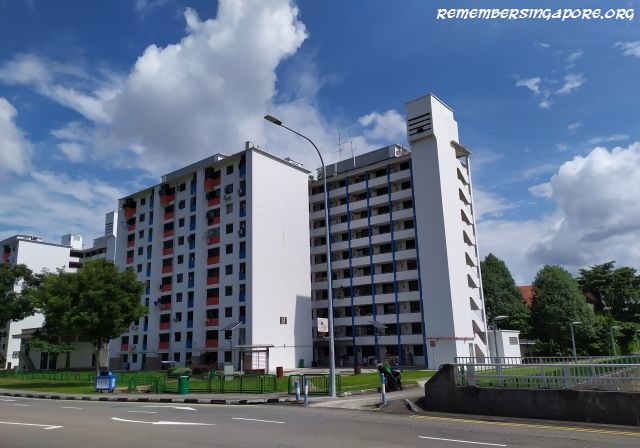
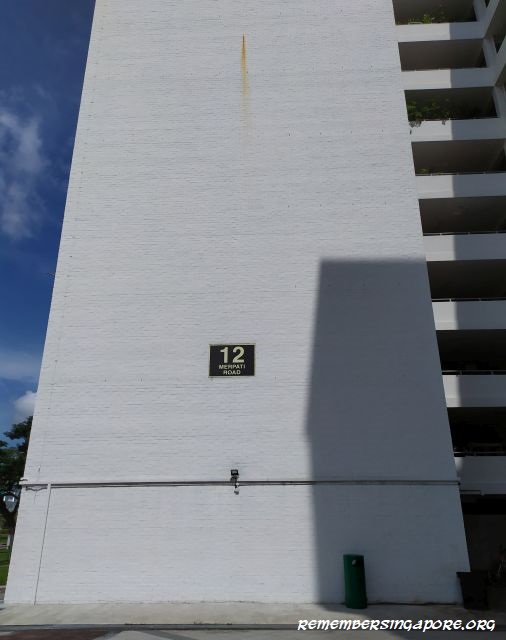
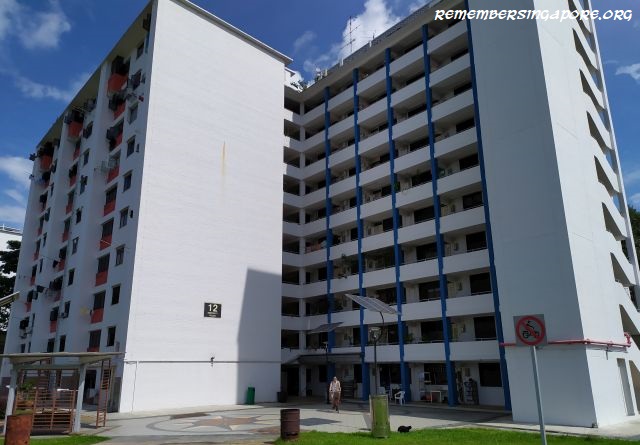
Hence, the title of the first flats fully planned and developed by HDB should belong to the ones at Mattar Road and Merpati Road (was called Jalan Merpati prior to the seventies). This small neighbourhood, part of the MacPherson Road Housing Estate, was made up of 18 HDB blocks (Block 1 to 18) of two different designs. At Mattar Road were three-storey one-room blocks that acted as emergency-type flats for some of the affected families of the Bukit Ho Swee Fire, whereas along Merpati Road were the taller 10-storey slab blocks.

Before the merger under Singapore Bus Services (SBS) in 1973, there were many large and small private bus operators in Singapore. Several bus services passed through Mattar and Merpati Roads in the sixties and seventies; they were the Singapore Traction Company (STC), Amalgamated Bus Company (ABC), Associated Bus Services (ABS), United Bus Company (UBC), Changi Bus Service, Bedok Bus Service and Paya Lebar Bus Service.

Some of the obsolete bus services that served Mattar and Merpati Roads were:

Period

Bus Company

Bus Service

Route

1970s

Singapore Traction Company (STC)

60A

MacPherson, Geylang Road, Kallang Road, Beach Road, Nicoll Highway, Stamford Road, Jalan Sultan, Waterloo Street

61

MacPherson, Geylang Road, Kallang Road, North Bridge Road, South Bridge Road, Telok Blangah, Alexandra Road

64

MacPherson, Bendemeer Road, Whampoa, Serangoon Road, Jalan Besar, Orchard Road, Tanglin Road, Alexandra Road, Commonwealth Avenue

100A

Serangoon Gardens, MacPherson, Kallang Road, North Bridge Road, Nicoll Highway, Collyer Quay, Victoria Street

1970s

Amalgamated Bus Company (ABC)

62

MacPherson, Geylang Road, Kallang Road, North Bridge Road, Neil Road, Tiong Bahru, Jalan Rumah Tinggi (Bukit Merah)

63

MacPherson, Geylang Road, Kallang Road, North Bridge Road, South Bridge Road, Cantonment Road, Lower Delta Road

65

MacPherson, Bendemeer Road, Whampoa, Serangoon Road, Jalan Besar, Orchard Road, River Valley Road, Lower Delta Road

1970s

Associated Bus Services (ABS)

155/155A

Toa Payoh, Upper Serangoon Road, MacPherson, Geylang Road, Changi Road, East Coast Road, Bedok Road

1980s

Changi Airport Supplementary Bus Service

737

Toa Payoh, MacPherson, Paya Lebar Road, Jalan Eunos, Still Road, East Coast Parkway, Changi Airport

Incidents and Trivia 

In its early days, the Merpati Road flats frequently witnessed unfortunate fatal falls, due to either accidents or suicides, that dominated the news headlines. In 1977, a serious gas leakage incident at Block 1 of Mattar Road led to a family of four knocked out unconscious in their flat. A gas pipe in their kitchen was damaged but the tenants only wrapped it with a piece of cloth. They were only discovered when another family member returned home and called police.

In 1982, the residents of the Merpati Road flats spontaneously formed a team to clean and wash their lifts every night at 8:30pm. About 15 to 20 residents, including students, equipped themselves with brooms, mops and pails in the big wash-out. Merapti Road’s 11 blocks – each block had two lifts – were unglamorously known as the “Dirty Dozen” due to the filthy conditions of their lifts, which were often stained with litters and foul-smelling urine by inconsiderate people.

The HDB MacPherson area office gave its full support to the residents by supplying them the cleaning equipment and sending circulars to every household at Merpati Road. Urine detectors were later installed at the lifts, automatically stalling the lifts whenever a violation was detected. In 1989, a man was fined $800 for urinating inside Block 16’s lift.

Demolitions Over the Years

In 1979, the HDB decided to demolish four of the Mattar Road blocks. About 444 tenants shifted by 1980. The last 16 families were served eviction notices, and reluctantly moved out when the demolition started in June 1981. After the demolition, the small neighbourhood was left with 14 blocks (Block 3 to 5, 7 to 8, 10 to 18).

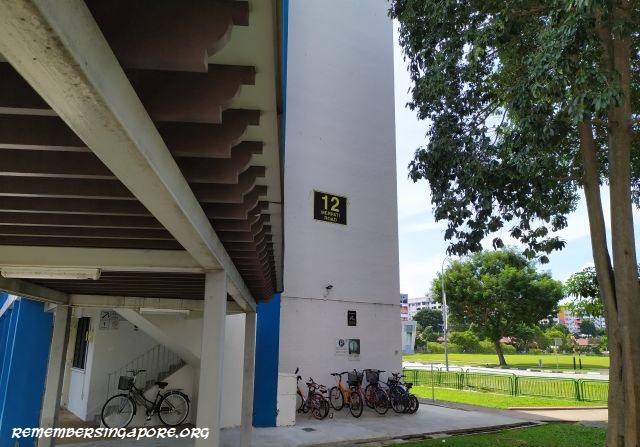
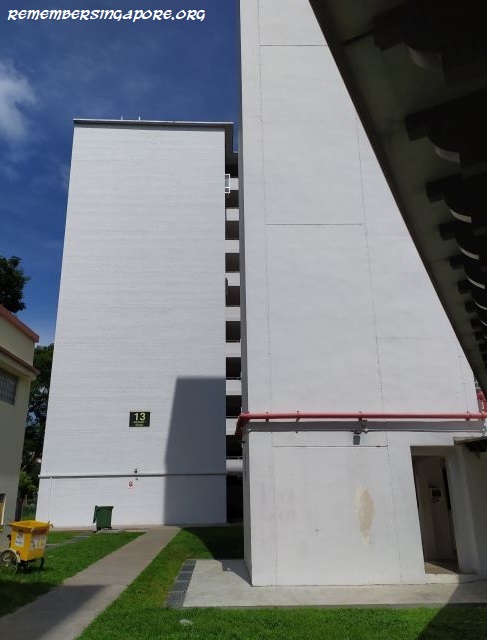
By the late eighties, another three blocks – the low-rise Block 5, 7 and 10 – were pulled down. This was followed by the demolition of Block 3, 4 and 11 in the early nineties. Block 8, 15, 16, 17 and 18 were gone by 1993, leaving only Block 12, 13 and 14 in the vicinity.

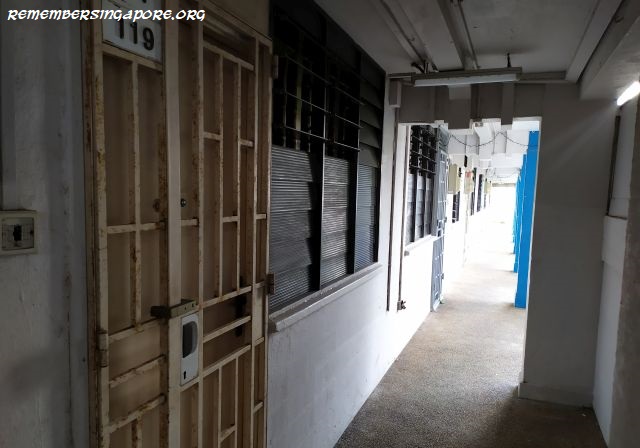
The three remaining blocks stood undisturbed for three more decades until 2023. They will be making way for redevelopment plans of the area around Downtown Line’s Mattar MRT Station, which opened in 2017. Beside the flats, the freehold terrace houses in the vicinity were also acquired. As many as 15 private properties were gazetted by the government in 2010.
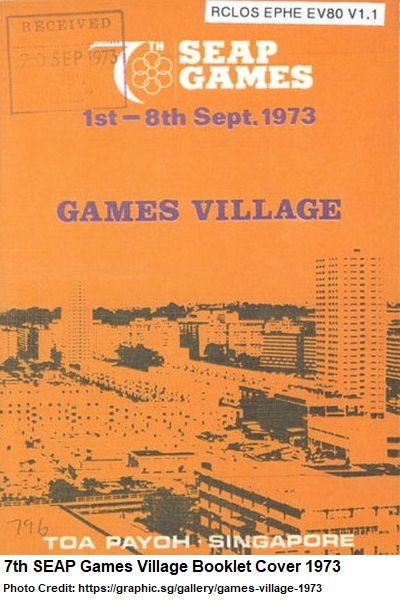
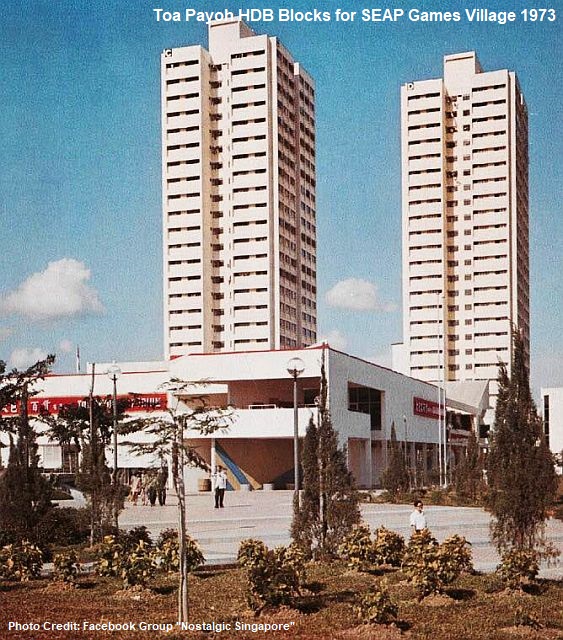
With the impending demolition of the Merpati Road blocks, it spells the end of Singapore’s first HDB flats.

Published: 29 September 2023

Updated: 6 October 2023

Posted in General, Nostalgic | Tagged , , , , , , , , , , , , , | 10 Comments