Below is a collection of some of the biggest news headlines that shook the Singapore society since 1955, when Singapore was given self-governance (Extending the timeline from the previous version of “1970 to Present”). The headlines are categorised into Social Unrest, Politics, Accident, Terrorism, Disaster, Finance, Public Health and Others.
Please feel free to contribute and I will update accordingly.
Self Governance (1955-1961)
12 May 1955 – Hock Lee Bus Strike
(Social Unrest)
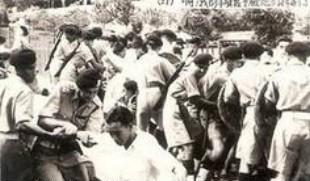 Protesting against long hours, poor benefits and working conditions, the workers of Singapore Bus Workers Union (SBWU) organised a peaceful demonstration on 23 April 1955.
Large number of drivers were dismissed by Hock Lee Bus Company, who in turn protested by locking themselves in the garages at Alexandra Road. Soon, students from Chinese middle schools took sympathy of the drivers and joined in the protests. The government viewed the strike as pro-communist and anti-colonial.
The mob grew to a strength of 2000 and riots broke out between the angry protesters and the police, resulting in four deaths and 33 injuries. Two policemen, a student and a reporter were killed in the conflicts.
Negotiation between the bus company owners and the union took place on 14 May before bus services were resumed two days later.
24 October 1956 – Chinese Middle Schools Riots
(Social Unrest)
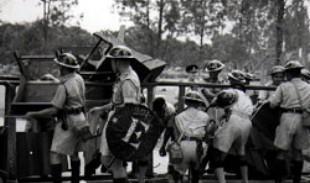 When the Chief Minister of Singapore David Marshall resigned in 1956, Lim Yew Hock took over and implemented tough measures on pro-communist organisations. The Singapore Chinese Middle School Students Union (SCMSSU) was forced to close down.
Students gathered at the Chinese High School and Chung Cheng High School for protests, and refused to soften their stand even after their parents’ persuasion. On 26 October, police forced their ways into the schools and dispersed the students using tear gas.
The angry students took to the streets, throwing stones at the police and overturning the cars. Curfews were imposed by the government, as more than 900 were arrested. The riots caused 13 lives and left more than 100 injured. The detainees were released in 1959 after the People’s Action Party (PAP) won the election to form the government.
10 June 1957
(Politics)
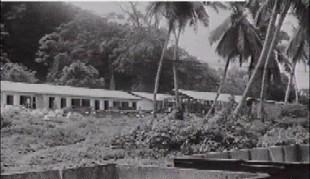 After the Second World War, Christmas Island was placed under the administration of the Colony of Singapore. Phosphate was discovered, leading to a booming mining industry which required large number of labourers from Singapore.
By 1957, with the independence of Singapore becoming more imminent, the British proposed the transfer of Christmas Island to Australia. Taking consideration of the losses in phosphate mining, Australia compensated the self-government of Singapore a total of 2.9 million pounds. The transfer took effect on 1 October 1958.
This event contributed indirectly to the political downfall of Second Chief Minister of Singapore Lim Yew Hock (1914-1984), who was blamed by the public for his lack of effort in securing the sovereignty of Christmas Island, even though Singapore never truly had the ownership of Christmas Island.
5 April 1958
(Disaster)
A large fire swept through Kampong Koo Chye, located at Lorong 3 Geylang. Most of the wooden houses in the kampong were burnt down, resulting in multiple casualties and thousands homeless. The Lorong Tiga Estate houses were built rapidly to rehouse the disaster victims.
25 May 1961 – Bukit Ho Swee Fire
(Disaster)
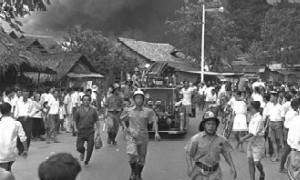 A disaster that had a direct impact on the development of public housing in our country, Bukit Ho Swee Fire took away a life, injured dozens and made at least 16,000 homeless. Most of the attap houses in the squatter settlement were destroyed as the fire spread rapidly by the strong winds in the late afternoon.
The self-government of Singapore acted promptly over the next four years by building many low-cost public flats in Queenstown and other estates to reallocate the refugees. The root cause of this disaster, the largest fire ever in Singapore’s history, however remains unknown till this day.
7 May 1962
(Crime)
Two young gang members of “The Little Black Wind Gang” kidnapped a 12-year-old boy at Karikal Lane and demanded a $100,000 ransom. See Ah Wang, the boy’s father and a prominent Chinese contractor, eventually paid only $6,000 for his release after 13 days.
The kidnappers Robert Tang Keng Lock and Lim Kheng Tiong were caught three months later, and were sentenced to life with 10 strokes of cane.
Merger with Malaysia (1962-1965)
2 February 1963
(Politics)
Under “Operation Coldstore”, 111 people deemed anti-government leftists with a plan to build a communist Singapore were arrested and detained.
12 July 1963
(Social Unrest)
Prison riots erupted at Pulau Senang caused deaths of four prison officers, including Daniel Stanley Dutton, the Superintendent in charged of the island. More than 50 rioters were trialed, with 18 prisoners sentenced to death.
27 August 1963
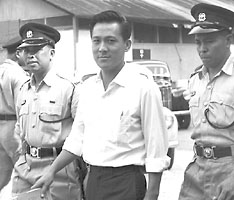 (Crime)
Sunny Ang (1939-1967) was sentenced to death after he was found guilty of murdering bar waitress Jenny Cheok Cheng Kid for her insurance.
In August 1963, Ang, a rich playboy-turned-bankrupt, brought Jenny, who was insured for a total of $450,000, to Sisters’ Islands for diving. The body was never found.
21 July 1964 – Prophet Muhammad Birthday Riots
(Social Unrest)
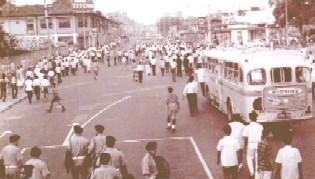 During the merging with Malaysia, the Singapore society was filled with unstable racial, religious and political elements.
On 21 July 1964, tens of thousands of Malays gathered at Padang to celebrate Prophet Muhammad’s Birthday. During their march to Geylang, the groups got into conflicts with the police, which worsened to riots by the evening. The government had to impose curfews, but 36 people died in the violent events. More than 3000 were arrested, while the United Malays National Organisation (UMNO) of Malaysia and People’s Action Party (PAP) of Singapore pointed fingers at each other.
Another major riot happened again in September, when a Malay trishaw-driver was suspected to be murdered by a group of Chinese gangsters in Geylang Serai. The series of racial riots and violence played an important part for Singapore to withdraw from the merging of one Malaysia.
10 March 1965 – MacDonald House Bombing
(Terrorism)
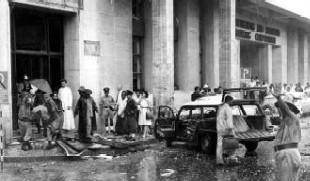 During the peak of Konfrontasi (1962-1966) between Indonesia and Malaysia, Singapore became an victim of terrorism when Indonesia sent two commandos to plant a bomb at the MacDonald House (formerly known as Hong Kong and Shanghai Bank Building).
Then Indonesian president Sukarno was openly opposed to the merging of Malaya, Singapore, Sabah, Sarawak and Brunei, and ordered armed attacks in East Malaysia, incited revolts in Brunei and carried out sabotage activities in West Malaysia and Singapore.
There were dozens of bombing in Singapore, and the one at MacDonald House was the most serious of all as two bank employees were killed and 33 injured. The two Indonesian saboteurs were caught and hanged in 1968.
5 August 1965
(Crime)
Some of Singapore’s most notorious kidnappers and gunmen Morgan Teo, Oh Kim Kee and Lim Bah Lim escaped after killing an inspector in an exchanged gunfire with the police at Siang Lim Park. Both Morgan Teo and Lim Bah Lim were eventually killed by the police and Gurkhas after weeks of raids.
Post-Independence (1966-1970)
29 October 1967
(Others)
Rumours spread among hundreds of Singaporean Chinese that the disease of koro (shrinking penis) was caused by eating pork inoculated with anti-swine-fever vaccine. As many as 97 Chinese men rushed to the emergency department of Singapore General Hospital in one day. The rumours faded away after about one month.
14 July 1968
(Accident)
More than 10 villagers from Kampong Bereh ventured into a prohibited area to pick rambutans during a live artillery exercise at the Singapore Armed Forces Training Institute (SAFTI) Firing Ground at Pasir Laba. Four of the trespassers were killed, while nine were left injured.
31 May to 6 June 1969 – Seven-Day Racial Riots
(Social Unrest)
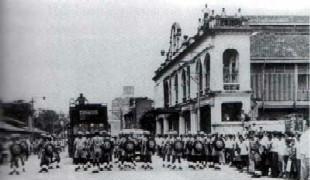 The Singapore society remained shaky after independence in 1965. On 13 May 1969, the largest riot erupted in Kuala Lumpur (KL), capital of Malaysia, due to the rising tensions between the Malaysian Malays and Malaysian Chinese.
Soon, rumours began to spread here that the Singaporean Malays, a minority in Singapore, would be subjected to revenge after Malaysian Chinese were unfairly treated by the Malaysian government. Chinese secret societies began plans to attack the Malay-majority Jalan Ubi and Jalan Kayu. The Malay triads retaliated by burning Chinese shophouses in Geylang.
The Internal Security Department (ISD) of Singapore worked with the police to quash all conflicts, but the seven-day riots still caused at least four deaths and 80 injuries. The mounting tensions between the two races continued for another couple of years, but the government made efforts to ensure such high level of violence would not happen again.
11 December 1969
(Disaster)
The worst floods in 35 years saw the Hari Raya holiday ruined when heavy thunderstorms swept Singapore and disrupted electricity, water and telephone services. Trees were uprooted and landslides occurred. Almost three-quarters of the island were affected by the rising floodwater, resulting in 3 deaths.
8 February 1970
(Accident)
22-year-old Susan Lim of The Crescendos, a popular local band in the sixties, was swept away by strong waves during a holiday trip at the Kemaman beach at Trengganu. Her body was never recovered. With the loss of their lead singer, The Crescendos disbanded and never regrouped again.
23 April 1970
(Terrorism)
The Communist Party of Malaya (CPM) planted red flags and a booby-trap explosive at a playground at 10½ milestone Changi Road, causing the death of a 7-year-old girl and injury of a 9-year-old boy. In the same evening, two homemade bombs by CPM were found at Haji Lane. Another bomb was discovered at an overhead bridge near Chinese High School five days later.
26 August 1970
(Accident)
A high-profile accident happened at the grenade range of the Singapore Armed Forces Training Institute (SAFTI).
During the training, a live grenade fell off the fumbling hand of recruit Kwok Seong Fan. In a bid to save Kwok Seong Fan’s life, 21-year-old Second Lieutenant Tay Siow Kai was killed when the grenade exploded before he could hurl it to safety.
Struggles of a New Nation (1971-1975)
29 December 1971
(Crime)
The case of “Gold Bar Murders” where businessman Ngo Cheng Poh was killed for his 120 gold bars. Seven were hanged while three escaped death due to underage.
17 September 1972
(Crime)
A 22-year-old seamstress Chan Chee Chan (Zeng Lizhen) was walking with her sister along Tanglin Halt when she was hit by a bullet straight at her heart. She died from the fatal wound at the Singapore General Hospital. The police suspected a sniper was hiding in one of the high-rise buildings but the case remains a mystery till today.
21 November 1972 – Robinson’s Fire
(Disaster)
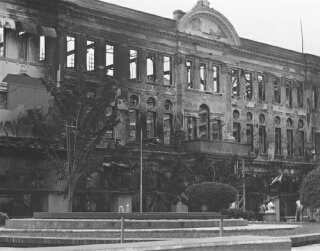 114-year-old Robinson’s Department Store at Raffles Place was destroyed in a huge fire that also claimed nine lives and property loss of $14 million.
At the time of the fire, there were some 350 employees and 200 shoppers in the departmental store. Most of the consumer goods went up in flames, and the glare of the fire was said to be visible as far as Jurong at a height of more than 60m.
07 March 1973
(Others)
A black panther on the loose set off a massive hunt in the Seletar-Mandai Road area.
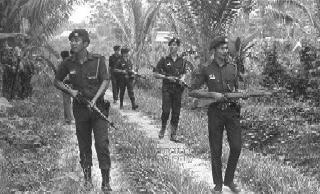 The three-year-old panther, acquired from Thailand just six days earlier, was one of three at the zoo which was scheduled to open the following month. It was reported missing the previous evening.
The police hunted in teams of five and eight. Just before noon, one police party opened fire when it spotted movement in the jungle along the zoo boundary. But the animal turned out to be a bear that had also escaped from the zoo a few days earlier.
12 July 1973
(Crime)
20-year-old Hoo How Seng, from Pontian of Johor, shot dead Detective Ong Poh Heng at East Coast Road. The wanted man, who was involved in smuggling and robbery earlier, was shot six times in the head and body after a police ambush at his Cavanagh Road flat nine days later.
26 November 1973
(Finance)
The worldwide oil shortage hit the Singapore stock market hard in a “Black Monday” as a total value of $1 billion was wiped out in the selling frenzy.
2 January 1974
(Others)
Darkness covered 90% of Singapore, a scene not seen since the fifties, as the worst blackout since the Second World War affected Singapore’s 2 million population for more than 6 hours. More than 100 PUB engineers were recalled to restore the supply at the power stations, but the island was hit by another major blackout 4 days later.
31 January 1974 – Laju Incident
(Terrorism)
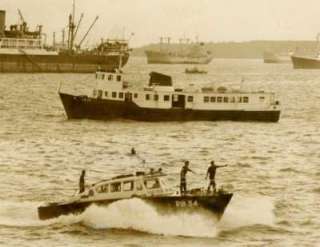 Two Japanese and two Arab terrorists of the Japanese Red Army and Popular Front for the Liberation of Palestine (PFLP) bombed Pulau Bukom’s Shell oil refinery and hijacked a ferryboat called Laju.
Holding hostages, the terrorists were granted their wish to fly to Kuwait on 7 February after days of intense negotiations. This terrorist act was later known as “Bukom Bombers” or “Laju Incident”.
August 1974
(Crime)
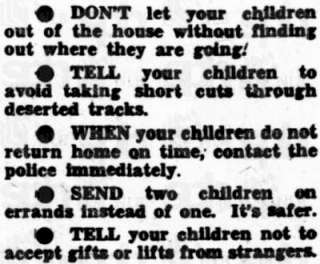 The murders of two schoolgirls shook the society in 1974. The remains of a 11-year-old Chinese girl called Sim Lay Wah and a 9-year-old Malay girl, Yatimah bte Abdul Rahman, were found in the jungles off Upper Thomson Road and Clementi Road respectively.
Due to the high profile nature of the two cases, the police had to issue advisory to school principals, teachers and parents regarding the safety of young children. A 41-year-old man was later arrested and charged.
20 December 1974
(Terrorism)
The members of the Communist Party of Malaya (CPM) attempted to sabotage Nanyang Manufacturing Company by planting bombs at the company’s managing director Soh Keng Chin’s bungalow at Katong. The three CPM operatives carried four bombs in their Austin car, but one of the bombs suddenly exploded at a traffic junction at Still Road, killing two and injuring one.
02 May 1975
(Politics)
Operation Thunderstorm kicked off when the first wave of 300 Vietnamese refugees arrived at Singapore on a vessel named Troung Hai. The refugees had escaped from Vietnam following the fall of Saigon at the end of the Vietnam War (1955-1975).
More than 8,000 refugees arrived near Singapore in two weeks. Many boats were intercepted by the Republic of Singapore Navy and the Police Coastal Guard. Some refugees were quarantined at Marine Parade and Bedok Jetty, while others were housed temporarily at Hawkins Road in Sembawang. The rest of the refugees were denied from entering Singapore.
24 July 1975
(Crime)
Four robbers, cladding only in swimming trunks and dabbling in black magic, terrorised Singaporeans as they committed more than 200 armed robberies, housebreaking, assaults and rape. Hiding at Bidadari Cemetery, they were not caught until 30 months later.
The four “swimming trunk” robbers were sentenced to a total of 64 years’ imprisonment.
18 August 1975
(Crime)
After making a suicide pact with his wife Neo Yoke Kua, 24, pork-seller Lim Back Yong, 27, drove his borrowed car to Sembawang and plunged it into the waters off Mata Jetty. At the last moment, Lim backed out and escaped, leaving his wife drowned. He was later imprisoned for 10 years for culpable homicide.
The couple had been married for eight years and had two children, and the cause of the tragedy was believed to be sparked off by a series of family problems, including Neo’s suspicion of Lim’s unfaithfulness.
Rapid Economic Growth (1976-1985)
12 October 1978 – The Spyros Disaster
(Disaster)
It was the worst industrial accident in Singapore’s history. At about 2pm of 12 October 1978, Liberian-registered Greek tanker Spyros exploded at the Jurong shipyard, killing 76 people and injuring hundreds.
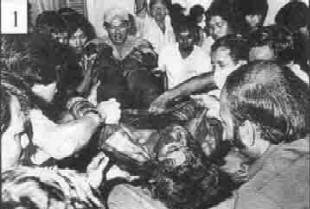 Due to the after-lunch timing, the number of casualties increased dramatically, as many workers were returning to the repair works. Many were burnt to death. Others suffered serious burns and inhalation of toxic gases.
During the seventies, safety practices at the shipyard was not strongly enforced. A repair cutting tool might have caused the sparks to ignite the vapour of the crude oil on the tanker. More safety regulations were implemented after the disaster.
2 December 1978
(Disaster)
Huge monsoon rains caused disastrous floods in areas from Bishan to Potong Pasir. Seven person were drown, hundreds were evacuated from their homes, massive amount of crops were destroyed and thousands of pigs and poultry died. Total damage was estimated to be S$10 million.
6 January 1979
(Crime)
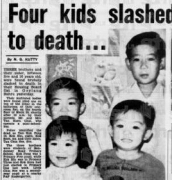 It was one of the most brutal homicides in the recent history of Singapore.
Four children of a Tan family, three boys and a girl aged between 5 and 10, were found murdered in their flat at Geylang Bahru district. They were cruelly slashed to death, with their bodies piled up in the bathroom. The case remains unsolved till this day with no suspects identified, no motives established and no weapons ever recovered.
01 November 1980
(Politics)
The former SIA Pilots Association (SIApa) initiated a work-to-rule action after negotiations broke down, and the month-long dispute had disrupted many international flights. The expatriate pilots had earlier demanded higher pays and better benefits. Then-Prime Minister Lee Kuan Yew stepped in and confronted the pilots: “I don’t want to do you in, but I won’t let anybody do Singapore in”.
The pilots eventually backed down. SIApa was de-registered a year later, and 15 leaders that incited the strike were charged and convicted.
19 December 1980
(Crime)
National bowler Peter Lew’s mother and 3 siblings were shot dead in a mysterious murder case. The four died in their Joo Chiat home, but no traces of the killer were found as the house was not forced into and nothing was heard by the neighbours.
The case remains unsolved till this day.
January/February 1981 – Adrian Lim Murders
(Crime)
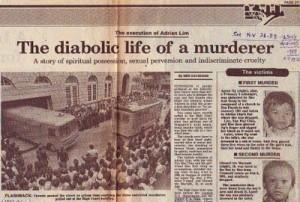 In 1981, the murders of two young children, Agnes Ng Siew Heok and Ghazali bin Marzuki, led to investigations that resulted in the capture of Singapore’s most notorious murderers to date: Adrian Lim, his wife Catherine Tan Mui Choo, and his mistress Hoe Kah Hong.
The murders had opened a complex case involving rituals of human sacrifice, drinking of human blood, as well as sexual perversion. During the days of the trial, crowds of people gathered outside the courts, and the proceedings were closely monitored and reported by the media.
The trial turned out to be the second-longest murder trial in Singapore, lasting as it did for about eight weeks, and unveiling disturbing accounts of rites and rituals that were both cruel and perverse. The trio were ultimately sentenced to death and were hanged on 25 November 1988.
5 February 1982
(Others)
Singapore fell into total darkness as the Jurong Power Station tripped and left Singaporeans without light for 8 hours.
14 April 1982
(Others)
Temperatures rose to a sizzling 35.8degC, smashing the previous record of 34.8degC set in 1948. Singaporeans began to swarm to the swimming pools and beaches, and sales of ice-cream and soft drinks soared.
29 January 1983 – Sentosa Cable Car Accident
(Disaster)
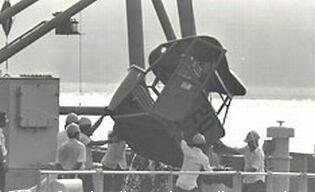 Tragedy struck when the towering structure of a Panamanian-registered oil rig struck the cable of the Sentosa Cable Car and caused two cable cars to plunge 55m into the sea. The disaster, happened shortly after 6 pm, caused thirteen people trapped in four other cable cars between Mount Faber and Sentosa.
This accident was the first involving death or injury since the cable car system opened in 1974. A total of seven people died in the cable car tragedy.
This operation involved all the three Services of the Singapore Armed Forces (SAF). The Diving Unit of the Singapore Navy was assigned to conduct the underwater search for the passengers in the two cable cars which had plunged into the sea, while the 120 Squadron of the RSAF were tasked to rescue the people who were still trapped in the four cable cars as the cars could not be moved along the remaining cables.
Helicopters fitted with floodlights approached the cable cars in strong winds, with the airman winched down to enter the cable-car and pull out the rescued one by one, until all thirteen passengers were brought to safety. The rescue took three and a half hours of risky hovering in darkness and high wind conditions.
23 July 1983
(Crime)
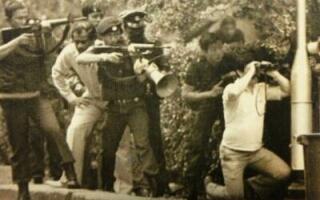 Robert Tay Bak Hong, a 61-year-old businessman, his wife Annie Low Au Ie and their Filipino maid Jovita Virador were brutally killed in their bungalow at Andrew Road in a cold-blooded armed robbery committed by two youths.
National serviceman Sek Kim Wah and Malaysian Nyu Kok Meng, both 19, had robbed the Tay family with a M16 rifle and ammunition stolen from an army camp. Sek Kim Wah strangled and killed the three with nylon cords, and the two held their young daughter and her Mandarin tutor as hostages while the police surrounded the house for four hours. When the police stormed in, the robbers had escaped but they were caught a week later.
Sek Kim Wah was charged of murdering another two people whose bodies were found at Seletar Reservoir on 30 June 1983. He was eventually sentenced to death for murder and was hanged on 9 December 1988. Nyu Kok Meng was caught in Malaysia and was extradited to Singapore for trial. He was sentenced to life imprisonment with six strokes of cane for armed robbery.
12 December 1984 – Gruesome Curry Murder
(Crime)
Mr Ayakannu Marithamuthu was murdered on 12 December 1984 at the Orchard Road Presbyterian Church and his body cooked in curry before being disposed of. The case became popularly known as the “Curry Murder”.
Ayakannu’s wife Naragatha, her three brothers, mother and a sister-in-law planned the murder to put an end to Ayakannu’s continuous abuses. To destroy all traces of incriminating evidence, his body was then chopped up into pieces. The body parts were then cooked into a curry which was later tied in different plastic bags to be disposed all over the island to allay suspicions.
Initially, Naragatha and her brothers were charged in 1987 with murder, but they were unconditionally released in June 1991 as the prosecution was unable to prove that it was indeed the family members who caused Ayakannu’s death. The cooking pot in which Ayakannu’s body parts were allegedly cooked could not be found, leaving no traces of the savage act.
15 December 1984
(Crime)
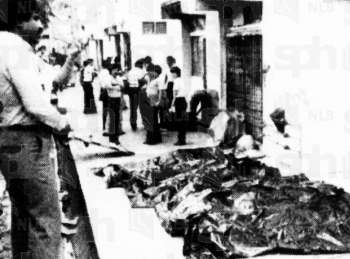 A tragedy occurred at the Woodlands Town Centre when an arsonist burnt down two shophouses, causing the death of 10 people. According to the coroner, most of the victims died of asphyxiation.
It was the worst fire case in Singapore since 1972, when the Robinson fire claimed a total of nine lives.
23 May 1985
(Crime)
18-year-old Catholic Junior College student Winnifred Teo Suan Lie was the victim of a rape-murder during her jogging along Old Holland Road. The murderer was never caught.
March-June 1985
(Finance)
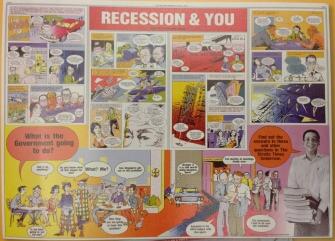 Since 1965, Singapore GDP had been growth at an average rate of 9.7% per year. It was the first time in 20 years that Singapore faced a major test when the recession hit with the growth shrunk to negative 1.7%.
The economy had shown significant decline in 1984, but the worst was in the second quarter of 1985, when the growth recorded a -10.1% on the year-on-year data. It was not until the early 1986 before Singapore slowly pulled itself out of the recession.
02-04 December 1985 – Pan-Electric Crisis
(Finance)
The Stock Exchange of Singapore (SES) was shut down, for a total of three days, for the first time in history after the collapse of Pan-Electric Industries (Pan-El). Pan-El had defaulted on a $7.5 million payment three weeks earlier, and was discovered to have owed as much as $453 million to 35 banks (its market capitalisation was $230 million during that time).
The stock was subsequently suspended from trading, and thousands of shareholders had their savings wiped out after its rescue plan failed. It was known as the Pan-Electric Crisis, which also caused the Kuala Lumpur Stock Exchange (KLSE) of Malaysia to shut down for three days. A series of new securities’ regulations was later introduced. In October 1986, Pan-El was officially wound up.
Harmonious Society (1986-1999)
15 March 1986 – New World Hotel Disaster
(Disaster)
Disbelief was shared by Singaporeans when news broke out that the six-storey Hotel New World Hotel at Serangoon Road collapsed. The tragedy claimed 33 lives.
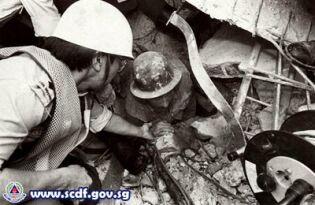 A national disaster, the Singapore Armed Forces (SAF), hundreds of volunteers and the Singapore Civil Defence Force (SCDF) worked hand in hand with specialist equipment to rescue the victims. They bravely faced a mammoth task in their attempt to save lives and clear the rubble. The rest of the nation gave help in any way they could: blood, food, money and care.
Companies voluntarily offered the use of specialist equipment worth thousands of dollars. Equipment such as the ultra-high pressure water machines that were able to blast through concrete without causing vibrations and 100-ton cranes to lift heavy concrete slabs facilitated the rescue efforts.
In the 7-day ordeal, People from different walks of life, races and nationalities responded as one. Public service organisations like the Red Cross and hundreds of ordinary Singaporeans came voluntarily and speedily to help. Staff of all the relief aid organisations looked after and alleviated the plight of the families of the victims.
14 December 1986
(Politics)
Then Minister of National Development of Singapore Teh Cheang Wan (1928-1986) committed suicide after allegations of corruption of SGD1 million by Corrupt Practices Investigation Bureau (CPIB).
14 May 1987 – McDonald’s Boys
(Crime)
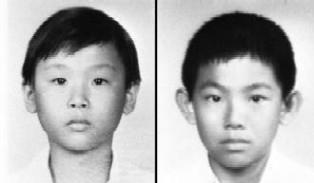 Where are the missing boys? Exactly a year earlier, 12-year-old schoolboys Keh Chin Ann and Toh Hong Huat had gone missing.
Despite a huge police search, a poster campaign, a $100,000 reward from McDonald’s and a feature on television’s Crime Watch program, nothing had emerged which would explain their disappearance.
The two Primary Six students of Owen Primary School were last seen on their way to school. The search for them was extended to Malaysia, Thailand and Indonesia, but proved to be fruitless after many years.
21 May, 20 June 1987 – Operation Spectrum
(Politics)
Accusing 22 Roman Catholic activists of plotting against the government, the Internal Security Department (ISD) carried out a swift arrest of these so-called Marxist conspirators.
 The details were never released by the government, while critics were doubtful and pointed out that the alleged detainees were mainly professionals, lawyers, social workers and actors, which hardly fit into the description of a typical political leftist.
Nine accused were arrested again a month later after they complained of mental torture during their detains without trial. Most of the detainees were released one or two years later.
18 December 1988
(Crime)
Lim Keng Peng, nicknamed Ah Huat, became Singapore’s most wanted criminal in 1988 when he shot dead Detective Goh Ah Khia at Upper Serangoon Road. He was gunned down at a kopitiam at Sunset Way by a submachine gun used by the police, ending a manhunt that lasted 30 months.
15 May 1990
(Crime)
A couple dating at the East Coast Park’s Amber Beacon tower at night was stabbed from behind by two masked men. James Soh Fook Leong survived the attack but his 21-year-old female friend Tan Ah Hong died from a deep wound near her neck. The assailants’ motives and identities were unknown, and the weapon used in the attack was never found. The case remains unsolved till this day.
29 May 1990
 (Others)
A family of three elephants was found on in the jungles of Pulau Tekong by national servicemen. They were captured and sent back to Johor.
A year later, another bull elephant made its way to Pulau Ubin across the Johor Strait.
26 March 1991 – Singapore Airlines SQ 117 Hijack
(Terrorism)
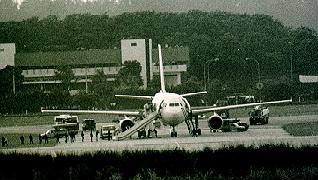 Singapore Airlines Airbus flight SQ 117 took off from Subang Airport in Kuala Lumpur with 129 passengers and crew on board when four Pakistanis took control of the plane, forcing it to land in Singapore at 10:15pm.
The hijackers wanted the release of former Pakistan Prime Minister Benazir Bhutto’s husband and other Pakistan People’s Party members detained in Pakistani jails.
Before the deadline at 6:45am after which they threatened to kill one passenger every ten minutes if their demands were not acceded to, elite Commandos stormed the plane, killing the four hijackers and freeing all 118 passengers and 9 crew. The rescue of SQ 117 was over in just 30 seconds and ended at 6:50am. None of the passengers and crew were hurt.
05 August 1993
(Accident)
MRT suffered its first major accident when an east-bound train hit a stationary train at Clementi station in the morning peak hours. Many passengers were flung aside or collide against the metal poles inside the train, resulting in 156 injuries. The accident was investigated to be caused by a large oil spill that affected the braking of the moving train.
28 February 1994
(Crime)
American teenager Michael Fay was sentenced to four months’ jail and four strokes of caning after being found guilty of vandalism, theft and mischief. The caning punishment received highly-publicised criticism from the West.
6 June 1994
(Crime)
Two Japanese tourists were robbed and assaulted in their Oriental Hotel rooms by 25-year-old Abdul Nasir bin Amer Hamsah and 32-year-old Abdul Rahman bin Arshad. One of the victims died from serious injuries. The two aggressors were caught in 1996 after Abdul Nasir attempted to rob a taxi driver. Abdul Rahman, by then, was already in prison after a theft case.
Both men were charged with murder, but Abdul Rahman’s charge was reduced to robbery with hurt and he was sentenced to 10 years’ imprisonment with 16 strokes of cane. For Abdul Nasir, the prosecutors could not prove his stamp on the victim’s face, that resulted in her death, was intentional. His murder charge was also reduced to robbery with hurt, and was sentenced to 18 years’ imprisonment and 18 strokes of cane.
During Abdul Nasir’s remand, he was, however, involved in another kidnapping case. For this crime, he was sentenced to life imprisonment of 20 years. Abdul Nasir appealed for the two sentences to run concurrently, so that he could be released after 20 years instead of 38 years. Chief Justice Yong Pung How adjudicated that life sentence would mean serving imprisonment until the end of a convict’s natural life, instead of 20 years. This change in the definition of life imprisonment became a landmark in Singapore’s legal history.
15 October 1994
(Crime)
Top nightclub mamasan Mona Koh was left paralysed after being ambushed by an unknown hitman at the ground floor lift lobby of Katong People’s Complex. She was hit by two bullets in the face and spine. The hitman was never caught.
8 March 1995
(Crime)
Known as the “Body Parts Murder”, British national John Martin Scripps killed a South African tourist Gerard George Lowe at River View Hotel. The body was dismembered and dumped at the Singapore River. The victim’s head and arms were never found. John Martin was arrested when he landed at Changi Airport on 19 March 1995. He had also murdered two tourists in Thailand.
On 19 April 1996, John Martin was hanged in Changi Prison. He was the first Briton to be executed in Singapore since independence.
July 1997
(Finance)
The Asian Currency Crisis struck, and the Singapore economy was not spared. Singapore dollar’s value dropped 20% while the Straits Time Index (STI) plunged 60%.
19 December 1997
(Disaster)
Singapore-bound SilkAir Flight 185 crashed into the Musi River at southern Sumatra, killing all of its 104 passengers and crew members. 46 Singaporeans died, including the pilot Captain Tsu Way Ming.
New Millennium (2000-Present)
13 February 2000
(Crime)
A 27-year-old female jogger was raped and murdered at Bukit Batok Reserve Park. The case remains unsolved.
31 October 2000
(Disaster)
First fatal crash of Singapore Airlines (SIA), SQ006 was destroyed in a failed takeoff at Taipei during a typhoon. A total of 83 passengers were killed.
December 2001
(Terrorism)
Plot to attack foreign embassies and Yishun MRT Station by terrorist group Jemaah Islamiyah (JI) was foiled by the authority. 37 were arrested and detained under Internal Security Act (ISA).
2 January 2002
(Crime)
A case known as “Orchard Towers Murder”, British expat Michael McCrea murdered his friends Kho Nai Guan and Susie Lan. The bodies were found in an abandoned car at Orchard Towers.
March 2003
(Public Health)
Singapore society and economy was hit hard by the outbreak of Severe Acute Respiratory Syndrome (SARS). Many stringent measures were imposed, but 33 in Singapore died.
18 March 2004
(Crime)
The Singapore Police was informed by the Royal Malaysia Police at about 8:45am on 18 March 2004 that they were pursuing three men on board a motorised sampan and the sampan had landed at Pulau Tekong. The men, 2 Indonesians and a Malaysian, were suspected to have earlier committed armed robbery in Johor.
The Singapore Armed Forces (SAF) and the Singapore Police Force (SPF) were immediately activated to conduct a joint search for the three persons on the island. Security measures had also been stepped up on the island and all military trainings on the island had been temporarily suspended to facilitate the search operations.
All three were caught within 3 days and were charged with illegal entry and possession of firearms.
20 April 2004 – Nicoll Highway Collapse
(Disaster)
A tunnel at Nicoll Highway, constructed as part of the SMRT Circle Line, collapsed when the supporting structure gave way, killing four people and injured three. Three days of rescue efforts were carried at the 30m-deep cave-in, which triggered a series of investigations and probes. The construction was halted for almost eight months, and the man-in-charge, project director Ng Seng Yoong, was fined $8,000 for negligence.
10 October 2004
(Crime)
Malaysian Took Leng How admitted to the murder of Chinese girl Huang Na after her body was found dumped at Telok Blangah Hill.
16 June 2005
(Crime)
Leong Siew Chor was found guilty of murdering Chinese national Liu Hong Mei in what was later known as the “Kallang body parts murder”. After killing the victim, Leong chopped up her body into seven parts and dumped the pieces into Kallang River. He was hanged in 2007.
7 Sept 2005
(Crime)
29-year-old Filipino maid Guen Garlejo Aguilar murdered her good friend Jane Parangan La Puebla at her employer’s condominium SunGlade at Serangoon Avenue 2. Quarreling over money matters, Guen Garlejo Aguilar suffocated the 26-year-old victim and dismembered her body. Two days later, she dumped the body parts near Ochard MRT Station and Lornie Road.
Diagnosed with depression, Guen Garlejo Aguilar was charged with manslaughter and sentenced to 10-year imprisonment.
2 December 2006
(Crime)
Tan Chor Lin, nicknamed “One-Eyed Dragon” shot nightclub owner Lim Hock Soon five times in a Serangoon flat. He was later sentenced to death.
27 February 2008 – Mas Selemat Escape
(Terrorism)
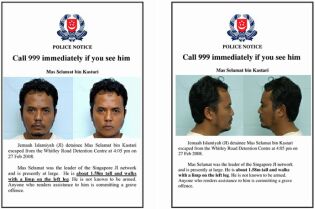 Mas Selamat Kastari, leader of Jemaah Islamiah (JI) terror network, is one of Singapore’s most wanted terrorist. He was involved in plans to attack Yishun MRT station and United States naval vessels in Singapore.
In early 2006, he was arrested in Malang and was deported to Singapore, detained under Internal Security Act. However, on 27 February 2008, Mas Selemat escaped from Whitley Road Detention Centre, sparking nationwide manhunt. The Malaysian authorities revealed later that after his escape, he swam across Johor Strait and hid in Kampung Tawakal in Skudai. Malaysia says he hatched plans to bomb targets in Singapore and Malaysia after fleeing.
In 2009, after a year of escape, Malaysian police raided his hideout in Kampung Tawakal and captured him. The news is not made public (shortly after capture, Malaysia informed Singapore but asked that the matter be kept quiet) until May 2009.
Finally in September 2010, Mas Selamat was handed over to Singapore, prompting detailed investigation of his escape.
18 September 2008
(Crime)
A shocking murder case occurred in a Yishun flat in which three were killed and one was left with serious injuries.
45-year-old China national Wang Zhi Jian stabbed her girlfriend Zhang Meng multiple times after a quarrel. When the latter’s daughter Feng Jian Yu woke up from her sleep after hearing the cries, Wang Zhi Jian proceeded to stab her as well. Both women died from their injuries. Wang Zhi Jian then entered a second room to attack another pair of mother-and-daughter, who were staying in the same unit. The mother Yang Jie was forced to escape through the kitchen window but fell to her death, while her daughter Li Mei Lin, the only survivor of the killing frenzy, was injured badly.
Wang Zhi Jian, who arrived at Singapore for only 10 days before he committed the horrific murder, was sentenced to death in 2012 after a four-year trial.
September 2008
(Finance)
Due to the subprime crisis in the United States, Singapore became the first Asian nation to enter recession as STI plunged more than 30% in a couple of weeks.
15 December 2009
(Crime)
Romanian diplomat Dr Silviu Ionescu hit three pedestrians at Bukit Panjang, causing the death of Tong Kok Wai. Ionescu was suspected of drunk-driving and hit and run. He escaped from Singapore three days later.
25 June 2010
(Crime)
Swiss Oliver Fricker became the highest-profiled foreigner since 1994 to receive caning after he trespassed SMRT Changi depot and vandalised two train carriages.
15 and 17 December 2011
(Others)
The North-South line of SMRT was hit by major disruptions for several hours due to track faults. More than 200,000 commuters were affected and thousands were stranded in the tunnels.
12 May 2012
(Accident)
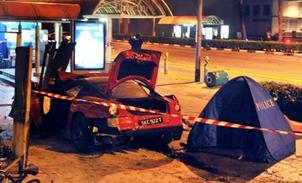 China national Ma Chi, 31, sped in his Ferrari and beat the red-lights at Victoria Street in the wee hours of Saturday morning, resulting in a horrific collision with a taxi and motorcycle. The taxi driver Cheng Teck Hock and his passenger Shigemi Ito died in the crash, along with Ma Chi. Another two were injured.
The shocking accident also sparked off strong anti-foreigner sentiments from Singaporeans, who were increasingly unhappy with the massive influx of foreigners in recent years.
10 July 2013
(Crime)
In the criminal case popularly known as Double Kovan Murder in the media, senior police staff sergeant Iskandar Rahmat, 34, was charged for murdering workshop owner Tan Boon Sin, 66, and his 42-year-old son Tan Chee Heong at their Hillside Drive terrace house.
The case is still pending.
9 August 2013
(Accident)
A 36-year-old speeding driver, under the influence of alcohol and medicine, crashed into five people at the shoulder lane of the Central Expressway (CTE), near Yio Chu Kang Road exit, at 4am. The victims were changing a punctured tyre. The accident resulted in four deaths, including three Koreans. In 2015, the driver was sentenced to five years’ jail and banned from driving for 20 years.
08 December 2013 – Little India Riot
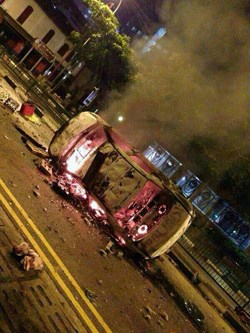 (Social Unrest)
A riot involving about 400 South Asian foreign workers broke out at 9.30pm after a bus knocked down and killed an Indian national at the junction of Race Course Road and Hampshire Road. An ambulance was set on fire, while several police cars were overturned and burnt. Bottles, stones and rubbish bins were hurled, resulting in at least 18 injuries, including police officers and Singapore Civil Defence Force (SCDF) personnel. More than 30 were arrested for rioting with dangerous weapons.
It was Singapore’s first major riot in more than 40 years.
13 April 2015
(Crime)
How could anyone be capable of such monstrosities? It was a question many Singaporeans asked when they read this horrific crime.
On 13 April 2015, Annie Ee Yu Lian, an intellectually disabled 26-year-old waitress, was found dead in a Woodlands flat. She had been subjected to abuses by a couple whom she regarded as “elder brother” and “sister”.
For eight months, the pair tortured the victim by beating her with slippers, belt, dustbin, bamboo stick and a shrink wrap. The abuses caused her to suffer from 12 broken ribs, 7 fractured vertebrae, a ruptured stomach and a body covered with bruises and blisters. Annie Ee Yu Lian was also forced to surrender her entire paycheck, in return for a meagre allowance.
In December 2017, Tan Hui Zhen and her husband Pua Hak Chuan were sentenced to 16.5 and 14 years’ jail term respectively. Pua Hak Chuan was also given 14 strokes of the cane.
23 April 2018
(Accident)
A lorry recklessly slammed and killed three pedestrians along Ang Mo Kio Avenue 6, opposite Yio Chu Kang MRT Station. The driver, 28-year-old permanent resident Xu Kai Xiang, was driving the lorry without a valid Class 3 license. He was fined $1,400 and banned from driving for a year. It was reported that he has congenital heart disease that could lead to blackouts. Following the accident, the Traffic Police reviewed the certification process of people fit to drive.
January 2020-13 February 2023 – Covid-19 Pandemic
(Public Health)
As China fell into the turmoil of Covid-19 outbreak, the rest of the world could not prevent the spread of the pandemic, declared by the World Health Organisation (WHO) on 11 Mar 2020. For Singapore, the first confirmed case occurred on 23 January when an infected Chinese national from Wuhan flew into Singapore. As more cases surfaced, Singapore’s Disease Outbreak Response System Condition (DORSCON) level was raised from Yellow to Orange on 7 February 2020. On 21 March 2020, Singapore reported its first Covid-19 fatality.
By early April 2020, there were more than 1,100 confirmed cases and six deaths. The Singapore government announced a one-month “circuit breaker” on 3 April 2020, where all non-essential workplaces and services would be halted until 4 May 2020, in a bid to slow down the community and asymptomatic spread. Doses of vaccination were rolled out to all residents from December 2020 onwards.
After more than 2 years, as the global and local pandemic situation gradually stabilised, Singapore lowered its DORSCON level from orange to yellow on 26 April 2022. It was eventually reverted to green on 13 February 2023 as Singapore adopted an endemic Covid-19 new norm. Most of the restrictions were lifted, such as the wearing of masks in public transport, use of TraceTogether and SafeEntry apps, and proofs of negative pre-departure Covid-19 tests by incoming travellers.
13 February 2021
(Accident)
Five men, aged between 26 and 29, were killed when the BMW they were in crashed into one of Tanjong Pagar Road’s shophouses and burst into flames. A woman was severely burnt when she tried to save her boyfriend from the burning car.
19 July 2021
(Crime)
Singapore was shaken by the news of a vicious assault at River Valley High School, when a 16-year-old teenager killed a fellow 13-year-old schoolmate with an axe. The boy was charged with murder and has been in remand since the shocking incident.
15-16 August 2023
(Crime)
The Singapore Police Force (SPF) carried out one of its largest anti-money laundering operations, arresting 10 foreigners who had amassed about $1 billion worth of assets in Singapore, including high-end properties, luxury cars and expensive watches and merchandises. Originated from Fujian, China, these foreigners, holding different nationalities, were charged for frauds and money laundering of proceeds from their overseas criminal activities such as scams and online gambling.
Published: 24 January 2011
Updated: 13 February 2024

















 Remember Singapore