The seventies and eighties saw the rise of Singapore’s public swimming complexes. In almost every new town developed, there was one public pool to serve the residents. In the 20 years between 1970 and 1990, more than a dozen public swimming complexes were built at the heartlands.
Other than Bedok Swimming Complex, the other public swimming complexes built in the period of the seventies and eighties were at Queenstown (opened in 1970), Toa Payoh (1973), Katong (1975), Buona Vista (1976), Geylang East (1978), Delta (near Henderson, 1979), Paya Lebar (1981), Bukit Merah (1982), Ang Mo Kio (1982), Kallang Basin (1982), Clementi (1983), Yio Chu Kang (1986), Hougang (1987), Yishun (1988), Bukit Batok (1988) and Tampines (1989).
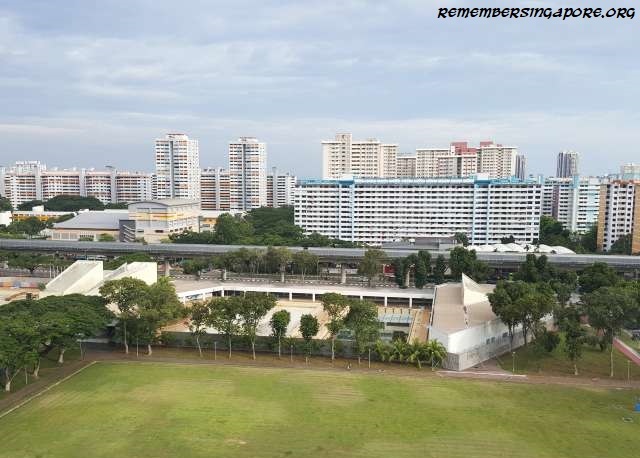
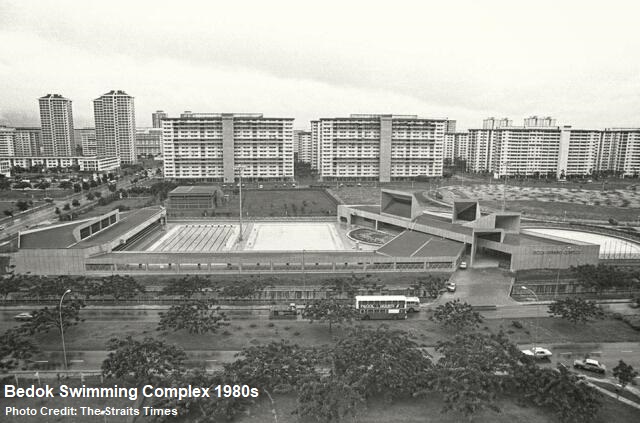
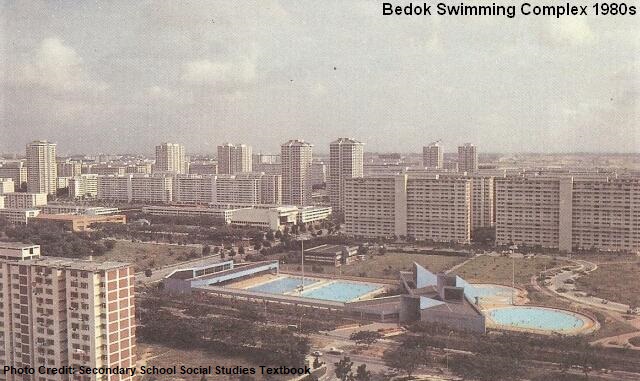
Opened in late 1981, Bedok Swimming Complex had four swimming pools – one competition pool and three used for training, wading and practice. The charges were at 60c and 30c for adults and those below 18 years old respectively for a two-hour swim.
In the early eighties, Bedok Swimming Complex was one of the most popular public swimming facilities in Singapore, with about 2,500 visitors daily. It was also one of the earliest in the country to install ticketing machines for payment of entry fees, a pilot scheme initiated in 1982 by the Singapore Sports Council (SSC).
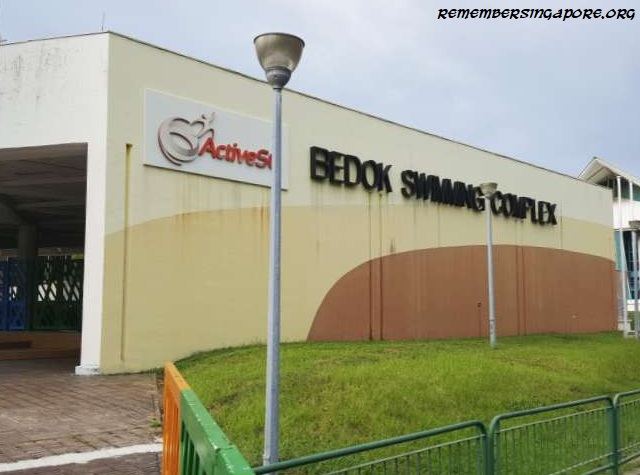
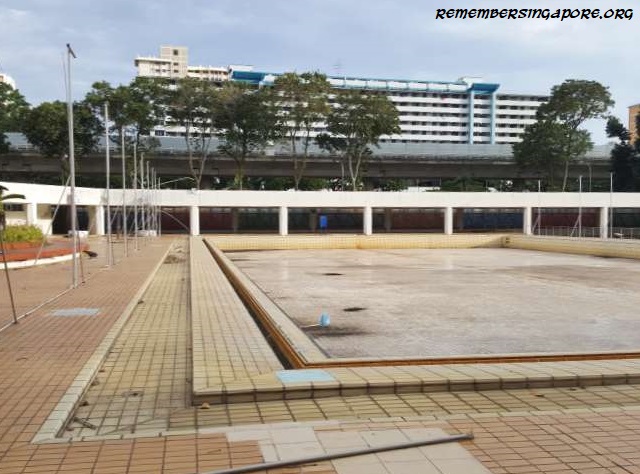
The architectural design of Bedok Swimming Complex did not follow the conventional rectangular shape. Instead, Bedok Swimming Complex, when viewed from the top, had a trapezium shape, and its buildings had roofs in the shape of prisms. Similarly, the Ang Mo Kio Swimming Complex, also built in the early eighties, has buildings with roofs designed in triangular prism shapes.
The design of Bedok Swimming Complex won, in 1983, the outstanding design award at the Singapore Institute of Architects, along with six other Housing and Development Board (HDB) projects – the Zhujiao Centre (later renamed Tekka Centre), Rowell Court, Bedok Town Area Office, Jurong Mosque, Bukit Merah Town Centre and Ang Mo Kio New Town.
In the late eighties, Bedok Swimming Complex was one of the four swimming complexes used for training local sportsmen with potential to represent Singapore in swimming, diving and water polo. It was also one of the public swimming complexes where the National Family Swim was held. In 1997, despite the hazy condition, the mega event, flagged off by Minister of Community Development Abdullah Tarmugi, attracted more than 25,000 participants in more than a dozen pools.
A number of public swimming pools had closed in recent years. Yan Kit Swimming Complex (1952-2001), Jurong Town Swimming Complex (built by Jurong Town Corporation (JTC), 1970-mid-2000s), Boon Lay Swimming Complex (mid-1970s-mid-2000s), Buona Vista Swimming Complex (1976-2014), Pandan Gardens Swimming Complex (1978-early-2000s) and Paya Lebar Swimming Complex (1981-2007) were either demolished or redeveloped for other usages.
The new public swimming facilities at Bedok are currently located at the Sport Centre at the integrated community hub Heartbeat@Bedok, opened in February 2018.
Published: 30 August 2018
Discover more from Remember Singapore
Subscribe to get the latest posts sent to your email.






 Remember Singapore
I have a fascination with Bedok before earth was moved to reclaim Marine Parade. Photos and descriptions of the landscape from that time would be grate. Siglap Hill and the hill that is Chai Chee avoided ending up in the sea because the area was already somewhat developed by the time reclamation started?
Totally gone already
So sad ..I remembered I took SWIMMING course . All my MEDALS ..BADGES..AWARD
.LIFE SAVING..ALL THE COURSES I TOOK.JUST NAME IT..I AM SO THANKFUL WIF ONE N ONLY E BEST COACH IN UNIVERSE..HE MADE A TALENTED N TOUGH SWIMMER.IF NOW I HV E CHANCE TO C HIM..I WILL HUG HIM N CRY..AND SAY….COACH Y U LEAVE ME AND LEFT WITH A DIFF POOL.. THAT’S OUR MEMORY.EVERY I PRAY ..TO C HIM AGAIN..HIS IS MUSTAFA..COACH..MUS..I REALLY WANT TO C HIM
Plans to redevelop Bedok Stadium being studied
20 May 2024
The Straits Times
The authorities are studying the potential redevelopment of Bedok Stadium, the only stadium in the east operated by national sports agency Sport Singapore (SportSG).
At an ongoing roving exhibition for the Urban Redevelopment Authority’s (URA) upcoming recreation masterplan, URA said “plans are being studied to redevelop and refresh Bedok Stadium for easties to get active with even more diverse community and sport offerings”.
The authorities’ plans to potentially redevelop the stadium were presented from May 11 to 19 at one of the exhibition’s stops at Bedok Town Square, which showcased plans for the east region.
Asked for more details about the plans, such as when the studies will be completed and what a redeveloped stadium may include, SportSG and URA told The Straits Times on May 18 that the agencies are seeking public feedback on “possible future recreational facilities and exploring various opportunities for the east region, including Bedok Stadium”.
“More details can be shared only when ready,” they said.
The stadium is part of Bedok Sports Complex, which opened in stages from the early 1980s.
Heartbeat@Bedok, a nearby integrated development that opened officially in 2018, took over many of the complex’s public sporting functions.
Heartbeat@Bedok houses several facilities run by SportSG, such as a gym, a swimming complex, a tennis centre and a sports hall for activities such as badminton.
What remains at the sports complex’s original location in Bedok North Street 2 are the stadium, a tennis centre that takes only corporate bookings and three blocks.
One of the blocks – the old Bedok Sports Hall (Block 3) – houses the Singapore Weightlifting Federation, the Wrestling Federation of Singapore and the Singapore Boxing Federation.
Block 7 is occupied by the Singapore Wushu Dragon and Lion Dance Federation and the Singapore Taekwondo Federation. Block 5 is empty.
Also part of the sports complex was Bedok Swimming Complex, which was demolished after it closed in July 2017. Six new basketball courts – two sheltered and four outdoor – are slated to open on the site later in 2024.
While URA and SportSG did not say where the stadium, if redeveloped, may be sited, URA’s 2019 masterplan indicates that a site of about 3.4ha – where the tennis centre and the upcoming basketball courts sit – is zoned for sports and recreational use.
Meanwhile, the 7ha site that the stadium and the three blocks now occupy is zoned for residential use, with a gross plot ratio of 3.5. Gross plot ratio refers to the amount of development permitted for a site.
Architectural historian Yeo Kang Shua, a Bedok resident who runs at Bedok Stadium, noted that it is the only public sports facility in the east with an eight-lane running track, making it a popular venue for schools hosting their track and field days.
Hence, redeveloping the stadium may inconvenience many schools, said the 48-year-old, adding that the absence of running track options in the area also makes the stadium popular with the public.
Geotechnical supervisor Jasim Uddin, 35, commutes weekly to the stadium from Kaki Bukit, where he lives, to do interval training at the track.
He said that given the lack of eight-lane tracks in the east, Bedok Stadium is one of only two training venues for him – the other being the Singapore University of Technology and Design in Upper Changi.
“Just increasing the number of shower facilities and toilets will do at the current stadium.”
He added that should redevelopment be pursued, a sheltered running track – like the one at the National Stadium in Kallang – would allow him to continue training on rainy days.
Mr Fa’iz Malik, who runs at Bedok Stadium once or twice a week, hopes that the stadium will not lose the eight-lane track as the former Tampines Stadium did when it made way for integrated development Our Tampines Hub.
Mr Fa’iz, who works in sport events management, said the Tampines facility’s partially sheltered running track is not suited to the needs of many athletes because of its irregular shape and length.
The 39-year-old added that if refurbishment is done instead of redevelopment, the grandstand at Bedok Stadium – which he said has become rundown – could be spruced up and made wheelchair-accessible.
Dr Yeo hopes the authorities will consider conserving the old, hexagonal-shaped Bedok Sports Hall, if the site is redeveloped.
The building, he said, has a unique structure, achieved by having four pairs of inclined columns at each of the hall’s six corners.
Dr Yeo noted that the hall is the third Housing Board-built indoor sports hall, with the first in Toa Payoh being redeveloped into an integrated development, and the second at Delta Sport Centre, which reopened in 2023 after a revamp.
Photographer Gareth Phua, a Bedok resident since the 1990s, said redeveloping the stadium is likely to “change the feel of Bedok”.
Mr Phua, 53, who documented Bedok Swimming Complex on the last day of its operations and its subsequent demolition, said Bedok Sports Complex had facilities spread over a wide area, such that its structures were “not humongous and not imposing” in the way that integrated facilities such as Heartbeat@Bedok appear to him.
He hopes an eight-lane track will still feature in the stadium if it is redeveloped.
“Nothing can replace running around on an open field or on the track, and there is only that much you can do on a stair-climbing machine or stationary bike,” he added.
Mr Fa’iz noted that it is also popular with many seniors who gather for morning exercises.
Shortly after its opening, the stadium was one of six locations for decentralised National Day celebrations in 1983.
Besides Bedok Stadium, URA also wants ideas for the Paya Lebar Air Base (PLAB) site and the Long Island project off East Coast.
Citing the former Stapleton airport in Denver, Colorado, which has been repurposed into an entertainment venue and brewery, a panel at URA’s exhibition said PLAB’s terminal and control tower could be used as a bowling alley, arcade and restaurant, or even an aviation-themed brewery.
Ideas to repurpose a train shed at Changi Depot for temporary community uses are also being sought, with URA showing examples of other projects overseas, such as the Hin Bus Depot in Penang and Carriageworks in Sydney, both used as arts spaces.
https://www.straitstimes.com/singapore/plans-to-redevelop-bedok-stadium-being-studied