In the past, the area along Havelock Road, between Zion Road and Delta Road, was colloquially known as orh kio tau (乌桥头) by the local Chinese. The name, literally “black bridge head” in Hokkien and Teochew, means “starting from the black bridge”. Bukit Ho Swee, or hor zhwee sua (河水山), was on the other side of Havelock Road.
Pipeline Arch
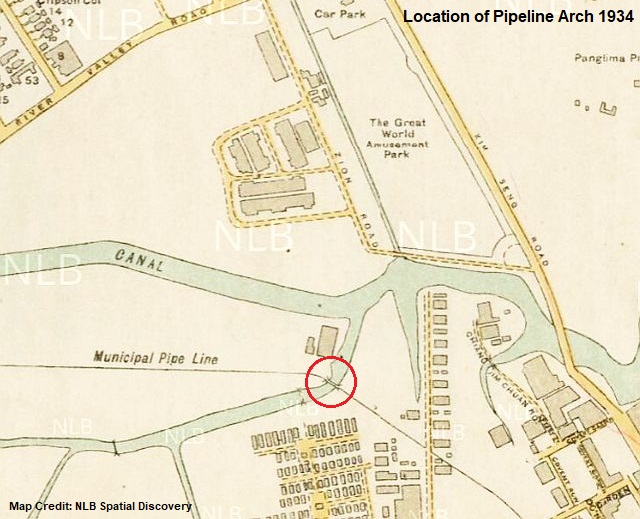
The name “black bridge” was likely derived from a pipeline arch near Havelock Road, where the Municipal Commission had acquired lands in 1925 for the laying of the Woodlands Singapore Pipelines. Singapore River’s multiple distributaries ran through this area, making it swampy and prone to flooding during downpours.
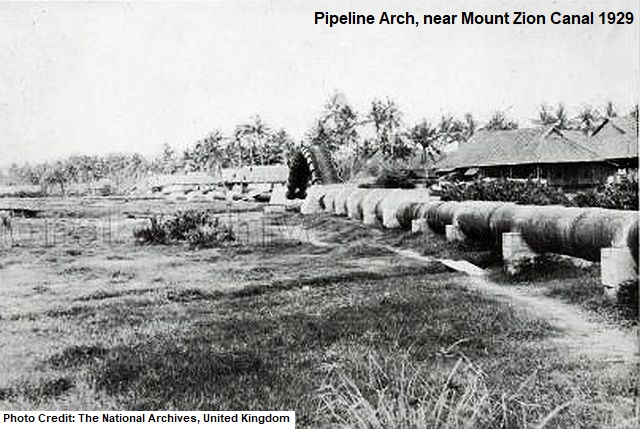

A pipeline arch was constructed over one of the river distributaries in the late 1920s. It was painted black and became an obvious landmark, which probably led to the locals referencing it as the name of this area. It was called a “bridge” because the curved dual pipeline had handrails and walking deck installed to allow people to use it for crossing the stream.
Mount Zion
To alleviate the frequent flooding, a Mount Zion Canal was built in the area in the 1920s. The Municipal Commission routinely carried out dredging to maintain the canal’s drainage efficiency. The dredging process, usually strenuous hand dredging by labourers, would cost the government about $2,700 annually.

Mount Zion Canal and Zion Road (formerly Mount Zion Road, first appeared in the maps in the 1890s) were named after Mount Zion, a small knoll between River Valley Road and Singapore River. Mount Zion was possibly named by the Keasberry’s Missionary, which referenced it after a biblical mountain in Jerusalem and had built a school at this place in the mid-19th century.
Despite its name, Mount Zion was only 45.4 feet (or 13.8m) tall, as listed in the 1848 report by John Turnbull Thomson (1821-1884), the Straits Settlements’ surveyor from 1841 to 1853. Today, the name Mount Zion has ceased to exist in Singapore, with Zion Road the remaining reminder of this forgotten name.
“Coloured” Bridges
The old colloquial names were often derived and associated with the colours of the landmarks, which were easily identifiable and understood by the local Chinese who might not be familiar with the English names of certain places and roads.
Below are some of the examples of “coloured” bridges:
- ang kio (“red bridge”) refers to a small road bridge with red railings across the Rochor Canal at the junction of Norfolk Road and Kampong Java Road.
- ang kio tau (“red bridge head”) refers to Balestier Road, near its junction with Thomson Road.
- pek kio (“white bridge”) refers to a road bridge with white railings across the Rochor Canal at the junction of Dorset Road and Keng Lee Road.
- cheanh kio (“green bridge”) refers to Ord Bridge across the Singapore River.
- orh kio (“black bridge”) refers to a former dark wooden bridge across Sungei Whampoa between Ah Hood Road and Toa Paypoh.
Orh kio should not be confused with orh kio tau.
SIT Estates
During the Second World War, the Japanese had built a prisoner-of-war (POW) camp at Indus Road for the imprisonment of Indian POWs. After the war, the British took over the camp and used it to detain the Japanese POWs instead. The Japanese POWs were then used as free labour to build infrastructure and clean up the streets and drains before they were eventually deported back to Japan at the end of the 1940s.
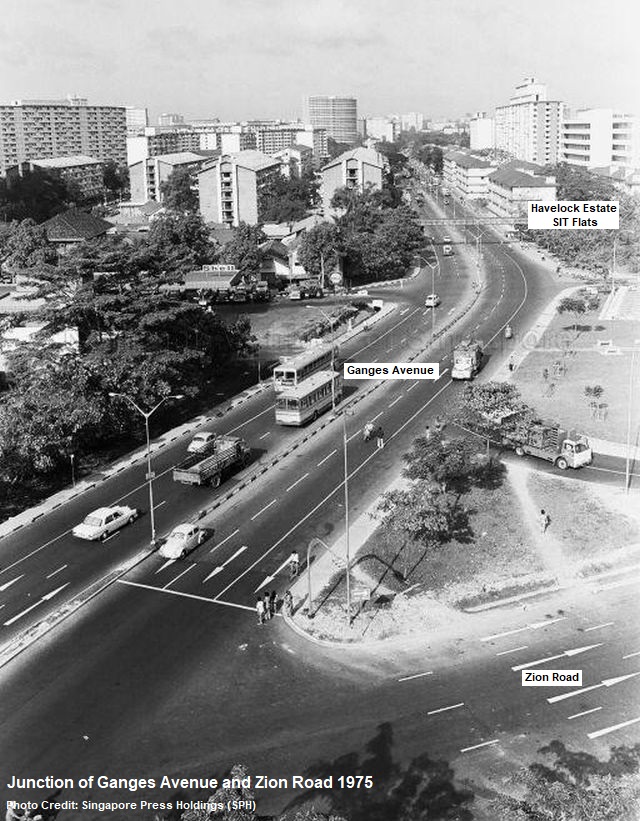
In the early fifties, the Municipal Commission carried out another flood alleviation plan at orh kio tau. The swamps in the area were filled and the several Singapore River’s distributaries were diverted and consolidated into the new Alexandra Canal. The pipeline arch lost its bridge function as the stream under it dried up.
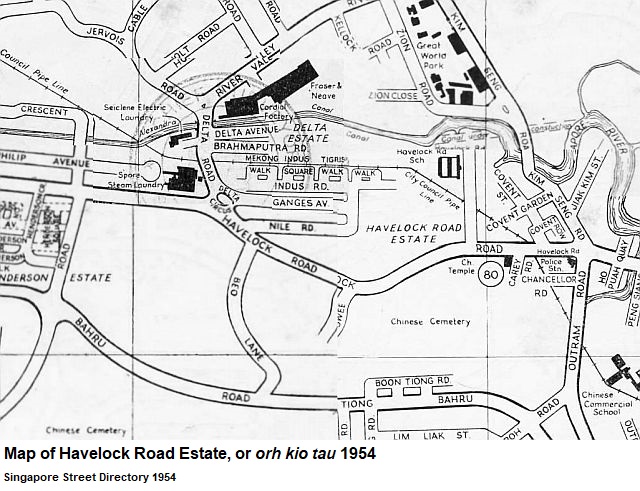
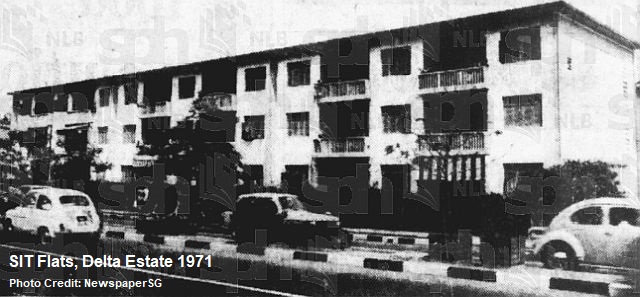
After reclaiming the area, the site was developed by the Singapore Improvement Trust (SIT) into a small housing estate called Havelock Estate (or Havelock Road Estate). Costing $2.5 million in construction, the estate was made up of 10 blocks of four-storey two-bedroom flats and artisan quarters, reserved specially for workmen and artisans.
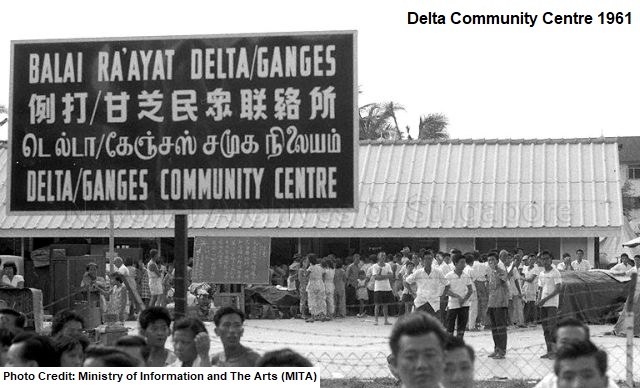
Almost 3,000 residents lived in Havelock Estate in the fifties. The neighbouring Delta Estate was another SIT housing estate with 16 blocks of SIT flats built along Ganges Avenue, housing about 6,000 residents. Two community centres, Havelock Estate Community Centre and Delta Community Centre, were set up to serve the residents of both estates, which would later be merged to become Havelock-Delta Estate in the seventies.
Three schools were established within the estates. They were the Havelock Road School, Delta East School and Delta West School. Havelock Road School was later renamed Havelock Primary School, and Delta East and West Schools became Delta East Primary School and Delta West Primary School respectively.
The three primary schools were merged in 1985 to become Delta Primary School, but this new primary school would last for only five years before it walked into history in 1990 due to declining student enrolment. After its merger into Delta Primary School, Havelock Primary School’s old premises was converted into the headquarters for the Boys’ Brigade from 1985 to 2022.
Here is a rare Chinese newspaper article published in 1990 about the pipeline arch. In the article, the author reminisced his younger days playing with his friends at the pipeline arch. It was also a place where lovers dated. In his memories, an old Indian and his herd of cattle would come and pass under the pipeline arch every evening.

Beside the flats and public amenities, there was also a thriving light industry at orh kio tau. Rice mills and sawmills could be found here. There were various factories producing garment, biscuit, peanut oil, cuttlefish and tongkangs.
Adrian’s Cane, a local cane furniture company popular with overseas buyers, had a production workshop set up in the area. But the factories most familiar to the locals were the large soft drink manufacturers of Fraser & Neave (F&N), Coca Cola and Pepsi Cola.
Bukit Ho Swee Fire
On 25 May 1961, the residents living in the area were struck with one of the worst fire disasters in Singapore history. Started from Tiong Bahru Road and spreading across Bukit Ho Swee by the strong winds, the inferno rapidly burned towards the orh kio tau area, reaching Havelock Road and Delta Estate. It was only slowed down by the wide Ganges Avenue, which acted as an effective firebreak and allowed more time for the firemen to fight the blaze.
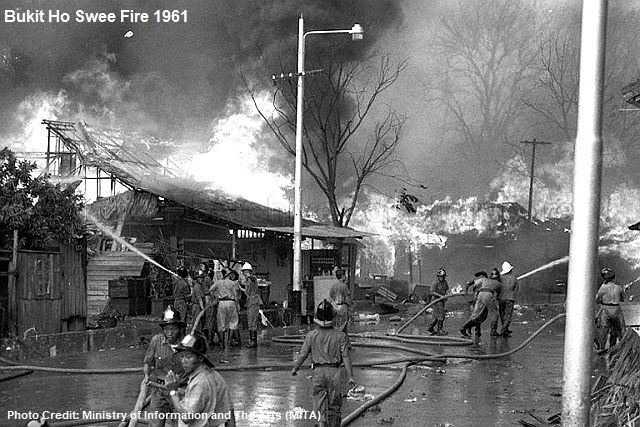
In the end, the Bukit Ho Swee Fire destroyed hundreds of buildings, including wooden kampong houses, shophouses, workshops and factories. Four people were killed and an estimated $2 million worth of property had gone up in smokes. Almost 16,000 villagers were left homeless.
To relocate the affected families, the government quickly pushed forward the completion of low-cost Housing and Development Board (HDB) flats at Queenstown, Tiong Bahru and Kallang. Several of the emergency-type flats were built at Delta Estate. By February 1962, within nine months from the disaster, all affected families of Bukit Ho Swee Fire had been rehoused.

Bukit Ho Swee was redeveloped into a HDB housing estate in the sixties, while the opposite Havelock-Delta Estate was mixed with old SIT and new HDB flats. These initial batches of HDB flats were not the best quality and were eventually torn down to make way for newer and better HDB flats (Block 77 to 79 of Indus Road built in the mid-seventies, and Block 1 to 5 of Delta Avenue in the mid-eighties). The remaining SIT flats were gone by the late eighties.
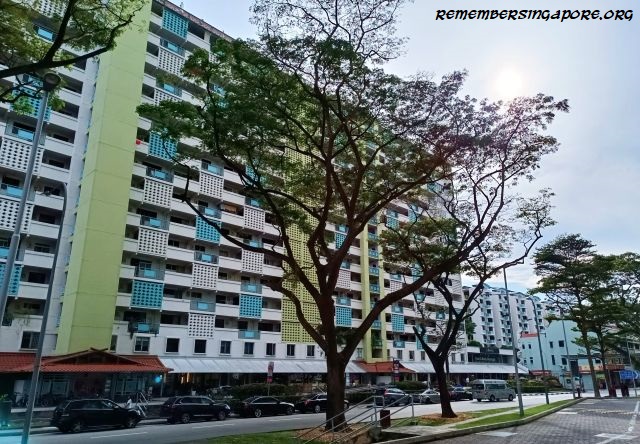
Block 22 of Havelock Road, nicknamed chup lark lau (“sixteen floor” in Hokkien), is one of the oldest HDB flats at orh kio tau today. It was completed in around 1963, as part of Jalan Klinik’s cluster of flats. Block 22’s neighbouring flat, Block 29, which had the similar 16-storey design and façade, was demolished back in 2013.
Crimes and Pollution
Orh kio tau and hor zhwee sua were notoriously known as gangster strongholds since the fifties. There was a lack of police presence and adequate street lights in these areas, which made it unsafe for the residents to go out at night. The 24, 08 and 36 secret society groups roamed the streets, where fights frequently broke out between parang-yielding rival gangs. In 1954, a youth gang, which labelled themselves “9999 Gang”, was involved in many cases of theft, extortion and harassment to the residents.
On the New Year’s Eve of 1954, Guok Sin Inn, general manager of Hock Lee Bus Company, was shot and killed by gunmen in his office at Delta Road, shocking the residents of nearby estates.
Orh kio tau remained crime-infested for the next two decades. In the seventies, it was a hotspot where pirate taxis, illegal gambling dens and gangsters gathered. Delta Estate was reported to have a crime rate second only to Toa Payoh.
Along the Havelock-Delta Estate, the Alexandra Canal was constantly polluted and clogged with household garbage such as plastic bags, bottles, rusty tins and even old pillows dumped by the residents, making the canal’s water murky and foul-smelling and posing a serious hygienic problem.
Shaping the Roads
The roads at orh kio tau underwent several changes in the seventies and eighties. It once had a small network of roads that were named after the famous rivers of the world. These roads were Mekong Walk, Tigris Walk, Brahmaputra Road, Indus Road, Indus Square, Nile Road and Ganges Avenue.
|
Street Name |
Named After |
Description |
|
Brahmaputra Road |
Brahmaputra River |
A 3,969km-long trans-boundary river that flows through Tibet (China), India and Bangladesh |
|
Ganges Avenue |
Ganges River |
A 2,525km-long trans-boundary river that flows through India and Bangladesh |
|
Indus Road, Indus Square |
Indus River |
A 3,120km-long trans-boundary river that flows through Tibet (China), India and Pakistan |
|
Mekong Walk |
Mekong River |
A 4,909km-long trans-boundary river that flows through China, Myanmar, Laos, Thailand, Cambodia and Vietnam |
|
Nile Road |
Nile River |
A 6,650km-long trans-boundary river that flows through Egypt, Sudan, South Sudan, Ethiopia, Uganda, Democratic Republic of the Congo, Kenya, Tanzania, Rwanda, Burundi |
|
Tigris Walk |
Tigris River |
A 1,900km-long trans-boundary river that flows through Turkey, Syria and Iraq |
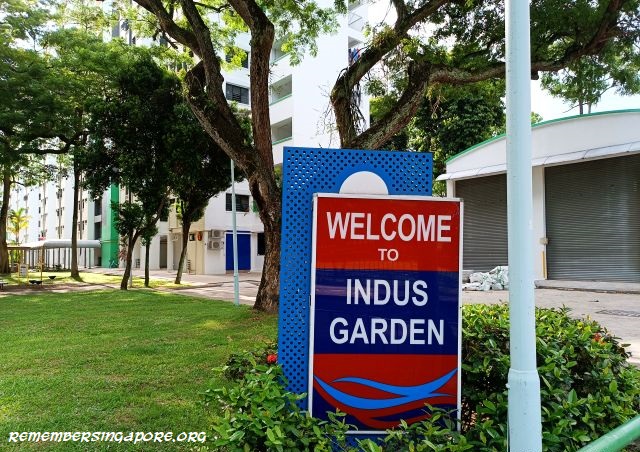
Mekong Walk, Indus Square and Tigris Walk were expunged in the early seventies to make way for the new HDB flats (Block 77 to 79) built at Delta Estate. This little housing estate is now known as the Indus Garden.
Brahmaputra Road was removed when the Delta Avenue HDB flats (Block 1 to 5) were built between 1983 and 1985. Nile Road was expunged in the late 2000s for new HDB flats under Havelock View.
Only Indus Road and Ganges Avenue remain today.
Ganges Avenue was extended across orh kio tau in the early seventies to link directly with Kim Seng Road. Zion Road was also lengthened in the mid-seventies, with a road bridge built over the Alexandra Canal, to form a junction with Ganges Avenue. Both Zion Road and Kim Seng Road were switched to single-way traffic looping the former site of tua si gai (Great World Amusement Park).

Orh kio tau used to be the terminus for bus service 9 of the Singapore Traction Company (STC) in the fifties. This bus service would ply the daily route between Havelock Road and Lau Pa Sat.
After STC ceased operations in 1971, the new Singapore Bus Services (SBS) became the main public bus operator in Singapore. The orh kio tau area was then served by SBS bus service 139. Another bus service 5, under the Trans-Island Bus Services (TIBS), was added along Havelock Road in the eighties.
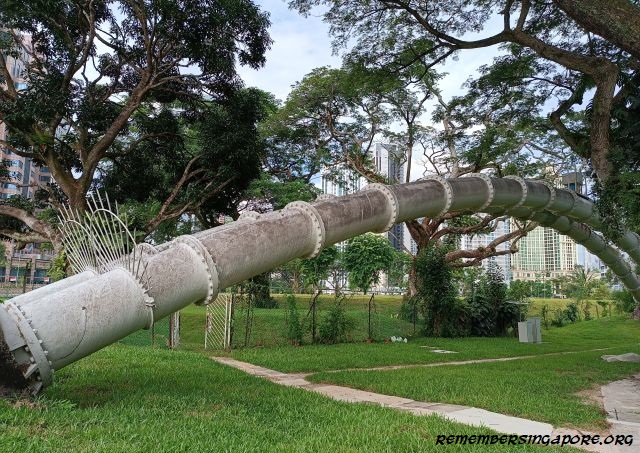
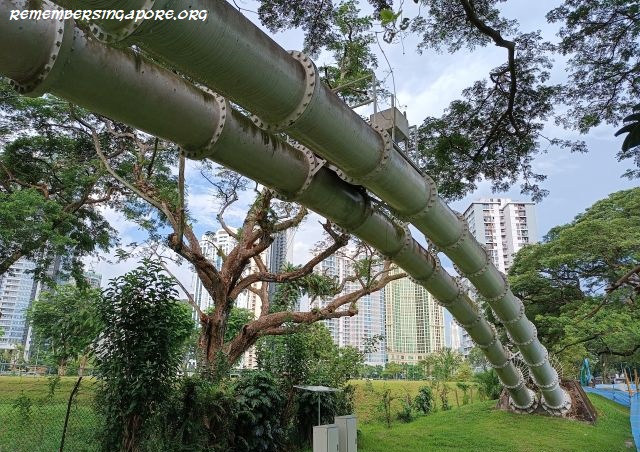
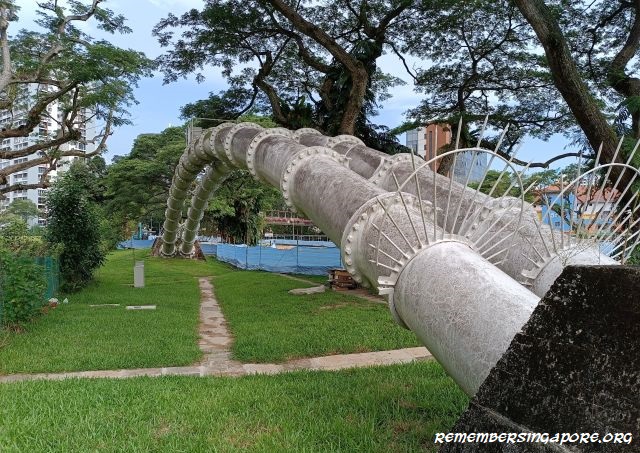
The pipeline arch is still around today, although it has since been repainted white. There are no more streams and swamps in the area, so it no longer serves as a bridge and its handrails and deck were removed many decades ago. The “black bridge” does not exist anymore, but the name orh kio tau still resonates among the older Singaporeans.
The pipeline arch is now a forgotten structure that still quietly performs its primary function; that is to convey water from one point to another.


Published: 19 September 2023
Updated: 20 September 2023
Discover more from Remember Singapore
Subscribe to get the latest posts sent to your email.






 Remember Singapore
I find it interesting that it still remains, most of the other sections of the pipeline seems to be underground now. It would be interesting if the open space around ganges ave is converted to a park and this portion marked as historically significant lol. Also, I think I see another curved pipeline across the Alexandra canal at Kellock Road; a short distance away on satellite imagery.
Hi, very interesting read. However, Blk 22 Havelock Road was completed in 1964, as one published research paper by a Singaporean historian put it. I live there and I’m much into the history of that area. https://nuspress.nus.edu.sg/products/squatters-into-citizens
Hi Adam, thanks for pointing out this. You are right, although I’d put its completion a year earlier in 1963.
The HDB infoweb states that Block 22’s 99-year lease started in 1969 (might be due to its first few years as a rental block), whereas the Jalan Klinik’s Block 26, 28 and 30 began in 1963. As a cluster, they should be built in the same period.
Some news articles here also implied that the block was built in 1963/64:
https://eresources.nlb.gov.sg/newspapers/digitised/article/newpaper19930813-1.2.10
https://eresources.nlb.gov.sg/newspapers/digitised/article/newpaper19930813-1.2.11.1
Thanks again.
Thanks for your reply. Yes, the lease for Blk 22 started in 1969. However the hyperlinks you put of the accident as reported by The Newpaper, the block number was wrong. It should be Blk 20, as the bridge links Jln Klinik to the block. I use it every day 🙂
FYI. According to Loh Kah Seng, in his doctoral thesis – The 1961 Kampong Bukit Ho Swee Fire and the Making of Modern Singapore (2008) – the completion dates of Bukit Ho Swee data were extracted from HB 99/48 Vols. II & III, Reports of the Building Department, 1961-65, HDB, Bukit Ho Swee, pg 40.
FYI. Home ownership started in 1964. https://eresources.nlb.gov.sg/history/events/2ab696d3-d9f5-4970-9108-e0f95919cc98
Found the dates of completion of Blk 22 (Phase III Contract V): https://eservice.nlb.gov.sg/flipviewer/data/booksg_publish/a/a5978c27-7ae2-4737-912c-4c31cac47e16/web/html5/index.html?opf=tablet/BOOKSG.xml&launchlogo=tablet/BOOKSG_BrandingLogo_.png&pn=45
Very interesting read. I didn’t think about the roads named after famous rivers. Seems so obvious now you have pointed it out. Thank you very much.
FYI. “Chap Lak Lau” actually referred to 16-storey blocks of flats in Tanglin Halt. https://www.mynicehome.gov.sg/lifestyle/places/queenstown-tidbits/
Hi, you are right, but Block 22 Havelock Road was also fondly known as orh kio tau chup lark lau
https://eresources.nlb.gov.sg/newspapers/digitised/article/nysp19770717-1.2.18.15
Just like chup lau (10-storey), there were several around of the same colloquial name.
Block 35 and 36 of Persiaran Keliling (Circuit Road) were called chup lark lau too 🙂
https://eresources.nlb.gov.sg/newspapers/digitised/article/straitstimes19860219-1.2.31.4
I loved this neighbourhood and until today, I can still visualise how it was during the years I lived in Ganges Ave from 1953 til I was called up for national service in 1967. I used to call it the land of rivers as the roads were named after rivers. We were always outdoors, playing marbles, catching spiders or long kang fish. Also spent a lot of time on the pipeline or the “humpback bridge” behind Delta School. That bridge use to have railway sleepers so you can run “over the rainbow”. However, in the 50s, some of the sleepers were damaged and actually quite dangerous as they may break anytime. The drop from the top is about 25′ to 30′. I have not contacted Tan Howe Liang to ask if he was living at Tigris walk. Once, as a young kid, I passed by the terrace houses along Tigris Walk and someone in the group of onlookers told me the man inside is training for weight lifting in the Olympics. Indus Sq was behind my home and It had almost everything, barbers, provision shops, coffee shop, charcoal shop, tea leaves shop, plastic signs maker, etc, and a bakery making the old bread where we always go to in the afternoon, when they sliced off the crusts of the bread and will give us some the crusts. You will turn into Indus Road from Ganges Avenue and that’s when the fun starts for another activity. Cycling! Indus Sq has a field in the centre so you can cycle around it like a circuit. In those years there are rarely any cars on the roads, so! Aiyoh! Kong Buay Liaw. Better stop now.
Nostalgia!!! I too grew up along Brahmaputra Road from 1966 to 1972
My family lived at that 4-storey “mata” block that just stones’ trhrow from the mosque
Behind my block, we would walk over a creaky wooden bridge constructed over the Big waterpipe to Indus Square
Remembered that old bread bakery shop,a hair salon, the chap huay tiam
Missed the serenity of a quiet afternoon at at Indus Square