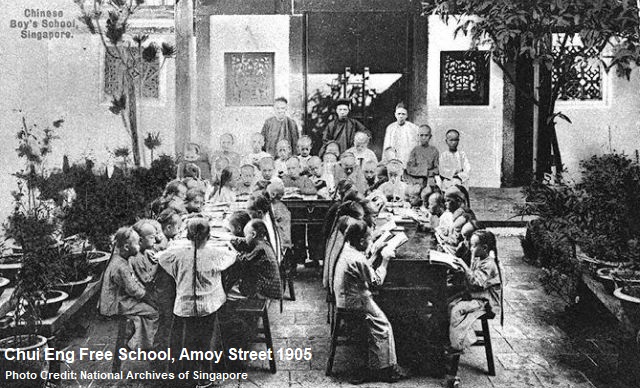
Located at Amoy Street, Chui Eng Free School (萃英书院) was established by the Hokkien Huay Kuan in 1854 with endowment from Tan Kim Seng (陈金声, 1805-1864), a wealthy Peranakan businessman and philanthropist who had donated generously to the education causes and public water works in Singapore in the mid-19th century.
Chui Eng Free School, also known as the Chinese Free School, provided free education to the boys of the local Hokkien community. Its name means “gathering of talents”; the school hoped to nurture young children into brilliant and skilled individuals. Three stones on its walls bore the inscriptions of the school’s objectives: “to enable the children of both the rich and the poor to receive education so that they can become useful citizens“.
After Raffles’ founding of Singapore in 1819, Chinese immigrants began arriving in large batches. Chinese schools, however, were non-existent. A couple of private Chinese tutoring was reported to have emerged at Chinatown in 1829. One was taught in Cantonese, while the other two were in Hokkien. All three private Chinese tutoring had a total of 50 students.
By the 1840s, Tan Kim Seng led the local Chinese community leaders in establishing the first proper Chinese private school in Singapore. Chong Wen Ge (崇文阁) was set up beside Thian Hock Keng Temple in 1849, providing free education to the underprivileged girls of the Hokkien community. Chong Wen Ge went on to become Chong Hock Girls’ School (崇福女学校) in 1915, before evolving into Chongfu School today.

In the 1850s, Tan Kim Seng again rallied the community in contributing to the setup of another Chinese private school, this time for the boys of the poorer families. He donated $1,710 in purchasing a parcel of site along Amoy Street for the new school. A total of $10,000 was successfully collected, making Chui Eng Free School the second private Chinese school in Singapore. Both Chong Wen Ge and Chui Eng Free School were Singapore’s earliest free educational institutions.
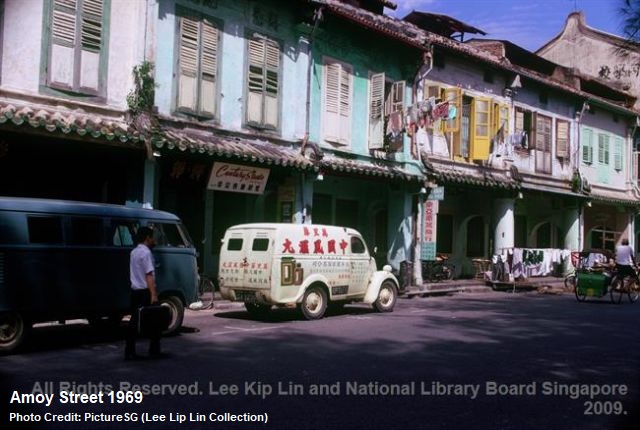
Amoy Street was built in the 1830s. After the school was built, the road became colloquially known as gi oh kau (“义学口” in Hokkien) to the local Chinese. The name literally means the front of the charity school, referring to Chui Eng Free School and its noble cause.

The two private Chinese schools were taught in Hokkien in their early days. Their teaching method largely followed the Qing Dynasty’s education system, where students were taught Chinese Classics such as the Analects of Confucius, Four Books, Book of Filial Piety and U-Ching.
Chui Eng Free School was designed in typical Hokkien architectural style originated from Quanzhou, Fujian. Skilled craftsmen and the construction materials were imported from China to build the school. It had a courtyard, inner hall and swallowtail-ridged roof with terracotta tiles.
It was at the courtyard where the students, sitting at two parallel tables, recited their lessons and homework. A peach tree once stood at the main entrance, symbolising the Chinese idea of successfully educating generations of students (桃李满天下).
Tan Kim Seng’s descendants continued to support the education causes in Singapore. In the 1880s, his grandson rallied the local Chinese community to donate $20,000 to renovate the aging Chui Eng Free School.

Chui Eng Free School continued to provide free education until the Second World War. After the war, due to the inflationary pressures, the school had no alternatives but to start charging its students a monthly fee of $3 to support the daily operational costs. The school had three teachers and 80 students during the fifties.
Despite its persistence, Chui Eng Free School struggled with many issues, such as aging amenities, outdated teaching materials and dwindling number of students. It was eventually closed in 1954, after 100 years of existence.


The school was vacated and soon its building and premises fell into a state of disrepair. The courtyard was illegally used by trespassers for gambling activities and storage of goods. In the early sixties, Hokkien Huay Kuan took over the ownership of the premises. There were suggestions to convert the place into an old folks’ home or funeral parlour, but the plans did not materialise.
The school’s plaque, inscribed with the Chinese name “Chui Eng School”, was removed from the entrance door in the nineties and acquired by a local antique collector. He later donated it to the Overseas Chinese Museum in Xiamen, China. Over the years, the local Chinese community and history enthusiasts have been trying to liaise with the museum for the return of the plaque.

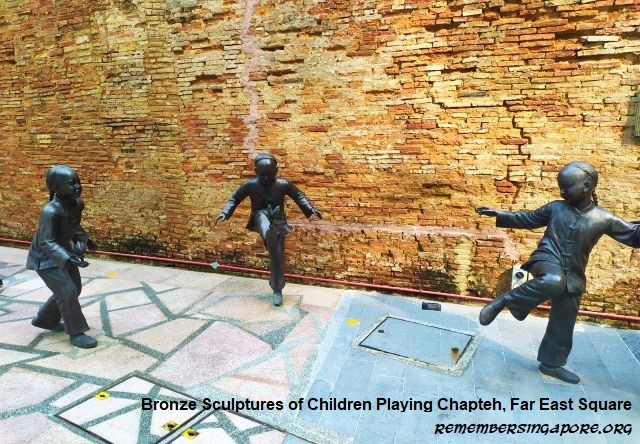
The former Chui Eng Free School welcomed a new lease of life in the nineties when a new mix-use development called Far East Square was put in place to refurbish and rejuvenate the vicinity. In this $190-million development and conservation project, the former school building and 61 old shophouses would be extensively renovated and restored.
Fuk Tak Chi (福德祠), a Chinese temple that was established at Amoy Street in 1824 by the early Hakka and Cantonese immigrants, was also refurbished into a museum today. It is one of the few buildings in Singapore with a history of more than 200 years.

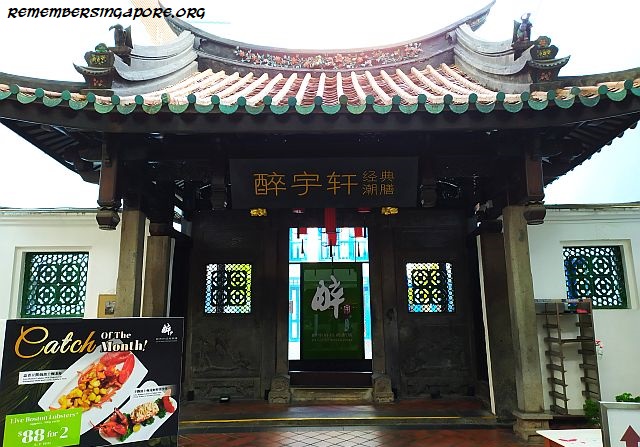
During the restoration in the nineties, only the entrance walls, door and windows of the former Chui Eng Free School were retained. The refurbished premises was designated to be used as a restaurant, although this was initially met with objections by some members of the public.
Far East Square was completed in 1998 and officially opened a year later by then-Singapore President Ong Teng Cheong. After more than two decades, the former Chui Eng Free School remains the façade of a restaurant, but not many still remember its history and legacy.
Published: 26 February 2025
Discover more from Remember Singapore
Subscribe to get the latest posts sent to your email.





 Remember Singapore
A recollection of the former Chui Eng Free School (in Chinese):
https://eresources.nlb.gov.sg/newspapers/digitised/article/lhzb19920913-1.2.61.4.1