Built in the mid-sixties, Dieppe Barracks’ early occupants included the 3rd Commando Brigade of the Royal Marines and 95th Commando Light Regiment of the Royal Artillery.
It was at Dieppe Barracks where the Royal Marines first flew their regimental colours in a parade held in August 1967. However, due to a weakened economy and devalued pound, Britain made the unexpected announcement in 1968 to withdraw all its military troops that were “east of Suez” by 1971.
ANZUK (Australia, New Zealand and the United Kingdom), the new five-nation defence arrangement with Singapore and Malaysia, was established in 1971 to replace the defunct Anglo-Malayan Defence Agreement. The new command would be supported by Sembawang Garrison that comprised Nee Soon Barracks, Dieppe Barracks and Kangaw Barracks (present-day Sembawang Air Base).
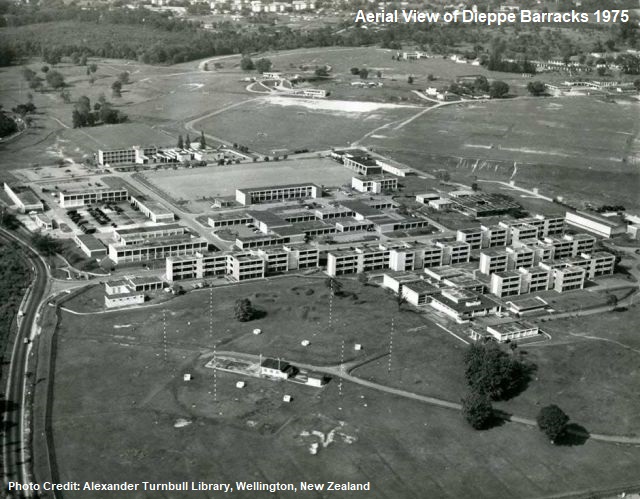
Kangaw Barracks became the home for the HQ 28th ANZUK Brigade and 6th Battalion Royal Australian Regiment, whereas Nee Soon Barracks accommodated the First Royal Highland Fusiliers. At Dieppe Barracks, the First Battalion Royal New Zealand Infantry Regiment (RNZIR) took over the camp from the departing Royal Marines.
New Zealand soldiers were first sent to Singapore and Malaya in 1955, when the region was in a state of instability and high tensions; the Malayan Emergency was at its height, the Korean War had just ended, Thailand was facing an increasing communist threat, and in northern Vietnam, the French lost their colonial rule in the Battle of Dien Bien Phu to the Viet Minh.

New Zealand based some of its fighter aircraft and warships at Singapore, and sent a squadron of the New Zealand Special Air Service to help Malaya fight against the communists. In 1957, the first New Zealand regular infantry battalion was deployed to serve in Southeast Asia.
The New Zealand troops later played a role in helping Singapore during the Konfrontasi period (1963-1966), earning them the “Big Gurkhas” nickname and reputation.
Other New Zealand military presence in Singapore included the Royal New Zealand Air Force at Tengah Air Base and Royal New Zealand Navy’s HMNZS Otago and Waikato at Sembawang Naval Base.
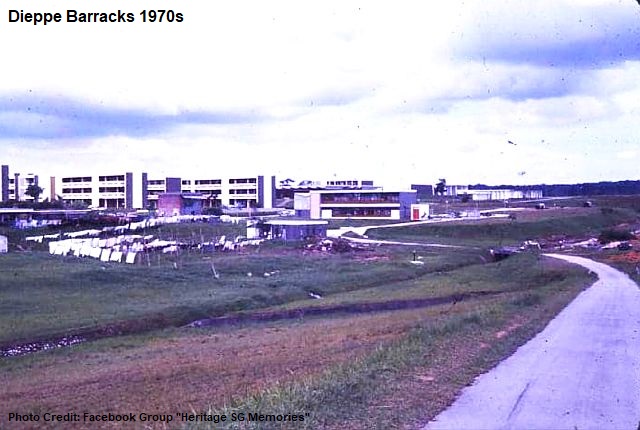
In 1974, with the Australian government’s decision to withdraw its troops from ANZUK Command, New Zealand stepped in with the establishment of an independent 1,250-strong overseas military force in Singapore.
Established in January 1974, the New Zealand Force Southeast Asia (NZFORSEA) comprised the First Battalion Royal New Zealand Infantry Regiment at Dieppe Barracks, Royal New Zealand Air Force 41 Squadron at Tengah Air Base and a Royal New Zealand Navy frigate.
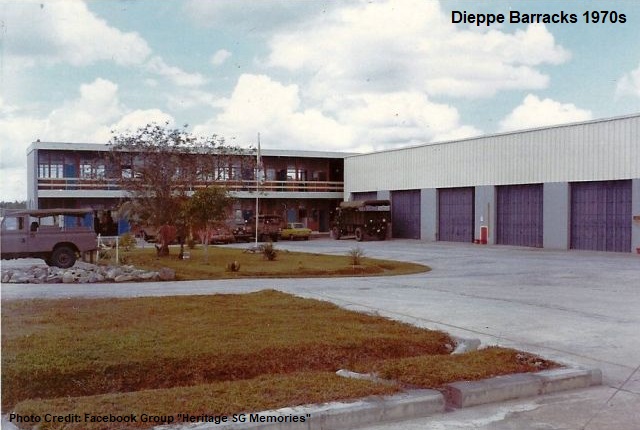
The Australian troops left Singapore in December 1975. Shortly after that, Britain, due to their economic turmoil, also withdrew its ANZUK support, with the last British soldier departing in March 1976.
New Zealand, too, was considering their withdrawal from Singapore. They reiterated their intention for their soldiers to return home in 1975 and 1978. The New Zealand troops, however, continued their deployment in Singapore into the eighties, due to the resurgence of Cold War tensions.
In 1982, the First Battalion Royal New Zealand Infantry Regiment commemorated their 25th year of service in Southeast Asia with a parade at Dieppe Barracks, where the soldiers put up war-paint and dressed themselves in traditional Māori costumes.
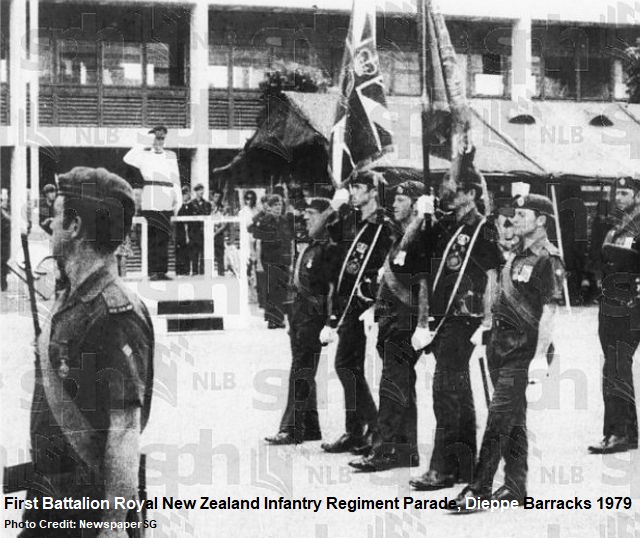
The First Battalion Royal New Zealand Infantry Regiment, in 1983, also marked their first anniversary of alliance with the Singapore Armed Force’s (SAF) 1st Commando Battalion in a Colours parade at Dieppe Barracks. Both units had established ties since the seventies, collaborating closely with each other in information exchanges, training and regimental traditions.
Dieppe Barracks played a recreational role in hosting many sports competitions, such as football and cricket, in the seventies and eighties. For the New Zealanders, rugby was more than their favourite sports; it was a national identity and culture. The New Zealand troops strengthened ties with their Southeast Asian counterparts by actively playing competitive rugby matches against the local and Malaysian teams. New Zealand played their last rugby game in Singapore in 1988.
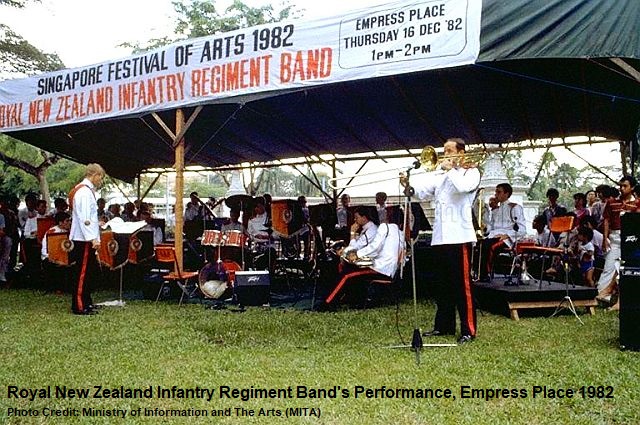
Besides the rugby diplomacy, the regiment band of the New Zealand infantry boosted relationships in its own way by putting up performances and participating in local art festivals in various parts of Singapore.
In 1986, the New Zealand government confirmed its plan to withdraw its military presence in Singapore in order to switch its main strategic interests to the South Pacific.
In June 1989, the New Zealand troops participated in its last major military exercise in Malaysia. Codenamed Taiaha-Tombak XI, in Malaysia, the exercise also involved British, Australian and Gurkha soldiers.
A final ceremonial parade with helicopter flypast was held at Dieppe Barracks for the New Zealand force in July 1989. The event’s poignant moment came when the lone bugler blew the sombre notes of the Last Post.
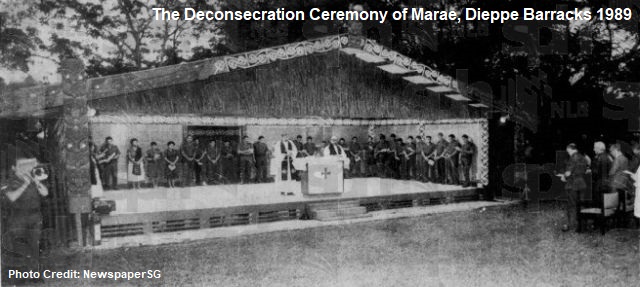
Dieppe Barracks’ marae, a traditional meeting house and centre of Māori cultural life, was deconsecrated in 1989. The ceremony was attended by the New Zealand troops, their families and invited dignitaries as they prayed and sang hymns. The wooden building, with an icon of Māori god of war Tumatauenga at the top of its roof, was subsequently dismantled and sent back to New Zealand.
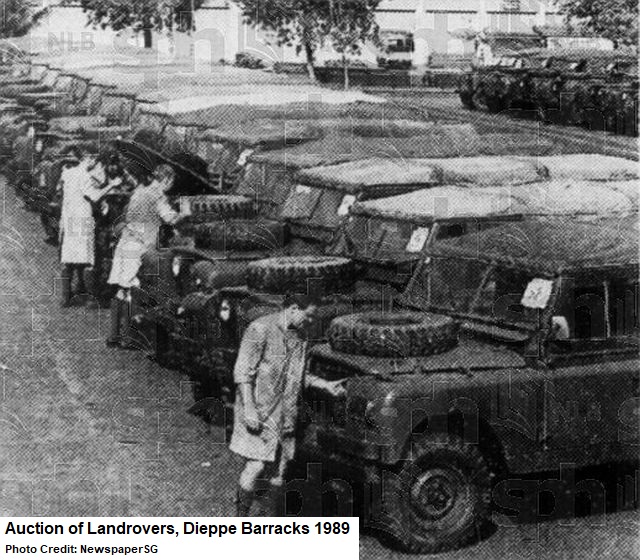
Just before their departure, the New Zealand troops put up an auction at Dieppe Barracks for their trucks, land rovers, buses and spare parts to be sold to the local and overseas buyers. Some of the vehicles were more than 25 years old, but remained functionable and suited for rough terrains at Indonesia, Philippines and Papua New Guinea’s plantations and remote areas.
The New Zealand troops eventually bid goodbye to Singapore and Dieppe Barracks in August 1989, ending their 34 years of military legacy in Southeast Asia. The three decades saw the New Zealanders involved in three campaigns – the Malayan Emergency, Konfrontasi and South Vietnam. 34 of their officers and men were killed in action, and a further 33 died of illness or accidents.
The vacated Dieppe Barracks was handed over to the SAF for a $1 token, after which the camp became the new home for the 1st Battalion, Singapore Guards. Today, it houses the HQ Singapore Guards and HQ 13th Singapore Infantry Brigade.
Published: 30 May 2025
Discover more from Remember Singapore
Subscribe to get the latest posts sent to your email.






 Remember Singapore
I am surprised by the lack of response to this installment, by both the Kiwis who were there, many in their 60-70s nowadays and the local NS men (or rather, reservists, for the pre-1992 NSFs) who serve their time there.
this is a marked contrast to the 1st instalment of army camp along Sembawang Road.
probably just need someone who were there to come across this article and let their friends know.
on the other hand, it would be much appreciated if these articles were not separated by time too far apart (almost 2 years)
any chance of letting us know approximately when is the next instalment and on which camp?
thanx
Thank you for writing these articles. I was a schoolboy playing rugby in the 1980s, so that’s how I came to know about Dieppe Baracks. Also enjoyed your other article about SIT flats at Stirling Road. I used to live in block 26, Commonwealth Avenue, one of the blocks demolished to make way for the MRT station. I remember receiving news in 1985 that my family had to move. It was an exciting time of rapid changes in Singapore’s landscape.