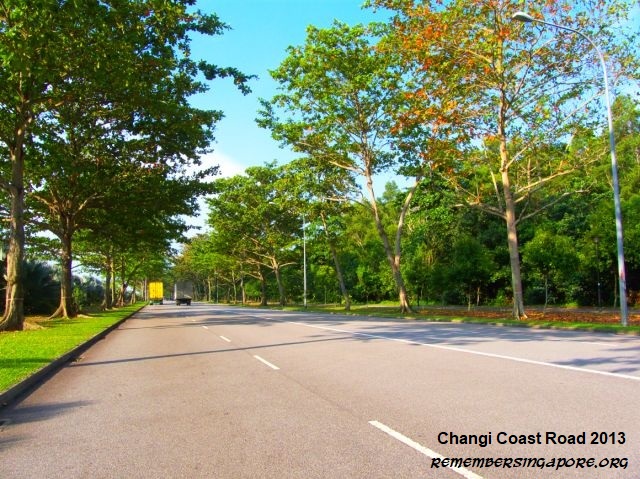
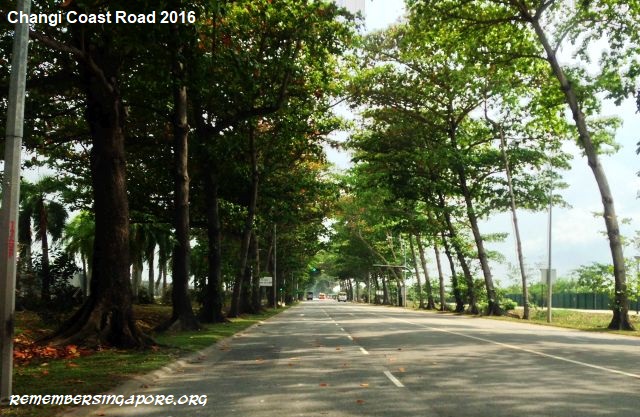
Many drivers and cyclists would fondly remember the long, straight and scenic Changi Coast Road with rows of trees by its sides. It was a popular road for late night leisure car rides, where one could catch close views of planes taking off from the airport. It was also a route for those going for some scrumptious supper at Changi Village.
Changi Coast Road today is a much reduced version. The long and straight part of it had been expunged since its closure in 2017, when the area had to make way for the development of Terminal 5 and Changi Airport’s third runway.
Project Lido
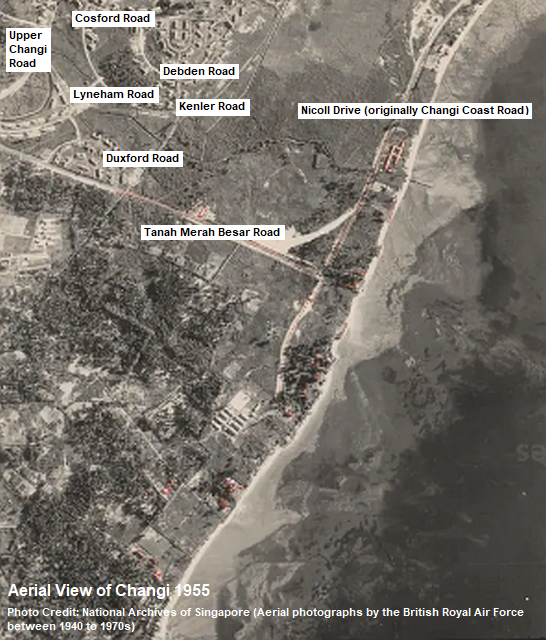
The Changi Beach and Changi Coast Road project, nicknamed “Lido”, was first proposed in 1950 by the Singapore Rural Board. The coastal road, approximated to be 6km long, would run along a stretch of beach between Tanah Merah Besar Road and Changi Point. This beach was described by the board’s chairman John Allen Harvey as the best in Singapore. He visualised it to be comparable to Margate, an English town known for its sandy beach, when it was fully developed with chalets, restaurants and other facilities.
But the Singapore Rural Board had insufficient budget for the road’s construction, and had to seek help from the Finance Committee. There were funds available as the extension of Bukit Timah and Dunearn Road was being held up due to the difficulties met in the land acquisitions.
The Lido project, however, was repeatedly delayed. First, the projected construction cost rose from $200,000 in 1950 to $700,000 in 1952. Then, there were delays in the acquiring of lands from the Royal Air Force, which owned most of the sites on which the road was to be built. The project engineer Ralph Robert Cambridge of the Public Works Department (PWD) also demanded an assistant engineer from the Singapore Rural Board.
Nicoll Drive
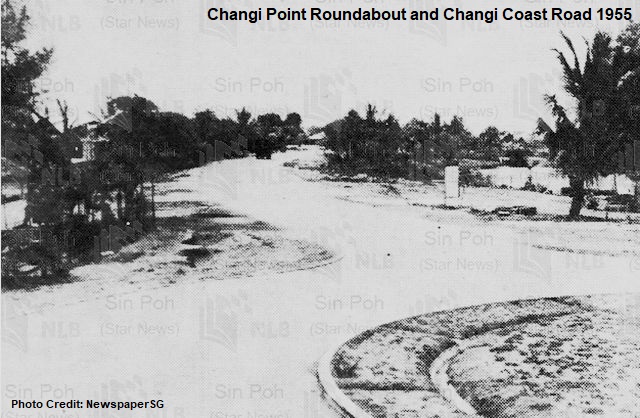
After a difficult start, the new road was eventually completed by 1955. Enhancements such as parking bays, street lights and planted trees were added by the PWD along the road.
The newly completed road, however, was not called Changi Coast Road as originally planned. It was instead named Nicoll Drive, after Sir John Nicoll (1899-1981), the Governor of Singapore from 1952 to 1955. Nicoll Drive was extended southwards in the sixties to link up with Wing Loong Road.
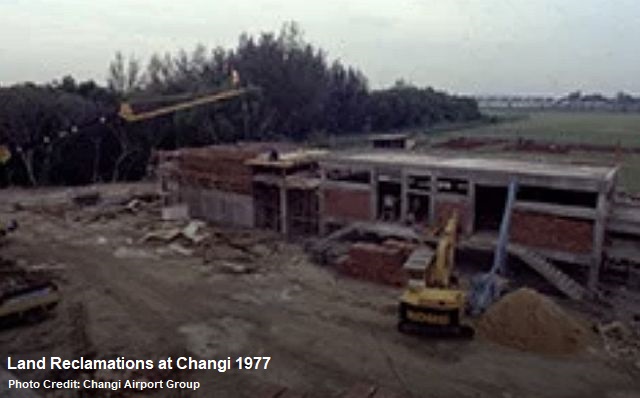
Singapore’s eastern coastline was further extended eastwards when land reclamation projects for the Changi area kicked off in 1976. More than two years of reclamation works added 745 hectares of lands that were reserved for the construction of the new Changi Airport.
The land reclamations, however, removed the sandy beach and expunged much of Nicoll Drive. Nicoll Drive was reduced to a short road at the northeastern side of Changi.
Changi Coast Road
Changi Airport was completed in 1981. At the same time, at the eastern side of the airport, a new road was built along the newly-created coastline. It was called Changi Coast Road, a vanished name that was used again after more than 25 years. Changi Coast Road was connected to the shortened Nicoll Drive and East Coast Parkway (ECP) at its two ends.
Changi Coast Road was officially opened on 5 September 1981 by Teo Chong Tee, the Member of Parliament (MP) for Changi. Costing $6.25 million in construction, the four-lane dual-way road was 8.5km long. Like the one in the mid-fifties, there were public amenities such as carparks and toilets built, and coconut and casuarina trees planted along the road.
Accident Prone
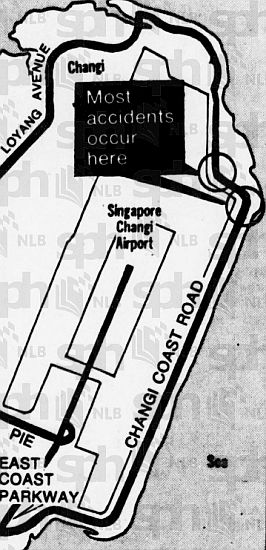
Due to its long and straight design with sharp bends at the both ends of the road, Changi Coast Road was one of the most accident prone roads in Singapore. It was also relatively deserted at night, making it a favourite illegal racing route for cars and motorcycles.
In 1983, the police rounded up 700 people at Changi Coast Road in one of the largest operations against hell-riders. Many of the men caught were found to have committed thefts and gang fights, or linked to gambling syndicates.
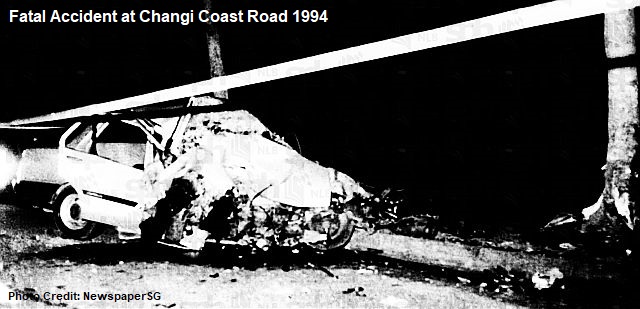
Over the years, Changi Coast Road witnessed many fatal and tragic accidents. As many as 77 accidents at Changi Coast Road were reported in just three years from 1984 to 1986. One of the first fatal accidents at Changi Coast road was the death of a motorcyclist in 1984 when he crashed his bike into the drain.
1986 was probably the worst year in Changi Coast Road’s history. In July, a driver and his passenger perished when their pick-up hit the lamp post, overturned and burst into flames. In the same month, a female pregnant driver passed away after a head-on collision with another car. Later that year, in three separate accidents between September and October, three drivers were killed when their cars crashed into the trees along Changi Coast Road.
The 70km/h speed limit signages and traffic police patrols were not effective enough to dissuade speeding and reduce the number of accidents. In 1987, the police installed speed cameras at Changi Coast Road; they were the first of their kind to be used in Singapore. The cameras were upgraded to 24-hour all-weather type in 1993.
Accidents, however, continued plaguing Changi Coast Road throughout the nineties and after the millennium. Multiple fatal accidents involving cars, motorcycles, trucks and even joggers were constantly reported in the news. A horrific accident, one of the last fatal ones at Changi Coast Road, occurred in July 2016. It claimed the life of a Republic of Navy (RSN) national serviceman (NSF) who crashed his car into a tree in an early morning.
Road Changes
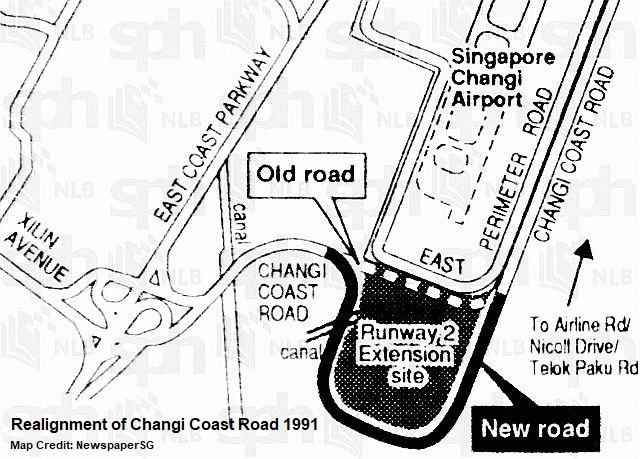
In 1991, Changi Coast Road was slightly realigned to make way for the extension of the airport’s runway. Two years later, a section of Changi Coast Road was diverted for six months to accommodate the construction of a drainage system for Terminal 2.
In 2013, the expansion plans of Changi Airport, including the building of Terminal 5 and a new third runway, were announced. Affected by the new development project, Changi Coast Road was eventually closed on 22 April 2017. The scenic views, good memories and the dark past of the road had all walked into history.
Published: 4 July 2026
Discover more from Remember Singapore
Subscribe to get the latest posts sent to your email.








Hello, what a wonderful write up of Changi Coast Road. I learnt a few things here and appreciate the beautiful pictures you have attached.
I miss this road very fondly and feel that Tanah Merah coast road is not exactly a replacement. What I miss the most is the trees for sure which got me wondering if Alps Avenue is actually an old alignment of Changi coast road (look at the trees there) looking at old maps maybe this isn’t impossible?
This also reminds me of the saddening recent felling of the same tall straight stubby trees at Changi Flyover from ECP to PIE 2 months ago and PIE to ECP (gone 10 years ago). I really wish they would replant the same species or recreate the look of the road once construction is completed. The past landscape of Singapore, especially Changi is absolutely stunning and more should be done to preserve it. For me, Changi Coast Road lives on on limited sections of old street view of Google maps, some YouTube videos and some photos online.
Going even further back, before my Singapore time but in fabled memory, was the Changi Tree anywhere nearby?
Hey Michael, the famed Changi tree was located at Digby Road, about a mile away from Changi Coast Road in terms of straight line distance.
Today, Digby Road and its surrounding area is strictly out of bounds for any Singaporean civilian. Only a handful of military personnel assigned to Changi Airbase West are allowed in that area with many caveats of course.
A decade ago, there were still some visits every few years for old British servicemen and privileged locals with good connections but now visits to that area are non existent, or at least never made public.
Quite a shame, really.