McNair Road, Townerville and the Kwong Wai Shiu Hospital

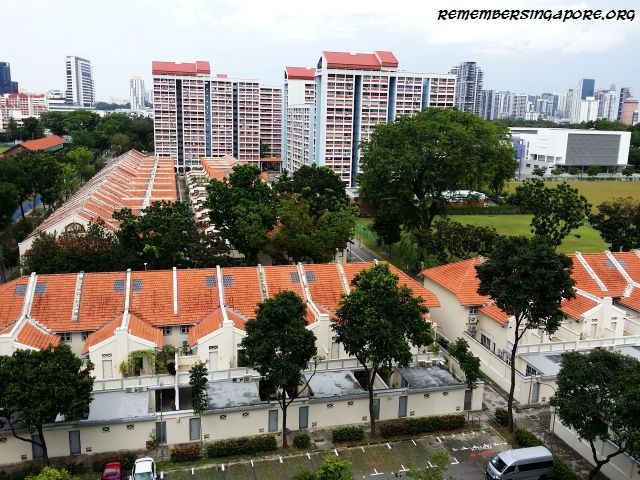
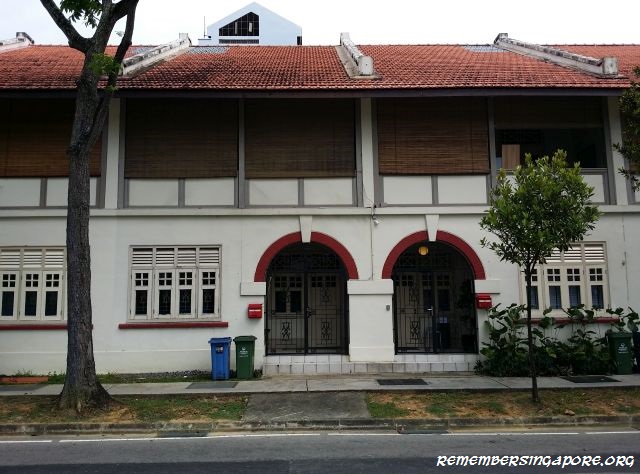
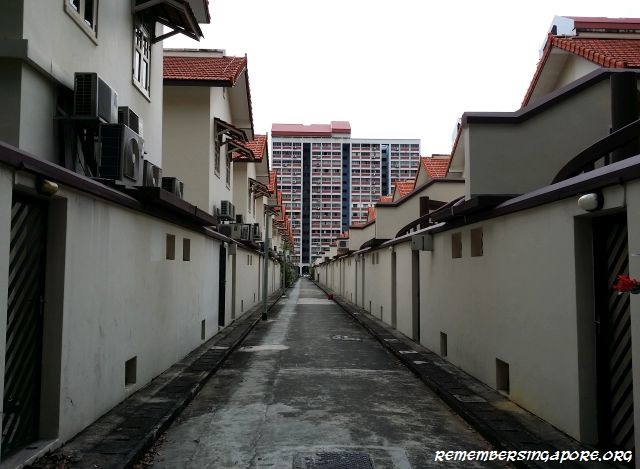
Along McNair Road is an interesting sight, where the prewar terrace houses meet the modern public flats in an interesting mix of old and new architecture. Townerville, the prominent landmark of the McNair/Towner vicinity, refers to the rows of double-storey houses that were built way back in the 1920s.
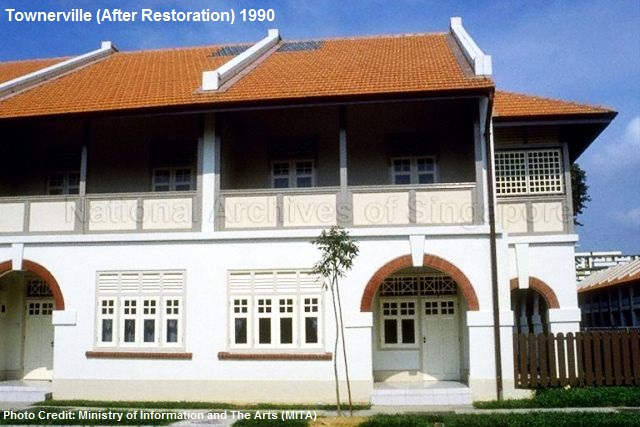
Townerville

The terrace houses, bounded by McNair Road, Towner Road and May Road, were designed in a combination of Malay, Chinese and European architectural styles. Every unit is made up of unique features such as a high ceiling, wide verandah, balcony, courtyard and picture rails and skirting.

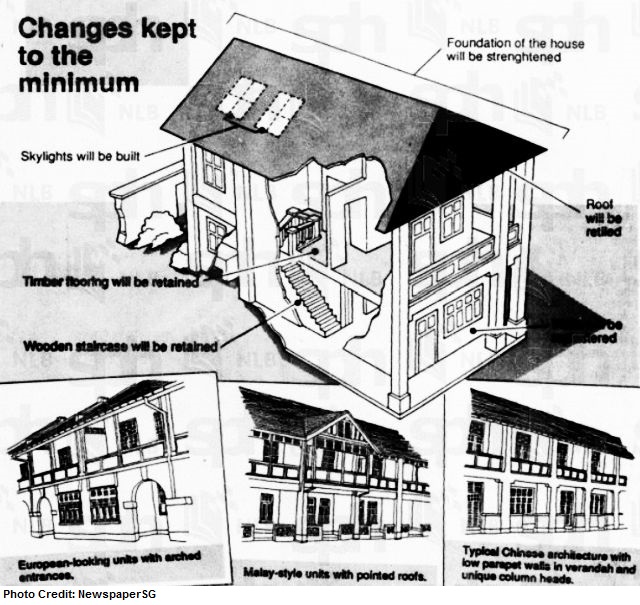
The six blocks of 84 houses are largely divided into three distinct groups. The 24 apartments along McNair Road are European-looking, while the 34 units, situated at the junction of Towner and May Roads, were built with Chinese-influenced low parapet walls in the verandah and unique column heads. The remaining have Malay-styled pointed roofs.
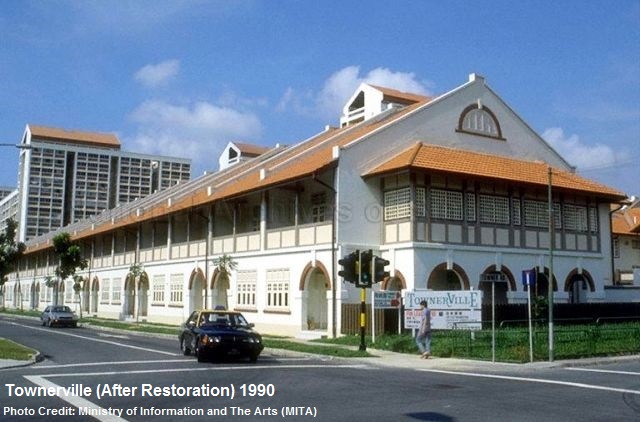
Townerville was previously utilised by the Ministry of Finance as government quarters in the seventies and eighties. The houses were then left vacant for many years.

In 1986, the Housing and Development Board (HDB) decided to develop the McNair/Towner area as a new housing estate. Eighteen new blocks of flats – Block 108 to 112 and Block 119 to 124, now collectively known as McNair Springs, along McNair Road, and Block 101 to 107 at Towner Road – were built.
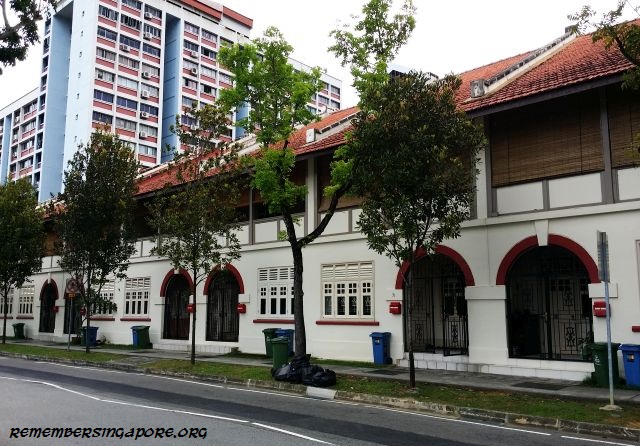
The old dilapidated terrace houses soon became an eye sore beside the new HDB flats. Fortunately, instead of demolition, the Urban Redevelopment Authority (URA) announced restoration plans for the empty houses in 1988. Working together with HDB, the restoration project,  costing about $12.4 million, aimed to integrate the old world charm of the colonial ethic-style houses into the upcoming housing estate.

It was URA’s first residential restoration project where its carefully applied 3R principles – Maximum Retention, Sensitive Restoration and Careful Repair – set a benchmark for future restoration projects in Singapore.
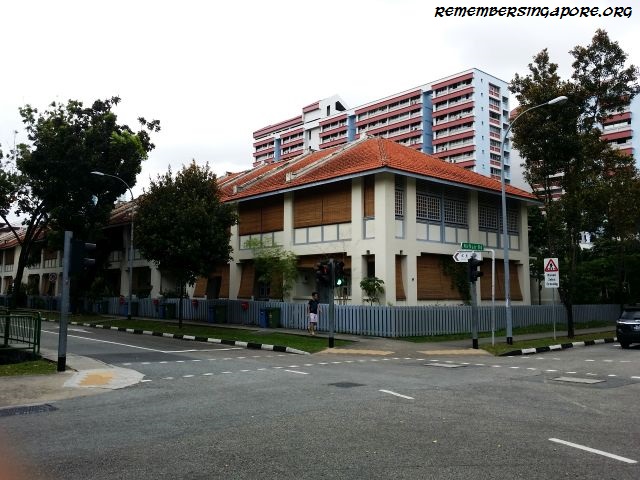
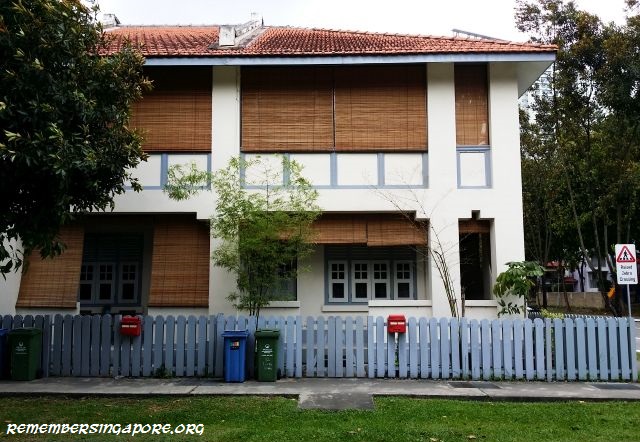
After the completion of the restoration in 1990, the terrace houses, now under conservation, were put up for open tender. In just two weeks, the highly sought-after properties attracted more than 1,000 bids. Local real estate tycoon Ng Teng Fong’s (1928-2010) Far East Group eventually clinched the multi-million deal with their highest bids.

By the early 2000s, each unit cost between $1.1 million to $1.6 million. The units were put up for sale again in 2001. Today, the Townerville apartments are largely used for residential and commercial purposes.
Rayman Estate

The residential estate bounded by McNair Road, Towner Road and the main Balestier Road used to be known as Rayman Estate. It was originally called the Balestier Estate, but was renamed in 1949 by the Municipal Commissioners in honour of Lazarus Rayman (1891-1948), the former Singapore Improvement Trust (SIT) chairman and Municipal President.
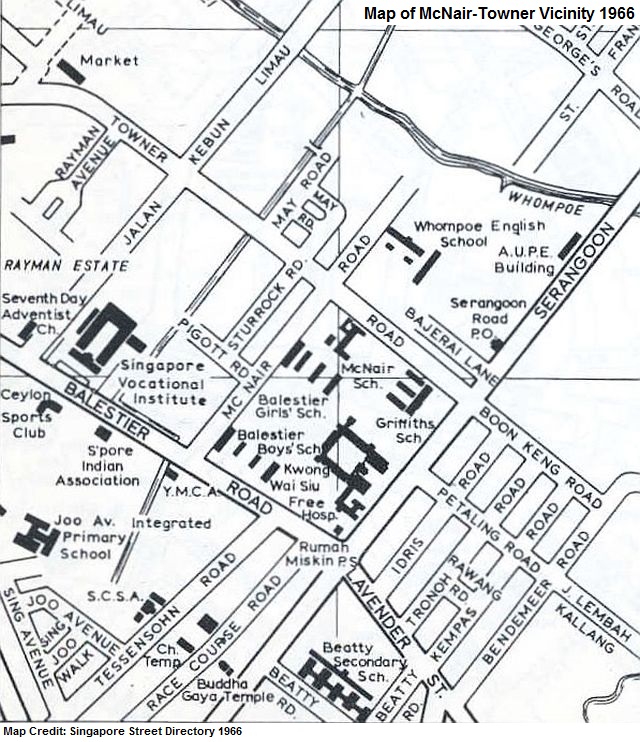
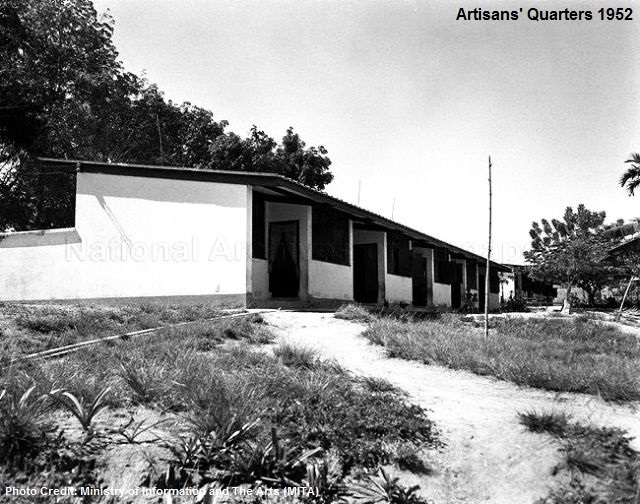
The estate, one of the projects undertaken by Lazarus Rayman’s progressive housing policy, consisted of some 1,400 Artisans’ Quarters, 20 flats and 63 shops, and had its public market added in 1952.

Artisans’ quarters were low-cost apartment units built by SIT to house the skilled workers. Back then such quarters could be found in many parts of Singapore, including Balestier, Tiong Bahru, Tanjong Pagar, Henderson, Bukit Timah Road, Kim Keat Road, Mackenzie Road, Silat Road and Morse Road.
By the late fifties, a new road named Jalan Kebun Limau split the Rayman Estate into two. Thirty years later, in the late eighties, the road would be redeveloped and absorbed into the Central Expressway (CTE), becoming the exit road (Exit 7D) that led to Balestier Road.

Rayman Estate itself vanished into history, together Rayman Avenue, a small road off Towner Road that once led to the housing estate.

Former Schools

Junior technical trade schools were established in British Malaya to equip students with technical skills such as bricklaying, plumbing, construction and mechanical and electrical fittings. In Singapore, the first government technical trade school was set up at Scotts Road in 1929.
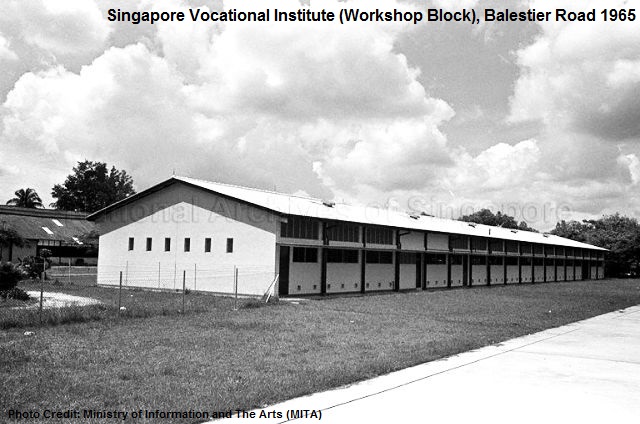
The school was relocated to Balestier Road in 1940, but due to the Second World War, its technical classes only began in 1948. The Balestier Junior Technical Trade School lasted until 1963, when it was restructured to become the Singapore Vocational Institute, with its training and courses managed by the Vocational and Industrial Training Board (VITB).

In 1992, the Ministry of Education (MOE) decided to introduce the Institute of Technical Education (ITE) as a post-secondary institution to improve the employability of vocational trainees. With the new implementation, the Singapore Vocational Institute was replaced by ITE Balestier, which had its new premises built and operated at the former Rayman Estate from 1994 to 2013. Today, the site is occupied by Northlight School.
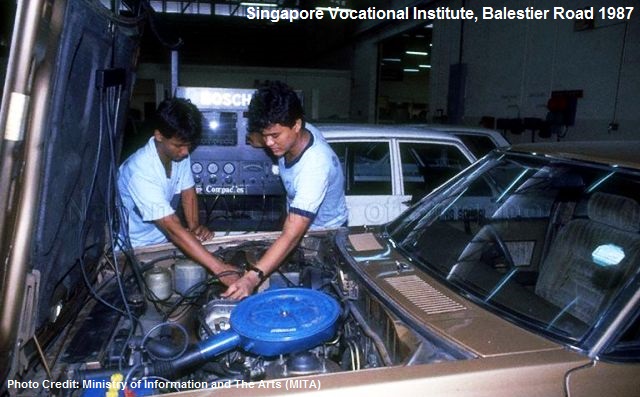
Other than Balestier Junior Technical Trade School, there were several other schools at the McNair-Towner vicinity during the fifties and sixties, including the McNair Road School, Whampoa School, Griffiths School, Balestier Road Boys’ School and Balestier Girls’ School.

The McNair Road School first started as McNair Road English School in 1925, but was shut down during the Second World War and had its premises used by the military. After the war, the school buildings were returned to the Singapore Education Department.

In 1950, McNair Road School became one of Singapore’s first four schools – the other three being Duchess Road School, Anthony Road School and Monk’s Hill School – to be opened under the Supplementary Education Plan. It was part of the colonial government’s 10-year postwar educational program to provide primary education to almost 9,000 students in Singapore. A total of eighteen schools were opened in the $1.5 million project.
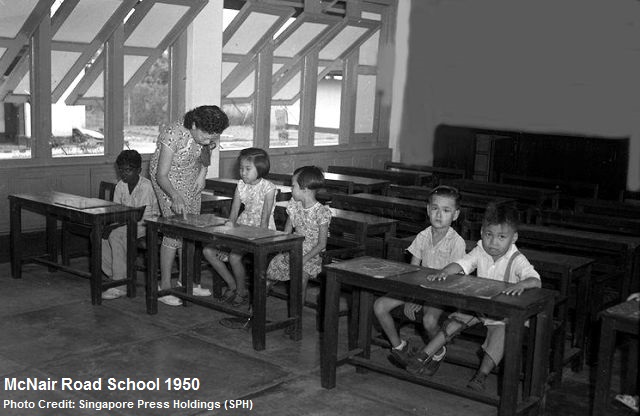
McNair Road School was eventually merged into Rangoon Road Primary School in 1968.

Originally known as Towner Road School, Griffiths School was renamed after James Griffiths (1890-1975), the British Secretary of State for the Colonies who visited Singapore and officially opened the school in 1950.

In 1982, the school faced closure due to declining enrolment, and was forced to merge with Balestier Girls’ School to form Moulmein Primary School. It got its name Griffiths back when the primary school was relocated to Tampines in 1988.
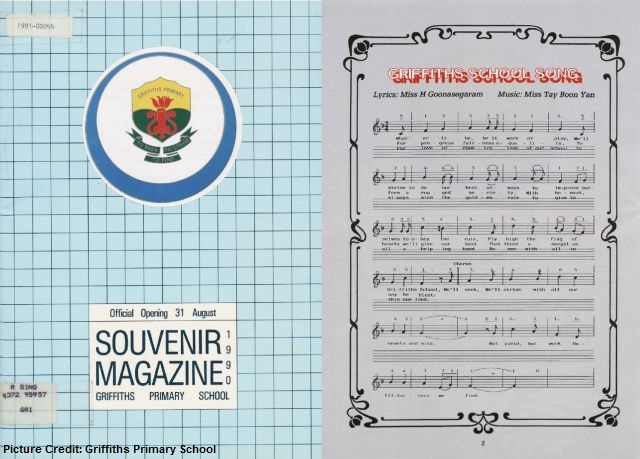
Griffiths Primary School merged once again in 2015, together with Qiaonan Primary School, to form Angsana Primary School. The second controversial merger might see the name Griffiths permanently walk into history.

The eighties and nineties saw the numerous old schools at McNair-Towner ceased to exist, replaced by the newer ones in May Primary School, Towner Primary School and the Precision Engineering Institute (McNair Campus).

There were other schools too, along McNair and Towner Roads, that provided education to students with special needs. Examples were the MINDS (Movement for the Intellectually Disabled of Singapore) Towner Gardens School, Spastic Special School and the Rainbow Centre Balestier Special School. The latter was established in 1995; its premises was later converted into the Singapore Boys’ Hostel.
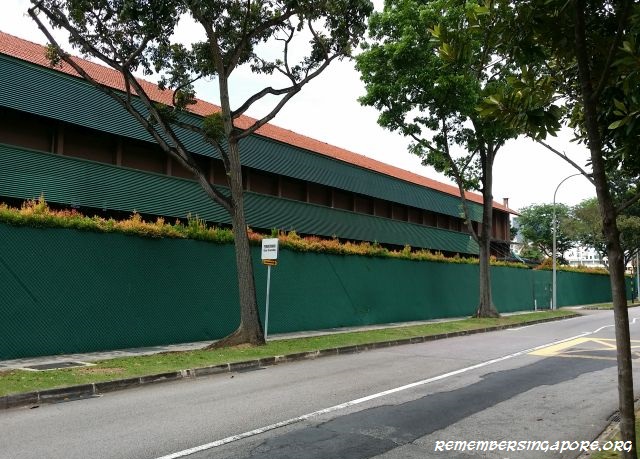
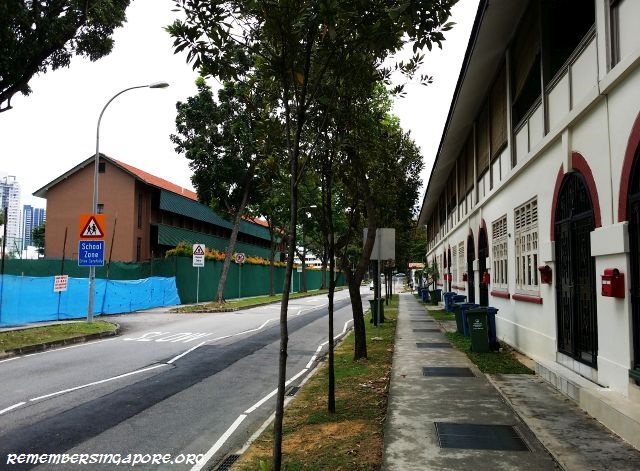
Shitoryu Karate Association

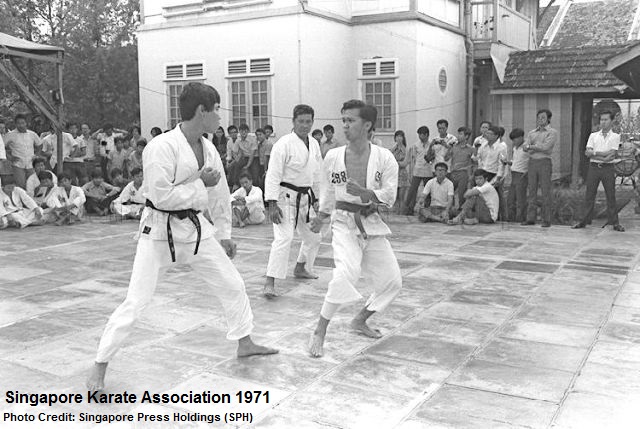
One of the former tenants at McNair Road was the Shitoryu Karate Association (SKA). Originally known as Singapore Karate Association, the karate school had its history dated back to the early sixties. It was founded in 1964 by a group of martial arts enthusiasts and professionals, and was based at the bungalow belonging to one of its founders, a police officer, at McNair Road.
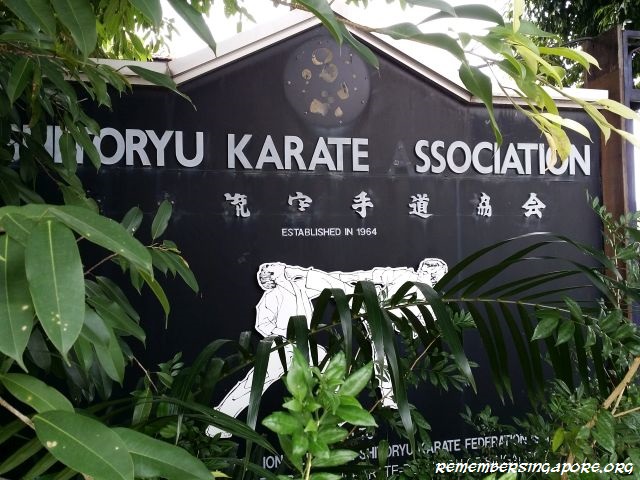
During the first decade of its establishment, karate instructors were invited from Japan to impact the skills to local students who had signed up for the courses. Tough training were then carried out at the McNair Road bungalow’s courtyard.

Over the years, the association’s membership steadily increased, and by the seventies, SKA had produced many outstanding karate-kas who competed in the world tournaments.
The SKA, in the late seventies, also held many international karate-do championships. Many participants from Singapore, as well as regional countries such as Malaysia, Japan, Indonesia, Hong Kong and Brunei, contested at the Gay World Stadium.

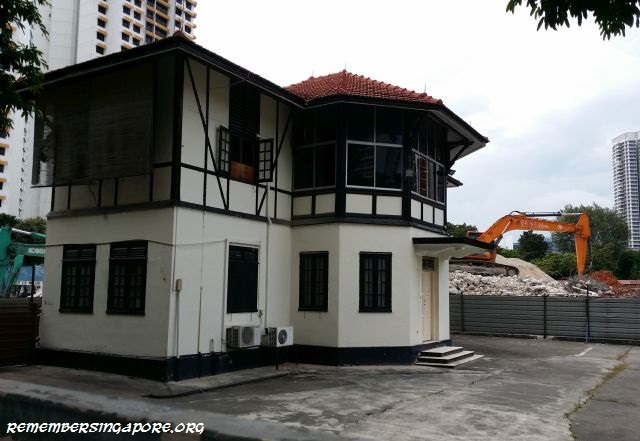
In 2017, the association’s headquarters, after 52 years at McNair Road, had to be relocated to Tessensohn Road, a short distance away from its old premises. It was one of the buildings that were affected by the latest redevelopment plan at the McNair-Towner vicinity.
Kwong Wai Shiu Hospital

The Kwong Wai Shiu Hospital is a century-old landmark at the vicinity, located at the junction of Serangoon Road and Balestier Road.

It sits on the former site of Tan Tock Seng Hospital, before the latter was shifted to its current location off Moulmein Road in 1909. Tan Tock Seng Hospital was originally situated at Pearl’s Hill. It was in 1861 when it was forced to move to the junction of Serangoon and Balestier Roads.
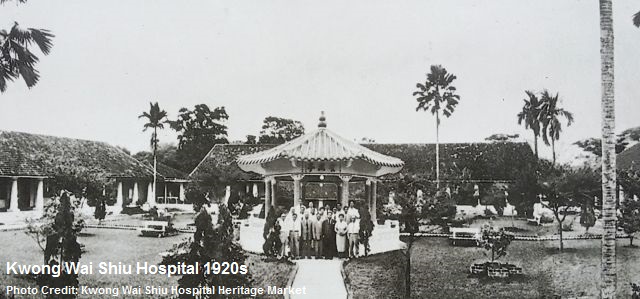
Kwong Wai Shiu Hospital started as a small Traditional Chinese Medicine (TCM) hospital manned by only one physician. It was founded by four prominent local Cantonese community leaders – Leong Man Sau (1866-1916), Yow Ngan Pan (1863-1930), Ng Seng Pang (1873-1953) and Wong Ah Fook (1837-1918) – in 1910.

The purpose of setting up a hospital was to provide free medical care to the clan members and immigrants from the Guangdong province of China. The hospital was named after the Kwong Chau, Wai Chau and Shiu Heng prefectures, the ancestral home for most of the local Cantonese.
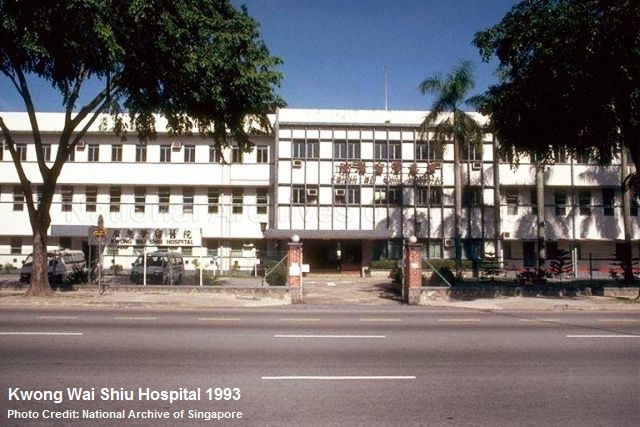
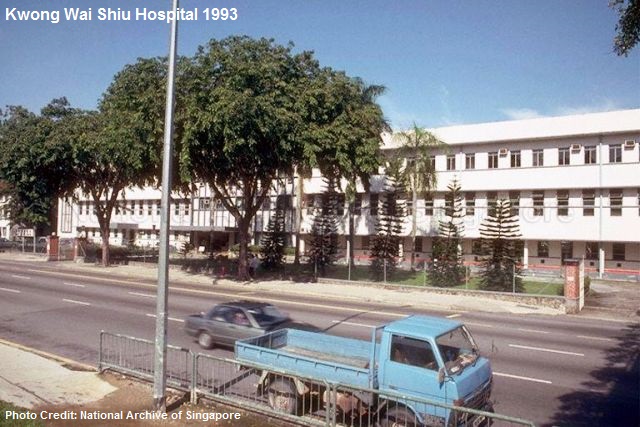
From a humble medicine outlet, Kwong Wai Shiu Hospital expanded over the decades. In the fifties, it added a maternity ward, hostel, kitchen and a new front block.

Since its establishment in 1910, the hospital had offered free outpatient services to all the locals, although its in-patient facilities remained limited only to the Cantonese. This, however, changed in 1974 when Kwong Wai Shiu Hospital amended its constitution to admit Singaporeans of all races and dialects.
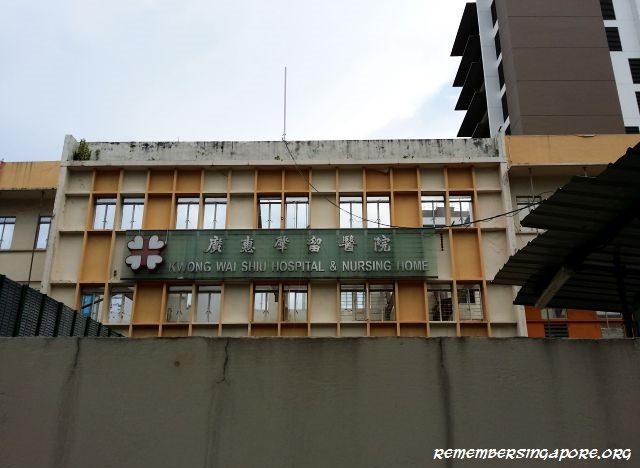
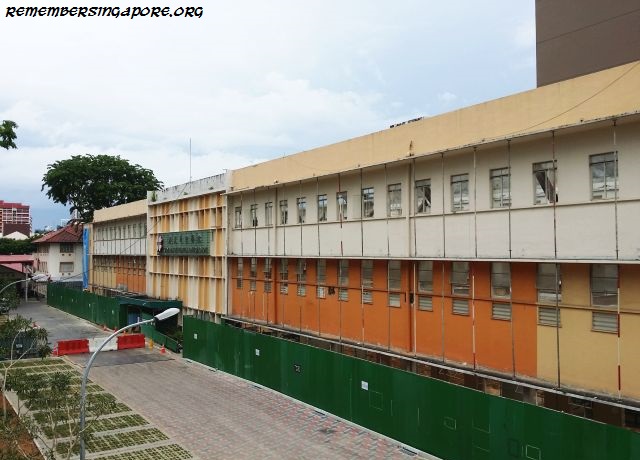
The Kwong Wai Shiu Hospital of the modern era includes a TCM centre and nursery home. Three of its colonial buildings and front block were conserved in 2010. Its other buildings, however, were demolished in 2015 in a $96-million redevelopment project. Upon its completion in late 2017, the hospital will have the largest nursing home in Singapore.
Central Sikh Temple

The Central Sikh Temple is the main temple for all Sikhs in Singapore. It is the country’s two recognised public Sikh temples, along with the Silat Road Sikh Temple.

A Skih place of worship is called a gurdwara. In 1912, a group of Sikhs purchased a bungalow at Queen Street, though the financial support of Wassiamull, a Sindhi merchant, and converted it into a gurdwara. It became known as the Central Sikh Temple, or Wadda Gurdwara (“The Big Temple”).
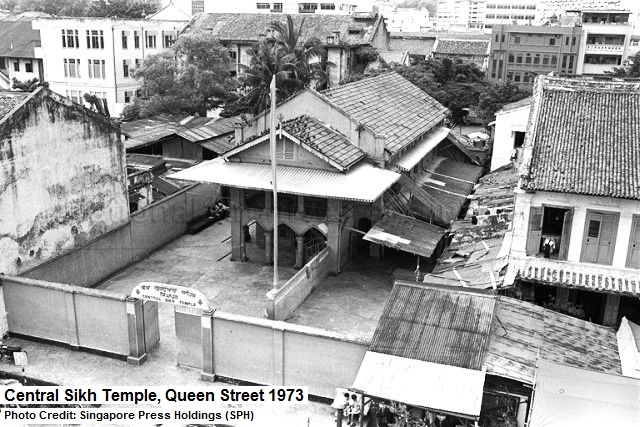
Beside being a place of worship for the local Sikhs, the temple also had housing quarters for the aged and poor Sikhs. In 1977, the plot of land where the Central Sikh Temple formerly stood on was acquired by the HDB for residential and commercial redevelopment. It had to be temporarily relocated to Seng Poh Road at Tiong Bahru, while a new Central Sikh Temple was being constructed at the corner of Towner Road and Serangoon Road.

At a cost of $6.5 million, the new temple building was completed in 1986, the year that was celebrated by the Sikhs as the 518th anniversary of the birth of Guru Nanak, the founder of Sikhism. On 16 November 1986, the temple was officially opened by Wee Kim Wee (1915-2005), the former President of Singapore.
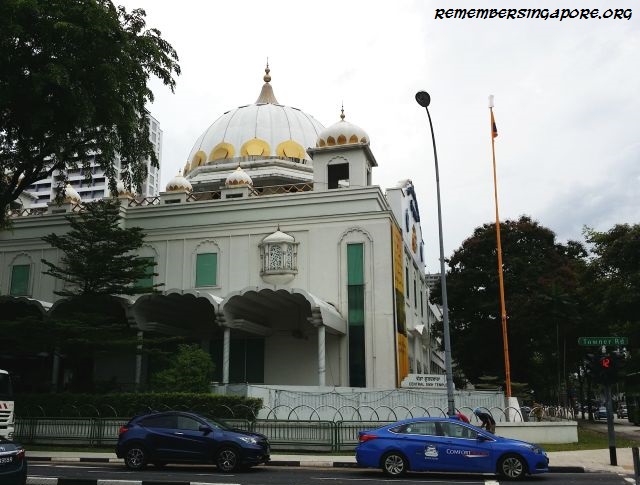
Central Sikh Temple was designated in May 1999 by the National Heritage Board as a historical site.

Published: 31 May 2017
Posted in Cultural, General, Historic | Tagged , , , , , , , , , , , , , , , , , , , , , , , , , , , , , , , , , , , | Leave a comment

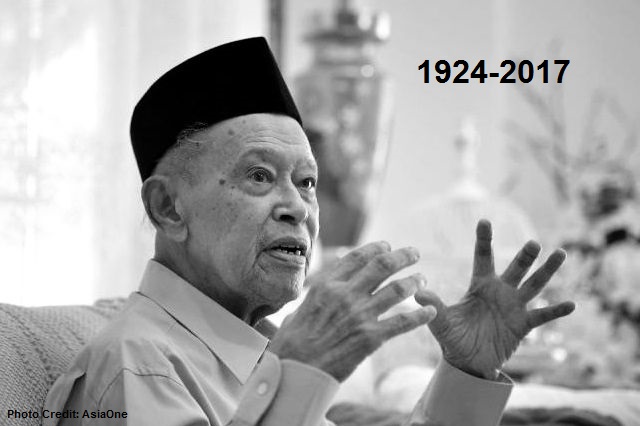
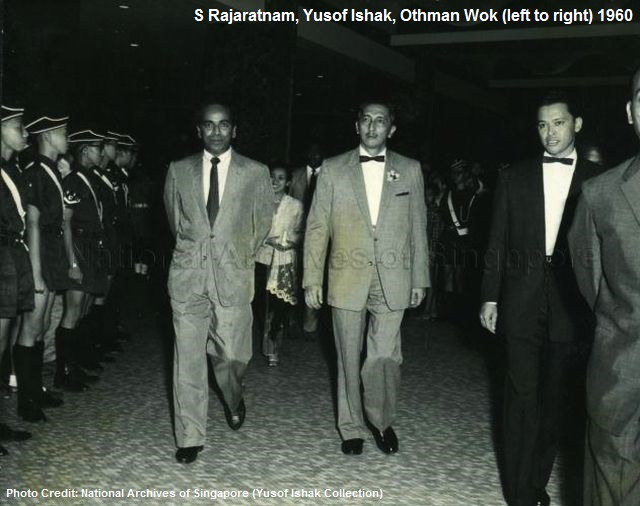
Remembrance of Othman Wok (1924-2017), Singapore’s First Malay Minister

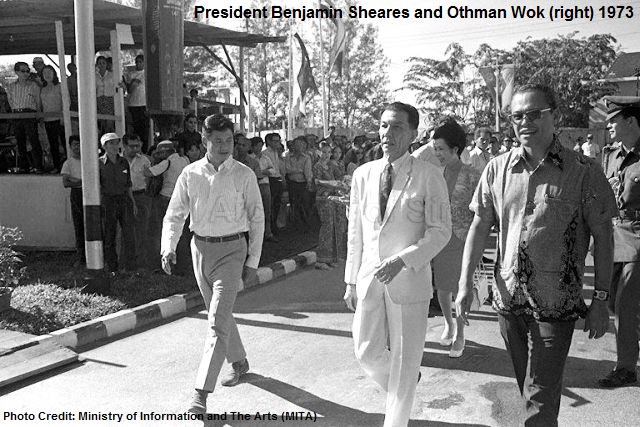
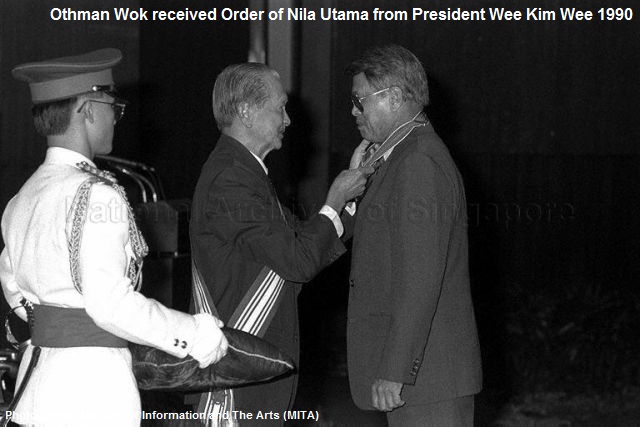
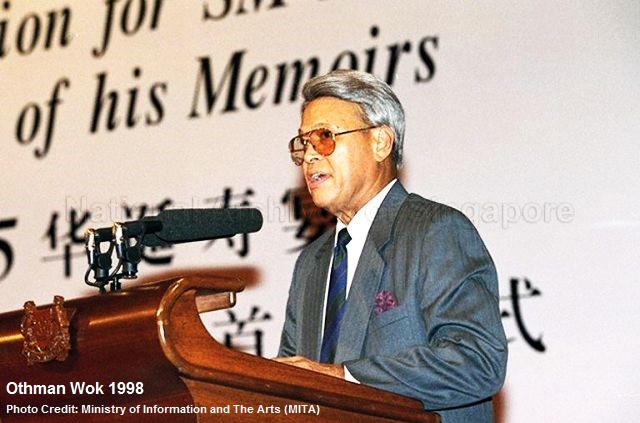
One of Singapore’s early Cabinet ministers and old guards (first generation of the People’s Action Party (PAP)), Othman Wok was perhaps best known for his active participation and contributions to the nation’s social development and welfare of the local Malay and Muslim communities.

Born in 1924 to a Malay school principal, Othman Wok, whose full name was Tuan Haji Othman Bin Wok, received English educations at Radin Mas School and Raffles Institution. After graduation, he worked at Utusan Melayu, a Malay newspaper company, where he was gradually involved in union-related activities. He would later be appointed as the Singapore Printing Employees Union’s secretary, and became associated with Lee Kuan Yew, the union’s legal advisor.

Othman Wok joined the PAP when it was formed in 1954, and was elected as an Assemblyman for the Pasir Panjang constituency in 1963. He would continue to serve as a Member of Parliament (MP) for the Pasir Panjang constituency between 1963 and 1981.

But the first real test for Othman Wok came in 1964, when a series of racial riots broke out in July and September between the Malays and Chinese. Singapore had joined the Federation of Malaysia a year before, but political tensions were rising between the two rivaling parties, PAP and the United Malays National Organisation (UMNO), in both the Malaysia and Singapore general elections. The UMNO accused the PAP government of oppressing the Malays in Singapore, and condemned Othman Wok and the Malay MPs for betraying the Malay communities. When Singapore split from Malaysia in 1965, Othman Wok’s will was tested once again – but he stood firm in supporting the island’s independence.

In total, Othman Wok served as the Minister for Social Affairs for 14 years until 1977. He would serve another three years as the minister without portfolio and the ambassador to Indonesia until his retirement from politics in 1981.

As the Minister for Social Affairs, one of Othman Wok’s responsibilities was to take note of the needs of the disadvantaged groups, and that included the disabled, elderly, orphans, troubled teens and single parents. He also worked hard for racial harmony, as well as the well-being of Singapore’s Malay-Muslim population.

Othman Wok’s active involvement saw the implementation of the Administration of Muslim Law Act (AMLA), which led to the establishment of the Islamic Religious Council of Singapore (Majlis Ugama Islam Singapura (MUIS)) in 1968 to look after the welfare of the Muslims in Singapore. It was followed by the setting up of the Mosque Building Fund (MBF) in 1975. Voluntary contributions were collected, via the Central Provident Fund (CPF), from working Muslims for the building of mosques in new housing estates.

When the Malay communities were resettled in the seventies from their kampongs to the new Housing and Development Board (HDB) estates, they had to live without a community mosque. In 1974, the former Prime Minister Lee Kuan Yew, together with Othman Wok and several Malay MPs, met the members of the MUIS to discuss possible solutions, one of which was the establishment of MBF to fund the construction of mosques.

There were about 1,200 Muslim families living at Toa Payoh in the seventies. By 1977, the first mosque was built with the help of MBF. It was named Masjid Muhajirin, and was officially opened by Othman Wok. Since then, 26 new mosques have been constructed in Singapore using the fund.

Othman Wok also campaigned for the funds needed to develop a national stadium for Singapore in the late sixties. Sports could always unite the people together, especially football, Singapore’s favourite sport. A need to spur the people’s interest in fitness and health was essential too, as many newly conscripted recruits in the early batches of the National Service were deemed lacking in fitness.

Othman Wok passed away at the Singapore General Hospital on 17 April 2017. He was 92 years old. His final journey was honoured with a ceremonial gun carriage from the Sultan Mosque to Pusara Abadi at the Choa Chu Kang Muslim Cemetery.

Published: 29 April 2017

Posted in General, Historic | Tagged , , , , , , , , , , , , , , , , , , , , | 2 Comments

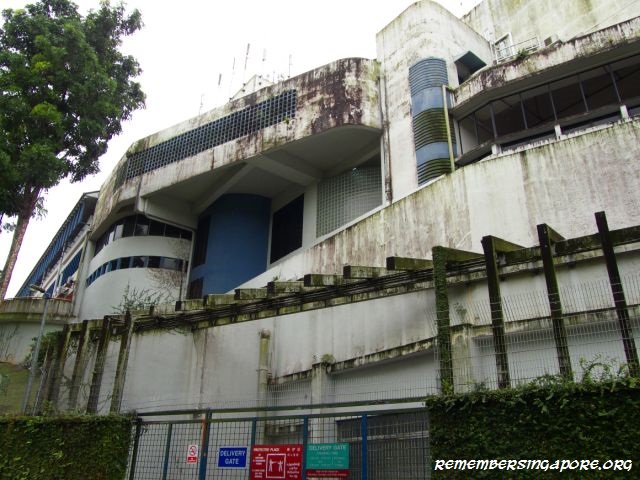
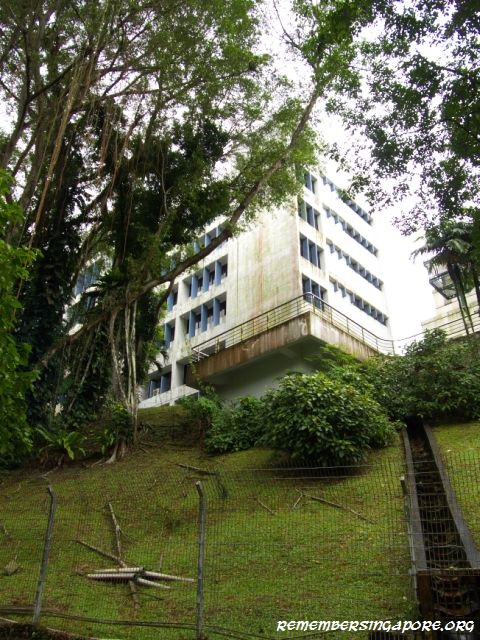
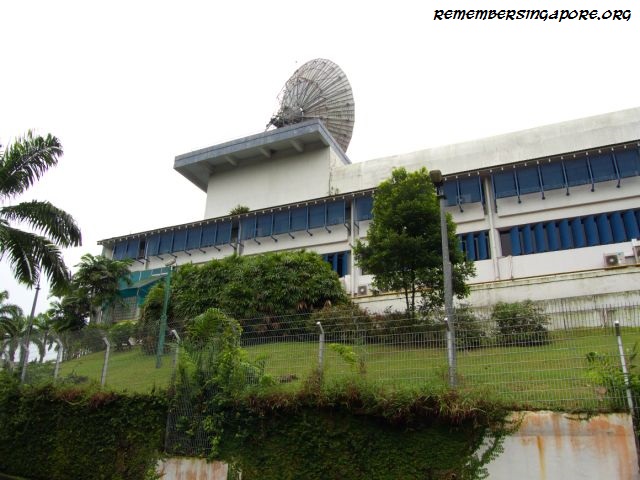
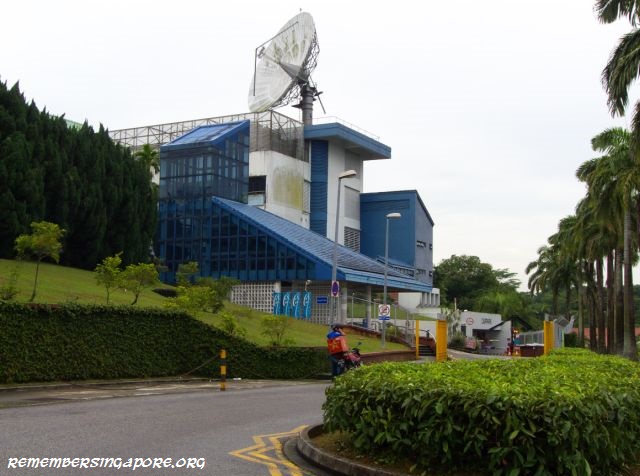
Broadcasts, Dramas and Dreams… Caldecott Hill in 80 Years

Singapore’s broadcasting history officially started in 1935, 82 years ago, when the British Malayan Broadcasting Company (BMBC) was set up at Caldecott Hill. However, the first commercial wireless station had already existed in Singapore as early as 1915. In 1924, the Amateur Wireless Society of Malaya was founded and operated by a group of radio enthusiasts from a studio located at Collyer Quay’s Union Building.

In 1932, the British Broadcasting Corporation’s (BBC) new Empire Service was launched, ensuring the Malayan listening audience could tune in to its programmes just like the other British colonies. But it was not until 1935 when the establishment of BMBC signified the true start of local radio development.

A New Era

In 1935, the government granted the broadcasting license to BMBC. Also known as ZHL, its Caldecott Hill station would broadcast a medium wavelength of 225m in a daily transmission of about 4.5 hours, typically between 6pm and 1030pm. At the beginning, official announcements, news, weather forecasts, English songs, Malay music and cricket matches’ commentaries were broadcast.

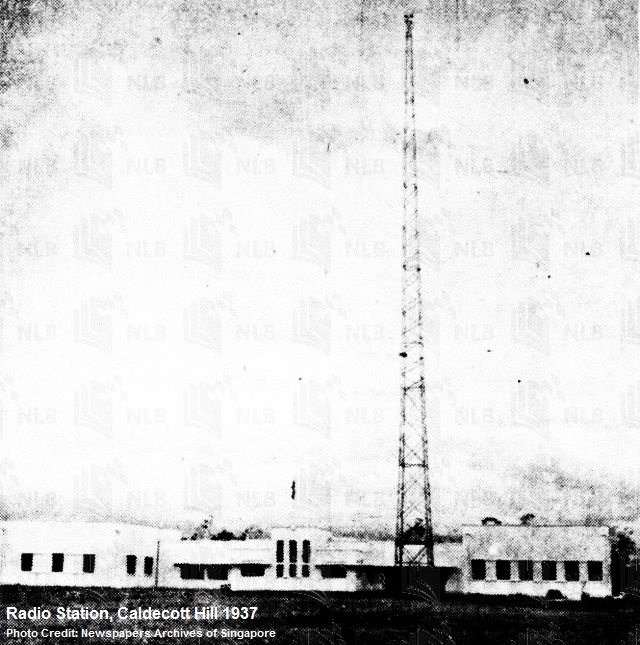
The radio station was officially opened on 01 March 1937 by then-British governor Sir Shenton Thomas (1879-1962), marking a new era in Singapore’s radio sector. It was after more than four years of testing and pilot runs from a temporary studio. The new station was made up of a single-storey building that had transmission, administration as well as accommodation rooms.

The most prominent feature of the radio station was the 2kW-powered mast, at 200-ft tall, that functioned as the signal transmitting and receiving structure. The staff had to adjust the mast’s height whenever the station’s wavelength was required to be changed.

Caldecott Hill Estate

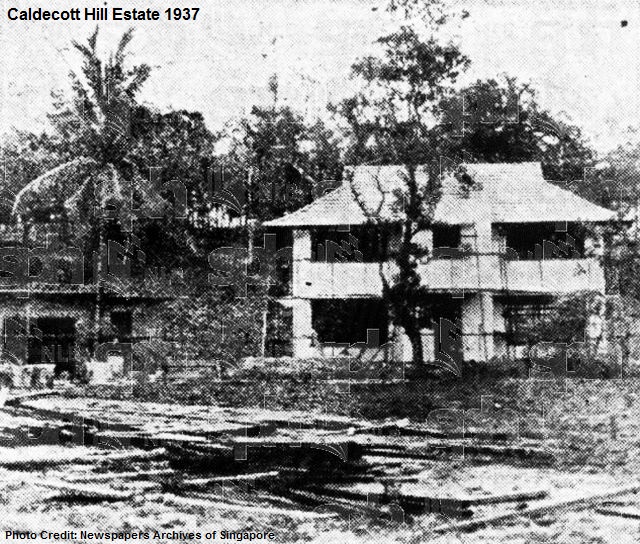
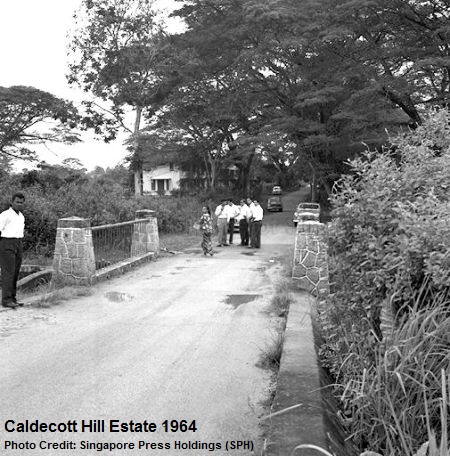
The Caldecott Hill Estate flourished with the establishment of BMBC. As many as 70 new houses were built within 100 acres of land at the residential estate in 1937, in a project launched by a private company named Fogden, Brisbane and Co., to accommodate the personnel working at the new broadcasting service.

The up and coming Caldecott Hill Estate was one of the earliest suburban residential estates to be fitted with modern sanitation. This was an attractive feature then, considering the Municipal sewerage system was still percolating through Geylang and Katong, and would take several more years before it reached the suburbans.

Second World War

The British government acquired BMBC in 1940, restructuring it as the Broadcasting Station, Posts and Telegraph Department, Singapore and the Federated Malay State). A year later, the operation was taken over by the new Malayan Broadcasting Corporation (MBC), a joint venture between the governments of the Straits Settlements and the United Kingdom.

News of the Second World War and potential Japanese aggression in Southeast Asia soon filled up the radio airtime as thousands of listeners anxiously waited for the latest updates.

When the enemies inched in by early 1942, the Caldecott Hill radio station and studios were quickly abandoned with the radio mast and transmitter destroyed. When Singapore fell, the Japanese military took over the station and repaired it, changing its name to Syonan Hoso Kyoku. A Caldecott Hill camp was also set up nearby, where the Japanese imprisoned, interrogated and tortured many Australian prisoners-of-war.

During the war, the British Ministry of Information carried out broadcasting to enemy-occupied territories in the Far East through a confidential British Far Eastern Broadcasting Service (BFEBS). It came under the British Foreign Office after the war and had its office briefly at Caldecott Hill, operating with sixty European directors, technicians and announcers. It later became known as the Voice of Britain and its facilities were used as a relay station for BBC.

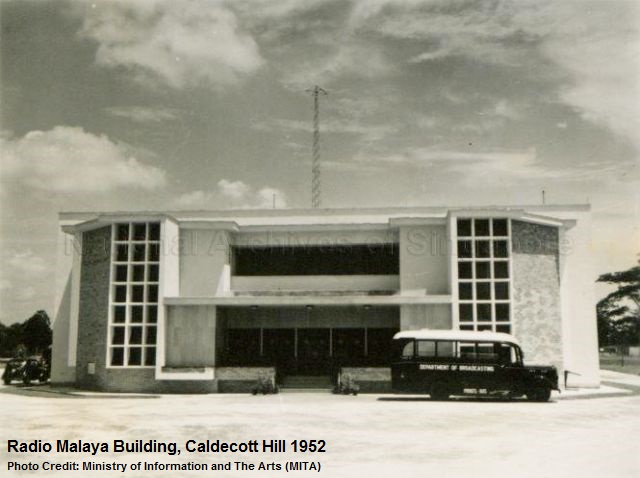
Radio Malaya, under the charge of Department of Broadcasting, later shared the Caldecott Hill premises with BBC when they left their Cathay Building headquarters and moved into the new $430,000-building in 1951.

Property Boom

The late forties, after the war, was a period of property boom. Many properties and estates exchanged ownership. In 1947 alone, the transaction in properties hit $7 million. The Caldecott Hill Estate, like many others, was sold in that year.

It was purchased by India-born Parsi entrepreneur Navroji R. Mistri (1885-1953) for $1 million, an astronomical figure during that time. A successful and wealthy entrepreneur who built a soda water business empire in Singapore and Malaya, Navroji Mistri was better known for as a philanthropist. Dubbed as the godfather of the poor, he had donated millions of dollars to hospitals, universities and charities dedicated to Singapore’s poor children.
Mistri Road, off Shenton Way, was named in honour of him.

In the mid-fifties, Dale Marden and Co., a Singapore housing development company, launched an ambitious project to build more than 700 detached, semi-detached and terrace houses in Singapore, Malaya and Sarawak. 49 of the Singapore houses were constructed at Caldecott Hill, while the rest were built at Thomson Road, Upper Serangoon Road and Carlton Green.

Caldecott Hill Estate had been a residential estate for the upper-middle class. One of its prominent residents were cinema magnates Runme Shaw and Run Run Shaw, who owned a double-storey bungalow worth $80,000.
The estate, like other residential estates in Singapore, was constantly bothered by the squatter issues in the late fifties and early sixties, where scattered rows of illegal attap houses were erected without permission.

Television Singapura

Radio Malaya split into two in 1957, when the Federations of Malaya achieved independence from the British. One branch was relocated to Kuala Lumpur, retaining the name Radio Malaya (changed to Radio Malaysia in 1963), and went on air in 1959. The other was renamed as Radio Singapura, and operated from the original studio at Caldecott Hill.

Singapore wanted to explore the feasibility of a television service in the early sixties. A Japanese Colombo Plan team of experts was invited to survey the situation and make recommendations to the Singapore government. The report convinced the government to inaugurate a television service, and the Ministry of Culture was assigned to lead the project.

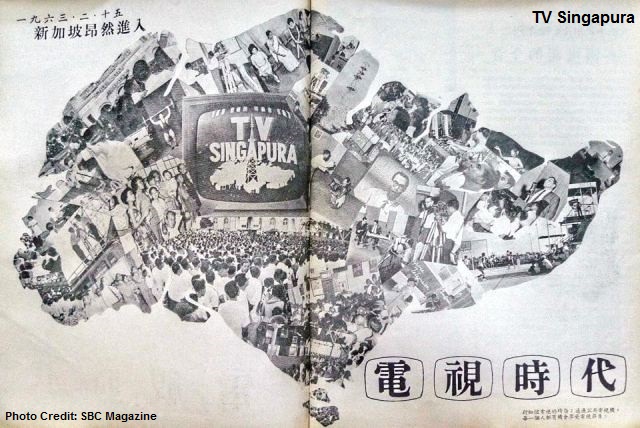
After three years of study, Television Singapura ran its first pilot television service on 15 February 1963. Although the television telecast lasted only an hour, it was nevertheless a great achievement and significant milestone.

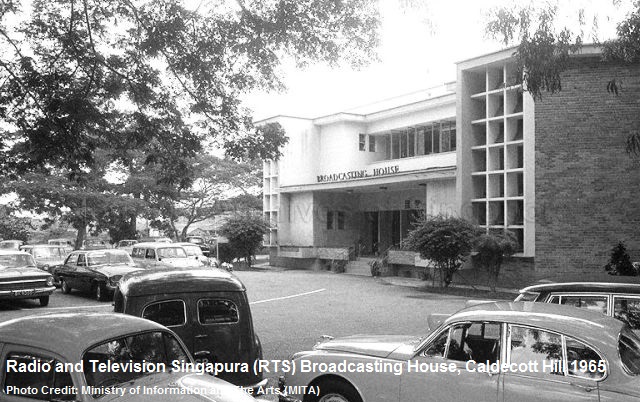
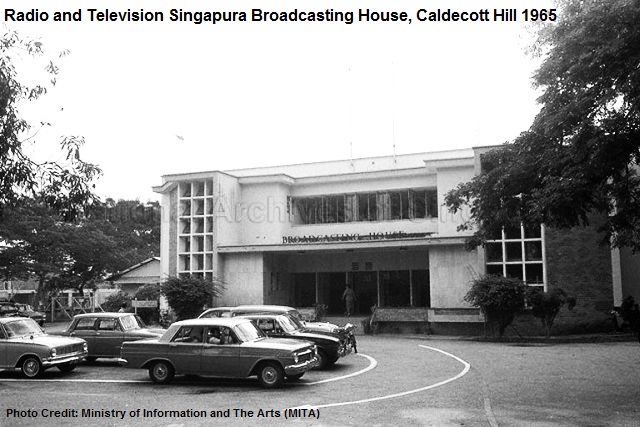
The new television service adopted the CCIR 625 line system and telecast on Channel 5 at 174 to 184 megacycles a second, operating from the Caldecott Hill Broadcasting House and using a permanent television transmitter building and tower at Bukit Batok.

The daily programme was soon extended to four hours, and a second channel, Channel 8, was introduced later that year. Films, documentaries, children’s shows, sports, variety entertainment and news made up the programmes, which came in English, Malay, Mandarin, Tamil, Hokkien and other Chinese dialects.

The newly-established Television Singapura started recruiting experienced staff from overseas and local employees were sent to Japan, Australia and Britain for training.

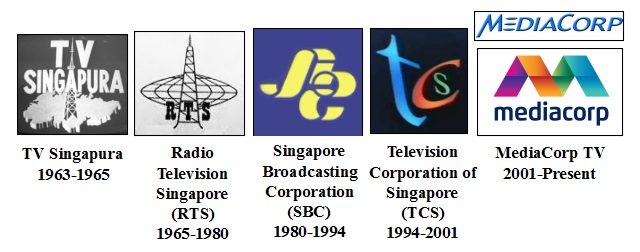
In August 1965, with the independence of Singapore, both entities of Radio Singapura and Television Singapura were combined to form the Radio and Television Singapore (RTS).

The license fees for television sets were set at $24 per year, or $2 a month. A luxury item in the sixties, a television set was not affordable for many families in Singapore. Hence, residents would often gather at the community centres at night to catch their favourite programmes.

Trivia: Former Prime Minister Lee Kuan Yew’s tearful TV interview on the separation of Singapore from Malaysia had become one of Singapore’s iconic moments in history.

State-of-the-art Studios

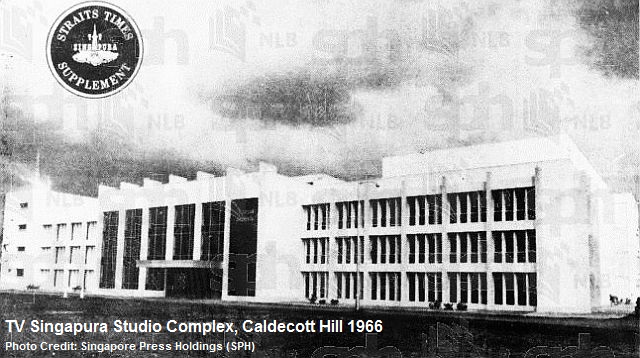
By 1966, TV Singapura had its new $3.5-million studio complex at Caldecott Hill completed. The site was acquired from an owner named Liu Hsue Ying at a cost of $485,000, or 92 cents per square foot, in a controversial deal that developed into a legal tussle. The Singapore government later compensated her another $120,000.

The opening of the new modern four-storey studio complex, fitted with a further $2-million worth of equipment, by former Prime Minister Lee Kuan Yew on 26 August 1966, meant that Singapore now had one of the best TV studios in Asia.

The state-of-the-art complex was also designed with the plan of introducing colour television within the next 10 years. In the mid-sixties, colour television service was highly costly for newly developing countries and Japan was the only Asian nation to provide colour television service.

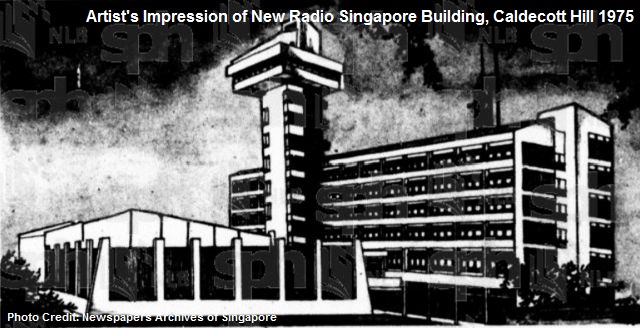
The development of amenities at the Caldecott Hill studios sped up in the seventies. In 1972, the Radio House was added with a $485,000 full air-conditioning system. Three years later, in December 1975, a new Radio Singapore complex, featuring a six-storey office tower, auditorium, recording studios, tape library and canteen, was constructed at a cost of $4.2 million.

TV viewership also rapidly increased. By 1971, there were almost 200,000 licensed TV sets in Singapore. This was compared to only 7,000 when television service made its debut in Singapore in 1963, and 57,000 in 1964.

The TV viewers’ appetite and expectation also grew in the seventies as watching TV shows became a daily routine. Among the feedback to RTS were “feature films are too old, why can’t we get better ones?” and “are the Cantonese the privileged class that everyone must keep watching Cantonese films?”.

Other vocal viewers called for more war movies, Hindi films, religious programmes, children play-and-learn shows, repeat of Sesame Street on Sunday mornings and even a third TV channel.

Trivia: RTS celebrated Singapore’s 10th anniversary of television service in 1973 with an one-hour variety show performed by Anita Sarawak.

TV World of Colours

By 1973, Singapore was getting ready for colour TV service. Some $3.1 million was budgeted by the Ministry of Culture for Caldecott Hill’s new offices, studios, film processing units and printing laboratory. Another $1.2 million was used to purchase two transmitters, and a further $2.9 million spent on preliminary works.

Producers and engineers were sent to Britain, West Germany and Holland for retraining in colour TV programme production and techniques. Even the Singapore Polytechnic began offering diploma courses in colour TV. The institute had previously produced more than 500 graduates in electronics and communication engineering, which enabled them to have the knowledge adapting themselves to the needs of colour TV.

The moment finally arrived in 1974, as it was the first time TV telecasts in Singapore was shown in colours. The World Cup final on 07 July 1974, shown live on TV, was a pleasant surprise to many football fans as RTS’ colour TV transmission was not expected to commence until August that year.

Other viewers eagerly anticipated the coloured telecast of popular American drama series such as Kung Fu, Ironside, Cannon, Medical Center and Shaft. Local shows and productions in colours, however, were presented to the audience only after 1976.

Colour TV sets, at those years, were almost three times more expensive than the monochrome ones. But with the expected increasing demands, local TV set manufacturers and assemblers such as Setron started producing colour TV sets at competitive costs in the mid-seventies.

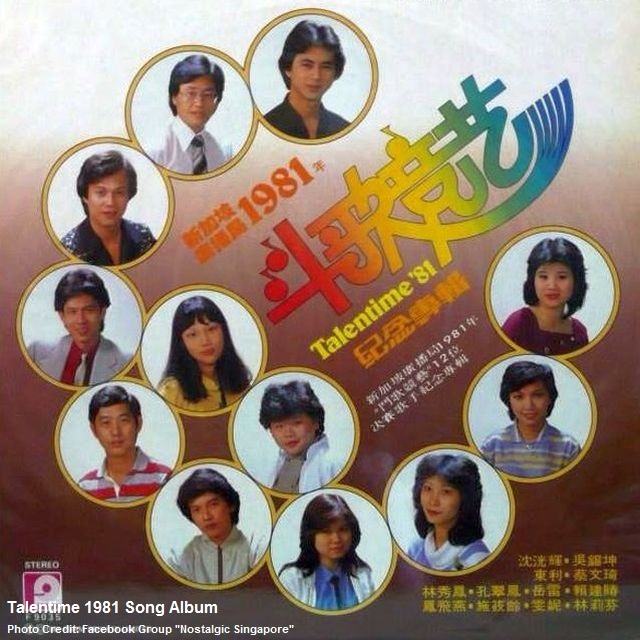
Local productions developed significantly in the late seventies and early eighties. Intellectual competitions such as the inter-school Science & Industry Quiz and  Science Challenge were regularly held at Caldecott Hill. Other popular variety shows and contests such as Sharp Night and Talentime were well-received by the TV audience.

RTS also progressed in its live telecast in 1978. The Science & Industry Quiz and Talentime went live on TV for the first time. Previously, only the matches of the Malaysia Cup finals, National Parades and news were telecast live. In addition, on-the-spot reporting was included in the news.

Trivia: The costly project in colour TV service was almost abandoned by the government due to the 1973 oil crisis, which impacted Singapore’s economy.

Singapore Broadcasting Corporation

The beginning of the eighties saw another milestone in the broadcasting history of Singapore. Corporatised on 1 February 1980, RTS was renamed Singapore Broadcasting Corporation (SBC) and became the Singapore government’s latest statutory board.

The switch was not met with optimism from the TV viewers, who had already gotten used to RTS. The new entity received complaints that its acronym SBC was easily confused with the Singapore Bus Service (SBS). Others sarcastically mocked that SBC stood for “si bei cham” (damn terrible in Hokkien).

But SBC would slowly improve over time. In 1980, it went full colours when the last 10% of its locally produced shows switched from black and white. Then it introduced many popular American series, BBC documentaries, Hong Kong dramas and Taiwanese serials as well as local variety shows such as the Datsun Show. The highly successful Talentime singing contest, categorised in English, Mandarin, Malay and Tamil languages, continued.

By the end of 1980, most viewers were generally satisfied with the TV programmes scheduled by SBC.

In the early eighties, SBC aggressively recruited singers, actors, actresses and dubbing specialists from Malaysia and Taiwan to enhance its Mandarin TV programmes. There were also cultural exchanges with the Hong Kong artistes, producers and scriptwriters.

Locally, a drama training course was established in 1982 to develop Singapore’s own drama artistes, singers, dancers and other production staff, as SBC readied itself to produce a series of planned Mandarin drama series. When the first application window opened in late 1981, more than 5,000 people, largely between 16 and 24 years old, signed up.

Other than Chinese TV programmes, SBC also rolled out its Tamil productions on Channel 8. One of its earliest Tamil dramas was Chitiram Pesuthadi, although it was not very well-received by the Indian viewers.

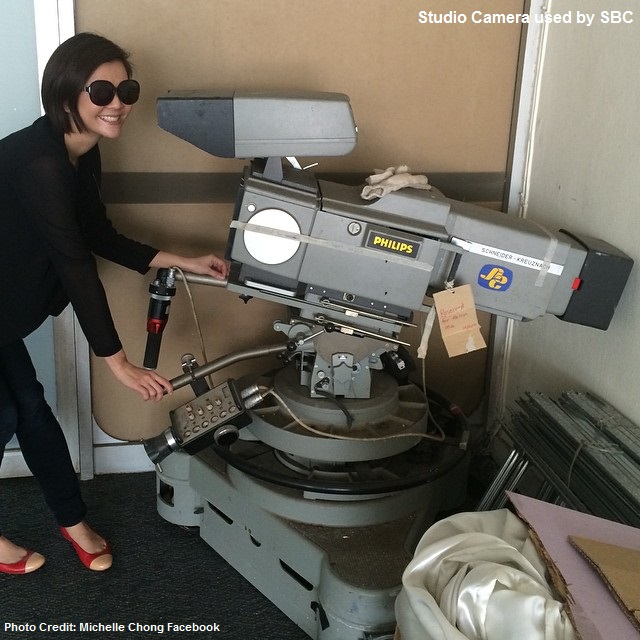
Trivia: From Arriflex BL to the Marconi Mk IV, the cameras used for shooting dramas and shows had evolved throughout the decades. The Marconi Mk IV cameras were retired when colour TV service was introduced.

The Awakening

In 1983, SBC created a 2,000-square-metre large village, on the former grounds of the radio building, for the ambitious filming of multi-episode drama The Awakening (雾锁南洋, previously named Fog Over Nanyang).

Replicating scenes from old Chinatown, Singapore River, Emerald Hill and Joo Chiat, the crews put together a collection of realistic props in jinrickshas, bullock carts, antiquated tubby postboxes and fire hydrants for the “village”. Kampong houses, shophouses, warehouses, back alleys and even a boat quay were also set up to accommodate the blockbuster drama whose storyline was cast between the 1920s and 1940s.

Extensive studies were conducted on tea houses, wayang halls and Chinese clan associations to ensure the details were as accurate as possible. A permit was also obtained from the Ministry of National Development for SBC’s largest project till date.

The Awakening was one of the early blockbuster dramas produced by SBC. Building on its success, SBC, and later TCS, moved on to produce many memorable dramas throughout the eighties and nineties.

Other Milestones

In January 1984, SBC added a third channel – Channel 12 – after Channel 5 and 8. The purpose of a third channel was to simulate the public’s interest in the arts as well as to provide information and instructions. The new TV channel mainly focused on programmes such as Broadway plays and musicals, Shakespearean and contemporary plays, forums and debates, classical music, jazz and brass band concerts, Western and Chinese operas, classic dramas and films, and historical documentaries.

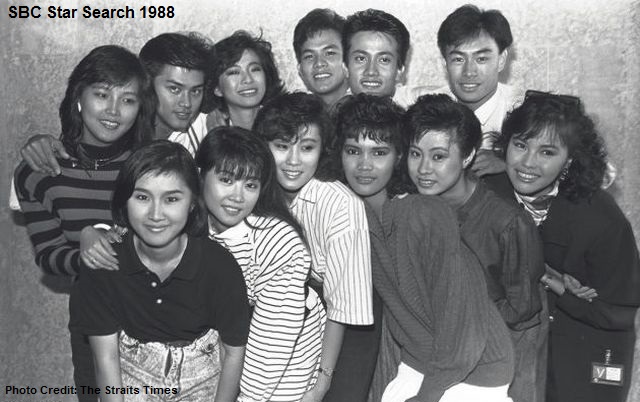
The Star Search 1988 was SBC’s first attempt to discover new talents for its Mandarin dramas, and the contest entered its 10th installment in 2010. Meanwhile, the Star Awards was started in 1994.

In the same year, SBC was privatised and restructured into Television Corporation of Singapore (TCS), Radio Corporation of Singapore and Singapore Television Twelve (STV12), all came under a single holding company called the Singapore International Media (SIM). TCS continued to operate Channel 5 and 8, while STV12’s Channel 12 evolved into Prime 12 and Premier 12 in 1995.

In 1999, Channel NewsAsia, a news and current affairs channel that was broadcasted in many parts of Asia, was launched. Then SIM was rebranded as MediaCorp Singapore. In the two years that followed, TCS became MediaCorp TV, while Prime 12 and Premier 12 became known as Suria and Central (Vasantham Central, Kids Central and Arts Central) respectively.

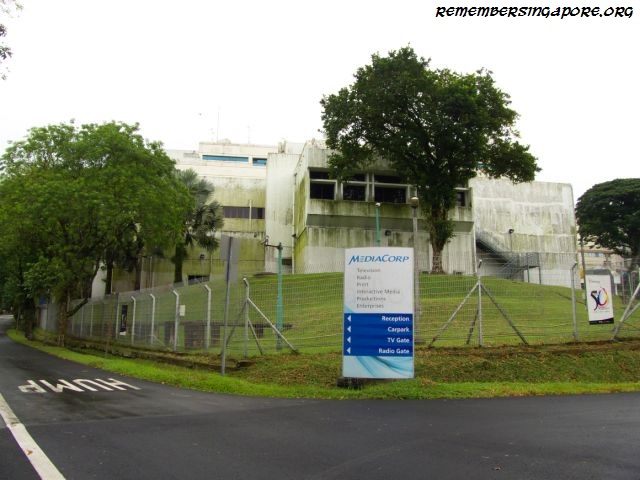
In 2015, MediaCorp began shifting to its new Mediapolis broadcasting centre at Buona Vista. With the relocation completed by 2017, it also spelt the end of Caldecott Hill’s 82-year-old role as Singapore’s broadcasting centre. The vicinity is expected to be redeveloped in future, although no detailed plans have been released yet.

Date: 16 April 2017

Posted in Cultural, Historic | Tagged , , , , , , , , , , , , , , , , , , , , , , , , , , , , , , , , , , , , , , , , , , , , | 9 Comments

A Brief Jewish History in Singapore

After the British East India Company established Singapore as a trading post in 1819, various trading communities began to arrive and settle on the island, one of which was the Jewish community. Although there was only a handful of them in Singapore in the early 1830s, by 1858, the population grew to almost 20 Jewish families. Known as the Sephardi or Oriental Jews, most of them were born in India and had their ancestries traced back to Baghdad.

Another group of Jews – the Ashkenasi Jews – arrived much later and were from Germany and other parts of Europe. Largely engaged in trading and the merchandise businesses, they associated with the Europeans regularly and distanced themselves from the locals and even the Sephardi Jews in Singapore.

The early Jewish settlers lived at Boat Quay, moving later to North Bridge Road, Dhoby Ghaut, Mount Sophia and the Rochor vicinity. Their numbers gradually grew – by the Second World War, there were more than 800 Jews in Singapore. During the war, Nazi Germany requested Japan, under the Axis alliance, to kill all the Jews within its boundary. The Japanese did not carry out the genocide, but the Jews were nevertheless brutalised and suffered like other races in Singapore. Many of them were rounded up and imprisoned at the Changi Gaol and Sime Road Camp.

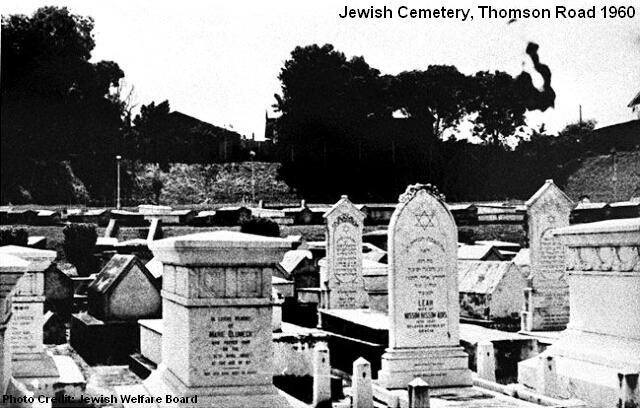
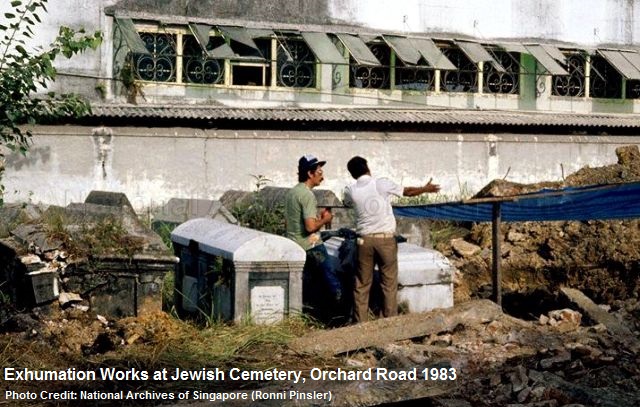
The early Jews had built their own cemetery in Singapore in the mid-19th century. It was located behind the Fort Canning, and was known as the Old Cemetery. The Jewish cemetery was later moved to the Moulmein area, near the junction of Thomson Road and Newton Road, and contained mostly the burials of the Jews that died between 1904 and 1973. Together with another Jewish cemetery at Orchard Road, it was exhumed and cleared by 1985 due to the construction of the new Mass Rapid Transit (MRT) stations.

A Jewish house of worship is called a synagogue. There are two synagogues in Singapore – the Maghain Aboth Synagogue and Chesed-El Synagogue – both are of significant historical values.

Maghain Aboth Synagogue

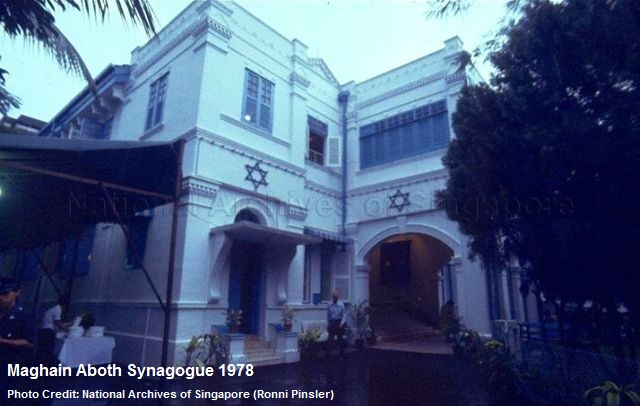
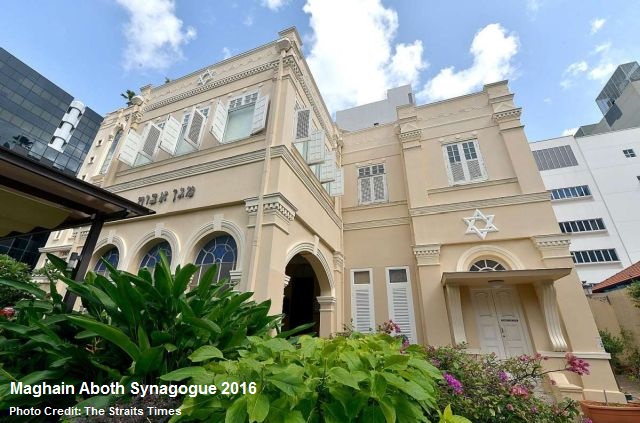
The Maghain Aboth Synagogue – its name means “Shield of our Fathers” – is the oldest synagogue in Singapore as well as Southeast Asia. The building was built in 1878, but its history went back to almost 1841, when the British colonial government granted the Jewish community a plot of land to built a double-storey shophouse that functioned as their synagogue. The street where the synagogue stood was later named Synagogue Street.

By the 1870s, there was a need for a larger synagogue to accommodate the growing local Jewish community. Wealthy Jewish businessman and community leader Sir Manasseh Meyer (1846-1930) pushed for the acquisition of a piece of land at Waterloo Street to be used for the construction of the Maghain Aboth Synagogue. The old synagogue was subsequently sold and demolished after the Second World War.

In 1978, during Maghain Aboth Synagogue’s 100th anniversary celebrations, David Saul Marshall (1908-1995), Singapore’s first Chief Minister, addressed the community at the synagogue as a Jewish elder and unveiled the seven-branched candle stand menorah, a symbol of Judaism. The synagogue was also visited by former Israeli President Chaim Herzog in late 1986 when he stopped over for a three-day trip at Singapore.

On 27 February 1998, the Maghain Aboth Synagogue was gazetted as one of Singapore’s national monuments.

Chesed-El Synagogue

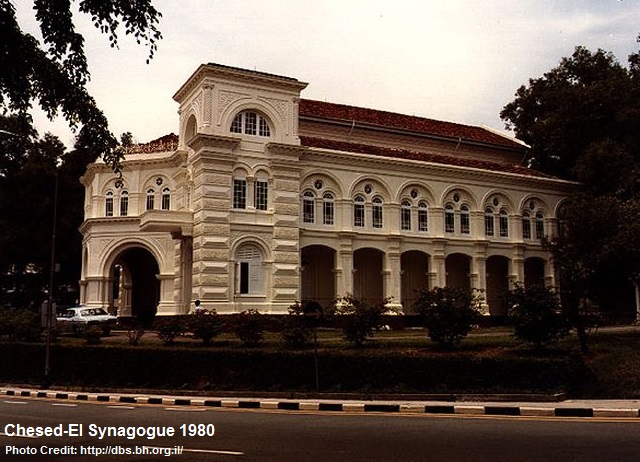
Meaning “bountiful mercy and goodness of God”, the Chesed-El Synagogue was built in 1905, initially as a private synagogue, by Sir Manasseh Meyer, who was increasingly bothered by the differences, especially in the ritual and service matters, between the local Jews of Asian and European backgrounds.

Designed in late-Renaissance style, the synagogue was situated near Meyer’s residence Belle Vue at Oxley Rise. During the Second World War, the building was taken over by the Japanese military to be used as a storage for ammunition and other goods. The synagogue was opened up after the war for the local Jewish community. Like the Maghain Aboth Synagogue, the Chesed-El Synagogue was also gazetted, on 18 December 1998, as a national monument.

Other than the two synagogues, there are also several buildings that represent the influences and legacies of the Jewish pioneers in early Singapore.

David Elias Building

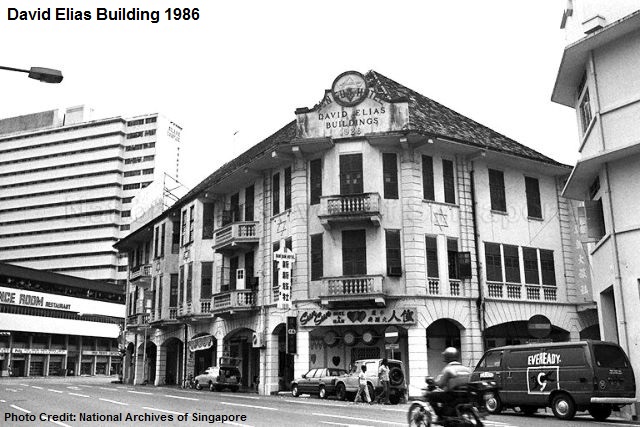
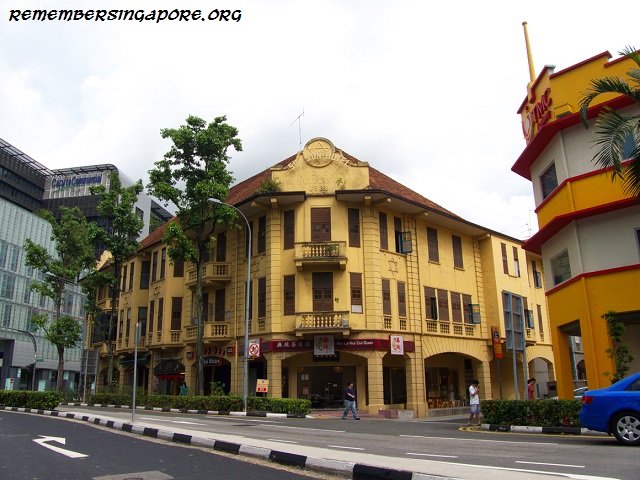
One of the best known Jewish-influenced landmarks in Singapore is the David Elias Building, located at the junction shared between Middle Road, Selegie Road and Short Street. The three-storey building was built in 1928 and was named after its owner David Elias, who had set up a trading company in Singapore in the early 20th century.

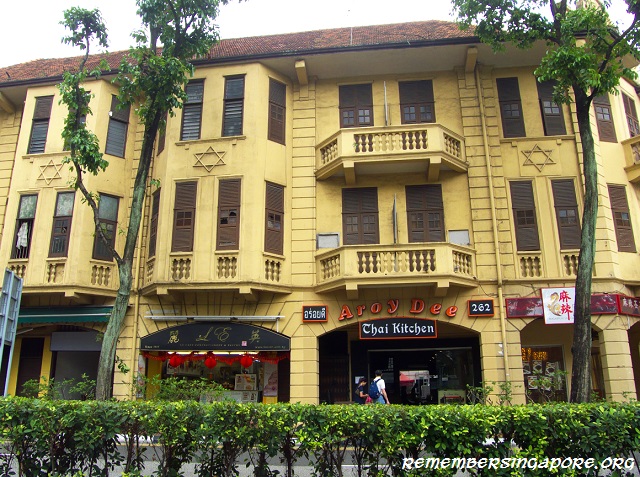
Architectural firm Swan & Maclaren was the designer behind the building, which featured extensively the neo-classical style made popular in the 1920s. Its most eye-catching feature is the pitched roof with a concrete frontage inscribed with a six-pointed Star of David, the name “David Elias Building” and “1928”, the year of its completion.

The David Elias Building was given the conservation status on 28 October 1994.

Ellison Building

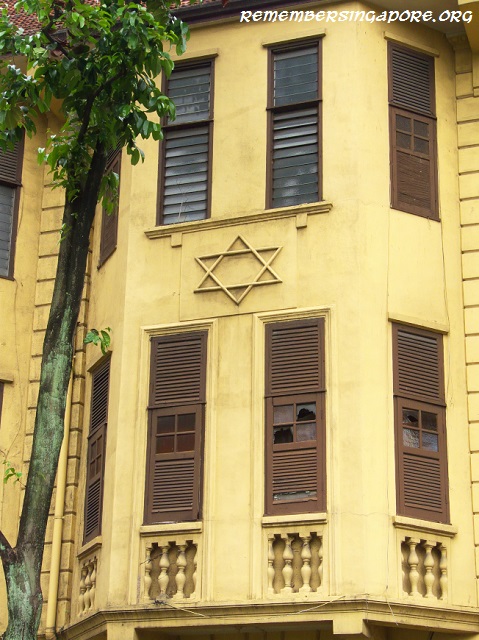
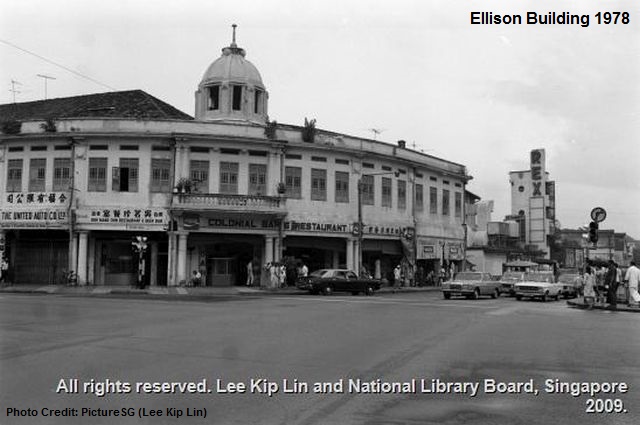
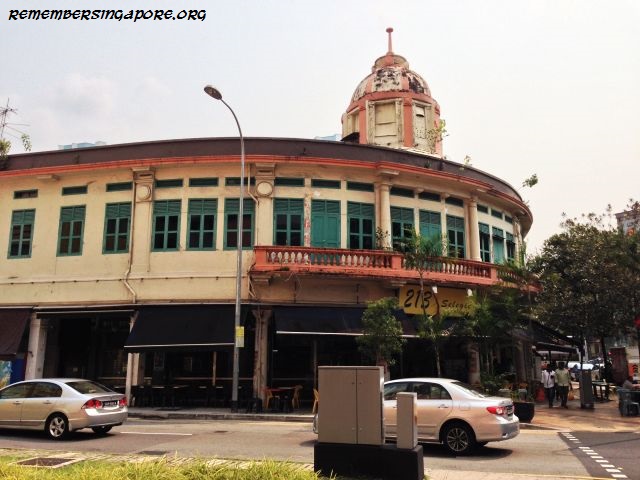
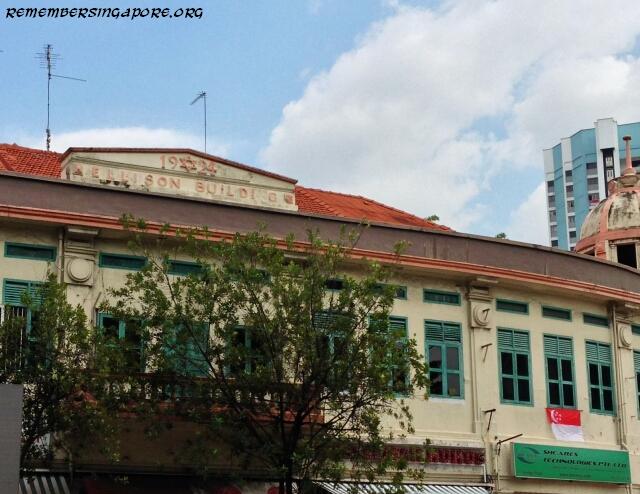
The Ellison Building is another landmark in the Rochor vicinity that was built and owned by a Jewish. The construction of the double-storey building, with its prominent curved facade and two semi-circular domes, was completed in 1924 and belonged to Issac Ellison’s (1864-1928), a wealthy local Jewish businessman and community leader.

It was said that during the pre-independence days, the British governors would sit at the building’s upper balconies, during the Sundays, to watch races that were held at the opposite Race Course Road.

The Ellison family owned the building until 1989, when they sold it to a private developer. In 2003, the building was gazetted for conservation, as part of the Mount Sophia Conservation Area project. It, however, came into the spotlight in 2016 when the government announced that parts of the building will be demolished, to make way for the new underground North-South Corridor, and reconstructed.

Like the David Elias Building, the Ellison Building also has its name, year of construction and a Star of David embossed on its roof.

Other notable houses in Singapore that were built and owned by the early Jews are former Prime Minister Lee Kuan Yew’s residence at Oxley Road, built by a Jewish merchant in the late 19th century, and the Beaulieu House located at the end of Sembawang Road. The Beaulieu House was said to be built in the 1910s by a Jewish family who used it as a holiday bungalow. It was acquired by the British government in 1924 when the Sembawang Naval Base was constructed, and was subsequently occupied by a British superintending civil engineer and naval admirals.

Several roads in Singapore were also named after the early Jewish community leaders, prominent businessmen and philanthropists who had contributed much to the society.

Meyer Road was named after the above-mentioned Sir Manasseh Meyer. Others are Adis Road, Elias Road and Solomon Street, named after Nissim Adis (1857-1927), Joseph Aaron Elias (1881-1949) and Abraham Solomon (1798-1884) respectively. In addition, Amber Road was named after Joseph Elias’ family clan name.

Frankel Estate was named after the Frankel family, who owned large plots of coconut palm plantations at the vicinity in the early 20th century. Dealing in textile and furniture businesses as well, they also contributed to the development of the neighbouring Opera Estate.

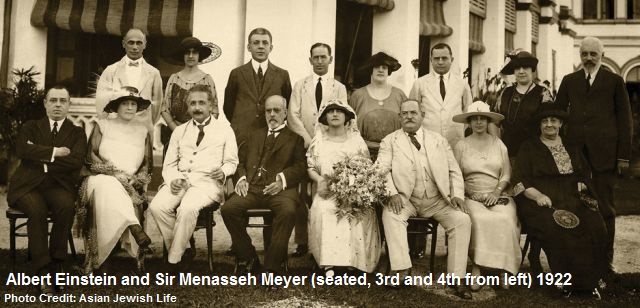
In 1923, the Jewish community living at Frankel and Opera estates were visited by famous physicist and Nobel Prize winner Albert Einstein, who was also a distinguished guest at Sir Menasseh Meyer’s grand Belle Vue a year earlier.

Other Jews pioneers who had stamped their legacies in Singapore include Abdullah Salleh Shooker (1849-1942), a Baghdadi Jewish businessman who started by working for Sir Manasseh Meyer. He later became successful himself but died in captivity during the Japanese Occupation. After his death, part of Abdullah Shooker’s estate were donated to take care of the poor and sick Jews in Singapore, Palestine and Baghdad, while his colonial bungalow at Wilkie Road became a welfare home.

Jacob Ballas (1921-2000), a successful stockbroker, philanthropist and Jewish leader, was another well-known Jew in Singapore. Born in Iraq, he and his family moved to Labuan, North Borneo, before settling in Singapore in the 1920s. Despite being a brilliant student, Jacob Ballas could not afford his further studies after secondary education. A young Jacob Ballas became a car salesman and insurance agent before finding success in the stock exchange after the war.

By the sixties, he became a millionaire and was appointed the chairman of the Malaysia and Singapore Stock Exchange. Jacob Ballas had been an active philanthropist, donating generously to the community and synagogues. After his death, his estate and assets benefacted many charities in Singapore. The Jacob Ballas Centre and Jacob Ballas Children’s Garden at the Singapore Botanic Gardens are named after him.

Published: 26 March 2017

Updated: 03 April 2017

Posted in Historic | Tagged , , , , , , , , , , , , , , , , , , , , , , , , , , , , , , , , , , , , , , , , , | 11 Comments

15 February – A Trip to The Bukit Batok Memorial

bukit-batok-memorial1

Today marks the 75th anniversary of the fall of Singapore.

During Japan’s invasion of Singapore, one of the fiercest battles between the Allied troops and the aggressors took place at the Bukit Timah area. It was also near the former Ford Factory, where the General Commanding Officer (GOM) Malaya Lieutenant-General Arthur Ernest Percival (1887-1966) eventually surrendered Singapore to Japan. That day was 15 February 1942, the beginning of Singapore’s darkest moments in history.

At the end of April 1942, the Japanese took more than 500 British and Australian prisoners-of-war (POWs) from the Changi Camp. Yamashita Tomoyuki, the Japanese Commander-in-Chief, had ordered the construction of a memorial to commemorate the Japanese soldiers that had died in the battle for Singapore. It was to be built on a small Bukit Batok hilltop that overlooked the place where the battle took place.

bukit-batok-memorial3

bukit-batok-memorial2

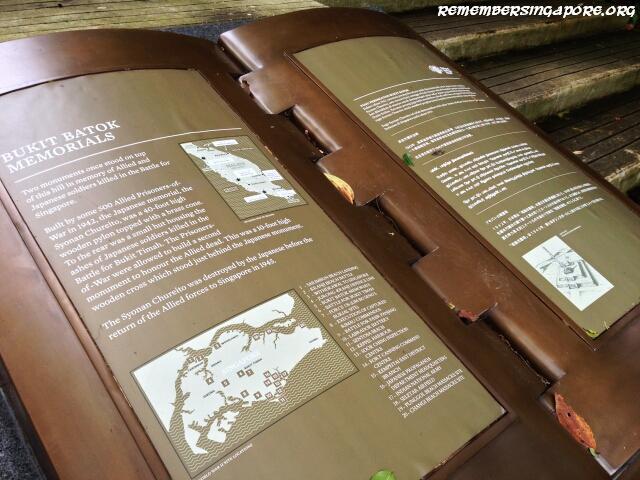
Under the Japanese’s supervision, the POWs were forced to flatten the land and construct a long flight of steps that would lead to the memorial. A 40-feet tall cylindrical pylon capped with a brass cone was built on a double-tier platform, surrounded by gravel paths and a wooden fence. The finished monument was named Syonan Chureito. A small shrine was also set up at the base of the structure where it was used to store the ashes of the dead Japanese troops.

The Allied POWs also wanted to build a memorial for their fallen comrades. The Japanese initially refused, but later accepted the request as they thought the gesture would show their magnanimity. Hence, at the back of the monument, a 10-feet tall wooden cross was erected as a memorial for the perished Allied soldiers.

syonan-chureito-bukit-batok-1942

The Syonan Chureito was officially unveiled by the Japanese on 10 September 1942, whereas the Memorial Cross was unveiled a day later. During the unveiling ceremony, the local community leaders were forced to attend. The local Chinese were represented by Dr Lim Boon Keng, the Malays by Ibrahim bin Haji Yaacob, the Indians by S.C. Goho and the Eurasians by Dr C. J. Paglar.

Throughout the Japanese Occupation, the memorial was frequently used as the venue for Shinto ceremonies and services to honour the Japanese soldiers who had died in Southeast Asia. At the end of the occupation, the Japanese, fearing that the returning British would commit sacrilegious attacks on their sacred site, destroyed the monument. Likewise, the Syonan Jinja at the MacRitchie Reservoir was burnt down. The ashes of the dead Japanese soldiers were transferred to the Japanese Cemetery Park at Chuan Hoe Avenue.

bukit-batok-memorial-lorong-sesuai-1995

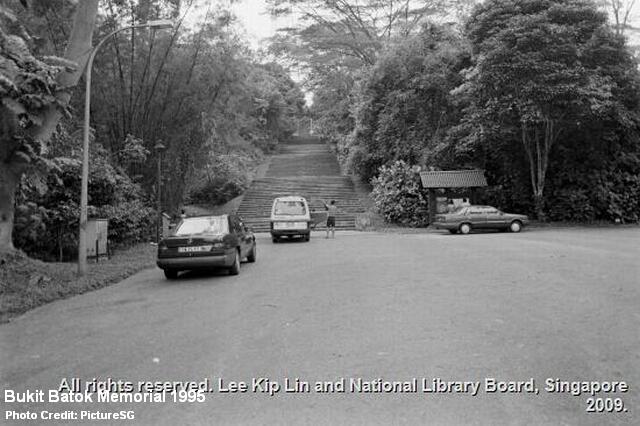
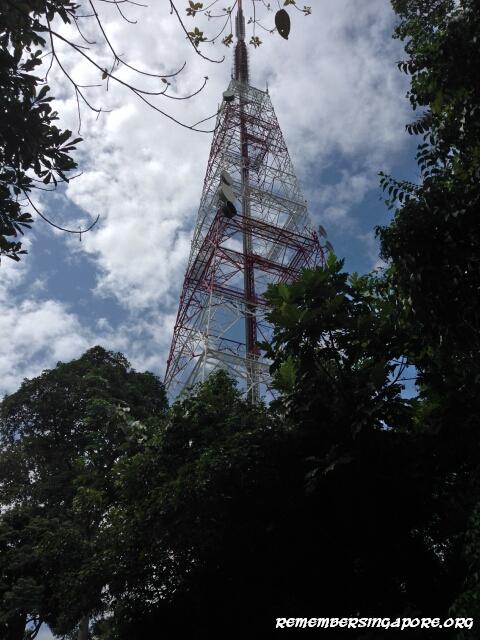
Today, none of the Syonan Chureito structures had remained, except for the 121 concrete steps and Lorong Sesuai, the small road that once led to it. A television transmitting tower now stands tall at the original site of Syonan Chureito. The site was gazetted by the National Heritage Board in 1995, during the 50th anniversary of the end of the Pacific War, as one of the 11 World War II sites (later increased to 20) in Singapore.

transmitting-station-bukit-batok

Published: 15 February 2017

Posted in Historic | Tagged , , , , , , , , , , , | 1 Comment

Singapore Trivia – The Tree of One Tree Hill

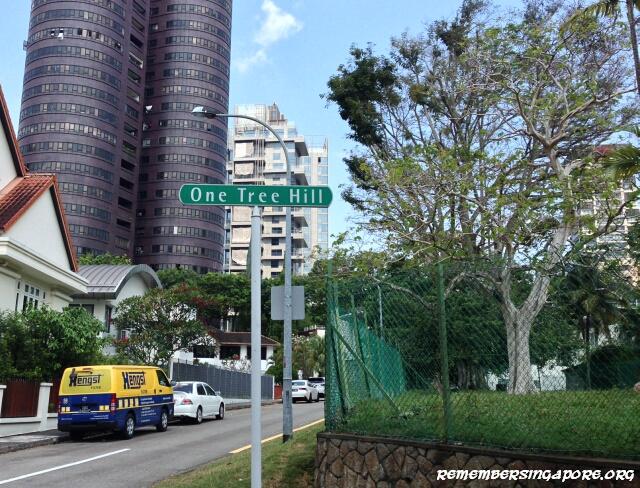
At the prime district of Orchard lies a road with an interesting name – One Tree Hill.

one-tree-hill-street-signage2

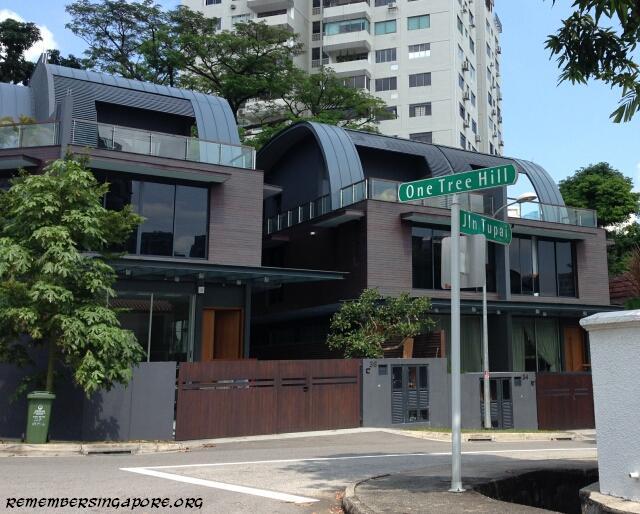
Located off Grange Road, the 500m-long road is home to rows of private residences and condominiums today. But in the 19th century, it was a vast rubber plantation owned by Guthrie & Company. One of Singapore’s early leading trading houses, Guthrie & Company was established in 1821 by Alexandre Guthrie (undetermined-1865), a Scotsman who was granted a license by the British East India Company to trade in the region.

Besides trading of British manufacture goods, Alexandre Guthrie was also engaged in commodities and services such as insurance and shipping. Through his investments in gambier, clove, nutmeg and pepper, he owned several properties and plantations at the Orchard and Tanjong Pagar vicinity.

one-tree-hill-trivia

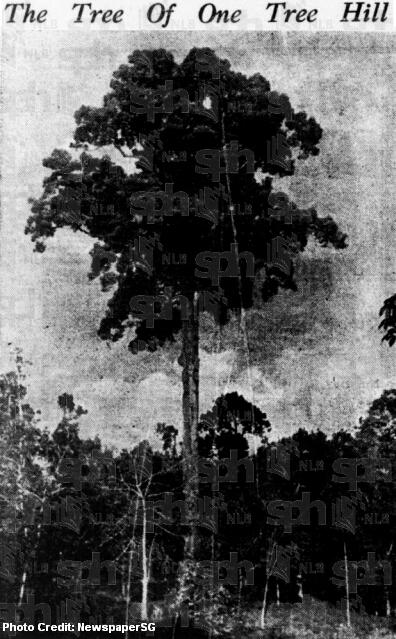
At Alexandre Guthrie’s Orchard rubber plantation, there was a particularly tall tree that obviously stood out among the rubber trees (A mature rubber tree can grow to 30m tall). The tall tree was said to be one of the remaining jungle trees that had survived in the suburbs of Singapore. It was also due to this tall tree that the area was named One Tree Hill.

In the early 20th century, one Tree Hill was home to several British military leaders, including General Theodore Stephenson (1856-1928), who had arrived at Singapore in 1910 to take over the command of the troops in the Straits Settlements, and Major Frederick Lumsden (1872-1918), a General Staff officer.

semi-detached-bungalow-one-tree-hill-1963

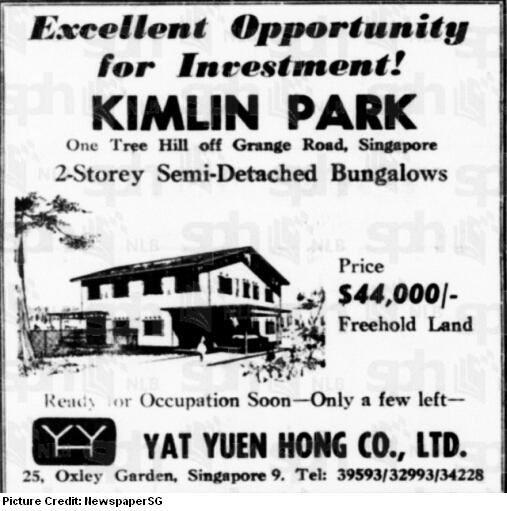
There was a Teochew kampong nearby as well, but by the 1930s, the vicinity had seen many modern houses, furnished with water, gas and electricity supplies, built. In 1963, a double-storey semi-detached bungalow at One Tree Hill would cost $44,000.

New 16-storey apartments were built at One Tree Hill in 1973, where thirty 1,500 square feet units were reserved for the Port of Singapore Authority (PSA) staff at about $65,000 each. The units, intended as a benefit to encourage home ownership among PSA employees, had three bedrooms, one living room, a kitchen, two toilets and a garden terrace. There were also built-in cupboards and high quality sanitary fittings; a carpark lot was even allocated for each flat.

The better perks offered by the One Tree Hill apartments meant that they would be much more expensive than the similar PSA flats at Sporttiswoode Park, which were priced between $23,000 and $26,000 in the early seventies.

one-tree-hill-street-signage1

Besides One Tree Hill, Singapore also has a One Tree Island – Pulau Satumu – where the Raffles Lighthouse is located. Sa refers to satu (one in Malay) and tumu was the Malay name of the large mangrove tree on the island.

Published: 16 January 2017

Posted in General | Tagged , , , , , , , , , , , | 6 Comments

Tales of Kampongs at Old Upper Thomson Road

In the sixties and seventies, the long meandering Old Upper Thomson Road was well-known as a racing circuit for the popular Singapore Grand Prix. A lesser known fact is that it was also home to some long forgotten villages, some of which had been there since the 1910s.

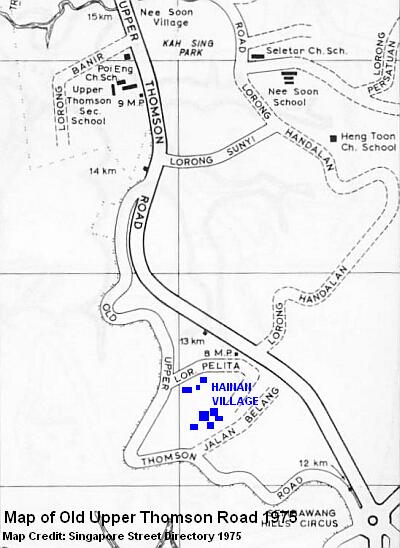
map-of-hainan-village-at-old-upper-thomson-road-1975The village was situated at Jalan Belang, off Old Upper Thomson Road. The short road began as a track and was later upgraded to an asphalt road. By the early nineties, Jalan Belang was expunged after the village was demolished. Remnants of the road could still be observed today.

The name Belang means stripes in Malay, which refers to the wild tigers that once roamed on this island. There were reports of a man killed by a tiger at Thomson Road in 1890, while the last wild tiger went extinct in Singapore when it was shot at Choa Chu Kang Village in 1930.

Jalan Belang was also linked to Lorong Pelita (pelita means light in Malay), another minor road off Old Upper Thomson Road 9 milestone, where they shared a common exit to the main Upper Thomson Road. Like Jalan Belang, Lorong Pelita also became defunct by the early nineties.

Upper Thomson Road, originally known as the New Upper Thomson Road, was constructed in the mid-fifties. After its completion, it served as the major route between Nee Soon and the downtown area.

jalan-belang-village-ruins10

jalan-belang-village-ruins1

In the 19th century, there were large plots of gambier plantations at Upper Thomson, owned by famous Teochew businessman Seah Eu Chin (1805-1883). Between the 1920s and 1940s, the dense Upper Thomson forest became part of a rubber plantation, according to the pre-war Survey Production Centre (Southeast Asia), but it was abandoned during the Second World War. By the fifties, the vicinity had been largely reclaimed by nature, although some parts of it were used for sundry cultivation.

When the Hainanese village settled at Jalan Belang, the vegetation was cleared for residential houses, rambutan plantations, small factories, warehouses and several fish ponds that were used for breeding turquoise discus and other freshwater fish.

jalan-belang-village-ruins2

In 1971, a group of Public Utilities Board (PUB) workers, while clearing the vegetation to lay a water pipe inside the forest at Old Upper Thomson Road 8 milestone, discovered nine century-old graves. The blurred Chinese inscriptions on the tombstones showed that they were put up in the middle of the 19th century, and were owned by the Ong, Tan, Lee and Soh families. This suggested that several Chinese villages might have already been established at Upper Thomson since the 19th century.

jalan-belang-village-ruins3

There were around 500 residents from 80 families living at Lorong Pelita in the mid-seventies. The kampong, largely made up of pig and poultry farmers, had existed at the old Upper Thomson vicinity since the early 20th century. The village huts were scattered along Lorong Pelita and, for many years, it was extremely inconvenient for the residents to make their way to the main Upper Thomson Road. On the other hand, postmen and the PUB meter readers also found it difficult to locate the villagers’ houses.

In 1976, the Lorong Pelita village was in the news when its residents stopped a bulldozer from demolishing a laterite track that linked the village to Upper Thomson Road. The land where the track ran through had been purchased by a private owner, but the villagers needed the track to access to the main road.

jalan-belang-village-ruins4

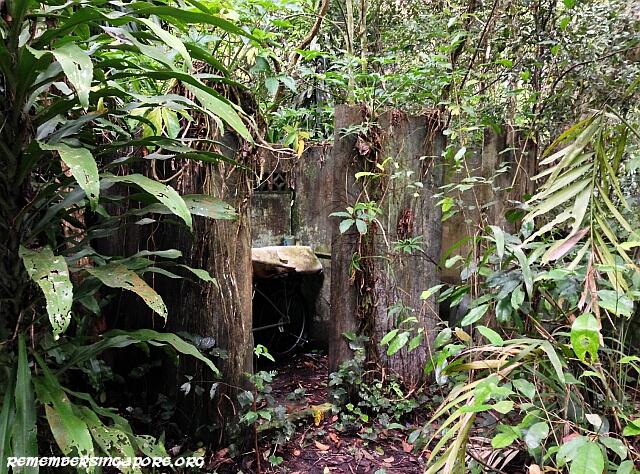
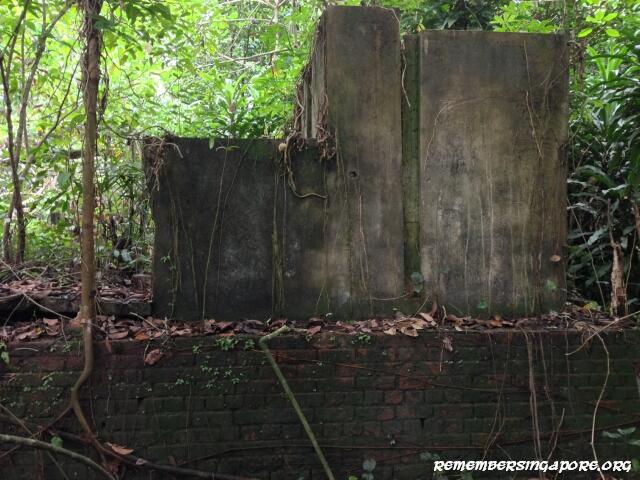
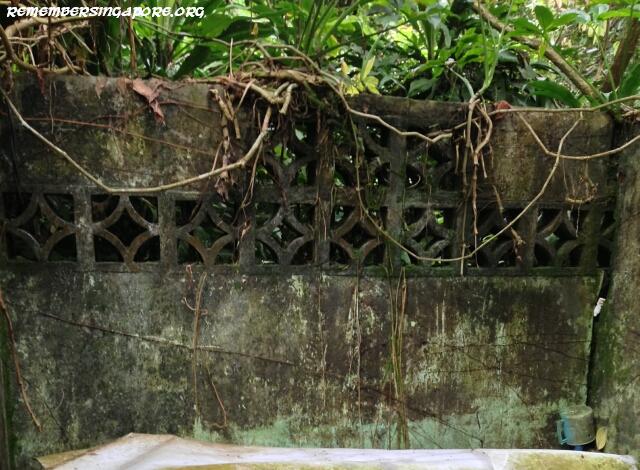
Today, the remnants of the Hainan village at Jalan Belang could still be found. They are mostly the ruins of concrete walls and structures, and have been hidden and consumed by nature for several decades. But the abandoned structures may see the light soon, as they will be part of a new nature trail. The 50-hectare Thomson Nature Park will be developed in 2017 and is expected to be completed by next year.

jalan-belang-village-ruins9

jalan-belang-village-ruins8

jalan-belang-village-ruins6

jalan-belang-village-ruins7

jalan-belang-village-ruins5

Published: 08 January 2017

Posted in Exotic, Historic | Tagged , , , , , , , , , , , , , | 68 Comments

Those Years When We Played Arcade Games Together

After 18 years of operation at Bugis Junction, the Virtualand will be closing their flagship outlet in January 2017. It is hardly surprising, as the popularity of arcades has been gradually declining since the early 2000s, challenged by the rise of LAN gaming centres as well as advanced home video game consoles such as PlayStation and Xbox. By the 2010s, the local arcade industry, already tied down by high rentals and maintenance costs, took another hit by the rapid emergence of mobile games on smartphones and tablets.

arcade-games-1990s

The nineties was perhaps the golden era of local arcade game centres. Various names such as Wywy WonderSpace, Astropolis, Jackie Fun World, Uncle Ringo, Genie Funland, Country Fun World, Super Fun World, Paco Fun World, Circus Circus, E-Zone, Fun Plus, The Wonderful World of Whimsy and Magic Land could probably ring a bell to those who had frequently hung out at the arcade centres during the nineties and early 2000s.

At their peak, arcade game centres could almost be found all over Singapore, from the suburban Ang Mo Kio’s Big Mac Centre, Bedok’s Princess and Empress Cinema buildings and Parkway Parade to the downtown’s shopping malls of Funan, Parklane and Lucky Plaza. Marina South, with its popular arcade, bowling alley and steamboat restaurants, was also another favourite haunt for the youngsters.

circus-circus-arcade-centre-advert-1990s

Ban on Arcade Games

Do you know that video game arcades were once banned in Singapore? In the early eighties, many parents expressed concern that the games had bad influences to young children and teenagers, who could easily be addicted to the gaming. In some extreme cases, students were found playing truant in schools or caught stealing money to play at the video game arcades.

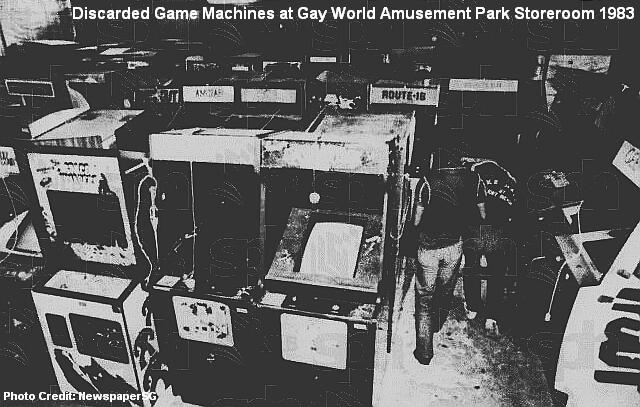
In mid-1983, there were about 64 video game amusement centres in Singapore. By the end of August, the Ministry of Culture decided to impose a nationwide ban on video game arcades, despite repeated appeals from the arcade operators to Suppiah Dhanabalan (born 1937), then-Minister of Culture, and Devan Nair (1923-2005), former President of Singapore.

video-arcade-ban-1983

In the end, all the arcade operators were ordered to wind up their businesses. They had to sell off their game machines, totaled more than 1,200 sets, at huge losses to either the private clubhouses or overseas.

Private clubhouses, such as the Singapore Armed Forces Reservists’ Association (SAFRA) and Automobile Association of Singapore (AAS) Recreation Club, were allowed to continue offering video games to their members, provided they enforced checks regularly.

beating-the-video-arcade-ban-1984The ban did little to dissuade the game enthusiasts, who flocked to the computer shops at Funan Centre, Peninsula Shopping Centre and Far East Plaza and rented their terminals, originally used for word-processing and programming, to play games such as “Computer Ambush” or “World War III” at a rate of $1 to $2 per hour.

While the teenagers and young adults were unhappy with the ban of video amusement arcades, the home video game manufacturers were delighted to see their sales shot up. The local home video game market had enjoyed a booming year in 1981, importing some $21 million worth of video and handheld electronic games into Singapore. But an economic slowdown and competitions from amusement centres and home computers saw its decline in the following years until the ban of video game arcades was imposed.

While home video games such as Pacman, Space Invaders and Donkey Kong were popular, the consoles, however, did not come cheap. An Atari 2600 would cost $285 in 1983, while the ColecoVision was priced at $380. Both were considered luxurious items that were almost out of reach for an average Singaporean family in the early eighties.

old-school-arcade-games-basketball

Old School Arcade Games

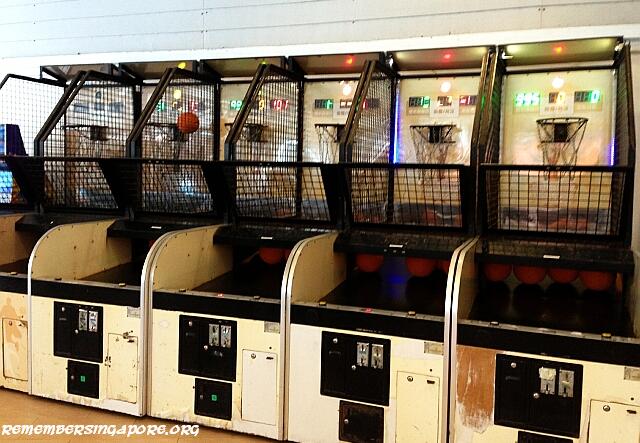
The video game arcades made a comeback in the nineties. Hundreds of amusement centre outlets mushroomed all over Singapore in a matter of years. The old fashioned pinball machines and basketball arcades were quickly obsoleted, replaced by the more popular racing, fighting, shooting and sport video games.

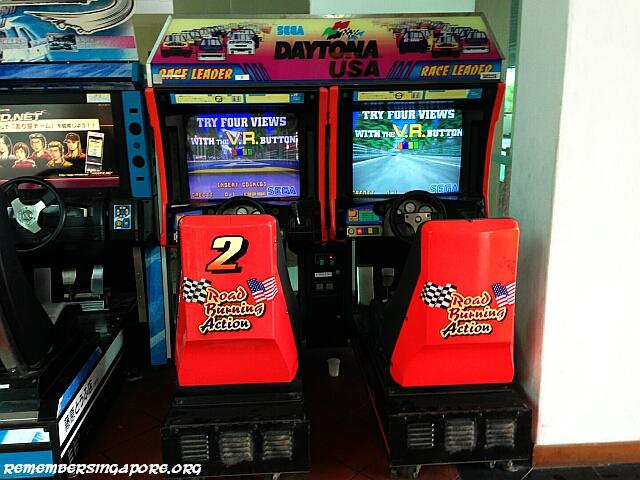
Daytona USA (first launched in 1994), with its high resolution realistic gameplay, manual gears’ switching, and four racing views, was perhaps the most popular racing arcade game in Singapore in the nineties. The larger arcade outlets even offered the multi-playing competition for up to eight different players. Other popular racing arcade games that were launched in the nineties and early 2000s were the Manx TT Super Bike (1996) and Initial D Arcade Stage (2002).

old-school-arcade-games-daytona

The nineties also saw the rise of popular fighting arcade games. Street Fighter II (1991), Mortal Kombat (1992), Virtua Fighter (1993), King of Fighters (1994) and Marvel Super Heroes (1995) were all the rage, although some had expressed concern in the games’ excessive display of violence.

It did not help that arcade centres in the nineties were often the favourite hanging out venues for teenage gangs. Fights often broke out over humiliating losses in the video games, arguments or staring incidents, giving some of the arcade centre outlets a bad reputation.

street-fighter-2-video-game

king-of-fighters-video-game-1997

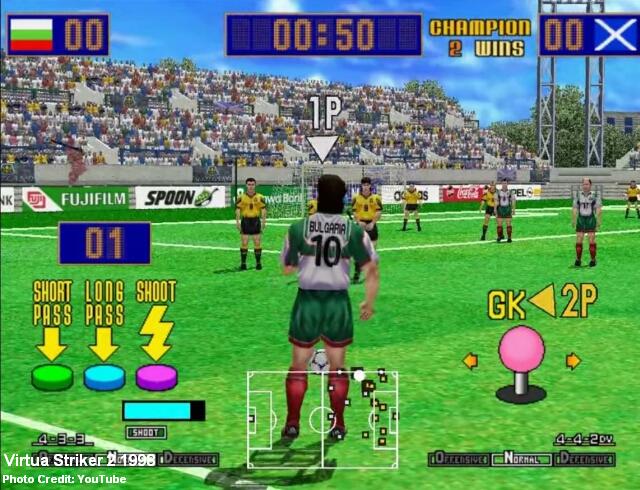
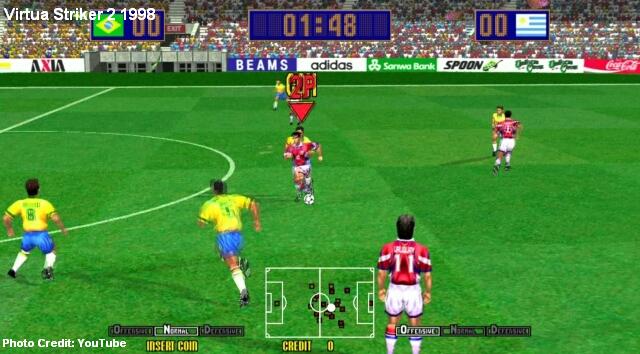
Virtua Striker (1994) was another popular arcade game that came with impressive computer graphics and smooth controls, allowing two players to select different national football teams and challenge each other. There were also special codes for the player to unlock FC Sega, a hidden tribute team that consisted of the game’s developing staff. The game series lasted four versions over 12 years. In the series, Virtua Striker 2 (1997) was perhaps the most popular among its fans.

virtua-striker2-1998-1

virtua-striker2-1998-2

Other popular old school arcade games included Metal Slug, Wrestlefest, Virtua Cop, Macross Plus, Streets of Rage and the alien- or zombie-shooting games.

The game machines typically accepted 20c (later raised to 50c) coins for each gameplay. By the late nineties, almost all the major arcade centre operators had issued their own tokens, with their names embossed onto the customised coins. Newer game consoles in the early 2000s accepted cards topped up with game credits; some also came with redemption tickets or gaming coupons to allow players to exchange for prizes and gifts.

Arcade video games saw some mini revival in the 2000s, when revolutionary dancing games such as Para Para Paradise Mix or Dance Dance Revolution became the hottest and trendiest attraction at any arcade centres.

old-school-arcade-games-alien-the-gun

old-school-arcade-games-mahjong-metal-slug

From the vanished Wywy WonderSpace and Paco Fun World to the recent Arcadia (closed in 2014), Virtualand and Time Zone, the local video game arcade centres have gone through their ups and downs. Only time will tell if they can ever make a comeback again.

Editor’s Note: I used to hang out at arcade centres during my schooling days, spending much of my allowances on Virtua Striker 2 and King of Fighters 97. Those were the days. How many of those old school arcade games do you remember? And which were your favourite ones?

Published: 28 December 2016

Posted in General, Nostalgic | Tagged , , , , , , , , , , , , , , , , , , , , , , , , , , , , , , , , , , , , , , | 17 Comments

Vroom Vroom… Looking Back at the Old Singapore Grand Prix

The Formula One Singapore Grand Prix has been in the headlines lately. There is a possibility that Singapore will end the race after 2017, after statistics show that its most recent ticket sales and attendance are declining. The three-day weekend race, held at the Marina Bay Street Circuit every September since 2008, is the world’s only full night race so far.

The Early Days of Racing

The Formula One Singapore Grand Prix is not Singapore’s first motorcar race. The first Singapore Grand Prix was held 55 years ago, in 1961, at the Thomson Road Circuit. It was then organised, by the Singapore Motor Club (SMC) and sponsored by the Ministry of Culture, in an event named “Visit Singapore – The Orient Year”. The sport event was part of a campaign in promoting and boosting Singapore’s tourism sector in the sixties.

The Singapore racers, however, had an even earlier start. In 1948, a group of local motor sports enthusiasts founded the Singapore Motor Club, and organised races at South Buona Vista, Lim Chu Kang and Farrer Road. Some early local racers, such as Lim Peng Han and Osman Abbas, also competed at the Johore Grand Prix, a 3.7km long circuit running through the Johor Bahru town, in the early fifties. The Johore Grand Prix, first held in 1940 and ended in 1969, was one of the oldest races in Malaya.

johore-grand-prix-1952

johore-grand-prix-1953

Then came 1957, when an one-day race was organised by the Forces Motoring Club at the Royal Air Force (RAF) Changi’s 3.2km-long circuit. The 5-lap motorcar and 10-lap motorcycle races attracted 106 participants and almost 100,000 spectators. In the motorcar racing event, the winner Chan Lye Choon and his Aston Martin DB3S sprinted well ahead of the other contestants.

The 1957 race attracted much interest and fanfare but it turned out to be an one-off event. The Forces Motoring Club and Singapore Motor Club wanted other suitable sites for regular racing competitions, and the Sembawang circuit at the Old Upper Thomson Road, belonged to the War Department during that time, was one of the favourite choices. But the authorities would approve the circuit to be used only for motorcycle races, as it was deemed too tight and dangerous for motorcar racing.

first-singapore-grand-prix-1961

Hence, the initial plan of a Singapore Grand Prix in the early sixties was to use a road circuit looping via Thomson Road, Whitley Road, Dunearn Road and Adam Road. But this would affect thousands of residents living in the vicinity. The Sembawang Circuit remained as the best choice, but it would have to be expanded to include the New Upper Thomson Road. Certain stretches of the roads that were narrow and bumpy would also have to be resurfaced and improved by the authorities.

Singapore’s First Grand Prix

Finally, the first Singapore Grand Prix was held over a weekend in mid-September 1961, promising entertainment and excitement for the spectators, both local and foreign. The Grand Prix kicked off on Saturday – the first day was more of an amateur and leisure contest, with motorcycles, vintage cars and saloons taking part in various races.

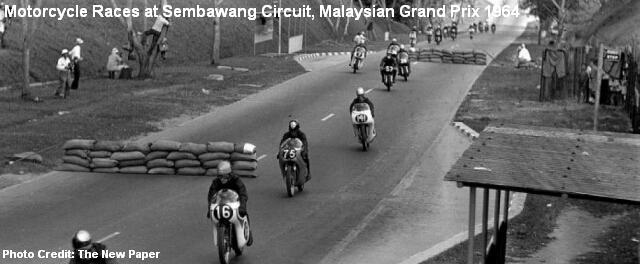
malaysian-grand-prix-motorcycle-races-1964

The main attraction came on Sunday, when two competitive races – one for the motorcycles and the other for motorcars – were hosted. Among the participating racing cars were established brands like Volvo, Lotus, Lola, Saab and Cooper, driven by famous Singaporean and Malayan racers such as Rodney Seow, Chan Lye Choon, Peter Cowling, Saw Kim Thiat and Yong Nam Kee.

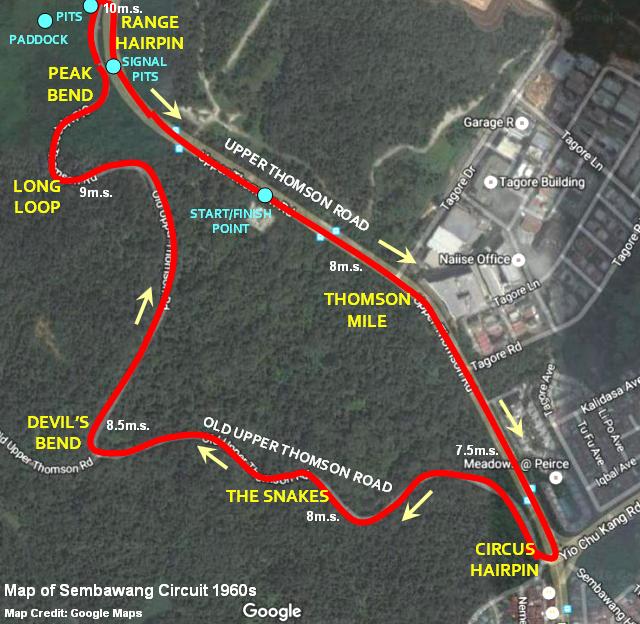
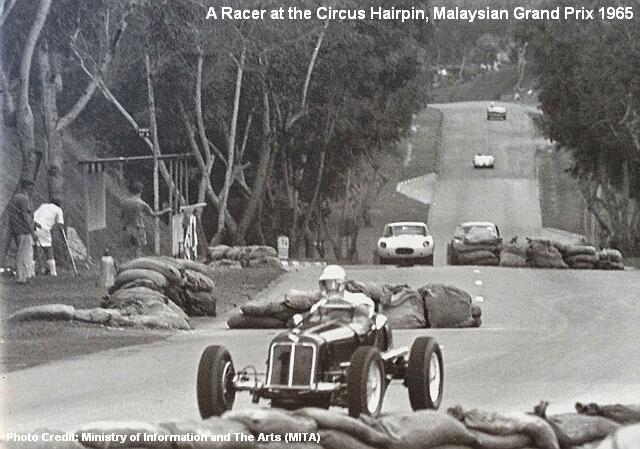
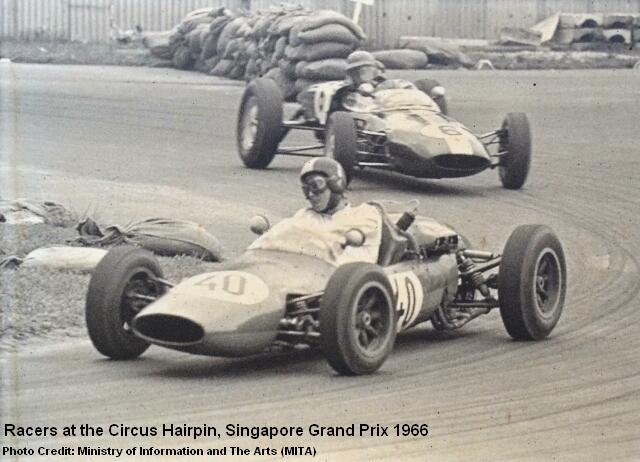
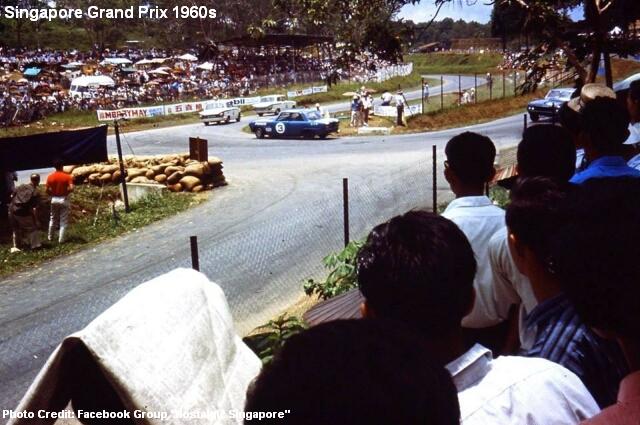
Via the Old Upper Thomson Road and Upper Thomson Road, the competing drivers had to race in the 4.8km-long Sembawang Circuit that had several challenging bends with interesting nicknames such as Circus Hairpin, The Snakes, Long Loop and the Devil’s Bend.

The famous but dangerous Devil’s Bend, located near the entrance to the Upper Peirce Reservoir, was the most challenging of all. Shaped like the letter V, the chicane tested the skills and reactions of the qualified 30 racers, who had to complete 60 laps and a distance of approximately 286.5km, and the capabilities of their vehicles.

map-of-sembawang-circuit-old-upper-thomson-road

The first Singapore Grand Prix was a major success. Tickets, priced at nine ringgits for grandstand seats and one ringgit for general stands, were snapped up fast. Almost 20,000 spectators turned up for the first day’s races. On the second day, a 100,000-strong crowd packed along the sides of the roads to watch the speeding cars and motorbikes. Due to Grand Prix’s enormous success, Singapore’s tourism sector in 1961 posted a record revenue and number of tourists.

The Singapore Grand Prix gained global prominence and recognition in the subsequent years. The motorcycle racing event was listed in the international racing calendar since 1963, followed by the motorcar race three years later (although it was not considered a world championship).

racer-circus-hairpin-malaysian-grand-prix-1965

racer-circus-hairpin-singapore-grand-prix-1966

By the early seventies, the races were telecast, with live commentary, across Asia, Australia and New Zealand. Over the years, the competitions of Singapore Grand Prix had improved to higher standards with professional racers from Japan, Indonesia, Thailand, Britain, The United States, Canada, Australia and New Zealand participating together with the Singaporeans and Malaysians.

The old Singapore Grand Prix lasted 13 years between 1961 and 1973. In between, it was renamed as Malaysian Grand Prix from 1962 to 1965, when Singapore joined the Federation of Malaysia as a state. After independence, the racing event was named once again as Singapore Grand Prix.

singapore-grand-prix-1960s

End of the Races

In 1973, Singapore officially ended the Singapore Grand Prix. After the 13th annual race, the Singapore Sports Council (SSC) informed the Singapore Motor Sports Club, the event’s organiser, of the sudden decision. Safety concern was the main reason given, since there were several high profile fatal accidents occurred in the races over the years. As many as seven racers had died between 1963 and 1973. Many fans, however, believed it was a move by the authorities to discourage illegal motor racing.

motorcycle-racing-singapore-grand-prix-1972

After the ban of the Singapore Grand Prix, most of the local racers went over to Malaysia to train and compete. In 1974, star rider Gerry Looi led a team of Singaporean motorcycle racers to compete in the Selangor Grand Prix at the Batu Tiga Circuit.

Meanwhile, there were calls from the public to revive the popular races. The Singapore Motor Sports Club actively looked for sponsorship to build a complete circuit at Mandai, but the plan was called off due to the potential high construction cost of $5 million. Other alternatives were proposed, such as making use of a driver training circuit at Sembawang or a runway at Changi Airbase, but they were all rejected by the authorities. The Singapore Grand Prix did not make a comeback in Singapore until 35 years later.

singapore-grand-prix-1973

List of Winners of Singapore Grand Prix (Motorcars)

1961 (1st Singapore Grand Prix) – Ian Barnwell, Britain (Aston Martin DB3S)
1962 (1st Malaysian Grand Prix) – Yong Nam Kee, Singapore (Jaguar E-Type)
1963 (2nd Malaysian Grand Prix) – Albert Poon, Hong Kong (Lotus 23)
1964 (3rd Malaysian Grand Prix) – race cancelled after 5 laps due to downpours
1965 (4th Malaysian Grand Prix) – Albert Poon, Hong Kong (Lotus 23)
1966 (1st Singapore Grand Prix) – Lee Han Seng, Singapore (Lotus 22)
1967 (2nd Singapore Grand Prix) – Rodney Seow, Singapore (Merlyn F2)
1968 (3rd Singapore Grand Prix) – Garrie Cooper, Australia (Elfin-Ford)
1969 (4th Singapore Grand Prix) – Graeme Lawrence, New Zealand (McLaren-Cosworth F2)
1970 (5th Singapore Grand Prix) – Graeme Lawrence, New Zealand (Ferrari V5)
1971 (6th Singapore Grand Prix) – Graeme Lawrence, New Zealand (Brabham BT30)
1972 (7th Singapore Grand Prix) – Max Stewart, Australia (Mildren)
1973 (8th Singapore Grand Prix) – Vern Schuppan, Australia (March 722)

singapore-grand-prix-max-stewart-mildren-1972

singapore-grand-prix-geoff-perry-suzuki-1972

List of Winners of Singapore Grand Prix (Motorcycles)

1961 – (1st Singapore Grand Prix) Chris Proffit-White, Singapore (Honda 4)
1962 – (1st Malaysian Grand Prix) Teisuke Tanaka, Japan (Honda)
1963 – (2nd Malaysian Grand Prix) Chris Conn, Britain (Norton Manx)
1964 – (3rd Malaysian Grand Prix) Akiyasu Motohashi, Japan (Yamaha)
1965 – (4th Malaysian Grand Prix) Akiyasu Motohashi, Japan (Yamaha)
1966 – (1st Singapore Grand Prix) Mitsuo Ito, Japan (Suzuki)
1967 – (2nd Singapore Grand Prix) Akiyasu Motohashi, Japan (Yamaha)
1968 – (3rd Singapore Grand Prix) Akiyasu Motohashi, Japan (Yamaha)
1969 – (4th Singapore Grand Prix) Tham Bing Kwan, Malaysia (Norton)
1970 – (5th Singapore Grand Prix) Ou Teck Wing, Malaysia (Yamaha)
1971 – (6th Singapore Grand Prix) Geoff Perry, New Zealand (Suzuki)
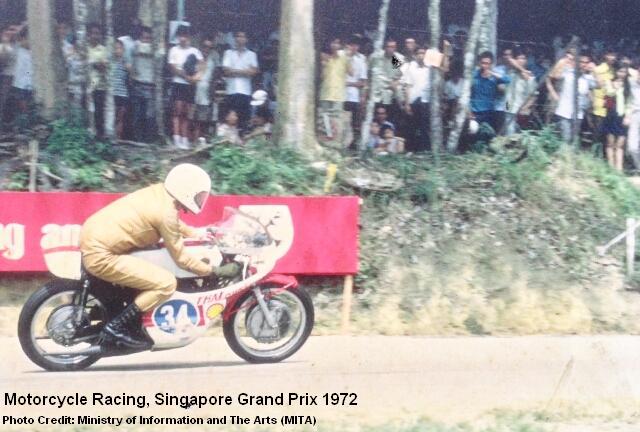
1972 – (7th Singapore Grand Prix) Geoff Perry, New Zealand (Suzuki TR 500)
1973 – (8th Singapore Grand Prix) Bill Molloy, New Zealand (Kawasaki)

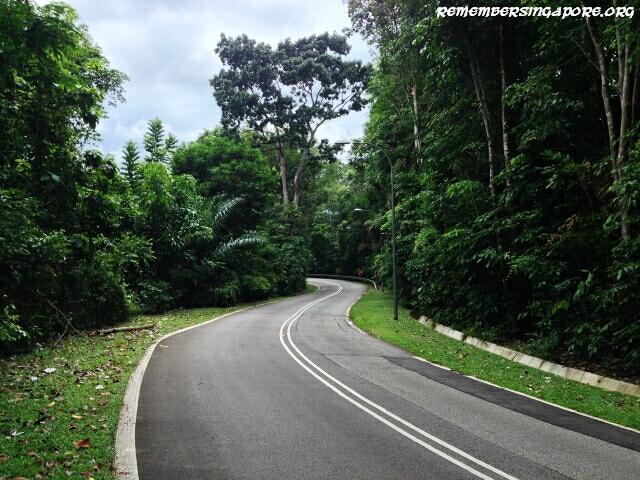
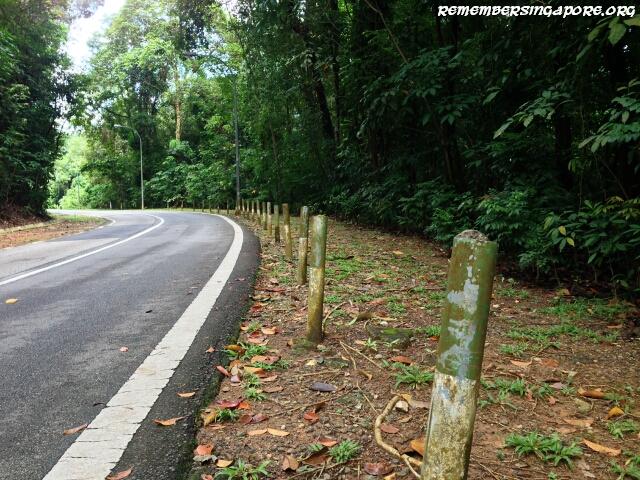
Today, the Old Upper Thomson Road is a quiet winding road, where people use it mainly for jogging and cycling. Half a century ago, this was the venue that hosted one of Singapore’s most popular annual events.

old-upper-thomson-road1-2016

old-upper-thomson-road2-2016

old-upper-thomson-road3-2016

Published: 26 November 2016

Posted in Cultural, Historic | Tagged , , , , , , , , , , , , , , , , , , , , , , , , | 22 Comments

Flashback 30 Years Ago… Singapore in 1986

30 years have passed in the blink of an eye. Do you still remember the major events happened in Singapore in 1986?

Singapore’s First Recession

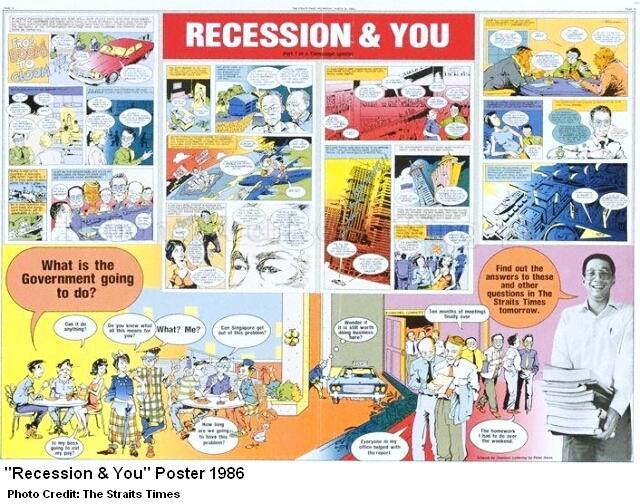
In early 1986, Singapore was still recovering from its first ever post-independence recession, which began in the second quarter of 1985. For 20 years, Singapore had emerged as a frontrunner among the developing countries, enjoying substantial Gross Domestic Product (GDP) growths averaging about 10% a year.

straits-times-recession-and-you1-1986

Towards the end of 1984, however, a combination of global and domestic factors led to a downturn. First, the developed countries, especially the United States, were experiencing a slowdown in their economies. Next, demands for Singapore’s exports and services had declined, and increasing operating costs made the country less competitive.

Singapore’s growth rate plunged to -3.5% in the third quarter of 1985, while unemployment rate jumped to 4.1%. Companies going bankrupt and mass retrenchments of workers hit the headlines. Residential and commercial projects by private developers also hit the slump, recording only 1,089 projects and an estimated total construction cost of only $1.6 billion, the lowest in seven years.

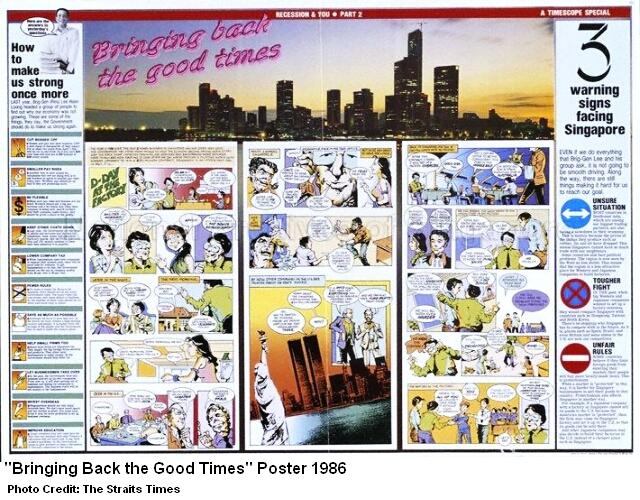
straits-times-recession-and-you2-1986

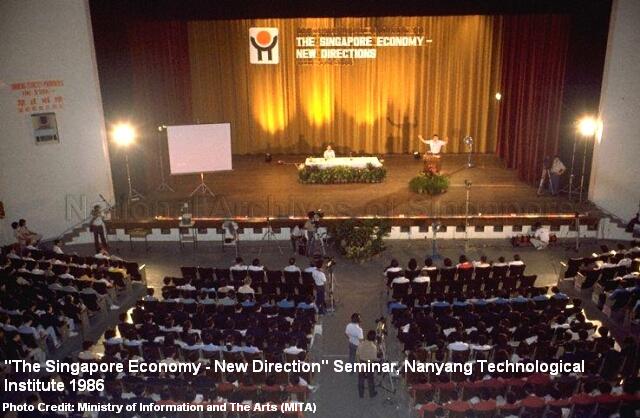
An Economic Committee was quickly appointed to review and analyse the economic downturn and propose policies to restructure the economy. The committee, headed by Lee Hsien Loong, then Minister of State for Defence and Trade and Industry, suggested implementing wage flexibility in the labour market, making changes to the Central Provident Fund (CPF), handing out rebates on various taxes and privatising certain state-owned companies. Also, to counter the decline in the construction sector, many public projects were pushed forward, resulted in the most number of approved government projects since 1980.

singapore-economy-seminar-nanyang-technological-institute-1986-mita

What happened next?

By mid-1986, Singapore’s economy showed signs of rapid recovery, posting a 1.2% growth in the second quarter and 3.8% in the third quarter. The country’s budget also improved from a $1.25-billion deficit in 1985 to a $500-million deficit in 1986. Overall, Singapore posted a modest 1.8% GDP growth in 1986. The recovery was confirmed when a year later, its economic growth jumped to more than 8%.

The 1985 recession, however, remained as the only time Singapore’s economy contracted while the global economy was still growing.

After-Effects of Pan-El Crisis

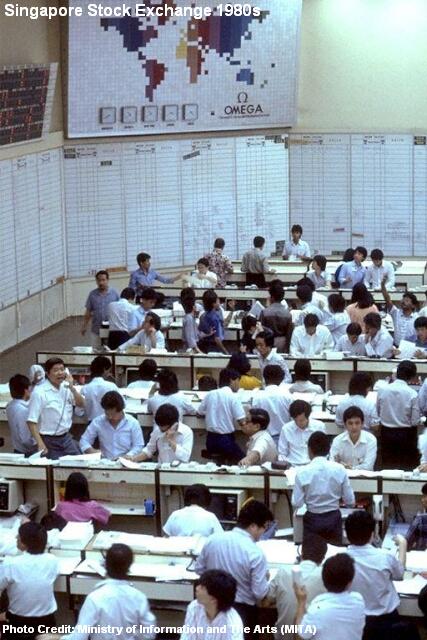
The stock market was still in a chaotic mess, due to the spectacular collapse of Pan-Electric Industries Limited which was suspended from listing two months earlier on 19 November 1985.

singapore-stock-exchange-trading-1980sBy end of November 1985, it almost spelt the death of the company as it went into receivership. Thousands of small shareholders had their investments and savings wiped out. Rumours of “white knights” rescuing the company gave hopes to the shareholders, but all optimisms were dashed in February 1986 when the liquidation proceedings of Pan-Electric commenced.

The Pan-El crisis resulted in a 3-day closure of the Singapore and Kuala Lumpur stock exchanges in early December 1985. It was the first and only time the Singapore Stock Exchange was forced to shut down due to a trading emergency.

The effect was catastrophic and widespread. In the following weeks, share prices across the market plunged and investors’ confidence badly shaken. Singapore’s reputation as a leading financial centre was tarnished.

What happened next?

A series of new regulations and stringent checks were enforced to the local stockbroking industry and stock market to curb speculations and manipulation in shares. Listed companies were also required to be more transparent in their financial reports.

Tan Koon Swan (born 1940), the president of the Malaysian Chinese Association (MCA) and major shareholder of Pan-El, was arrested for criminal breach of trust and was subsequently sentenced to two years’ imprisonment by the Singapore High Court. The MCA Youth protested aggressively against Tan Koon Swan’s arrest and sentence, calling for a boycott of Singapore goods and services.

Hotel New World Tragedy

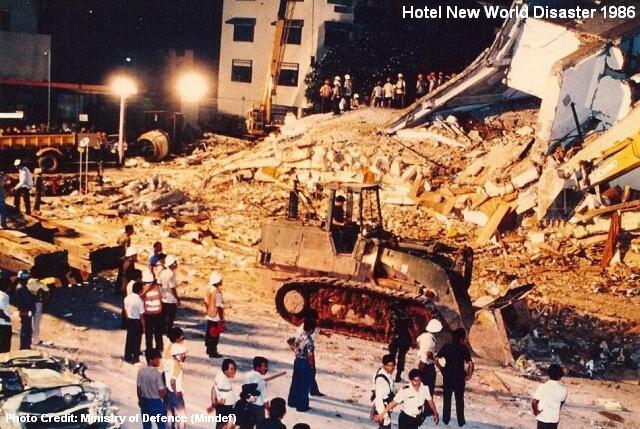
In the late morning of 15 March 1986, the sudden news of the Hotel New World collapse shocked Singapore. Singaporeans were horrified by the tragedy, which remains as one of the country’s worst disasters after the Second World War.

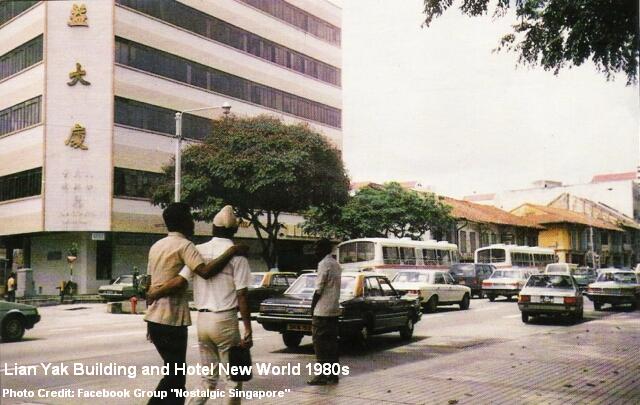
lian-yak-building-hotel-new-world-1980s

Located at the junction of Serangoon and Owen Roads, Hotel New World, formerly known as New Serangoon Hotel, was housed in a six-storey building called Lian Yak Building. The sudden collapse of the hotel, occurred in less than a minute, was later investigated to be due to the building’s inadequate structural integrity and an overloaded roof with water tank and air-conditioning system installations. The negligence in the maintenance of the building also played a part. Weeks before the disaster struck, many cracks had been observed in the walls and floors.

hotel-new-world-collapse-disaster-1986

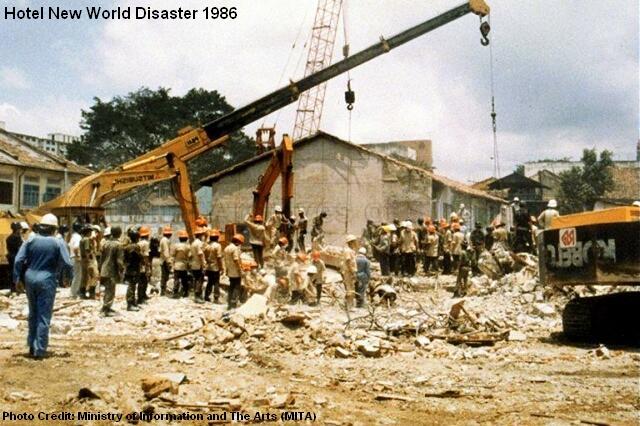
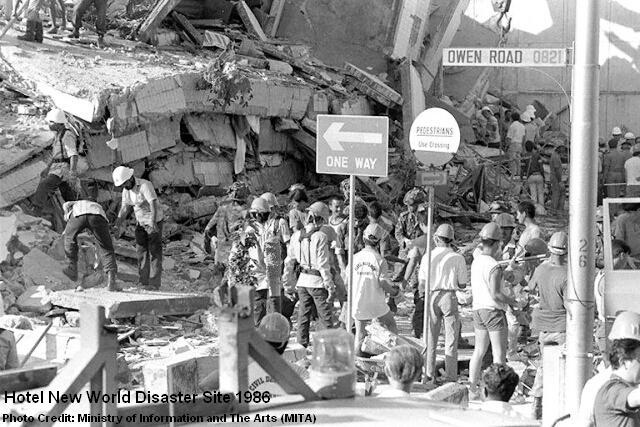
A search and rescue operation was immediately planned and carried out. A temporary command centre was set up in a shophouse opposite the disaster site, and more than 500 personnel from the Singapore Civil Defence Force (SCDF), Singapore Fire Service, Singapore Armed Forces (SAF) and Singapore Police Force (SPF) were activated. Foreign experts from Britain and Japan – they were in Singapore for the construction of the Mass Rapid Transit (MRT) tunnels – were also roped in. A total of 17 survivors were rescued from the rubble in the operation, but the death toll numbered 33.

The Hotel New World tragedy traumatised the whole nation, but it also brought all Singaporeans together. Many private organisations loaned their mechanical cutting equipment and lifting cranes to assist the SCDF, while the public actively raised funds and rendered help in all possible ways. Leaders of different political parties came together to rally the rescue teams and assist the victims’ families.

hotel-new-world-collapse-rescue-operations-1986

hotel-new-world-disaster-1986

What happened next?

The government assumed a more active role in the regulation of the building industry in Singapore. The Ministry of National Development’s (MND) Development and Building Control Division was assigned to conduct regular structural and maintenance checks on buildings, and all building plans and drawings were more stringently checked and approved.

In addition, the Singapore Fire Service was integrated with the SCDF to improve the organisation’s efficiency and response in rescue missions.

Babies Not Enough

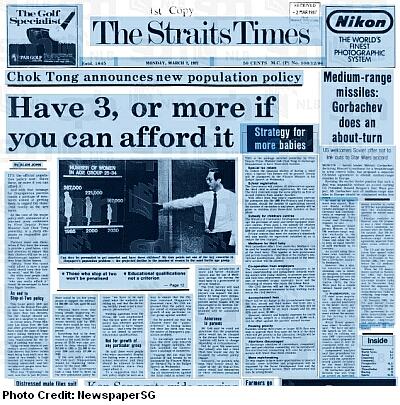
In 1986, the Total Fertility Rate (TFR) of Singapore fell to 1.42, the lowest level in the eighties. The “Stop At Two” population policy, began as early as 1972, was showing its impact by the late seventies when the TFR slipped to 1.82, well below the replacement level of 2.1 children per woman.

What happened next?

have-three-or-more-if-you-can-afford-it-1987The Singapore government in 1986 switched from anti-natalist schemes to pro-natalist policies. Incentives such as childcare subsidies, tax rebates, allocation priorities in Housing and Development Board (HDB) flats were implemented.

In March the following year, a new slogan “Have Three Or More, If You Can Afford It” was launched by Deputy Prime Minister Goh Chok Tong. But Singapore’s TFR would continue to decline constantly throughout the three decades.

Conservation Master Plan

In December 1986, the Urban Redevelopment Authority (URA), for the first time, included six historical districts in its Conservation Master Plan. Kampong Glam, Little India, Chinatown, Emerald Hill, Singapore River and the Civil District from Empress Place to Fort Canning Park were identified as part of the URA’s plan to preserve the city’s history, architecture, colour and character.

pagoda-street-chinatown-1986

Prior to this, Singapore had been undergoing massive urban renewal programs and conservation efforts were only limited to single building or landmarks. The Conservation Master Plan, in total, covered almost 1 square kilometre of site or 4 percent of the city core.

What Else Happened in 1986?

12 January – The Singapore Bus Services (SBS) introduced a new air-conditioned bus service, numbered 3, plying daily from Bedok to Chinatown. Aircon buses were getting popular among the commuters, after the first SBS aircon bus, numbered 168, debuted in April 1985.

use-nets-instead-of-cash-198618 January – The Network for Electronic Transfers (NETS) was officially launched, as Singapore aimed to move towards a cashless society. The electronic payment service enabled more than 1 million users to make transactions through the NETS terminals at restaurants, shopping malls, petrol stations and government departments.

17 February – Armed with an axe, a gang of three men committed a robbery of a goldsmith shop at Chander Road. After robbing a Beauty World Centre goldsmith shop in June, two of the robbers were caught by the Criminal Investigation Department (CID).

15 March – The Singapore Armed Forces’ (SAF) first full-scale civilian vehicle mobilisation exercise, named Civil Resource Mobilisation, was carried out at the carparks of the Chinese and Japanese Gardens in Jurong. More than 170 pickups, lorries, buses and trailers were notified, registered and tested in the three-hour exercise. The owners were compensated for their time and use of their vehicles.

14 May – Two 12-year-old Owen Primary School students, Toh Hong Huat and Keh Chin Ann, mysteriously disappeared without a trace while on their way to school. Many theories were put forward but the case remained unsolved.

missing-boys-owen-primary-1986After investigations, the police deduced the boys were unlikely to have run away from homes as they were both well looked after by their families. It was not kidnap either, since the families had never received any ransom demands. There were also no known cases of illegal trades then, and illegal traders would have taken more than two boys. In addition, the police did not think it was a murder or drowning case as the bodies of the two boys were not found.

19 May – The new $7-million Toto computerised system made its debut, replacing the old laborious method in which betting agents had to manually stamp the betting slips with agency numbers, seal numbers and control stamps.

20 May – The closed National Theatre, deemed unsafe in its structural integrity, began its demolition.

national-theatre-demolished-august-1986

25 June – Minister of State for Defence and Trade and Industry Lee Hsien Loong engaged with vocational, secondary and pre-university students in a talk named Conversations With The Young – The Economic Recession. In the talk, shown on TV later, were discussions on the effects of the recession, job prospects, expectations and the hope of a Swiss standard of living by 1999.

26 June – Armed with a knife, a jobless man robbed a DBS Finance’s branch at North Bridge Road. He robbed the finance company again in the following week, and got away with a total of $27,500. He was subsequently arrested by the police.
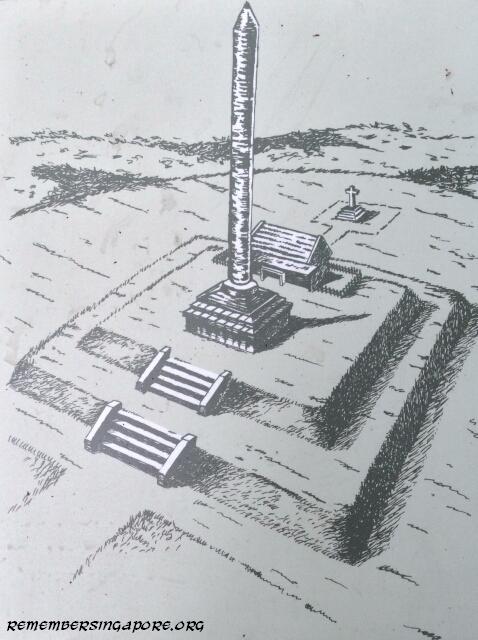
27-29 June – Pulau Brani was opened to the public for the first time in many years as the Republic of Navy (RSN) held an open house at the island’s naval base, demonstrating sea cruises and mock target shootings.

republic-of-singapore-navy-naval-base-at-pulau-brani-1986

2 July – Singaporeans were shocked when two separate robbery-cum-murder cases occurred on the same day. A 83-year-old man was robbed and killed in a restaurant at Joo Chiat Road, while a pregnant woman was found strangled in her Tampines flat. Her cash and jewellery, worth about $1,500, were missing.

6 July – A 38-year-old kopitiam (coffeeshop) stallholder was slashed to death by 10 men armed with knives and parangs (machetes) in a heated argument at a carpark at Mattar Road.

1 August – The Newspaper and Printing Presses (Amendment) Bill was passed in the parliament to curb the sale and distribution of foreign publications containing news that were deemed to have interfered in Singapore’s politics and internal affairs, destabilised the society or damaged the country’s image.

1 September – Singapore’s first town councils were established in Ang Mo Kio to reduce the role of HDB and involved in greater participation of residents in the policy-making and decision-making. With the success of the pilot project, the Town Council Act was passed in the parliament two years later.

5 September – The Association of Small and Medium Enterprises (ASME) was formed, with approval by the government, to protect the interests of the small- and medium-sized companies in Singapore, as well as to allow them to have a common channel in knowledge and experience sharing.

27 October – The Legal Profession (Amendment) Bill was passed by the parliament to enforce the regulation and disciplinary processes of legal practitioners by the Law Society.

18 November – Israeli President Chaim Herzog paid an official 3-day visit to Singapore, the first visit by an Israeli head of state. His visit was met with protests by the Malaysian, Indonesian and Bruneian governments.

20 November – Pope John Paul II arrived, becoming the first Catholic pope, as well as the first Vatican’s head of state, to visit Singapore. A special welcoming ceremony was held at the National Stadium, where the pope delivered a sermon, prayers and speeches to almost 80,000 Catholics.

papal-mass-at-national-stadium-1986

3 December – The Singapore Informatics exhibition was opened at the World Trade Centre.

21 December – The Faber House at Orchard Road, housing the Israeli embassy and Canadian high commission, was cordoned off by the police after an explosion went off at the back of its building. It was the second time the Faber house was bombed. The first incident occurred a year earlier on 17 March 1985, when an explosion in a nearby drain shattered the building’s windows and damaged its walls. It was a sign of early terrorism in Singapore.

A Pictorial Gallery of Singapore 1986

chinese-new-year-shopping-chinatown-1986

singapore-river-coleman-bridge-1986

garland-maker-little-india-1986

changi-airport-1986

serangoon-road-street-scene-1986

may-day-charity-walk-1986

hari-raya-haji-cooking-malay-kampong-1986

national-day-parade-1986

bugis-aerial-view-1986

christmas-light-up-orchard-road-1986

Published: 20 November 2016

Updated: 28 February 2022

Posted in Cultural, General, Historic | Tagged , , , , , , , , , , , , , , , , , , , , , , , , , , , , , , , , , , , , , , , , , , , , , , , | Leave a comment