Last Breakfast at Tong Ah Kopitiam

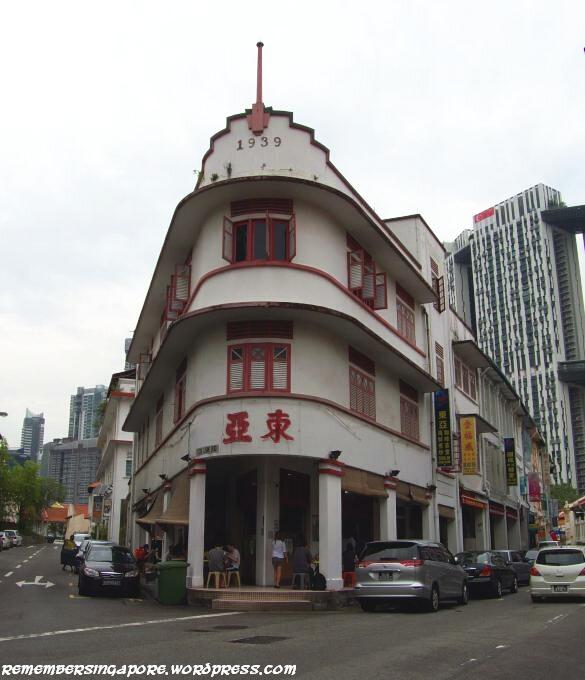
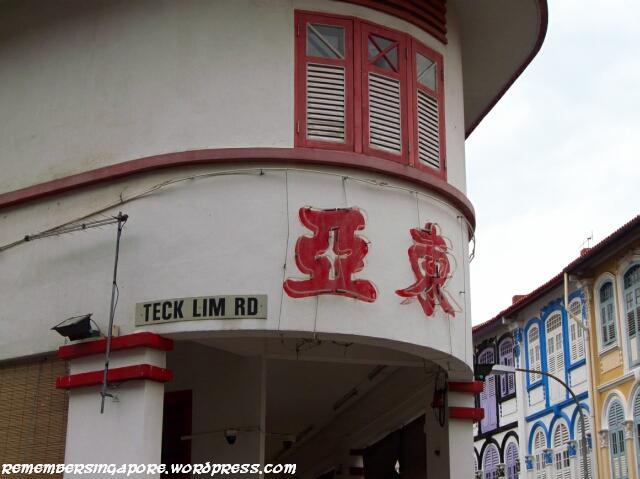
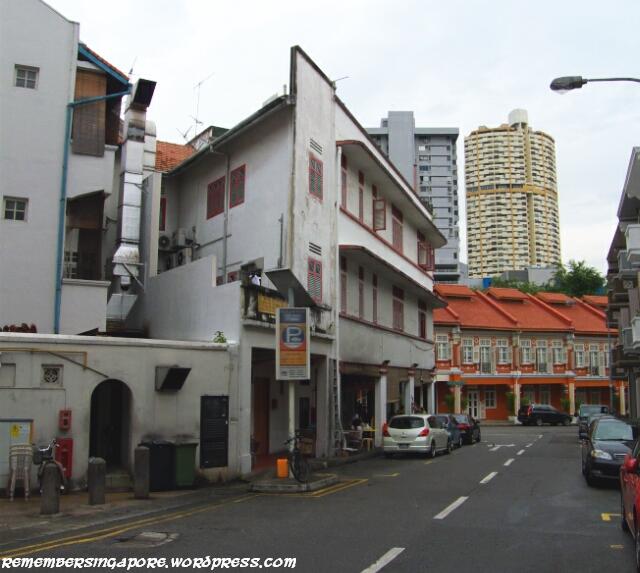
It was a cooling Sunday morning, but I decided to wake up a little earlier to make a trip down to Tong Ah Eating House. It was the last day of operation for the 74-year-old iconic kopitiam located at the junction of Keong Saik Road and Teck Lim Road.

tong ah kopitiam

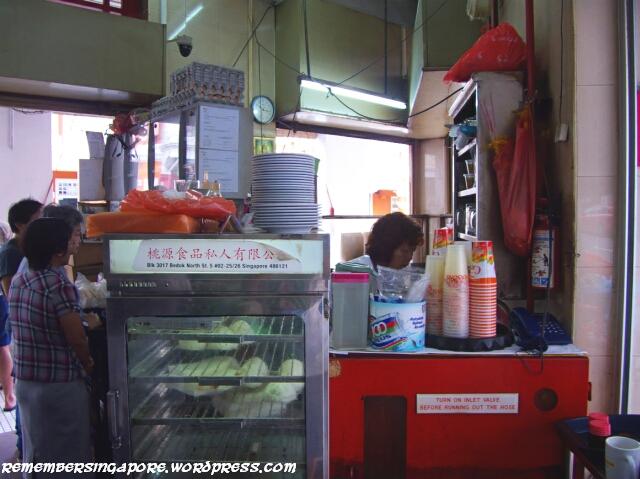
There was already a long queue of customers at the kopitiam, many of them regulars who wanted to salvage a last piece of memory of their favourite breakfast joint. Others probably wished to capture another glimpse of the place, which could be turned into a boutique hotel soon. The eye-catching triangular shaped building was apparently bought by a foreign investor in hotels for $8 million.

The Tanjong Pagar area has been a hot spot for private investors in recent years. Traditional shopowners are being squeezed out of business by the surging rental fees and property prices. Tong Ah Eating House, for example, has to pay a reported $8,000 per month for its rental.

tong ah kopitiam2

tong ah kopitiam3

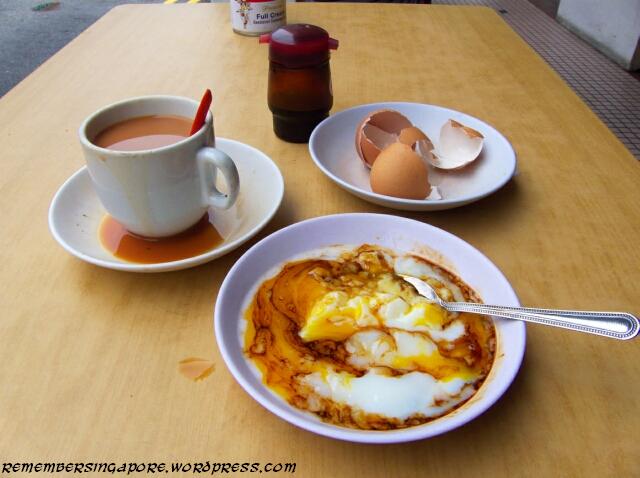
The number 1939 listed at the top of the facade of the building stated the year of its construction. It was also the same year Tong Ah Eating House was established by the great-grandfather of Tang Chew Fue, who took over from his father in 1999. Now, after four generations of family business, the 50-year-old owner had no choice but to bid farewell to a place filled with memories. The faithful customers could no longer enjoy a laid-back meal, or simply a cup of kopi, at the familiar five foot way.

tong ah kopitiam4

For seven decades, the kopitiam had survived the Second World War and endured the triad-infested streets and red-light district of the sixties. But even so, it could not defeat the rising rental cost and flexing financial muscle of the big players. Other traditional kopitiams are facing the same challenges too, such as the 70-year-old Hua Bee coffee shop at Tiong Bahru and North Bridge Road’s Heap Seng Leong.

The only positive thing is that Tong Ah Eating House will be shifted to a nearby location at a refurbished shophouse along Keong Saik Road, but that old charming feel of the kopitiam will probably never be the same again.

tong ah kopitiam5

Published: 14 July 2013

Posted in Nostalgic | Tagged , , , , | 10 Comments

Haze – A Burning Issue For Four Decades

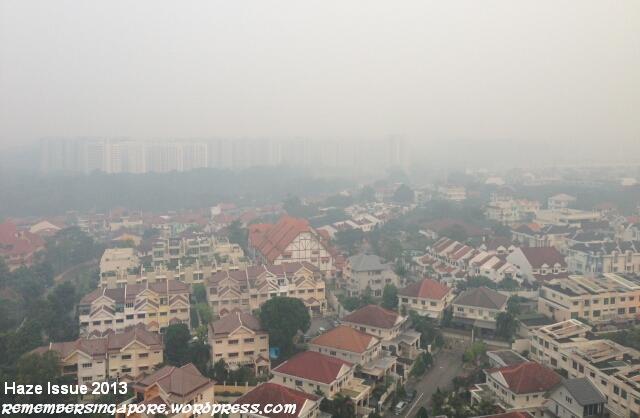
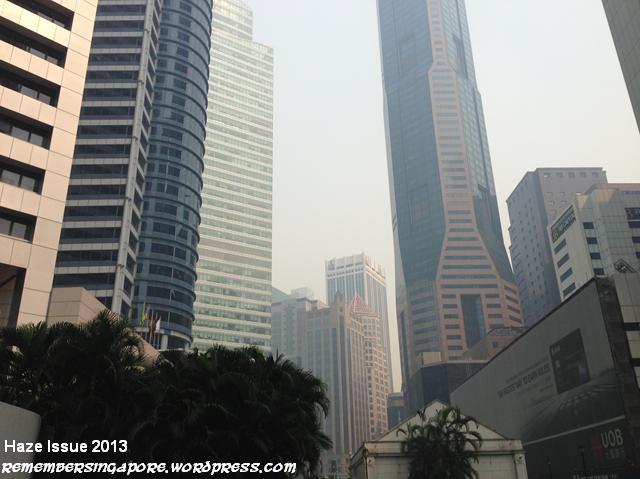
singapore haze 2013-4

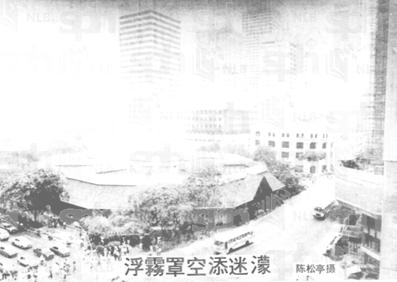
Singapore is fortunate to be freed of most natural disasters, but we are not spared of occasional floods and haze. The records at the National Archives and Newspaper Archives of Singapore show that the haze issue has been affecting Singapore and Malaysia for the past four decades. Most were due to the massive burning of forests at Kalimantan and Sumatra.

Here are some of the reports:

1972

In October 1972, Singapore and West Malaysia were covered by thick haze after days of burning of extensive forests and grass lands around Palembang, Indonesia. The worst day happened on the 14th October, when practically every part of Singapore was fog-bound. Motorists had to switch on their full headlights at Orchard Road and Nicoll Highway.

1975

A reddish haze hanged over the eastern and southern parts of Singapore due to the jungle clearing works at Johor Bahru and Kota Tinggi.

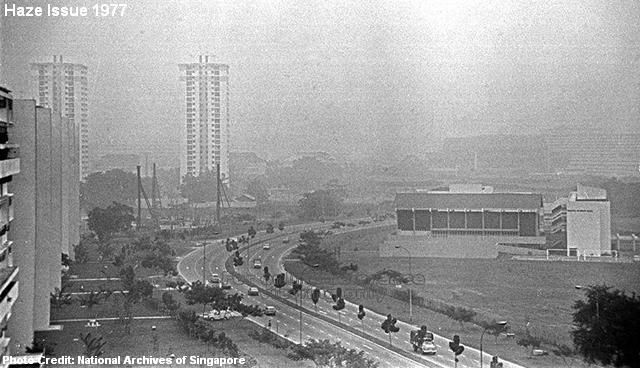
singapore haze 1977

1977

By October 1977, the smokes from the raging forest fires at Sumatra had covered much of Singapore and the western and southern parts of Peninsula Malaysia. Reported to be 366m high, the thick haze caused visibility to be so low that towering skyscrapers could hardly be seen from short distances.

1979

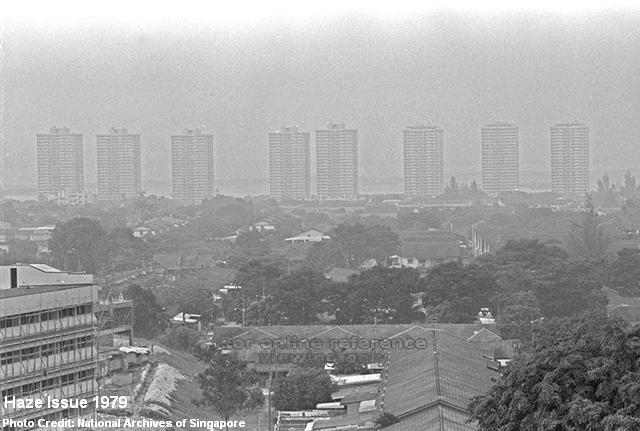
In May 1979, a combination of mist and haze covered almost three-quarter of Singapore, reducing the visibility to less than 2km. In Bedok, neighbouring blocks of HDB flats 400m away were barely visible. The source of the haze was undetermined.

singapore haze 1979

1982

Many complained eye irritation after the Anti-Pollution Unit of the Prime Minister’s Office detected 300 micrograms of fine suspended particles in the atmosphere, the highest level since there were records. The haze was reported to be originated from forest fires.

singapore haze 19831983

Thousands of hectares of forests at East Kalimantan were burned since March 1983, causing a blanket of smoke over Singapore, Malaysia and Sarawak. Visibility was down to 1km. Fortunately, an occurrence of widespread rain helped to lighten the hazy condition.

1987

Days of smoky haze bothered Singaporeans in September 1987 as a result of dry weather and forest fires at Indonesia. Visibility rapidly dropped from 10-20km to 2-3km.

1991

The 73-storey Westin Stamford, the world’s tallest hotel then, and other buildings at Raffles City were barely visible from the Fort Road flyover of the East Coast Parkway in October 1991, covered by the haze caused by the raging fires in Indonesia.

1994

The thick smoke from the fires, engulfing forests and plantation areas at Jambi and South Sumatra, were blown by strong winds to Singapore in September 1994. The runway lights at the Changi airport had to be switched on during the day to help pilots land safely.

1995

ASEAN ministers (of environment) gathered at Kuala Lumpur to discuss the management of haze and other forms of transboundary pollution.

southeast asia haze 1997

1997

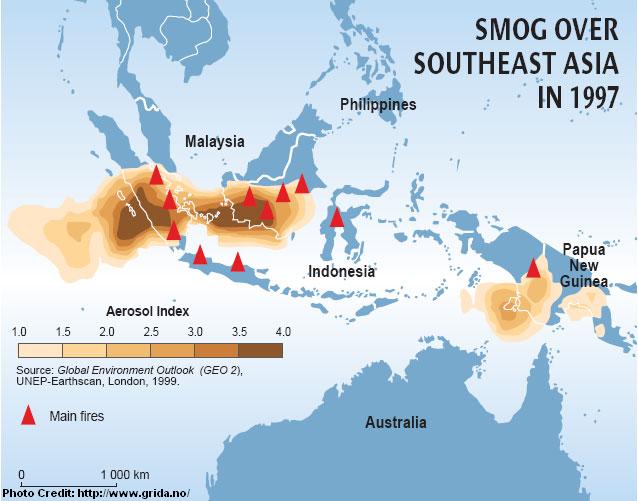
The worst haze issue hit Singapore and Malaysia in September 1997, with the local 3-hour PSI (Pollutant Standards Index) level recorded at the peak of 226 (on 18th September). Known as the 1997 Southeast Asian Haze, it was caused by massive forest fires at Kalimantan and Sumatra. Singapore suffered USD300 million in losses, due to health cost, slowdown in tourism and numerous flight disruptions. Malaysia declared a state of emergency in Sarawak after their pollutant level exceeded the 500-mark. Total regional loss amounted to a hefty USD9 billion.

1998

ASEAN officials met at Manila, seeking ways to deal with future forest fires and the haze that enveloped large parts of the region in the previous year.

1999

Singapore provided more than $600,000 worth of forest-fire and haze-monitoring equipment to Indonesia. The Indonesian enforcement authorities were also alerted of hot spots detected by the satellite. Indonesia also passed a law to ban open burnings. The haze condition in 1999 was lightened by the rainy season.

singapore haze 2005

2000-2005

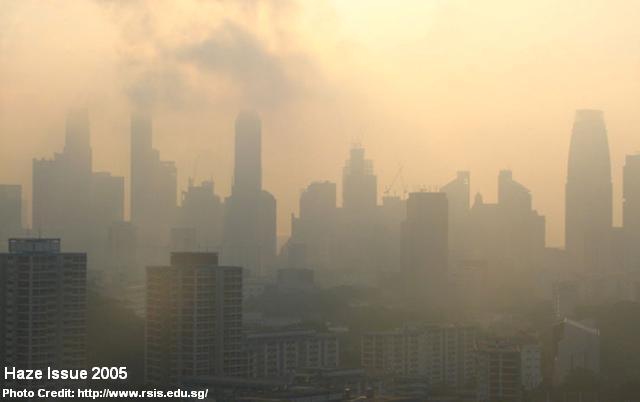
The strong winds sent the smoke of the burnings at Borneo and Sumatra to Singapore, Peninsula Malaysia and southern Thailand. In October 2002, the PSI recorded 79. The economic losses for Singapore was estimated to be USD50 million. By January 2003, all member nations of ASEAN, except Indonesia, had agreed to sign the environmental treaty in a bid to control the recurring haze issue.

Singapore experienced a PSI of 95 in March 2005, but was spared when a worse haze situation hit Peninsula Malaysia later that year. With the pollutant index shot up to 424, Port Klang was declared an emergency state. Selangor followed suit soon after that. Hundreds of flights were suspended, and schools were shut down.

2006-2013

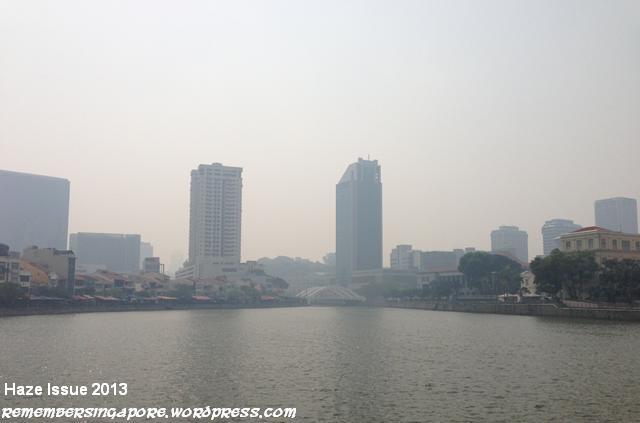
The region practically experienced haze problem every year after the millennium. Singapore experienced its worst ever haze crisis in June 2013, when the PSI level rose to an unprecedented 321 on the 19th June, before hitting an all-time high of 401 two days later.

Previously, the highest record in the new millennium was 150 in 2006 (on 7th October). In that year alone, the regional losses in economic, social and environmental aspects amounted to be approximately USD50 million.

singapore haze 2013

singapore haze 2013-3

Published: 19 June 2013

Updated: 08 July 2013

Posted in General | Tagged , , | 15 Comments

10 Common Misconceptions of the Names of Places in Singapore

Is Ang Mo Kio “ang mo kio” (tomato)? Or is Holland Village named after the Dutch community in Singapore? Are there any links between the new Chong Pang estate and the old Chong Pang Village? Let’s find out more…

1. Ang Mo Kio

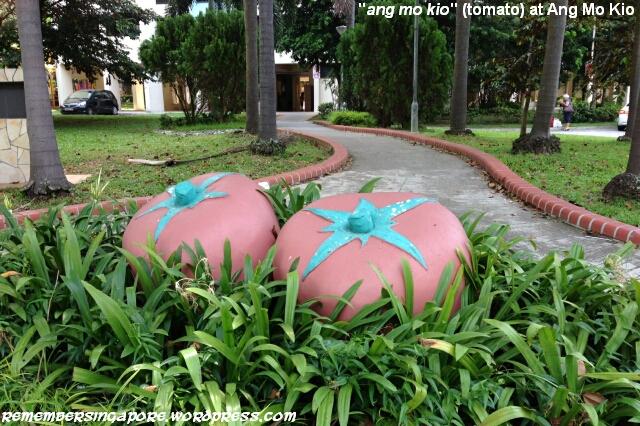
Tomatoes are called “ang mo kio” (Caucasian’s brinjal) in Hokkien, which probably led to the misconception that the name of Ang Mo Kio New Town was named after the fruit. However, no tomato farms were ever recorded growing in the old Ang Mo Kio vicinity.

tomato sculpture at ang mo kio

A more likely explanation of the name Ang Mo Kio was the bridge purportedly built by the British Government Surveyor John Turnbull Thomson (1821–1884), where the locals referred it as the “Caucasian’s bridge”. It was also said that there was not one but a total of nine bridges built along Thomson and Upper Thomson Roads, starting from the “red bridge” at Cavenagh Road  and ending at the junction of Upper Thomson Road and Ang Mo Kio Avenue 1.

But for the time being, the tomato sculptures near the Ang Mo Kio Town Centre shall stay on.

2. Holland Road & Holland Village

Holland Village has one of the most common misnomers in Singapore, mistakenly thought to be named after the Low Country of Europe. Started off as a humble plantation village located at the junction of Holland Road and Buona Vista Road, the name Holland Village was proposed by the Singapore Rural Board in 1929.

Holland Road, on the other hand, has been in existence since the late 19th century, and was reportedly named after Hugh Holland, an early resident, architect and amateur actor in Singapore in the early 1900s. There was, however, limited information of Hugh Holland.

Holland Village gradually became a vibrant private residential estate for the Europeans since the fifties, and remained so until the British military withdrew from Singapore in the early seventies. More arterial roads of Holland namesake (Holland Drive, Holland Avenue, Holland Close) were added in 1972, paving way for the construction of the first batch of public housing flats in the vicinity.

holland village

Another interesting trivia is that the local Chinese used to associate the name Holland with some of the day-to-day stuff, such as soft drinks (荷兰水, “hor lan zhui“, Holland water) and peas (荷兰豆, “hor lan dao“, Holland beans). This may be derived from the facts that they were imported from Holland (or by the Dutch East India Company in the past). There is also a crude Hokkien phrase “dua ker hor lan” (弹去荷兰), which literally means “being sprung to Holland” but it refers to sabotage instead. The origin of the phrase is unknown today, though there are some sayings that “hor lan” refers to the genitals of a tiger instead of Holland!

3. Tampines

The pronunciation of the name Tampines may sound embarrassing to some, but it has really nothing to do with the male reproductive organ.

Tampines was originally named after a highly-valued timber tree tempinis, or “strebulus elongata“, once abundant in this area. In the early days, however, there were several variations of the name appearing in maps and newspapers, such as Tampinis, Tempines, Tampenis and Tampenes. The name tampenis, in particular, was commonly used in Kedah as a reference to the tree.

In 1939, after consulting the Malay Union in an effort to standardize the spelling, the Singapore Rural Board began erecting new street signs bearing the name Tampines. Tampenis Road, the oldest road in the vicinity built in 1864, therefore became officially known as Tampines Road. There were concerns, though, that the new name might be confusing to the newly arrived Europeans, who might pronounce the name as “tam-pynes” and mistakenly linked the history of the vicinity to pine trees instead of tempinis tree.

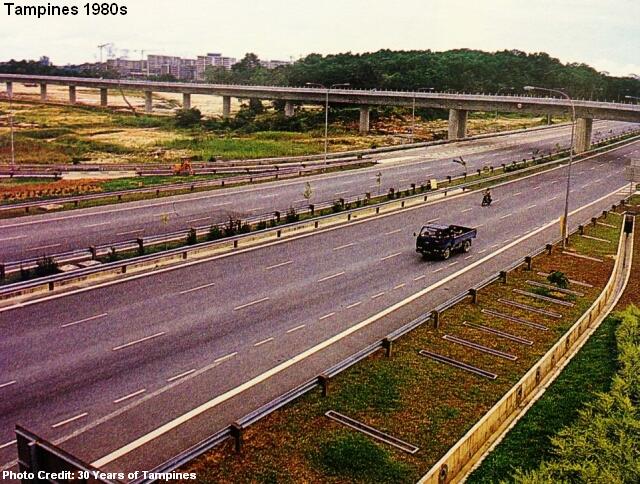
tampines 1980s

Although the spelling had changed, the pronunciation of the name remained the same. Tampenis was also casually used in books and newspapers until the early eighties, when the construction of Tampines New Town started. Perhaps by then people realised the old name was not very appropriate for the new upcoming housing estate.

Interesting Trivia: Due to the non-standardisation of street names in the 19th century, it was not uncommon to have two different streets bearing the same name. There was, in fact, another Tampenis Road located between present-day Robertson Quay and River Valley Road. In 1907, local rubber tycoon Tan Chay Yan (1871-1916) made a request to the Municipal Commissioners to rename the street as Teck Guan Street, in honour of his father Tan Teck Guan who once owned the land in the area. Teck Guan Street later became home of the Singapore Cold Storage complex before it was expunged in the late nineties.

4. Hong Kah

The residential district of Hong Kah used to cover the region between part of Bukit Batok and Jurong West. Today, the name refers to a small housing estate after its vicinity was splitted up and renamed respectively as Jurong Green, Nanyang and Gek Poh Ville.

The Chinese name of Hong Kah has been interpreted as 丰加 (or 丰嘉). It literally means “abundance and bountiful (or praises)”, an auspicious description of the new town established in the eighties. However, the actual origin of the name Hong Kah was derived from 奉教 (“to serve the religion”), the Teochew term for Christianity.

Established in 1876, the St. John Church at Jurong Road had been preaching to the Chinese farmers in the vicinity for decades. Most of the families were Teochews and Hokkiens, with a minority being Hakkas and Cantonese. By the late forties, the kampongs became collectively known as “Hong Kah Choon” (“Christian Village” in Teochew).

old jurong road and hong kah village 1986

A series of minor roads existed between the sixties and eighties bore the name Hong Kah. Mostly muddy trails without street lamps, Hong Kah Road, Hong Kah Drive, Hong Kah Lane and Hong Kah Circus were located off the main Jurong Road, which was the first road in Jurong built as early as the mid-1800s.

Due to the development of Jurong New Town in the early eighties, Hong Kah Village was later demolished, with many of its former residents resettled at the new flats at Jurong West. The name Hong Kah was retained but its Chinese characters were modified, probably in a bid to remove the religious context.

5. Lavender Street

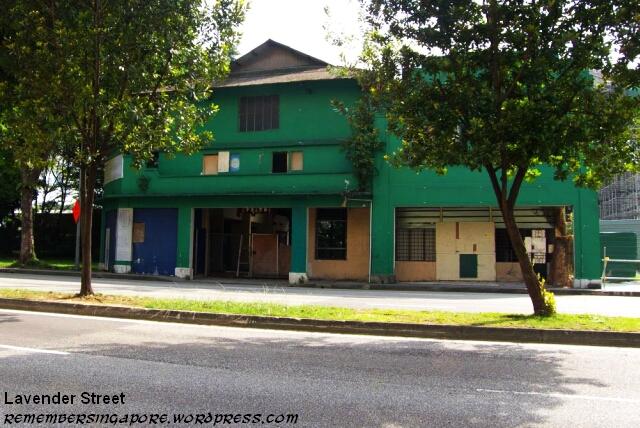
As mentioned in the previous article, the Lavender Street has a misnomer name as it was not a place of pleasant smell in the old days. It was, in fact, filled with foul smells of night soil, urine and fertilizers used for the plantations in the vicinity. To make things worse, the pungent odour of gases produced by the nearby Kallang Gasworks could also be detected.

lavender street old building

Another misconception of Lavender Street was its colloquial name “mang kah kar“. Similar in its Hokkien pronunciation, it could mean “foot of the jackfruit [tree]” or “mosquitoes bite leg”. Although mosquitoes were abundant in the plantations, it was widely accepted that “mang kah kar” actually referred Lavender Street as a road located at “the end of the jackfruit plantations”.

6. Jalan Kayu

We often hear screams of “referee kayu!” during local football matches, whenever the referee puts in a poor performance, commits perceived errors or makes some decisions that are unflavourable to the fans’ team.

The word kayu refers to wood in Malay, thus the popular football phrase can be interpreted as “referee you blockhead!”. Some, though, argue that kayu was derived from the Chinese word “jiayou” (加油), which means “buck up!” or “put in more efforts!”. That can be considered an encouragement offered to the poor verbally-abused man in black.

jalan kayu

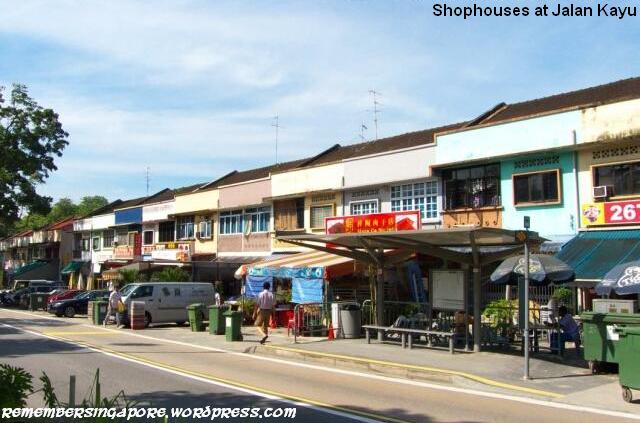
Jalan Kayu, on the other hand, has no links to petrol or referees. It was built in the 1930s by the Royal Air Force (RAF) as a link to the newly completed Seletar Airbase. When the airbase’s chief designer and engineer C.E.O. Wood returned to London with glory in 1937, RAF made a proposal to the Singapore Rural Board for the road to be named after him.

7. ABC Market

Built in 1974, the popular ABC Market (its full name is ABC Brickworks Market and Food Centre) along Jalan Bukit Merah was not randomly named, nor was it named after some nursery rhymes. It has also nothing to do with the now-defunct Alexandra Brickworks Company.

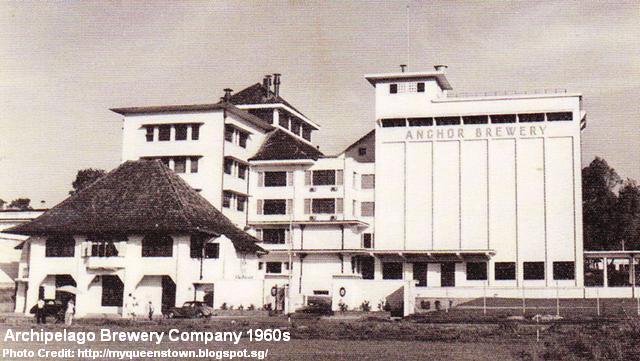
The market was actually named after Archipelago Brewery Company, the first commercial brewery in Singapore, established by a group of German investors in 1931. The factory was located at where Anchorpoint is standing right now, at the junction of Jalan Bukit Merah and Queensway. During its peak between 1930s and 1960s, its star product Anchor Beer was one of the favourite alcoholic drinks in Singapore.

archipelago brewer company 1960s

Archipelago Brewery Company was seized by the British government in 1941, at the onset of the Second World War, with its assets taken over by Fraser and Neave (F&N). The German brewery, however, was soon captured by the Japanese Army during the occupation for their own production of Japanese beer.

8. Chong Pang

Although Chong Pang Garden, a residential district within Yishun New Town, shares the same name with the vanished Chong Pang Village, both have little in common in their histories.

In recognition to his contributions in the public service, the former Chong Pang Village was named after Lim Chong Pang (1904-1956), the second son of prominent Teochew rubber magnate and “pineapple king” Lim Nee Soon (1879-1936). In the 1930s, Lim Chong Pang, as a member of the Singapore Rural Board (1929-1938), built a village at a rubber estate near the 12th milestone of Sembawang Road. Originally known as Westhill Estate, it was then renamed as Chong Pang Village in 1956 upon his death. There was also a Chong Pang Road (originally Westhill Road), branching off Sembawang Road and linking to Sultan Theatre, one of the many cinemas in Singapore set up by Lim Chong Pang.

chong pang village 1980s

chong pang road 1980s

The bustling Chong Pang Village was demolished in March 1989, becoming part of Sembawang New Town, although its exact location is still an undeveloped piece of forested land today. Chong Pang Garden, on the other hand, was built in 1981 between Sembawang Road and Yishun Avenue 2, approximately 1.2km away from the village.

Chong Pang Road was expunged when Chong Pang Village was torn down. Ironically, Chong Kuo Road, located some 5km away, managed to survive till this day. The road was named after Lim Nee Soon’s eldest son Lim Chong Kuo (1902-1938) in 1955.

9. Newton Road & Newton Circus

“For every action there is always an equal and opposite reaction“

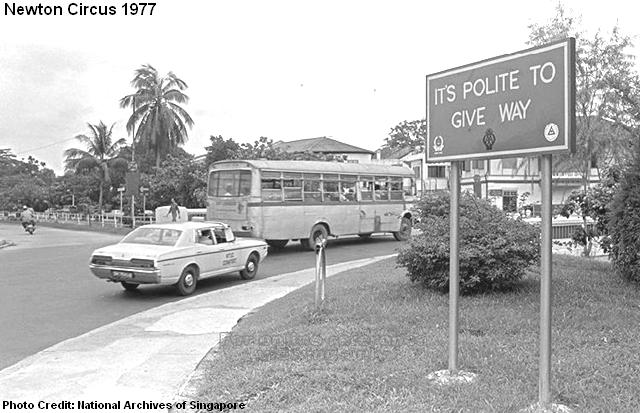
The famous Newton’s third law of motion has been taught in Singapore’s secondary school science classes for decades. The name Issac Newton (1642-1727) is so well-known in Singapore that people tends to associate the English physicist and mathematician with Newton Circus, Newton Road and the Newton vicinity located in the central part of the country.

newton circus 1977

Newton Circus and Newton Road, however, were named after Howard Newton (1852-1897), a capable British engineer who arrived at Singapore in his early twenties. Howard Newton spent twenty years as the Deputy Executive Engineer in the Water Department of the Singapore Municipality, working hand in hand with James MacRitchie (1848-1895) to improve the waterworks of Singapore.

When MacRitchie (the MacRitchie Reservoir was named after him in 1922) passed away in 1895, Newton was expected to take over his position as the chief Municipal Engineer. The Municipal Commissioners unexpectedly appointed S. Tomlinson from Bombay of British India instead, while the vacated post of the Executive Engineer of Waterworks of Bombay Municipality was given to Newton.

It turned out to be a misfortune for Howard Newton, as he died of cholera shortly after taking up his new position in India. In 1914, Syed Ali Road was renamed as Newton Road as a tribute to him.

10. Orchard Road

Orchard Road, the bustling famous shopping belt of Singapore, underwent many major transformation since it started as a simple lane in the early 19th century. Nutmeg plantations first flourished at the hillocks by the road, before pepper farms and fruit tree orchards took over. It was not until the collapse of nutmeg prices in the mid-19th century before private residences and bungalows appeared around Orchard, Scotts and Tanglin Roads. A portion of the lands near Orchard Road was also acquired by Ngee Ann Kongsi as their Teochew private cemetery.

Shophouses began to dot along Orchard Road during the 1890s. The popular Orchard Road Market and Singapore Cold Storage, opened in 1891 and 1905 respectively, brought crowds to the vicinity. The definition of Orchard Road as a shopping haven was finally established in the late 1950s when C.K. Tang opened their flagship departmental store.

It has been widely accepted that Orchard Road was named after the fruit orchards in the 19th century. However, the prominent existence of nutmeg, gambier and pepper plantations led to suggestions that the road was actually named after a certain Mr Orchard, who supposedly owned some of the plantations in the vicinity. It might be a similar case to the streets near Orchard Road, where Scotts Road, Cuppage Road and Koek Road were named after major plantation owners William G. Scotts (1786-1861), William Cuppage (1807-1872) and Edwin Koek (unknown-1891) respectively.

However, little is known of the plantation owner. Even his existence is debatable. That will be left to the historians to verify.

Published: 16 June 2013

Updated: 09 July 2018

Posted in Cultural | Tagged , , , , , , , , , , | 20 Comments

Compassvale Ancilla and Mang Kah Kar

Recently, there was a rather amusing news regarding the chim (profound) names of the new housing estates at Sengkang and Punggol.

Some joke that the job of a taxi driver will get tougher next time with the latest Build-To-Order (BTO) flats given fanciful names like Matilda Portico(柱廊), Ancilla(女随从), Nautilus(鹦鹉螺), Periwinkle(长春花), Edgedale Green, Waterway Sunbeam, Spectra(光谱) and The Coris (红喉盔鱼).

Most public housing estates in Singapore are easily recognisable by their block numbers or street names, such as Ang Mo Kio Street 43 or Bedok South Avenue 3, but the “branding” of HDB housing estates is not something new. Kim Keat Court was the first such “branding” in 1995, although its name may sound ordinary by today’s standard.

The Colloquial Names

Beside the official names, there used to have an alternate type of naming of streets, places or landmarks that proved to be popular among locals. Call them variant, common or colloquial names, these vividly descriptive names were simple, easy to remember and largely reflect the history of certain places. Ask any older generation of Singaporeans, and they are likely to be able to pinpoint you the exact locations of “mang kah kar“, “orh kio tau” or “pek sua pu“.

The early Chinese immigrants, mostly from South China, could not really comprehend the English names of the streets named by the British, such as Phillip Street and Waterloo Street, so they took matters into their own hands and named the roads in their familiar Hokkien, Teochew and Cantonese dialects. Many were named after the notable landmarks in the vicinities where the streets ran through, such as temples, markets, trading houses or even a rich or famous man’s residence.

Others were named after bridges, cemeteries, hills or just simply numbers. Today, many locals still fondly call the seven parallel roads near City Hall “first (main) road” to “seventh road”.  Waterloo Street, known as “si beh lor” (四马路, fourth road) is arguably the most famous of all, due to the popularity of the Kwan Im Thong Hood Cho Temple.

City Hall vicinity

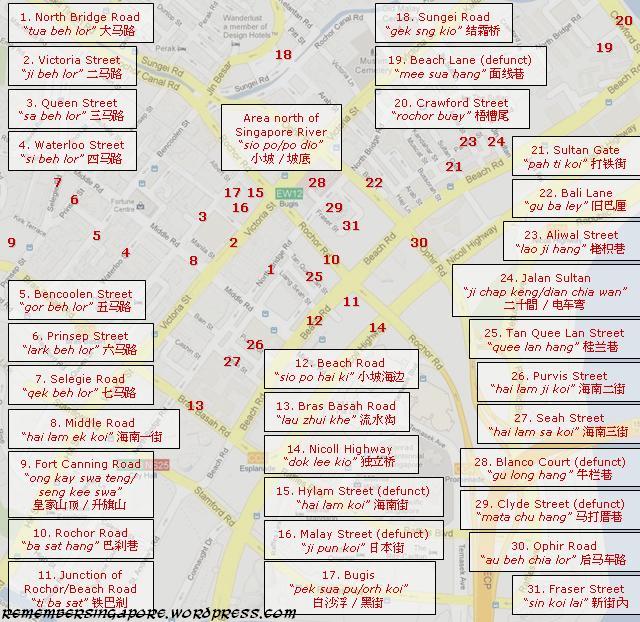
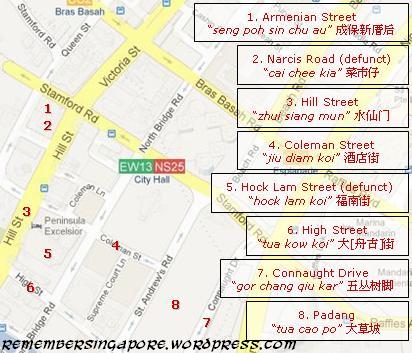
The vicinity around present-day City Hall, bounded by Crawford Street, Jalan Besar, Fort Canning and the Singapore River, was generally known as “sio po” (小坡, little downtown) in the past, where a large number of its streets had colourful colloquial names.

common names city hall-1 v5

In the sixties, the Ellenborough Market (1845-1968) and Clyde Terrace Market (1872-1983) were the two largest public markets in Singapore, situated at opposite sides of the Singapore River. Standing at the junction of Beach Road and Rochor Road, the Clyde Terrace Market was nicknamed “ti ba sat” (铁巴刹, iron market) due to its iron framework. Rochor Road, therefore, became better known as “market lane” in Hokkien, even after the market was demolished in the eighties.

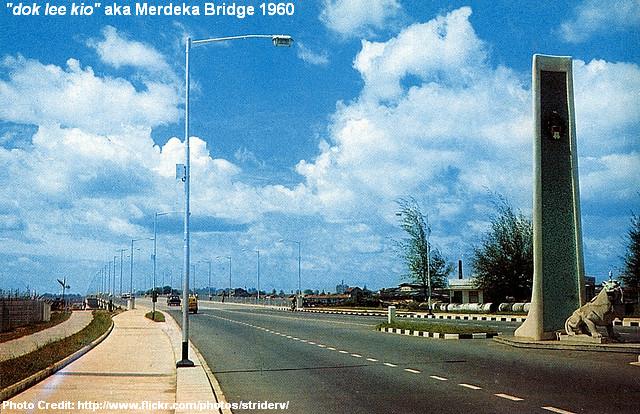
“dok lee kio” (独立桥, independence bridge) actually refers to the Merdeka Bridge, opened in 1956 together with Nicoll Highway, linking the city to Kallang, Geylang and Mountbatten over the Kallang Basin. Over the years, the variant name became the reference for Nicoll Highway instead.

merdeka bridge

The vicinity around Istana Kampong Glam was a historic district once belonged to the Malay royalty of Singapore. Sultan Gate, the road leading the former palace, was well-known for its iron-smiths; some of them still plying their trades today. Hence, Sultan Gate was given a range of variant names such as “pah ti koi” (打铁街, iron-smith street), “ong hoo kau” (王府口, mouth [front] of palace) and “tua che kar” (大井脚, foot of big well), referring to an old well at the middle of the road.

rochor canal and new singapore ice works ltd 1970s

Famous for its flea market and charcoal-cooked laksa, Sungei Road is better known as “gek sng kio” (结霜桥, frosted bridge). The name was derived from the establishment of the Singapore Ice Works, the major ice supplier in Singapore, at the junction of Sungei Road and Pitt Street in the 1930s. The factory, however, was shut down in the early eighties with its site taken over by HDB.

common names city hall-2 v4In the 19th century, Tan Seng Poh 陈成保 (1830-1879), a wealthy Teochew opium farm owner as well as a municipal commissioner and Justice of Peace, built a large mansion at Loke Yew Street near Fort Canning. The house was so prominent that the local Chinese named the adjacent Armenian Street as “seng poh sin chu au” (成保新厝后, at the back of Seng Poh’s new house).

Trading houses and godowns (warehouses at the dockside) used to line up on both sides of the busy Singapore River filled with many old traditional wooden boats called sampans (舢板), tongkangs (舯舡) and twakows (大[舟古]). These provided inspirations to the variant names of the roads beside the waterway. High Street was known as “tua kow koi” (大[舟古]街, twakow street) while Clarke Quay and Boat Quay are called “cha zhun tau” (柴船头, front of wooden boat) and “zhap buay keng” (十八间, eighteen [trading] houses) respectively.

Raffles Place vicinity

The streets in the modern Central Business District (CBD), filled with skyscrapers, office towers and banks, are a far cry from their appearances in the old days. During the 19th and early 20th century, the southern part of the Singapore River, known as “tua po” (大坡, large downtown) was a place mixed with legitimate businesses and illegal activities. Old dingy shophouses lined up along the cramped streets, housing the street hawkers, coolies, Samsui women, secret society members and prostitutes.

common names raffles place v5

One notoriously famous road within the vicinity was China Street. Better known as “giao keng kau” (赌间口, mouth [front] of gambling den), it was then filled with gambling dens and secret societies. One particular Hokkien secret society Ghee Hin Gongsi (义兴公司) was so powerful and influential that the local Chinese also called China Street “ghee hin koi” (义兴街, Ghee Hin street).

Other colloquial names that were named after secret societies were the Upper Nankin Street, Upper Cross Street and Carpenter Street. The former two were coined “seong pek koi” (松柏街, Seong Pek street) and “hoi san koi” (海山街, Hoi San street), named after Siong Pek Kwan (松柏馆), or Siong Pek Gongsi, and Hoi San (海山), two large Hakka secret societies that functioned as the oversea branches of Tiandihui (Heaven and Earth Society) in Qing China. Carpenter Street was known as “ghee hock hang” (义福巷, Ghee Hock lane), where Hokkien triad Ghee Hock Gongsi (义福公司) ruled their territories.

The gambling and unlawful activities were eventually eliminated in the late 1930s by the British government.

china street and ocbc centre 1982

“tau hu koi” (豆腐街, tofu street), made famous by the local Chinese drama of the same namesake in 1996, was the colloquial name for Chin Chew and Upper Chin Chew Streets, where there were many beancurd makers and sellers in the late 19th century. The beancurd trade, however, disappeared by the early 20th century. The streets then became known as “orh sa koi” (黑衣街, black shirt street), referring to the red headgear and dark shirts donned by the Samsui women who led a tough life living in the tiny cramped cubicles of the old shophouses.

Affected by the constructi0n of Hong Lim Complex, Upper Chin Chew Street was expunged in the late seventies.

lau pa sat telok ayer market

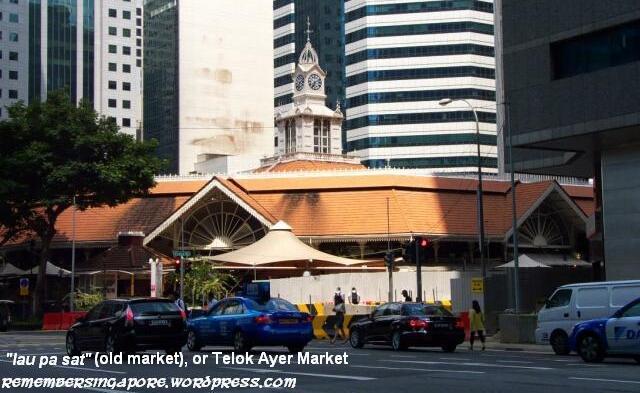
Telok Ayer Market, the trademark orthogonal-shaped market at the junction of Raffles Quay and Cross Street, had a long significant history dating back to 1822. Despite its conservation as a national monument in 1973, it had to be dismantled in the mid-eighties due to the construction of the Mass Rapid Transit (MRT) tunnels at Raffles Place. In 1989, the market’s signature iron-frames were reassembled in a $6.8 million renovation, and was renamed as “Lau Pa Sat” (老巴刹, old market), a name that had been used by the locals for decades.

collyer quay 1968

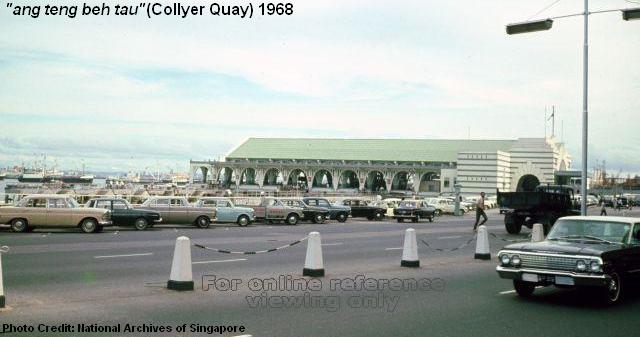
In the 1860s, land reclamation and the construction of a seawall were carried out at the mouth of the Singapore River. A road named Collyer Quay was completed in 1864, and offices, godowns and trading houses started to emerge at the new street. At Johnston’s Pier, red beacon lights were installed, which later led to the local Chinese’s naming of Collyer Quay as “ang teng beh tau” (红灯码头, red light pier). The famous Change Alley and Arcade also became known as “tor kho hang” (土库巷, godown lane).

Some streets at “tua po” were derived from the Chinese temples situated. One of them is Magazine Road’s Tan Si Chong Su Temple (陈氏宗祠), built in 1876 as an ancestral hall for the Tan clan in Singapore and a temple for Chen Yuan Guang (陈元光), a famous Tang Dynasty general worshipped at Taiwan and Southeast Asia. Over time, the deity’s honorary title “tan seng wang” (陈圣王) became the colloquial name for Magazine Road.

Another example is Phillip Street, commonly known as “lao ya keng” (老爷宫, deity palace). It refers to Yueh Hai Ching Temple (粤海清庙), Singapore’s oldest Taoist temple built in 1826.

Chinatown/Tanjong Pagar vicinity

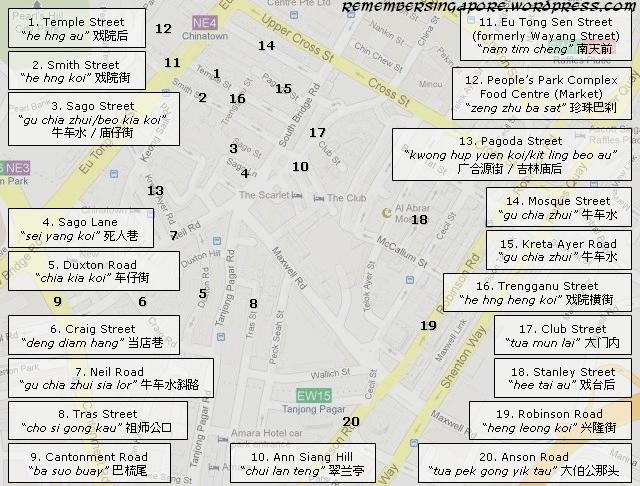
“gu chia zhui” (牛车水, buffalo cart water) is possibly Singapore’s most well-known colloquial name, so famous that the Chinese name of Singapore’s Chinatown had taken reference to it instead of the usual “Tang Street” (唐人街).

The colloquial name, however, refers to the bullock carts that delivered the fresh water between Ann Siang Hill and Telok Ayer Bay for consumption and cleaning of the streets. “gu chia zhui” is not limited to Kreta Ayer Road only; it refers to the vicinity that generally covers between Mosque Street and Neil Road.

common names chinatown v4

Eu Tong Sen Street, the main road to Chinatown, was nicknamed “nam tin cheng” (南天前, front of Southern Sky), referring to the Great Southern Hotel that once stood at the junction of Eu Tong Sen and Upper Cross Streets. Completed in 1936, it was the tallest skyscraper in Chinatown and was the first Chinese hotel to have a lift. Today, the hotel no longer existed; its conserved building has been converted into a departmental store called Yue Hwa.

great southern hotel 1980s

Lai Chun Yuen Theatre (1887-1942) was a famous Cantonese opera theatre located at Smith Street before the Second World War. It was so popular that the locals named Smith street as “hee hng koi” (戏院街, theatre street). Its widespread fame also ensured the theatre was taken as the main reference for the nearby Temple Street and Trengganu Street, which were simply called “hee hng au” (戏院后, back of theatre) and “hee hng hang koi” (戏院横街, street adjacent to theatre) respectively.

sago lane late 1970s

It once housed many sago flour factories and, later, brothels before the early 20th century, but Sago Lane was more famous for its death houses that lined up the street until their ban in 1961. Its variant name “sei yang koi” (死人巷, lane of the death) vividly described the dreadful scene back then, where many old and sick folks were left to live out the remaining of their days.

By the mid-seventies, part of Sago Lane was expunged for the construction of the Kreta Ayer Complex and HDB flats. Some of the former funeral paraphernalia shops at Sago Lane were moved to the adjacent Banda Street.

tanjong pagar plaza late 1970s

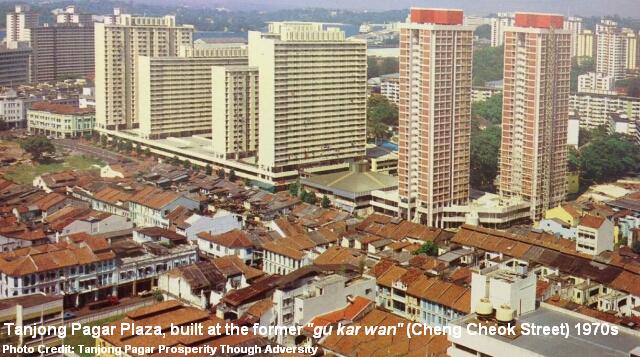
Cheng Cheok Street, also known as “gu kar wan” (牛角湾, bull horn bay), was formerly an important crossroad at Tangjong Pagar. Its colloquial name referred to the goods-carrying bullock carts that plied their routes between the Singapore River and the wharves. The road was later expunged in an urban redevelopment project, replaced by Tanjong Pagar Plaza and its flats in the mid-seventies.

Tiong Bahru vicinity

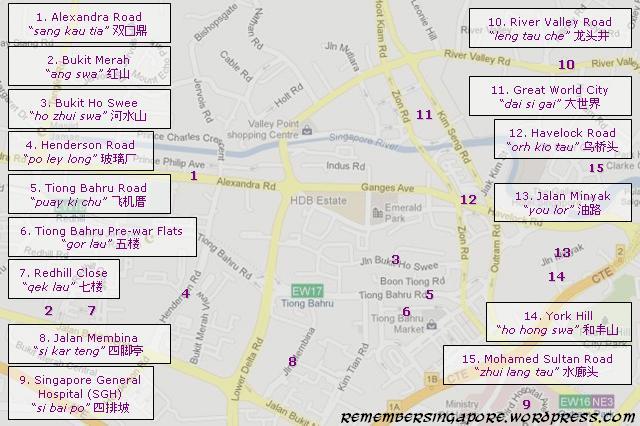
There were many familiar colloquial names around the old estates between Bukit Merah and Tiong Bahru. The terms “ho zhui sua“, “orh kio tau“and “si bai po” easily ring a bell with many Singaporeans.

common names tiong bahru redhill alexandra v2

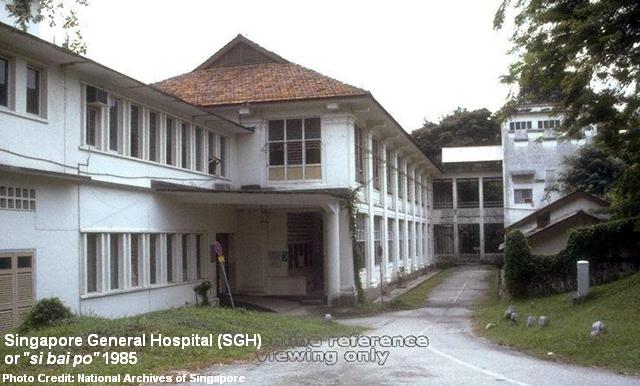
One of the first Indians to arrive at Singapore in the early 19th century, the sepoys, hired by the British East India Company, were initially accommodated in the barracks near Outram Road. The military site later became known as “si bai po” (四排坡, sepoy plain), a phonetic interpretation of the name Sepoy Lines. After the Singapore General Hospital (SGH) was established at Sepoy Lines in 1882, it became associated with the colloquial name instead.

Some elderly Singaporean Chinese today still harbour subconscious fear of “si bai po“, due to the word “si” which also means dead in the Hokkien and Teochew dialects, even though the colloquial name has nothing to do with death.

singapore general hospital 1985

One end of Havelock Road, near Beo Crescent, used to be known as “orh kio tau” (乌桥头, head [start] of black bridge). It belonged to one group of past colloquial names that referenced after bridges. Other than Havelock and Sungei Roads, there were “orh kio” (乌桥, black bridge), “pek kio” (白桥, white bridge) and “gao tiao kio” (九条桥, nine bridges), referring to Balestier, Moulmein and Upper Thomson Roads respectively.

Queenstown vicinity

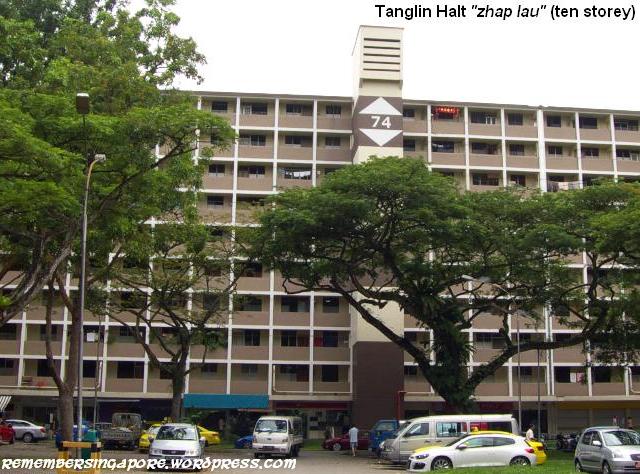
When HDB high-rise flats were built at the early housing districts such as Queenstown, Tanglin Halt, Strathmore, Dawson and Commonwealth, many were confused by their official English names. An easy way to remember the different locations was to nickname the estates according to the height of their flats.

tanglin halt zhap lau

Hence, Tanglin Halt was coined “zhap lau” (十楼, ten storeys). The former iconic Forfar House at Strathmore Avenue was popularly known as “zhap si lau” (十四楼, fourteen storeys), while “zhap lark lau” (十六楼, sixteen storeys) generally referred to the area around Commonwealth Close, Commonwealth Lane and Commonwealth Crescent.

common names queenstown v2

Other “shorter” versions included “gor lau” (五楼, five storeys), “qek lau” (七楼, seven storeys) and “gao lau” (九楼, nine storeys), referring to the SIT (Singapore Improvement Trust) flats at Tiong Bahru, Redhill Close and St Michael’s respectively.

As more HDB flats were built in other parts of Singapore, the conventional naming became impracticable, and probably discontinued due to confusion.

Kallang/Serangoon vicinity

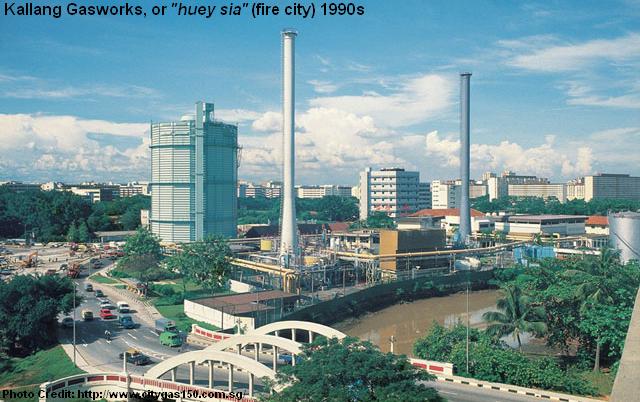
For many years, the iconic blue cylindrical tower and its incinerator chimneys at Kallang was well-known as “huey sia” (火城, fire city), a colloquial name derived from the nearby residents’ phobia that the facilities would explode. Fortunately, the fear of a fire disaster was never realised, as Kallang Gasworks produced an amazing 137 years of continuous supply of gas until its closure in 1998.

kallang gasworks 1990s

“mang kah kar“, the colloquial name of Lavender Street, has been the subject of debate for years. Was it the Hokkien translation of 芒胶脚 (foot [end] of jackfruit) or 蚊咬脚 (mosquitoes bite leg)?

Apparently, there were many jackfruit plantations near the junction of Lavender Street and Serangoon Road in the old days. Jackfruit was called nangka in Malay, but the local Chinese somehow mistranslated it into mangka. Hence, the street was coined “mang kah kar“, meaning the end of a jackfruit plantation. It had nothing to do with mosquitoes although the pesky insects were abundant in the plantations. An interesting trivia of Lavender Street was that its official name “lavender” was originally, and ironically, referring to the foul smells of night soil and fertilisers used for the plantations.

“kim jio kar” (金蕉脚, foot end] of banana) was another colourful colloquial name in the vicinity, but it was unknown whether there were large banana plantations at Petain Road in the past. It is, however, more famous as a red-light district today.

common names serangoon kallang v2

Largely known as “Little India” today, the Serangoon Road had a rather romantic name: “nam seng heu hng pi” (南生花园边, side of Nam Seng garden), which referred to the Whampoa’s Gardens, a Chinese garden beside the grand mansion built by Hoo Ah Kay (1816–1880), one of the wealthiest men in Singapore during his time.

Jalan Besar, on the other hand, was known as “kam gong ka por tai ter long” (甘榜加卜宰猪厂, Kampong Kapor pig slaughterhouse), due to the numerous pig abattoirs, situated between Desker and Rowell Roads, in the old days.

Upper Serangoon vicinity

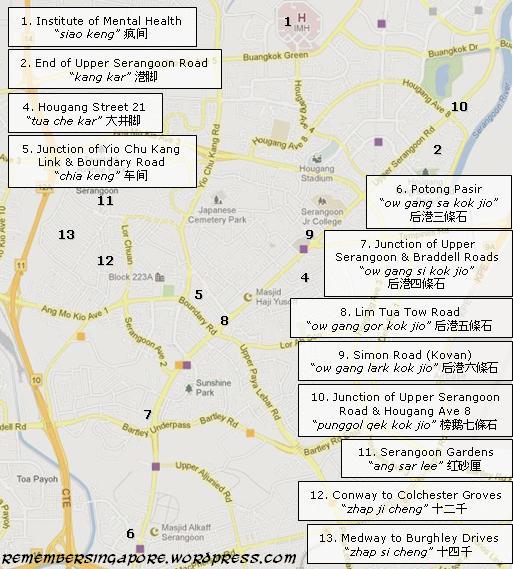
When the colonial-flavoured estate of Serangoon Gardens was built in the fifties, the eye-catching red roofs of the early batches of houses led to its colloquial naming of “ang sar lee” (红砂厘, red zinc). The name is still commonly mentioned by the older residents today, outlasting its lesser known cousins of “zhap ji cheng” (十二千, twelve thousands) and “zhap si cheng” (十四千, fourteen thousands), both referring to the prices of the houses in the vicinity during the sixties and seventies.

common names upper serangoon v1

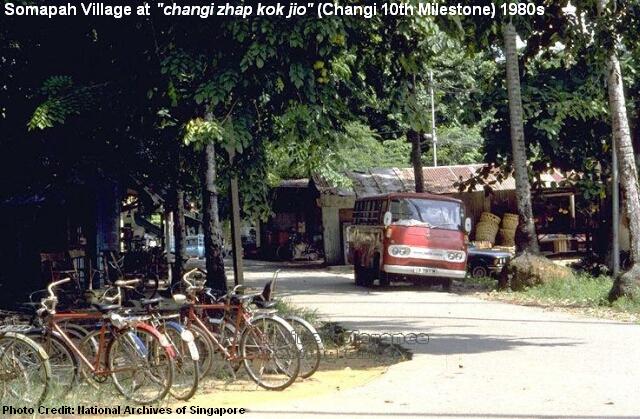
Another local way of naming the places was using the milestone method, in which one milestone was approximately equivalent to 550m. The origin or “point zero” started from the Fullerton Building (previously General Post Office), and the milestones were measured with reference to “point zero” on the old long roads that extended to the rest of Singapore, such as Bukit Timah Road, Jurong Road, Punggol Road and Changi Road.

An example was the Upper Serangoon Road, where there were [ow gang] “si kok jio” ([后港]四條石, Hougang 4th milestone – near the junction of Upper Serangoon Road and Upper Aljunied Road), “gor kok jio” ([后港]五條石, Hougang 5th milestone – Lim Tua Tow Road) and “lark kok jio” ([后港]六條石, Hougang 6th milestone – Simon Road).

Other examples were:

Beauty World – Bukit Timah (Upper Bukit Timah Road) 7th milestone
Bukit Panjang – Bukit Timah (Upper Bukit Timah Road) 10th milestone
Cheng Hwa Village – Bukit Timah (Upper Bukit Timah Road) 11th milestone
Chong Pang (Old) Village – Sembawang (Road) 13½th milestone
Hun Yeang Village – Tampines (Road) 9th milestone
Jalan Ulu Sembawang Village – Sembawang (Road) 2nd milestone
Jurong Village – Jurong (Upper Jurong Road) 7th milestone

somapah changi village 1980s

Kampong Sungei Tengah – Choa Chu Kang (Road) 13th milestone
Kampong Teban – Tampines (Road) 7th milestone
Princess Elizabeth Estate – Bukit Timah (Upper Bukit Timah Road) 9th milestone
Sixth Avenue – Bukit Timah (Road) 6th milestone
Somapah Village – Changi (Upper Changi Road) 10th milestone
Teck Hock Village – Tampines (Road) 7½th milestone
Thong Hoe Village – Lim Chu Kang (Road) 13th milestone
Tua Pek Kong Kau – Yio Chu Kang (Road) 11th milestone
Tuas Village – Jurong (Upper Jurong Road) 18th milestone

Many of these names were associated with villages, and when these villages were demolished, the names also ceased to exist.

Elsewhere in Singapore

The colloquial names of places elsewhere in Singapore:

Arumugam Road (“gu cai ba“, 韭菜芭, farm of chives)
Bukit Brown (“kopi swa“, 咖啡山, coffee hill)
Chai Chee (“chai chee“, 菜市, vegetable market) – referring to the small markets selling fresh produce from the nearby farmlands.
Changi Village (“changi buay“, 樟宜尾, end of Changi)
Coleman Bridge (“tiao kio tau“, 吊桥头, head [start] of suspension bridge)
Dhoby Ghaut (“kok tai“, 国泰, Cathay) – referring to Cathay Cinema at Handy Road
Elgin Bridge (“ti tiao kio“, 铁条桥, iron bridge)
Java Street (“pah jio koi“, 打石街, mason street)
Kampong Silat (“gu kia swa“, 龟仔山, little tortoise hill)
Kandang Kerbau (KK) Hospital (“tek ka“, 竹脚, foot of bamboo)
Lorong Tai Seng (“dai seng hang“, 大成巷, Tai Seng lane)
Old Holland Road (“kek nang ba“, 客人芭, Hakka farm) – referring to the Hakka villages in the vicinity during the sixties and seventies
Ord Bridge (“tse kio“, 青桥, green bridge)
Rangoon Road (“gia dau hang“, 拿豆巷, aloe lane) – referring to the plantations of aloe in the vicinity in the old days
Seletar (“goon kang“, 军港, military port) – referring to the British Royal Air Force base and Seletar Airport
South Buona Vista Road (“gao zhap gao wan“, 九十九弯, 99 bends) – referring to the numerous bends of the road
Springleaf (“nee soon kang kar“, 义顺港脚, foot of Nee Soon port or “chia zhui kang” 淡水港, fresh water port) – referring to the flavourable deep waterways at Sungei Seletar
Telok Blangah Way (“sit lat mun“, 石叻门, Silat door)
Thomson Garden (“gor ba keng“, 五百间, five hundred houses), referring to the terrace houses in the vicinity

ow gang lark kok jio hokkien mee

By the eighties, new colloquial naming of places and landmarks almost came to a stop, probably due to the government’s efforts in discouraging dialects and promoting the usage of Mandarin and English.

Some of old names can still be found today though, particularly at the hawker centres or kopitiams where they are used by the food stalls as their signature branding. A few that come to mind are the “giao keng kau you zar kueh” (赌间口油条) at Maxwell Market, “ow gang lark kok jio hokkien mee” (后港六條石福建面) at Simon Road and “mang kah kar char kuay teow” (芒胶脚炒馃条) at Ang Mo Kio Avenue 10.

All maps credited to Google Maps

Published: 28 May 2013

Updated: 06 November 2016

Posted in General | Tagged , , , , , , , , , | 49 Comments

Once in Our Life, Two Years of Our Time

“Training to be soldiers
To fight for our land
Once in our life
Two years of our time

Have you ever wondered
Why must we serve?
Coz we love our land
And we want it to be free, to be free

Looking all around us
People everywhere
While they’re having fun
We are holding guns

Have you ever wondered
Why must we serve?
Coz we love our land
And we want it to be free, to be free

Stand up!
And be on your guard
Come on every soldier
Do your part
Do it for our nation
Do it for our Singapore”

After almost 18 years of active National Service (two-and-a-half years of full-time NS plus ten cycles of In-Camp Trainings), I finally received my precious MR (Mindef Reserve) certificate. Looking back, the unforgettable experiences were both fun and siong (tough). There were good and bad memories, as well as absolute nightmares in the confinements, devilish trainings and tekan by sadistic instructors. Memories of NS may be nostalgic to some, but most, if not all, will not want to go through it again.

NS life is a favourite chit chatting topic among male Singaporeans. Many like to reminisce their NS days, and compare whose units were the most siong. There are always countless tales to tell; from outfields and trainings to supernatural stuff.

Pre-Independence Period

The British colonial government first mooted the idea of national service in 1952. The bill, named the National Service Ordnance, was passed by the Legislative Council and was supposed to come into effect in 1954. The new law required the local men of ages between 18 and 20 to be called up for trainings at the Singapore Military Force (SMF) or the Civil Defence Corps (CDC). Those who failed to register would be fined or jailed.

However, most locals rejected the new law. Thousands of local Indians left Singapore, while the Chinese middle school students organised aggressive protests. In May 1954, the National Service Riots broke out. As many as 2,500 students locked themselves at Chung Cheng High School. Police marched in to quash the riots, but the colonial government eventually backed down and “postponed” the bill.
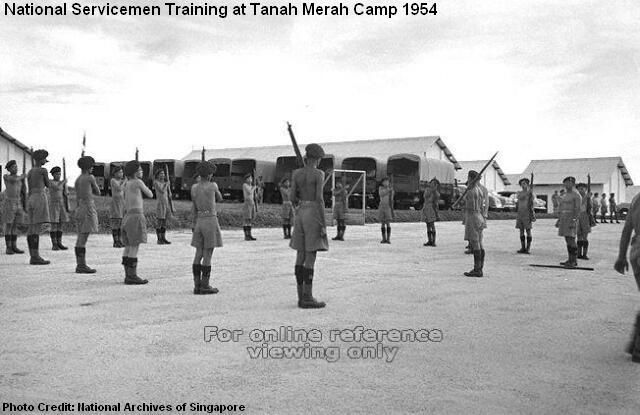
national servicemen training at tanah merah camp 1954

Even though the students successfully forced the authority to reverse their decision, dozens of them were injured and arrested in the riots. The Chinese middle schools, in the later years, even became a breeding ground for pro-communist elements.

Singapore’s First Battalion
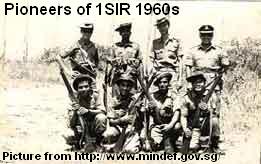
1sir pioneers 1960sThe history of local military regulars has gone a long way back. In April 1955, Singapore was given its first Legislative Assembly Election, with David Marshall (1908-1995) served as the First Chief Minister of Singapore. When Lim Yew Hock took over the partial self-government a year later, his hardline approach against the communists persuaded the British to grant Singapore more autonomy.

As the complete self-rule of the country became imminent, there was a need for Singapore to have its own military defence. On 12 March 1957, a total of 237 men born in Singapore was selected from an application pool of 1,420 to form the First Singapore Infantry Regiment (1SIR). Trainings of the new recruits were first carried out at Nee Soon Camp, which was still under the ownership of the British Army and was used to train their own forces.
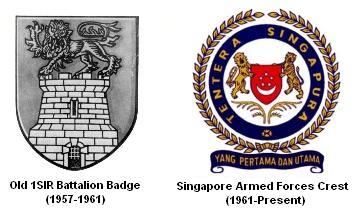
1sir battalion badges 1957-presentThe officers and men were later based at Ulu Pandan Camp, but it took six years before 1SIR reached its full battalion strength of over 800 men. The early roles of 1SIR was mainly to engage internal security and maintain civil order with the police.

During the merging with Malaysia and the Konfrontasi period against Indonesia (1963-1965), 1SIR was posted to Perak, Sabah and Johor for jungle trainings and defensive missions. The experienced battalion later produced many commanders to train the new enlistees when NS started in 1967.

Compulsory National Service

When Singapore attained independence in 1965, there was an urgency for the newly born nation to have its own defence force. Its two existing battalions of regulars were clearly insufficient, but any expansion of the army would cost a lot of money and put a strain on the economy.

Finance Minister Dr Goh Keng Swee (1918-2010) was appointed as the first Minister for Defence to work on the proposal in building up a sizable voluntary force to back up the regulars. However, when the British indicated their intention to reduce their forces in Malaysia and Singapore in 1966, the need for compulsory national conscription with reservist became the long term plan.
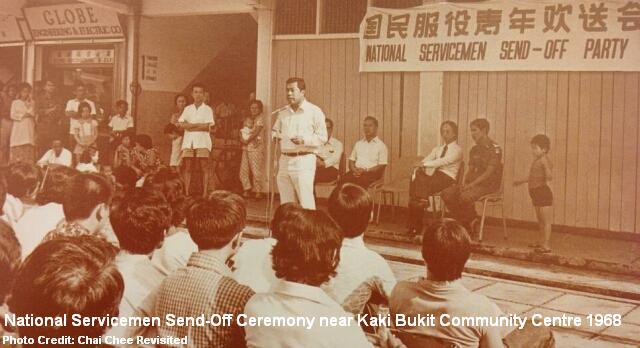
national servicemen send-off party near kaki bukit community centre 1968

At the beginning, Singapore’s military development and directions were not determined. Several international case studies were conducted, and Switzerland was one of the considerations, based on the success of its economy and citizen army. In the end, Israel was deemed as a more suitable model. A secret pact with Israel was reached, with Israeli advisors flew in to train the first batch of graduates from the Singapore Armed Forces Training Institute in June 1967.

In the early days of Singapore’s independence, the military cooperation with Israel was never formally acknowledged, due to the sensitivity of a predominately Muslim region. The Israeli advisors, when arrived at Singapore, even had to take up the identities of “Mexicans” or “Indians”.

first commissioned officers passing out parade 1968

By January 1967, all new civil servants were required to undertake military training. A month later, the NS (Amendment) Act was passed in the parliament. On 28 March 1967, registration was first opened for all 18-year-old male Singaporeans. Only one tenth of the 9,000 applicants was selected for full-time NS due to the limited training facilities. The remaining was posted to part-time national service at the People’s Defence Force (PDF), the Special Constabulary and the Vigilante Corps.

The 900 selected personnel were officially enlisted on 17 July 1967, added to the newly-formed infantry battalions of 3SIR and 4SIR after weeks of basic military training (BMT). Subsequent batches of fresh enlistees soon followed, reporting at the community centres or the Central Manpower Base.
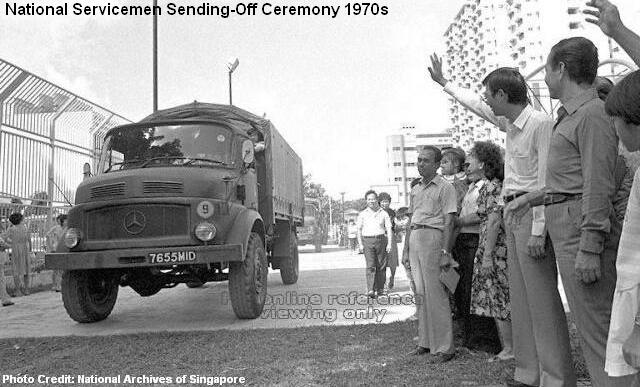
national servicemen send-off ceremony 1970s

In the late sixties and early seventies, send-off dinners and ceremonies were regularly organised at the community centres to boost the morale and the commitment of the new national servicemen, whose loved ones would line up along the roads to witness their departures on the three-tonner trucks.
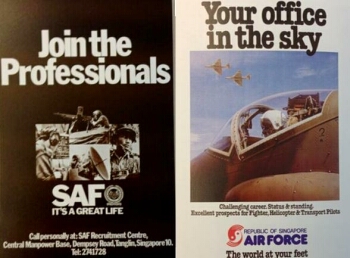
saf recruitment posters 1978-1980With the successful establishment of the additional infantry battalions and the new SAF Training Institute, other facilities such as the School of Artillery and School of Signals soon followed. In the late sixties, SAF also introduced its first scholarship program to attract the brightest talents to join the military as their careers. The university study fees and living expenses were offered in exchange for an eight-year bond with the armed forces.

Singapore celebrated its first ever National Day on 9 August 1966. Six contingents, including the Singapore Infantry Regiment and the People’s Defence Force, marched past the building of City Hall, saluting then-President Yusof bin Ishak. Crowds of thousands cheered loudly as the troops continued their march to Chinatown and Tanjong Pagar. On 1st July 1969, Singapore also celebrated its first Armed Forces Day (SAF Day) to mark the armed forces’ loyalty and dedication to the nation. A 1,500-strong contingent of national servicemen and servicewomen was involved in the special day filled with parades and open houses.
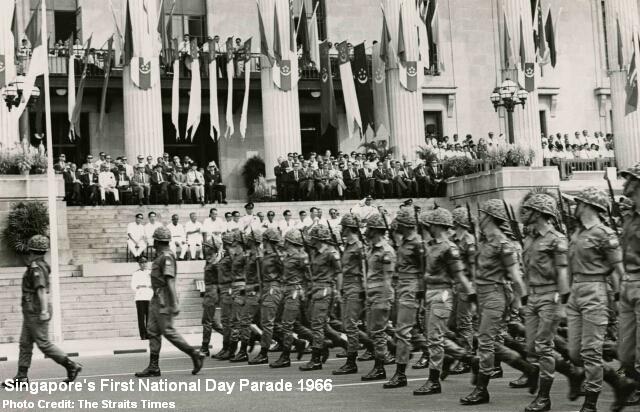
national day parade 1966

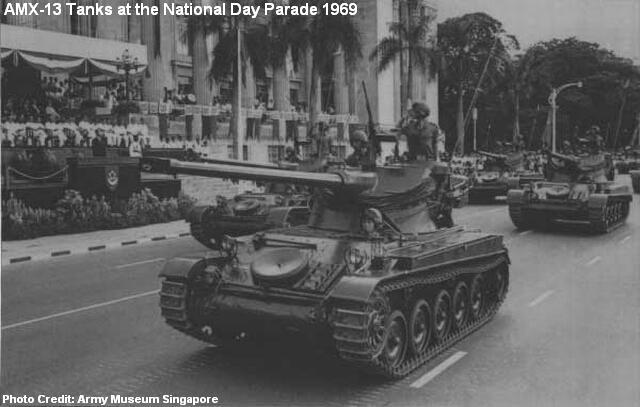
amx-13 tanks at national day parade 1969

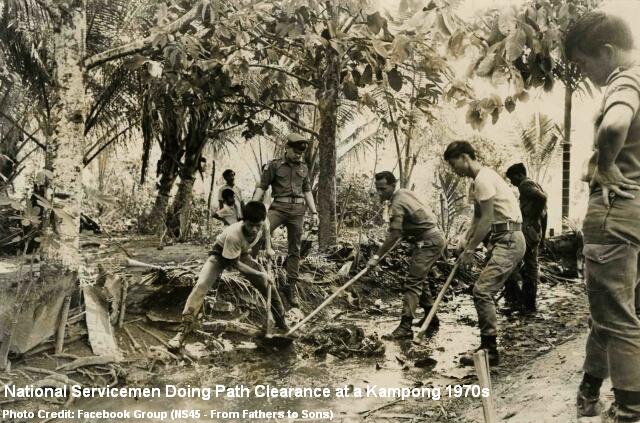
The national servicemen of the sixties and seventies, beside trainings, took part in many gotong royong (helping out in the communities) such as tree planting, rivers’ clean-up, debris removal in flood-affected areas and road repairs at kampongs. Many were also activated for major rescue operations, notably the Laju Crisis in 1974, the Spyros Disaster in 1978, the Sentosa Cable Car Accident in 1983 and collapse of Hotel New World in 1986.

national servicemen kampong clearance 1971

MINDEF and CMPB

Before its split into Ministry of Defence (MINDEF) and Ministry of Home Affairs in 1970, it was the Ministry of Interior and Defence (MID) which took charge of SAF. The ministry was established in 1965 with only a small office at Empress Place as its headquarters. It was then shifted to Pearl’s Hill Barracks in early 1966, sharing the premises with the Central Manpower Base (CMPB) and the Police Headquarters.
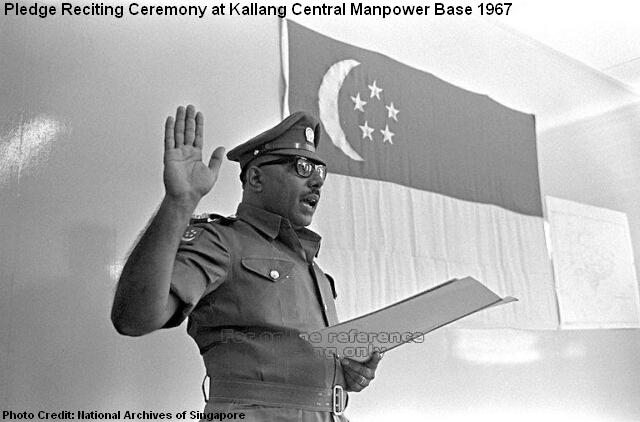
reciting the pledge at kallang central manpower base 1967

A year later, CMPB was moved to Kallang Camp. It was reunited with MINDEF at the Tanglin Barracks in 1972, after its buildings were left vacant by the departed British forces. This lasted 17 years until 1989, when MINDEF moved to its new headquarters at Bukit Gombak, while CMPB was relocated to Depot Road.

Training to be Soldiers

Before the official inauguration of the centralised Basic Military Training Centre (BMTC) in 1996, the recruits were trained in two major camps at Nee Soon and Pulau Tekong. A small number of other enlistees was recruited directly in units through the mono-intake system introduced since 1980.

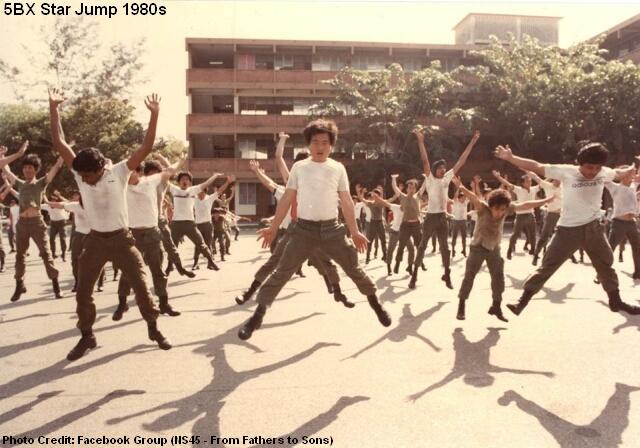
To many, the Physical Training Instructor (PTI) was a terror figure during BMT. Daily routine of morning exercises included jumping jack, burpees, star jumps, pushups, situps, half squats and others. Waking up at 5.30am, the recruits gathered at the parade square to do 5BX (5 Basic Exercises) in the darkness, followed by a short run before they could have their breakfasts.
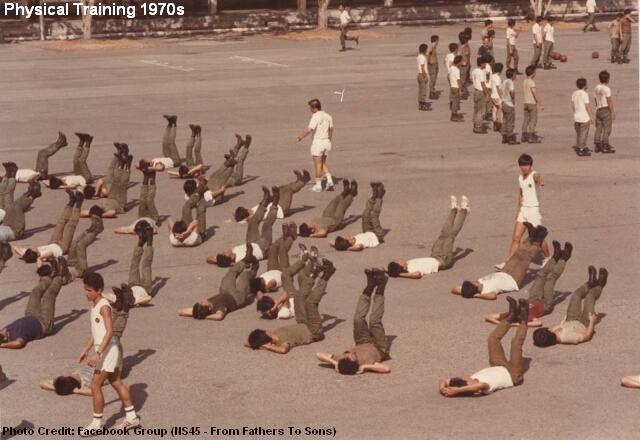
physcial training 1970s

5bx star jump

To do more than 200 pushups in a morning session of physical training was a norm in the nineties. After the tekan, the body would ache so much that many could not lift their arms while changing shirts. Threading water for several minutes in the swimming pool was another gruelling exercise. Nevertheless, the tough physical trainings ensured the national serviceman was kept at his best fighting-fit condition.
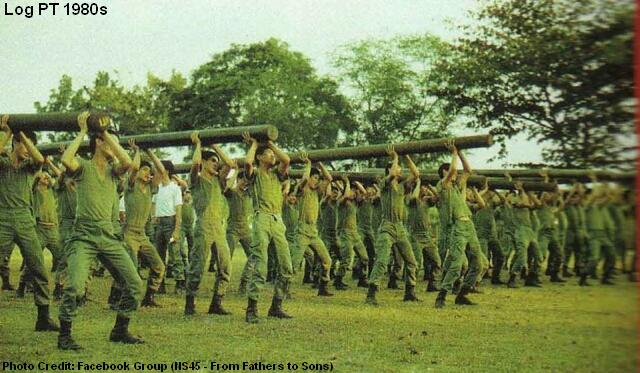
log pt

Today, the likes of log PT and medicine ball are banned. Even the role of PTI is being outsourced to commercial fitness outfits.
standard obstacle course 1990s

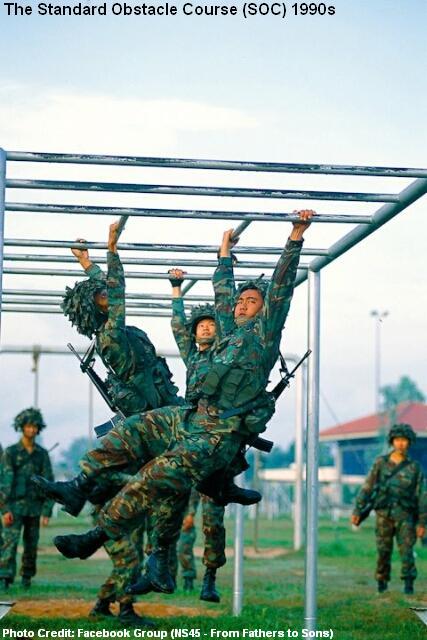
The Standard Obstacle Course, or SOC, was a nightmare for many.

Dressed in combat attire with SBO, helmet and rifle, this was one of the basic courses in BMT that a recruit must complete within 9 minutes.

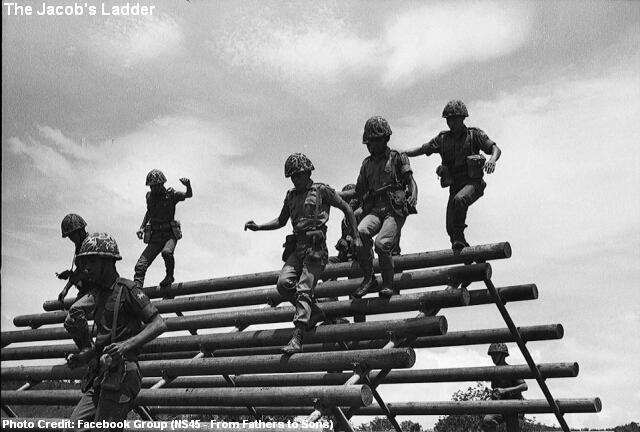
A short 50m run was followed by a 1.83m low wall. Other obstacles were the monkey bars, stepping board, 3.5m rope, swinging bridge, balancing log, Jacob’s Ladder and a low ramp with concertina wires.

After clearing all the obstacles in this “military playground”, the recruit had to run another 600m before finishing the physically-demanding course.

The Battle Inoculation Course (BIC) was an interesting course a recruit had to go through in his BMT. It was a simulation of a battlefield environment during wartime, and the trainees had to get past barbed wires by doing leopard crawling and back crawling with live rounds flying above them. After an exhausting 90m of crawling and wiggling in the mud, the recruits would have to gather all their might to make a final charge at their “enemies”.

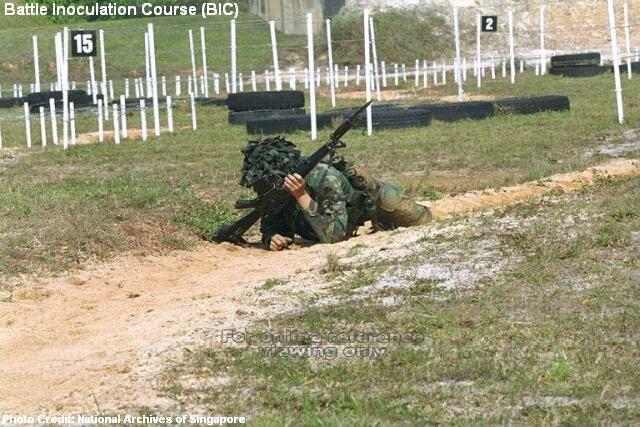
battle inoculation course

battle inoculation course2

Many older Singaporeans would be familiar with the hand grenade training in BMT, influenced by the classic SBC drama The Army Series (新兵小传) in 1983, in which veteran actor Huang Wenyong played an acting role as a lieutenant who lost his life while saving a recruit during a hand grenade training.

In reality, the course was not as dangerous as it seemed. Trainees had to be familiarised through repeated throwing practices with a dummy grenade before they could actually try the real thing. Standing behind a concrete barrier, the recruit had to release the safety pin before throwing the live grenade and witnessing its explosion six seconds later.
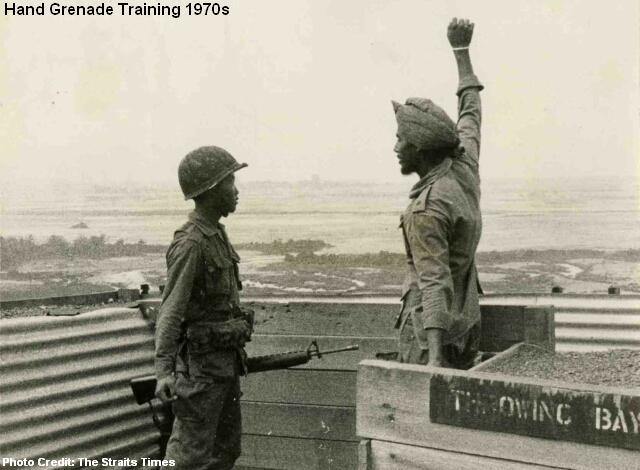
hand grenade training 1970s

The instructor must keep his calm at all time, but even the most experienced ones would be unnerved by three types of recruits, namely the blur sotongs, the gan cheong spiders and those with sweaty palms!

Chemical Agent Training used to be one of the courses in BMT. Trainees donned in masks and full body suits had to go through a tear gas-filled chamber. The worst experience was not the eye-burning sensation caused by the tear gas but the sight and smell of those stains of tears, saliva and mucus on the used mask!
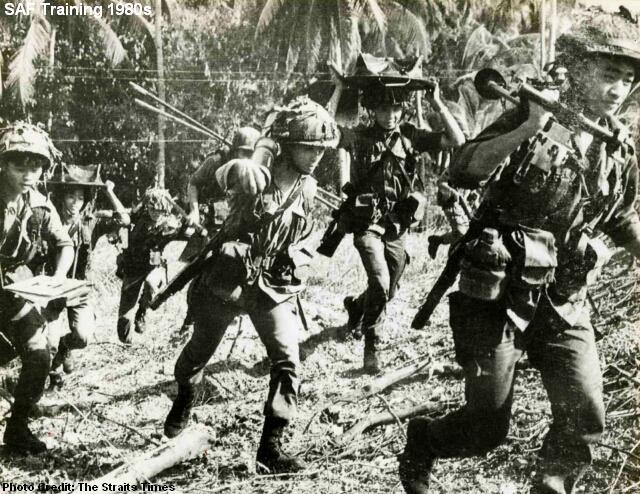
saf training 1980s

The eight-week BMT was rounded off with a six-day field camp and a 24km route march in FBO (Full Battle Order). But it was not over yet! In fact, it was just the beginning of a two-year (two-and-a-half year previously) National Service. Different batches of national servicemen, depending on their vocations, went to experience different types of training courses.
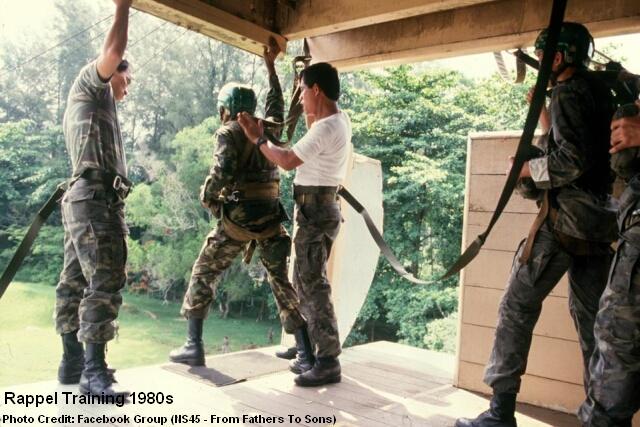
rappel training 1980s

Cheong sua, literally “means charging (up) the hill” in Hokkien, is a phrase used to describe basic infantry training. The tactical movement was by no means an easy feat. Many national servicemen could recall their exhausted days at the notorious Peng Kang Hill and Elephant Hill (at Pasir Laba) and Botak Hill (at Pulau Tekong).

In the 1970s, there were many small knolls at the training area between Woodlands and Mandai, such as Hill 180 and Hill 255, which were named according to their heights (in feet). The most famous was perhaps Hill 265 with its steep barren slopes covered with orange mud. Part of it was flattened in the nineties due to the construction of the Seletar Expressway (SLE).
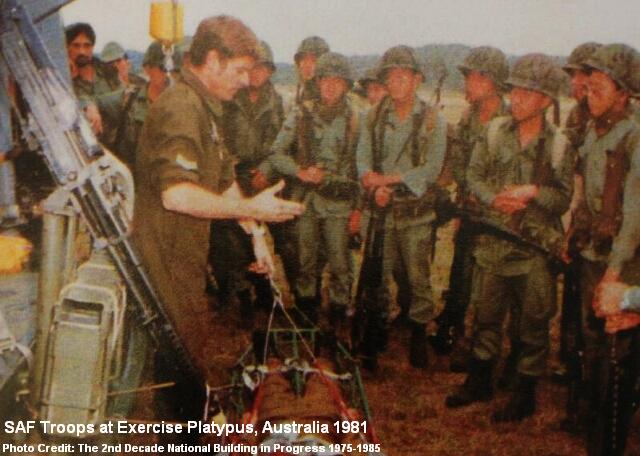
exercise platypus at australia 1981

Not all national servicemen had the chance to experience it, but for those who did, the oversea exercises at Brunei were unforgettable experiences, or nightmares. Its thick and dense jungles made Singapore’s Mandai or Sungei Gedong look like playgrounds.

Wearing sweat-drenched No. 4 and carrying heavy weapons, the soldiers had to trek long distances over hilly areas filled with commando-trained mosquitoes, sand flies, armies of giant ants and, occasionally, some mean-looking centipedes. As if the physical toil was not enough, there were also rumours that the jungles contained many restless souls of previous National Servicemen who got lost in the thick vegetation and never made it back home.

Life in the Army Camps

Beside combat trainings and physical exercises, national servicemen had to learn to adapt to routine life in the army camps, sharing bunks with each other and working hand in hand to ensure the required disciplinary standards were met.
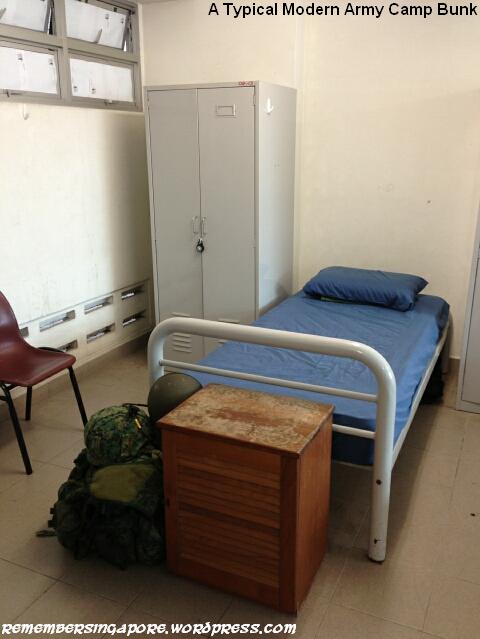
typical modern bunk in army campUnlike today, the past national servicemen had to do all the area cleanings themselves, taking turns to wash the toilets, empty the drains and clear the dry leaves on the carparks. Beds had to be made each morning with wrinkle-free bedsheets. The boots must be polished gilat gilat, and displayed neatly along with the shoes and slippers by the beds. The items in the cupboards should be placed in their orders, with the shelves kept dust-free.

The two-week confinement period during BMT was perhaps the most restricted period for the national servicemen. In those days without internet or handphones, the connection with the outside world was basically cut off. At nights, the recruits queued up in long lines at the coin phones, while others tried to find pleasure listening to their walkman. Leisure time was short anyway, as the lights had to be off by 10pm.

Despite the authority’s denial, the existence of “white horse” was never in doubt. Those who had the “luck” to be part of a BMT platoon or company with a “white horse” would enjoy more canteen breaks and less punishments!

Life in the units was generally better, but new birds were likely to be tekan with constant stand-by-bed, turn-outs (in the middle of the night) and change parades in their first few weeks. The worst of all was the falling-in of beds’ and cupboards’ at the parade square. Imagine carrying those heavy and bulky cupboards up and down three or four levels. Luckily for the new national servicemen, this sadistic practice is banned today.

Rifles as Wives

On the first day when M16 (or SAF21 today or AR15 before the 1980s) was handed to a recruit, he was taught that he must treat the 3.3kg weapon like his wife.

saf rifle range targetIt was a grave mistake to lose one’s rifle. Without his weapon, a soldier was like a vulnerable sheep during the war. During an outfield exercise, the weapon must be slung by the side at all times, even during sleeping. The sergeants would not hesitate to “steal” the rifle from any careless soldier, and a “lost” weapon would mean extra confinement and burnt weekends.

There were many M16-related trainings. For the fitness part, a M16 (or the heavier dummy weapon) was often used to train the endurance and the strength of the arms. In close combat trainings, a recruit also learned, in times of ammunition shortage, how to pierce the target with the bayonet fixed at the end of his M16, or hit the target with the rifle butt. In reality, it seems a better idea to lie low or retreat when your rounds are exhausted.

To many, shooting range was one of the most enjoyable activities in NS. But the excitement of firing live rounds and hitting the targets was often offset by the fear of punishment due to misfiring or other silly mistakes in the range. And not forgetting the exhausting moment during that 300m run down. A shooting range exercise usually took a day to complete. The difference between marksmen and bobo shooters became more obvious during the night shoot.
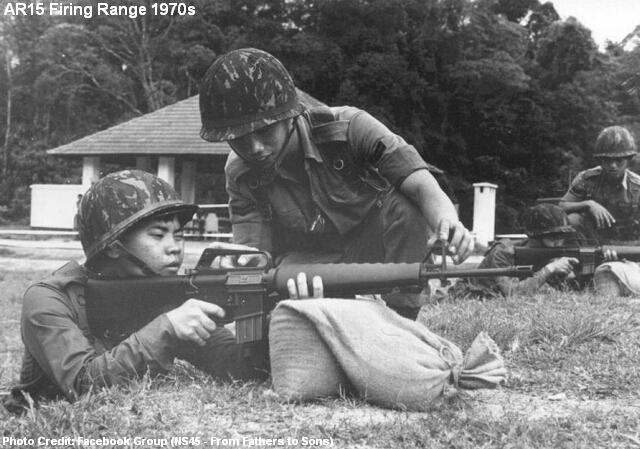
ar-15 firing range 1970s

The arrival of the ninja van, with its fried bee hoon, nasi lemak and soft drinks, was perhaps the best consolation in an otherwise boring range where sections of trainees sat on long wooden benches waiting for their turns. The nickname of ninja van probably derived from its ability to find the starving troops in ulu camps and training grounds.

There were much to do after a shooting range exercise. Empty cartridges had to be picked up; rifles had to be cleared, cleaned, oiled and checked before returning to the armskote. By then, the soldiers were already shack out.

The Military Identity

The SAF 11B is a military identification card all active national servicemen must possess. The predecessor of 11B was 11A, which was phased out two years after the introduction of 11B in 1981.
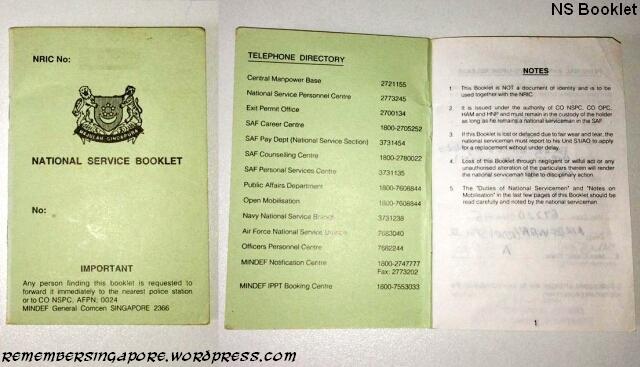
my ns booklet

The little green NS Booklet was replaced by the convenience of the online NS Portal in the early 2000s. National servicemen no longer need to refer to their booklets on their total number of high-key and low-key ICTs.

The Defence Industry

The first Minister for Defence Dr Goh Keng Swee was also the chief architect in the development of local defence-related companies to support SAF. One of its first in the industries, Chartered Industries of Singapore (CIS) was established in 1967 to supply 5.56mm ammunition rounds for the M16 rifles.
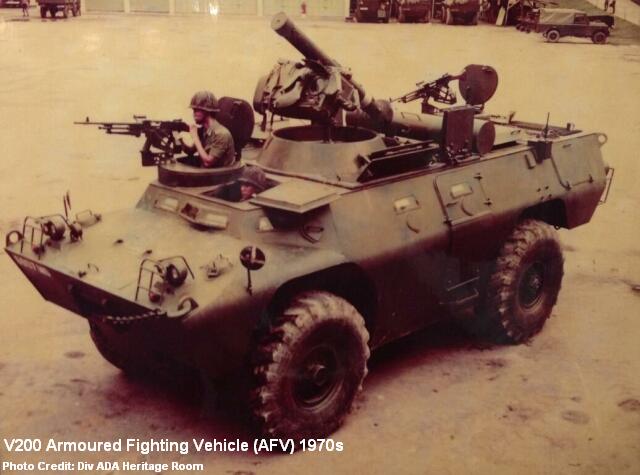
v200 armoured fighting vehicle 1970s

In 1969, Singapore bought 72 French-made AMX-13 tanks and 170 V200 armoured vehicles. The purchase was significant, as it kicked off a program of continuous upgradings in the history of SAF.

The late sixties and early seventies also saw the formation of Singapore Shipbuilding & Engineering (SSE), Singapore Electronic & Engineering Limited (SEEL), Singapore Automotive Engineering (SAE), Singapore Food Industries (SFI) and SAF Enterprises (SAFE).
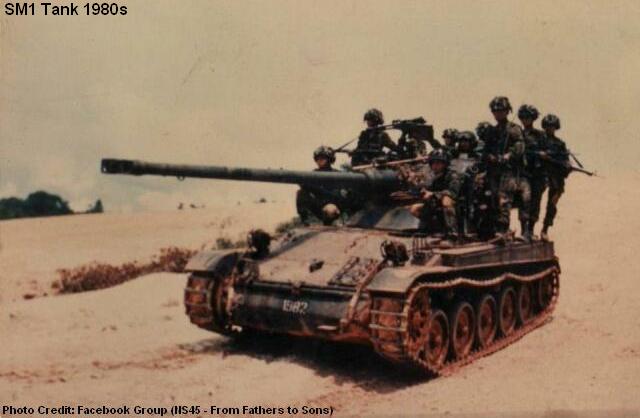
sm1 tank 1980s

These supporting companies provided SAF with maintenance services in communication and electronic equipment, military vehicle servicing, engineering and design, and even daily food supply to the SAF soldiers.

Evolution of SAF Cookhouses

The sight of military chefs, metal trays and green plastic mugs represented the days before the commercialisation of SAF cookhouses in 1997.

Hungry soldiers risked facing the wrath of cooks who were frustrated by long hours of work and oily environment, whose sweat would sometimes trickle down into the large pot while they were stirring the rice. A request for more vegetable? The emotionless cook would just dump a big load onto your tray, spilling over onto your fingers.
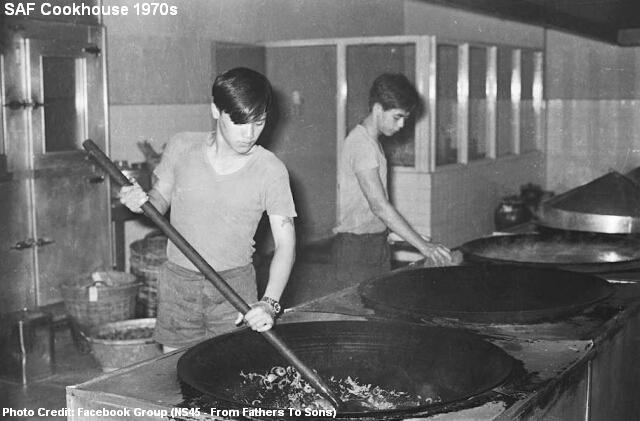
saf cookhouse 1970s

Daily meals of just rice, meat and vegetable were a norm. On occasional days, there would be fish ball noodles, but the noodles tasted more like rubber bands than anything else. During BMT, recruits had to take turns to wash the cookhouses and clear the garbage too. Canteen breaks became a valuable treat, as the national servicemen looked to avoid cookhouses at all cost.
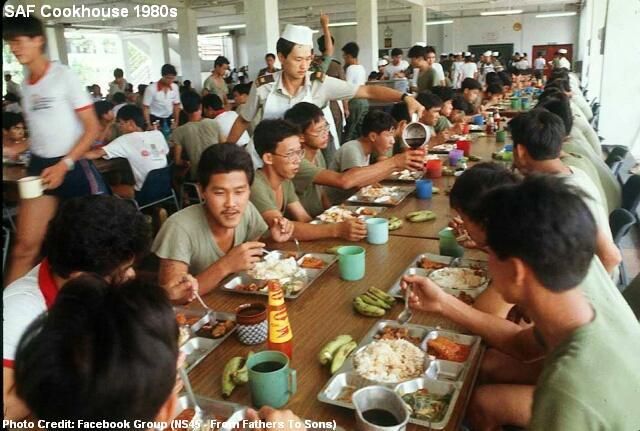
saf cookhouse 1980s

The plan of outsourcing to civilian caterers was proposed as early as 1984, due to the declining number of young male Singaporeans entering the national service. However, the commercialisation of SAF cookhouses was not finalised until 1997.
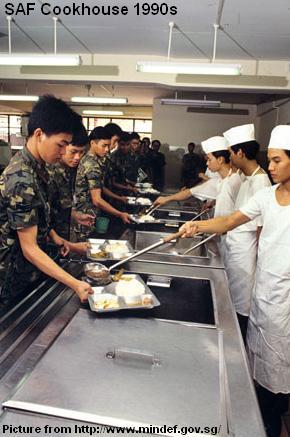
saf cookhouse 1990sTwo catering companies Singapore Food Industries Manufacturing (SFIM) and Foodfare Catering (FFC) were contracted to manage 60 SAF cookhouses and provide a wide range of food to the National Servicemen, who were treated with safer food preparation and healthier choice of food.

The environment-friendly packaging and higher quality and lighter combat rations also made it convenient for the soldiers during their outfield exercises. The cans of baked beans, hard tack biscuits and melting chocolates were replaced by commercial off-the-shelf snacks and beverages that could be found in the supermarkets.

Today, the national servicemen enjoy different daily menus such as chicken rice, nasi bryani, pasta and even fish and chips.

Temasek Green, Camouflaged and Pixelised

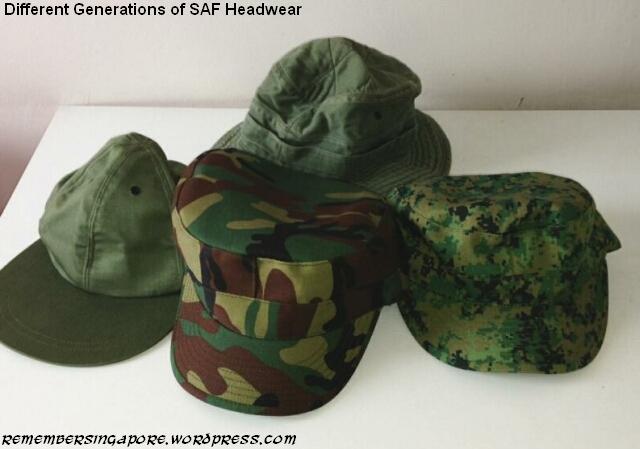
Temasek Green, the first generation of SAF combat uniform debuted in 1967, replacing the old military clothing formerly used by the British. The uniform, which was made of thick cotton and had two pockets for the shirt and three for the pants, was modified in 1977 with a darker green tone, baggier in size and an addition of two extra shirt pockets.
different generations of saf headwear

In 1983, the old Temasek Green uniform was replaced by the camouflaged type. Its colour fastness, however, was poor and the camouflage patterns faded easily after repeated washings. A new version made by a different material was introduced in 1985. Lighter in weight and had better air permeability, the second generation of SAF uniform lasted 25 years before being replaced by the latest 3G uniform with pixelised patterns.

With the introduction of the No.3 uniform in 1982, the parade days of the starch-stiff Temasek Green were all but memories. New monotone PT kits also made their way into SAF in 1995, replacing the old camouflaged ones.

Army Ghost Stories

Ghost stories always ranked high in the list of common topics among national servicemen during chit chatting sessions, especially if they were stationed in an old ulu camp.

The most famous of all was the legendary three-door bunk of Charlie Company at Pulau Tekong. The story managed to find its way between batches and generations even though the unfortunate incident happened more than 30 years ago and the creepy bunk no longer exists today.
jacobs ladder

Prowling around the old Tekong camp at night was never fun, especially when there were rife rumours of a weeping female ghost in white dress sitting on the Jacob’s Ladder. Another popular ghost story in NS was the spirit of an old man walking around at night with his granddaughter. Their footsteps could be heard from afar, but the next moment you could sense them standing beside your bed.

“This one not asleep yet!” the granddaughter mocked, pointing to those who closed their eyes tightly pretending to sleep.

What about the famous haunted White House at Nee Soon Camp? Sounds were always heard at night, yet the building was empty when the prowlers checked it out. Or that poor soul of a soldier who had to return to the same level of the building every night to repeat his suicide. And when a pack of dogs gathered and howled at the chin up bar, there were whispers that it was due to the spirit of a national serviceman who hanged himself at the bar many years ago.

Colourful NS Lingo

Singapore is a place full of acronyms and abbreviations, such as PIE (Pan-Island Expressway), ERP (Electronic Road Pricing) and MOE (Ministry of Education). Likewise, SAF itself has many abbreviations. With the addition of our unique Singlish, a list of colourful NS lingo is born.

my grandmother can run faster than youHokkien used to be a common language used during SAF trainings. It was, however, banned in October 1978. Only English, Malay and Mandarin were allowed. But as the old army saying goes: “Do whatever you want, just don’t get caught“, the widespread usage of Hokkien, especially the vulgarities, has continued to this day.

Some common phrases seemed to be frequently used by most instructors. Eg, during a run, the instructors like to say sarcastically: “Walk some more! Never mind, take your time” or “My grandmother can run faster than you“.

During a tekan session: “Whole lot knock it down!“, “I can’t hear you!“, “Shack right? Cannot think properly isn’t!?“. Other favourite phrases include “You think I thought who confirms?“.

common ns lingo1 v4

eye power

common ns lingo2 v4

ROD (Run Out Date), arguably the most significant acronym to any national serviceman, was changed to ORD (Operational Ready Date) in July 1994.

NS Sing-a-Long

“Any Sweat? No Sweat! Chicken feed, ha ha all the way!”

Little was known of how the NS songs came about. Some were perhaps passed down by the British during the colonial era, while others might be created by some talented local national servicemen in the seventies and eighties. Nevertheless, the songs aimed to boost the morale of the soldiers during a run or a route march. Who forget the 24km BMT graduation route march, where everyone sang in high spirits (at the start) and encouraged each other to complete the feat?

“C130 rolling down the street
Airborne rangers take a little trip
Stand up hook up shuffle to the door
Jump right down by the count of 4

If this chute doesn’t open wide
I have another one by my side
If this one doesn’t open too
Then you all can see me die

If I die in a Russian front
Bury me with a Russian gun
If i die in a Vietnam war
Send me back to Singapore

Tell my major I’ve done my best
Silver wings upon my chest
Tell my mama I’ve done my best
Now its time to take a rest”
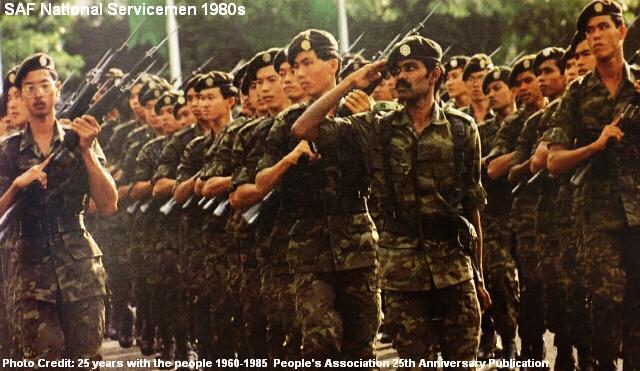
saf national servicemen 1980s

“Purple light, in the army
That is where, I wanna be
Infantry, best companion
With my rifle and my buddy and me

SOC, sibei jialat
Log PT, lagi worse
Everyday, doing PT
With my rifle and my buddy and me

Booking out, saw my girlfriend
Holding hands, with another man
Broken heart, back to army
With my rifle and my buddy and me

ORD, back to studies
Get degree, so happy
Can’t forget, still remember
With my rifle and my buddy and me

Purple light, in the war front
There is where, my body dies
If I die, would you bury
With my rifle and my buddy and me”
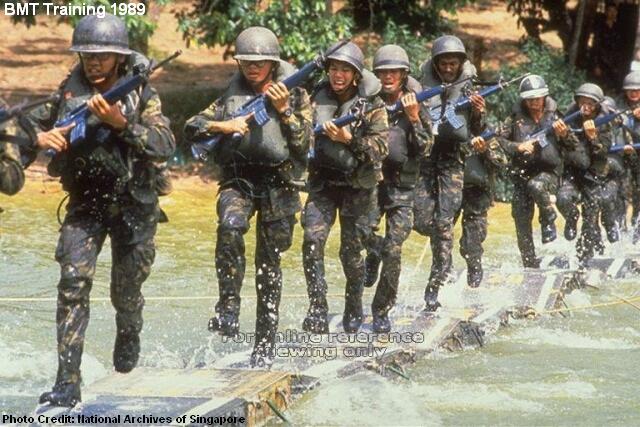
bmt training 1989

“Far far away in the South China Sea
I left a girl, with tear in her eyes,
I must go where the great men fights ya
A soldier has to fight the front because he love his land ya
A soldier has to fight even his has to die!
Coz we are the one who fight the front
And we are the one who holds the gun,
We are mighty warriors from this land ya
Alpha warriors marching in hoorah hoorah
Coz we are the one who fight the front
And we are the one who holds the gun,
We are mighty warriors from this land ya”

“Everywhere we go-o
People want to know-o
Who we are
Where we come from
So we tell them
We are from (name of platoon/company/battalion)
Mighty, mighty (name of platoon/company/battalion)
And if they can’t hear us
We sing a little louder”

Army Camps in Singapore
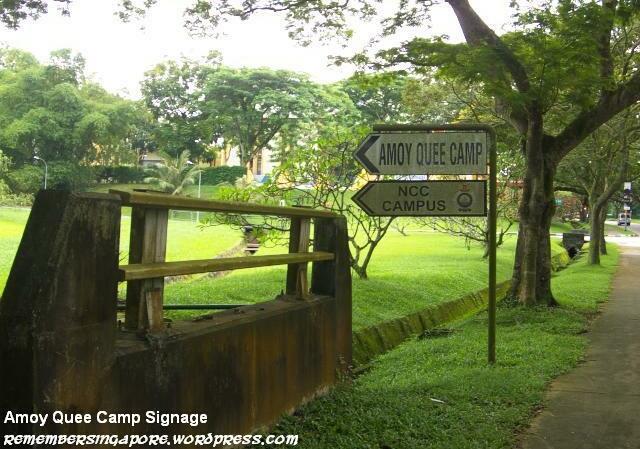
amoy quee camp sign

There are over 100 army camps and military bases in Singapore. Many were built by the British during the colonial era, while the rest were formed by the Singapore Armed Forces after independence. Below are brief descriptions of some of the old and former camps in Singapore.

Ayer Rajah Camp (1940s-2010)

Located at Portsdown Road, the Ayer Rajah Camp was well known as a servicing and vehicle maintenance camp. It was formerly part of the British’s Pasir Panjang Complex that also included the Gillman Barracks and Alexandra Camp. The camp was first home to the British Royal Electrical and Mechanical Engineers, which provided maintenance services to the British military vehicles before the Second World War.

former ayer rajah camp

After the war, the camp was taken back from the Japanese forces and placed under British control for another 27 years before they departed in 1971. It was then handed over to SAF’s Ordnance Maintenance Base (OMB). In the eighties, the Headquarters (HQ) Maintenance and Ordnance Engineering Training Institute (OETI) moved in to share the premises with OMB, which was reorganised as General Support Maintenance Base (GSMB).
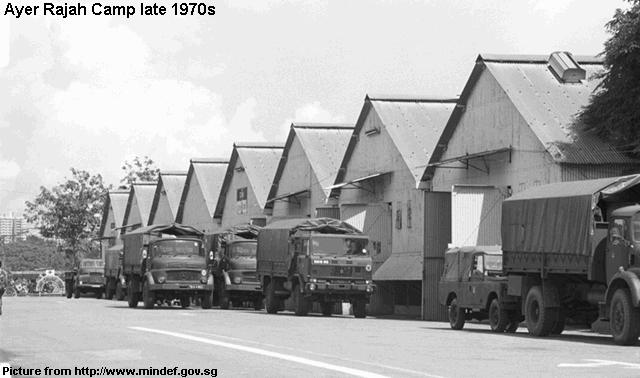
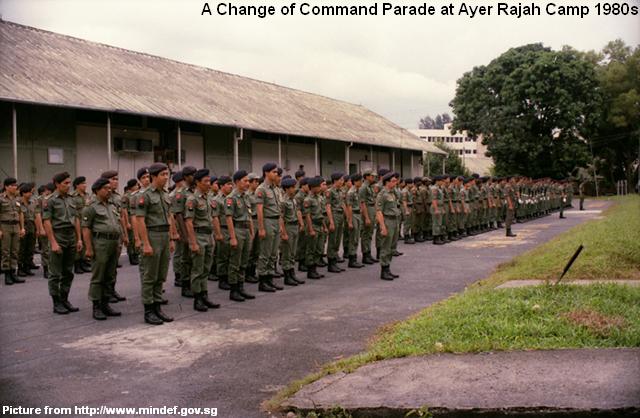
ayer rajah camp late 1970s

change of command parade at ayer rajah camp 1980s

In 2010, the camp was closed and its site was returned to the State. Its premises will be leased to MediaCorp in 2014.

Beach Road Camp (1930s-2000)

One of the few former military camps situated in the City, the Beach Road Camp was built on reclaimed lands and originally standing just beside the coastline. Its Art Deco-styled buildings were functioning as the headquarters for the Singapore Volunteer Corps (SVC), which was formerly located at Fort Fullerton.
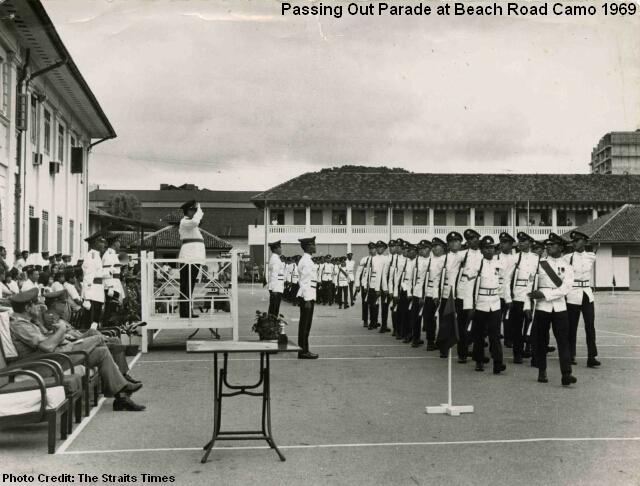
passing out parade at beach road camp 1989

Beach Road Camp played a significant military role in the early days of Singapore’s independence. It served as the main registration centre for the early batches of NS enlistees, and was home to several SAF units such as the infantry regiment, signal unit and provost company. The People’s Defence Force (PDF), formerly SVC, retained the camp as its headquarters.
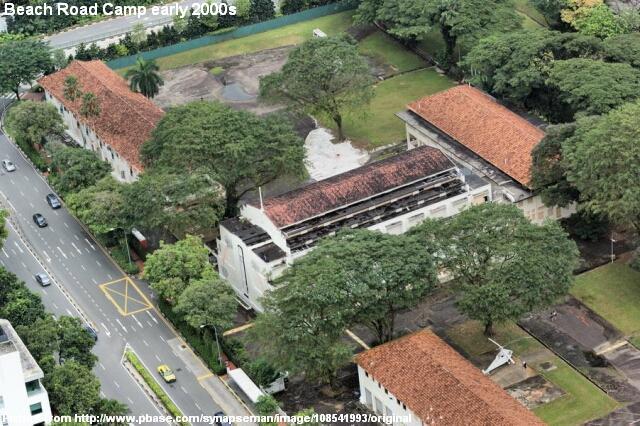
beach road camp early 2000s

By the mid-nineties, it became apparent that Beach Road Camp would be shifted due to its location in the prime land district. In 2000, the camp was officially shut down. Its three colonial buildings Block 1, 9 and 14 were given conservation status in 2002, while its plot of land, along with the former NCO club, was sold to private developers of hotels, offices and residences.

Blakang Mati Artillery Barracks (1910-1972)

Built in 1910, the Blakang Mati Artillery Barracks on present-day Sentosa was part of the British’s defensive facilities for the southern coastline of Singapore. The island and the barracks, however, fell to the Japanese forces during the Second World War, and were used as a prisoners-of-war camp.
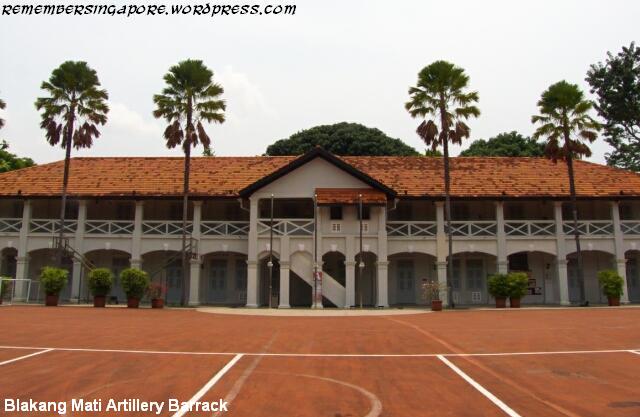
blakang mati artillery barrack

Singapore’s first artillery division First Singapore Regiment Royal Artillery was established at Blakang Mati Artillery Barracks in 1948. It also housed the Singapore Naval Volunteer Force, School of Maritime Training and Naval Medical School after Singapore’s independence. But SAF’s control of the barracks lasted only until 1972, when the government decided to develop the island for leisure and tourism.

The barracks were abandoned for many years until recently, when the site was put up for sale for a hotel development project.

Changi Command Barracks (1935-1990s)

Standing proudly on Fairy Point Hill, the former Changi Commando Barracks was once an integrated part of the British’s naval and air defence strategy against any potential invasions at the eastern part of Singapore. Constructed in 1935, it was originally a command building for the British Royal Engineers.

In 1971, the vicinity became part of the Commando Unit’s premises when the SAF elite troops were relocated from Pasir Laba Camp to Changi Camp. Two years later, the unit was strengthened with its first NS battalion, supported by a new school and headquarters. The iconic colonial building on Fairy Point Hill was used as the HQ office for the Commandos.

changi commando barracks

When Hendon Camp was officially inaugurated in 1993 as the new home for the Commandos, Changi Commando Barracks was abandoned for many years. In 2002, it was given the conservation status, and the premises are now part of a new hotel development project.

Guillemard Camp (1969-2003)

The former Guillemard Camp was home to 1SIR, Singapore’s first military unit. It was established at the start of 1969 for the relocation of 1SIR from Taman Jurong Camp. Generations of recruits had gone through intensive infantry training at the small Guillemard Camp for past 30-plus years.
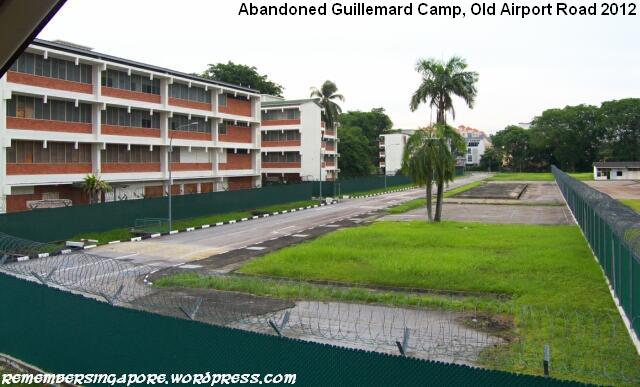
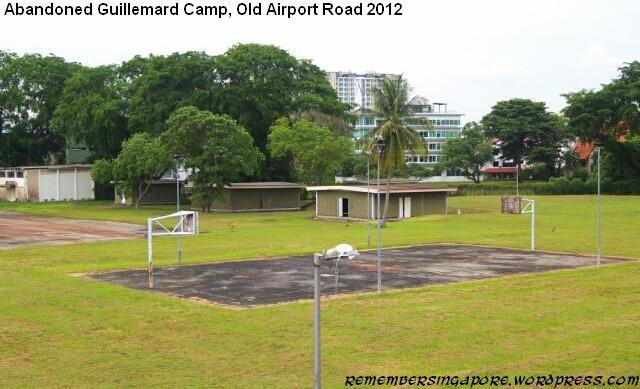
guillemard camp

guillemard camp2

The camp stayed relatively the same despite the changes in its surroundings, where blocks of residential flats popped up along Old Airport Road and Dakota Crescent. Due to the limitation in space and aging training facilities, its operations were finally ceased in in 2003, with 1SIR shifted to Mandai Hill Camp. The plot of land has since been reserved for future housing development.
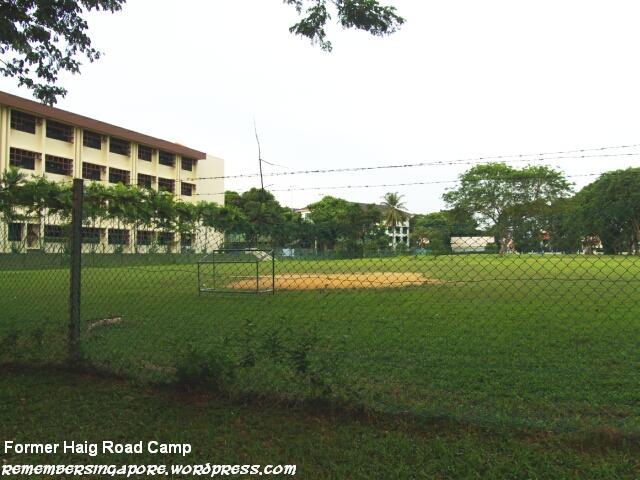
former haig road camp

As the population increases, the growing need for more residential development means those old redundant camps have to make way. In recent years, the likes of Haig Road Camp, (Old) Keat Hong Camp and Simon Road Camp were demolished for the construction of public flats and condominiums. As the old barracks were being torn down, they vanished together with the memories of many generations of national servicemen once stationed at those camps.
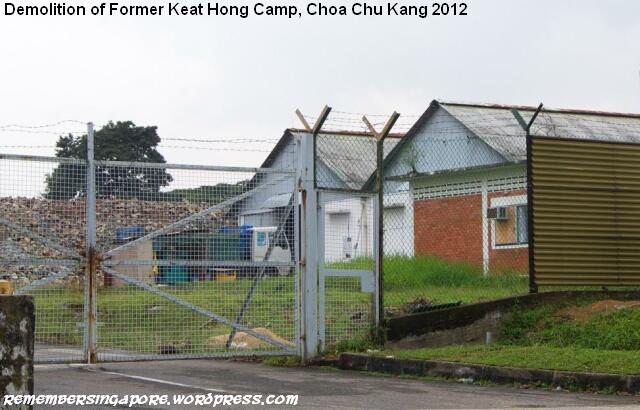
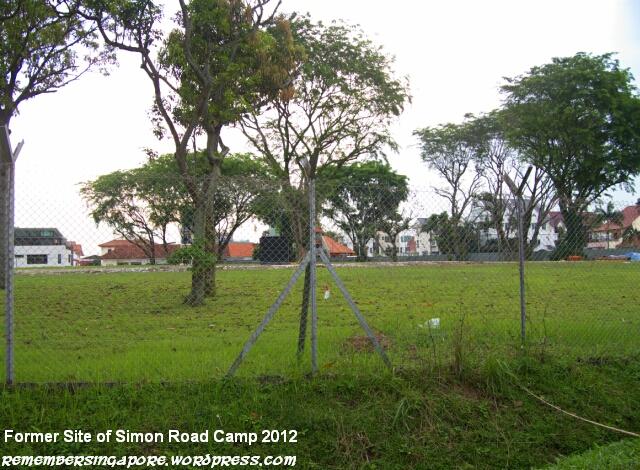
old keat hong camp under demolition 2012

former site of simon road camp

Mowbray Camp (Old) (1937-2002)

The old Mowbray Camp at the junction of Ulu Pandan Road and Clementi Road was a former British camp that used to house its guard contingent. It was, however, more well-known for being the home of the SAF Provost Unit between 1971 and 2002. SAF Provost Unit was first established in 1966 at Beach Road Camp, before moving to Hill Street Camp and finally settled at Mowbray Camp for 31 years.

The mentions of MP (Military Police) and DB (Detention Barracks) had struck fear into the hearts of many generations of national servicemen. SAF’s first military detention cells were set up at Beach Road Camp together with the SAF Provost Unit in 1966. By the eighties, there was a total of four major detention barracks in Singapore (Kranji, Nee Soon, Changi and Tanglin). In 1987, the SAF Detention Barracks was officially opened as a centralised military prison, replacing the other old detention barracks.
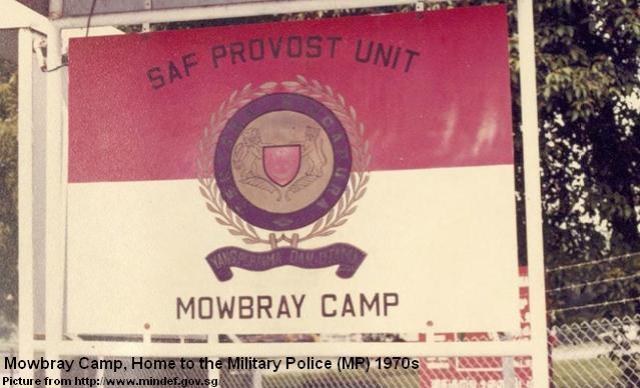
mowbray camp home to military police 1970s

Mowbray Camp was also home to Home Team’s canine unit. The Police Dog Unit was stationed here as early as the 1950s, before being linked up with the Customs & Excise Department’s canine unit (in 1987), the Prisons Department’s canine unit (1995) and the Singapore Civil Defence Force’s Rescue Dog Section (1997).

In 2002, the SAF Provost Unit moved to the new Mowbray Camp at Choa Chu Kang Way.

Nee Soon Camp (1934-Present)

Located opposite Kangkar in the olden days, Nee Soon Camp was first set up by the British in 1934 as one of the military bases in the northern part of Singapore. The recruits of first Singapore Infantry Battalion were trained at Nee Soon Camp when Singapore established its own military forces in 1957.

The establishment of Nee Soon Camp brought prosperity to its surroundings, increasing the population and commercial activities. In 1930, prominent Chinese businessman Lee Kong Chian (1893-1967) saw the opportunities and bought the row of 24 shophouses opposite Nee Soon Camp, renting them out as provision shops, bakeries, barber salons, tailor shops and others.
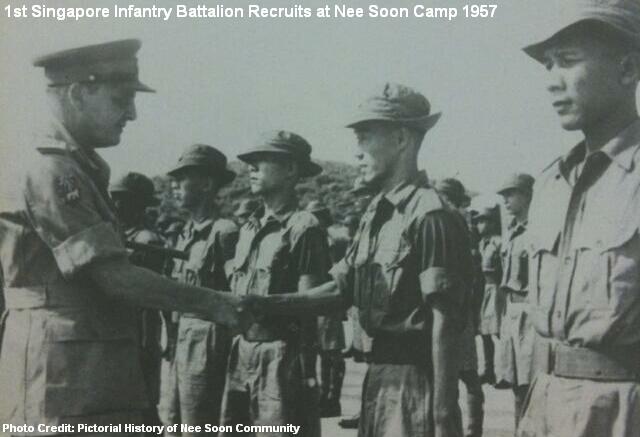
singapore infantry battalion recruits at nee soon camp 1957

Nee Soon Camp functioned as a school of BMT until the late 1990s. It received major revamp in the 2000s, with many of its old colonial buildings demolished. Today, there is even a condominium standing near the entrance of Nee Soon Camp, beside the row of shophouses that are famous for their military apparel and paraphernalia.

Selarang Camp (1938-Present)

The British built Selarang Camp at Loyang, in the eastern part of Singapore, in 1938. It was used by the Scottish Battalion but was occupied by the Japanese during the Second World War. During the Japanese Occupation, as many as 15,000 Australian Prisoners-of-War (POWs) were imprisoned at Selerang Camp. In 1942, the Japanese forced the POWs onto the parade square for five days without water and sanitation, in a bid to force the prisoners to agree not to escape. This was later known as the “Changi Incident”.
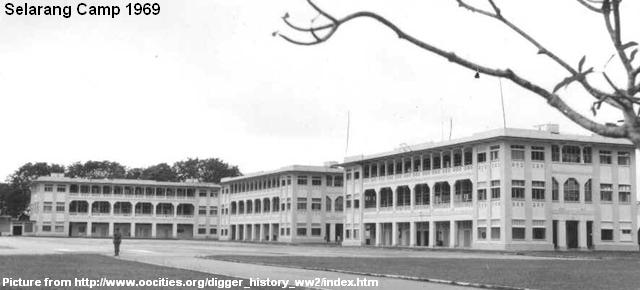
selarang camp 1969

After the Second World War, Selarang Camp was used as a base by the Australian Army units from the ANZUK, which was made up of troops from Australia, New Zealand and the United Kingdom. In 1971, the camp was officially handed over to SAF, and had housed the 9 Division of the Armed Forces since 1984. Its premises were given an extensive upgrading at a cost of $50 million in 1991. Many of its old colonial buildings were demolished to be replaced by new modern complexes.

Seletar Camp (1920s-Present)

Seletar Camp and its airbase were largely constructed in the 1920s as British military facilities for air travel and air defence. The premises were officially owned by the Royal Air Force in 1930 but fell to the hands of the Japanese forces during the Second World War. The Japanese navy captured Seletar Airbase in 1942 and renamed it as Seretar Hikojo.

seletar camp

After the war, the British repossessed Seletar Camp but the airbase no longer boasted the largest in Singapore, being replaced by the new airfield at Changi. SAF took over Seletar Camp in 1971, and maintained restricted public access to its eastern part of the camp. The western part was open to public and commercial aircraft.
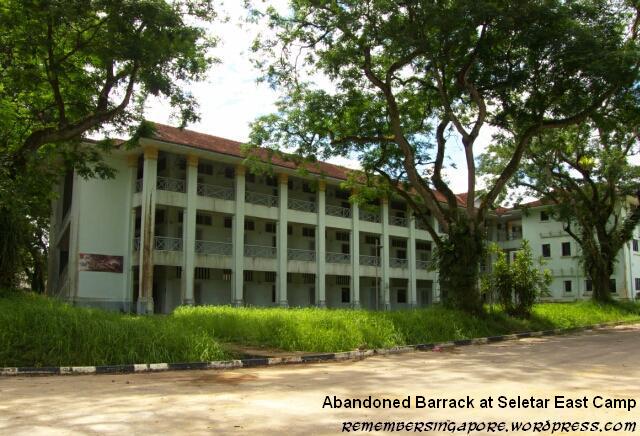
abandoned seletar barracks

Due to the Seletar Aerospace Park project since the late 2000s, the quiet rustic Seletar Camp had gone through tremendous changes, with many of its old colonial buildings demolished.

Tanglin Barracks (1861-1989)

Tanglin Barracks were one of the oldest camps in Singapore. Built in 1861, it was situated in a former nutmeg plantation, functioning as a base for the British garrison infantry battalion. After SAF took over it in 1971, the camp was designated as the headquarters for the Ministry of Defence and the Central Manpower Base. Since the early 2000s, the premises around the vacated Tanglin Barracks had seen significant development as a hub for lifestyle, fine dining and cultural arts.
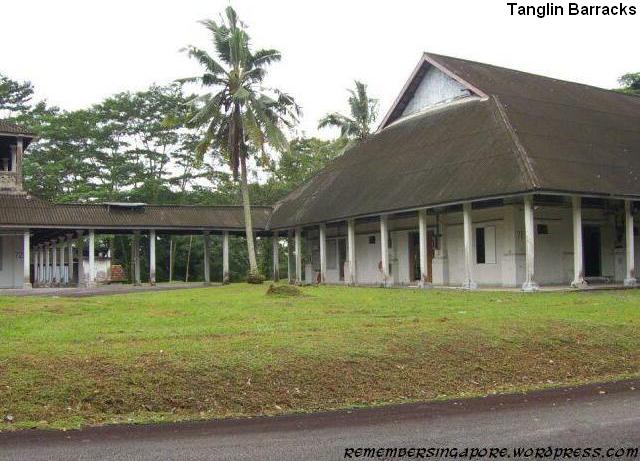
tanglin barracks

The list consists of other camps not mentioned above:

list of army camps singapore v3

Saluting all former and current NS personnel!

Published: 01 May 2013

Updated: 19 October 2014

Posted in Cultural, Historic | Tagged , , , , , , , , , , , , , , , , , , , , , , , , , , , , , , , , | 103 Comments

Old Holland Road and The Hakka Clan

It is Qing Ming Festival (Tomb Sweeping Day) again. I make my annual trip to pay respects at Fung Yun Thai Association Columbarium near Old Holland Road, where my grandparents’ funeral urns are stored. Also commonly known as Hakka Clan (客人邑), this is where the early Chinese Hakka immigrants had settled and lived for generations.

Old Holland Road

There are many “old” roads in Singapore, such as Old Yio Chu Kang Road, Old Upper Thomson Road and Old Tampines Road. In most cases, these roads were renamed after their roles and importance diminished over time and were replaced by the newer arterial roads of the same names.

In the sixties, a long stretch of the original Holland Road wound its way through a massive Chinese Hakka graveyard called Fung Yun Thai Cemetery (丰永大坟山), serving as a link between 6½ Milestone Bukit Timah Road and its main arterial portion at the junction with Ulu Pandan Road.

old holland road

When the cemetery was exhumed in the early eighties, part of Holland Road (see map below) was also demolished. A new road by the name of Holland Road North was constructed in the late nineties as an accessible route to planned private condominiums in the vicinity. It was supposed to be linked up with Holland Road South and Holland Road West, but the constructions were never completed.

Holland Road North was later renamed as Old Holland Road, as a continuation of the road that started off Bukit Timah Road. The incomplete Holland Road South and West, on the other hand, became rocky paths, and are out of bounds to motor vehicles today.

map of old holland road

The newer Holland Plain and Holland Link, as their names suggest, refer to the grass plain that has formerly the exhumed cemetery, and the link that joins Old Holland Road to the original Holland Road. The rocky paths are now a favourite route for joggers and dog owners, while many enthusiasts can be seen flying their kite and remote-controlled aircraft at the vast grass plain.

junction of holland plain and holland link

Shocking Crime

Durian plantations were once abundant off Old Holland Road; there were several cases of thefts of durians reported on the newspapers in the eighties. A horrific crime, however, shocked Singapore on 22 May 1985 when 18-year-old Catholic Junior College student Winnifred Teo Suan Lie (张碹丽) went missing while jogging near the exhumed cemetery. Her body was discovered naked and lying in the bushes along Old Holland Road the next morning, with six fatal slashes on her neck. The murderer was never caught.

fung yun thai association columbarium

Changing Landscape

The Hakka columbarium, completed in 1991 and tucked at the corner of Holland Plain and Holland Link, off Old Holland Road, has enjoyed undisturbed peace and serenity for the past two decades. In the last three years, however, the columbarium started to experience changes in its surroundings. Like other parts of Singapore affected by the construction frenzy, private development are now slowly engulfing the former graveyard that has been vacated and forgotten over time.

fung yun thai association columbarium 2010-1

Almost a forgotten place in Singapore, the Fung Yung Thai Association Columbarium receive few visitors in any days other than Qing Ming or other special occasions. Before 2011, its main ancestral hall was accompanied by a large garden, with a main tomb that probably buried a significant or wealthy Hakka figure of the past. Few would have expected these to vanish within two years.

fung yun thai association columbarium 2010-3

fung yun thai association columbarium 2010-4

fung yun thai association columbarium 2010-2

By April 2013, the latest private property project in the highly sought-after District 10 is almost ready. Named Eleven @Holland, the brand new strata-titled semi-detached houses are located such a short distance away that a tall circling wall has to be built around the columbarium, probably to prevent the new residents from facing its ghastly neighbours. The vanished garden and main tomb of the columbarium had become part of the premises of the new housing project.

fung yun thai association columbarium3

fung yun thai association columbarium 2010-6

An Old Hakka Association

The history of Fung Yun Thai Association (丰永大公会) dated back to the 19th century, when the early Hakka immigrants from the three counties of China (Fung Shoon 丰顺, Yun Teng 永定 and Tai Po 大埔), arrived at Singapore.

By the late 19th century, there were about 6,000 Hakkas settled at the areas around present-day Commonwealth and Buona Vista, a relatively small number compared to the three major Chinese dialect groups in Singapore. According to a population census conducted by the Straits Settlements government in 1881, the strength of the Hokkien, Teochew and Cantonese groups ranged between 15,000 and 25,000 each.

yu shan teng cemetery temple 1980s

In 1888, for the price of 300 silver dollars plus an annual tax of 50 cents, the Hakkas purchased parcels of land off Holland Road from the Straits Settlements government for their ancestral temple (Sanyi Ci 三邑祠) and cemetery (Fung Yun Thai Cemetery 丰永大坟山, also known as Yu Shan Teng 毓山亭), with Fun Yun Thai Kongsi (丰永大公司) established to manage the properties.

The kongsi was re-registered as an association in 1906 in order to run the temple, cemetery and small surrounding clusters of Hakka villages effectively. In the fifties, the ancestral temple also functioned as Nam Tong School (南同小学) to provide elementary education for the Hakka children who lost their opportunities to study during the Japanese Occupation.

fung yun thai association columbarium 2010-5

fung yun thai association columbarium2

Acquisition of Cemetery

This lasted until 1977, when the entire cemetery hill was acquired by the Singapore government. Nam Tong School was discontinued, while the Hakka villagers were resettled elsewhere. A compensation of $1 million and a small 6.38 hectares of land, including the site of the temple, was reserved for Fung Yun Thai Association. Exhumation was then carried out four years later. In 1991, a columbarium was constructed within the designated area to house the exhumed ashes.

Together with another Hakka cemetery Ying Fo Fui Kuan, Fung Yun Thai Cemetery was one of two earliest burial grounds in Singapore to be acquired by the government for redevelopment purposes. It was rumoured that Lee Bok Boon, the great-grandfather of former Prime Minister Lee Kuan Yew, was previously buried here, and the move was to demonstrate to other Chinese dialect clans that, should their cemetery hills be also acquired for redevelopment, they would have no reasons to object.

canal near old holland road

A large canal called Bukit Timah Diversion Canal, constructed in the early seventies, makes its way behind the columbarium. Half a century ago, this was a long stream, with farms and fish-rearing ponds on its either sides. Today, the long canal runs through the vicinity between the Bukit Timah Road Canal and Sungei Ulu Pandan, serving as a reminder of the olden days.

After being left vacated for more than three decades, the grass plain and greenery of Old Holland Road may soon be giving way for more private residential development.

Published: 09 April 2013

Updated: 13 April 2013

Posted in Exotic, Religious | Tagged , , , , | 42 Comments

60 Years of Community Centres

Community centres are commonly found in the West, especially the United States and the United Kingdom. Largely catering for the needs of the grassroots, some of their oldest community centres were built in the early 20th century. After the Second World War, the British brought the concept of community centres to its oversea colonies such as Australia, Hong Kong and Singapore.

kim seng community centre

Today, community centres, or CC in short, together with HDB flats and hawker centres, have become representative features of Singapore heartland. In its sixty years of history, the local community centres have evolved from simple zinc-and-wood buildings to sophisticated clubs furnished with different types of modern facilities.

The Early Community Centres (1950s)

When the British returned to Singapore after the war, they wanted to foster the community development in order to dampen the anti-colonial sentiments. The idea of community centres was mooted in the late 1940s, and the task was given to the Department of Social Welfare, which under the instruction of the Colonial Office, started building community centres in the early 1950s.

The first community centres in Singapore were the Serangoon Community Centre and Siglap Community Centre, both officially opened in May 1953. A couple of community centres, such as the Balestier Community Centre, Rochore Community Centre and Alexandra Community Centre, were built as early as 1951, but were only officially opened a few years later, thus losing the honour of being Singapore’s first community centre.

tiong bahru community centre 1951

Tiong Bahru Community Centre was unofficially Singapore’s earliest community centre, with its history traced all the way back to 1948. Started as a suburb communal hall, the Tiong Bahru Community Centre’s initial objective was to provide social amenities for the residents of Tiong Bahru. Basketball court, football field and badminton courts were built, while night classes, open-air cinema and even barber service were offered at cheap rates.

By 1951, 13,000 residents at Tiong Bahru district had signed up as members of the community centre to enjoy its facilities. It later became so self-sufficient that it could assist residents’ in funeral works, provide ambulance and civil defence training, and, at one stage, even planned to recruit volunteer police to ensure the security of Tiong Bahru.

The community centre, however, became mismanaged a few years later. In 1956, it was forced to shut down after it became a notorious gambling venue for the residents. The management of the centre was handed over to the Department of Social Welfare, and later to the People’s Association. After a thorough revamp, the community centre was reopened in 1960.

construction of a typical community centre in early 1960s

Most of the early community centres were relatively small and simple structures which cost around tens of thousands of dollars in their construction. The larger ones, such as the Bukit Panjang Community Centre and Buona Vista Community Centre built in 1955 and 1956 respectively, cost about $150,000 each.

tanjong pagar community centre 1965

Built at a cost of $160,000, the Bukit Timah Community Centre, equipped with basketball court, football field, badminton halls, classrooms and a science room, was dubbed as Singapore’s best community centre when it was opened in 1959.

The Roles of Community Centres

When the People’s Action Party (PAP) won the election in 1959 to form the full internal self-government of Singapore, the community centres started to take on many other roles.

gym and billiard in a community centre 1960sIts function as a to-and-fro channel remained; to disseminate information and policies, as well as gather feedback from the grassroots. In addition, social unity, multi-racial harmony and national identity were promoted through nation-building activities at the community centres. Residents mingled with each others. Youths were encouraged to compete through sports and games, so as to reduce the chances of them getting involved with drugs and gangsterism. Pro-communist ideas were also contained as they were kept out of reach to the ordinary folks.

The People’s Association (PA) was established in 1960, taking over the management of community centres from the Department of Social Welfare. Top civil servants and political leaders formed the board that managed PA, whereas grassroots leaders were appointed as members of the Community Centre Management Committee (CCMC), in order to engage with the residents in a more efficient way.

The Rise of Community Centres (1960s)

The 1960s of Singapore represented an eventful decade that was plagued by social instability, protests and riots. It was also glorious moment in history of community centres as more than a hundred of them sprung up like mushrooms in many parts of Singapore.

As many as 60 community centres were established in 1961 alone. Community centres became places to hold celebratory events, such as the Chinese New Year, Hari Raya, National Day (after 1965) and send-off dinners for the early batches of National Servicemen (after 1967). Other common activities included children camps and exhibitions of national campaigns. Inter-community centre games were such as basketball, sepak takraw, and even boxing, became extremely popular.

basketball tournament at community centre 1960s

There were issues, though, faced by the community centres in the early 1960s. Secret society members often infiltrated the centres, while pro-communist groups tried their means to enter the organisation and management committees. The communist supporters even gathered and camped at the entrance of the PA’s headquarters, forcing the PA to shift its operations temporarily to the Department of Social Welfare at Havelock Road.

outram park community centre 1960sChinese-educated grassroots leaders, consisting of businessmen, teachers and even shopkeepers and hawkers, were the key to the struggle against the pro-communist elements. Many contributed effortlessly in time and money in the building of the community centres and the cohesiveness and harmony of the different communities.

In order to ease the demands at the National Library at Stamford Road, the National Library Board kicked off the mobile library services at the rural schools in 1960. By 1964, it was extended to the community centres, with Tanjong Pagar, West Coast, Nee Soon and Bukit Panjang Community Centre among the first to provide such services.

In 1966, a gift of $10,000 grant from the New Zealand government helped the library to purchase more than 20,000 books which were then offered for loan at the mobile library services established at six more community centres (Chong Pang, Changi, Kaki Bukit, Kampong Tengah, Bukit Timah and Paya Lebar). Over the next 30 years, many more community centres were chosen to provide the services.

mobile library service at kaki bukit community centre 1967

(Perpustakaan Negara Perkhidmatan Berkereta refers to Mobile National Library Services in Malay)

By 1991, with more public libraries built in the new towns, mobile library services gradually lost their popularity and were eventually stopped for good. Nevertheless, the services were a big success. It had provided many kampong dwellers, especially the kids, the chance and joy of reading.

In February 1963, the first television broadcast, aired by Television Singapura, was held at the Victoria Theatre and Memorial Hall. Many witnessed the historical milestone in more than fifty community centres elsewhere in Singapore that were supplied with television sets, another novelty service offered by the centres.

Two years later, thousands of Singaporeans, cramped in front of the television sets at the community centres, captured the defining moment of former Prime Minister Lee Kuan Yew speaking in tears upon the announcement of the separation of Malaysia and Singapore.

national servicemen send-off party near kaki bukit community centre 1968

Between 1966 and 1967, the leading politicians gave dozens of speeches at the community centres to disseminate the idea of compulsory military conscription to the public. Becoming the citizens of a newly independent nation with unknown future, many Singaporeans were feeling a sense of insecurity. The importance of National Service (NS) and the sense of national pride and loyalty were thus emphasized to the people, that Singapore would be able to survive and defend itself.

Send-off dinners and ceremonies of the early batches of National Servicemen were mostly held at the community centres.

opening of jalan tenteram community centre 1963

Community centres also played an instrumental role during the racial riots in 1964. They provided secure venues where different community leaders came together to discuss plans in defusing the rising racial tensions.

The Kampong Community Centres

In 1959, the self-government of Singapore decided to extend community centres to the rural areas of Singapore. Kenneth Michael Byrne, the former Minister for Labour and Law, suggested nine venues to be given top priority for the construction of community centres.

In addition to relatively urbanised Minto Road and Joo Chiat, Nee Soon Village, Thong Hoe Village, Sembawang, Tuas Village, Kampong Tengah, Jalan Kayu, Kampong Bugis, and later Lan Sam Village (13th milestone, Lim Chu Kang Road) and the new Malay Settlement, were some of the earliest kampongs in Singapore to receive their community centres.

opening of tuas community centre 1960

Located at 18th milestone Jurong Road (near junction of AYE and PIE/Tuas Road today), Tuas Community Centre was the westernmost community centre in Singapore in the sixties. When it was first opened, more than 700 villagers, most of them Chinese and Malay fishermen and their families, visited the community centre daily. Civil courses on the improvement methods of fishing and farming were held by the centre for the villagers, while their children joined in the fun with basketball, table tennis and carom.

lorong ah soo village community centre 1960s

The community centres at the rural places were mostly simple single-storey zinc-and-wood buildings that cost less than S$10,000 each. Despite their simplicity, they were powered by electricity and water supply. In some cases, the local residents gathered together to build their own community centres, one of which was the Yio Chu Kang Community Centre, being set up in 1956.

mandai village community centre 1987

A typical kampong community centre usually carried a large black plaque, sometimes white, that listed the community centre’s name in four main languages of Singapore. A flag pole with the Singapore flag would be standing in front of the building. Those larger kampong community centre would have a basketball court or a sepak takraw court, or an outdoor television set mounted on a tall frame. By night fall, the benches were filled up quickly by eager residents from the nearby kampongs to watch their favourite TV programs.

residents watching tv at community centre 1980s

By the late eighties, most of the rural community centres were demolished together with the kampongs. Many of them, with their unique and colourful names such as Malay Farm, Boh Sua Tian, Hun Yeang Village, Jin Ai Village, Ong Lye Sua (黄梨山), Tua Pek Kong Kow (大伯公口), Khe Bong Village, Lam Tong Village, Kampong Jagor, Kampong Chu Ban San, Kampong Heap Guan San and Plantation Avenue Village (see “List of Community Centres” below), had vanished in the rapid progress of Singapore.

plantation avenue village community centre 1980

Reaching Out to the Islanders

pulau semakau community centre 1969As the government started mass building community centres in the sixties, the residents living on the outlying islands of Singapore were not forgotten. On each island with sizable populations, there was a community centre built. By the late sixties, the community centres at Pulau Semakau, Pulau Bukom Kechil, Pulau Tekong, Pulau Samulun, Pulau Seking, Pulau Seraya and Pulau Ubin were up and running.

In 1960, a community centre was also planned for the detainees at Pulau Senang. Intended for penal experiment, the prisoners on the island were not restricted in their freedoms. Soon, the number of prisoners detained on Pulau Senang grew to more than 300. A large-scaled riot broke out in 1963, resulting in the death of a superintendent and two police officers. The offshore prison was eventually shut down, and the plan of Pulau Senang Community Centre was cancelled.

group photo of residents at pulau tekong community centre 1970s

Pulau Ubin Community Centre started as a small simple community hall in 1961. It was built by the residents of the island, and was converted into a community centre five years later. It occupied a vast area of 1,900 square metres, including a basketball court, the only basketball court on the island, that sometimes functioned as a temporary open-air cinema for the residents.

Throughout its existence, Pulau Ubin Community Centre had witnessed the rise and decline of the island. When the granite quarries were operating at its peak during the seventies, there were several thousands residents and workers living on Pulau Ubin. By the nineties, the island’s population had decreased to only a few hundreds; majority of them elderly folks who had lived on the island for decades.

pulau ubin community centre 1986

The community centre was given a renovation in 1993 to replace its wooden-planked walls with brick and concrete. The roof was also upgraded from zinc to tiles. Until its closure in 2003, Pulau Ubin Community Centre was the oldest community centre in Singapore, and was the only remaining community centre found in the outlying islands. Its premises is being utilised as a Volunteer Hub today.

pulau ubin community centre 1992

Most of the Southern Islands’ villagers were resettled on mainland Singapore by the late eighties. Likewise, rapid development of new housing estates such as Pasir Ris, Simei and Tampines at the Changi district in the eighties and nineties provided alternative resettlement plans for the residents of Pulau Ubin and Pulau Tekong. Affected by the militarisation of the island, the last batch residents of Pulau Tekong was relocated by the early nineties.

New Generation Community Centres (1970s to 1980s)

For twenty years after independence, Singapore had enjoyed rapid economic growth. It was not until 1985 before Singapore experienced its first economic recession. The two decades of progress had seen many kampongs made way for satellite towns and new housing estates. Thousands of zinc-and-wood houses were demolished, replaced by rows of new public flats.

kampong cantek lama community centre 1970

Likewise, changes were also made to the community centres. By the mid-seventies, the models of single wooden structures for community centres were discontinued. Larger double- or three-storey concrete buildings were built and fitted with modern amenities such as air-condition, general purpose rooms and better sports facilities. New modern courses and classes were also offered to the residents, such as tai chi, fencing, interior decoration, canoeing, yoga, cooking and flower arrangement.

chai chee consumers' club 1973

During the seventies and eighties, it was not unusual to have donation drives or building funds, in order to raise funds from the members of the public to build community centres.

The rapid economic growth in the seventies also brought years of inflation to Singapore. Consumer clubs were thus set up in areas such as Chinatown and Chai Chee, in order to help residents to fight inflation by providing basic necessities at low cost.

hock choon village community centre 1974

tampines community centre 1975

Moving into the eighties, more emphasis were placed on the designs and facilities of the new generation community centres. Architects and designers were tasked to make the buildings more aesthetically pleasant, and well-equipped gyms, studios, computer labs and function rooms were added.

bukit merah community centre 1979

construction of kampong chai chee community centre 1980

Each constituency in Singapore was also “assigned” with a key community centre. This was different from the fifties and sixties, where there were hundreds of small community centres stationed in different kampongs. The larger new towns, though, had more than one community centre.

yio chu kang community centre foundation stone laying ceremony mid-1980s

yio chu kang community centre 1986

Ang Mo Kio, for example, currently has five community centres (Ang Mo Kio, Teck Ghee, Kebun Baru, Yio Chu Kang and Cheng San) in its six districts. Other earlier centres such as Ang Mo Kio Bo Wen, Chong Boon, Jalan Kayu, Jalan Kayu South and Kampong Cheng San had all ceased to exist.

There are also five modern community centres at Tampines, namely Tampines Central, Tampines Changkat, Tampines East, Tampines North and Tampines West. The old rural Tampines before the eighties had as many as seven community centres, including Tampines Community Centre (along Tampines Avenue), Hun Yeang Village Community Centre and Teck Hock Community Centre.

table tennis at community centre 1980s

taekwondo at community centre 1980s

Excursions to places of interest and oversea trips were common activities organised by community centres especially in the eighties when Singapore’s standard of living improved by leaps and bounds, benefited by years of economic expansion.

Trips to Singapore Zoological Gardens, Van Kleef Aquarium, Haw Par Villa, Pulau Ubin, Kusu Island, Sisters’ Islands, St. John Island, Genting Highland, Desaru, Tioman and Batam were often met with overwhelming responses and high participation rates from the residents.

cooking class at community centre 1980s

Upgrading to Community Clubs (1990s to Present)

Since 1990, many community centres were renamed as community clubs. Signifying a status upgrade, many modern community centres began to function more like recreational and leisure clubs with facilities such as swimming pools, libraries, café and restaurants. The upgrading, however, was not applied to all. Many remained as community centres. A few, like the Aljunied Community Centre along Lorong Ah Soo and Bukit Gombak Community Centre at Bukit Batok West, still have their offices located at the void decks of public flats.

aljunied community centre

Community bonding and social harmony, however, still remained as the top objectives for community centres and clubs.

Community Centres… A Political Tool?

Even though their importance may look less significant today, the fact that community centres have played a crucial role in assisting PAP’s status as the dominant ruling party of Singapore for more than five decades is undeniable. Together with other grassroots organisations like the Residents’ Committees (RCs), they easily reach out to the low- and middle-class of the Singapore population.

When it comes to politics, the roles of community centres become complicated. Their primary objective is to serve the community of Singapore, yet their management by PA ensures PAP gets the advantage. The opposition parties have difficulties in their participation in PAP-controlled wards, while in their own constituencies, the community centres are run by grassroots advisers from PAP.

3-million nee soon community centre completed in 1988

Despite the flaws, the community centres aim to continue doing their part in reducing the disparity between the rich and poor. In his book, former Prime Minister Lee Kuan Yew highlighted the importance of such social outlets in the midst of Singapore’s growth and progress. It ensures that the ordinary and poor have equal chance of using facilities provided by the community centres. While the rich have their exclusive private clubs, no Singaporeans should be denied a place to play sports, use computers or read books.

After six decades of existence, how will the community centres evolve in the future?

Community Centres A to Z

Below is the list of community centres, in alphabetical order, of the past and present. The names in red refer to the community centres that are functioning today, while those in green refer to the community centres once found on the outlying islands of Singapore.

ama keng village community centre 1960s

ang mo kio community centre 1983

changi community centre 1984

List of Community Centres in Singapore (Then and Now)

Name

Location

Opening Year

Notes

Ace The Place Community Centre

Woodlands Drive 16

2008

First community centre in Singapore not to be named after its location. ACE stands for Admiralty Community’s Experience

Admiral Garden Community Centre

Woodlands Ring Road

2001

Alexandra Community Centre

Prince Philip Avenue
(later Queensway Circus)

1953

Moved to its new $750,000 building at the junction of Commonwealth Avenue and Queensway Circus in 1979.
Was Singapore’s second costliest community centre in the 1970s after Havelock Community Centre. Renamed as Queenstown Community Centre in the mid-2000s

Alexandra Terrace Community Centre

Pasir Panjang

early 1960s

Visited by Malaysia’s first Prime Minister Tengku Abdul Rahman in 1964

Aljunied Community Centre

Block 110 Hougang Avenue 1

1984

One of the few community centres in Singapore to be still located at the void deck of a public flat today. Formerly known as Hougang Avenue 1 Community Centre

Ama Keng Village Community Centre

Lim Chu Kang Road

1960s

Closed in 1988

Anchorvale Community Centre

Sengkang East Way

2008

First community centre in Singapore to be co-located with a sports and recreation centre

Ang Mo Kio Community Centre

Ang Mo Kio Street 22
(later Ang Mo Kio Street 31, then Ang Mo Kio Avenue 1)

1976

First started at the void deck of Block 226B along Ang Mo Kio Street 22. Relocated to Block 329 at Ang Mo Kio Street 31 in the 1980s, before moving to the former building of Ang Mo Kio Bowen Community Centre at Ang Mo Kio Avenue 1

Ang Mo Kio Bo Wen Community Centre

Ang Mo Kio Street 22

1980s

Renamed as Ang Mo Kio Community Centre in the early 1990s

Anson Community Centre

Maxwell Road
(later Silat Avenue)

1966

Affected by urban renewal in 1974. Relocated to a new $3-million building at Silat Avenue in 1984, and was later replaced by Silat Community Centre

Ayer Rajah Community Centre

Teban Gardens
(later Pandan Gardens)

1960s

Opened in 1984 by Tan Cheng Bock, Member of Parliament for Ayer Rajah to replace the old one at Teban Gardens. Relocated to Pandan Gardens. Underwent extensive $9-million upgrading in 1998. Became the first community centre to Singapore to have a swimming pool when it took over Pandan Gardens Swimming Complex in 2002, but the swimming facilities were closed a year later

Balestier Community Centre

Lorong Limau

1954

Completed in 1951 and officially opened in 1954 by the wife of Thio Chan Bee, the Singapore Legislative Councillor

Banda Street Community Centre

Banda Street

1960

Built at a cost of $40,000 and opened by former Finance Minister Goh Keng Swee and Minister for Labour and Law Kenneth Michael Byrne

Bartley Community Centre

Bartley Road

1966

Held exhibitions of the National Courtesy Campaign and National Health Campaign in the 1970s and 1980s. Closed in 1983

Beach Road Community Centre

Beach Road

1960

Opened by former Minister for Labour and Law Kenneth Michael Byrne

Bedok Community Centre

New Upper Changi Road

1980

In 1979, $230,000 was raised for the building fund of the three-storey community centre

Bishan Community Club

Bishan Street 13

late 1990s

Bishan North Community Centre

Bishan Street 22

late 1990s

A void deck community centre located at Block 233 Bishan Street 22

Boh Sua Tian Community Centre

Boh Sua Tian Road, off Yio Chu Kang Road

1965

Opened by Ong Pang Boon, former Minister for Education. Boh Sua Tian Road was a long road that linked Jalan Kayu/Seletar and Nee Soon from the 1960s to 1980s, but was later replaced by CTE extension to SLE

Boon Lay Community Centre

Boon Lay Place

1980

Its foundation stone was laid in 1979 by Ngeow Pack Hua, former MP for Boon Lay. Damaged by fire in 1986. Upgraded to four-storey Boon Lay Community Club in 2011

Boon Teck Community Centre

Boon Teck Road, off Balestier Road
(later Lorong 6, Toa Payoh)

1960

A fund-raising of $500,000 for the building of a new community centre started as early as 1973. New building was completed years later and opened in 1981 by Michael Liew Kok Pun, former Member of Parliament for Boon Teck. Renamed Toa Payoh East Community Centre in 1997

Braddell Heights Community Centre

Serangoon Avenue 2

late 1970s

Won the most understanding community centre in Singapore for 5 straight years between 1987 and 1991. Upgraded to Braddell Heights Community Club in early 1990s

Bras Basah Community Centre

Middle Road

1961

Added a $15,000 community hall in 1968

Brickworks Community Centre

Lengkok Bahru

1980

Its foundation stone was laid in 1979 by Ahmad Mattar, former Acting Minister for Social Affairs and MP for Brickworks

Bukit Batok Community Centre

Hillview
(later Bukit Batok Central)

1980s

Originally located at Hillview estate to cater for its residents and those living at Upper Bukit Timah Road. Moved to Bukit Batok Central in early 1990s and upgraded to Bukit Batok Community Club

Bukit Gombak Community Centre

Hillview Avenue
(later Bukit Batok West Avenue 5)

1980s

Moved to Block 386 Bukit Batok West Avenue 5 in late 1990s, becoming one of few void deck community centres in Singapore

Bukit Ho Swee Community Centre

Seng Poh Road, Tiong Bahru
(later Jalan Bukit Ho Swee)

1965

Opened in 1965 by Chan Choy Siong, Assemblywoman for Delta. Had its new building opened in 1982, and was upgraded in 1997. Closed in 2004

Bukit Merah Community Centre

Jalan Bukit Merah

1963

An extension building was added in 1992. Also known as Bukit Merah South Community Centre

Bukit Merah North Community Centre

Redhill Road

late 1970s

Located at Block 65 Redhill Road. Block 65-67 had since been demolished and replaced by Block 75A-D

Bukit Panjang Community Centre

Lorong Malai, off Woodlands Road
(later Gangsa Road, then Pending Road)

1955

Started at Lorong Malai, which no longer exist today. Closed in 1985, and moved to the void deck of Block 110 at Gangsa Road. Moved again to its new building at Pending Road, and upgraded to Bukit Panjang Community Club in 1993

Bukit Timah Community Centre

7 Milestone, Bukit Timah Road
(later Toh Yi Drive)

1959

Dubbed Singapore’s best community centre when it was completed in 1959 at a cost of $160,000, equipped with basketball court, football field, badminton halls, classrooms and a science room. Its new building at the junction of Jalan Jurong Kechil and Toh Yi Drive was officially opened in 1988 by former First Deputy Minister and Minister for Defence Goh Chok Tong. Renamed as Bukit Timah Community Club in the late 1990s

Buona Vista Community Centre

South Buona Vista Road
(later Holland Drive)

1956

One of Singapore’s earliest large community centres built in the 1950s. Costing $150,000, it was handed over to Ministry of Labour and Law in 1961. The community centre was closed and its premises converted into a junior school. In 1982, a new $1.2-million Buona Vista Community Centre was opened at Holland Drive by Ang Kok Peng, former MP for Buona Vista. Upgraded to Buona Vista Community Club in early 2000s

Cairnhill Community Centre

Buyong Road
(later Anthony Road)

1960s

Moved to its new building at Anthony Road in 1982. Upgraded to Cairnhill Community Club in the 1990s

Canberra Community Centre

Sembawang Close

1974

The old Canberra Community Centre was closed in 1985. The new Canberra Community Centre is now located along Sembawang Crescent

Changi Community Centre

Upper Changi Road

1958

Its new building was opened in 1983 by Teo Chong Tee, former Parliamentary Secretary for Environment and Social Affairs and Member of Parliament for Changi

Changi Point Community Centre

Nicoll Drive

1960

One of mainland Singapore’s easternmost community centres

Changi Simei Community Centre

Block 148 Simei Street 1
(later Simei Street 2)

1990s

Started as a void deck community centre in the 1990s.
Moved to its new building at Simei Street 2 in 2001 and renamed as Changi Simei Community Club

Changkat Community Centre

Tampines Street 11

1984

The void deck office of Tampines Sub-community Centre at Block 138 Tampines Street 11 was renamed as Changkat Community Centre in 1984

Changkat South Community Centre

Bedok North Street 4

early 1990s

Located at Block 90 Bedok North Street 4

Cheng Hwa Village Community Centre

10¾ Milestone, Upper Bukit Timah Road

1963

Opened by Lee Khoon Choy, former Parliamentary Secretary to Ministry of Education

Cheng San Community Centre

Ang Mo Kio Street 53

mid-1980s

Built to cater for the residents of the new Ang Mo Kio New Town. Upgraded to Cheng San Community Club in the mid-1990s. Also See “Kampong Cheng San Community Centre”

Chong Boon Community Centre

Ang Mo Kio Avenue 10

1983

First started at the void deck of Block 408 at Ang Mo Kio Avenue 10. Its $3-million building was completed in 1983.
Renamed Teck Ghee Community Centre in 1991

Chong Nee Road Community Centre

Chong Nee Road, off Sembawang Road

1960s

Chong Nee Road no longer exists today

Chong Pang Community Club

Yishun Ring Road

1988

Formerly known as Yishun New Town Community Centre. See “Yishun New Town Community Centre”

Chong Pang (Village) Community Centre

Bah Tan Road (13½ Milestone, Sembawang Road)

1961

The former Chong Pang Village was situated in present-day Sembawang instead of Yishun. Closed in 1985, replaced by the new Sembawang Community Centre. Chong Pang village was destroyed by fire in 1989, while Bah Tan Road no longer exists today

Chua Chu Kang Community Centre

16 Milestone, Choa Chu Kang Road

1960s

Closed in 1987

Chua Chu Kang Community Club

Teck Whye Avenue

early 1990s

Its IT Centre was established in 1998 to promote awareness and usage of IT in the community.

Chye Kay Village Community Centre

Chye Kay Road, off Sembawang Road

1960s

Chye Kay Road no longer exists today

Ci Yuan Community Centre

Hougang Avenue 4

1990s

A void deck community centre located at Block 662 Hougang Avenue 4

Clementi Community Centre

Clementi Avenue 2
(later Clementi Avenue 4)

1979

Started at Block 354 Clementi Avenue 2 in 1979. Moved to its new $3.5-million building a street away along Clementi Avenue 4 in 1985

Coronation Road Community Centre

Coronation Road

1962

Opened by former Prime Minister Lee Kuan Yew and Mohamed Ariff bin Suradi, former Assemblyman for Ulu Pandan

Crawford Community Centre

Beach Road

1960

Upgraded to Crawford Community Club in 1990s. Renamed Kampong Glam Community Centre, after its original building at Victoria Street was demolished

duxton plain community centre 1970s

gek poh road community centre 1986

hock choon village community centre 1960s

Delta Community Centre

Havelock Road
(later Belvedere Close)

1966

Opened by former Prime Minister Lee Kuan Yew. Its new building at Belvedere Close, off Tanglin Road, was opened in 1982

Delta-Ganges Community Centre

Havelock Road

1960

Originally a single-storey zinc-and-wood building opened by Chan Choy Siong, Assemblywoman for Delta. Also the 12th community centre to open in Singapore. Used as a registration centre for the Bukit Ho Swee fire victims during 1961

Dover Community Centre

Dover Road

1990s

Located at Block 1 Dover Road. Took over the role from Dover Road Community Centre a few blocks away in the 1990s

Dover Road Community Centre

Dover Crescent

early 1980s

A void deck community centre at Block 5 Dover Crescent. Closed in 1993 due to constrained space

Duxton Plain Community Centre

Cantonment Road

1963

Opened by former Prime Minister Lee Kuan Yew. Had an extensive renovation in 1989, and became part of the Pinnacle@Duxton upon its completion in 2009

Eunos Community Centre

Bedok Reservoir Road

1989

The $2-million three-storey Eunos Community Centre with a Minangkabau roof was specially designed to reflect the Malay heritage. Opened by Zulkifli Bin Mohammed, former Political Secretary and MP for Eunos. Upgraded to Eunos Community Club in late 1990s

Eunos Crescent Community Centre

Eunos Crescent

late 1970s

A void deck community centre at Block 7 Eunos Crescent

Fengshan Community Centre

Bedok North Street 2

mid-1980s

First located at Block 122 Bedok North Street 2 before it moved to its new building along the same street in 1987

Fuchun Community Centre

Woodlands Street 11
(later Woodlands Street 31)

1988

Started as a void deck community centre at Block 167 Woodlands Street 11. Moved to its new six-storey building at Woodlands Street 31 in 2001, and renamed Fuchun Community Club

Fushan Community Centre

woodlands Street 83

1990s

Located at Block 852 Woodlands Street 83

Gek Poh Road Community Centre

Gek Poh Road, off Upper Jurong Road

1964

Gek Poh Road and Upper Jurong Road gave way to the development of Jurong West housing district in 1990s

Gek Poh Ville Community Centre

Jurong West Street 73
(later Jurong West Street 74)

1996

Started as a void deck community centre at Block 749 Jurong West Street 73. Moved to its new building at Jurong West Street 74 in 2003, and was renamed Gek Poh Ville Community Club

Geylang Community Centre

Geylang Lorong 3
(later Upper Boon Keng Road)

1957

Started as Geylang Community Centre and moved to Upper Boon Keng Road in 1977, and renamed Geylang West Community Centre

Geylang East Community Centre

Sim Avenue

1960s

Added a building extension in 1979. Closed in 1990s

Geylang West Community Centre

Upper Boon Keng Road

1957

See “Geylang Community Centre”

Geylang Serai Community Centre

Haig Road

1981

Its foundation stone was laid by Haji Rahmat Bin Kenap, former MP for Geylang Serai. Cost $1 million in construction. Upgraded to Geylang Serai Community Club in 2000s

Ghim Moh Community Centre

Ghim Moh Road

late 1970s

Havelock Estate Community Centre

Ganges Avenue

1952

Opened in 1952 as the fifth community centre in Singapore, serving the residents of the new Havelock Estate. 300 people attended its opening ceremony on 29 June 1952

Havelock Road Community Centre

Havelock Road
(later Merchant Road)

1960

The second community centre in Chinatown after Banda Street Community Centre. Opened by Low Por Tuck, former Member of Parliament of Havelock and Parliamentary Secretary (Finance). In 1961, hundreds of people protested at the community centre after 17 employees of the People’s Association were dismissed on charges of anti-government activities. Became Singapore’s most expensive community centre when it moved to its new $1.7-million three-storey building at Merchant Road in mid-1970s
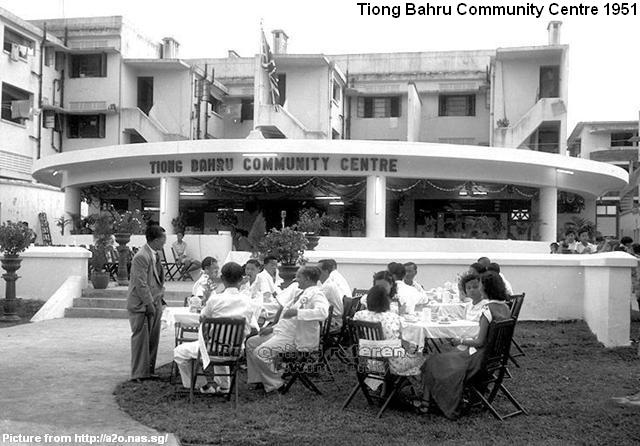
Henderson Community Centre

Bukit Merah View

late 1970s

Upgraded to Henderson Community Club in 2000s

Henderson Crescent Community Centre

Henderson Crescent

late 1970s

Located at Block 106 Henderson Crescent

Hock Choon Village Community Centre

Marsiling Road, Sungei Kadut

1962

Opened by former Prime Minister Lee Kuan Yew. Moved to Lorong Chikar, Bukit Panjang in the 1970s and renamed Hock Choon Community Centre. Closed in 1981 due to the construction of an arterial road

Hong Kah Community Centre

Junction of Hong Kah Circle and Jurong Road

1964

Located near Hong Kah Village. The village and Hong Kah Circle were demolished in the late 1980s

Hong Kah East Community Centre

Jurong West Avenue 1

1996

Started as a void deck community centre. Later moved to Jurong West Avenue 1 and renamed Jurong Green Community Club in 2001

Hong Kah North Community Club

Bukit Batok Street 31

early 1990s

Cost $3 million in construction. Its three-storey building was given an extensive renovation in 1996

Hong Kah South Community Centre

Jurong West Street 52

1990

Cost $3.6 million and was opened by Yeo Cheow Tong, former Acting Minister for Health and MP for Hong Kah. In 1995, McDonald’s opened its first ever outlet in a community centre at Hong Kah Community Centre. Renamed Hong Kah West Community Centre in 1997, and upgraded to Jurong Spring Community Club in 2011.

Hong Kah West Community Centre

Jurong West Street 52

1990

See “Hong Kah South Community Centre”

Hong Lim Community Centre

Pekin Street

1961

Opened by Ong Pang Boon, Minister for Home Affairs, and was the 30th community centre opened in Singapore. Closed in the late 1980s, and its building used as the Art Activity Centre

Hong Lim Green Community Centre

Upper Pickering Street

1970s

See “Telok Ayer Hong Lim Green Community Centre”

Hougang Community Centre

Hougang Avenue 3

1989

Formerly Punggol Community Centre. Renamed Hougang Community Centre in 1989, and upgraded to Hougang Community Club in 2002

Hougang Avenue 1 Community Centre

Hougang Avenue 1

1984

Opened at Block 110 Hougang Avenue 1 to replace Irving Road Community Centre which was closed in the same year. Also known as Lorong Ah Soo Community Centre. Later renamed Aljunied Community Centre

Hsin Min Community Centre

Junction of Woodlands Road and Jalan Gali Batu

1960s

Situated opposite of Hsin Min School. Closed in early 1990s

Huang Long Village Community Centre

Huang Long Road, Sembawang

1960s

Closed in 1985. Huang Long Road no longer exists today

Hun Yeang Village Community Centre

9 Milestone, Tampines Road

1960s

Hwi Yoh Community Centre

Serangoon North Avenue 4

1995

Located at Block 535 Serangoon North Avenue 4. Opened by George Yeo, former Minister for Information and the Arts and Health

Irving Road Community Centre

Irving Road, off Upper Paya Lebar Road

1964

Also known as Paya Lebar Community Centre. Closed in 1984. See “Paya Lebar Community Centre”

Jalan Besar Community Centre

Jellicoe Road

1984

Opened by Goh Chok Tong, former Defence and Second Health Minister. Upgraded to Jalan Besar Community Club

Jalan Eunos (Malay Settlement) Community Centre

Jalan Pegek, off Jalan Eunos

1959

There were calls to build a community centre at the Malay Settlement at Jalan Eunos as early as 1949, but the $23,200 building was only completed and opened ten years later.

Jalan Haji Karim Community Centre

Paya Lebar

1962

A single-storey zinc-and-wood community centre

Jalan Kaki Bukit Community Centre

Jalan Damai

early 1960s

Had its mobile library services in 1967

Jalan Kayu Community Centre

Junction of Yio Chu Kang Road and Seletar Road

1960s

Closed in early 2000s. Situated at the site of present-day Greenwich V

Jalan Kayu South Community Centre

Ang Mo Kio Avenue 10

1987

A void deck community centre at Block 556 Ang Mo Kio Avenue 10

Jalan Pagak Community Centre

early 1970s

Jalan Petua Community Centre

Jurong Road

1960s

Closed in 1981

Jalan Teck Kee Village Community Centre

along Yio Chu Kang Road, Serangoon Gardens

1963

Opened by former Prime Minister Lee Kuan Yew. Closed in the 1980s

Jalan Tenteram Community Centre

Jalan Tenteram, St. Michael’s Estate

1960

A double-storey building opened by Buang bin Omar Junid, former Assemblyman for Kallang

Jalan Ulu Sembawang Village Community Centre

1¾ Milestone, Sembawang Road

1963

Also known as Jalan Ulu Sembawang (2km) Community Centre. Opened by Tan Kia Gan, the former Minister for National Development. Closed in 1979 due to the development of Sembawang

Jalan Ulu Sembawang (3km) Community Centre

Jalan Ulu Sembawang

1960s

Closed in 1985

Jalan Hwi Yoh Village Community Centre

Jalan Hwi Yoh, off Serangoon North Avenue 1

1963

A simple single-storey community centre. Closed in 1982 due to resettlement of the villagers

Jin Ai Village Community Centre

Upper Bukit Timah Road

1963

Opened by K.C. Lee, former Parliamentary Secretary to Ministry of Education

Joo Chiat Community Centre

Joo Chiat Road

1960

Renovated in the early 1970s due to its rapidly deteriorated conditions. Upgraded to Joo Chiat Community Club in 1995

Joo Seng Community Centre

Upper Aljunied Lane

late 1960s

Jurong Community Centre

12½ Milestone, Jurong Road

1964

Opened by Ong Soo Chuan, the former Political Secretary to Ministry of Culture

Jurong East Community Centre

Jurong East Street 24

1984

Located at Block 252 Jurong East Street 24

Jurong Green Community Club

Jurong West Avenue 1

2001

See “Hong Kah East Community Centre”

Jurong Spring Community Club

Jurong West Street 52

2011

See “Hong Kah South Community Centre”

Jurong Town Community Centre

Yung Sheng Road

1977

Opened by former Prime Minister Lee Kuan Yew. An extension building was added in 1983. Replaced by Taman Jurong Community Centre in early 2000s

Jurong Village Community Centre

7¾ Milestone, Jurong Road

1963

Fund-raising of $40,000 for the building of the community centre started as early as 1957. Its facilities were mainly catered to Jurong Village, Kampong Teban and Tanjong Penuru in the 1960s

jalan besar community centre 1980s

jin ai village community centre 1960s

kallang community centre 1984

kebun baru community centre 1980s

Kaki Bukit Community Centre

Bedok North Street 3

1985

Added a $750,000 extension in 1988

Kallang Community Centre

Tronoh Road
(later Boon Keng Road)

1967

Opened by Buang bin Omar Junid, the former Parliamentary Secretary to Deputy Prime Minister and MP for Kallang. Tronoh Road, no longer exists today, was a road near the junction of Boon Keng Road and Bendemeer Road. Moved to a new $2.7-million building across Boon Keng Road in 1984, opened by by S. Dhanabalan, Minister for Foreign Affairs and Minister for Culture. Later upgraded to Kallang Community Club

Kampong Bugis Community Centre

Kallang Road

1961

Closed in 1982

Kampong Chai Chee Community Centre

Upper Changi Road
(later Bedok North Avenue 1)

1971

Opened by Sha’ari Tadin, former Parliamentary Secretary (Culture) and MP for Kampong Chai Chee. Moved to its new double-storey building at Bedok in 1981

Kampong Chantek Bahru Community Centre

Jalan Kampong Chantek

1960s

Visited by Yusof bin Ishak, Singapore’s first President, in 1967

Kampong Chantek Lama Community Centre

Whitley Road

1963

Kampong Cheng San Community Centre

Serangoon Garden Way

1963

Started as a single-storey building located at Serangoon Garden Way in Kampong Cheng San, and was officially opened by former Prime Minister Lee Kuan Yew. Had its mobile library services in 1968. Renamed Serangoon Gardens Community Centre in 1977, and later replaced by a new building in 1986

Kampong Eunos Community Centre

Changi Road

1972

Kampong Glam Community Centre

Beach Road
(later Victoria Street, and Beach Road again)

1960

Started as a single-storey building along Beach Road. Upgraded to a new three-storey building in 1973, with former Prime Minister Lee Kuan Yew invited to paint two red dots on the eyes of two lions at the open ceremony. Won the Community Centre of the Year award in 1986. Moved to former building of Crawford Community Centre along Beach Road when its site was used for construction of Bugis MRT in late 1990s. Upgraded to Kampong Glam Community Club in the 2000s

Kampong Jagor Community Centre

Telok Blangah

1968

Kampong Kapor Community Centre

Kampong Kapor Road, off Serangoon Road

1961

The original community centre was destroyed by arsonists in 1970. A fund-raising drive was organised and managed to raise $120,000 by the residents. New double-storey building was completed in 1971 and officially opened by then-President Benjamin Henry Sheares

Kampong Kembangan Community Centre

Jalan Lapang
(later Lengkong Tiga)

1963

Opened by former Prime Minister Lee Kuan Yew. Moved to Lengkong Tiga in 1990s and upgraded to Kampong Kembangan Community Club

Kampong Salabin Community Centre

Changi

1963

Opened by former Prime Minister Lee Kuan Yew. Moved to Lengkong Tiga in 1990s and upgraded to Kampong Kembangan Community Club

Kampong Serangoon Kechil Community Centre

1960s

Kampong Silat Community Centre

Silat Crescent

1950s

Kampong Sungei Tengah Community Centre

13½ Milestone, Choa Chu Kang Road

1963

Had its mobile library services in 1967

Kampong Teban Community Centre

7 Milestone, Tampines Road

1959

Built by the Singapore Junior Chamber of Commerce at a cost of $12,000 for the 4,000 residents at Kampong Teban. Praised by Peter Frankel, the world president of the Junior Chamber of Commerce, during his visit in 1961

Kampong Ubi Community Centre

Jalan Ubi

1960

Kangkar Community Centre

6½ Milestone, Upper Serangoon Road

1979

Closed in 1984. See “Ponggol Community Centre”

Katong Community Centre

Kampong Arang Road

1972

Keat Hong Community Centre

Choa Chu Kang Road

early 1970s

Kebun Baru Community Centre

Ang Mo Kio Avenue 4

1982

Cost $3 million in construction. Its three-storey building was given an extensive renovation in 1996

Kebun Ubi Community Centre

Lorong Renjong

1970s

Lorong Renjong, near Buangkok Farmways, was cleared during the development of Sengkang in mid-1990s

Keppel Harbour Community Centre

Seah Im Road

1960

The idea of building a community centre at Seah Im Road was mooted as early as 1956 when the Singapore Government requested the Legislative Assembly to provide a $40,000 fund

Khe Bong Community Centre

Lorong 1, Toa Payoh

1981

Its foundation stone was laid in 1980 by Ho See Beng, former MP for Khe Bong. Cost $1.5 million in construction

Kim Chuan Road Community Centre

Kim Chuan Road

1960s

Kim Tian Community Centre

Jalan Membina, off Jalan Bukit Merah

1970s

Located at Block 15 Jalan Membina. The flats and community centre were demolished in 1990s and replaced by new flats

Kim Keat Community Centre

Lorong 8, Toa Payoh

1978

Its foundation stone was laid in 1976 by Ong Teng Cheong, Member of Parliament for Kim Keat. Renamed Toa Payoh South Community Centre in late 1990s, and later Toa Payoh South Community Club. Previously home to Kim Keat Community Centre Lion & Dragon Dance Troupe, founded in 1978. See “Toa Payoh South Community Centre” and “Kim Keat Avenue Community Centre”

Kim Keat Avenue Community Centre

Kim Keat Avenue

1955

Opened by David Marshall, Singapore’s first Chief Minister. Its building was allocated by Singapore Improvement Trust

Kim Pong Community Centre

Tiong Bahru

1963

Kim Seng Community Centre

Havelock Road

1980

Opened in 1980 and upgraded in 1995. Its facilities were further renovated to provide more community activities after the nearby Bukit Ho Swee Community Centre was closed in 2004. First community centre in Singapore to provide day care for elderly residents

Koh Sek Lim Road Village Community Centre

Koh Sek Lim Road, off Upper Changi Road

1960s

Koh Sek Lim Road still exists today, although the village had long vanished

Kolam Ayer Community Centre

Geylang Bahru

1980

Cost $2 million in construction. Was upgraded to Kolam Ayer Community Club in 1990s

Kong Kuan Community Centre

Jalan Kong Kuan

1963

Jalan Kong Kuan no longer exists today. It used to be located at one end of Bukit Panjang Road

Kota Raja Community Centre

Sultan Gate, off Beach Road

1963

Opened by S Rajaratnam, former Minister for Culture

Kranji Community Centre

Woodlands Road

1963

Opened by Lee Khoon Choy, the former Political Secretary to the Prime Minister. In 1981, its lecture rooms caught fire and were partially damaged. Closed in 1988

Kreta Ayer Community Centre

Sago Lane
(later Kreta Ayer Road)

1960

Had its new $300,000 building opened in 1980 along Kreta Ayer Road, next to Kreta Ayer People’s Theatre. Upgraded to Kreta Ayer Community Club in 2000s

Kuo Chuan Community Centre

Lorong 2, Toa Payoh

1972

Initially known as Toa Payoh West Community Centre. Upgraded to Toa Payoh West Community Club in the 1990s

Lam Soon Community Centre

13 Milestone, Choa Chu Kang Road
(later Choa Chu Kang Avenue 4)

1965

Situated at the junction of Jalan Lekar and Old Choa Chu Kang Road. Closed in early 1990s and moved to Blk 421 Choa Chu Kang Avenue 4 as a void deck community centre. Closed in 2008

Lam Tong Village Community Centre

7 Milestone, Holland Road (near Ulu Pandan Road)

1969

In late 1970, a thunderstorm swept away the embankment and toilet of the community centre, causing the building on the verge of collapse

Leng Kee Community Centre

Lengkok Bahru

1983

Opened in 1983 by Ow Chin Hock, Parliamentary Secretary for Culture and Member of Parliament for Leng Kee. Construction started in 1980 and completed in 1982.

Lim Chu Kang Community Centre

19½ Milestone, Lim Chu Kang Road

1972

Its opening was held in conjunction with the $250,000 electrification scheme of rural Lim Chu Kang. The scheme helped in the provision of electricity to some 8,500 residents and 1,010 houses. Underwent renovation in 1984. Closed in 1987

Lorong Ah Soo Community Centre

Lorong Ah Soo
(later Hougang Avenue 1)

1960s

A single-storey kampong centre built to cater for the needs of the residents of Lorong Ah Soo Village. Moved to Block 110 Hougang Avenue 1 in 1984. Also known as Hougang Avenue 1 Community Centre. Later renamed Aljunied Community Centre

Lorong Lew Lian Community Centre

Lorong Lew Lian

early 1980s

Closed in 1980s

Lorong Tai Seng Community Centre

Lorong Tai Seng

1960s

Closed in 1979 due to an industrial development plan of the area. Lorong Tai Seng no longer exists today

Lowland Road Community Centre

Upper Serangoon Road

1963

Closed in 1980s

koh sek lim road village community centre 1960s

leng kee community centre 1980s

pek kio community centre 1984

queen street community centre 1984

MacPherson Community Centre

Paya Lebar Way

1963

Had its new building built in 1981. Upgraded to MacPherson Community Club in 1995

Malay Farm Community Centre

Jalan Penggaga, off Jalan Eunos

1960

Regularly organised tournaments of sepak takraw, badminton and table tennis for the Malay-majority community. Also had sewing and cake baking courses for the Malay women. Jalan Penggaga was later removed due to the construction of Eunos MRT

Mandai Community Centre

Mandai Road

1960

Built to cater for the needs of the farmers in Mandai

Mandai Village Community Centre

12½ Milestone, Mandai Road

1975

Also known as Mandai 20km Community Centre. Situated at junction of Mandai Road and Lorong Asrama, where there were clusters of Mandai Village. Demolished by late 1980s

Mandai 2km Community Centre

Jalan Ulu Sembawang

Demolished by late 1980s

Manila Street Community Centre

Cheng Yan Place

1963

Opened by DPM Toh Chin Chye, located at Cheng Yan Place. Lasted until the 1980s

Marine Parade Community Centre

Marine Parade Road

1981

Upgraded to Marine Parade Community Club in 2000

Marsiling Community Centre

Admirality Road

1980

Its foundation stone was laid in 1979 by Lee Yiok Seng, former Parliamentary Secretary (National Development) and MP for Bukit Panjang. Upgraded to Marsiling Community Club

Maude Road Community Centre

Maude Road, off Jalan Besar

1960

Opened by Assemblyman for Jalan Besar Chan Chee Seng

Maxwell Community Centre

Maxwell Road

early 1980s

Closed in 1985

Minto Road Community Centre

Minto Road, off Jalan Sultan

1960

Opened by former Prime Minister Lee Kuan Yew and Minister for Labour and Law Kenneth Michael Byrne. The cost of original building was $10,000

Moulmein Community Centre

Shan Road, off Balestier Road

1990

A three-storey community centre opened by Lawrence Sia Khoon Seong, former MP for Moulmein. Closed in 2007 and converted into an office building

Mountbatten Community Centre

Jalan Satu, off Guillemard Road

1960

Formerly known as Katong Boys’ Club. Opened by then Deputy Prime Minister Toh Chin Chye. Upgraded to Mountbatten Community Club in 2004

Nan Hoe Community Centre

Neo Tiew Road

1970s

Closed in late 1980s

Nanyang Community Club

Jurong West Street 91

1996

Built at a cost of $8 million, it has many modern facilities such as a rooftop garden, a karaoke lounge and a theatrette

Nee Soon Community Centre

10 Milestone, Upper Thomson Road

1961

Catering to the Nee Soon Village, it had its mobile library services in 1965, the third such services established in community centres of Singapore

Nee Soon Central Community Centre

Yishun Street 72

1990s

Located at Block 749 Yishun Street 72

Nee Soon East Community Club

Yishun Avenue 9

1990s

Nee Soon South Community Centre

Yishun Street 81

1990

Upgraded to Nee Soon South Community Club in 2000s

Nelson Road Community Centre

Nelson Road (off Borneo Road), Radin Mas

1966

Both Nelson Road and Borneo Road no longer exist today

Ong Lye Sua Community Centre

present-day Yishun Avenue 1

1960s

Ong Lye Sua was named after the vast pineapple plantations owned by Lim Nee Soon in the early 1900s. The site is now home to Orchid Country Club

Onraet Road Community Centre

Onraet Road

1964

Opened by EW Baker, former Speaker and Assemblyman for Tanglin. Closed in 1982

Outram Hill Community Centre

Chin Swee Road

1963

Opened by former Prime Minister Lee Kuan Yew and Minister for Labour and Law Kenneth Michael Byrne. The cost of original building was $10,000

Outram Park Community Centre

Outram Park

1978

Opened by DPM and Minister of Defence Goh Keng Swee. Located at Block 31 Outram Park. Blocks of flats were demolished in late 1990s

Pasir Ris Central Community Centre

Pasir Ris Street 1

1990s

Located at Block 428 Pasir Ris Street 1

Pasir Ris East Community Club

Paris Ris Drive 4

2001

Considered Singapore’s first “mega-CC”, as it provides facilities and activities similar to country clubs

Paris Ris Elias Community Centre

Elias Road
(later Paris Ris Drive 3)

1996

Started as a void deck community centre at Block 629 Elias Road. Formerly known as Pasir Ris West Community Centre, and renamed Pasir Ris Elias Community Centre in 1997. Moved to its new building along Pasir Ris Drive 3 in 2004 as Pasir Ris Elias Community Club

Pasir Ris West Community Centre

Elias Road

1996

See “Pasir Ris Elias Community Centre”

Pasir Panjang Community Centre

5½ Milestone, Pasir Panjang Road

1960s

Its new building was opened in 1980 by Othman Wok, former MP for Pasir Panjang

Paya Lebar Community Centre

Irving Road, off Upper Paya Lebar Road
(later Surin Avenue)

1964

Had its mobile library services in 1967. Also known as Irving Road Community Centre in the early 1980s. The Upper Serangoon Community Centre along Surin Avenue was renamed Paya Lebar Community Centre in 1980s. Later upgraded to Paya Lebar Community Club in 1994. Closed in 2000s

Paya Lebar Kovan Community Club

Hougang Street 21

2004

Pek Kio Community Centre

Gloucester Road

1954

First opened in a shophouse at Cambridge Road, then relocated to a nearby single-storey building in 1964, opened by AP Rajah, former Assemblyman for Farrer Park. Moved to a new $600,000 building just beside the old one. Moved again to Gloucester Road in the 2000s

Pioneer Community Centre

Jurong West Street 64

2004

Plantation Avenue Village Community Centre

Plantation Avenue, off Yio Chu Kang Road

early 1970s

Ponggol Community Centre

6½ Milestone, Upper Serangoon Road

1964

Opened by Tan Kia Gan, former chairman of Housing and Development Board. After a new Punggol Community Centre was built at Tampines Way, it was renamed Kangkar Community Centre in 1979. Closed in 1984

Potong Pasir Community Centre

Potong Pasir Avenue 2

1984

The façade of its original building was designed with sloping roofs, in order to blend in among the unique Potong Pasir HDB flats. Upgraded to a new building and renamed Potong Pasir Community Club in the 2000s

Princess Elizabeth Estate Community Centre

Prince Elizabeth Drive
(later 9¼ Milestone Bukit Timah Road)

early 1950s

One of Singapore’s earliest community centres. Moved from Prince Elizabeth Drive to 9¼ Milestone Bukit Timah Road in 1959

Pulau Brani Community Centre

Pulau Brani

1961

Pulau Bukom Kechil Community Centre

Pulau Bukom Kechil

1963

Opened by former Prime Minister Lee Kuan Yew as part of the Southern Island tour

Pulau Seking Community Centre

Pulau Seking

1960s

By the late 1980s, Pulau Seking Community Centre was one of Singapore’s remaining two offshore community centres; the other being Pulau Ubin Community Centre. Also known as Pulau Sakeng (or Sekeng), it has now combined with Pulau Semakau though land reclamation

Pulau Semakau Community Centre

Pulau Semakau

1963

Opened by Tuan Haji Yacob bin Mohamed, the former Parliamentary Secretary to the Prime Minister

Pulau Samulun Community Centre

Pulau Samulun

1960s

Pulau Seraya Community Centre

Pulau Seraya

1960s

Part of the Southern Islands which were dominated by oil refineries and plants in the 1970s. Became part of Jurong Island after land reclamation in the mid-1990s

Pulau Sudong Community Centre

Pulau Sudong

1963

Opened by former Prime Minister Lee Kuan Yew as part of the Southern Island tour

Pulau Tekong Community Centre

Pulau Tekong

1960s

Pulau Ubin Community Centre

Pulau Ubin

1961

First started as a community hall in 1961, built by the residents of the island. Converted into a community centre in 1966 with facilities added. In 1995, its chairman, 89-year-old Lim Chye Joo, was the oldest chairman among others in the community centre management committees in Singapore. The community centre itself was also the oldest in Singapore, before its closure in 2003

Punggol Community Centre

Upper Serangoon Road

1978

Renamed Hougang Community Centre in 1989

Punggol Community Club

Hougang Avenue 6

1993

The $5.8-million building was the first community centre in Singapore to have an air-raid shelter. Replaced the Punggol Point Community Centre to serve the residents in the vicinity

Punggol East Community Centre

Hougang Avenue 10

early 2000s

See “Punggol Park Community Centre”

Punggol Park Community Centre

Hougang Avenue 10

early 2000s

Formerly known as Punggol East Community Centre. Located at Block 458 Hougang Avenue 10

Punggol Point Community Centre

Ponggol Seventeenth Avenue

1960s

Had its new building built in 1981, and opened by Ng Kah Ting, former MP for Punggol. Closed in 1992 and was converted to Punggol Point Sea Sports Club

Punggol South Community Centre

Hougang Avenue 9

early 2000s

Located at Block 662 Hougang Avenue 9

Queenstown Community Centre

Margaret Drive
(later Commonwealth Avenue)

1960

First started in Margaret Drive neighbourhood, beside Queenstown cinema, library and market. Closed in the mid-2000s, and the nearby Alexandra Community Centre was renamed Queenstown Community Centre

Queen Street Community Centre

Queen Street

1961

Renamed Rochore Community Centre in 1989

Radin Mas Community Centre

Kampong Radin Mas Road (old)

Telok Blangah Crescent (new)

1961 (old)

1978 (new)

Original Radin Mas Community Centre was opened by Telok Blangah Assemblyman John Mammen.

New Radin Mas Community Centre was opened by Bernard Chen Tien Lap, former Minister of State (Defence) and MP for Radin Mas. Its sub-centre was opened in 1979 at Block 134, Jalan Bukit Merah. Upgraded to Radin Mas Community Club

River Valley Community Centre

Junction of Penang Road and Oxley Road
(later River Valley Road)

1961

Opened by Lim Cheng Lock, former Assemblyman for River Valley. Moved to its new $4-million building along River Valley Road, opposite Oxley Rise, in 1982

Rivervale Community Centre

Rivervale Drive

2004

Opened by Penny Low, MP for Pasir Ris-Punggol. First community centre in Singapore to have a horse riding club

Rochore Community Centre

Prinsep Street

1963

Opened by former Deputy Prime Minister Toh Chin Chye.
Closed in 1988, after which Queen Street Community Centre was renamed Rochore Community Centre. Its three-storey building was left vacated for many years and was replaced by Bugis+ (formerly Iluma) in the late 2000s

serangoon gardens community centre late 1970s

orange valley nursing home former silat community centre

taman jurong community centre 1965

tanjong pagar community centre 1982

Sembawang Community Centre

Sembawang Road

1984

Built to replace the old Chong Pang Village Community Centre. Upgraded to Sembawang Community Club

Senja-Cashew Community Centre

Senja Road, Bukit Panjang

2000s

Located at Block 607 Senja Road

Senja-Cashew Community Club

Bukit Panjang Road

2011

Singapore’s first fully integrated community club and sports complex. Opened by Vivian Balakrishnan, Minister for Community Development, Youth and Sports and MP for Holland-Bukit Timah

Sengkang Community Club

Sengkang Square

2004

Co-located in a hub that comprises of SingPost, SingHealth Polyclinc, Singapore Anti-Narcotics Association (SANA), a Neighbourhood Police Centre (NPC)

Sennett Community Centre

MacPherson Road

1963

Closed in 1985

Serangoon Community Centre

Cheng San Road, off Serangoon Garden Way
(later Serangoon North Avenue 2)

1980

Shared the name of the first community centre in Singapore, located at Lim Ah Pin Road, before it was renamed Upper Serangoon Community Centre. Its foundation stone was laid in 1980 by Dr Lau Teik Soon, former MP for Serangoon Garden. Later moved to Serangoon North Avenue 2, and was upgraded to Serangoon Community Club in 2006

Serangoon Gardens Community Centre

Serangoon Garden Way

1986

Previously called Kampong San Teng Community Centre before 1977. A new building was built in 1986, replacing the old one. Upgraded to Serangoon Garden Community Club in 1990

Siglap Community Centre

Palm Road, off Upper East Coast Road
(later Bedok South Avenue 3)

1953

One of Singapore’s first community centres, together with (Upper) Serangoon Community Centre, when it was opened in 1953. Later moved to Bedok South Avenue 2, while its old premises was renovated and renamed Siglap South Community Centre

Siglap South Community Centre

Palm Road, off Upper East Coast Road

2000

Had an extensive multi-million renovation in 1999 at the old premises of Siglap Community Centre to upgrade its decades-old single-storey building to a three-storey arts hub. Upon Completion, was renamed Siglap South Community Centre

Silat Community Centre

Silat Avenue

1990

Built at the former site of Anson Community Centre. Closed in early 2000s, and its premises were taken over by Orange Valley Nursing Home

Sim Avenue Community Centre

Lorong 31, Geylang Road

mid- 1950s

Stamford Community Centre

Short Street
(later Queen Street)

early 1950s

One of the earliest community centres in Singapore established by the British colonial government. Moved to a nearby location at Queen Street in the late 1960s

Sungei Kadut Village Community Centre

Woodlands Road

1963

Opened by Lee Khoon Choy, former Parliamentary Secretary to Ministry of Education

Taman Jurong Community Centre

Taman Jurong

1965

Opened by Jek Yeun Thong, former Minister for Labour. Had its mobile library services in 1969

Taman Jurong Community Club

Yung Sheng Road

2005

Built at the former site of Jurong Town Community Centre. Originally called Taman Jurong Community Centre. Upgraded to Taman Jurong Community Club in 2005

Tampines Community Centre

Tampines Avenue

1975

Replaced Hun Yeang Village Community Centre in the mid-1970s to serve Hun Yeang Village, Kampong Loyang and other villages in Tampines. Closed in early 1990s after completion of other community centres in Tampines. Tampines Avenue is now a quiet road famous for its row of Chinese temples. Its sub-community centre at Block 138 Tampines Street 11 was renamed Changkat Community Centre in 1984

Tampines Central Community Centre

Tampines Street 71
(later Tampines Street 83)

1990s

First located at the void deck of Block 702 Tampines Street 71. Moved to void deck of Block 866 Tampines Street 83 in late 1990s, before its new building called Tampines Central Community Complex was completed nearby in 2001

Tampines Changkat Community Centre

Tampines Street 11

1992

Formerly called Changkat Community Centre and located at the void deck of Block 138 Tampines Street 11. Moved to its new building nearby in 1992, and renamed Tampines Changkat Community Centre. Later upgraded to Tampines Changkat Community Club

Tampines East Community Club

Tampines Street 23

1994

Tampines North Community Centre

Tampines Street 41

late 1980s

Opened by Goh Chok Tong, former First Deputy Prime Minister. Cost $3.1 million in construction. Upgraded to Tampines North Community Club in early 1990s

Tampines West Community Club

Tampines Avenue 3

1993

Tanah Merah Community Centre

Bedok South Avenue 3

1984

Its new $2.4-million building at Bedok South Avenue 3 was built in 1982. Officially opened by Dr Lee Chiaw Meng, former MP for Tanah Merah two years later

Tanah Merah Besar Community Centre

1966

Tanah Merah Kechil Community Centre

Changi Road

1967

Tanglin Community Centre

Whitley Road

1974

Underwent an extensive $4.5-million renovation started in 1991. Was ready more than three years later, and in 1998, officially opened as Tanglin Community Club

Tanjong Pagar Community Centre

Yan Kit Road

1960

Opened by former Prime Minister Lee Kuan Yew. Initially called Yan Kit Community Centre before its change of name in 1962. Had its mobile library services, one of Singapore’s first, in 1964. Was also one of the first venues for send-off ceremonies of young men heading for National Service in 1967. Upgraded to Tanjong Pagar Community Club in the mid-1990s

Teck Ghee Community Centre

Ang Mo Kio Avenue 1
(later Ang Mo Kio Avenue 10)

1978

Its operation at Ang Mo Kio Avenue 1 was ceased after Chong Boon Community Centre at Ang Mo Kio Avenue 10 was renamed Teck Ghee Community Centre in 1991. Later upgraded to Teck Ghee Community Club

Teck Hock Community Centre

7½ milestone Tampines Road

1960s

One of the seven rural community centres in old Tampines. Closed in 1970s

Teck Whye Community Centre

Teck Whye Lane

1980s

Located at Block 17 Teck Whye Lane. Closed in 1990s after Chua Chu Kang Community Club opened nearby

Telok Ayer Community Centre

Telok Ayer Street

1960

Opened by former Minister for Home Affairs Ong Pang Boon

Telok Ayer Hong Lim Green Community Centre

Upper Pickering Street

1970s

Organised Singapore’s first mass swim across the Singapore River in 1984. Later renamed Telok Ayer Hong Lim Green Community Centre

Telok Blangah Community Centre

Block 77, Telok Blangah Drive
(later Telok Blangah Street 31)

1970s

Started as a void deck community hall at Block 77 at Telok Blangah. Raised $250,000 for its building fund in 1979, and construction of a new building took place nearby. Opened in 1983 by Ong Teng Cheong, former Minister without Portfolio. Upgraded to Telok Blangah Community Club in 1995 with a $3.2-million wing extension

Thomson Community Centre

Lorong Puntong, off Sin Ming Avenue
(later Upper Thomson Road)

late 1950s

The construction of its new $3.6-million building, located further south of Upper Thomson Road, started as early as 1982, and was completed and officially opened two years later. Upgraded to Thomson Community Club in the late 1990s

Thong Hoe Community Centre

18½ Milestone Lim Chu Kang Road

1961

Located near Thong Hoe Village, at the junction of Lim Chu Kang Road and Neo Tiew Road. Was one of the six community centres located at old Lim Chu Kang vicinity. Closed in the late 1980s

Tiong Bahru Community Centre

Eu Chin Street, Tiong Bahru

1960

Unofficially Singapore’s first community centre when it was opened to public as early as 1948. Was forced to close in 1956 by the Department of Social Welfare, citing the community centre was used for “unlawful purposes”. Revamped in 1960 and officially opened by former Minister for Labour and Law Kenneth Michael Byrne. Its new building was completed and opened in 1994

Toa Payoh Community Centre

Lorong 5, Toa Payoh
(later Toa Payoh Central)

1978

Formerly established at block 79 Toa Payoh Lorong 5 in the early 1970s. Its standalone building was opened in 1978 by Eric Cheong Yuen Chee, former MP for Toa Payoh. Later upgraded Toa Payoh Central Community Club

Toa Payoh East Community Centre

Lorong 6, Toa Payoh

1990s

Formerly known as Boon Teck Community Centre before 1997. Later upgraded to Toa Payoh East Community Club

Toa Payoh South Community Centre

Lorong 8, Toa Payoh

late 1990s

Formerly known as Kim Keat Community Centre. Renamed in late 1990s, and later upgraded to Toa Payoh South Community Club

Toa Payoh West Community Centre

Lorong 2, Toa Payoh

1970s

Later renamed Kuo Chuan Community Centre. Upgraded to Toa Payoh West Community Club in 1990s

Tua Pek Kong Kow Community Centre

11 Milestone, Yio Chu Kang Road (Track 32)

1969

Opened by S Rajaratnam, former Minister for Foreign Affairs and Labour. The road was renamed as Munshi Abdullah Avenue and the vicinity Teacher’s Estate in the late 1970s

Tuas Community Centre

18 Milestone, Jurong Road

1960

Opened by Chor Yeok Eng, former Assemblyman for Jurong. One of mainland Singapore’s westernmost community centres

Ulu Pandan Community Centre

Coronation Road West
(later Ghim Moh Road)

1963

Opened by former Prime Minister Lee Kuan Yew. Construction of its new three-storey building at Ghim Moh Road started in 1978, before it was officially opened by Dr Chiang Hai Ding, former MP for Ulu Pandan, in 1981. Upgraded to Ulu Pandan Community Club

Upper Serangoon Community Centre

Lim Ah Pin Road, off Upper Serangoon Road
(later Surin Avenue)

1953

One of Singapore’s first two community centres; the other being Siglap Community Centre. Officially opened by E.V.G. Day, former chairman of the Singapore Rural Board. Initially named Serangoon Community Centre. Moved to its new premises at Surin Avenue in 1979, and was renamed Paya Lebar Community Centre

West Coast Community Centre

(later Clementi Avenue 2, then Clementi West Street 2)

1961

Visited in 1961 by Yang Di-Pertuan Negara Yusof Ishak, who planted a tree in its compound. Had its mobile library services, one of Singapore’s first, in 1964. Later moved to Block 354 Clementi Avenue 2, and in 1983, it moved again to Block 728 Clement Street 2, with the old office became West Coast Subcommunity Centre (present-day West Coast Neighbourhood Police Post). Had its new standalone building in the 1990s
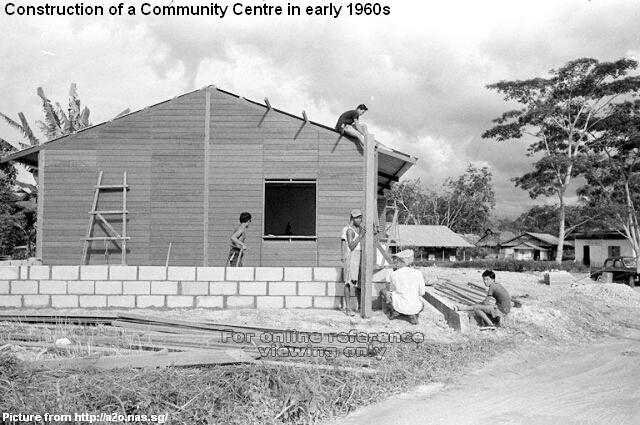
Whampoa Community Centre

Whampoa Drive

late 1970s

First community centre in Singapore to become computerised in 1981. Won Singapore’s best community centre award in 1980 and 1981. Upgraded to Whampoa Community Club
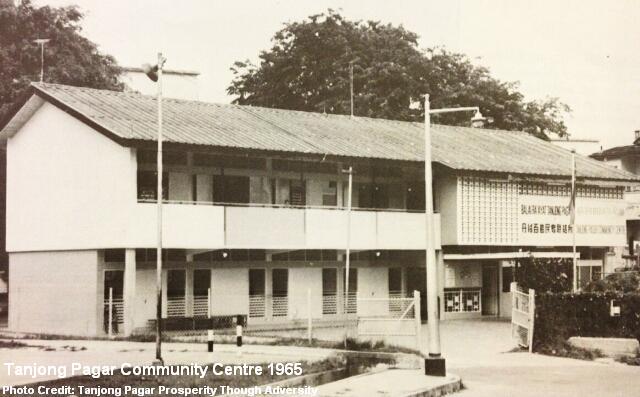
Woodlands Community Centre

15 Milestone, Woodlands Road
(later Block 18, Marsiling Lane)

1963

Opened by former Prime Minister Lee Kuan Yew. Moved to a void deck office at Block 18 Marsiling Lane in the 1970s

Woodlands Community Club

Woodlands Street 83
(later Woodlands Street 81)

early 2000s

Previously located at Block 852 Woodlands Street 83. Moved to its new building at Woodlands Street 81 in the mid-2000s, and was renamed Woodlands Community Club

Yan Kit Community Centre

Cantonment Road

1960

See “Tanjong Pagar Community Centre”

Yew Tee Community Centre

90 Lorong Kebasi, off Choa Chu Kang Way

1963

Closed in 1988 due to low utility rate. Lorong Kebasi became an entry road to Kranji Camp

Yew Tee Community Club

Choa Chu Kang Street 52

early 2000s

Yio Chu Kang Community Centre

Yio Chu Kang Road
(later Ang Mo Kio Street 61)

1960

Started as early as 1955, but was officially opened by Tan Cheng Tong, former Assemblyman for Jalan Kayu in 1960. It was the 10th community centre managed by PAP. Moved to its $3-million building at Ang Mo Kio Street 61 in 1986. Upgraded to Yio Chu Kang Community Club in 2002

Yio Chu Kang (Track 14) Community Centre

Track 14, Yio Chu Kang Road

1970s

Demolished by late 1980s

Yishun New Town Community Centre

Yishun Ring Road

1988

Its new building cost more than $3 million in construction, and was officially opened by Koh Lip Lin, former MP for Nee Soon South. Later renamed Chong Pang Community Club

Yuhua Community Centre

Boon Lay Way

1980s

Started as a void deck community centre at Block 252 Jurong East Street 24. Moved to its new three-storey building along Boon Lay Way in 1989. Its new building was designed like a Chinese bungalow to blend with the Chinese and Japanese Gardens nearby. Later upgraded to Yuhua Community Club

Zehnder Road Community Centre

Zehnder Road, off South Buona Vista Road

1963

The single-storey community centre was opened by former Prime Minister Lee Kuan Yew. Received a new $10,000 basketball court from the British in 1971

Zhenghua Community Club

Segar Road

2009

telok blangah community centre 1980s

thomson community centre 1984

toa payoh community centre 1980s

yio chu kang track 14 community centre 1986

yio chu kang track 14 community centre2 1986

yio chu kang track 14 community centre3 1986

zehnder road community centre 1970

Published: 24 March 2013

Updated: 15 November 2024

Posted in Historic | Tagged , , , , , , , , , , , , , , , , , , , | 29 Comments

Printing and Minting: The Singapore Dollars and Coins

The Monetary Authority of Singapore (MAS) has just announced that the new set of Singapore coins will be introduced in mid-2013. Belonging to the Third Series since independence, the designs of the new coins feature five of Singapore’s most iconic landmarks: the Merlion, Port of Singapore, Changi Airport, HDB Flats and the Esplanade.

third series singapore coins 2013

MAS was given the right to issue Singapore dollar notes and coins in October 2002 after its merger with the Board of Commissioners of Currency, Singapore (BCCS). Previously, the BCCS, set up in 1967 under the Currency Act, was the main body of currency issuance. Before the circulation of the first series of Singapore notes and coins, Singapore had been using a common currency issued by the Board of Commissioners of Currency, Malaya and British Borneo between 1953 and 1967. The new currency system of Singapore signified the full independence of the nation from the British.
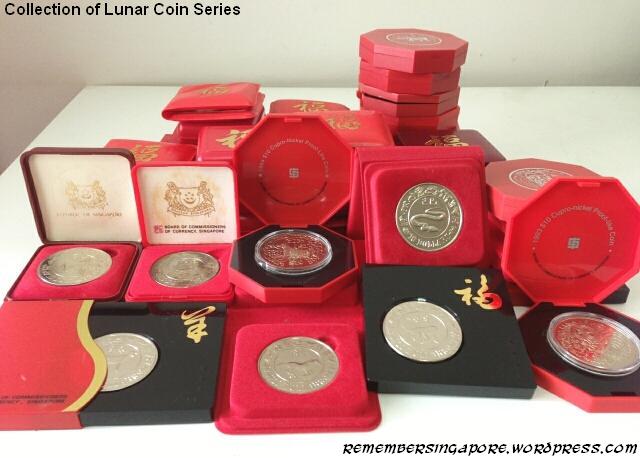
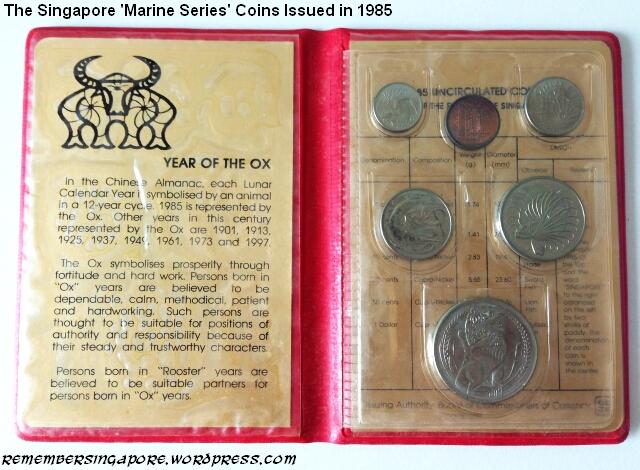
The Singapore Mint

the singapore mint 1968In 1968, to maintain a high standard of precision engineering and security, the Singapore Mint was established by the former Minister for Finance Dr Goh Keng Swee for the minting of Singapore coins. The following year, it issued Singapore’s first commemorative coin to celebrate the 150th year of the founding of Singapore  (in 1819). It was a 22-carat gold coin that featured the Raffles Lighthouse.

commemorative coins 1970sThe high quality of the Singapore Mint became internationally well-known in the seventies. Other countries and regions, such as the Philippines, Nepal, the Western Samoa, and later Macau, Cook Islands and Brunei, approached Singapore for the minting of their own circulation coins. In 1975 and 1977, two sets of commemorative coins were launched to mark the 10th year anniversaries of Singapore’s independence and its membership to the Association of the Southeast Asian Nations (ASEAN) respectively.

commemorative coins changi airport 1981 southeast asia games 1983

Other than the core business of coin minting, the Singapore Mint also took on other businesses such as minting of military medals and memorabilia for private companies. Entering privatisation in the eighties, the Singapore Mint began to focus in production, design, packaging and marketing.

commemorative coins benjamin sheares bridge 1982 25 years nation building 1984

More commemorative coins were launched to mark the important milestones in the progress of Singapore, such as the official opening of the Changi Airport (1981), the completion of the Benjamin Sheares Bridge (1982), 25th anniversary of HDB (1985) and the success of MRT (1989).

lunar coin series collection

One popular collection of commemorative coins introduced was the lunar coin series, first started in 1981 with the Year of the Rooster coin. Since then, it had become one of the longest series, with an animal of the Chinese Zodiac (Rat, Ox, Tiger, Rabbit, Dragon, Snake, Horse, Goat, Monkey, Rooster, Dog and Pig) designed, minted and sold to the public every year.

The Singapore Coins – Marine Series

singapore marine series coins year of the ox 1985

Singapore’s first set of coins was launched in 20 November 1967, about five months after the introduction of its first set of dollar notes. The denomination of the coins ranged from 1-cent to $1, with designs of public housing (1-cent), snake-bird (5-cent), sea horse (10-cent), swordfish (20-cent), lionfish (50-cent) and a Singapore-styled lion ($1).

old singapore marine series 1-dollar coins

In 1971, the Singapore Mint also issued a limited edition of a FAO 5-cent coin to the public. It was to mark Singapore’s participation in the Food and Agricultural Organisation (FAO), and the coin was designed with a fish and wordings of “INCREASE PRODUCTION” and “MORE FOOD FROM THE SEA”. Made of aluminum, the 1.24g coin was even lighter than the normal 5-cent coins, even though it was almost as large as the 20-cent coin. Due to its limited quantity, light weight and a large size for a 5-cent coin, many people thought it was a counterfeit coin.

singapore marine series 5-cent fao coin 1971 comparison with normal 5-cent coin

The Singapore Coins – Floral Series

In December 1985, the Singapore Mint introduced Singapore’s second coin series. New 5-cent to 50-cent coins were issued with designs of flowers and plants on the faces. The fruit salad plant, star jasmine, powder-puff plant and the yellow allamanda were chosen for the 5-cent, 10-cent, 20-cent and 50-cent coins respectively.

singapore flora series coins

The 1-cent and $1 coin of the ‘flora series’ were issued only almost two years later, in September 1987, with face designs of Singapore’s national flower Vanda Miss Joaquim (1-cent) and the periwinkle ($1). The $1 coin was also the first design of a Singapore coin with an octagonal frame, which led to the famous feng shui and bagua rumours.

The current ‘flora series’ coins are expected to be phased out by 2017, replaced by the new third series coins. Interestingly, the design of an octagonal frame is retained on the new $1 coin.

The Singapore Notes – Orchid Series

The ‘orchid series’ Singapore dollar notes were the first set of currency notes issued by Singapore. Six denominations of $1, $5, $10, $50, $100 and $1,000 were launched first, in June 1967, followed by $25, $500 and $10,000 denominations in August 1972 and January 1973.

singapore notes orchid series

Various types of orchids were chosen as designs for the faces of the ‘orchid series notes, whereas the back designs consisted of public housing ($1), Singapore River ($5), four grasped hands ($10), Supreme Court building ($25), Clifford Pier ($50), Singapore waterfront ($100), Government Offices ($500), Victoria Theatre ($1,000) and The Istana ($10,000).

singapore 10-dollar note back design

The $10 design had perhaps the most iconic design, with its striking red background and the four grasped hands that represents the racial harmony and unity among Singapore’s four main races. It signified the importance of a stable society that was much needed in the sixties just after the country’s independence.

Till date, the $25 ‘orchid series’ note was the only denomination of its kind in Singapore currency.

The Singapore Notes – Bird Series

Between August 1976 and February 1980, Singapore’s second note series were issued. The ‘bird series’, as its name suggested, involved a range of bird designs on the faces on the dollar notes, including kingfisher, sunbird, oriole and eagle.

singapore notes bird series

At the back, there were designs of National Day Parade ($1), cable cars ($5), Garden City ($10), Changi Airport and Concorde ($20), school music band ($50), ethics group dancers ($100), oil refinery ($500), container terminal ($1,000) and the Singapore River ($10,000). The new back designs of the ‘bird series’ notes demonstrated the rapid progress enjoyed by Singapore in the seventies.

The previous $25 denomination note of the ‘orchid series’ was replaced by a new $20 denomination ‘bird series’ note.

The Singapore Notes – Ship Series

The third series of the Singapore dollar notes was introduced between October 1984 and August 1989. Boats and ships ranging from tongkangs and twakows, used to be commonly found at the Singapore River in the eighties, to the huge cargo container “Neptune Garnet”, were used for the face designs of the dollar notes.

singapore 2-dollar note purple orange colour

The $20 denomination was disused in the third series, but a new $2 denomination was added to the ‘ship series’ in January 1991. Designed with reddish orange background, the new $2 dollar note caused confusion among the public, due to the similarity in the colour with the $10 note. In December 1991, a purple variation of the $2 note was issued.

The likes of Changi Airport, Benjamin Sheares Bridge, PSA Container Terminal and Sentosa Satellite Earth Station were featured in the back designs of the third series notes to reflect the economic success of Singapore in the eighties.

singapore first polymer 50-dollar note 1990

In 1990, Singapore issued its first polymer dollar note to celebrate its 25 years of independence. It was only two years after Australia became the first country in the world to introduce polymer currency. The $50 polymer notes, however, were for commemorative purpose and printed in limited quantities. It was not until the mid-2000s before polymer currency was widely used for circulation in Singapore.

The Singapore Notes – Portrait Series

In conjunction with the Millennium celebration, Singapore issued its fourth and current series of dollar notes in September 1999. Known as the ‘portrait series, it features the portrait of Singapore’s first president Encik Yusof bin Ishak (1910-1970) on the face designs of every denomination.

singapore notes four series

Some significant changes made to the new series are the discontinuation of the $1 dollar note and the introduction of polymer currency. By the mid-2000s, the polymer notes in the denomination of $2, $5 and $10 portrait series notes became available for circulation. The higher denomination, however, remained printed in paper forms.

The Early Currency

early silver dollarsWhen Sir Stamford Raffles established Singapore as free port in 1819, trading flourished rapidly, with the Chinese, Indian, Arab and European merchants preferring to deal mainly in the Spanish and Mexican silver dollars due to their high silver content.

first coins in singapore 1824The first coin in circulation in Singapore was minted in 1824 by the Calcutta Mint of India. The valuation was fixed at 1/3-cent and 1/30-dollar, but the quality of the coins was poor, resulting in a brief circulation before they were gradually phased out.

After the establishment of the Straits Settlements in 1826, the British East India Company, which also administrated the Indian subcontinent, enforced the Indian silver rupee as the sole legal currency in Singapore and Malaya. Meanwhile, in the 1850s, private banks such as Asiatic Banking Corporation, Oriental Bank Corporation, Chartered Mercantile Bank of India, London & China and Hong Kong and Shanghai Banking Corporation (HSBC) began to issue their own currency notes. These were the first paper currency used in Singapore.

straits settlement 1-dollar note 1935In April 1867, the Straits Settlements were placed under direct British rule as the Crown Colony. The Indian silver rupee was abandoned and replaced by the silver dollars as the legal tender currency. This lasted until 1903 when the standardised Straits Dollars were issued.

straits settlement 10-cent coin 1926

The British Malayan Currency

In October 1938, the Commissioners of Currency, Malaya was established. British financial administrator Sir Basil Blackett (1882-1935) had earlier published a report, later known as the Blackett Report, on the feasibility of the Straits Settlement currency.

commissioners of currency malaya coins

malaya 1-dollar note 1941

Legalised by the government of the Straits Settlement, the Malay states and Brunei, the board started issuing a common currency for circulation within Malaya and Brunei. The currency system would later extend to Sarawak and North Borneo in 1953.

The Banana Notes

The Japanese forces began their invasion of Malaya at the end of 1941, and by February 1942, the conquest of the entire peninsular was completed with the surrender of Singapore. At the start, the Japanese invasion currency, officially known as the Southern Development Bank Notes, were serial-numbered dollar notes in denominations of $1, $5 and $10, and were intended to be circulated together with the existing British Malayan currency.

After the Japanese strengthened their foothold in Malaya, the British Malayan currency were forced to be obsolete, and replaced by new Japanese notes ranging from 1-cent to 50-cent. In the later years of the Second World War, the Japanese authorities printed large amount of money to support their military causes. Serial numbers were abandoned, resulting in hyperinflation and steep depreciation of the currency.

the japanese banana notes 1944By August 1945, the Japanese invasion currency became worthless due to an imminent surrender of Japan. Tens of thousands of locals rushed to dump their money in exchange of the old currency, provisions or other assets. Many became bankrupt, while others who had secretly kept their old Malayan money benefited by the return of the British.

The Japanese invasion currency used in Malaya, Singapore, Sarawak, North Borneo and Brunei would later popularly known as the banana notes, due to the designs of banana trees on the face of the $10 dollar note.

The Common Currency

With Sarawak and North Borneo established as British crown colonies after the Second World War, the Board of Commissioners of Currency, Malaya, was restructured in 1952 to become the Board of Commissioners of Currency, Malaya and British Borneo, and was given the sole right to issue dollars and coins for Malaya, Singapore, Sarawak, British North Borneo and Brunei.

malaya and british borneo 1-dollar note 1953

Bearing the image of the British monarch Queen Elizabeth II, the common currency lasted until 1967 and signified the British influence over Malaya and Borneo, even though the Federation of Malaya achieved independence in 31 August 1957.

malaya and british borneo currency 1959In a bid to demonstrate independent sovereignty and to welcome the new era, the Malayan government introduced a new currency design in March 1959.

In June 1967, the currency used commonly by the Federation of Malaysia, Singapore and Brunei was discontinued with each country’s establishment of its own currency system, although the common currency remained legal tender for a further two years. The Board of Commissioners of Currency, Malaya and British Borneo, finally ceased its operation in November 1979.

40th anniversary of interchangeability agreement singapore brunei 2007The Interchangeability Agreement

In order to boost trade relations and economic ties, an Interchangeability Agreement was adopted by the three countries, in which the currencies of the three countries were allowed to interchange at a fixed rate.

This tripartite agreement, however, lasted until 8 May 1973 when Malaysia decided to opt out, but Singapore and Brunei continued the agreement till present day.

To mark the 40th anniversary of the Interchangeability Agreement between Singapore and Brunei, a set of commemorative $20 dollar notes was launched in 2007.

Published: 24 February 2013

Updated: 30 May 2021

Posted in Historic | Tagged , , , , , , , , , , , , , , , , , | 22 Comments

Singapore Campaigns of the 70s/80s

us army post i want you 1917With intensive usage of media, campaigns are launched to achieve certain particular goals, usually in a political, social or commercial sense. Sometimes, a campaign represents an era, and some of its posters go on to become iconic representations that are even remembered after decades. One of the examples is the United States’ “I Want You For U.S. Army” poster in 1917.
china great sparrow campaign 1958Campaigns are meant to have a long term impact. However, human errors, wrong judgement or a lack of foresight during the introduction of campaigns can sometimes lead to failures or even disasters to the country. In 1958, the new China launched the Four Pests Campaign in a bid to eliminate rats, flies, mosquitoes and sparrows. The sparrows were targeted because they ate the farmers’ grain seeds. In a short time, millions of Chinese were mobilised for the campaign. Sparrows, as well as other birds, were shot, with their nests and eggs destroyed. Soon, the Chinese government realised that, besides eating grains, sparrows were also natural predators to many insects. It was too late then. By 1960, rice farms in China were swarmed by locusts, leading to the Great Chinese Famine in which millions died of starvation.
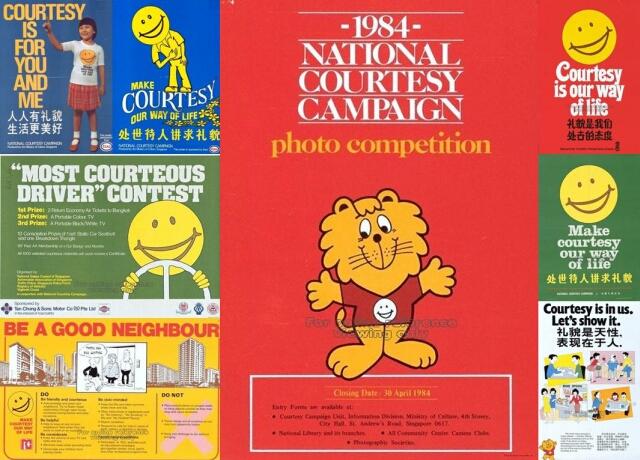
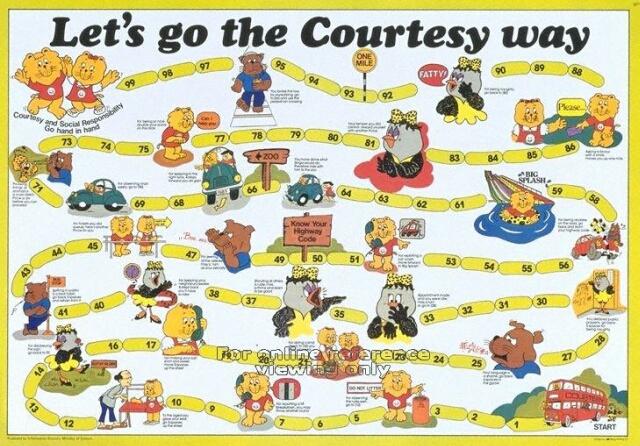

Singapore had launched over 200 campaigns in the seventies and eighties. Many of these campaigns had positive effects, even till today, such as water-saving, anti-smoking and anti-littering. Below are some of the most memorable Singapore campaigns of the past.

National Courtesy Campaign (1979-2001)

Started by the Ministry of Culture (later Ministry of Information, Communications and the Arts, and now Ministry of Communications and Information) in June 1979, the objective of the campaign was to promote a pleasant living environment filled with kind, considerate and polite Singaporeans.

national courtesy campaign (1979-2000)

The courtesy campaign was actually kicked off much earlier in the seventies, when Singapore was focusing in developing its tourism sector. Launched by the Singapore Tourism Promotion Board (STPB) to encourage Singaporeans to be polite to the tourists, the successful campaign was “extended” to all aspects so that courtesy and thoughtfulness could be spontaneous characteristics in Singaporeans’ everyday life.

let's go the courtesy way 1983

In 1982, the National Courtesy Campaign adopted Singa the Courtesy Lion as their official mascot to replace their Smilely logo. Singa went on to become one of Singapore’s most recognisable mascots in the eighties and nineties, and the designer even added a female companion and three little cubs for Singa in 1987.

bring on a smile, say please thank you 1985Since its debut, the National Courtesy Campaign has introduced many catchy slogans. The first was “Courtesy is our way of life. Make courtesy our way of life.” in 1979, while other popular ones included “A little thought means so much. Bring on a smile. Say “Please/Thank You” (1985) and “Courtesy begins with me” (1989).

A song named “Make courtesy our way of life” was also composed in 1980 by De Souza J.J.

“Courtesy is for free,
Courtesy is for you and me.
It makes for gracious living and harmony.
Giving a friendly smile,
Helping out where we can.
Trying hard to be polite all the time.

Courtesy is for free,
Courtesy is for you and me.
It makes for gracious living and harmony.
Living could be a treat,
If people are awfully sweet.
Courtesy could be our way of life.

It is rude to be abusive,
Just to prove we’re right.
Instead we could be nice about it if we tried.

Courtesy is for free,
Courtesy is for you and me.
It makes for gracious living and harmony.
Living could be a treat,
If people are awfully sweet.
Courtesy could be our way of life.

Make courtesy our way of life!”

The music clip is available at http://eresources.nlb.gov.sg/music/music/track/ebdd7595-bd86-4f7c-8b4d-f7f9c47e83b0.

let's go the courtesy way 1983In March 2001, the National Courtesy Campaign was officially replaced by the Singapore Kindness Movement (SKM). Former Prime Minister Goh Chok Tong highlighted in the New Year of 1996 that Singapore aimed to become a gracious society by the 21st century.
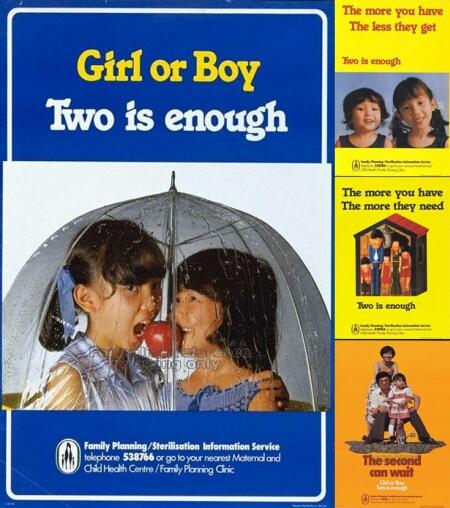
Stop At Two (1970-1986)

The poster with two sisters sharing an apple under an umbrella was perhaps the most iconic media representing Singapore’s population control campaign of the seventies and eighties.

stop at two campaign2 (1970-1986)After the Second World War, Singapore experienced a post-war baby boom. Overcrowding became a social issue, leading to various problems in housing, education, medical and sanitation. After Singapore’s independence, former Prime Minister Lee Kuan Yew was concerned that the uncontrolled growing population would put stress on the economy of a developing Singapore. Thus, the National Family Programme was launched with the Family Planning and Population Board (FPPB) established in 1966.
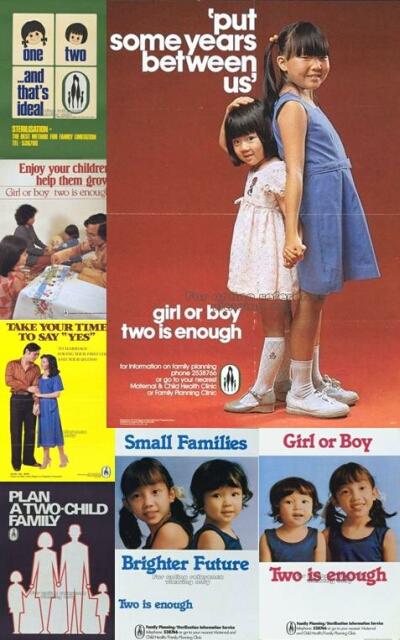
stop at two campaign3 (1970-1986)The campaign reached its peak after 1970, when abortion and sterilisation were legalised. Women deemed low-educated with low incomes were urged to go for sterilisation after their second child, and a range of disincentives, such as lesser benefits in maternity leaves, housing allocations, tax deductions and children’s educations, was implemented for those had three or more. The campaign also aimed to discourage families to stop trying for a boy after having two girls.
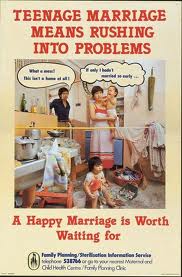
It was perceived that the “Stop At Two” campaign was targeted at the uneducated batch of citizens who were deemed to contribute lesser to the economy. The introduction of the Graduate Mothers’ Scheme in 1984 provided further proof when the government encouraged the male Singaporeans to choose higher-educated wives and gave out more incentives for higher-educated mothers to have three or more children. Causing an uproar in the public and press, the scheme was eventually scrapped a year later.

teenage marriage means rushing into problems a happy marriage is worth waiting for 1978The Graduate Mothers’ Scheme was the beginning of the reversal of the population control scheme. In 1986, the Family Planning and Population Board was abolished, and a new campaign “Have Three or More, if you can afford it” was launched. It was predicted that Singapore’s birth rate would recover by 1995. But it never did.

small families enjoy better health 1978Some critics note that even without the population control campaigns, Singapore’s birth rate would still decline as the society became more developed. The rising number of higher-educated individuals who were less willing to start a family at an early age would be unavoidable. In any case, it was obvious that the campaign had lasting effects even till today. In recent years, the government relaxed its immigration policy in a bid to battle against an aging population and a shrinking workforce in Singapore, a move that proves to be hugely unpopular among the Singaporeans.
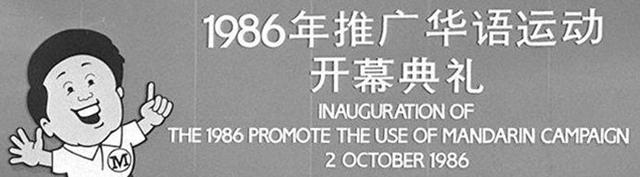
Speak Mandarin Campaign (since 1979)

The Speak Mandarin Campaign was officially started in September 1979 by former Prime Minister Lee Kuan Yew. Originally designed as a ten-year program, the campaign was headed by Dr Ow Chin Hock and was targeted at the Singaporean Chinese, which made up almost 3/4 of the country’s population.

speak mandarin campaign (1979-present)

The early Chinese immigrants in Singapore largely came from the southern provinces of China, and spoke mainly in dialects such as Hokkien, Cantonese, Teochew, Hakka, Hainanese and Hockchew. In the 19th century, different Chinese communities often clashed against each others over territories and businesses. One of the major conflicts was the Hokkien-Teochew Riots in 1854, which lasted 10 days and caused 500 casualties. The differences between the various dialect groups became less defined by the late 1930s, when the oversea Chinese united together to aid China financially against the invasion of Japan.

In the late seventies, English was determined as the mainstream for a bilingual education in Singapore, with “mother tongue” used as the second language. Mandarin was deemed as the mother tongue for all Singaporean Chinese. Slogans and posters were put up in public places, while civil servants were ordered not to use dialects during working hours. Parents were encouraged to use hanyu pinyin names for their children, instead of names in dialects. Dramas, movies and radio programs in dialects were gradually phased out, with only a few exceptions.

1986 promote the use of mandarin campaign

The classic theme song of the early Speak Mandarin Campaign “大家说华语” was definitely memorable for many Singaporeans growing up in the eighties. The song was composed in 1980 by Taiwanese composers Feng Qingxi (music) and Sun Yi (lyrics), and performed by Taiwanese songbird Tracy Huang Yingying.

国家要进步 语言要沟通
就从今天起 大家说华语
不分男和女 不分老和少
不再用方言 大家说华语
听一听 记一记
开口说几句 多亲切 多便利
简单又容易

The government attempted to change the names of some places in Singapore to the standard Chinese hanyu pinyin format in the late eighties. The move was, however, backfired, when there were numerous complaints about the renaming of Nee Soon, Tekka and Bukit Panjang to Yishun, Zhujiao and Zhenghua respectively.

By the nineties, the Speak Mandarin Campaign had a change of objective. It was targeted at a growing number of working class and professionals who preferred to use English solely as their spoken language. The government became worried that this group of Singaporean Chinese, who had received the mainstream English education in their early days, were beginning to lose their roots in the Chinese heritage and culture. It also created a divided society, where the English-speaking population looked down on their fellow Chinese-educated and lower-income Singaporeans.

speak mandarin campaign bookiet 1987

Chinese dialects, along with Malay and some local expressions, largely make up Singlish, the localised language that is easily identifiable among the Singaporeans themselves. In order to encourage Singaporeans to speak proper English, former Prime Minister Goh Chok Tong launched the Speak Good English Movement (SGEM) in 2000. However, studies had shown that many Singaporeans are able to switch between standard English and localised English (Singlish) easily, and therefore Singlish, as an unofficial yet important ingredient of a unique Singapore identity, should not be suppressed or eliminated.

i like to speak mandarin2 1984The Speak Mandarin Campaign has been a controversy since its introduction. Some critics view it as a propaganda tool to eliminate the Chinese dialects. It was a dilemma for the Singapore government in the seventies. While it was great foresight to predict the rise of China and the importance of Mandarin as a common language, the danger of Chinese-dominated institutes being used as breeding grounds for communist ideas meant that the authority was always quick to act.
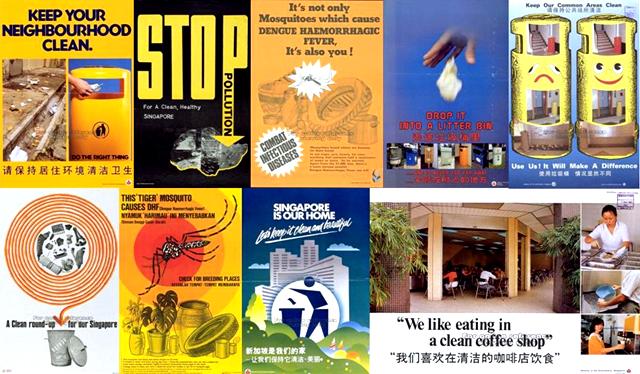
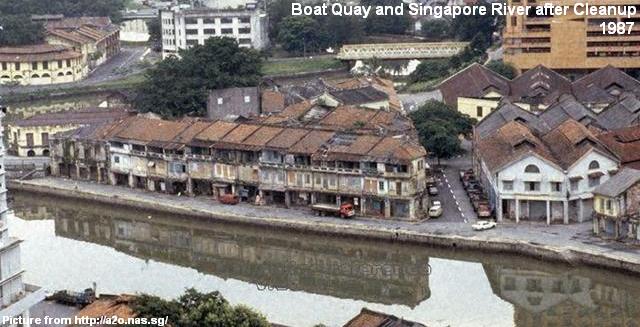

Chinese dialects in Singapore has been in an awkward status for many years. While the likes of Cantonese operas and Teochew wayangs were not restricted in public places, mainstream media such as television and radio were banned, with few exceptions, from broadcasting programs in dialects since the early eighties. Hong Kong and Taiwanese dramas are not allowed to be shown on TVs in their original Cantonese and Taiwanese Hokkien (Minnan), and have to be dubbed in Mandarin. Such rules, however, are not applied on foreign-language dramas from Japan and Korea, which gave audiences an option in dual sounds. Likewise, J-pop and K-pop music are allowed to be aired on radio, but not Cantopop and Taiwanese Hokkien songs.

In just two decades between 1980 and 2000, the usage of Chinese dialects at home had dropped from 80% to 30%, resulting in the current situation where the majority of the new generation of Singaporeans having difficulties to engage in conversations with their grandparents.

Keep Singapore Clean Campaign (1968-1990)

Started as early as October 1968 by former Prime Minister Lee Kuan Yew, the Keep Singapore Clean Campaign was one of the first campaigns launched by the government. Various ministries and non-government organisations were involved, led by then Health Minister Chua Sian Chin, to instill the importance and awareness of environmental cleanliness to the public. The objective was to make Singapore the cleanest city in the region, in order to boost tourism and the attraction of foreign investment.

keep singapore clean campaign (1968-1990)

The Keep Singapore Clean Campaign had a positive impact throughout the years, tackling many issues such as mosquitoes, pollution, inconsiderate littering, street hawkers and sanitation. Posters and banners were displayed, while seminars and spot checks were carried out. Competitions such as the cleanest offices, toilets, buses and taxis were organised. On the other hand, the dirties places were also named in the media so as to apply social pressure to their owners.

A decade-long campaign was also launched between 1977 and 1987 to clean up the Singapore River and the Kallang Basin. By the mid-eighties, most tongkangs and twakows in the Singapore River were cleared, and garbage in the waters removed. The river was clean enough that a mass swim was organised in 1984.

boat quay and singapore river after cleanup 1987

The success of the campaign ensured its continuity till today. It was merged with the Garden City Campaign in 1990, and into the 2000s, it evolved to become the Clean and Green Singapore, which aims to inspire Singaporeans in caring and protecting the living environment.

Public Health Campaign (since 1969)

Public health was one of the top priorities in the government’s agendas after independence. It first covered areas such as dental, heart, disease control, anti-drug abuse, and later extended to anti-smoking, AIDS, mental, workplace health promotion and healthy lifestyle.

Dental Health

dental health programme (1970s-1980s)

The Ministry of Health kicked off the Dental Health Programme in 1969. The standard of dental hygiene was poor in the sixties, with reports indicating that half of Singapore’s population was unaware of proper tooth-brushing, and half of the students did not own toothbrushes. Compulsory tooth-brushing was therefore carried out in all primary one across the country. Students were supplied with toothbrushes and mugs, while teachers were trained to teach proper techniques to their classes. The exercise was a success; in 1973, the programme was extended to all kindergartens in Singapore.

National Heart Week

national heart week (1970s-1980s)

With the establishment of the Singapore National Heart Association (present-day Singapore Heart Foundation) in 1970, the National Heart Week has been held annually till today. The aim was to promote the awareness of heart disease, its causes and the preventive measures. Deaths related to cardiovascular diseases had been one of the top killers in Singapore. The campaign touched on various aspects in anti-smoking, a balanced and healthy diet, exercises and effective stress management to help reduce the likelihood of high blood pressure and stroke.

Anti-Drugs

anti-drug abuse campaign (1970s-1980s)

Drug abuse had been a major concern in the seventies. The Ministry of Health worked with the Singapore Anti-Narcotics Association to launch a series of anti-drug abuse campaigns to emphasize the dangers and consequences of drugs. From the “Youth Anti-drug” (1971) and “Against Glue-Sniffing and Inhalant Abuse“(1985) to the annual National Anti-Drug Campaign (since 1995), the campaigns had invited showbiz celebrities such as Andy Lau, James Lye and Chen Hanwei to spread the message.

Wash Your Hands

By the seventies, infectious diseases such as tuberculosis, leprosy and cholera were still plaguing the society. The Ministry of Health introduced “Wash Your Hands” campaign to promote self hygiene, disease control and the proper handling of food, especially after visiting the toilets. The relocation of street hawkers took place in the early seventies, with the first hawker centre built (1971) at Yung Sheng of Jurong.

food hygiene and disease control late 1970s

By the eighties, most hawkers plying their trades on the streets were resettled at the new wet markets and hawker centres across the island. There was also significant improvement in the sanitation system. The nightsoil removal service was phased out in January 1987, with the bucket latrine becoming a thing of the past. The measures implemented by the Keep Singapore Clean and Public Health campaigns had greatly improved the cleanliness, hygiene and public health of Singapore.

As the standard of living in Singapore gradually improved in the eighties, the focus of public health shifted towards keeping fit, healthy diets, anti-smoking and the benefits of breastfeeding.

Anti-Smoking

One of the campaigns that had little impact since its introduction was the National Smoking Control Programme, started in December 1986 with an objective to make Singapore a nation without smokers. The sale of cigarettes rose dramatically in the seventies and eighties, reaching more than 4 million kg per year. The number of smoke-related deaths, caused by heart disease, lung and nose cancer, also jumped, prompting the Ministry of Health to act.

anti-smoking campaigns 1980s

Other than the aggressive campaign of anti-smoking, the government also issued bans of smoking in certain public places, as well as tobacco advertisements on newspapers, magazines and television. In the later years, more measures continued to be carried out, such as the compulsory printing of graphic photos of the effects of smoking on cigarette boxes, higher taxes of tobacco and extensive banning of smoking in all public places.

Breastfeeding

breast milk campaign 1980sIn the seventies, breastfeeding by Singaporean mothers had fallen to an all-time low. Studies show that it was due to many women entering the working sector. In 1971, only 28% of high income mothers, and 51% of low income mothers, initiated breastfeeding to their babies, as compared to 85% and 90% in the fifties.


Thus a campaign to promote the benefits of breastfeeding was carried out, but with limited success. While the percentage of high income women who breastfed their babies had increased to 70% by 1980, the low income breastfeeding women dropped to less than 40%.

AIDS Control

While the infectious diseases in tuberculosis, leprosy and cholera were gradually taken under control, the rise of AIDS (Acquired Immuno-Deficiency Syndrome) became a concern in the mid-eighties. AIDS was first discovered by the United States scientists in 1982. The first AIDS-positive case in Singapore was reported in 1985, and the number of such cases increased in a worrying trend. Soon after the first case, the Ministry of Health launched the National AIDS Control Programme to raise awareness of AIDS and HIV (Human Immuno-Deficiency Virus). Many activities were carried out, such as the lifting of the ban of condom advertisements, conducting of blood tests and training of medical and healthcare personnel.

Healthy Lifestyle

healthy living, everyone a winner 1986

The Ministry of Health had consistently encouraged Singaporeans to adopt a healthy lifestyle by emphasizing in food nutrition and regular exercises. One of the first campaigns launched was the Better Food For Better Health Campaign in March 1975. Studies in the eighties show that Singaporeans’ increasing intake of fats had led to a rise in heart diseases and cancers. In 1989, Nutrition Week was introduced. Customers dining in hawker centres were encouraged to request for lesser oil and salt, while school canteens were asked to sell healthier food to students in a bid to battle against obesity.

A series of other health-related campaigns were also launched between the seventies and eighties, such as immunisation for babies, understanding leprosy, awareness against cancer, detection of mental illness and prevention of venereal diseases.

public health campaigns (1970s-1980s)

Other than the campaigns mentioned above, there were also dozens of campaigns in other aspects:

seat belts save lives 1981Road Safety Campaigns

1970 “Queue Up for Safety and Speed”
1971 “Pedestrian Safety”
1971 “Safe Cycling”
1972 “Road Courtesy”
1974 “Reduce Peak Hour Travel”
1974 “Keep Singapore Accident Free”
1977 “Road Safety For You”
1981 “Seat Belts Save Lives“

Environmental Campaignswater conservation campaigns 1980s

1970 “Tree Planting and Gardening”
1971 “Save Water”
1973 “Keep Our Water Clean”
1973 “National Save Energy”
1974 “Safe Water”
1977 “Energy Conservation”
1981 “Let’s Not Waste Precious Water”
1985 “Let’s Save Precious Water“

males with long hair will be attended to last 1972 home accidents cause injuries make your home safe keep good safety habits 1983

Social Campaigns

1970 “Crime Prevention”
1972 “Campaign Against Long Unkempt Hair Among Males”
1973 “Home Safety”
1974 “Police Week“national productivity campaign 1983
1974 “Keep Singapore Crime Free”
1983 “Home Accidents Cause Injuries“

Workplace Campaigns

1972 “Industrial Safety and Health”
1974 “Building Construction Safety and Health”
1977 “Safety Month for Metal Workers”
1981 “National Productivity Campaign”
1986 “Civil Service Productivity“

prevent unwanted litters 1985Other Campaigns

1974 “Anti-Profiteering Against Shopkeepers”
1974 “Go-Metric”
1978 “Eat Frozen Fish”
1983 “School’s Saving Campaign”
1983 “Blood Donation Campaign”
1985 “Prevent Unwanted Litters (Pet Sterilisation)”
1985 “Eat Frozen Pork”
1985 “Minimise Cash Transactions (ATM)”
1985 “Do Not Misuse Accident And Emergency Departments“

(Credit: All pictures from the National Archives of Singapore unless otherwise stated)

Published: 18 January 2013

Updated: 08 August 2020

Posted in Cultural | Tagged , , , , , , , , , , , , , , , , , , , , , , , , , , , , , | 38 Comments

Swimming in the Summer Sun of Singapore

Most of the time, it is either rain or shine in Singapore. Swimming has always been a popular activity for Singaporeans, especially in the hot summer days between March and July, when temperatures sometimes hit as high as 35 degree Celsius.

Here we look at the list of swimming facilities in Singapore since the early 20th century.

The First Public Swimming Pool

The Thirties

The Mount Emily Swimming Complex was the first public pool in Singapore when it was opened in January 1931 by the President of the Municipal Commissioners R.J. Farrer (1873-1956)(See Farrer Park Swimming Complex below). It was converted from an old municipal reservoir built in the 1880s that provided fresh water to the town as well as the Kandang Kerbau (KK) Hospital.

mount emily swimming complex 1960s

Situated at Upper Wilkie Road, the Mount Emily Swimming Complex, consisting of a large pool 50m long and 12m wide and a maximum depth of 2.3m, was extremely popular in the 1930s, serving almost 8,000 swimming enthusiasts per month. It used water supply from the second municipal reservoir nearby, which in turned used the recycled water for town cleansing and drain flushing.

The swimming pool was occupied by the Japanese during the Second World War, who converted the pool into a seawater type. After the war, the public was still unable to access the pool as it was reserved solely for the British servicemen. In 1946, the Municipality took over and switched the pool back to the fresh water one, and upgraded it with full filtration and chlorination system. After three years of repair and a cost of $36,000, it was finally opened to a delighted public.

mount emily swimming complex 1947

Other Early Swimming Pools

The Forties

haw-par-swimming-pool-1940sThe Haw-Par Swimming Pool, also known as Pasir Panjang Swimming Pool, was built in the late 1930s and officially opened in October 1940 by the Chinese Consul-General Kao Ling-Pai. Costing $50,000 in construction, the pool was considered a modern facility during that era. It had an electric pump to empty and refill the 36.6m by 12.2m pool within a few hours, thus allowing the pool to be fully utilised every day of the year.

The premises of the swimming pool included accommodation for the swimmers, shower baths and changing rooms, and a restaurant and bar to satisfy the visitors’ appetites after their swim. The admission charge to the swimming pool was 10c in its initial years of operation.

Built just before the Second World War at Deptford Road, the Sembawang Swimming Complex was used to serve the British, Australian and New Zealand servicemen and their families. It was later opened to the public but attendance declined sharply in the late eighties, even after its swimming facilities were upgraded in 1984. In 1990, the swimming complex with its other sports facilities were returned to the Singapore Land Authority (formerly Land Office), which in turn, leased it to the US Marines.

The Fifties

The Yan Kit Swimming Complex was the second swimming facility in Singapore opened to the public. Opened in December 1952, it was situated at Yan Kit Road at Tanjong Pagar, where its name was attributed to Look Yan Kit (1849-1931). A Cantonese dentist who first plied his trade in Hong Kong, Look Yan Kit later came to Singapore in 1877 and became a wealthy rubber plantation owner. He was also one of the founding fathers of Kwong Wai Shiu Hospital built in 1910.

yan kit swimming complex

The site where Yan Kit Swimming Complex stood was formerly a stretch of the old railway line. It was a densely populated area, in which the swimming pool was surrounded by attap houses between the fifties and seventies. Yan Kit Swimming Complex had witnessed tremendous changes in its surrounding environment in its fifty-odd years’ history. The kampongs were replaced by flats and commercial buildings, while the swimming pool itself was shut down and abandoned after 2001.

yan kit swimming complex 1960s

yan kit swimming complex2

The plans to give this aging swimming complex a new lease of life never materialised, as it would cost an estimated $4 million to upgrade the facilities and a further $400,000 for annual maintenance. In 2012, with no alternative plans from both the Singapore Sports Council and the private developers, Yan Kit Swimming Complex was demolished. The empty pools were filled up with concrete, while one of its buildings was preserved.

yan kit swimming complex3

The Farrer Park Swimming Complex was built in 1957 by the Singapore City Council, a year after the completion of Farrer Park Athletic Centre (FPAC), which was the main training ground for the Singapore national track and field between the fifties and the seventies. Designed by British architect M.E. Crocker, the swimming complex produced one of Singapore’s swimming legends in Ang Peng Siong (see below). For many years, Farrer Park Swimming Complex was supervised by Ang Peng Siong’s father Ang Teck Bee, also an Olympian who had participated in judo in the 1964 Olympics Games.

farrer park swimming complex

Farrer Park was named after R.J. Farrer (1873-1956), the former President of the Municipal Commissioners. Farrer had came to Singapore in 1896 at an age of 24, and had held several important posts in other parts of Malaya such as Penang, Kelantan and Ipoh. During his tenure in Singapore, Farrer was in charge of many major projects, such as City Hall, Gunong Pulai waterworks, St. James Power Station and Elgin Bridge. He passed away in his home at St. John Islands in 1956 and was buried at Bidadari Cemetery.

Farrer Park Swimming Complex was shut down in June 2003 after low public utilisation. After its closure, the Singapore Sports Council put the premises up for lease for the private operators.

river valley swimming complex 1960s

Due to few sports facilities opened to the public in the fifties, the Singapore City Council decided to building a swimming pool at the former King George V’s Park. It was designed by Crocker, also the designer of Farrer Park Swimming Complex, and was named River Valley Swimming Complex. Officially opened in August 1959, the swimming complex had an Olympic-sized pool and a wading pool, constructed at a cost of $520,000.

river valley swimming complex 1961After the independence of Singapore, the National Sports Promotion Board and the Singapore Sports Council took over the swimming complex in 1971 and 1973 respectively. As more swimming facilities were built in the new towns in other parts of Singapore, River Valley Swimming Complex went into a decline. Its non-favourable location among commercial buildings and shopping malls meant that few residents would travel far to visit the pools. It was finally shut down in April 2003.
Swimming Pools in the Heartlands

When the Housing and Development Board (HDB) embarked on their projects of public housing estates in the seventies and eighties, swimming facilities, along with other public amenities such as libraries, hawker centres, wet markets and playgrounds, were constructed together with the flats to provide a pleasant and modern living environment for the people.

The Seventies

Almost each new town has its own swimming facilities. Opened in January 1970, the Queenstown Swimming Complex was the first public pool built in a housing estate in Singapore. Designed with a 4m-deep diving pool as well as an Olympic-sized competition pool, Queenstown Swimming Complex was the training ground of the famous water polo team in the seventies.

queenstown swimming complex 1970s

In 1971, legendary water polo coach Kenneth Kee gathered a group of neighbourhood boys, some of whom could not even swim. Under his strict disciplinary guidance and training regime, the boys emerged as some of Asia’s best water polo players. By the mid-seventies, many Queenstown water polo players represented Singapore in the national team and won many gold medals in the Southeast Asian (SEA) Games.

toa payoh swimming complex 1973

Soon, other swimming complexes also found their ways into other new towns of Singapore. The next to follow was Toa Payoh Swimming Complex, opened in September 1973. In 1978, the National Survival Swimming Award Scheme was introduced to raise Singaporeans’ proficiency in water survival skills, and students were encouraged to take up swimming lessons as their extra-curriculum activities.

The national mass swim was held at Toa Payoh Swimming Complex in 1978, attracting an impressive 3,561 participants. Singapore was the host of the 12th SEA Games held in 1983, and Toa Payoh Swimming Complex was chosen as the venue of the Games’ swimming events.

southeast asian games at toa payoh swimming complex 1983

katong swimming complex

Opened in September 1975, Katong Swimming Complex is located along Mountbatten Road and serves the residents at Tanjong Katong and Dakota for more than thirty years. The aging swimming complex has a unique feature; there is a row of animal structures, in shapes of fish, duck and seal, spouting water into the pool.

buona vista swimming complex 1976The Buona Vista Swimming Complex at Holland Drive was opened in September 1976. Also known fondly as the Holland Drive Swimming Complex, it was then considered a modern facility fitted with bi-flow filter system in which the water was continuously drained off the surface and floor of the pool.

Geylang East Swimming Complex was opened in August 1978 at Aljunied Avenue 2. It was closed for several months in 2004 in a massive upgrading project, in which a children waterplay station was added.

Opened in November 1979 and August 1982 respectively, both Delta Swimming Complex and Bukit Merah Swimming Complex shared the responsibility of serving the vast residential region of Redhill, Hendersen, Tiong Bahru and Telok Blangah.

The decision of building the Delta Swimming Complex near Hendersen Road in 1978 caused a massive uproar as HDB planned the swimming complex at the site where an old Buddhist temple stood. Built in 1858, the temple, known as Tang Suahn Kiong San Soh Hoo Chu Buddhist Temple or Kuan Kong Temple, had a rich 120-year history and was extremely popular with its devotees.

delta swimming complex 1995

The site acquisition notice was served to the temple in 1973, with a compensation amount of $184,000, but the trustees of the temple and its devotees felt that the sacred building should be preserved. In September 1978, three bulldozers were ordered to block the paths leading to the temple, leading to its isolation and much to the disgust of the public. Policemen were deployed as the bulldozers forced their way in. Eventually, the temple caretakers had to pack the place up and relocate.

The Eighties

bukit merah swimming complex 1982

The larger Bukit Merah Swimming Complex, located beside the Bukit Merah Bus Interchange and occupies a large 21,000 square metres site, consists of three pools and buildings with dome-shaped roofs.

bedok swimming complex 1980s

At the start of the eighties, more public swimming facilities were built for the convenience of the residents living in the new housing estates. In a space of three years, six swimming complexes were constructed at some of the biggest upcoming new towns of Singapore, namely the Paya Lebar Swimming Complex (opened in September 1981), Bedok Swimming Complex (December 1981), Kallang Basin Swimming Complex (March 1982), Ang Mo Kio Swimming Complex (May 1982), Bukit Merah Swimming Complex (August 1982) and Clementi Swimming Complex (August 1983).

kallang basin swimming complex

kallang basin swimming complex2

Unlike many other swimming complexes, the Paya Lebar Swimming Complex was built by the Urban Renewal Authority for the Singapore Sports Council. It was officially opened in September 1981 by then MP for Paya Lebar Sia Kah Hui. Standing along the quiet Aroozoo Road at Upper Serangoon Road, the swimming facilities had less than average number of attendance. It also received negative feedback due to its cleanliness and security. Paya Lebar Swimming Complex was eventually shut down in the 2000s and put up for lease by the Singapore Land Authority (SLA). The premises is now being used as a childcare center.

ang mo kio swimming complex2

The design of the distinctive triangular roofs of the red-bricked Ang Mo Kio Swimming Complex, located along Ang Mo Kio Avenue 1, had helped it won the Singapore Institute of Architects’ Architectural Design Award in 1986.

clementi swimming complex 1983

The Clementi Swimming Complex at Clementi Avenue 2 has three swimming pools; two rectangular and one palm-shaped pool. The swimming complex, surrounded by lush greenery, is designed in such a way that its three buildings stand parallel to each other in the southwestern direction.

clementi swimming complex2 1983

As more new housing estates were being developed in the late eighties, HDB continued their plan of building swimming facilities in each of the new town centres. The addition of Yio Chu Kang Swimming Complex (opened in July 1986), Hougang Swimming Complex (May 1987), Yishun Swimming Complex (March 1988), Bukit Batok Swimming Complex (April 1988), Woodlands Swimming Complex (August 1989) and Tampines Swimming Complex (December 1989) had brought a total of 11 swimming complexes constructed in a single decade.

The Nineties

In the nineties, only Bishan Swimming Complex (opened in December 1991) and Serangoon Swimming Complex (March 1995) were built. This might be due to the property boom in Singapore in which dozens of condominiums with private swimming facilities mushroomed in many residential parts of Singapore. The property boom first began in the early nineties and reached its peak by 1996, before the bubble was ultimately burst by the Asian financial crisis in 1997.

The New Millennium

Jurong East Swimming Complex (opened in March 2000) became the first public swimming complex to be completed in the new millennium. It was then followed by Choa Chu Kang Swimming Complex (May 2001), Jalan Besar Swimming Complex (June 2003), Jurong West Swimming Complex (November 2006) and Sengkang Swimming Complex (August 2008). The latest is Pasir Ris Swimming Complex (July 2011), bringing the total of public swimming complexes managed by the Singapore Sports Council to 25.

Other Swimming Complexes

There was a swimming facility along Corporation Road in the early seventies known as Jurong Town Swimming Pool. It was managed by the Jurong Town Corporation (JTC), which was responsible in building flats and amenities for its residents working at the developing Jurong industrial area. Also opened to the public for an admission charge of 40c, the swimming pool was renovated and repaired several times until it eventually shut down in the late eighties.

nanyang university swimming complex 1976

The former Nanyang University became the first tertiary institution in Singapore to have a complete sport complex when its $4.2 million facilities, including an Olympic-sized swimming pool and a 13.5m-deep diving pool, were completed in 1976. In the same year, the Raffles Institution had their own swimming complex officially opened by then Minister for Law & The Environment E.W. Barker.

The Swimming Clubs

Established in 1894, the Singapore Swimming Club was the first swimming club in Singapore. Originally known as the Swimming Club Singapore, it was formed by a group of young European men who had their occasional gatherings at the beach of Tanjong Rhu. An perfect location for swims, sandwiches and tea, the Europeans mooted the idea of having a permanent recreational facility built.

singapore swimming club 1940

In 1893, the club was formed at an attap house rented from a Malay fisherman. A year later, a nearby bungalow was rented to serve as the clubhouse of about 20 members. Accessibility to the new swimming club was not easy as members had to travel via a sampan from Johnston’s Pier. The Swimming Club Singapore was officially opened in February 1894.

Membership of the club grew steadily, with its membership fee remained at $1 per month over the years. By 1900, there were more than 100 members. In 1931, the club changed its name to Singapore Swimming Club and added a pool to its club facilities. It was a sensational headline in the newspapers of Malaya and Singapore, and membership soon ballooned to 2,000. The prosperity and popularity of the club was, however, disrupted by the Second World War. It never really managed to recover since then, due to the instability of the society and the imminent withdrawal of the British soldiers and their families.

singapore swimming club2 1940

The club first accepted female members in the early 1920s, but it would remain a “white only” club for another 40 years until the independence of Singapore, when former Prime Minister Lee Kuan Yew ordered all British clubs in Singapore to discontinue their discriminative rules. All races were welcomed to join the club since 1963.

While the Europeans had their Singapore Swimming Club, the local Chinese enjoyed swimming at the Chinese Swimming Club, formed in 1909. First started as a weekly event during Sundays to swim and play water polo at the Tanjong Katong beach, the six local Peranakan baba (Straits Chinese) decided to form a club when other participants joined the water games.

chinese swimming club 1974

Their clubhouse was first established at Chapel Road, before moving permanently to the current site of Amber Road. In 1939, a new three-storey clubhouse and a 25m concrete seawater-filled swimming pool were built. However, the club met its worst moment during the Second World War when it was occupied by the Japanese forces. The Kempeitai (Japanese Military Police) used the clubhouse as an interrogation building and the platform of the swimming pool as a massacre site of the Chinese.

After the war, the clubhouse was in a derelict state. The turning point of the club was in 1947, when the offering of a life-time membership at $100 helped to attract more than 600 members. With enough funds raised, the club was able to build an Olympic-sized pool in 1951. Today, the Chinese Swimming Club has over 7,000 members and possesses a $27.4-million Sports Complex, completed in 2005.

Other early swimming clubs included the Tiger Swimming Club, Cantonese Swimming Union and the Oversea Chinese Swimming Club, which forms the Singapore Amateur Swimming Association (SASA) in 1939 together with the Singapore Swimming Club, Chinese Swimming Club and YMCA (Young Men’s Christian Association). SASA was renamed as the Singapore Swimming Association (SSA) in 2002.

The Lagoons

The Katong Park Bathing Pagar became one of the locals’ favourite place of leisure when it was opened in December 1931 by W. Bartley, the President of the Municipal Commissioners. The 45m by 30m swimming area was Singapore’s first public swimming enclosure. Its facilities included 40 dressing rooms and a raised platform that extended into the sea. It was a common sight to see kids swimming in their floats, while others enjoyed tanning in the sun.

Another Katong landmark situated near to the bathing pagar was the old Seaview Hotel, built in the mid-1930s. Both the pagar and the hotel were demolished in the sixties due to the land reclamation.

katong park bathing pagar 1950s

Sentosa Swimming Lagoon was opened in August 1974 as part of the promotion efforts by the Sentosa Development Corporation, established since 1972 for the recreational development of the island.

In the mid-seventies, the Sentosa Development Corporation cooperated with the Port of Singapore Authority (PSA) to develop Kusu Island and Pulau Hantu. Swimming lagoons, jetties and hawker centres were built. However, the plans to turn the islands into holiday resorts did not really went on well. Instead, Kusu Island remains better known as a religious pilgrimage for the devotees, while Pulau Hantu becomes a popular venue for nature lovers.

east coast park lagoon 1980

Constructed at a cost of $4 million, the East Coast Lagoon was opened in April 1976 to the delight of the Marine Parade residents. Formed using a barrier that separated the sea, the oval-shaped lagoon, equivalent to almost 40 Olympic-sized swimming pools, was able to accommodate as many as 6,000 swimmers at any time. The popularity of the lagoon declines in recent years, but the East Coast Lagoon Food Village, situated beside the lagoon, remains as one of the most popular hawker centres in Singapore. The lagoon is currently being used as a ski park.

The Water-Theme Parks

The Big Splash was probably the best known water-theme park in Singapore. Occupying a 2.8 hectare site at East Coast Park, the privately owned recreational centre was opened in 1976 at a cost of $6 million. Its iconic colourful 85m-long waterslides with five lanes of different heights soon became the unmistakable landmark of East Coast.

big splash 1976

After more than two decades of operation, the water-theme park was shut down by the mid-2000s due to dwindling attendance and rising cost. In 2008, Big Splash made a comeback, without its already-demolished waterslides. The new Playground @Big Splash was revamped as a lifestyle hub, featuring bars, seafood restaurants and a indoor mini golf course.

big splash early 2000s

While there was Big Splash in the east of Singapore, the western side had Mitsukoshi Garden. Designed with massive waterslides almost equivalent to Big Splash, Mitsukoshi Garden was, however, less well-known as compared to their rival at East Coast. The water-theme park was co-owned by Mitsukoshi Limited, the largest departmental store chain in Japan, Yamakuni Iron Co. Limited and a Singaporean by the name of Akiko Aw.

mitsukoshi garden water slides early 1980s

Located at Japanese Garden Road, Mitsukoshi Garden lasted less than five years. It was completed and opened in April 1979, but was sold to a Japanese restaurant chain West Overseas Co. Private Limited for $4.5 million in June 1983, which spent a further $3 million in the renovation and addition of restaurants, gymnasium and tennis and squash courts. The premises was later known as CN West Leisure Park.

Today, the youngsters are more familiar with the Wild Wild Wet at Downtown East.

Swimming Across the Singapore River

The Singapore River used to be the lifeline of the country, where different communities lived and work by the sides of the river. It was also the playground for the kids, who would jump and swim in the waters, as depicted by local sculptor Chong Fah Cheong’s masterpiece “First Generation”.

bronze - first generation

By the late seventies, the Singapore River, however, had gained a notorious reputation. It was filled with garbage, dead animals, tongkangs and twakows (bumboats). In 1977, former Prime Minister Lee Kuan Yew launched a decade-long campaign (1977-1987) to clean up the Singapore River and the Kallang Basin.

first swim across singapore river 1984Pig and poultry farms near the Kallang Basin were phased out, 5,000 street hawkers along the river were resettled at the markets and hawker centres elsewhere, and 800 bumboats were towed to Pasir Panjang.
By 1984, the water in the Singapore River was clean enough that a mass swim was organised in mid-May. Some 400 brave participants took the plunge for the first ever swim across the Singapore River.

It was a rainy day, but the participants, including former Parliamentary Secretary of Education Ho Kah Leong and former Minister of State (Culture) Fong Sip Chee, completed the memorable feat.

Our Swimming Legends

Perhaps the most famous swimmer in Singapore, Ang Peng Siong‘s (born 1962) illustrious swimming career between 1977 and 1993 included being the world’s fastest 50m freestyle swimmer in 1982, won a total of 20 gold medals in the SEA Games and held national records of 50m free style (unbroken), 100m freestyle and 100m butterfly (both held for more than 30 years).

The three-time “Sportsman of the Year” (1982-1984) also clinched a gold medal in the 100m freestyle swimming competition at the 9th Asian Games in India, and represented Singapore in the Olympic Games held in the United States two years later.

singapore swimming legends

“Golden Girl” Patricia Chan Li Yin (born 1954), also fondly known as Pat Chan, was the dominating female swimmer at the early SEA Games. The two-time Olympian won 8 golds at the 3rd SEA Games at an age of only 11. It was the year 1965, when Singapore had just became independent. The new nation was greatly excited by Pat Chan’s remarkable performance, and the national anthem touched many when it was first played at the medal-awarding ceremony.

Pat Chan went to win 29 more gold medals in the next four SEA Games, and a couple of silver and bronze Asian Games 1966 and 1970, before retiring from swimming in 1973. She was only 19 then.

13 year-old Junie Sng Poh Leng (born 1966) caused a stir at the Asian Games at Bangkok in 1978 when she shocked her Japanese opponents by winning two golds and breaking the records in the 400m and 800m freestyle. Three years later, Junie Sng went on to win seven golds in the SEA Games at Manila.

Pat Chan’s national record of 39 golds stood for 32 years until it was overtaken by another “golden girl” Joscelin Yeo Wei Ling (born 1979). Joscelin Yeo first competed in the SEA Games in 1991, winning two silvers and three bronzes. Two years later, she announced her arrival at the region’s swimming arena with a personal best of nine golds and one silver. In the next four SEA Games, Joscelin Yeo bagged a total of 40 golds, the only SEA GAmes athlete to do so.

Swimming Trivia

the flying fish 1983In 1983, the Singapore Broadcasting Corporation (SBC) produced an eight-episode drama named The Flying Fish (小飞鱼). Dubbed as Singapore’s first idol drama, it catapulted actor Wang Yu Qing to national fame and inspired many youngsters to take up swimming.

A couple of years later, there were three more swimming-related dramas produced (Splash to Victory 绿水英姿 in 1989, The Champion 任我遨游 in 2004 and No Limits 泳闯琴关 2010) but none was as memorable as The Flying Fish.

In December 2010, a 18-year-old recruit serving his Basic Military Training (BMT) at Pulau Tekong tried the unthinkable by attempting to swim towards Singapore mainland. He was picked up by the Police Coast Guard in the waters near Pulau Tekong Kechil.

Published: 10 January 2013

Updated: 27 August 2018

Posted in Historic | Tagged , , , , , , , , , , , , , , , , , , , , | 40 Comments